

India Caustic Soda Market, 2032
- Chemicals & Advanced Materials, Petrochemicals & Intermediates
- Nov 2026
- Pages 140
- Report Format: pdf
- Report Price: $2400 USD
India’s caustic soda market is witnessing steady structural growth, driven by alumina refinery expansions in Odisha, rising textile and viscose fibre output, growing chemical, pharmaceutical and agrochemical manufacturing, higher soap and detergent consumption, expanding water treatment programmes, and fresh investment by domestic chlor-alkali majors in membrane-cell capacity, captive renewable power and downstream chlorine integration.
| Study Duration | 2021-2032 |
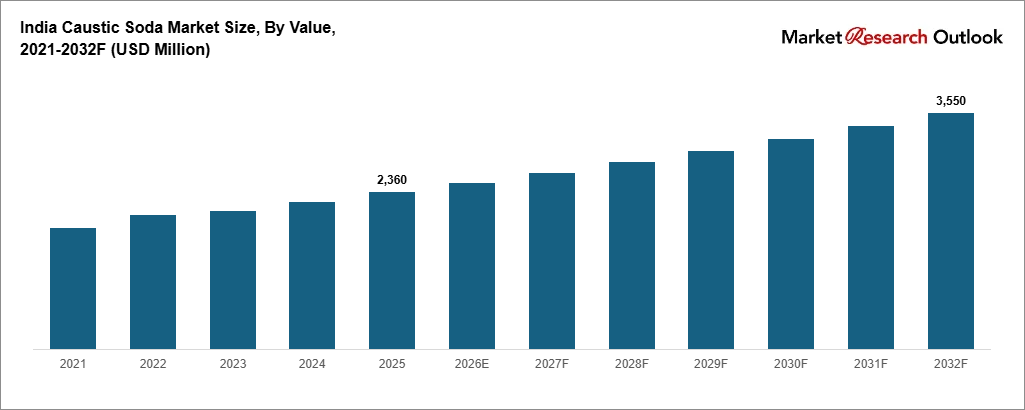
| Market Size (2025) | USD 2,360 Million |
| CAGR (2026-2032) | 6.0% |
| Leading Segment | Liquid Caustic Soda (Alumina Refining) |
| Fastest Growing Segment | Caustic Soda Flakes & Water Treatment |
| Market Size (2032) | USD 3,550 Million |
Market Overview: India Caustic Soda Market
The India caustic soda market size is witnessing steady expansion, driven by rising alumina refining capacity, growing textile and viscose fibre output, expanding chemical and pharmaceutical manufacturing, higher consumption of soaps and detergents, and fresh membrane-cell capacity added by domestic chlor-alkali producers. Valued at USD 2,360 million in 2025 and projected to reach USD 3,550 million by 2032, growing at a CAGR of 6.0%, India caustic soda market growth is being supported by strong demand from alumina refiners in Odisha, chemical clusters in Gujarat and Maharashtra, and textile hubs in Tamil Nadu and Gujarat. Liquid caustic soda (lye) leads consumption, while caustic soda flakes and the water treatment segment are emerging as the fastest growing categories. India is now the world’s third largest caustic soda producer, with installed capacity of over 6.5 MTPA, and producers are working to balance chlorine output, power costs and export sales. As domestic majors including Grasim Industries, Gujarat Alkalies and Chemicals, DCM Shriram, Epigral, Chemplast Sanmar and Nirma expand membrane-cell capacity and integrate into chlorine derivatives, the India caustic soda market is evolving into a larger, export-capable and energy-efficient industry with strong long-term growth potential.
Key Report Takeaways: India Caustic Soda Market
- The India caustic soda market size is projected to grow from USD 2,360 million in 2025 to USD 3,550 million by 2032, registering a CAGR of 6.0%, driven by alumina refinery expansions, rising chemical and textile output, and a steady shift toward high-purity caustic soda grades across industrial India.
- Liquid caustic soda (lye) dominates the India caustic soda market, accounting for around 70% of total volume in 2025, driven by bulk demand from alumina refiners, viscose fibre plants, paper mills and chemical units located close to chlor-alkali plants in Gujarat, Odisha and Tamil Nadu.
- Caustic soda flakes and water treatment applications are the fastest growing segments in the India caustic soda market, expected to grow at 7% to 9% annually as exports, small and medium industrial buyers, and municipal water projects under Jal Jeevan Mission and AMRUT 2.0 scale up.
- Alumina refining capacity in India stood at around 9 MTPA in 2025 and is projected to cross 13 MTPA by 2030, with each tonne of alumina consuming 70 to 120 kg of caustic soda, structurally expanding the India caustic soda market across the Odisha and Chhattisgarh mineral belt.
- Rising investments by domestic chlor-alkali majors such as Grasim Industries, Gujarat Alkalies and Chemicals, DCM Shriram, Epigral and Chemplast Sanmar in membrane-cell capacity, captive renewable power and chlorine derivatives are strengthening local caustic soda supply and supporting the India caustic soda market forecast 2032.
Key Market Drivers: India Caustic Soda Market
Expansion of Alumina Refining, Textile and Paper Output Driving Caustic Soda Demand Across India
Growth in the India caustic soda market is being driven by expanding alumina refining, steady textile and viscose fibre output, and recovering paper production. Alumina refining is the single largest application, accounting for 24% to 26% of caustic soda consumption in 2025. Vedanta is scaling its Lanjigarh refinery toward 5 MTPA, NALCO is adding a 1 MTPA fifth stream at Damanjodi, and Hindalco continues to debottleneck its Odisha operations. Each tonne of alumina consumes 70 to 120 kg of caustic soda depending on bauxite quality, so every 1 MTPA of new refinery capacity adds roughly 70,000 to 120,000 tonnes of yearly caustic soda demand. Textiles and viscose fibre account for another 16% to 18% of consumption, with caustic soda used in mercerising, scouring and viscose production. India’s per-capita caustic soda consumption remains near 3.5 kg a year, well below the global average of around 10 kg, which signals large long-term headroom. Rising aluminium demand from power transmission, electric vehicles and packaging is creating strong pull-through demand across the India caustic soda market.
Growth of Chemicals, Pharmaceuticals, Soaps and Detergents Manufacturing Fuelling Caustic Soda Consumption
The India caustic soda market is benefiting from sustained growth in chemical, pharmaceutical and consumer goods manufacturing. Organic and inorganic chemicals together account for 20% to 22% of caustic soda demand, covering uses in dyes, agrochemicals, phenol, sodium silicate, sodium hypochlorite and active pharmaceutical ingredients. PLI schemes for bulk drugs and pharmaceuticals, along with the China plus one sourcing shift, are drawing new plants into Gujarat, Maharashtra, Andhra Pradesh and Telangana, and each one adds steady caustic soda offtake. Soaps and detergents represent 8% to 10% of consumption, supported by deeper rural FMCG reach and higher hygiene spending. Domestic caustic soda lye prices ranged between INR 32,000 and INR 46,000 per tonne during 2023 to 2025, compared with a 2022 peak above INR 60,000 per tonne, which improved affordability for downstream users. BIS norms under IS 252 and stricter purity requirements from pharmaceutical buyers are also steering purchases toward organised membrane-cell producers, supporting price stability across the India caustic soda market.
Capacity Additions in Membrane-Cell Chlor-Alkali Plants Strengthening Domestic Caustic Soda Supply
Rapid capacity addition in membrane-cell chlor-alkali plants is a major catalyst for the India caustic soda market, with installed capacity rising from around 4.6 MTPA in 2020 to over 6.5 MTPA in 2025, and projected to cross 8.5 MTPA by 2030. India has fully phased out mercury-cell technology, and membrane-cell units now make up more than 99% of capacity, using 2,300 to 2,500 kWh of power per tonne of caustic soda. Producers are pairing new electrolysers with captive solar, wind and hybrid power to lower energy costs, and are using chlorine in PVC, epichlorohydrin, chloromethanes and CPVC to improve the economics of each electrochemical unit (ECU). Leading producers including Grasim Industries, Gujarat Alkalies and Chemicals, DCM Shriram, Epigral, Chemplast Sanmar and Nirma have added or announced fresh capacity across Gujarat, Tamil Nadu, Rajasthan and Madhya Pradesh. This build-out has also turned India into a growing exporter of caustic soda flakes and lye, structurally expanding India caustic soda market growth through 2032.
Key Market Challenges: India Caustic Soda Market
High Power Costs and Energy Intensity Squeezing Caustic Soda Producer Margins
The India caustic soda market continues to face pressure from high power costs, since electrolysis uses 2,300 to 2,500 kWh of electricity for every tonne of caustic soda produced. Power accounts for 55% to 65% of the cash cost of production, and industrial grid tariffs in major producing states remain higher than in the Middle East, China and Southeast Asia because of cross-subsidy surcharges and electricity duties. Producers without captive power find it hard to compete when prices fall, and many smaller plants run below 75% utilisation in weak periods. While open access renewable power and captive plants help larger players lower costs, coal price swings and slow approvals for renewable open access continue to limit relief. This high power cost base reduces the export competitiveness of Indian caustic soda and narrows margins across the India caustic soda market.
Chlorine Co-Product Imbalance and Weak Chlorine Realisations Limiting Operating Rates
The India caustic soda market faces a structural constraint because every tonne of caustic soda produced also yields about 0.89 tonnes of chlorine and around 25 kg of hydrogen. Chlorine is hazardous, costly to store and difficult to move over long distances, so plants must either use it in captive derivatives or sell it nearby. When chlorine demand from PVC, chloromethanes, water treatment and pharmaceutical intermediates slows, chlorine realisations turn negative and producers end up paying buyers to take it, which lowers ECU realisations. Industry operating rates have moved between 76% and 82% in recent years as producers balance chlorine offtake with caustic soda demand. Players such as Grasim Industries, DCM Shriram, Gujarat Alkalies and Chemicals and Epigral are investing in chlorine derivatives, but chlorine imbalance remains a near-term challenge for the India caustic soda market.
Capacity Running Ahead of Demand, Price Volatility and Import Pressure Impacting Caustic Soda Margins
The India caustic soda market faces practical challenges from capacity growth outpacing demand, price volatility and periodic import pressure. Installed capacity has been growing at close to 9% a year, while domestic caustic soda demand is rising at 4% to 5%, pushing producers toward exports at thinner margins. Global oversupply from Northeast Asia and the Middle East has kept international caustic soda prices volatile, with landed import prices at times falling 10% to 15% below domestic realisations. Smaller producers struggle to pass on cost increases without losing volume, and EBITDA margins for Indian chlor-alkali businesses have moved between 12% and 25% over 2022 to 2025. Exports, BIS quality controls and chlorine integration offer some relief, but price swings and import competition remain barriers to stable earnings across the India caustic soda market.
Key Market Trends: India Caustic Soda Market
Rising Shift Toward Caustic Soda Flakes, High-Purity Grades and BIS-Certified Supply in India
The India caustic soda market is seeing a clear move toward caustic soda flakes, high-purity grades and BIS-certified supply. Flakes made up about 24% to 26% of caustic soda volume in 2025, and their share is rising because flakes are easier to store, ship and export than 48% to 50% lye. Rayon grade lye with low iron and low chloride content is in steady demand from viscose fibre makers, while pharmaceutical, food and reagent grades are growing faster than industrial grade as API, edible oil and specialty chemical buyers tighten their specifications. The BIS Quality Control Order for caustic soda, linked to IS 252, requires both domestic and imported material to carry BIS certification, which raises quality standards across the supply chain. Leading producers including Grasim Industries, Gujarat Alkalies and Chemicals, DCM Shriram, Chemplast Sanmar and Nirma have expanded flaking capacity and certified grades through 2024 and 2025. This product shift is reinforcing the India caustic soda market forecast 2032 across both domestic and export channels.
Growth of Green Chlor-Alkali Production, Renewable Power and Hydrogen Use in the India Caustic Soda Market
A clear shift toward green chlor-alkali production is reshaping the India caustic soda market, especially among large producers in Gujarat, Rajasthan and Tamil Nadu. Chlor-alkali makers are signing open access and group captive agreements for solar, wind and hybrid power to cut both energy costs and carbon emissions, and several producers are targeting 30% to 50% renewable power in their electricity mix by 2030. Upgraded zero-gap membrane electrolysers can cut power use by 5% to 8% compared with older designs. The hydrogen co-product, about 25 kg per tonne of caustic soda, is increasingly used as boiler fuel, turned into hydrogen peroxide or hydrochloric acid, or sold to nearby industries, adding value to each ECU. The National Green Hydrogen Mission and corporate net zero targets are also encouraging buyers such as alumina refiners and textile mills to prefer low-carbon caustic soda, supporting green procurement across the India caustic soda market.
Capacity Expansion and Downstream Chlorine Integration by Domestic Chlor-Alkali Majors
A wave of capacity expansion and downstream chlorine integration is reshaping the India caustic soda market supply base. Combined capital spending announcements in chlor-alkali, chlorine derivatives and captive power by Indian producers exceeded INR 15,000 crore between 2023 and 2025. Grasim Industries, India’s largest caustic soda producer, has expanded chlor-alkali and chlorine derivatives capacity at its Gujarat and Andhra Pradesh units, while Gujarat Alkalies and Chemicals, DCM Shriram, Epigral and Chemplast Sanmar have added caustic soda capacity together with derivatives such as epichlorohydrin, CPVC resin, chlorotoluene and hydrogen peroxide. Lower ECU volatility from captive chlorine use, combined with the BIS Quality Control Order and steady alumina and chemical demand, is helping organised producers gain caustic soda market share. These developments are reinforcing the India caustic soda market forecast 2032 across the entire value chain.
Segmental Insights: India Caustic Soda Market
By Application: Alumina Refining Segment Dominates the India Caustic Soda Market
The alumina refining segment dominates the India caustic soda market by application, accounting for an estimated 24% to 26% of total consumption, driven by large refineries in Odisha, Chhattisgarh, Jharkhand and Uttar Pradesh that use caustic soda to dissolve alumina from bauxite in the Bayer process. Liquid lye is the dominant form within this segment, with rail tankers, road tankers and dedicated storage terminals handling over 90% of supplies to refiners. Organic and inorganic chemicals contribute another 20% to 22% of demand, while textiles and viscose fibre account for 16% to 18%, led by mercerising units in Tamil Nadu, Gujarat and Maharashtra and by viscose fibre plants. Pulp and paper uses 9% to 11%, soaps and detergents 8% to 10%, and water treatment 4% to 6%. In 2025, refinery expansions by Vedanta, NALCO and Hindalco lifted caustic soda offtake from eastern India, reinforcing the lead of alumina refining in the India caustic soda market.
By Form: Liquid Caustic Soda Leads While Flakes Grow Fastest
Liquid caustic soda, or lye, leads the India caustic soda market by form, accounting for around 70% of total volume, driven by low processing cost, easy pipeline and tanker supply to nearby users, and its fit for bulk consumers such as alumina refiners, paper mills and chemical plants. Caustic soda flakes contribute 24% to 26% of volume and are the fastest growing form, expanding at 7% to 9% annually on the back of exports, demand from small and medium enterprises located far from chlor-alkali plants, and longer shelf life. Solid caustic soda and prills or pearls together account for 4% to 6% of the market, serving specialty, laboratory and pharmaceutical users. By production process, membrane cell technology covers more than 99% of Indian capacity. Leading producers including Grasim Industries, Gujarat Alkalies and Chemicals, DCM Shriram, Epigral and Nirma have aligned their caustic soda portfolios to this form mix, supporting value growth across the India caustic soda market.
Regional Insights: India Caustic Soda Market
Regional analysis of the India caustic soda market shows that West India accounts for approximately 42% to 46% of total caustic soda consumption, driven by Gujarat (Bharuch, Dahej, Vadodara and Ankleshwar chemical belt) and Maharashtra (Thane, Raigad and Tarapur), supported by dense chemical, pharmaceutical, textile and detergent clusters located near major chlor-alkali plants. East India contributes around 20% to 23% of demand, led by Odisha, Jharkhand and West Bengal, where alumina refineries operated by Vedanta, NALCO and Hindalco form the largest single source of caustic soda demand. South India accounts for 18% to 20%, supported by Tamil Nadu, Andhra Pradesh, Telangana and Karnataka through textile, paper, pharmaceutical and chemical industries. North and Central India together account for 14% to 16% of demand, supported by Rajasthan, Punjab, Uttar Pradesh and Madhya Pradesh. In 2025, capacity additions and distribution operations by Gujarat Alkalies and Chemicals and Epigral in Gujarat, Chemplast Sanmar and Tamilnadu Petroproducts in Tamil Nadu, DCM Shriram in Rajasthan and Gujarat, and Grasim Industries across several states reinforced regional supply hubs across the India caustic soda market.
Recent Developments: India Caustic Soda Market
- The India caustic soda market saw strong momentum in capacity and trade during 2024 and 2025. India’s chlor-alkali capacity crossed 6.5 MTPA in 2025, adding close to 0.5 MTPA in a single year, according to industry tracking. Caustic soda exports rose to an estimated 0.45 to 0.55 million tonnes in FY25, with flakes making up the bulk of shipments to Southeast Asia, Africa and the Middle East. Domestic caustic soda consumption is projected to rise from about 5.0 million tonnes in 2025 to nearly 6.8 million tonnes by 2032, growing at around 4.5% annually.
- Domestic chlor-alkali majors have deepened India-focused capacity expansion. In 2024 and 2025, Grasim Industries expanded chlor-alkali and chlorine derivatives capacity, Gujarat Alkalies and Chemicals strengthened its caustic soda flakes and hydrogen peroxide portfolio, DCM Shriram scaled caustic soda and epichlorohydrin operations at Bharuch, Epigral added CPVC and chlorotoluene capacity at Dahej, and Chemplast Sanmar expanded its caustic soda and specialty chemicals business in Tamil Nadu. These developments are strengthening domestic supply and supporting the India caustic soda market forecast 2032.
- Alumina and downstream demand momentum has gained strong traction in the India caustic soda market. In 2025, Vedanta continued to ramp up its Lanjigarh refinery, NALCO advanced its 1 MTPA fifth stream refinery at Damanjodi, and Hindalco progressed brownfield alumina projects in Odisha. Long-term supply arrangements between chlor-alkali producers and alumina refiners are positioning India as one of the fastest growing caustic soda markets in Asia, strengthening long-term competitive positioning in the India caustic soda market forecast 2032.
Key Market Players: India Caustic Soda Market
- Grasim Industries Limited (Aditya Birla Chemicals)
- Gujarat Alkalies and Chemicals Limited
- DCM Shriram Limited
- Epigral Limited
- Chemplast Sanmar Limited
- Nirma Limited
- Reliance Industries Limited
- Gujarat Fluorochemicals Limited
- DCW Limited
- Tamilnadu Petroproducts Limited
- Lords Chloro Alkali Limited
- Chemfab Alkalis Limited
- Punjab Alkalies & Chemicals Limited
| By Form | By Grade | By Production Process | By Application | By Sales Channel |
| Liquid Caustic Soda (Lye) Caustic Soda Flakes Solid Caustic Soda Prills & Pearls |
Industrial Grade Rayon Grade Reagent & Pharmaceutical Grade Food Grade |
Membrane Cell Diaphragm Cell Others |
Alumina Refining Textiles & Viscose Fibre Pulp & Paper Soaps & Detergents Organic Chemicals Inorganic Chemicals Water Treatment Others (Petroleum Refining, Metals Processing, Food Processing) |
Direct Sales (Contract & Pipeline Supply) Distributors & Traders |
Report Scope
In this report, the India Caustic Soda Market has been segmented into the following categories, in addition to detailed analysis of key industry trends, market dynamics, competitive landscape, and growth opportunities across the forecast period:
- By Form
- Liquid Caustic Soda (Lye)
- Caustic Soda Flakes
- Solid Caustic Soda
- Prills & Pearls
- By Grade
- Industrial Grade
- Rayon Grade
- Reagent & Pharmaceutical Grade
- Food Grade
- By Production Process
- Membrane Cell
- Diaphragm Cell
- Others
- By Application
- Alumina Refining
- Textiles & Viscose Fibre
- Pulp & Paper
- Soaps & Detergents
- Organic Chemicals
- Inorganic Chemicals
- Water Treatment
- Others (Petroleum Refining, Metals Processing, Food Processing)
- By Sales Channel
- Direct Sales (Contract & Pipeline Supply)
- Distributors & Traders
- By Geography
- North India
- South India
- West India
- East India
- Central India
Competitive Landscape
Company Profiles:
Detailed analysis of the leading companies operating in the India Caustic Soda Market, including business overview, product portfolio, strategic initiatives, competitive positioning, and recent developments.
Company Information
Detailed profiling and strategic analysis of additional market players (up to five companies), including emerging chlor-alkali producers, specialty flakes and high-purity caustic soda suppliers, regional producers, or state-level chemical distributors.
For a free sample of the India Caustic Soda Market report, customised insights or delivery timelines, submit your query here
India Caustic Soda Market, 2032
- Research Framework
- Market Segmentation
- Research Objective
- Research Methodology
- Qualitative Research
- Primary Research
- Secondary Research
- Quantitative Research
- Market Breakdown & Data Triangulation
- Demand Side
- Supply Side
- Primary Research Respondents
- Assumption & Limitation
- Executive Summary
- Market Overview, 2021-2032
- By Form
- By Grade
- By Production Process
- By Application
- By Sales Channel
- By Region
- Analyst Recommendations
- Geopolitical Impact on India Caustic Soda Market
- India Caustic Soda Market Insights
- Market Dynamics
- Growth Drivers
- Expansion of alumina refining, textile and paper output driving caustic soda demand across India.
- Growth of chemicals, pharmaceuticals, soaps and detergents manufacturing fuelling caustic soda consumption.
- Capacity additions in membrane-cell chlor-alkali plants strengthening domestic caustic soda supply.
- Restraints
- High power costs and energy intensity squeezing caustic soda producer margins.
- Chlorine co-product imbalance and weak chlorine realisations limiting operating rates.
- Capacity running ahead of demand, price volatility and import pressure impacting caustic soda margins.
- Opportunities
- Alumina refinery expansions by Vedanta, Hindalco and NALCO opening large-volume caustic soda demand.
- Green chlor-alkali production using renewable power and hydrogen co-product monetisation.
- Water treatment programmes, exports and downstream chlorine derivatives creating new growth avenues.
- Challenges
- Stringent environmental norms, brine sludge disposal and chlorine handling safety requirements.
- Logistics constraints and high freight costs for hazardous liquid caustic soda to inland consumers.
- BIS Quality Control Order compliance and competition from imports during global oversupply.
- Technological Advancements
- Recent Technological Advancements
- Prior to 2020
- Porter’s Five Forces Analysis
- PESTLE Analysis
- Industry Value Chain & Entry Points
- Upstream Raw Materials (industrial salt, brine, power, water, process chemicals)
- Salt Suppliers & Power Utilities (Gujarat salt works, captive power plants, renewable power developers)
- Electrolyser & Membrane Technology Providers (thyssenkrupp nucera, Asahi Kasei, AGC, INEOS Electrochemical)
- Chlor-Alkali Producers (Grasim, GACL, DCM Shriram, Epigral, Chemplast Sanmar)
- Quality Control, R&D & Testing Laboratories (BIS, IS 252, CPCB, ISO standards)
- Storage, Tanker Logistics & Port Terminals (rail tankers, road tankers, bulk liquid terminals)
- Distributors, Traders & Exporters (B2B chemical distributors, flakes traders, export houses)
- Chlorine & Hydrogen Downstream Users (PVC, ECH, CPVC, chloromethanes, hydrogen peroxide)
- Industrial Consumers (alumina refiners, textile & viscose mills, paper mills, soap & detergent makers)
- End-Use Sectors (aluminium, textiles, paper, FMCG, pharmaceuticals, water utilities)
- India Caustic Soda Market: Regulatory Framework
- India Caustic Soda Market Overview
- Market Size & Forecast, 2021-2032
- By Value (USD Million)
- By Volume (Million Tonnes)
- Market Share & Forecast
- By Form
- Liquid Caustic Soda (Lye)
- Caustic Soda Flakes
- Solid Caustic Soda
- Prills & Pearls
- By Grade
- Industrial Grade
- Rayon Grade
- Reagent & Pharmaceutical Grade
- Food Grade
- By Production Process
- Membrane Cell
- Diaphragm Cell
- Others
- By Application
- Alumina Refining
- Textiles & Viscose Fibre
- Pulp & Paper
- Soaps & Detergents
- Organic Chemicals
- Inorganic Chemicals
- Water Treatment
- Others (Petroleum Refining, Metals Processing, Food Processing)
- By Sales Channel
- Direct Sales (Contract & Pipeline Supply)
- Distributors & Traders
- By Geography
- North India
- South India
- West India
- East India
- Central India
- Competitive Landscape
- India Caustic Soda Market Company Market Share Analysis, 2025
- Competitive Benchmarking, By Operating Parameters
- Key Strategic Development (Mergers, Acquisitions, Partnerships, Etc.)
- List of Emerging Players
- Company Profile
- Grasim Industries Limited (Aditya Birla Chemicals)
- Introduction & Company Profile
- Product Benchmarking
- Strategic Outlook
- Key Competitors
- Financial Analysis
- SWOT Analysis
(Same Data Pointers Will Be Provided for The Below Companies)
- Gujarat Alkalies and Chemicals Limited
- DCM Shriram Limited
- Epigral Limited
- Chemplast Sanmar Limited
- Nirma Limited
- Reliance Industries Limited
- Gujarat Fluorochemicals Limited
- DCW Limited
- Tamilnadu Petroproducts Limited
- Lords Chloro Alkali Limited
- Chemfab Alkalis Limited
- Punjab Alkalies & Chemicals Limited
- Other Prominent Players
* Financial information in case of non-listed companies will be provided as per availability
The segmentation and the companies are subjected to modifications based on in-depth secondary for the final deliverable
Frequently Asked Questions
1. How large is the India caustic soda market and what is its growth forecast?
Ans: The India caustic soda market is valued at USD 2,360 million in 2025 and is projected to reach USD 3,550 million by 2032, growing at a CAGR of 6.0%, led by alumina, chemicals and textiles demand.
2. Which segments are driving demand in the India caustic soda market?
Ans: Liquid caustic soda leads with around 70% volume share, while flakes and water treatment are the fastest growing segments, supported by exports, small industrial buyers and municipal water projects.
3. What are the key drivers of growth in the India caustic soda market?
Ans: Key drivers include alumina refinery expansions, rising textile and paper output, growing chemical and pharmaceutical manufacturing, and new membrane-cell chlor-alkali capacity backed by captive renewable power.
4. Which regions are driving growth in the India caustic soda market?
Ans: West India leads with 42% to 46% of caustic soda consumption, driven by Gujarat and Maharashtra chemical clusters, while East India grows fast on alumina refinery demand in Odisha.
5. What are the latest trends in the India caustic soda market?
Ans: Latest trends include a shift toward flakes and high-purity grades, BIS-certified supply, green chlor-alkali production using renewable power, hydrogen co-product use, and downstream chlorine integration.