

India LPG Market, 2032
- Energy, Power & Storage
- Nov 2026
- Pages 140
- Report Format: pdf
- Report Price: $2400 USD
India’s LPG market is witnessing steady structural growth, driven by near-universal household access under the Pradhan Mantri Ujjwala Yojana, rising refill rates, expanding commercial and industrial demand, large investments in import terminals, bottling plants, and cross-country LPG pipelines, wider supply diversification beyond the Gulf, and fast adoption of digital booking, Aadhaar-linked subsidy delivery, and composite cylinder solutions across urban and rural India.
| Study Duration | 2021-2032 |
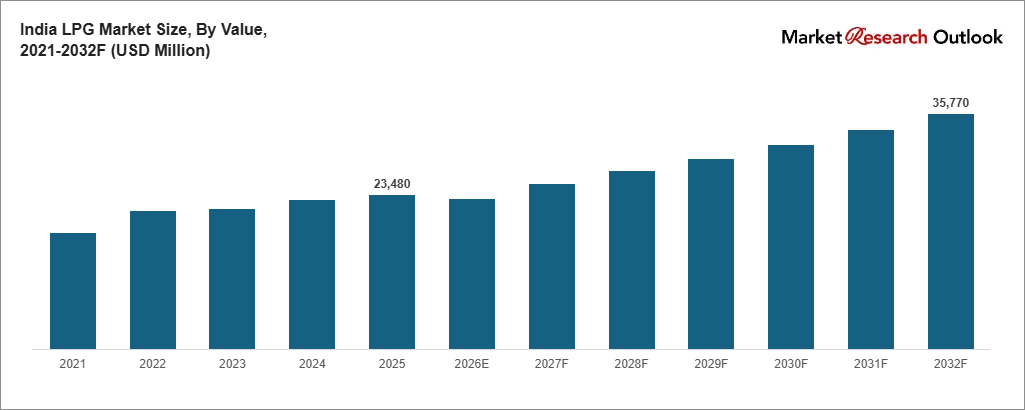
| Market Size (2025) | USD 23,480 Million |
| CAGR (2026-2032) | 6.2% |
| Leading Segment | Residential (14.2 kg Domestic Cylinders) |
| Fastest Growing Segment | Commercial & Industrial LPG |
| Market Size (2032) | USD 35,770 Million |
Market Overview: India LPG Market
The India LPG market size is witnessing consistent expansion, supported by near-universal household coverage, rising per-capita refill consumption, growing commercial and hospitality demand, a widening distributor footprint, and record investment in import, pipeline, and bottling infrastructure. Valued at USD 23,480 million in 2025 and projected to reach USD 35,770 million by 2032, growing at a CAGR of 6.2%, the India LPG market growth is anchored in the cooking fuel needs of more than 33 crore active domestic consumers, including over 10.5 crore Ujjwala beneficiaries. LPG consumption touched a record 33.2 million tonnes in FY 2025-26, up 6% from 31.3 million tonnes a year earlier, while domestic output stood near 13.1 million tonnes, leaving close to 60% of demand to be met through imports. Residential cooking leads consumption, while commercial and industrial LPG is emerging as the fastest growing application as hotels, restaurants, ceramics units, and MSMEs move away from diesel and furnace oil. Public sector oil marketing companies IOCL, BPCL, and HPCL serve the bulk of the market through 25,605 distributors and over 200 bottling plants, while private players such as Reliance, Nayara, SHV Energy, and Aegis are scaling parallel marketing and import capacity. With the 2026 West Asia supply shock exposing import risk, the India LPG market is evolving into a more diversified, digitally managed, and infrastructure-led ecosystem with strong long-term growth potential.
Key Report Takeaways: India LPG Market
- The India LPG market size is projected to grow from USD 23,480 million in 2025 to USD 35,770 million by 2032, registering a CAGR of 6.2%, driven by higher household refill rates, rising commercial and industrial demand, and continued investment in pipelines, terminals, and bottling capacity.
- Residential applications dominate the India LPG market, accounting for close to 88% to 90% of total volume in 2025, supported by more than 33 crore active domestic connections, the INR 300 targeted subsidy for PMUY households, and the deep reach of Indane, Bharatgas, and HP Gas across rural India.
- Commercial and industrial LPG is the fastest growing application in the India LPG market, expected to expand at 8% to 10% annually through 2032 as hotels, restaurants, caterers, ceramics clusters, and food processing units shift from diesel, furnace oil, and coal toward cleaner gaseous fuel.
- Rapid expansion of the distribution network, from 13,896 distributors in 2014 to 25,605 by March 2026, with 17,677 located in rural areas, is structurally widening the India LPG market across villages, small towns, and semi-urban clusters.
- Investments by IOCL, BPCL, HPCL, GAIL, and private importers in the 2,805 km Kandla-Gorakhpur pipeline, new coastal import terminals, underground storage caverns, and the first structured 2.2 million tonne US LPG contract are improving supply security and supporting the India LPG market forecast 2032.
Key Market Drivers: India LPG Market
Universal Clean Cooking Access Under PMUY and Rising Household Refill Rates Driving LPG Demand Across India
Growth in the India LPG market is being driven by the government’s push for universal clean cooking access and the steady rise in household refill consumption. Active domestic LPG customers grew from 14.5 crore in 2014 to more than 33 crore by 2026, and LPG coverage has moved from about 56% of households to near saturation. The Pradhan Mantri Ujjwala Yojana alone has released over 10.5 crore deposit-free connections, and the government approved INR 12,000 crore in FY 2025-26 to continue the INR 300 targeted subsidy on up to nine 14.2 kg refills a year. As a result, the effective cylinder price for PMUY households is around INR 553 against INR 853 for other consumers in Delhi. Average PMUY consumption has climbed from about 3 refills in 2019-20 to 4.47 refills in FY 2024-25 and roughly 4.85 refills in FY 2025-26. Each additional refill per PMUY household adds close to 1.5 million tonnes of annual demand, which gives the India LPG market a large and visible volume runway through 2032.
Expanding Commercial, Hospitality, and Industrial Consumption Fuelling 19 kg, 47.5 kg, and Bulk LPG Demand
The India LPG market is benefiting from rapid growth in commercial, hospitality, and industrial use of LPG. India’s organized foodservice sector, cloud kitchens, hotels, hostels, and institutional canteens depend on 19 kg and 47.5 kg cylinders, while ceramics clusters in Morbi, glass units in Firozabad, and food processing plants increasingly use bulk propane and LPG in place of diesel, furnace oil, and coal. Non-domestic packed and bulk LPG together account for about 10% to 12% of national demand, yet this segment is expanding faster than household use, with growth of 8% to 10% a year expected through 2032. Commercial users pay market linked prices, which makes this segment important for OMC margins and for private parallel marketers such as SHV Energy, Aegis, and Confidence Petroleum. Pollution control norms in the National Capital Region and other non-attainment cities are also pushing small industries toward cleaner gaseous fuels, adding steady volume to the India LPG market.
Import Terminal, Pipeline, and Bottling Infrastructure Expansion Strengthening LPG Supply Security and Reach
Large investments in import terminals, pipelines, storage, and bottling are a major catalyst for the India LPG market. The 2,805 km Kandla-Gorakhpur LPG pipeline, built by IOCL, BPCL, and HPCL through their joint venture IHB at a cost of about USD 1.3 billion, is designed to move 3.75 million tonnes a year from the west coast to bottling plants in Gujarat, Madhya Pradesh, and Uttar Pradesh. India’s LPG pipeline network already spans nearly 5,000 km, yet trucks still carry around 70% of LPG to bottling plants, so every new pipeline kilometre cuts freight cost and road risk. PSU oil marketing companies operate more than 200 bottling plants with combined capacity of about 23 million tonnes a year, and new terminals at Haldia, Mangaluru, Visakhapatnam, and Ennore are lifting import handling. Refiners also raised LPG output to 13.1 million tonnes in FY 2025-26, and supply contracts outside the Gulf are spreading sourcing risk across the India LPG market.
Key Market Challenges: India LPG Market
High Import Dependence and International Price Volatility Impacting LPG Affordability and OMC Under-Recoveries
The India LPG market continues to face pressure from high import dependence and volatile international prices. India imports close to 60% of its LPG, and about 90% of those imports have historically come from the UAE, Qatar, Saudi Arabia, and Kuwait through the Strait of Hormuz. The average international LPG price rose by 63%, from USD 385 per tonne in July 2023 to USD 629 per tonne in February 2025, while domestic retail prices stayed regulated. This gap forces OMCs to absorb heavy under-recoveries, and the government has approved INR 30,000 crore in compensation to IOCL, BPCL, and HPCL. The 2026 West Asia conflict showed how exposed supply remains, as LPG consumption fell 15.9% to 11.3 million tonnes during April to August 2026 and commercial and bulk users faced rationing. Currency movements and freight costs add further uncertainty to pricing across the India LPG market.
Low Refill Rates Among PMUY Beneficiaries and Rural Affordability Gaps Limiting Per-Capita LPG Consumption
The India LPG market faces structural limits from low refill rates among newer and poorer households. Even after recent gains, PMUY beneficiaries consume only about 4.5 to 4.9 cylinders a year, compared with roughly 6 to 7 cylinders for general domestic consumers. Field surveys show that while around 73% of rural households use LPG, only about 23% use it exclusively, as many families continue to stack firewood, crop residue, and cow dung cakes with LPG to manage costs. The upfront cost of a 14.2 kg refill remains a large share of monthly income for landless and daily wage households, and delayed subsidy credit adds to the burden. Distance to distributors in remote blocks and irregular home delivery also discourage regular refills. These gaps cap per-capita demand and slow the conversion of connections into steady volume for the India LPG market.
Rising Competition from Piped Natural Gas and Electric Induction Cooking in Urban Households
The India LPG market faces growing substitution risk in large cities from piped natural gas and electric cooking. City gas distribution now covers 307 geographical areas, and domestic PNG connections rose from about 1.57 crore in September 2025 to nearly 1.74 crore by June 2026, supported by government campaigns that encouraged PNG users to surrender LPG connections during the 2026 supply crunch. PNG offers continuous supply without booking or storage, and in many metros its monthly cost is similar to or lower than that of cylinders. At the same time, induction cooktops and rooftop solar are gaining share in premium urban homes. Active domestic LPG customers fell from 33.39 crore in April 2026 to 32.77 crore by September 2026, the first decline in over a decade, which highlights urban demand risk for the India LPG market.
Key Market Trends: India LPG Market
Rapid Adoption of Composite, 5 kg FTL, and Smart QR-Coded LPG Cylinders in India
The India LPG market is seeing a clear shift toward lighter, safer, and smarter cylinders. Fibre-reinforced composite cylinders, which weigh about half as much as steel cylinders and allow users to see the gas level, are being rolled out by IOCL and HPCL across metro and tier-1 cities. Free Trade LPG (FTL) 5 kg cylinders, sold over the counter at fuel stations and kirana outlets without address proof, are gaining traction among migrant workers, students, and street food vendors. OMCs have also started fitting QR codes on cylinders to track filling, delivery, and safety testing, which helps curb pilferage and diversion. Smart regulators and IoT-based leak detectors are entering premium housing and commercial kitchens. Together, these product changes are widening the consumer base and improving safety, which supports the India LPG market forecast 2032 across both residential and commercial categories.
Digital Booking, DBT, and Aadhaar Biometric Authentication Transforming the India LPG Market
A strong move toward digital booking, direct benefit transfer, and biometric authentication is reshaping the India LPG market. Under the PAHAL scheme, domestic cylinders are sold at market price and subsidy is credited straight to bank accounts, which has removed duplicate and ghost connections at scale. By December 2025, biometric Aadhaar authentication covered about 71% of PMUY consumers and 62% of non-PMUY consumers. Most refills are now booked through IVRS, SMS, WhatsApp, OMC apps, and UPI or wallet platforms, and consumers can track delivery in real time. Portability between distributors and online payment have raised service standards and transparency. These digital rails also give OMCs richer demand data for planning bottling and logistics, which improves efficiency across the India LPG market.
Pipeline, Import Terminal, and Supply Diversification Investments Reshaping LPG Logistics
A wave of infrastructure and sourcing investment is reshaping the supply side of the India LPG market. The Kandla-Gorakhpur pipeline, the Paradip-Haldia-Durgapur network, and new spur lines are shifting volumes from road to pipe, while underground LPG storage caverns at Visakhapatnam and Mangaluru provide strategic buffer stock. In November 2025, IOCL, BPCL, and HPCL signed India’s first structured contract to import about 2.2 million tonnes of US LPG in 2026, close to 10% of annual imports, priced against Mont Belvieu. During the 2026 Hormuz disruption, refiners diverted feedstock from petrochemicals to LPG, lifting March 2026 output to 1.4 million tonnes from 1.1 million tonnes a year earlier. Pilot programmes for bio-LPG and rDME blending are also under study. These moves are reinforcing the India LPG market forecast 2032 across the value chain.
Segmental Insights: India LPG Market
By Application: Residential Segment Dominates the India LPG Market
The residential segment dominates the India LPG market, accounting for an estimated 88% to 90% of total volume, driven by near-universal household coverage, the targeted PMUY subsidy, and the steady rise in refill frequency. The 14.2 kg domestic cylinder is the dominant format within this segment, while 5 kg cylinders serve low-income, single-person, and migrant households. The commercial segment, which covers hotels, restaurants, caterers, and institutions, contributes around 7% to 8% of demand and is the fastest growing application. Industrial users account for about 3% to 4%, led by ceramics, glass, metal treatment, and food processing, while autogas, agriculture, and feedstock uses together remain below 2%. In 2025, IOCL, BPCL, and HPCL added over 43 lakh new domestic customers while expanding non-domestic and bulk sales teams, reinforcing the leadership of residential demand in the India LPG market.
By Source: Imports Lead While Domestic Refinery Output Scales Up
Imported LPG leads the India LPG market by source, meeting close to 60% of total demand in FY 2025-26, with most cargoes landing at Kandla, Mundra, Haldia, Mangaluru, and Visakhapatnam. Refinery-based LPG supplies the largest share of domestic output, with Reliance’s Jamnagar complex and PSU refineries of IOCL, BPCL, and HPCL producing the bulk of India’s 13.1 million tonnes. Natural gas fractionation plants operated by GAIL and ONGC add a smaller but steady share. Domestic production is expected to grow at 3% to 4% a year as new refinery and petrochemical projects at Barmer, Panipat, and Numaligarh come on stream, while bio-LPG remains at pilot scale. Supply diversification toward the US, Africa, and Australia is helping importers lower concentration risk across the India LPG market.
Regional Insights: India LPG Market
Regional analysis of the India LPG market shows that North India and West India together account for close to 50% to 53% of total LPG volume. North India leads with around 29% to 31% of demand, driven by Uttar Pradesh, the country’s largest LPG consuming state with about 4.83 crore domestic customers, along with Delhi NCR, Rajasthan, Punjab, and Haryana. West India contributes about 20% to 22%, led by Maharashtra and Gujarat, where dense urban demand, industrial clusters, and coastal import terminals support strong consumption. South India accounts for 24% to 26%, supported by Tamil Nadu, Karnataka, Kerala, Andhra Pradesh, and Telangana, which have mature refill habits and large hospitality sectors. East and Central India together hold 23% to 26%, with West Bengal at about 2.71 crore customers, Bihar, Odisha, and Madhya Pradesh showing the fastest rise in new PMUY users. Pipeline and bottling additions by IOCL in Uttar Pradesh, BPCL and HPCL in Maharashtra, and terminal expansion at Haldia are reinforcing regional supply hubs across the India LPG market.
Recent Developments: India LPG Market
- The India LPG market recorded strong volume and policy momentum during 2025 and 2026. LPG consumption reached a record 33.2 million tonnes in FY 2025-26, up 6% from 31.3 million tonnes in FY 2024-25, while domestic production rose to 13.1 million tonnes. The PMUY base reached about 10.58 crore connections in 2026 after the government approved 25 lakh new deposit-free connections for FY 2025-26, and PMUY refill consumption rose to around 4.85 cylinders per household a year.
- Supply security moved to the top of the policy agenda in the India LPG market. In November 2025, IOCL, BPCL, and HPCL signed India’s first structured one-year deal to import about 2.2 million tonnes of US LPG in 2026. During the 2026 West Asia conflict, the government directed refiners to maximize LPG output and prioritize households, and approved INR 30,000 crore in compensation to OMCs for under-recoveries across FY 2025-26 and FY 2026-27.
- Infrastructure and service upgrades gained strong traction in the India LPG market. Large sections of the 2,805 km Kandla-Gorakhpur pipeline were laid and tested by 2025, BPCL reported record domestic sales of 7,492 thousand tonnes in FY 2024-25 with a 27.49% share of packed LPG, and OMCs widened composite cylinder, QR code, and digital booking coverage, strengthening long-term positioning in the India LPG market forecast 2032.
Key Market Players: India LPG Market
- Indian Oil Corporation Limited (Indane)
- Bharat Petroleum Corporation Limited (Bharatgas)
- Hindustan Petroleum Corporation Limited (HP Gas)
- GAIL (India) Limited
- Oil and Natural Gas Corporation Limited (ONGC)
- Reliance Industries Limited
- Nayara Energy Limited
- Mangalore Refinery and Petrochemicals Limited (MRPL)
- Chennai Petroleum Corporation Limited (CPCL)
- Numaligarh Refinery Limited
- SHV Energy Private Limited (SUPERGAS)
- Aegis Logistics Limited
- Confidence Petroleum India Limited (Go Gas)
| By Source | By Cylinder Size | By Supply Mode | By Distribution Channel | By Application |
| Refinery-Based LPG Natural Gas Fractionation LPG Imported LPG Bio-LPG & Renewable LPG |
5 kg (FTL & Domestic) 10 kg Composite 14.2 kg 19 kg 47.5 kg 425 kg Jumbo & Bulk |
Packed Cylinders Bulk LPG Piped / Reticulated LPG Auto LPG |
PSU OMC Distributors Private Parallel Marketers Auto LPG Dispensing Stations Bulk & Industrial Supply Digital Booking & Home Delivery |
Residential Commercial (Hotels, Restaurants & Caterers) Industrial Autogas (Transportation) Agriculture Petrochemical & Refinery Feedstock |
Report Scope
In this report, the India LPG Market has been segmented into the following categories, in addition to detailed analysis of key industry trends, market dynamics, competitive landscape, and growth opportunities across the forecast period:
- By Source
- Refinery-Based LPG
- Natural Gas Fractionation LPG
- Imported LPG
- Bio-LPG & Renewable LPG
- By Cylinder Size
- 5 kg (FTL & Domestic)
- 10 kg Composite
- 14.2 kg
- 19 kg
- 47.5 kg
- 425 kg Jumbo & Bulk
- By Supply Mode
- Packed Cylinders
- Bulk LPG
- Piped / Reticulated LPG
- Auto LPG
- By Distribution Channel
- PSU OMC Distributors
- Private Parallel Marketers
- Auto LPG Dispensing Stations
- Bulk & Industrial Supply
- Digital Booking & Home Delivery
- By Application
- Residential
- Commercial (Hotels, Restaurants & Caterers)
- Industrial
- Autogas (Transportation)
- Agriculture
- Petrochemical & Refinery Feedstock
- By Geography
- North India
- South India
- West India
- East India
- Central India
Competitive Landscape
Company Profiles:
Detailed analysis of the leading companies operating in the India LPG Market, including business overview, product portfolio, strategic initiatives, competitive positioning, and recent developments.
Company Information
Detailed profiling and strategic analysis of additional market players (up to five companies), including emerging private parallel marketers, LPG import terminal operators, composite cylinder makers, auto LPG dispensing networks, or state-level bulk LPG suppliers.
For a free sample of the India LPG Market report, customised insights or delivery timelines, submit your query here
India LPG Market, 2032
- Research Framework
- Market Segmentation
- Research Objective
- Research Methodology
- Qualitative Research
- Primary Research
- Secondary Research
- Quantitative Research
- Market Breakdown & Data Triangulation
- Demand Side
- Supply Side
- Primary Research Respondents
- Assumption & Limitation
- Executive Summary
- Market Overview, 2021-2032
- By Source
- By Cylinder Size
- By Supply Mode
- By Distribution Channel
- By Application
- By Region
- Analyst Recommendations
- Geopolitical Impact on India LPG Market
- India LPG Market Insights
- Market Dynamics
- Growth Drivers
- Universal clean cooking access under PMUY and rising household refill rates driving LPG demand across India.
- Expanding commercial, hospitality, and industrial consumption fuelling 19 kg, 47.5 kg, and bulk LPG demand.
- Import terminal, pipeline, and bottling infrastructure expansion strengthening LPG supply security and reach.
- Restraints
- High import dependence and international price volatility impacting LPG affordability and OMC under-recoveries.
- Low refill rates among PMUY beneficiaries and rural affordability gaps limiting per-capita LPG consumption.
- Rising competition from piped natural gas and electric induction cooking in urban households.
- Opportunities
- Commercial, industrial, and MSME fuel switching from diesel, furnace oil, and coal opening new bulk LPG demand.
- 5 kg FTL, composite, and smart QR-coded cylinders unlocking migrant, student, and urban rental consumer pools.
- Bio-LPG, rDME blending, and supply diversification from the US and Africa supporting long-term market resilience.
- Challenges
- Diversion of subsidized domestic cylinders to commercial use and illegal refilling practices.
- Ageing steel cylinder fleet, safety compliance, and PESO inspection gaps across smaller distributors.
- Last-mile delivery constraints in hilly, tribal, and North-East regions of India.
- Technological Advancements
- Recent Technological Advancements
- Prior to 2020
- Porter’s Five Forces Analysis
- PESTLE Analysis
- Industry Value Chain & Entry Points
- Upstream Feedstock & Sources (crude oil refining, associated natural gas, imported propane and butane)
- Refiners & Gas Fractionators (IOCL, BPCL, HPCL, Reliance, Nayara, GAIL, ONGC)
- LPG Importers & Import Terminals (Kandla, Mundra, Haldia, Mangaluru, Visakhapatnam, Ennore)
- Pipeline & Bulk Transportation (Kandla-Gorakhpur, Jamnagar-Loni, bullet trucks, rail tank wagons)
- Bottling Plants & Cylinder Manufacturers (steel and composite cylinders, valves, regulators)
- Quality, Safety & Testing Bodies (PESO, BIS, OISD, PNGRB standards)
- Distributors & Dealer Networks (PSU OMC distributorships, private parallel marketers)
- Auto LPG Dispensing Stations & Bulk Suppliers (ALDS, industrial and commercial bulk supply)
- Digital Booking & Delivery Platforms (IVRS, WhatsApp, OMC apps, UPI and wallet payments)
- End-Users (households, hotels and restaurants, industries, autogas vehicles, farms)
- India LPG Market: Regulatory Framework
- India LPG Market Overview
- Market Size & Forecast, 2021-2032
- By Value (USD Million)
- By Volume (Million Tonnes)
- Market Share & Forecast
- By Source
- Refinery-Based LPG
- Natural Gas Fractionation LPG
- Imported LPG
- Bio-LPG & Renewable LPG
- By Cylinder Size
- 5 kg (FTL & Domestic)
- 10 kg Composite
- 14.2 kg
- 19 kg
- 47.5 kg
- 425 kg Jumbo & Bulk
- By Supply Mode
- Packed Cylinders
- Bulk LPG
- Piped / Reticulated LPG
- Auto LPG
- By Distribution Channel
- PSU OMC Distributors
- Private Parallel Marketers
- Auto LPG Dispensing Stations
- Bulk & Industrial Supply
- Digital Booking & Home Delivery
- By Application
- Residential
- Commercial (Hotels, Restaurants & Caterers)
- Industrial
- Autogas (Transportation)
- Agriculture
- Petrochemical & Refinery Feedstock
- By Geography
- North India
- South India
- West India
- East India
- Central India
- Competitive Landscape
- India LPG Market Company Market Share Analysis, 2025
- Competitive Benchmarking, By Operating Parameters
- Key Strategic Development (Mergers, Acquisitions, Partnerships, Etc.)
- List of Emerging Players
- Company Profile
- Indian Oil Corporation Limited (Indane)
- Introduction & Company Profile
- Product Benchmarking
- Strategic Outlook
- Key Competitors
- Financial Analysis
- SWOT Analysis
(Same Data Pointers Will Be Provided for The Below Companies)
- Bharat Petroleum Corporation Limited (Bharatgas)
- Hindustan Petroleum Corporation Limited (HP Gas)
- GAIL (India) Limited
- Oil and Natural Gas Corporation Limited (ONGC)
- Reliance Industries Limited
- Nayara Energy Limited
- Mangalore Refinery and Petrochemicals Limited (MRPL)
- Chennai Petroleum Corporation Limited (CPCL)
- Numaligarh Refinery Limited
- SHV Energy Private Limited (SUPERGAS)
- Aegis Logistics Limited
- Confidence Petroleum India Limited (Go Gas)
- Other Prominent Players
* Financial information in case of non-listed companies will be provided as per availability
** The segmentation and the companies are subjected to modifications based on in-depth secondary for the final deliverable
Frequently Asked Questions
1. How large is the India LPG market and what is its growth forecast?
Ans: The India LPG market is valued at USD 23,480 million in 2025 and is projected to reach USD 35,770 million by 2032, growing at a CAGR of 6.2%, led by rising refills and commercial demand.
2. Which segments are driving demand in the India LPG market?
Ans: Residential use leads with close to 88% to 90% of volume, mainly through 14.2 kg cylinders, while commercial and industrial LPG is the fastest growing segment, expanding at 8% to 10% annually.
3. What are the key drivers of growth in the India LPG market?
Ans: Key drivers include PMUY-led household access, higher refill rates, rising commercial and industrial use, and new pipelines, import terminals, and bottling plants that steadily improve supply security and distribution reach across India.
4. Which regions are driving growth in the India LPG market?
Ans: North India and West India hold about 50% to 53% of volume, led by Uttar Pradesh, Maharashtra, and Gujarat, while Bihar, Odisha, West Bengal, and Madhya Pradesh are adding the fastest number of new PMUY users.
5. What are the latest trends in the India LPG market?
Ans: Major trends include composite and 5 kg FTL cylinders, QR-coded cylinder tracking, digital booking with Aadhaar authentication, the 2,805 km Kandla-Gorakhpur pipeline, and wider supply diversification through structured US LPG imports.