

India Small Modular Reactor (SMR) Market, 2032
- Energy, Power & Storage, Grid & Power Infrastructure
- Nov 2026
- Pages 140
- Report Format: pdf
- Report Price: $2400 USD
India’s small modular reactor market is witnessing strong structural growth, driven by the INR 20,000 crore Nuclear Energy Mission, the SHANTI Act 2025 opening civil nuclear power to private players, rising captive power demand from steel, aluminium, and cement producers, plans to repurpose retiring coal plant sites, indigenous BSMR-200 and SMR-55 reactor designs, and rising interest from domestic conglomerates and global SMR vendors investing in India-specific design, manufacturing, and project development capacity.
| Study Duration | 2021-2032 |
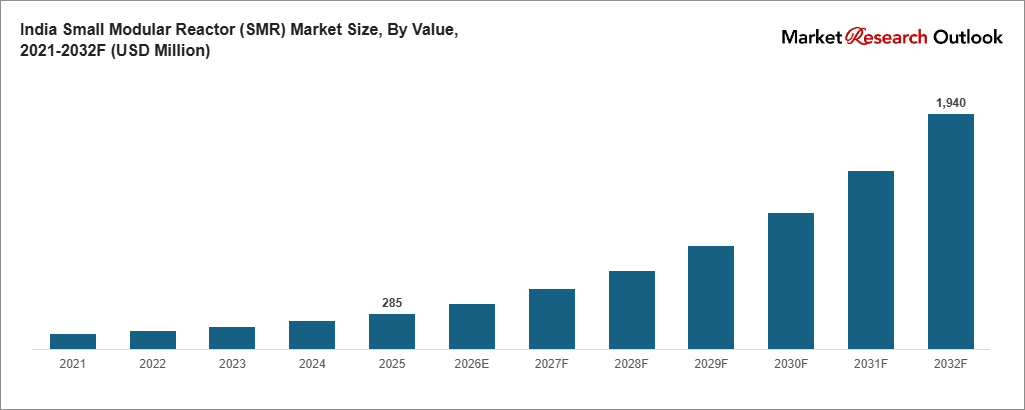
| Market Size (2025) | USD 285 Million |
| CAGR (2026-2032) | 31.5% |
| Leading Segment | PHWR-Based Small Reactors (201-300 MWe Class) |
| Fastest Growing Segment | LWR-Based SMRs & Captive Industrial Power |
| Market Size (2032) | USD 1,940 Million |
Market Overview: India Small Modular Reactor (SMR) Market
The India small modular reactor market size is witnessing rapid expansion, driven by the Nuclear Energy Mission, the SHANTI Act 2025, rising demand for firm clean power, growing industrial decarbonisation commitments, plans to repurpose retiring coal units, and major design progress by BARC and NPCIL. Valued at USD 285 million in 2025 and projected to reach USD 1,940 million by 2032, growing at a CAGR of 31.5%, the India small modular reactor market growth is being fuelled by strong interest from energy-intensive industries, the national target of 100 GW nuclear capacity by 2047, and the entry of private conglomerates into a sector long reserved for public companies. PHWR-based small reactors lead current spending, while LWR-based SMRs are emerging as the fastest growing category. India’s net zero goal for 2070, growing pressure on hard-to-abate sectors, and rising demand for round-the-clock carbon-free electricity are reshaping the supply landscape. As public sector leaders including NPCIL, BARC, NTPC, and BHEL expand design, siting, and component work, and private groups including Tata Power, Reliance Industries, Adani Power, JSW Energy, and Larsen & Toubro build dedicated nuclear divisions, the India SMR market is evolving into a policy-led, innovation-driven, and investment-ready ecosystem with strong long-term growth potential.
Key Report Takeaways: India Small Modular Reactor (SMR) Market
- The India small modular reactor market size is projected to grow from USD 285 million in 2025 to USD 1,940 million by 2032, registering a strong CAGR of 31.5%, driven by Nuclear Energy Mission funding, SHANTI Act reforms, and the structural shift toward firm, carbon-free power across industrial India.
- PHWR-based small reactors dominate the India small modular reactor market, accounting for about 52% of total value in 2025, driven by India’s proven pressurised heavy water reactor experience, the 220 MWe Bharat Small Reactor programme, and a mature domestic supply chain built by NPCIL, BHEL, and Larsen & Toubro.
- LWR-based SMRs are emerging as the fastest growing segment in the India SMR market, expected to grow at 36% to 40% annually as BSMR-200 and SMR-55 designs advance, global vendors seek Indian partners, and industrial users look for compact, factory-built units.
- A national target to operationalise at least five indigenously designed SMRs by 2033, along with interest from six private groups across 16 potential BSR sites in six states, is structurally expanding the India small modular reactor market across utility, captive, and brownfield categories.
- Rising investments by NPCIL, BARC, NTPC, BHEL, Larsen & Toubro, and Walchandnagar Industries in reactor design, heavy forgings, and modular fabrication capacity are strengthening local supply and supporting the India small modular reactor market forecast 2032.
Key Market Drivers: India Small Modular Reactor (SMR) Market
Nuclear Energy Mission Funding, SHANTI Act Reforms, and 100 GW by 2047 Target Driving SMR Deployment Across India
Growth in the India small modular reactor market is being driven by strong policy support, a reformed legal framework, and an ambitious long-term nuclear capacity target. The Union Budget 2025-26 set up a Nuclear Energy Mission with INR 20,000 crore for the research, design, development, and deployment of SMRs, with the aim of operationalising at least five indigenous units by 2033. India’s installed nuclear capacity stands near 8.8 GW, and the government plans to lift this to 100 GW by 2047, which implies average additions of over 4 GW every year. The SHANTI Act 2025 repealed the Atomic Energy Act, 1962 and the Civil Liability for Nuclear Damage Act, 2010, permitted private companies to build and operate nuclear plants, allowed foreign direct investment of up to 49%, and gave the Atomic Energy Regulatory Board statutory status. Units sized between 55 MWe and 300 MWe need far less land and capital per project than 700 MWe or 1,000 MWe plants, which makes them easier to finance and site. Together, these measures are creating strong structural pull-through demand across the India SMR market.
Industrial Decarbonisation, Captive Power Demand, and Coal Plant Repurposing Fuelling SMR Adoption Across Energy-Intensive Sectors
The India small modular reactor market is benefiting from rising demand for firm, low-carbon electricity from steel, aluminium, cement, chemicals, and refining companies that run captive power plants around the clock. India’s coal-based fleet exceeds 210 GW, and a large share of older units will reach retirement age over the next two decades, leaving behind land, water access, transmission lines, and trained staff that suit SMR deployment. BARC has designed the BSMR-200 specifically for repurposing retiring thermal plants and for captive power at aluminium, steel, and metal plants. Hindalco Industries, Jindal Steel & Power, Tata Power, Reliance Industries, JSW Energy, and Adani Power responded to the NPCIL request for proposal for 220 MWe Bharat Small Reactors and identified 16 potential sites in six states, including Gujarat and Madhya Pradesh. The Indian Carbon Market, the European Union’s Carbon Border Adjustment Mechanism on steel and aluminium exports, and corporate net zero pledges are pushing industrial buyers toward clean baseload power. Peak electricity demand crossed 250 GW in 2024, making firm clean power a priority for both grid planners and industrial buyers across the India SMR market.
Indigenous BSMR-200, SMR-55, and Bharat Small Reactor Designs Strengthening Domestic SMR Manufacturing and Supply Chain Growth
Rapid progress in indigenous reactor design is a major catalyst for the India small modular reactor market. BARC is developing the 200 MWe Bharat Small Modular Reactor (BSMR-200), the 55 MWe SMR-55 for remote and off-grid locations, and a high temperature gas-cooled reactor of up to 5 MWth for hydrogen production, with lead units of the two larger designs proposed at Tarapur in Maharashtra. NPCIL’s 220 MWe Bharat Small Reactor builds on India’s long operating record with more than a dozen 220 MWe PHWR units, which lowers technology risk for first projects. Domestic heavy engineering firms such as Larsen & Toubro, BHEL, Walchandnagar Industries, Godrej Enterprises, and MTAR Technologies already supply pressure vessels, steam generators, and critical components to NPCIL, giving PHWR-based units an estimated localisation level above 80%. Global vendors are also entering the India SMR market, with the US Department of Energy authorising Holtec International in March 2025 to share SMR-300 technology with Holtec Asia, Tata Consulting Engineers, and Larsen & Toubro. Factory-based module fabrication can cut construction schedules to 5 to 6 years, compared with 8 to 10 years for large plants. These developments are structurally expanding India small modular reactor market growth across all major end-user categories through 2032.
Key Market Challenges: India Small Modular Reactor (SMR) Market
High Upfront Capital Costs and First-of-a-Kind Project Risks Limiting Early SMR Investment Decisions
The India small modular reactor market continues to face challenges around high upfront capital costs and the risks attached to first-of-a-kind (FOAK) projects. Early SMR units in India are estimated to cost between INR 18 crore and INR 25 crore per MWe, higher per unit of capacity than large PHWRs that benefit from economies of scale. Lenders and private developers in the India SMR market remain cautious because no commercial SMR has yet been built in India, and cost overruns on early global projects have raised concerns about schedule and budget certainty. Under the SHANTI Act, the central government fixes the tariff for nuclear electricity, and industry participants have asked for competitive bidding and freedom to sell power, reflecting uncertainty over returns. Gestation periods of 5 to 7 years before revenue begins, combined with high interest costs, limit adoption among mid-sized industrial buyers across the India small modular reactor market.
Regulatory Licensing Timelines, Site Approvals, and Public Acceptance Delaying SMR Deployment Across States
The India small modular reactor market faces structural complexity from licensing timelines, site evaluation requirements, and local acceptance across states. Every new nuclear site needs seismic, hydrological, population density, and emergency planning studies, and site selection reports have been prepared for 39 candidate sites, with final suitability still subject to detailed review. Exclusion zone rules written for large reactors may not suit compact SMRs placed near industrial plants, and a dedicated SMR licensing approach is still being developed. Land acquisition, environmental clearances, and state-level approvals add further time, while past protests at Kudankulam and Jaitapur show the value of early community engagement. Differences in state industrial policy, water allocation, and grid connection rules also create operational complexity for developers such as NPCIL, NTPC, and Tata Power working across multiple states. While the statutory status of AERB under the SHANTI Act is expected to improve clarity, regulatory readiness remains a near-term challenge for the India SMR market.
Fuel Supply Constraints, Enriched Uranium Dependence, and Specialised Component Costs Impacting SMR Project Economics
The India small modular reactor market faces practical constraints around fuel availability, imported enriched uranium, and the cost of specialised nuclear-grade components. PHWR-based units run on natural uranium, but domestic production meets only part of current demand, and India relies on long-term import contracts with suppliers in Kazakhstan, Canada, Russia, and Uzbekistan. LWR-based SMRs such as the BSMR-200 and SMR-55 need low enriched uranium, and some advanced designs require high-assay low enriched uranium (HALEU), which has limited global supply. Nuclear-grade forgings, zirconium alloy tubes, and safety-class valves carry long lead times and price premiums of 20% to 35% over conventional power plant equipment. Smaller developers in the India SMR market face added complexity in securing fuel contracts and quality certification. Domestic fuel fabrication by the Nuclear Fuel Complex and new forging capacity are emerging as solutions, but limited scale and supply chain depth remain barriers to wider adoption across the India small modular reactor market.
Key Market Trends: India Small Modular Reactor (SMR) Market
Rising Private Sector Participation and Bharat Small Reactor Partnerships Under the SHANTI Act
The India small modular reactor market is undergoing a clear shift from a public sector monopoly toward shared public and private ownership, with private and joint venture projects expected to capture over 35% of new SMR capacity commitments by 2032. NPCIL issued its request for proposal for 220 MWe Bharat Small Reactors on 31 December 2024, under which industry partners provide land, water, and capital while NPCIL leads design, quality assurance, and operation, and it extended the submission deadline to 31 March 2026 to align with the new law. Larsen & Toubro, Tata Power, Reliance Industries, and the Adani Group have set up dedicated nuclear teams, and NTPC is expanding its nuclear plans through its joint venture with NPCIL. Industry consultations on tariff, liability, and offtake models are moving toward bankable project structures for the India SMR market. This ownership transition is reinforcing the India small modular reactor market forecast 2032 across both utility and captive categories.
Growing Global Technology Partnerships and SMR Technology Transfer Into the India Small Modular Reactor (SMR) Market
A clear shift toward international collaboration is reshaping the India small modular reactor market, particularly in the LWR-based segment. In March 2025, the US Department of Energy approved Holtec International to transfer unclassified SMR technology to Holtec Asia, Tata Consulting Engineers, and Larsen & Toubro, reviving momentum under the India-US civil nuclear agreement. Global vendors including Rolls-Royce SMR, GE Vernova Hitachi with its BWRX-300, Westinghouse with its AP300, and NuScale Power are actively marketing their designs to Indian utilities and industrial groups. Partnership models now range from licensed manufacturing and joint engineering to equity participation under the new framework. Indian manufacturers also see export potential, with Holtec outlining plans for a nuclear equipment plant in Gujarat. By 2025, an estimated 20 SMR technology partnerships, memoranda of understanding, and feasibility studies involved Indian firms, up from fewer than 5 in 2020, with refiners and data centre operators increasingly joining early evaluations in the India SMR market.
Factory-Based Modular Manufacturing and Heavy Engineering Capacity Expansion by Domestic Players
A wave of capacity expansion in modular fabrication and heavy engineering is reshaping the India small modular reactor market supply landscape. Combined India-focused investment announcements in nuclear manufacturing, forging, and component capacity are estimated to exceed USD 1.5 billion across 2023 to 2025. Larsen & Toubro strengthened its Hazira heavy engineering complex for nuclear vessels and modules, BHEL reinforced steam generator and turbine capacity, Walchandnagar Industries scaled precision nuclear component work, MTAR Technologies grew its nuclear assembly business, and Godrej Enterprises expanded critical equipment supply. Factory-built modules shift a large part of the work from site to workshop, improving quality control and cutting site labour needs by an estimated 30% to 40%. Nuclear Energy Mission funding, the new legal framework, and rising private interest have structurally favoured organised supply in the India SMR market. Combined with captive industrial demand and NPCIL fleet expansion, these developments are reinforcing the India small modular reactor market forecast 2032 across the entire value chain.
Segmental Insights: India Small Modular Reactor (SMR) Market
By End-User: Utilities and Public Sector Power Producers Dominate the India Small Modular Reactor (SMR) Market
The utilities and public sector power producers segment dominates the India small modular reactor market, accounting for an estimated 48% to 52% of total value, driven by NPCIL’s lead role, NTPC’s nuclear expansion, and government funding under the Nuclear Energy Mission. PHWR-based Bharat Small Reactors and grid-connected units are the main variants within this segment of the India SMR market, with the 201-300 MWe class capturing over 60% of utility spending. The energy-intensive industries segment contributes another 28% to 32% of demand, driven by steel, aluminium, cement, and chemical producers seeking captive clean power. Data centre and technology companies account for 8% to 10%, while defence and government establishments make up 9% to 12%, led by off-grid and strategic power needs. In 2025, leading participants including NPCIL, NTPC, Tata Power, Hindalco Industries, and Jindal Steel & Power advanced utility and captive SMR plans under the BSR programme, reinforcing segment dominance in the India SMR market.
By Reactor Type: PHWR-Based Leads While LWR-Based SMRs Grow Fastest
PHWR-based small reactors lead the India small modular reactor market by reactor type, accounting for approximately 52% of total value, driven by proven technology, domestic fuel cycle support, and a mature local supply chain. LWR-based SMRs contribute another 30% to 33%, led by design and early engineering work on the BSMR-200 and SMR-55 along with global vendor activity. LWR-based SMRs are the fastest growing category within the India SMR market, expanding at 36% to 40% annually, driven by compact designs, factory-built modules, passive safety systems, and growing interest from captive industrial users. High temperature gas-cooled reactors, molten salt reactors, and fast reactors together account for 15% to 18% of the India SMR market, with the HTGR segment expected to grow rapidly through 2032 as green hydrogen projects scale. By application, grid power generation holds about 46% of 2025 value, followed by captive industrial power at 29%. Leading participants including NPCIL, BARC, Larsen & Toubro, BHEL, and Holtec Asia have aligned their portfolios to this reactor mix, supporting wider SMR adoption across the India small modular reactor market.
Regional Insights: India Small Modular Reactor (SMR) Market
Regional analysis of the India small modular reactor market shows that West India and South India collectively account for approximately 58% to 62% of total value, driven by Maharashtra (Tarapur, the proposed site for the lead BSMR-200 and SMR-55 units), Gujarat (Kakrapar and a strong captive industrial base), Tamil Nadu (Kalpakkam and Kudankulam), Karnataka (Kaiga), and Andhra Pradesh, supported by existing nuclear sites, coastal water access, and dense industrial demand. North India contributes around 20% to 23% of demand, led by Rajasthan, Haryana, and Uttar Pradesh, supported by nuclear sites at Rawatbhata, Gorakhpur, and Narora and by coal plant repurposing studies. Central and East India together account for 16% to 19% of demand, supported by Madhya Pradesh, Odisha, Chhattisgarh, and Jharkhand, where steel, aluminium, and coal-based power clusters create strong captive and brownfield potential. In 2025, planning by NPCIL across Maharashtra and Rajasthan, private BSR site identification across Gujarat and Madhya Pradesh, and heavy fabrication by Larsen & Toubro at Hazira reinforced regional supply hubs, supporting closer execution of utility and captive projects across the India SMR market.
Recent Developments: India Small Modular Reactor (SMR) Market
- The India small modular reactor market witnessed strong momentum in policy and project progress during 2025 and 2026. The Union Budget 2025-26 launched the INR 20,000 crore Nuclear Energy Mission with a goal of at least five operational indigenous SMRs by 2033, and Parliament passed the SHANTI Act in December 2025 to open nuclear power to private and foreign participation. The Atomic Energy Commission identified Tarapur in Maharashtra as the site for the lead BSMR-200 and SMR-55 units, while the 100 GW by 2047 target remains the anchor for long-term planning in the India SMR market.
- Public and private developers have deepened India-focused SMR planning. NPCIL extended the deadline of its Bharat Small Reactor request for proposal to 31 March 2026 and held industry consultations to align the programme with the new law. Tata Power, Reliance Industries, Adani Power, JSW Energy, Hindalco Industries, and Jindal Steel & Power identified 16 potential BSR sites in six states, while Larsen & Toubro announced a focus on SMR manufacturing and began scouting global technology partners. These developments are strengthening domestic supply and supporting the India small modular reactor market forecast 2032.
- Global technology momentum has gained strong traction in the India SMR market. In March 2025, the US Department of Energy authorised Holtec International to share SMR-300 technology with Holtec Asia, Tata Consulting Engineers, and Larsen & Toubro, and Holtec has outlined plans for a nuclear equipment plant in Gujarat. Partnerships between Indian developers and vendors such as Rolls-Royce SMR, GE Vernova Hitachi, and Westinghouse are positioning India as one of the most actively developing SMR markets globally, strengthening long-term competitive positioning in the India small modular reactor market forecast 2032.
Key Market Players: India Small Modular Reactor (SMR) Market
- Nuclear Power Corporation of India Limited (NPCIL)
- Bhabha Atomic Research Centre (BARC)
- NTPC Limited
- Larsen & Toubro Limited
- Bharat Heavy Electricals Limited (BHEL)
- Tata Power Company Limited
- Reliance Industries Limited
- Adani Power Limited
- JSW Energy Limited
- Hindalco Industries Limited
- Walchandnagar Industries Limited
- Holtec Asia (Holtec International)
- Rolls-Royce SMR Limited
| By Reactor Type | By Power Capacity | By Deployment | By Application | By End-User |
| PHWR-Based Small Reactors (Bharat Small Reactors) Light Water Reactor (LWR) Based SMRs High Temperature Gas-Cooled Reactors (HTGR) Molten Salt Reactors (MSR) Liquid Metal Cooled Fast Reactors Others (Microreactors) |
Up to 50 MWe 51-100 MWe 101-200 MWe 201-300 MWe |
Greenfield Sites Brownfield Coal Plant Repurposing Captive Industrial Sites Off-Grid & Remote Locations |
Grid Power Generation Captive Industrial Power Green Hydrogen Production Industrial Process Heat Desalination Data Centres & Others |
Utilities & Public Sector Power Producers Energy-Intensive Industries (Steel, Aluminium, Cement) Data Centre & Technology Companies Defence & Government Establishments |
Report Scope
In this report, the India Small Modular Reactor (SMR) Market has been segmented into the following categories, in addition to detailed analysis of key industry trends, market dynamics, competitive landscape, and growth opportunities across the forecast period:
- By Reactor Type
- PHWR-Based Small Reactors (Bharat Small Reactors)
- Light Water Reactor (LWR) Based SMRs
- High Temperature Gas-Cooled Reactors (HTGR)
- Molten Salt Reactors (MSR)
- Liquid Metal Cooled Fast Reactors
- Others (Microreactors)
- By Power Capacity
- Up to 50 MWe
- 51-100 MWe
- 101-200 MWe
- 201-300 MWe
- By Deployment
- Greenfield Sites
- Brownfield Coal Plant Repurposing
- Captive Industrial Sites
- Off-Grid & Remote Locations
- By Application
- Grid Power Generation
- Captive Industrial Power
- Green Hydrogen Production
- Industrial Process Heat
- Desalination
- Data Centres & Others
- By End-User
- Utilities & Public Sector Power Producers
- Energy-Intensive Industries (Steel, Aluminium, Cement)
- Data Centre & Technology Companies
- Defence & Government Establishments
- By Geography
- North India
- South India
- West India
- East India
- Central India
Competitive Landscape
Company Profiles:
Detailed analysis of the leading companies operating in the India Small Modular Reactor (SMR) Market, including business overview, reactor and technology portfolio, strategic initiatives, competitive positioning, and recent developments.
Company Information
Detailed profiling and strategic analysis of additional market players (up to five companies), including emerging nuclear component manufacturers, specialised SMR technology developers, regional EPC contractors, or niche private captive power developers.
For a free sample of the India Small Modular Reactor (SMR) Market report, customised insights or delivery timelines, submit your query here
India Small Modular Reactor (SMR) Market, 2032
- Research Framework
- Market Segmentation
- Research Objective
- Research Methodology
- Qualitative Research
- Primary Research
- Secondary Research
- Quantitative Research
- Market Breakdown & Data Triangulation
- Demand Side
- Supply Side
- Primary Research Respondents
- Assumption & Limitation
- Executive Summary
- Market Overview, 2021-2032
- By Reactor Type
- By Power Capacity
- By Deployment
- By Application
- By End-User
- By Region
- Analyst Recommendations
- Geopolitical Impact on India Small Modular Reactor (SMR) Market
- India Small Modular Reactor (SMR) Market Insights
- Market Dynamics
- Growth Drivers
- Nuclear Energy Mission funding, SHANTI Act reforms, and 100 GW by 2047 target driving SMR deployment across India.
- Industrial decarbonisation, captive power demand, and coal plant repurposing fuelling SMR adoption across energy-intensive sectors.
- Indigenous BSMR-200, SMR-55, and Bharat Small Reactor designs strengthening domestic SMR manufacturing and supply chain growth.
- Restraints
- High upfront capital costs and first-of-a-kind project risks limiting early SMR investment decisions.
- Regulatory licensing timelines, site approvals, and public acceptance delaying SMR deployment across states.
- Fuel supply constraints, enriched uranium dependence, and specialised component costs impacting SMR project economics.
- Opportunities
- Repurposing retiring coal-fired power plant sites with SMRs opening large brownfield deployment opportunities across India.
- Green hydrogen, industrial process heat, and desalination applications supporting next-generation SMR demand.
- Private captive power, AI data centres, and global technology partnerships creating large SMR investment opportunities.
- Challenges
- Competition from low-cost solar, wind, and battery storage projects affecting SMR tariff competitiveness.
- Limited specialised nuclear workforce and heavy forging capacity across the Indian SMR supply chain.
- Ensuring nuclear safety, waste management, and liability clarity at scale across multiple private SMR operators.
- Technological Advancements
- Recent Technological Advancements
- Prior to 2020
- Porter’s Five Forces Analysis
- PESTLE Analysis
- Industry Value Chain & Entry Points
- Upstream Raw Materials & Nuclear Fuel (uranium, heavy water, zirconium alloys, nuclear-grade steel, graphite)
- Reactor Designers & Technology Developers (BARC, NPCIL, Holtec, Rolls-Royce SMR, GE Vernova Hitachi)
- Heavy Component & Equipment Manufacturers (L&T, BHEL, Walchandnagar, Godrej Enterprises, MTAR Technologies)
- Fuel Fabrication & Fuel Cycle Service Providers (Nuclear Fuel Complex, Heavy Water Board, UCIL)
- Quality Control, Safety & Regulatory Testing (AERB, IAEA, ASME, ISO nuclear quality standards)
- EPC Contractors & Construction Partners (L&T, Tata Projects, Hindustan Construction Company, Gammon)
- Project Developers & Plant Operators (NPCIL, NTPC, Tata Power, Reliance, Adani Power, JSW Energy)
- Grid Integration, Transmission & Power Offtake (Power Grid Corporation, state DISCOMs, power exchanges)
- Decommissioning, Waste Management & Lifecycle Services (BARC, NPCIL, specialised service providers)
- End-Users (utilities, steel, aluminium, cement, refineries, data centres, defence establishments)
- India Small Modular Reactor (SMR) Market: Regulatory Framework
- India Small Modular Reactor (SMR) Market Overview
- Market Size & Forecast, 2021-2032
- By Value (USD Million)
- By Capacity (MWe)
- Market Share & Forecast
- By Reactor Type
- PHWR-Based Small Reactors (Bharat Small Reactors)
- Light Water Reactor (LWR) Based SMRs
- High Temperature Gas-Cooled Reactors (HTGR)
- Molten Salt Reactors (MSR)
- Liquid Metal Cooled Fast Reactors
- Others (Microreactors)
- By Power Capacity
- Up to 50 MWe
- 51-100 MWe
- 101-200 MWe
- 201-300 MWe
- By Deployment
- Greenfield Sites
- Brownfield Coal Plant Repurposing
- Captive Industrial Sites
- Off-Grid & Remote Locations
- By Application
- Grid Power Generation
- Captive Industrial Power
- Green Hydrogen Production
- Industrial Process Heat
- Desalination
- Data Centres & Others
- By End-User
- Utilities & Public Sector Power Producers
- Energy-Intensive Industries (Steel, Aluminium, Cement)
- Data Centre & Technology Companies
- Defence & Government Establishments
- By Geography
- North India
- South India
- West India
- East India
- Central India
- Competitive Landscape
- India Small Modular Reactor (SMR) Market Company Market Share Analysis, 2025
- Competitive Benchmarking, By Operating Parameters
- Key Strategic Development (Mergers, Acquisitions, Partnerships, Etc.)
- List of Emerging Players
- Company Profile
- Nuclear Power Corporation of India Limited (NPCIL)
- Introduction & Company Profile
- Product Benchmarking
- Strategic Outlook
- Key Competitors
- Financial Analysis
- SWOT Analysis
(Same Data Pointers Will Be Provided for The Below Companies)
- Bhabha Atomic Research Centre (BARC)
- NTPC Limited
- Larsen & Toubro Limited
- Bharat Heavy Electricals Limited (BHEL)
- Tata Power Company Limited
- Reliance Industries Limited
- Adani Power Limited
- JSW Energy Limited
- Hindalco Industries Limited
- Walchandnagar Industries Limited
- Holtec Asia (Holtec International)
- Rolls-Royce SMR Limited
- Other Prominent Players
* Financial information in case of non-listed companies will be provided as per availability
** The segmentation and the companies are subjected to modifications based on in-depth secondary for the final deliverable
Frequently Asked Questions
1. How large is the India small modular reactor market and what is its growth forecast?
Ans: The India small modular reactor market is valued at USD 285 million in 2025 and is projected to reach USD 1,940 million by 2032, growing at a CAGR of 31.5%.
2. Which segments are driving demand in the India SMR market?
Ans: PHWR-based small reactors lead with about 52% value share, while LWR-based SMRs are the fastest growing segment, supported by BSMR-200 and SMR-55 designs and captive industrial demand.
3. What are the key drivers of growth in the India small modular reactor market?
Ans: Key drivers include the INR 20,000 crore Nuclear Energy Mission, SHANTI Act reforms, the 100 GW by 2047 nuclear target, industrial decarbonisation, and indigenous BSMR-200 and SMR-55 designs.
4. Which regions are driving growth in the India SMR market?
Ans: West India and South India lead with around 58% to 62% of total value, driven by Maharashtra, Gujarat, Tamil Nadu, Karnataka, and Andhra Pradesh, followed by North India.
5. What are the latest trends in the India small modular reactor market?
Ans: Key trends include private participation under the SHANTI Act, global SMR technology partnerships, factory-based modular manufacturing, coal plant repurposing, and rising interest from steel, aluminium, and data centre users.