

India Power Trading and Short Term Electricity Market, 2032
- Energy, Power & Storage, Grid & Power Infrastructure
- Nov 2026
- Pages 140
- Report Format: pdf
- Report Price: $2400 USD
India’s power trading and short term electricity market is witnessing strong structural growth, driven by record peak electricity demand, rapid renewable energy capacity addition, rising volumes in the Day-Ahead and Real-Time Markets, fast growth in green power trading, expanding open access participation, and regulatory reforms such as market coupling, electricity derivatives, and Green Energy Open Access that are deepening liquidity and price discovery across the short term electricity market.
| Study Duration | 2021-2032 |
| Market Size (2025) | USD 12,640 Million |
| CAGR (2026-2032) | 9.6% |
| Leading Segment | Power Exchanges (Day-Ahead Market) |
| Fastest Growing Segment | Real-Time Market & Green Market Segments |
| Market Size (2032) | USD 24,010 Million |
Market Overview: India Power Trading and Short Term Electricity Market
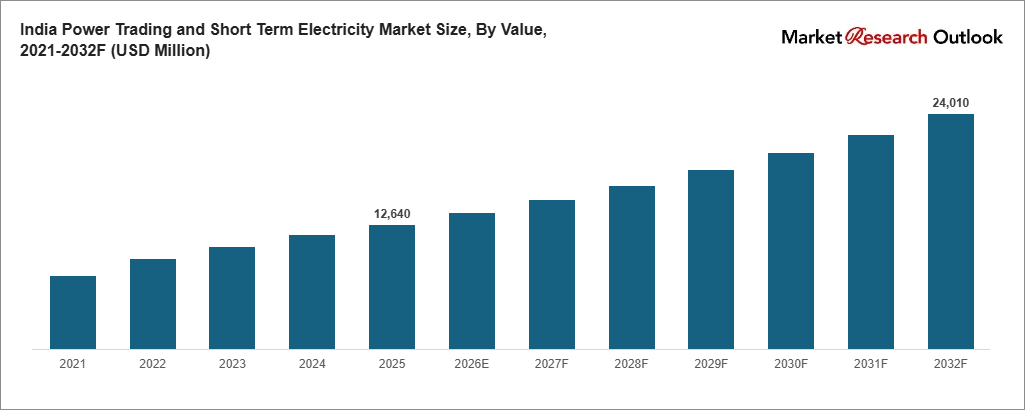
The India power trading and short term electricity market size is witnessing rapid expansion, driven by record peak electricity demand, fast renewable energy capacity addition, rising open access participation, deeper liquidity on power exchanges, and continued regulatory reform by CERC. Valued at USD 12,640 million in 2025 and projected to reach USD 24,010 million by 2032, growing at a CAGR of 9.6%, the India power trading and short term electricity market growth is being fuelled by strong buying from DISCOMs, commercial and industrial consumers, and the shift away from rigid long-term contracts. Total short term electricity transactions including DSM reached a record 238.35 BU in FY25, about 15% of national generation. Power exchanges lead the short term electricity market with nearly 46% of volume, while the Real-Time Market and green market segments are emerging as the fastest growing categories of power trading. Rising solar and wind supply, evening peak shortages, and wider use of price signals are reshaping power procurement. As IEX, PXIL, and HPX expand products, trading licensees such as PTC India, NVVN, and Tata Power Trading scale bilateral deals, and Grid-India prepares for market coupling, the India power trading and short term electricity market is evolving into a transparent, liquid, and digitally cleared ecosystem with strong long-term growth potential.
Key Report Takeaways: India Power Trading and Short Term Electricity Market
- The India power trading and short term electricity market size is projected to grow from USD 12,640 million in 2025 to USD 24,010 million by 2032, registering a strong CAGR of 9.6%, driven by rising peak demand, rapid renewable energy integration, and the structural shift toward flexible short term electricity procurement across India.
- Power exchanges dominate the India power trading and short term electricity market, accounting for nearly 46% of short term electricity volume in FY25, driven by transparent price discovery on IEX, PXIL, and HPX, record IEX volumes of 121 BU, and rising participation from DISCOMs and open access consumers.
- The Real-Time Market and green market segments are emerging as the fastest growing segments in the India power trading and short term electricity market, expected to grow at 15% to 20% annually as renewable sellers, DISCOMs, and corporate buyers use power trading to balance variable supply.
- Record peak demand of 250 GW in May 2024, projected to reach about 366 GW by 2031-32 under the National Electricity Plan, is structurally expanding the short term electricity market across day-ahead, real-time, and term-ahead power trading segments.
- Regulatory steps such as the CERC market coupling order of July 2025, monthly electricity futures on MCX and NSE, and Green Energy Open Access Rules are strengthening liquidity and supporting the India power trading and short term electricity market forecast 2032.
Key Market Drivers: India Power Trading and Short Term Electricity Market
Rising Peak Electricity Demand, Record Power Consumption, and DISCOM Procurement Gaps Driving Short Term Electricity Trading Across India
Growth in the India power trading and short term electricity market is being driven by fast-rising electricity demand and the growing gap between what DISCOMs contract under long-term PPAs and what consumers actually draw during peak hours. India’s electricity consumption rose 4.4% to 1,694 BU in FY25, while all-India peak demand touched a record 250 GW on 30 May 2024. The National Electricity Plan projects peak demand of about 366 GW by 2031-32, which means the short term electricity market will be called on to fill seasonal and evening gaps far more often. Total short term electricity transactions including DSM climbed from 218.22 BU in FY24 to 238.35 BU in FY25, a rise of 9.2%, and now equal about 15% of total generation. Heat waves, agricultural pumping loads, rising air-conditioner use, and the spread of data centres and electric vehicles are adding sharp demand peaks that long-term contracts cannot match hour by hour. DISCOMs in Uttar Pradesh, Maharashtra, Rajasthan, Punjab, and Tamil Nadu increasingly rely on power trading to buy at the margin, creating strong structural pull-through demand across the India power trading and short term electricity market.
Rapid Renewable Energy Capacity Addition and Green Market Products Accelerating Exchange-Based Power Trading
The India power trading and short term electricity market is benefiting from the fastest renewable energy build-out in the country’s history. India added a record 34 GW of generation capacity in FY25, including 29.5 GW of renewable energy, taking installed renewable capacity to nearly 220 GW, and the government targets 500 GW of non-fossil capacity by 2030. Solar now makes up about 61% of installed renewable capacity, which creates surplus power at midday and shortages after sunset. This daily swing is exactly what the short term electricity market is built to manage. Sell-side liquidity on IEX rose about 36% in FY25, pulling the average Day-Ahead Market price down nearly 15% to INR 4.47 per unit, from INR 5.25 per unit in FY24. The IEX green market, which combines Green Day-Ahead and Green Term-Ahead contracts, grew 171% to 8,746 MU, while about 178 lakh renewable energy certificates were traded during the year, up 136%. Corporate buyers chasing net-zero goals, together with DISCOMs meeting renewable purchase obligations, are turning green power trading into a core growth engine of the India power trading and short term electricity market.
Regulatory Reforms, New Contract Products, and Market Coupling Strengthening Liquidity in the Short Term Electricity Market
Policy support is a major catalyst for the India power trading and short term electricity market. The CERC Power Market Regulations, 2021 created the legal base for new exchange products, while the Green Energy Open Access Rules, 2022 lowered the open access threshold to 100 kW, opening power trading to thousands of mid-sized commercial and industrial users. In July 2025, CERC ordered a phased rollout of market coupling, starting with the Day-Ahead Market, and the draft Power Market (Second Amendment) Regulations, 2026 propose Grid-India as the single Market Coupling Operator to set a uniform clearing price across IEX, PXIL, and HPX. SEBI-approved monthly electricity futures went live on MCX on 10 July 2025 and on NSE on 14 July 2025, giving buyers and sellers a hedging tool for the first time. A CERC order in April 2025 also standardised short term contracts and moved the day-ahead contingency segment to a uniform price step auction. Combined with General Network Access for transmission and Late Payment Surcharge Rules for DISCOM dues, these reforms are structurally expanding India power trading and short term electricity market growth across all major buyer categories through 2032.
Key Market Challenges: India Power Trading and Short Term Electricity Market
Price Volatility, Intra-Day Price Spikes, and Regulatory Price Caps Limiting Predictable Short Term Electricity Procurement
The India power trading and short term electricity market continues to face challenges around price volatility and the difficulty of planning around it. On 25 May 2025, real-time prices fell close to zero during surplus solar hours, below the exchange fee of about 2 paise per unit, while evening blocks on many summer days cleared at the INR 10 per unit ceiling that CERC applies to the Day-Ahead and Real-Time Markets. Gas and imported coal power must use the separate High-Price Day-Ahead segment with a ceiling of up to INR 20 per unit, which splits liquidity. These sharp intra-day swings make it hard for state DISCOMs to budget power purchase costs, and many state regulators still review short term electricity purchases closely, pushing utilities toward cautious buying. The price cap also limits the signal for new peaking capacity and storage investment. Until deeper hedging and storage are in place, volatility will continue to restrain the pace of growth across the India power trading and short term electricity market.
Transmission Congestion and Inter-Regional Corridor Constraints Restricting Short Term Electricity Flows Across States
The India power trading and short term electricity market faces structural complexity from transmission congestion, especially on corridors linking surplus renewable states with high-demand load centres. India’s inter-regional transfer capacity stands at roughly 119 GW and is planned to reach about 168 GW by 2032, but new solar and wind parks in Rajasthan, Gujarat, and Karnataka are being commissioned faster than evacuation lines in several pockets. When corridors are congested, power exchanges split the market into separate price zones, so buyers in deficit regions pay more while surplus power stays stranded. Delays in right-of-way clearances, land acquisition, and Green Energy Corridor projects add to the gap. State-level transmission networks and SLDC scheduling practices also vary widely, which creates friction for open access power trading across state borders. While the Ministry of Power and CTUIL are fast-tracking inter-state lines under the National Electricity Plan, congestion remains a near-term challenge for the India power trading and short term electricity market.
Weak DISCOM Finances, Payment Delays, and Long-Term PPA Lock-Ins Limiting Participation in Power Trading
The India power trading and short term electricity market faces practical constraints from the weak financial position of many state DISCOMs. Most utilities have tied up the bulk of their supply through 25-year PPAs, so the short term electricity market still accounts for only about 15% of generation even after a decade of growth. Fixed capacity charges on these contracts mean that DISCOMs often prefer to back down cheaper exchange power rather than idle contracted plants. Aggregate technical and commercial losses remain around 16% nationally, and accumulated DISCOM debt limits their ability to pay upfront margins on power exchanges. The Late Payment Surcharge Rules, 2022 have cut legacy dues sharply, but some trading licensees still face credit risk on bilateral power trading deals. Average trading margins remain thin at about INR 0.029 per unit, leaving little room to absorb defaults. Better DISCOM finances, cost-reflective tariffs, and shorter PPA tenures are needed to unlock the full potential of the India power trading and short term electricity market.
Key Market Trends: India Power Trading and Short Term Electricity Market
Rapid Growth of Real-Time Market and Green Market Segments in India Power Trading
The India power trading and short term electricity market is undergoing a clear shift toward real-time and green trading segments. The Real-Time Market, which clears power in 15-minute blocks one hour ahead of delivery, grew 29% on IEX to 38,896 MU in FY25, while the Day-Ahead Market grew 15% to 61,311 MU. Real-time power trading lets DISCOMs correct forecasting errors close to delivery instead of paying penalties under the Deviation Settlement Mechanism, which itself accounted for about 32.14 BU in FY25. Green Day-Ahead Market prices averaged INR 4.01 per unit in FY25, making green power trading competitive with conventional supply. Renewable developers with merchant capacity, along with companies such as NTPC, NHPC, Tata Power, Adani Green, and JSW Energy, are increasingly selling uncommitted solar and wind output on exchanges. Corporate buyers in Maharashtra, Karnataka, and Gujarat are using the green market and renewable energy certificates to meet sustainability targets. This product shift is reinforcing the India power trading and short term electricity market forecast 2032 across both exchange and bilateral channels.
Market Coupling, Electricity Derivatives, and Digital Trading Platforms Reshaping Price Discovery
A clear shift toward uniform price discovery and risk management is reshaping the India power trading and short term electricity market. Under market coupling, bids from all three power exchanges will be pooled to discover a single clearing price, which is expected to reduce price differences between platforms and improve grid efficiency. Grid-India has already run shadow pilots for coupling the Day-Ahead and Real-Time Markets, and CERC has directed a further shadow pilot for the Term-Ahead Market. Monthly baseload electricity futures on MCX and NSE now allow DISCOMs, generators, and large industries to lock in prices months ahead, a tool the short term electricity market lacked for years. Power exchanges and trading licensees are also investing in algorithmic bidding, AI-based demand forecasting, and API-led trading terminals that let open access consumers trade directly from their energy management systems. PXIL recorded Term-Ahead volumes above 1,500 MU in February 2025 and 1,700 MU in March 2025, showing that competition across power trading platforms is intensifying in the India short term electricity market.
Battery Storage, Round-the-Clock Renewable Supply, and Cross-Border Power Trading Expanding Market Depth
A new wave of supply-side innovation is reshaping the India power trading and short term electricity market. Battery energy storage systems, supported by viability gap funding, are being tendered at scale so that surplus midday solar can be shifted into evening peaks and sold through real-time and day-ahead power trading. Firm and dispatchable renewable energy tenders, along with round-the-clock hybrid projects from developers such as ReNew, Greenko, Adani Green, and NTPC Green Energy, will add flexible supply that suits short term electricity contracts. Cross-border electricity trade is also growing. In FY25, India imported about 4,466 MU from Bhutan and 497 MU from Nepal, and exported about 8,118 MU to Bangladesh, while the tripartite Nepal-India-Bangladesh energy trade agreement took effect in November 2024. Neighbouring countries also bought power through the IEX Day-Ahead and Real-Time Markets. Combined with Green Energy Corridor investments and storage-backed capacity, these developments are reinforcing the India power trading and short term electricity market forecast 2032 across the entire value chain.
Segmental Insights: India Power Trading and Short Term Electricity Market
By End-User: DISCOMs Segment Dominates the India Power Trading and Short Term Electricity Market
The DISCOMs end-user segment dominates the India power trading and short term electricity market, accounting for an estimated 70% to 74% of total purchase volume, driven by peak-hour shortages, seasonal demand spikes, and the need to correct day-ahead forecasting errors. Day-Ahead and Real-Time Market contracts are the dominant instruments within this segment, with exchange-based power trading capturing a growing share of DISCOM short term purchases. Industrial open access consumers contribute another 16% to 19% of demand, led by steel, cement, chemicals, textiles, and data centre operators seeking lower energy costs and green power. Commercial and institutional consumers account for 6% to 8%, supported by Green Energy Open Access, while railways and deemed licensees make up the balance. In 2025, leading buyers including state utilities in Uttar Pradesh, Maharashtra, Rajasthan, Punjab, and Tamil Nadu scaled up short term electricity purchases during summer peaks, reinforcing segment dominance in the India power trading and short term electricity market.
By Trading Platform: Power Exchanges Lead While Real-Time and Green Segments Grow Fastest
Power exchanges lead the India power trading and short term electricity market, accounting for approximately 46% of total short term electricity volume in FY25, driven by transparent price discovery, standardised contracts, and guaranteed settlement. Bilateral power trading, both through trading licensees and directly between DISCOMs, contributes around 41%, primarily for banking arrangements, seasonal swaps, and medium-duration supply. The Deviation Settlement Mechanism accounts for the remaining 13% or so. Within power exchanges, the Real-Time Market and green market segments are the fastest growing categories, expanding at 15% to 20% annually, driven by renewable variability, 15-minute trading flexibility, and corporate demand for green power. IEX held a dominant share of exchange volume in FY25, while PXIL and HPX are building their presence in Term-Ahead and High-Price segments. Leading trading licensees including PTC India, NVVN, Tata Power Trading, Manikaran Power, and Arunachal Pradesh Power Corporation have aligned their portfolios to this mix, driving deeper liquidity across the India power trading and short term electricity market.
Regional Insights: India Power Trading and Short Term Electricity Market
Regional analysis of the India power trading and short term electricity market shows that the Northern and Western regions collectively account for approximately 56% to 60% of total short term electricity volume, driven by Uttar Pradesh, Punjab, Haryana, Rajasthan, Delhi, Maharashtra, Gujarat, and Madhya Pradesh, where summer and paddy-season peaks create heavy short term buying and where large solar parks supply surplus daytime power. The Southern region contributes around 24% to 27% of demand, led by Tamil Nadu, Karnataka, Telangana, and Andhra Pradesh, supported by high wind and solar penetration and active open access power trading in industrial clusters around Chennai, Bengaluru, and Hyderabad. The Eastern and North-Eastern regions together account for 14% to 17% of demand, supported by West Bengal, Odisha, Bihar, Jharkhand, and Assam, where hydro surplus and coal-based generation feed exchange sales. In 2025, new inter-regional transmission links, Green Energy Corridor projects, and cross-border supply from Bhutan and Nepal strengthened regional trading hubs, supporting smoother power flows across the India power trading and short term electricity market.
Recent Developments: India Power Trading and Short Term Electricity Market
- The India power trading and short term electricity market witnessed strong momentum during 2024 and 2025. Total short term electricity transactions including DSM reached a record 238.35 BU in FY25, up 9.2% from 218.22 BU in FY24, according to CERC market monitoring data. IEX traded a record 121 BU in FY25, up 19%, with the Day-Ahead Market at 61,311 MU and the Real-Time Market at 38,896 MU. About 178 lakh renewable energy certificates were traded on IEX during the year, up 136%.
- Regulators have deepened power trading reforms. In July 2025, CERC ordered a phased rollout of market coupling starting with the Day-Ahead Market, and the draft Power Market (Second Amendment) Regulations, 2026 propose Grid-India as the single Market Coupling Operator. In April 2025, CERC standardised short term contracts and moved the day-ahead contingency segment to a uniform price step auction. These developments are strengthening market design and supporting the India power trading and short term electricity market forecast 2032.
- New hedging and cross-border products have gained strong traction in the India power trading and short term electricity market. In July 2025, MCX and NSE launched SEBI-approved monthly electricity futures, while the Nepal-India-Bangladesh tripartite energy trade agreement became effective in November 2024. Trading licensees including PTC India, NVVN, and Tata Power Trading expanded bilateral and cross-border deals, positioning India as one of the most actively developing power trading markets in Asia.
Key Market Players: India Power Trading and Short Term Electricity Market
- Indian Energy Exchange Limited (IEX)
- Power Exchange India Limited (PXIL)
- Hindustan Power Exchange Limited (HPX)
- PTC India Limited
- NTPC Vidyut Vyapar Nigam Limited (NVVN)
- Tata Power Trading Company Limited
- Arunachal Pradesh Power Corporation Pvt. Ltd.
- Manikaran Power Limited
- GMR Energy Trading Limited
- JSW Power Trading Company Limited
- Adani Enterprises Limited (Power Trading)
- NHPC Limited
- Mittal Processors Pvt. Ltd.
| By Trading Platform | By Market Segment | By Contract Duration | By Power Source | By End-User |
| Power Exchanges (IEX, PXIL, HPX) Bilateral Trading Through Trading Licensees Direct Bilateral Transactions Deviation Settlement Mechanism (DSM) Others (Banking & Swap Arrangements) |
Day-Ahead Market (DAM) Real-Time Market (RTM) Term-Ahead Market (TAM) Green Day-Ahead Market (G-DAM) Green Term-Ahead Market (G-TAM) High-Price Day-Ahead Market (HP-DAM) Others (RECs & ESCerts) |
Real-Time & Intra-Day Day-Ahead Daily & Weekly Monthly Up to One Year |
Coal-Based Thermal Gas-Based Thermal Solar Wind Hydro Hybrid & Storage-Backed |
Distribution Companies (DISCOMs) Industrial Open Access Consumers Commercial & Institutional Consumers Railways & Deemed Licensees |
Report Scope
In this report, the India Power Trading and Short Term Electricity Market has been segmented into the following categories, in addition to detailed analysis of key industry trends, market dynamics, competitive landscape, and growth opportunities across the forecast period:
- By Trading Platform
- Power Exchanges (IEX, PXIL, HPX)
- Bilateral Trading Through Trading Licensees
- Direct Bilateral Transactions
- Deviation Settlement Mechanism (DSM)
- Others (Banking & Swap Arrangements)
- By Market Segment
- Day-Ahead Market (DAM)
- Real-Time Market (RTM)
- Term-Ahead Market (TAM)
- Green Day-Ahead Market (G-DAM)
- Green Term-Ahead Market (G-TAM)
- High-Price Day-Ahead Market (HP-DAM)
- Others (RECs & ESCerts)
- By Contract Duration
- Real-Time & Intra-Day
- Day-Ahead
- Daily & Weekly
- Monthly
- Up to One Year
- By Power Source
- Coal-Based Thermal
- Gas-Based Thermal
- Solar
- Wind
- Hydro
- Hybrid & Storage-Backed
- By End-User
- Distribution Companies (DISCOMs)
- Industrial Open Access Consumers
- Commercial & Institutional Consumers
- Railways & Deemed Licensees
- By Geography
- Northern Region
- Western Region
- Southern Region
- Eastern Region
- North-Eastern Region
Competitive Landscape
Company Profiles:
Detailed analysis of the leading companies operating in the India Power Trading and Short Term Electricity Market, including business overview, product and service portfolio, strategic initiatives, competitive positioning, and recent developments.
Company Information
Detailed profiling and strategic analysis of additional market players (up to five companies), including emerging trading licensees, renewable energy aggregators, electricity derivatives participants, regional power traders, or niche open access service providers.
For a free sample of the India Power Trading and Short Term Electricity Market report, customised insights or delivery timelines, submit your query here
India Power Trading and Short Term Electricity Market, 2032
- Research Framework
- Market Segmentation
- Research Objective
- Research Methodology
- Qualitative Research
- Primary Research
- Secondary Research
- Quantitative Research
- Market Breakdown & Data Triangulation
- Demand Side
- Supply Side
- Primary Research Respondents
- Assumption & Limitation
- Executive Summary
- Market Overview, 2021-2032
- By Trading Platform
- By Market Segment
- By Contract Duration
- By Power Source
- By End-User
- By Region
- Analyst Recommendations
- Geopolitical Impact on India Power Trading and Short Term Electricity Market
- India Power Trading and Short Term Electricity Market Insights
- Market Dynamics
- Growth Drivers
- Rising peak electricity demand, record power consumption, and DISCOM procurement gaps driving short term electricity trading across India.
- Rapid renewable energy capacity addition and green market products accelerating exchange-based power trading.
- Regulatory reforms, new contract products, and market coupling strengthening liquidity in the short term electricity market.
- Restraints
- Price volatility, intra-day price spikes, and regulatory price caps limiting predictable short term electricity procurement.
- Transmission congestion and inter-regional corridor constraints restricting short term electricity flows across states.
- Weak DISCOM finances, payment delays, and long-term PPA lock-ins limiting participation in power trading.
- Opportunities
- Market coupling, uniform price discovery, and electricity derivatives opening deeper liquidity across power exchanges.
- Green Energy Open Access, renewable energy certificates, and carbon credit trading supporting next-generation green power trading.
- Battery energy storage, round-the-clock renewable supply, and cross-border electricity trade creating new power trading opportunities.
- Challenges
- Intense competition among power exchanges and fragmented liquidity across power trading platforms ahead of market coupling.
- High cross-subsidy surcharges and additional surcharges limiting open access adoption among industrial consumers.
- Grid balancing complexity and forecasting errors from intermittent renewable generation affecting short term electricity trading.
- Technological Advancements
- Recent Technological Advancements
- Prior to 2020
- Porter’s Five Forces Analysis
- PESTLE Analysis
- Industry Value Chain & Entry Points
- Upstream Generation Sources (coal, gas, hydro, solar, wind, hybrid and storage-backed capacity)
- Power Generators & Sellers (NTPC, NHPC, Adani Power, Tata Power, JSW Energy, merchant IPPs)
- Renewable Energy Developers & Merchant Capacity (solar, wind, hybrid, round-the-clock projects)
- Transmission & Grid Operators (POWERGRID, Grid-India, RLDCs, SLDCs)
- Regulators & Policy Bodies (Ministry of Power, CERC, SERCs, CEA)
- Power Exchanges (IEX, PXIL, HPX)
- Trading Licensees (PTC India, NVVN, Tata Power Trading, Manikaran Power, GMR Energy Trading)
- Electricity Derivatives & Financial Platforms (MCX, NSE monthly electricity futures)
- Distribution Utilities & Open Access Channels (state DISCOMs, private DISCOMs, Green Energy Open Access)
- End-Users (industrial, commercial, institutional, railways, and retail consumers served through DISCOMs)
- India Power Trading and Short Term Electricity Market: Regulatory Framework
- India Power Trading and Short Term Electricity Market Overview
- Market Size & Forecast, 2021-2032
- By Value (USD Million)
- By Volume (Billion Units)
- Market Share & Forecast
- By Trading Platform
- Power Exchanges (IEX, PXIL, HPX)
- Bilateral Trading Through Trading Licensees
- Direct Bilateral Transactions
- Deviation Settlement Mechanism (DSM)
- Others (Banking & Swap Arrangements)
- By Market Segment
- Day-Ahead Market (DAM)
- Real-Time Market (RTM)
- Term-Ahead Market (TAM)
- Green Day-Ahead Market (G-DAM)
- Green Term-Ahead Market (G-TAM)
- High-Price Day-Ahead Market (HP-DAM)
- Others (RECs & ESCerts)
- By Contract Duration
- Real-Time & Intra-Day
- Day-Ahead
- Daily & Weekly
- Monthly
- Up to One Year
- By Power Source
- Coal-Based Thermal
- Gas-Based Thermal
- Solar
- Wind
- Hydro
- Hybrid & Storage-Backed
- By End-User
- Distribution Companies (DISCOMs)
- Industrial Open Access Consumers
- Commercial & Institutional Consumers
- Railways & Deemed Licensees
- By Geography
- Northern Region
- Western Region
- Southern Region
- Eastern Region
- North-Eastern Region
- Competitive Landscape
- India Power Trading and Short Term Electricity Market Company Market Share Analysis, 2025
- Competitive Benchmarking, By Operating Parameters
- Key Strategic Development (Mergers, Acquisitions, Partnerships, Etc.)
- List of Emerging Players
- Company Profile
- Indian Energy Exchange Limited (IEX)
- Introduction & Company Profile
- Product Benchmarking
- Strategic Outlook
- Key Competitors
- Financial Analysis
- SWOT Analysis
(Same Data Pointers Will Be Provided for The Below Companies)
- Power Exchange India Limited (PXIL)
- Hindustan Power Exchange Limited (HPX)
- PTC India Limited
- NTPC Vidyut Vyapar Nigam Limited (NVVN)
- Tata Power Trading Company Limited
- Arunachal Pradesh Power Corporation Pvt. Ltd.
- Manikaran Power Limited
- GMR Energy Trading Limited
- JSW Power Trading Company Limited
- Adani Enterprises Limited (Power Trading)
- NHPC Limited
- Mittal Processors Pvt. Ltd.
- Other Prominent Players
* Financial information in case of non-listed companies will be provided as per availability
** The segmentation and the companies are subjected to modifications based on in-depth secondary for the final deliverable
Frequently Asked Questions
1. How large is the India power trading and short term electricity market?
Ans: The India power trading and short term electricity market is valued at USD 12,640 million in 2025 and is projected to reach USD 24,010 million by 2032, growing at a CAGR of 9.6%.
2. Which segments lead the India short term electricity market?
Ans: Power exchanges lead with nearly 46% of short term electricity volume, while the Real-Time Market and green market segments are the fastest growing areas of power trading in India.
3. What drives growth in the India power trading market?
Ans: Key drivers include record peak demand, rapid renewable energy addition, green market products, and reforms such as market coupling, electricity derivatives, and Green Energy Open Access.
4. Which regions lead the India power trading and short term electricity market?
Ans: The Northern and Western regions lead with about 56% to 60% of short term electricity volume, driven by Uttar Pradesh, Rajasthan, Punjab, Maharashtra, and Gujarat.
5. What are the latest trends in India power trading?
Ans: Latest trends include fast Real-Time Market growth, green power trading, market coupling, monthly electricity futures on MCX and NSE, battery storage, and cross-border electricity trade.