

India Pumped Storage Hydro Market, 2032
- Energy, Power & Storage, Renewables & Clean Fuels
- Nov 2026
- Pages 140
- Report Format: pdf
- Report Price: $2400 USD
India’s pumped storage hydro market is witnessing strong structural growth, driven by rapid solar and wind capacity additions, rising evening peak demand, supportive Ministry of Power guidelines, ISTS charge waivers, falling storage tariffs, expanding off-stream and closed-loop project pipelines, long-term SECI and DISCOM storage contracts, and rising interest from private developers and global equipment makers investing in India-specific pumped storage capacity, reversible turbine supply, and grid connectivity.
| Study Duration | 2021-2032 |
| Market Size (2025) | USD 4,850 Million |
| CAGR (2026-2032) | 18.5% |
| Leading Segment | Off-Stream PSPs (Above 1,000 MW Capacity) |
| Fastest Growing Segment | Off-Stream Closed-Loop & Hybrid IREP PSPs |
| Market Size (2032) | USD 15,915 Million |
Market Overview: India Pumped Storage Hydro Market
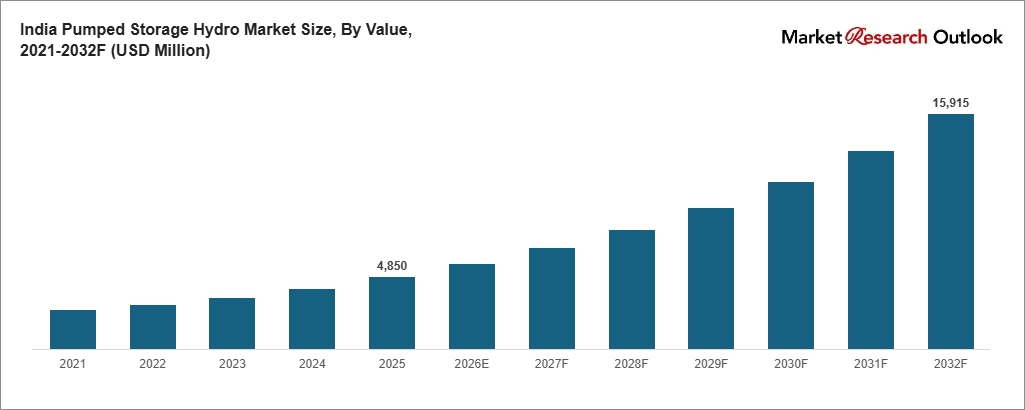
The India pumped storage hydro market size is witnessing rapid expansion, driven by accelerating renewable energy additions, rising evening peak demand, supportive storage policies, expanding tariff-based competitive bidding, increasing need for long-duration grid storage, and major project commitments by private and public developers. Valued at USD 4,850 million in 2025 and projected to reach USD 15,915 million by 2032, growing at a CAGR of 18.5%, the India pumped storage hydro market growth is being fuelled by strong demand from state DISCOMs, central procurers such as SECI and NHPC, and grid operators managing a power system where non-fossil sources already exceed 50% of installed capacity. Off-stream pumped storage projects lead investment, while closed-loop and hybrid IREP pumped storage projects are emerging as the fastest growing category. Shifting grid needs toward firm evening supply, frequency support, and 6 to 8 hour storage are reshaping the supply landscape. As private developers including Greenko, JSW Energy, Tata Power, Adani Green Energy, and Torrent Power expand off-stream pipelines, and central utilities including NHPC, THDC, NTPC, and SJVN scale pumped storage portfolios, the India pumped storage hydro market is evolving into a policy-backed, contract-driven, and technology-enabled ecosystem with strong long-term growth potential.
Key Report Takeaways: India Pumped Storage Hydro Market
- The India pumped storage hydro market size is projected to grow from USD 4,850 million in 2025 to USD 15,915 million by 2032, registering a strong CAGR of 18.5%, driven by renewable energy integration needs, supportive storage policies, and the structural shift toward long-duration grid storage across India.
- Off-stream pumped storage projects dominate the India pumped storage hydro market, accounting for over 62% of total market value in 2025, driven by large projects such as Greenko’s 1,680 MW Pinnapuram and 1,920 MW Gandhi Sagar, JSW Energy’s 1,500 MW Bhavali, and Torrent Power’s 1,500 MW Tarali pumped storage plants.
- Closed-loop and hybrid IREP pumped storage projects are emerging as the fastest growing segments in the India pumped storage hydro market, expected to grow at 22% to 26% annually as lower river impact, faster clearances, and round-the-clock power demand reshape developer strategies across water-stressed states.
- India’s pumped storage pipeline is scaling rapidly, with about 7.2 GW in operation and 11.6 GW under construction as of December 2025, and the CEA roadmap targeting around 87 GW by 2033-34 and 100 GW by 2035-36, structurally expanding the India pumped storage hydro market across utility, grid, and commercial categories.
- Rising equipment and construction investments by suppliers and developers such as ANDRITZ, Voith Hydro, BHEL, Greenko, JSW Energy, and Tata Power in reversible pump-turbines, tunnels, and grid connectivity are strengthening domestic supply and supporting the India pumped storage hydro market forecast 2032.
Key Market Drivers: India Pumped Storage Hydro Market
Rapid Renewable Energy Capacity Addition and Grid Integration Needs Driving Pumped Storage Demand Across India
Growth in the India pumped storage hydro market is being driven by rapid solar and wind additions, rising evening peak demand, and the growing need to balance variable generation across the national grid. India’s non-fossil installed capacity crossed 50% of total power capacity in 2025, five years ahead of schedule, and the country has set a target of 500 GW of non-fossil capacity by 2030. The Central Electricity Authority (CEA) estimates a storage requirement of about 74 GW / 411 GWh by 2031-32, including 26.7 GW / 175 GWh from pumped storage. Pumped storage plants absorb surplus daytime solar power and deliver it during evening peaks, with typical storage durations of 6 to 8 hours and design lives above 40 years. India’s identified pumped storage potential stands at around 267 GW, including 58 GW of on-stream and 209 GW of off-stream sites, while only about 7.2 GW was operational at the end of 2025, indicating significant long-term headroom for growth. Rising peak demand, a widening gap between solar hours and evening load, and stricter grid stability needs are creating strong structural pull-through demand across the India pumped storage hydro market.
Supportive Government Policies, ISTS Charge Waivers, and Budgetary Support Accelerating Pumped Storage Project Development
The India pumped storage hydro market is benefiting from a strong policy push, led by the Ministry of Power’s April 2023 guidelines to promote pumped storage projects. These guidelines provide budgetary support for enabling infrastructure of INR 1.5 crore per MW for projects up to 200 MW and INR 1 crore per MW for larger projects, along with exemptions from free power and local area development fund obligations. Pumped storage projects with construction awarded on or before June 30, 2028 qualify for a 100% waiver of inter-state transmission (ISTS) charges for 25 years. The Ministry of Power also issued tariff-based competitive bidding guidelines for procuring pumped storage capacity in 2025, setting minimum bid sizes of 50 MW for ISTS-connected and 10 MW for intra-state projects. States such as Maharashtra, Andhra Pradesh, Karnataka, Uttarakhand, and Madhya Pradesh have launched dedicated pumped storage policies, while the capital cost threshold for CEA concurrence has been raised to INR 3,000 crore. Together, these measures are cutting approval timelines and improving developer confidence across the India pumped storage hydro market.
Falling Storage Tariffs, Long-Term Contracts, and Private Developer Participation Strengthening Pumped Storage Bankability
Improving project economics are a major catalyst for the India pumped storage hydro market, with discovered pumped storage tariffs falling from about INR 16.7 million per MW per year in December 2022 to nearly INR 7.6 million to INR 7.7 million per MW per year by mid-2025. The levelised cost of storage for pumped storage projects now ranges between INR 7.87 and INR 8.15 per kWh, while capital costs typically range between INR 6.5 crore and INR 8 crore per MW. Long-term contracts are improving bankability, with MSEDCL approving procurement of 3,000 MW of 8-hour pumped storage capacity for 40 years and SECI awarding 1,344 MW to Greenko, Torrent Power, and Tata Power through a reverse auction. Private developers including Greenko, JSW Energy, Tata Power, Adani Green Energy, Torrent Power, and Avaada now hold most of the off-stream pumped storage pipeline. Lenders such as PFC, REC, and IREDA are expanding storage-focused financing, structurally expanding India pumped storage hydro market growth across all major end-user categories through 2032.
Key Market Challenges: India Pumped Storage Hydro Market
Long Gestation Periods, Land Acquisition Hurdles, and Environmental Clearance Delays Slowing Project Execution
The India pumped storage hydro market continues to face challenges around long gestation periods and complex approvals, with a typical large pumped storage project taking 5 to 7 years from survey to commissioning. Projects need several clearances, including detailed project report concurrence from CEA, environmental and forest clearances from MoEFCC, and water allocation approvals from state and central agencies. Several flagship projects have seen commissioning dates slip, with THDC’s 1,000 MW Tehri pumped storage plant reaching full commissioning only in 2025 and 2026 after decades of planning. Land acquisition in forest and tribal areas, rehabilitation needs, and local opposition add further delays, while 9.6 GW of pumped storage projects with concurred DPRs had yet to start construction by the end of 2025. India’s continued dependence on slow, sequential approval processes limits the pace of capacity addition across the India pumped storage hydro market.
High Upfront Capital Costs and Financing Constraints Limiting Smaller Developers
The India pumped storage hydro market faces structural complexity from high upfront capital needs, with a 1,000 MW pumped storage project typically requiring INR 6,500 crore to INR 8,000 crore of investment before earning any revenue. Under the bidding guidelines, developers must show a net worth or investible funds of at least 20% of the estimated project cost, along with a 2% earnest money deposit and a 5% performance bank guarantee. Civil works such as dams, reservoirs, and underground tunnels account for about 55% to 65% of total project cost and carry high geological risk, which raises insurance and financing costs. Interest during construction over long build periods further erodes returns for smaller players. While budgetary support and ISTS waivers have improved viability, the capital burden remains a near-term challenge, keeping the India pumped storage hydro market concentrated among large developers and central utilities.
Competition from Rapidly Falling Battery Energy Storage System Costs Impacting Pumped Storage Economics
The India pumped storage hydro market faces practical constraints from the rapid growth of battery energy storage systems (BESS), which CEA expects to make up about 47 GW / 236 GWh of the 2031-32 storage requirement. Standalone BESS tariffs discovered in recent Indian auctions have fallen to around INR 2.2 lakh to INR 2.8 lakh per MW per month, and battery projects can be built in 12 to 18 months compared with 5 to 7 years for pumped storage. Viability gap funding for BESS and shorter contract terms make batteries attractive to DISCOMs seeking quick capacity. Pumped storage still holds an edge for 6 to 10 hour storage, a 40-year plus asset life, and minimal degradation, but limited awareness of these lifecycle benefits among procurers remains a barrier to wider adoption across the India pumped storage hydro market.
Key Market Trends: India Pumped Storage Hydro Market
Rapid Shift Toward Off-Stream Closed-Loop Pumped Storage Projects in India
The India pumped storage hydro market is undergoing a clear technology shift toward off-stream and closed-loop pumped storage projects, which do not dam a flowing river and face lower environmental and rehabilitation risks. Off-stream sites make up about 209 GW of India’s estimated 267 GW pumped storage potential. Greenko’s 1,680 MW Pinnapuram project in Andhra Pradesh, fully commissioned in 2025, is now India’s largest operational off-stream closed-loop pumped storage plant. Other closed-loop projects in the pipeline include Greenko’s 1,920 MW Gandhi Sagar in Madhya Pradesh, Avaada’s 1,560 MW Chichlik in Uttar Pradesh, and JSW Energy’s 1,200 MW Sirohi in Rajasthan. The government is also studying exhausted mines and existing reservoirs as pumped storage sites to reduce land needs and construction costs, while developers are adopting variable speed units for faster grid response. This design transition is reinforcing the India pumped storage hydro market forecast 2032 across both public and private segments.
Growth of Integrated Renewable Energy Projects and Round-the-Clock Power Contracts in the India Pumped Storage Hydro Market
A clear shift toward integrated renewable energy projects (IREP) and round-the-clock (RTC) power contracts is reshaping the India pumped storage hydro market, particularly in the utility and commercial segment. Under IREP models, developers combine solar, wind, and pumped storage at one location to supply firm, dispatchable green power. Greenko’s Pinnapuram IREP links its pumped storage plant with large solar and wind capacity, while Adani Green Energy, JSW Energy, and Tata Power are pairing pumped storage with large renewable portfolios. RTC and firm and dispatchable renewable tenders issued by SECI, NHPC, and NTPC are increasing the value of 6 to 8 hour storage. Commercial and industrial buyers, including green hydrogen and data centre developers, are also seeking firm green power backed by pumped storage. Hybrid IREP pumped storage projects are expected to grow at 22% to 26% annually through 2032, making them one of the most dynamic categories in the India pumped storage hydro market.
Capacity Expansion by Private Developers and Electro-Mechanical Equipment Investments
A wave of private capacity expansion and equipment investment is reshaping the India pumped storage hydro market supply landscape. As of December 2025, 10 pumped storage projects with 11.6 GW were under construction, while 56 projects of about 78 GW were at various planning stages. In March 2026, ANDRITZ won an order from Tata Power to supply three reversible pump-turbines and motor-generators for the 1,000 MW Bhivpuri project in Maharashtra, taking its Indian pumped storage involvement to seven projects of over 11 GW. JSW Energy signed a contract with Voith Hydro in February 2026 for the electro-mechanical package of its 1,500 MW Bhavali project, and ANDRITZ also received an order from Adani Green Energy for the 1,800 MW Gandikota project. KPCL’s 2,000 MW Sharavathy, Torrent Power’s 1,500 MW Tarali, and APGENCO’s Upper Sileru pumped storage projects are advancing in parallel. Combined with BHEL’s domestic manufacturing base and leading civil and tunnelling contractors, these developments are reinforcing the India pumped storage hydro market forecast 2032 across the entire value chain.
Segmental Insights: India Pumped Storage Hydro Market
By End-User: State DISCOMs Segment Dominates the India Pumped Storage Hydro Market
The state DISCOMs end-user segment dominates the India pumped storage hydro market, accounting for an estimated 46% to 50% of total contracted capacity, driven by rising evening peak demand, energy storage obligations, and resource adequacy planning. Long-term 8-hour storage contracts of 25 to 40 years are the dominant procurement format within this segment, as seen in MSEDCL’s 3,000 MW pumped storage procurement. Central procurers and intermediaries such as SECI, NHPC, and NTPC contribute another 24% to 27% of demand, driven by national storage tenders and RTC renewable contracts. Commercial and industrial consumers account for 12% to 15%, led by green hydrogen, data centre, and heavy industry buyers, while grid operators and transmission utilities make up 10% to 12%. In 2025 and 2026, leading developers including Greenko, Tata Power, Torrent Power, JSW Energy, and Adani Green Energy secured DISCOM and SECI-backed pumped storage contracts, reinforcing segment dominance in the India pumped storage hydro market.
By Type: Off-Stream Leads While Closed-Loop and Hybrid IREP Grow Fastest
Off-stream pumped storage projects lead the India pumped storage hydro market type landscape, accounting for approximately 62% of total market value, driven by lower environmental impact, flexible site selection, and faster clearances. On-stream open-loop projects contribute another 28% to 30%, primarily legacy and state-owned plants such as Srisailam, Nagarjuna Sagar, Kadamparai, and Tehri. Closed-loop and hybrid IREP pumped storage projects are the fastest growing categories within the India pumped storage hydro market, expanding at 22% to 26% annually, driven by minimal river disturbance, round-trip efficiency of 75% to 80%, and strong demand for firm renewable power. Hybrid IREP and retrofit projects at existing hydro reservoirs together account for 8% to 10% of the market, with retrofit activity expected to grow through 2032 as older plants are restored to pumping mode. Leading developers including Greenko, JSW Energy, Tata Power, Adani Green Energy, and Torrent Power have aligned project portfolios to this mix, driving off-stream pumped storage adoption across the India pumped storage hydro market.
Regional Insights: India Pumped Storage Hydro Market
Regional analysis of the India pumped storage hydro market shows that South India and West India collectively account for approximately 58% to 62% of total market value, driven by Andhra Pradesh (Pinnapuram and Upper Sileru), Karnataka (Sharavathy), Tamil Nadu (Kundah), Telangana, Maharashtra (Bhivpuri, Bhavali, Tarali, and Shirwata), and Gujarat, supported by proactive state pumped storage policies and strong solar and wind resources. North India contributes around 20% to 23% of value, led by Uttarakhand, Himachal Pradesh, Uttar Pradesh, and Rajasthan, supported by Tehri’s 1,000 MW plant and new off-stream sites such as Chichlik and Sirohi. Central and East India together account for 16% to 19% of value, supported by Madhya Pradesh, West Bengal, Odisha, and Jharkhand, where Gandhi Sagar and Purulia anchor activity. In 2025 and 2026, projects by Greenko across Andhra Pradesh and Madhya Pradesh, Tata Power and JSW Energy across Maharashtra, KPCL across Karnataka, and THDC in Uttarakhand reinforced regional supply hubs, supporting closer execution of utility and grid storage projects across the India pumped storage hydro market.
Recent Developments: India Pumped Storage Hydro Market
- The India pumped storage hydro market witnessed strong momentum in commissioning and project progress during 2025 and 2026. India’s operational pumped storage capacity rose from about 4.7 GW in early 2025 to around 7.2 GW across 10 projects by December 2025, led by Greenko’s 1,680 MW Pinnapuram plant and THDC’s Tehri plant, whose final 250 MW unit was commissioned in April 2026. In January 2026, CEA released a roadmap targeting 100 GW of pumped storage by 2035-36, with average additions of about 9 GW per year, while assessed national pumped storage potential rose to around 267 GW.
- Developers and equipment makers have deepened India-focused pumped storage investment. In February 2026, JSW Energy signed with Voith Hydro for the electro-mechanical package of its 1,500 MW Bhavali project, and in March 2026, ANDRITZ secured Tata Power’s 1,000 MW Bhivpuri order valued in the low three-digit million euro range. ANDRITZ also won Adani Green Energy’s 1,800 MW Gandikota order, while Torrent Power’s 1,500 MW Tarali project received CEA concurrence in January 2026. These developments are strengthening domestic supply and supporting the India pumped storage hydro market forecast 2032.
- Long-term procurement momentum has gained strong traction in the India pumped storage hydro market. SECI awarded 1,344 MW of pumped storage capacity through a reverse auction, with Greenko winning 720 MW, Torrent Power 300 MW, and Tata Power 324 MW. In July 2026, Tata Power received a 40-year SECI contract for its 324 MW share, expected to generate about INR 351.3 crore annually. Strategic partnerships between developers, procurers, and equipment makers are positioning India as one of the fastest scaling pumped storage markets globally, strengthening long-term competitive positioning in the India pumped storage hydro market forecast 2032.
Key Market Players: India Pumped Storage Hydro Market
- Greenko Energies Private Limited
- JSW Energy Limited
- Tata Power Company Limited
- Adani Green Energy Limited
- Torrent Power Limited
- NHPC Limited
- THDC India Limited
- NTPC Limited
- SJVN Limited
- Andhra Pradesh Power Generation Corporation Limited (APGENCO)
- Bharat Heavy Electricals Limited (BHEL)
- ANDRITZ Hydro Private Limited
- Voith Hydro Private Limited
| By Type | By Capacity | By Component | By Application | By End-User |
| On-Stream Open-Loop PSPs Off-Stream Open-Loop PSPs Off-Stream Closed-Loop PSPs Hybrid IREP (Solar, Wind & Storage) PSPs Retrofit & Conversion of Existing Hydro Others |
Below 250 MW 250 MW to 500 MW 500 MW to 1,000 MW 1,000 MW to 1,500 MW 1,500 MW to 2,000 MW 2,000 MW to 2,500 MW Above 2,500 MW |
Civil Works (Dams, Reservoirs & Tunnels) Electro-Mechanical Equipment (Pump-Turbines & Motor-Generators) Hydro-Mechanical Equipment (Penstocks & Gates) Electrical & Control Systems Transmission & Grid Interconnection |
Energy Time-Shifting & Peak Load Management Renewable Energy Integration & Firming Frequency Regulation & Ancillary Services Black Start & Grid Restoration Round-the-Clock (RTC) Power Supply Others |
State Distribution Utilities (DISCOMs) Central Procurers & Intermediaries Commercial & Industrial (C&I) Consumers Grid Operators & Transmission Utilities |
Report Scope
In this report, the India Pumped Storage Hydro Market has been segmented into the following categories, in addition to detailed analysis of key industry trends, market dynamics, competitive landscape, and growth opportunities across the forecast period:
- By Type
- On-Stream Open-Loop PSPs
- Off-Stream Open-Loop PSPs
- Off-Stream Closed-Loop PSPs
- Hybrid IREP (Solar, Wind & Storage) PSPs
- Retrofit & Conversion of Existing Hydro
- Others
- By Capacity
- Below 250 MW
- 250 MW to 500 MW
- 500 MW to 1,000 MW
- 1,000 MW to 1,500 MW
- 1,500 MW to 2,000 MW
- 2,000 MW to 2,500 MW
- Above 2,500 MW
- By Component
- Civil Works (Dams, Reservoirs & Tunnels)
- Electro-Mechanical Equipment (Pump-Turbines & Motor-Generators)
- Hydro-Mechanical Equipment (Penstocks & Gates)
- Electrical & Control Systems
- Transmission & Grid Interconnection
- By Application
- Energy Time-Shifting & Peak Load Management
- Renewable Energy Integration & Firming
- Frequency Regulation & Ancillary Services
- Black Start & Grid Restoration
- Round-the-Clock (RTC) Power Supply
- Others
- By End-User
- State Distribution Utilities (DISCOMs)
- Central Procurers & Intermediaries
- Commercial & Industrial (C&I) Consumers
- Grid Operators & Transmission Utilities
- By Geography
- North India
- South India
- West India
- East India
- Central India
Competitive Landscape
Company Profiles:
Detailed analysis of the leading companies operating in the India Pumped Storage Hydro Market, including business overview, project portfolio, strategic initiatives, competitive positioning, and recent developments.
Company Information
Detailed profiling and strategic analysis of additional market players (up to five companies), including emerging pumped storage developers, specialty civil and tunnelling contractors, regional state utilities, or niche electro-mechanical equipment suppliers.
For a free sample of the India Pumped Storage Hydro Market report, customised insights or delivery timelines, submit your query here
India Pumped Storage Hydro Market, 2032
- Research Framework
- Market Segmentation
- Research Objective
- Research Methodology
- Qualitative Research
- Primary Research
- Secondary Research
- Quantitative Research
- Market Breakdown & Data Triangulation
- Demand Side
- Supply Side
- Primary Research Respondents
- Assumption & Limitation
- Executive Summary
- Market Overview, 2021-2032
- By Type
- By Capacity
- By Component
- By Application
- By End-User
- By Region
- Analyst Recommendations
- Geopolitical Impact on India Pumped Storage Hydro Market
- India Pumped Storage Hydro Market Insights
- Market Dynamics
- Growth Drivers
- Rapid renewable energy capacity addition and grid integration needs driving pumped storage demand across India.
- Supportive government policies, ISTS charge waivers, and budgetary support accelerating pumped storage project development.
- Falling storage tariffs, long-term contracts, and private developer participation strengthening pumped storage bankability.
- Restraints
- Long gestation periods, land acquisition hurdles, and environmental clearance delays slowing pumped storage project execution.
- High upfront capital costs and financing constraints limiting pumped storage participation by smaller developers.
- Competition from rapidly falling battery energy storage system costs impacting pumped storage project economics.
- Opportunities
- Off-stream closed-loop and mine-repurposed pumped storage sites opening untapped capacity across water-stressed states.
- Hybrid IREP projects combining solar, wind, and pumped storage supporting round-the-clock green power supply.
- Ancillary services markets, energy storage obligations, and C&I storage demand creating new pumped storage revenue streams.
- Challenges
- Limited domestic manufacturing base for large pumped storage pump-turbines and variable speed motor-generators.
- Water availability, inter-state water sharing, and ecological concerns affecting pumped storage sites across key Indian river basins.
- Transmission bottlenecks and grid connectivity delays at remote hilly pumped storage project sites.
- Technological Advancements
- Recent Technological Advancements
- Prior to 2020
- Porter’s Five Forces Analysis
- PESTLE Analysis
- Industry Value Chain & Entry Points
- Pumped Storage Site Identification & Surveys (topography, hydrology, geology, survey and investigation studies)
- Project Developers & IPPs (Greenko, JSW Energy, Tata Power, Adani Green Energy, Torrent Power)
- Civil & EPC Contractors (pumped storage dams, reservoirs, tunnels, underground powerhouses)
- Pumped Storage Equipment Suppliers (ANDRITZ, Voith Hydro, BHEL, GE Vernova)
- Hydro-Mechanical & Electrical Component Makers (penstocks, gates, transformers, switchgear)
- Regulatory, Clearance & Approval Agencies (CEA, MoEFCC, CWC, CERC, state regulators)
- Financing Institutions & Investors (PFC, REC, IREDA, commercial banks, multilateral lenders)
- Central & State Power Utilities (NHPC, THDC, NTPC, SJVN, APGENCO, KPCL)
- Procurers & Intermediaries (SECI, NHPC, NTPC, state DISCOMs, power exchanges)
- End-Users (state DISCOMs, grid operators, C&I consumers, RTC green power buyers)
- India Pumped Storage Hydro Market: Regulatory Framework
- India Pumped Storage Hydro Market Overview
- Market Size & Forecast, 2021-2032
- By Value (USD Million)
- By Volume (GW / GWh)
- Market Share & Forecast
- By Type
- On-Stream Open-Loop PSPs
- Off-Stream Open-Loop PSPs
- Off-Stream Closed-Loop PSPs
- Hybrid IREP (Solar, Wind & Storage) PSPs
- Retrofit & Conversion of Existing Hydro
- Others
- By Capacity
- Below 250 MW
- 250 MW to 500 MW
- 500 MW to 1,000 MW
- 1,000 MW to 1,500 MW
- 1,500 MW to 2,000 MW
- 2,000 MW to 2,500 MW
- Above 2,500 MW
- By Component
- Civil Works (Dams, Reservoirs & Tunnels)
- Electro-Mechanical Equipment (Pump-Turbines & Motor-Generators)
- Hydro-Mechanical Equipment (Penstocks & Gates)
- Electrical & Control Systems
- Transmission & Grid Interconnection
- By Application
- Energy Time-Shifting & Peak Load Management
- Renewable Energy Integration & Firming
- Frequency Regulation & Ancillary Services
- Black Start & Grid Restoration
- Round-the-Clock (RTC) Power Supply
- Others
- By End-User
- State Distribution Utilities (DISCOMs)
- Central Procurers & Intermediaries
- Commercial & Industrial (C&I) Consumers
- Grid Operators & Transmission Utilities
- By Geography
- North India
- South India
- West India
- East India
- Central India
- Competitive Landscape
- India Pumped Storage Hydro Market Company Market Share Analysis, 2025
- Competitive Benchmarking, By Operating Parameters
- Key Strategic Development (Mergers, Acquisitions, Partnerships, Etc.)
- List of Emerging Players
- Company Profile
- Greenko Energies Private Limited
- Introduction & Company Profile
- Project Benchmarking
- Strategic Outlook
- Key Competitors
- Financial Analysis
- SWOT Analysis
(Same Data Pointers Will Be Provided for The Below Companies)
- JSW Energy Limited
- Tata Power Company Limited
- Adani Green Energy Limited
- Torrent Power Limited
- NHPC Limited
- THDC India Limited
- NTPC Limited
- SJVN Limited
- Andhra Pradesh Power Generation Corporation Limited (APGENCO)
- Bharat Heavy Electricals Limited (BHEL)
- ANDRITZ Hydro Private Limited
- Voith Hydro Private Limited
- Other Prominent Players
* Financial information in case of non-listed companies will be provided as per availability
** The segmentation and the companies are subjected to modifications based on in-depth secondary for the final deliverable
Frequently Asked Questions
1. How large is the India pumped storage hydro market and what is its growth forecast?
Ans: The India pumped storage hydro market is valued at USD 4,850 million in 2025 and is projected to reach USD 15,915 million by 2032, growing at a CAGR of 18.5%, supported by renewable integration and policy support.
2. Which segments are driving demand in the India pumped storage hydro market?
Ans: Off-stream pumped storage projects lead with over 62% value share, while closed-loop and hybrid IREP projects grow fastest at 22% to 26% annually, driven by lower river impact and round-the-clock power demand.
3. What are the key drivers of growth in the India pumped storage hydro market?
Ans: Key drivers include rapid solar and wind additions, rising evening peak demand, the 100% ISTS charge waiver, budgetary support for enabling infrastructure, falling storage tariffs, and long-term SECI and DISCOM contracts.
4. Which regions are driving growth in the India pumped storage hydro market?
Ans: South India and West India lead with around 58% to 62% of market value, driven by Andhra Pradesh, Karnataka, Tamil Nadu, Maharashtra, and Gujarat. North India and Madhya Pradesh also show strong pumped storage pipelines.
5. What are the latest trends in the India pumped storage hydro market?
Ans: The latest trends include a shift toward off-stream closed-loop designs, hybrid IREP projects for round-the-clock power, variable speed pump-turbines, large ANDRITZ and Voith equipment orders, and tariff-based competitive bidding.