

India City Gas Distribution and CNG Market, 2032
- Energy, Power & Storage, Renewables & Clean Fuels
- Nov 2026
- Pages 140
- Report Format: pdf
- Report Price: $2400 USD
India’s city gas distribution and CNG market is witnessing strong structural growth, driven by PNGRB-led network expansion across 307 geographical areas, rising CNG vehicle adoption, priority APM gas allocation for CNG and household PNG, state CGD policies, fast growth in domestic PNG connections, compressed biogas blending mandates, and rising investment by city gas distribution majors and oil marketing companies in pipelines, CNG stations, and digital network management.
| Study Duration | 2021-2032 |
| Market Size (2025) | USD 11.42 Billion |
| CAGR (2026-2032) | 12.4% |
| Leading Segment | Compressed Natural Gas (Transportation) |
| Fastest Growing Segment | Domestic PNG (Residential) |
| Market Size (2032) | USD 25.88 Billion |
Market Overview: India City Gas Distribution and CNG Market
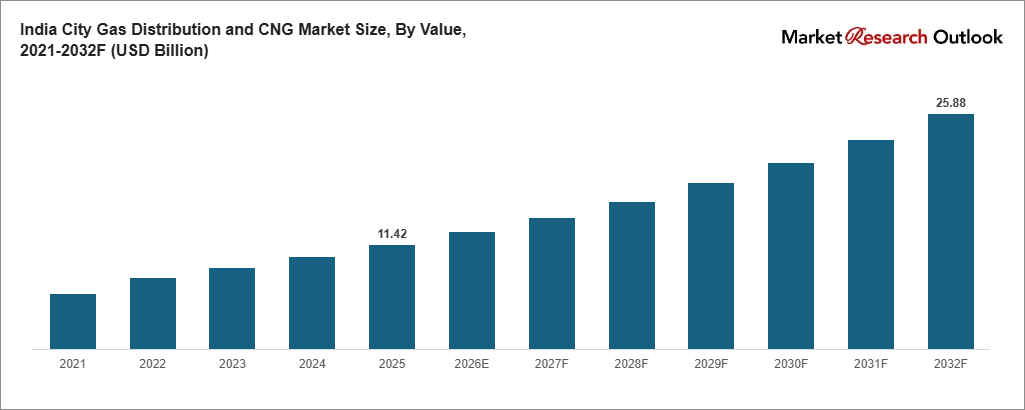
The India city gas distribution and CNG market size is witnessing rapid expansion, driven by PNGRB-led network growth, rising CNG vehicle sales, wider household PNG adoption, industrial fuel switching, supportive gas pricing reforms, and large capital investment by city gas distribution companies. Valued at USD 11.42 billion in 2025 and projected to reach USD 25.88 billion by 2032, growing at a CAGR of 12.4%, the India city gas distribution and CNG market growth is being fuelled by strong demand from transport users, cost-conscious households, and small industries, along with fast network build-out across tier-2 and tier-3 cities. CNG for transportation leads consumption, while domestic PNG is emerging as the fastest growing category. Shifting preferences toward cheaper and cleaner fuels, stricter urban air quality rules, and the national goal of lifting natural gas to 15% of the energy mix by 2030 are reshaping the supply landscape. As city gas distribution majors including Indraprastha Gas, Mahanagar Gas, Gujarat Gas, Adani Total Gas, and Torrent Gas expand pipeline and station networks, and oil marketing companies including IOCL, BPCL, and HPCL add CNG dispensers at fuel outlets, the India CGD and CNG market is evolving into a policy-backed, infrastructure-led, and digitally managed ecosystem with strong long-term growth potential.
Key Report Takeaways: India City Gas Distribution and CNG Market
- The India city gas distribution and CNG market size is projected to grow from USD 11.42 billion in 2025 to USD 25.88 billion by 2032, registering a strong CAGR of 12.4%, driven by rapid CGD network expansion, rising CNG vehicle adoption, and the structural shift toward natural gas across urban and semi-urban India.
- CNG dominates the India city gas distribution and CNG market, accounting for around 55% of total market value in 2025, driven by a running cost saving of 40% to 50% over petrol, dense station networks of IGL, MGL, Gujarat Gas, and Adani Total Gas, and strong demand from cars, three-wheelers, and buses.
- Domestic PNG is emerging as the fastest growing segment in the India city gas distribution and CNG market, expected to grow at 14% to 16% annually as households switch from LPG cylinders, new connections cross 20 lakh per year, and PNGRB pushes toward 12.63 crore domestic connections by 2034.
- Rapid scaling of CNG stations, from 938 in 2014 to over 8,400 by September 2025 and a 2034 target of 18,336, is structurally expanding the India city gas distribution and CNG market across metro, tier-2, and highway locations.
- Rising investments by CGD majors such as Indraprastha Gas, Mahanagar Gas, Gujarat Gas, Adani Total Gas, Torrent Gas, and GAIL Gas in steel and MDPE pipelines, CNG stations, CBG injection, and SCADA systems are strengthening local supply and supporting the India city gas distribution and CNG market forecast 2032.
Key Market Drivers: India City Gas Distribution and CNG Market
Expanding CGD Network Coverage, PNGRB Bidding Rounds, and Minimum Work Programme Targets Driving CNG and PNG Demand Across India
Growth in the India city gas distribution and CNG market is being driven by wide network coverage built through successive PNGRB bidding rounds. Authorised geographical areas reached 307 by 2025, covering nearly 100% of India’s mainland population across around 784 districts. Under the Minimum Work Programme, authorised entities must deliver 12.63 crore domestic PNG connections, 18,336 CNG stations, and 5.46 lakh inch-km of pipeline by 2034. Progress is picking up, with CNG stations rising from 938 in 2014 to over 8,400 by September 2025, and domestic PNG connections touching 1.57 crore in the same period. In FY25 alone, the India city gas distribution sector added 1,206 CNG stations and about 21 lakh PNG connections, which lifted gas sales by around 11%. Faster station openings in tier-2 and tier-3 cities, wider use of Mobile Refuelling Units in land-constrained areas, and CGD policies notified by 11 states by July 2025 are creating strong structural pull-through demand across the India city gas distribution and CNG market.
Rising CNG Vehicle Adoption, Favourable Fuel Economics, and Clean Mobility Mandates Fuelling CNG Consumption
The India city gas distribution and CNG market is benefiting from strong CNG vehicle growth, with more than 81 lakh CNG vehicles in operation by early 2025 across cars, three-wheelers, taxis, buses, and light commercial vehicles. CNG retailed at around INR 75 to INR 77 per kg in Delhi during 2025, against petrol at close to INR 95 per litre, giving users a running cost saving of 40% to 50% per kilometre. Carmakers have widened their CNG line-ups, with Maruti Suzuki selling about one-third of its domestic cars in CNG form, while Tata Motors, Hyundai, and Toyota have added twin-cylinder and factory-fitted models. Bajaj Auto’s launch of the world’s first CNG motorcycle in 2024 has opened a new two-wheeler category. Clean air rules in Delhi NCR, BS-VI emission norms, and state bus fleet conversions further support demand. Fleet operators and ride-hailing drivers prefer CNG for its lower fuel bill, and young urban buyers increasingly pick factory-fitted CNG cars over diesel, strengthening the India CGD and CNG market.
Government Push Toward a Gas-Based Economy, Priority APM Gas Allocation, and Policy Reforms Strengthening PNG Adoption
Policy support is a major catalyst for the India city gas distribution and CNG market, with the Government targeting a 15% share for natural gas in the national energy mix by 2030, up from around 6% to 7% today. Domestic APM gas is allocated on priority to CNG for transport and PNG for households, and the April 2023 pricing reform linked APM gas to 10% of the Indian crude basket with a ceiling of USD 6.50 per MMBtu, giving city gas distribution companies steadier input costs. PNGRB’s One Nation One Grid One Tariff reform, public utility status for CGD works, and directions to CPWD and NBCC to include PNG in new buildings have reduced rollout friction. Natural gas pipeline length has crossed 25,400 km, while LNG regasification capacity has reached 52.7 MMTPA, improving supply access for new geographical areas. Combined with the 2034 target of 12.63 crore household connections, these reforms are structurally expanding India city gas distribution and CNG market growth across all major end-user categories through 2032.
Key Market Challenges: India City Gas Distribution and CNG Market
Volatile LNG Import Prices and Declining APM Gas Allocation Impacting Overall CGD Margins
The India city gas distribution and CNG market continues to face pressure from gas supply costs, as close to half of India’s natural gas demand is met through imported LNG. Spot LNG prices swung between USD 8 and USD 40 per MMBtu over 2021 to 2023, and remain sensitive to global events. Output from ageing APM fields is falling, which led to sharp cuts in APM allocation to the CNG segment from late 2024, forcing city gas distribution companies to replace it with costlier new well gas or LNG. Many operators absorbed part of the higher cost, which pulled margins down by INR 1 to INR 3 per standard cubic metre in FY25. Frequent CNG price hikes also narrow the price gap with petrol and diesel, which is the main reason users switch fuels. This supply cost risk remains the biggest near-term concern for the India CGD and CNG market.
Right of Use, Land Acquisition, and Permission Delays Slowing Network Rollout Across Tier-2 and Tier-3 Cities
The India city gas distribution and CNG market faces execution complexity from Right of Use (RoU) approvals, road-cutting permissions, and land availability for CNG stations. While mature networks in Delhi, Mumbai, Ahmedabad, and Surat have settled approval processes, many newer geographical areas still depend on several local bodies, highway authorities, and railway departments for clearances. Securing land for a single online CNG station in a dense city can take 6 to 18 months, and road restoration charges vary widely across municipalities. These delays show up in MWP data, where several entities from newer bidding rounds trail their pro-rata targets for pipeline inch-km and connections. While PNGRB has pushed states to adopt CGD policies, single-window clearances, and lower VAT on natural gas, fragmented permissions remain a near-term challenge for the India city gas distribution and CNG market.
Rising Electric Vehicle Penetration and LPG Competition Limiting CNG and PNG Growth
The India city gas distribution and CNG market faces practical competition from electric mobility and subsidised LPG. Electric models, including e-rickshaws, now make up over half of new three-wheeler registrations in India, while electric buses backed by the PM e-Bus Sewa and PM E-DRIVE schemes are replacing some CNG bus orders in large cities. In homes, wide LPG coverage under PMUY means many families already own cylinders and see little reason to pay PNG deposits of INR 5,000 to INR 7,000. Low-income households in smaller towns also find a monthly bill harder to manage than buying a cylinder when needed. Hybrid cars, ethanol-blended petrol, and falling EV battery prices further narrow the CNG cost advantage, posing a gradual long-term risk for the India CGD and CNG market.
Key Market Trends: India City Gas Distribution and CNG Market
Rapid Adoption of Compressed Biogas Blending and Hydrogen-Blended CNG in India
The India city gas distribution and CNG market is moving toward lower-carbon gas, led by compressed biogas (CBG) and hydrogen-blended CNG (H-CNG). The CBG Blending Obligation requires city gas distribution entities to blend 1% CBG in CNG and domestic PNG from FY2025-26, rising to 3% in FY2026-27 and 5% by FY2028-29. Under the SATAT scheme, around 100 CBG plants are already running, and oil and gas companies are building large plants in Uttar Pradesh, Punjab, Gujarat, and Maharashtra. Pilot projects for hydrogen blending, including NTPC’s trial at Kawas in Surat, are testing blends of up to 8% in city gas lines. Gujarat Gas, IGL, MGL, and Adani Total Gas have announced CBG offtake deals or plant investments. This shift toward greener gas is reinforcing the India city gas distribution and CNG market forecast 2032 across transport and household categories.
Growth of Digital Metering, SCADA, and Smart CNG Stations in the India City Gas Distribution and CNG Market
A clear shift toward digital operations is reshaping the India city gas distribution and CNG market, particularly in large networks. city gas distribution entities are rolling out SCADA systems, GIS-based pipeline mapping, and smart PNG meters with remote reading to cut gas losses and billing errors. IGL and MGL have adopted app-based bill payment, online new-connection booking, and digital queue management at busy CNG stations. Smart dispensers with UPI payments and live pressure monitoring cut waiting time at peak hours, a common complaint among auto and taxi drivers. Unaccounted gas, which can run at 1% to 3% of gas purchased in older networks, is now tracked closely through AMR and AMI meters. A growing share of PNG bills is paid through digital channels, while PNGRB’s monitoring portal tracks MWP progress every month across all geographical areas of the India CGD and CNG market.
Capacity Expansion by CGD Majors and LNG Regasification Investments
A wave of capacity expansion is reshaping the supply landscape of the India city gas distribution and CNG market. Investment commitments for CGD networks under the MWP are estimated at over INR 1.2 lakh crore, covering steel pipelines, MDPE networks, city gate stations, and CNG stations. Indraprastha Gas has moved into new areas across Uttar Pradesh and Rajasthan, Mahanagar Gas has grown beyond Mumbai into Raigad and Ratnagiri, Gujarat Gas, Adani Total Gas, and Torrent Gas have each added hundreds of CNG stations, and GAIL Gas and IOAGPL are building networks in newer states. On the supply side, LNG regasification capacity reached 52.7 MMTPA with new terminals at Chhara and Dhamra. The Pradhan Mantri Urja Ganga pipeline, the North East Gas Grid, and unified pipeline tariffs are linking eastern and north-eastern states to gas supply. Together, these developments are reinforcing the India city gas distribution and CNG market forecast 2032 across the entire value chain.
Segmental Insights: India City Gas Distribution and CNG Market
By End-User: Transportation Segment Dominates the India City Gas Distribution and CNG Market
The transportation end-user segment dominates the India city gas distribution and CNG market, accounting for an estimated 53% to 56% of total market value, driven by fast-growing CNG car sales, large auto-rickshaw and taxi fleets, and city bus conversions. Passenger cars and three-wheelers are the dominant vehicle types within this segment, together drawing over 70% of CNG volumes sold at retail stations. The industrial segment contributes another 23% to 26% of demand, driven by ceramic, glass, textile, food processing, and pharmaceutical units shifting away from fuel oil, propane, and coal. The residential segment accounts for 13% to 15%, led by new domestic PNG connections, while commercial users such as hotels, restaurants, and hospitals make up 6% to 8%. In 2025, leading players including IGL, MGL, Gujarat Gas, Adani Total Gas, and Torrent Gas added new CNG stations under MWP commitments, reinforcing segment dominance in the India CGD and CNG market.
By Product Type: CNG Leads While Domestic PNG Grows Fastest
Compressed natural gas (CNG) leads the India city gas distribution and CNG market product landscape, accounting for approximately 55% of total market value, driven by its price edge over liquid fuels, dense station networks, and strong vehicle sales. Piped natural gas (PNG) contributes the remaining 45%, split across industrial, domestic, and commercial users. Within PNG, the domestic segment is the fastest growing category in the India CGD and CNG market, expanding at 14% to 16% annually, driven by more than 20 lakh new household connections each year, safer and continuous supply compared with LPG cylinders, and strong policy backing for 12.63 crore connections by 2034. Industrial PNG holds the largest share within PNG, with the Morbi ceramic cluster in Gujarat among the biggest city gas distribution consumers in India. Leading entities including IGL, MGL, Gujarat Gas, Adani Total Gas, and GAIL Gas have aligned their portfolios to this product mix, driving wider adoption across the India city gas distribution and CNG market.
Regional Insights: India City Gas Distribution and CNG Market
Regional analysis of the India city gas distribution and CNG market shows that West India accounts for approximately 40% to 44% of total gas volume, driven by Gujarat (Ahmedabad, Surat, Vadodara, and the Morbi ceramic cluster) and Maharashtra (Mumbai, Pune, and Thane), supported by early pipeline access, LNG terminals at Dahej, Hazira, and Dabhol, and mature CGD networks. North India contributes around 28% to 31% of demand, led by Delhi NCR, Uttar Pradesh, Haryana, and Rajasthan, supported by strict clean air rules and one of the largest CNG vehicle fleets in the world across Delhi, Noida, Gurugram, and Ghaziabad. South India accounts for 16% to 19%, led by Karnataka, Tamil Nadu, Telangana, and Andhra Pradesh, where newer networks are scaling fast with LNG supply from Kochi and Ennore. Central and East India together account for 10% to 13%, supported by Madhya Pradesh, West Bengal, Bihar, Odisha, and Jharkhand, where the Pradhan Mantri Urja Ganga pipeline is opening new geographical areas. In 2025, network additions by IGL across Delhi NCR and Uttar Pradesh, MGL across Mumbai and Raigad, Gujarat Gas and Adani Total Gas across Gujarat, and Torrent Gas across Uttar Pradesh, Maharashtra, and Tamil Nadu reinforced regional supply hubs across the India city gas distribution and CNG market.
Recent Developments: India City Gas Distribution and CNG Market
- The India city gas distribution and CNG market recorded strong momentum in network additions during 2024 and 2025. India added 1,206 new CNG stations in FY25, taking the total to 8,258 by March 2025 and over 8,400 by September 2025. About 21 lakh new domestic PNG connections were added in FY25, lifting the total to 1.5 crore, and further to 1.57 crore by September 2025. PNGRB also launched a National PNG Drive in January 2026 with time-bound targets for domestic and commercial PNG connections and CNG station commissioning across all authorised geographical areas.
- City gas distribution majors have deepened network expansion. In 2025, Indraprastha Gas widened its presence across new geographical areas in Uttar Pradesh and Rajasthan, Mahanagar Gas scaled its network across Raigad and Ratnagiri, Gujarat Gas added CNG stations along key Gujarat highways, Adani Total Gas expanded its CNG and CBG assets, and Torrent Gas grew its footprint across Uttar Pradesh, Maharashtra, and Tamil Nadu. GAIL Gas and IOAGPL continued steel pipeline laying in newer states. These developments are strengthening domestic supply and supporting the India city gas distribution and CNG market forecast 2032.
- CNG mobility momentum has gained strong traction in the India city gas distribution and CNG market. In 2024 and 2025, Maruti Suzuki, Tata Motors, Hyundai, and Toyota expanded factory-fitted CNG models, Bajaj Auto launched the Freedom 125 CNG motorcycle, and state transport undertakings added CNG and LNG buses. Partnerships between city gas distribution entities, oil marketing companies, and CBG producers are positioning India as one of the fastest growing city gas distribution and CNG markets globally, strengthening long-term competitive positioning in the India city gas distribution and CNG market forecast 2032.
Key Market Players: India City Gas Distribution and CNG Market
- Indraprastha Gas Limited (IGL)
- Mahanagar Gas Limited (MGL)
- Gujarat Gas Limited
- Adani Total Gas Limited
- GAIL Gas Limited
- Torrent Gas Private Limited
- Indian Oil-Adani Gas Private Limited (IOAGPL)
- Bharat Petroleum Corporation Limited (BPCL)
- Hindustan Petroleum Corporation Limited (HPCL)
- Think Gas Distribution Private Limited
- AG&P Pratham
- Megha City Gas Distribution Private Limited
- Bhagyanagar Gas Limited
| By Product Type | By Source | By Infrastructure | By Vehicle Type | By End-User |
| Compressed Natural Gas (CNG) Piped Natural Gas (PNG) |
Domestic Gas (APM & Non-APM) Imported LNG Compressed Biogas (CBG) |
Steel Pipeline Network MDPE Pipeline Network CNG Stations (Online, Mother & Daughter Booster) City Gate Stations Mobile Refuelling Units |
Passenger Cars Three-Wheelers Buses Light Commercial Vehicles Medium & Heavy Commercial Vehicles Two-Wheelers |
Transportation Residential Commercial Industrial |
Report Scope
In this report, the India City Gas Distribution and CNG Market has been segmented into the following categories, in addition to detailed analysis of key industry trends, market dynamics, competitive landscape, and growth opportunities across the forecast period:
- By Product Type
- Compressed Natural Gas (CNG)
- Piped Natural Gas (PNG)
- By Source
- Domestic Gas (APM & Non-APM)
- Imported LNG
- Compressed Biogas (CBG)
- By Infrastructure
- Steel Pipeline Network
- MDPE Pipeline Network
- CNG Stations (Online, Mother & Daughter Booster)
- City Gate Stations
- Mobile Refuelling Units
- By Vehicle Type
- Passenger Cars
- Three-Wheelers
- Buses
- Light Commercial Vehicles
- Medium & Heavy Commercial Vehicles
- Two-Wheelers
- By End-User
- Transportation
- Residential
- Commercial
- Industrial
- By Geography
- North India
- South India
- West India
- East India
- Central India
Competitive Landscape
Company Profiles:
Detailed analysis of the leading companies operating in the India City Gas Distribution and CNG Market, including business overview, network footprint, strategic initiatives, competitive positioning, and recent developments.
Company Information
Detailed profiling and strategic analysis of additional market players (up to five companies), including emerging city gas distribution entities, compressed biogas producers, CNG equipment suppliers, regional gas distributors, or state-level city gas companies.
For a free sample of the India City Gas Distribution and CNG Market report, customised insights or delivery timelines, submit your query here
India City Gas Distribution and CNG Market, 2032
- Research Framework
- Market Segmentation
- Research Objective
- Research Methodology
- Qualitative Research
- Primary Research
- Secondary Research
- Quantitative Research
- Market Breakdown & Data Triangulation
- Demand Side
- Supply Side
- Primary Research Respondents
- Assumption & Limitation
- Executive Summary
- Market Overview, 2021-2032
- By Product Type
- By Source
- By Infrastructure
- By Vehicle Type
- By End-User
- By Region
- Analyst Recommendations
- Geopolitical Impact on India City Gas Distribution and CNG Market
- India City Gas Distribution and CNG Market Insights
- Market Dynamics
- Growth Drivers
- Expanding CGD network coverage, PNGRB bidding rounds, and Minimum Work Programme targets driving CNG and PNG demand across India.
- Rising CNG vehicle adoption, favourable fuel economics, and clean mobility mandates fuelling CNG consumption across Indian cities.
- Government push toward a gas-based economy, priority APM gas allocation, and policy reforms strengthening PNG adoption.
- Restraints
- Volatile LNG import prices and declining APM gas allocation impacting overall CGD margins.
- Right of Use, land acquisition, and permission delays slowing network rollout across tier-2 and tier-3 cities.
- Rising electric vehicle penetration and LPG competition limiting CNG and PNG growth.
- Opportunities
- Compressed biogas blending under the SATAT scheme opening new low-carbon gas supply pools across Indian states.
- LNG and CNG adoption in long-haul trucking, bus fleets, and Mobile Refuelling Units supporting next-generation growth.
- Untapped tier-2 and tier-3 geographical areas and industrial PNG demand creating massive network expansion opportunities.
- Challenges
- Intense competition from electric vehicles, subsidised LPG, and other alternative fuels.
- Limited trunk pipeline connectivity and gas supply infrastructure across eastern and north-eastern states.
- Maintaining network safety, gas quality, and pressure consistency at scale across diverse Indian geographical areas.
- Technological Advancements
- Recent Technological Advancements
- Prior to 2020
- Porter’s Five Forces Analysis
- PESTLE Analysis
- Industry Value Chain & Entry Points
- Upstream Gas Sources (domestic APM gas, HPHT gas, new well gas, imported LNG, compressed biogas)
- LNG Regasification Terminals (Dahej, Hazira, Kochi, Dabhol, Ennore, Mundra, Chhara, Dhamra)
- Gas Transmission & Trunk Pipelines (GAIL, GSPL, IOCL, Pradhan Mantri Urja Ganga, North East Gas Grid)
- Gas Marketers & Aggregators (GAIL, IOCL, BPCL, HPCL, Shell, Indian Gas Exchange)
- Safety, Testing & Technical Standards (PNGRB T4S, PESO, OISD, BIS)
- CGD Equipment & Infrastructure Suppliers (compressors, dispensers, MDPE pipes, cascades, smart meters)
- City Gas Distribution Entities (IGL, MGL, Gujarat Gas, Adani Total Gas, Torrent Gas, GAIL Gas)
- CNG Station Operators & OMC Retail Outlets (IOCL, BPCL, HPCL, COCO and DODO stations)
- Vehicle OEMs & Retrofit Partners (Maruti Suzuki, Tata Motors, Hyundai, Bajaj Auto, Ashok Leyland)
- End-Users (households, commercial establishments, industries, CNG vehicle owners, fleet operators)
- India City Gas Distribution and CNG Market: Regulatory Framework
- India City Gas Distribution and CNG Market Overview
- Market Size & Forecast, 2021-2032
- By Value (USD Billion)
- By Volume (MMSCMD)
- Market Share & Forecast
- By Product Type
- Compressed Natural Gas (CNG)
- Piped Natural Gas (PNG)
- By Source
- Domestic Gas (APM & Non-APM)
- Imported LNG
- Compressed Biogas (CBG)
- By Infrastructure
- Steel Pipeline Network
- MDPE Pipeline Network
- CNG Stations (Online, Mother & Daughter Booster)
- City Gate Stations
- Mobile Refuelling Units
- By Vehicle Type
- Passenger Cars
- Three-Wheelers
- Buses
- Light Commercial Vehicles
- Medium & Heavy Commercial Vehicles
- Two-Wheelers
- By End-User
- Transportation
- Residential
- Commercial
- Industrial
- By Geography
- North India
- South India
- West India
- East India
- Central India
- Competitive Landscape
- India City Gas Distribution and CNG Market Company Market Share Analysis, 2025
- Competitive Benchmarking, By Operating Parameters
- Key Strategic Development (Mergers, Acquisitions, Partnerships, Etc.)
- List of Emerging Players
- Company Profile
- Indraprastha Gas Limited (IGL)
- Introduction & Company Profile
- Product Benchmarking
- Strategic Outlook
- Key Competitors
- Financial Analysis
- SWOT Analysis
(Same Data Pointers Will Be Provided for The Below Companies)
- Mahanagar Gas Limited (MGL)
- Gujarat Gas Limited
- Adani Total Gas Limited
- GAIL Gas Limited
- Torrent Gas Private Limited
- Indian Oil-Adani Gas Private Limited (IOAGPL)
- Bharat Petroleum Corporation Limited (BPCL)
- Hindustan Petroleum Corporation Limited (HPCL)
- Think Gas Distribution Private Limited
- AG&P Pratham
- Megha City Gas Distribution Private Limited
- Bhagyanagar Gas Limited
- Other Prominent Players
* Financial information in case of non-listed companies will be provided as per availability
The segmentation and the companies are subjected to modifications based on in-depth secondary for the final deliverab
Frequently Asked Questions
1. How large is the India city gas distribution and CNG market and what is its growth forecast?
Ans: The India city gas distribution and CNG market is valued at USD 11.42 billion in 2025 and is projected to reach USD 25.88 billion by 2032, growing at a CAGR of 12.4%.
2. Which segments are driving demand in the India city gas distribution and CNG market?
Ans: CNG leads with around 55% market share, driven by transport demand, while domestic PNG is the fastest growing segment as households shift from LPG cylinders to piped gas.
3. What are the key drivers of growth in the India city gas distribution and CNG market?
Ans: Key drivers include PNGRB-led CGD network expansion, rising CNG vehicle adoption, favourable fuel economics, priority APM gas allocation, and the government push toward a gas-based economy.
4. Which regions are driving growth in the India city gas distribution and CNG market?
Ans: West India leads with around 40% to 44% of gas volume, driven by Gujarat and Maharashtra, followed by North India, where Delhi NCR and Uttar Pradesh show strong CNG demand.
5. What are the latest trends in the India city gas distribution and CNG market?
Ans: Major trends include compressed biogas blending, hydrogen-blended CNG pilots, smart PNG meters, SCADA-based network monitoring, Mobile Refuelling Units, and rapid CNG station expansion by CGD majors.