

India Electric Bus Market, 2032
- Automotive & EV
- Nov 2026
- Pages 140
- Report Format: pdf
- Report Price: $2400 USD
India’s electric bus market is witnessing strong structural growth, driven by large central schemes such as PM E-DRIVE and PM-eBus Sewa, CESL demand aggregation across major cities, a lower total cost of ownership than diesel and CNG buses, falling LFP battery prices, rising concern over urban air quality, wider use of gross cost contracts by state transport undertakings, and growing investment by domestic electric bus makers and fleet operators in plant capacity, charging depots, and intercity electric coach networks.
| Study Duration | 2021-2032 |
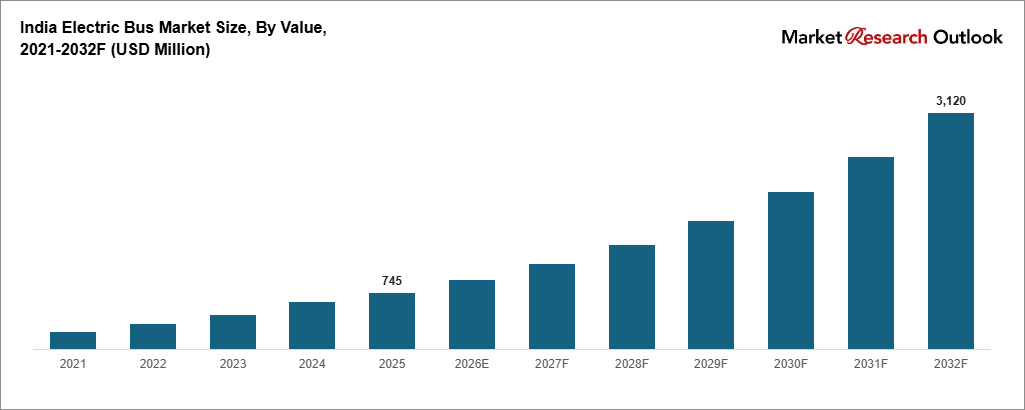
| Market Size (2025) | USD 745 Million |
| CAGR (2026-2032) | 22.7% |
| Leading Segment | Battery Electric Buses (9 to 12 Metre, LFP) |
| Fastest Growing Segment | Intercity & Fuel Cell Electric Buses |
| Market Size (2032) | USD 3,120 Million |
Market Overview: India Electric Bus Market
The India electric bus market size is witnessing rapid expansion, driven by central and state funding for clean public transport, large aggregated tenders, falling battery prices, high fuel costs for diesel fleets, and the steady replacement of ageing city buses. Valued at USD 745 million in 2025 and projected to reach USD 3,120 million by 2032, growing at a CAGR of 22.7%, the India electric bus market growth is being fuelled by strong orders from Delhi, Bengaluru, Hyderabad, Mumbai, Ahmedabad, and Surat, a lower cost per kilometre than diesel, and the scaling of electric intercity coach services. Battery electric buses lead deployments, while the intercity and fuel cell electric bus segments are emerging as the fastest growing categories. Electric buses still made up only about 5% of all bus registrations in 2025, although the monthly share touched 9.2% in December 2025, which leaves wide room for growth as India works toward an electric share of 40% in new bus purchases by 2030. As domestic makers including Switch Mobility, PMI Electro Mobility, Olectra Greentech, JBM Auto, and Tata Motors expand electric bus production, and operators such as GreenCell Mobility, EVEY Trans, and EKA Mobility scale GCC fleets, the India electric bus market is evolving into a policy-led, service-driven, and locally built ecosystem with strong long-term growth potential.
Key Report Takeaways: India Electric Bus Market
- The India electric bus market size is projected to grow from USD 745 million in 2025 to USD 3,120 million by 2032, registering a strong CAGR of 22.7%, driven by PM E-DRIVE and PM-eBus Sewa deployments, CESL demand aggregation, and the structural shift from diesel to electric city fleets across urban India.
- Battery electric buses dominate the India electric bus market, accounting for over 94% of total revenue in 2025, driven by mature LFP battery technology, proven 9 metre and 12 metre city bus platforms, the deep presence of makers such as Switch Mobility, PMI Electro Mobility, Olectra Greentech, and JBM Auto, and rising electric bus orders from state transport undertakings under GCC contracts.
- Intercity and fuel cell electric buses are emerging as the fastest growing segments in the India electric bus market, with intercity electric buses expected to grow at 32% to 36% annually and fuel cell electric buses at 38% to 42% from a small base, as private coach operators, state highway services, and hydrogen pilot programmes reshape long-distance travel across metro and tier-1 corridors.
- Rapid scaling of public fleets, with Delhi alone running more than 5,200 electric buses by October 2026 and procurement for 13,800 electric buses completed under PM E-DRIVE, is structurally expanding the India electric bus market across intracity, intercity, and staff transport applications.
- Rising investments by domestic makers such as Olectra Greentech, JBM Auto, Switch Mobility, PMI Electro Mobility, and Tata Motors in plant capacity, battery localisation, and charging partnerships are strengthening local electric bus supply and supporting the India electric bus market forecast 2032.
Key Market Drivers: India Electric Bus Market
Government Schemes, CESL Demand Aggregation, and PM E-DRIVE Funding Driving Electric Bus Demand Across India
Growth in the India electric bus market is being driven by strong central funding, pooled procurement, and clear electrification targets for public transport across tier-1, tier-2, and tier-3 cities. The PM E-DRIVE scheme, with a total outlay of INR 10,900 crore, sets aside INR 4,391 crore to support 14,028 electric buses in large cities, while PM-eBus Sewa targets 10,000 electric buses across 169 smaller cities. CESL concluded India’s largest electric bus tender for 10,900 units in December 2025, covering Bengaluru (about 4,500 buses), Delhi (2,800), Hyderabad (2,000), Ahmedabad (1,000), and Surat (600), with 16 bidders taking part. By September 2026, procurement for 13,800 electric buses under PM E-DRIVE had been completed, and states had asked for another 10,000. India still has only about 6 electric buses per million people against a world average of 85, indicating significant long-term headroom for growth. Severe air pollution in Delhi NCR and other large cities, the national aim of making 40% of new buses electric by 2030, and steady electric bus orders from state transport undertakings are creating strong structural pull-through demand across the India electric bus market.
Falling Battery Costs, Lower Total Cost of Ownership, and GCC Contracts Fuelling Electric Bus Adoption by Transport Undertakings
The India electric bus market is benefiting from a clear cost advantage over diesel and CNG buses once running costs are counted across the full life of the bus. Energy cost alone is roughly INR 6.5 per km for an electric bus against close to INR 25 per km for a diesel bus. Aggregated CESL tenders have discovered GCC rates in the range of INR 39 to INR 47 per km, which has made the electric bus affordable for cash-strapped transport bodies. Under the GCC model, the operator buys, runs, and maintains each electric bus for 10 to 12 years while the city pays a fixed fee per kilometre, so transport undertakings avoid the high upfront cost. LFP battery pack prices have fallen sharply since 2020, and local cell plants are expected to cut costs further, supporting price competitiveness across the India electric bus market. Buses make up about 1% of India’s vehicle fleet yet account for nearly 15% of road transport emissions, so every electric bus delivers an outsized gain for city air quality.
Urban Air Quality Goals, Net-Zero Targets, and State EV Policies Strengthening Electric Bus Adoption in Public Transport
Rising pressure to clean city air is a major catalyst for the India electric bus market, with state EV policies now treating the electric bus as the default choice for new city fleets. The Delhi EV Policy 2026 requires every new intra-state bus added by DTC and the transport department to be electric, and the city plans a total fleet of about 14,000 buses by FY2028-29. Maharashtra, Karnataka, Telangana, Gujarat, and Tamil Nadu have placed large orders for 9 metre and 12 metre electric buses, while India’s net-zero goal for 2070 keeps pushing transport bodies to cut diesel use. The PM-eBus Sewa Payment Security Mechanism, approved with an outlay of INR 3,435 crore, will back timely payments to operators for more than 38,000 electric buses deployed between FY2024-25 and FY2028-29. Local content rules under the Phased Manufacturing Programme have also pushed makers to source motors, controllers, and battery packs within India. City climate action plans combined with central funding are structurally expanding India electric bus market growth across all major application categories through 2032.
Key Market Challenges: India Electric Bus Market
High Upfront Cost and Limited Access to Low-Cost Financing Restricting Electric Bus Fleet Expansion
The India electric bus market continues to face challenges around high upfront cost and limited access to low-cost finance, with a 12 metre electric bus priced at INR 1.5 crore to INR 2.2 crore against INR 0.9 crore to INR 1.2 crore for a comparable diesel bus. The battery alone can account for 35% to 45% of the vehicle cost, and a mid-life battery replacement adds further expense over a 12 year contract. While central subsidies and GCC contracts have reduced the burden on transport bodies, operators still carry the asset on their books, and lenders often charge 10% to 12% interest because electric bus resale values and battery life remain uncertain. Smaller operators struggle to raise equity for fleets of 100 buses or more, while banks stay cautious about lending against city contracts with uneven payment records. India’s reliance on a handful of large operators to finance most fleets limits competition and slows electric bus deployment in middle-income cities across the India electric bus market.
Charging Infrastructure Gaps and Grid Capacity Constraints Across Tier-2 and Tier-3 Cities
The India electric bus market faces structural pressure from uneven charging infrastructure, depot space, and grid capacity across cities. While Delhi, Bengaluru, Mumbai, Hyderabad, and Pune have built dedicated electric bus depots with high-power chargers, many tier-2 and tier-3 cities still lack land, substations, and reliable power for overnight charging. A depot for 100 electric buses typically needs 4 MW to 6 MW of connected load, and a new high-tension connection can take 6 to 18 months depending on the state power utility. PM E-DRIVE sets aside funds for about 1,800 fast chargers for electric buses, yet demand from new fleets is running well ahead of this. Differences in tariffs, demand charges, and open access rules across states create operational complexity for operators such as GreenCell Mobility, EVEY Trans, PMI Electro Mobility, and Switch Mobility that run electric buses in many cities. While discoms and city bodies are working on joint depot planning, grid readiness remains a near-term challenge for the India electric bus market.
Payment Delays by Transport Undertakings and Import Dependence for Battery Cells Impacting Operator Margins
The India electric bus market faces practical constraints around delayed payments from state transport undertakings, import dependence for battery cells, and thin margins under aggressive GCC bids. Many transport bodies run at a loss on fares, and operators in several states have flagged payment delays of a few months, which strains cash flow and was a key reason for creating the Payment Security Mechanism. India still imports most of the LFP cells used in each electric bus, mainly from China, leaving costs exposed to currency moves, freight rates, and trade rules. Operating margins for electric bus fleets under GCC contracts typically range between 12% and 18% before interest, and a cut of even INR 2 to INR 3 per km in the bid rate can wipe out much of the return. The Payment Security Mechanism, local cell plants under the ACC PLI scheme, and longer warranty support from cell makers are emerging as solutions, but uneven state finances and limited local cell supply remain barriers to wider adoption across the India electric bus market.
Key Market Trends: India Electric Bus Market
Rapid Adoption of Intercity, Sleeper, and Long-Range Electric Buses in India
The India electric bus market is undergoing a clear shift toward intercity, sleeper, and long-range electric coaches, with these formats expected to make up over 15% of new electric bus deliveries by 2028. Long-range coaches now carry LFP packs of 350 to 450 kWh and offer 300 to 500 km on a single charge, compared with 150 to 250 km for a typical city electric bus. NueGo, the intercity brand of GreenCell Mobility, has expanded to more than 150 cities and launched India’s first electric AC sleeper bus service in 2025, while private operators and state undertakings in Karnataka, Telangana, and Maharashtra are adding electric coaches on busy corridors such as Bengaluru to Chennai and Hyderabad to Vijayawada. Hydrogen fuel cell buses are also gaining trial interest, particularly in Leh and Delhi NCR, where public sector energy firms such as NTPC and IndianOil are running pilot fleets for long and hilly routes. This shift is reinforcing the India electric bus market forecast 2032 across both public and private segments.
Growth of Smart Charging, Depot Electrification, and Fleet Telematics in the India Electric Bus Market
A clear shift toward smart charging, depot electrification, and fleet telematics is reshaping the India electric bus market, particularly in large city fleets. Operators now use software to schedule charging at night when tariffs are lower, cutting energy bills by 8% to 15% on many routes. Most new electric buses come with telematics that track state of charge, battery temperature, and driving behaviour in real time, which helps keep fleet uptime above 95% under GCC contracts. Charging providers and power firms such as Tata Power, Exicom, Servotech, and state discoms are installing depot chargers of 120 kW to 240 kW, while pantograph and opportunity charging pilots are being tested at busy terminals. Digital ticketing through apps such as Chalo is also improving ridership data and route planning across the India electric bus market. In 2026, Delhi opened new charging hubs at DTC depots, with each large depot sized to charge 100 to 150 electric buses overnight.
Capacity Expansion by Domestic Makers and Battery Localisation Investments
A wave of domestic capacity expansion and battery localisation is reshaping the India electric bus market supply landscape. Olectra Greentech started Phase I of its Seetharampur plant in Hyderabad on December 31, 2025, with a single-shift capacity of 2,500 electric buses a year and a planned 5,000 units per shift at full build-out. JBM Auto has scaled its integrated electric bus plant in the National Capital Region, Switch Mobility has expanded output at Ennore in Chennai for India and export markets, PMI Electro Mobility has added capacity in North India, and Pinnacle Mobility (EKA) has grown its Pune facility. The Advanced Chemistry Cell PLI scheme, with an outlay of INR 18,100 crore for 50 GWh of local cell capacity, along with new cell plants planned by Agratas (Tata Group), Exide Energy, and Amara Raja, is expected to cut import dependence for battery packs. Combined with PM E-DRIVE orders driving city demand and intercity operators adding fleets, these developments are reinforcing the India electric bus market forecast 2032 across the entire value chain.
Segmental Insights: India Electric Bus Market
By Application: Intracity Public Transit Segment Dominates the India Electric Bus Market
The intracity public transit segment dominates the India electric bus market, accounting for an estimated 72% to 76% of total revenue, driven by PM E-DRIVE and PM-eBus Sewa orders, fleet renewals by state transport undertakings, and the low cost per kilometre of electric buses on short urban routes. Battery electric 9 metre and 12 metre low-floor buses are the dominant variants within this segment, with GCC contracts covering over 85% of city electric bus deployments. The intercity and regional transport segment contributes another 12% to 15% of demand, driven by private coach brands, state highway services, and electric sleeper buses on routes of 250 km or more. The staff and school transport segment accounts for 7% to 9%, led by IT parks, factories, and private schools in Bengaluru, Pune, and Delhi NCR, while airport and tourism shuttles make up the remaining 3% to 4%. In 2025 and 2026, leading players including Switch Mobility, PMI Electro Mobility, Olectra Greentech, JBM Auto, and EKA Mobility scaled city electric bus deliveries under central and state programmes, reinforcing segment dominance in the India electric bus market.
By Propulsion Type: Battery Electric Buses Lead While Fuel Cell Electric Buses Grow Fastest
Battery electric buses lead the India electric bus market propulsion landscape, accounting for approximately 94% of total revenue, driven by mature LFP technology, falling pack prices, and strong support under PM E-DRIVE and PM-eBus Sewa. Plug-in hybrid and hybrid electric buses contribute another 2% to 3%, mainly in a few legacy fleets in Karnataka and West Bengal. Fuel cell electric buses are the fastest growing category within the India electric bus market, expanding at 38% to 42% annually from a small base, driven by National Green Hydrogen Mission funding, public sector pilots, and interest in long-range heavy routes. Retrofitted electric buses together with other formats account for 2% to 3% of the market, with retrofits expected to grow in cities that want a lower-cost way to convert existing diesel buses. Leading domestic makers including Switch Mobility, Olectra Greentech, JBM Auto, PMI Electro Mobility, and Tata Motors have aligned product portfolios to this mix, driving battery electric bus adoption across the India electric bus market.
Regional Insights: India Electric Bus Market
Regional analysis of the India electric bus market shows that West India and North India collectively account for approximately 58% to 62% of total electric bus revenue, driven by Maharashtra (BEST in Mumbai, PMPML in Pune, and MSRTC), Gujarat (Ahmedabad and Surat), Delhi NCR (the largest city electric bus fleet in India), Uttar Pradesh, and Jammu & Kashmir, supported by strong state funding and large PM E-DRIVE orders. South India contributes around 27% to 30% of demand, led by Karnataka, Telangana, Tamil Nadu, and Kerala, supported by large city orders in Bengaluru and Hyderabad and rising intercity electric coach services across southern corridors. Central and East India together account for 9% to 12% of demand, supported by Madhya Pradesh, West Bengal, Odisha, Assam, and Bihar, where PM-eBus Sewa deployments in smaller cities are accelerating. In 2025 and 2026, deliveries by PMI Electro Mobility and JBM Auto in Delhi, Olectra Greentech in Maharashtra and Telangana, Switch Mobility in Tamil Nadu and Delhi, and EKA Mobility in Maharashtra and Telangana reinforced regional supply hubs, supporting closer execution of city and intercity projects across the India electric bus market.
EV sales data: see the India EV Sales by State Tracker for electric bus registrations in every state, and the India Vehicle Sales Tracker for monthly sales by vehicle segment.
Recent Developments: India Electric Bus Market
- The India electric bus market witnessed strong momentum in tenders and deliveries during 2025 and 2026. India registered over 4,400 electric buses in calendar year 2025, compared with 3,616 units in 2024, according to Vahan-based industry tracking, and the electric share of bus registrations touched a monthly high of 9.2% in December 2025. Registrations rose a further 40% year-on-year to 2,944 units in the first half of 2026, with Switch Mobility, JBM Auto, and PMI Electro Mobility together holding about 70% share. Cumulative electric buses on Indian roads are projected to cross 55,000 units by 2030 from about 15,000 units at the end of 2025, supported by central and state programmes.
- Domestic makers and operators have deepened India-focused capacity and fleet growth. Olectra Greentech declared commercial operations at Phase I of its Seetharampur plant on December 31, 2025, and in August 2026 became the first Indian OEM to deploy 4,000 electric buses. Olectra is also set to deliver 1,085 electric buses to TGSRTC under PM E-DRIVE, while EKA Mobility and GreenCell Mobility received a letter of award for 915 electric buses in Hyderabad. GreenCell Mobility secured an order for over 1,200 electric buses under PM-eBus Sewa, and Jakson Green E-Mobility won a contract to run 220 electric buses across three Gujarat cities. These developments are strengthening domestic supply and supporting the India electric bus market forecast 2032.
- Tender and financing momentum has gained strong traction in the India electric bus market. In 2026, CESL launched a fresh tender for 6,230 electric buses, Switch Mobility won an order for 650 nine metre electric buses through Sai Green Projects, and JBM Electric Vehicles signed an agreement with leasing platform DRIVN to supply 500 electric buses. Delhi crossed 5,200 electric buses in October 2026 and remains the largest city fleet in the country. Strategic partnerships between makers, operators, lenders, and power utilities are positioning India as one of the most actively scaling electric bus markets globally, strengthening long-term competitive positioning in the India electric bus market forecast 2032.
Key Market Players: India Electric Bus Market
- Switch Mobility Automotive Ltd. (Ashok Leyland)
- PMI Electro Mobility Solutions Pvt. Ltd.
- Olectra Greentech Limited
- JBM Auto Limited
- Tata Motors Limited
- Pinnacle Mobility Solutions Pvt. Ltd. (EKA Mobility)
- VE Commercial Vehicles Limited (Eicher)
- Aeroeagle Automobiles Pvt. Ltd.
- Veera Vahana Udyog Pvt. Ltd.
- GreenCell Mobility Pvt. Ltd. (NueGo)
- EVEY Trans Pvt. Ltd.
- Jakson Green E-Mobility Pvt. Ltd.
- Azad India Mobility Limited
| By Propulsion Type | By Battery Type | By Bus Length | By Procurement Model | By Application |
| Battery Electric Buses (BEB) Plug-in Hybrid Electric Buses (PHEB) Hybrid Electric Buses Fuel Cell Electric Buses (FCEB) Retrofitted Electric Buses Others |
Lithium Iron Phosphate (LFP) Nickel Manganese Cobalt (NMC) Lithium Titanate Oxide (LTO) Nickel Cobalt Aluminium (NCA) Sodium-Ion Solid-State Others |
Below 8 Metres (Mini Buses) 8 to 9 Metres (Midi Buses) 9 to 12 Metres 12 to 14 Metres Above 14 Metres (Articulated) |
Gross Cost Contract (GCC) Net Cost Contract (NCC) Outright Purchase by STUs Dry Lease & Wet Lease Private Fleet Ownership Battery Leasing & Financing Models |
Intracity Public Transit Intercity & Regional Transport Staff & School Transport Airport & Tourism Shuttles |
Report Scope
In this report, the India Electric Bus Market has been segmented into the following categories, in addition to detailed analysis of key industry trends, market dynamics, competitive landscape, and growth opportunities across the forecast period:
- By Propulsion Type
- Battery Electric Buses (BEB)
- Plug-in Hybrid Electric Buses (PHEB)
- Hybrid Electric Buses
- Fuel Cell Electric Buses (FCEB)
- Retrofitted Electric Buses
- Others
- By Battery Type
- Lithium Iron Phosphate (LFP)
- Nickel Manganese Cobalt (NMC)
- Lithium Titanate Oxide (LTO)
- Nickel Cobalt Aluminium (NCA)
- Sodium-Ion
- Solid-State
- Others
- By Bus Length
- Below 8 Metres (Mini Buses)
- 8 to 9 Metres (Midi Buses)
- 9 to 12 Metres
- 12 to 14 Metres
- Above 14 Metres (Articulated)
- By Procurement Model
- Gross Cost Contract (GCC)
- Net Cost Contract (NCC)
- Outright Purchase by STUs
- Dry Lease & Wet Lease
- Private Fleet Ownership
- Battery Leasing & Financing Models
- By Application
- Intracity Public Transit
- Intercity & Regional Transport
- Staff & School Transport
- Airport & Tourism Shuttles
- By Geography
- North India
- South India
- West India
- East India
- Central India
Competitive Landscape
Company Profiles:
Detailed analysis of the leading companies operating in the India Electric Bus Market, including business overview, product portfolio, strategic initiatives, competitive positioning, and recent developments.
Company Information
Detailed profiling and strategic analysis of additional market players (up to five companies), including emerging domestic electric bus makers, battery pack and charging suppliers, regional GCC fleet operators, or niche intercity electric coach brands.
For a free sample of the India Electric Bus Market report, customised insights or delivery timelines, submit your query here
India Electric Bus Market, 2032
- Research Framework
- Market Segmentation
- Research Objective
- Research Methodology
- Qualitative Research
- Primary Research
- Secondary Research
- Quantitative Research
- Market Breakdown & Data Triangulation
- Demand Side
- Supply Side
- Primary Research Respondents
- Assumption & Limitation
- Executive Summary
- Market Overview, 2021-2032
- By Propulsion Type
- By Battery Type
- By Bus Length
- By Procurement Model
- By Application
- By Region
- Analyst Recommendations
- Geopolitical Impact on India Electric Bus Market
- India Electric Bus Market Insights
- Market Dynamics
- Growth Drivers
- Government schemes, CESL demand aggregation, and PM E-DRIVE funding driving electric bus demand across India.
- Falling battery costs, lower total cost of ownership, and GCC contracts fuelling electric bus adoption by transport undertakings.
- Urban air quality goals, net-zero targets, and state EV policies strengthening electric bus adoption in public transport.
- Restraints
- High upfront cost and limited access to low-cost financing restricting electric bus fleet expansion.
- Charging infrastructure gaps and grid capacity constraints restricting electric bus deployment across tier-2 and tier-3 cities.
- Payment delays by transport undertakings and import dependence for battery cells impacting operator margins.
- Opportunities
- Electric bus services for intercity, sleeper, and tourism travel opening untapped demand across state highways and regional routes.
- Hydrogen fuel cell electric buses and opportunity charging supporting next-generation growth in long-range and heavy-duty segments.
- Leasing platforms, green bonds, and multilateral finance creating large funding opportunities for private electric bus operators.
- Challenges
- Intense competition and aggressive GCC bidding compressing returns for electric bus OEMs and fleet operators.
- Limited electric bus depot land, slow power connections, and uneven grid reliability across smaller Indian cities.
- Maintaining electric bus battery health, fleet uptime, and service quality at scale across diverse Indian climate and route conditions.
- Technological Advancements
- Recent Technological Advancements
- Prior to 2020
- Porter’s Five Forces Analysis
- PESTLE Analysis
- Industry Value Chain & Entry Points
- Upstream Raw Materials (lithium, iron phosphate, graphite, copper, aluminium, steel, composites, glass)
- Electric Bus OEMs & Body Builders (Switch Mobility, PMI, Olectra, JBM Auto, Tata Motors)
- Battery Cell & Pack Suppliers (LFP cells, NMC cells, BMS, thermal management systems)
- Electric Bus Drivetrain & Component Makers (traction motors, inverters, e-axles, power electronics)
- Testing, Certification & Standards Bodies (ARAI, ICAT, BIS, AIS-038, AIS-052 bus body code)
- Electric Bus Charging Providers & Power Utilities (depot chargers, pantograph chargers, state discoms)
- Fleet Operators & GCC Concessionaires (GreenCell, EVEY Trans, Jakson Green, EKA Mobility, PMI)
- Public Transport Authorities & Aggregators (CESL, DTC, BMTC, BEST, TGSRTC, MSRTC)
- Financing & Leasing Partners (SBI, PFC, REC, IFC, World Bank, DRIVN)
- End-Users (city commuters, intercity travellers, corporate staff, students, airport passengers)
- India Electric Bus Market: Regulatory Framework
- India Electric Bus Market Overview
- Market Size & Forecast, 2021-2032
- By Value (USD Million)
- By Volume (Units)
- Market Share & Forecast
- By Propulsion Type
- Battery Electric Buses (BEB)
- Plug-in Hybrid Electric Buses (PHEB)
- Hybrid Electric Buses
- Fuel Cell Electric Buses (FCEB)
- Retrofitted Electric Buses
- Others
- By Battery Type
- Lithium Iron Phosphate (LFP)
- Nickel Manganese Cobalt (NMC)
- Lithium Titanate Oxide (LTO)
- Nickel Cobalt Aluminium (NCA)
- Sodium-Ion
- Solid-State
- Others
- By Bus Length
- Below 8 Metres (Mini Buses)
- 8 to 9 Metres (Midi Buses)
- 9 to 12 Metres
- 12 to 14 Metres
- Above 14 Metres (Articulated)
- By Procurement Model
- Gross Cost Contract (GCC)
- Net Cost Contract (NCC)
- Outright Purchase by STUs
- Dry Lease & Wet Lease
- Private Fleet Ownership
- Battery Leasing & Financing Models
- By Application
- Intracity Public Transit
- Intercity & Regional Transport
- Staff & School Transport
- Airport & Tourism Shuttles
- By Geography
- North India
- South India
- West India
- East India
- Central India
- Competitive Landscape
- India Electric Bus Market Company Market Share Analysis, 2025
- Competitive Benchmarking, By Operating Parameters
- Key Strategic Development (Mergers, Acquisitions, Partnerships, Etc.)
- List of Emerging Players
- Company Profile
- Switch Mobility Automotive Ltd. (Ashok Leyland)
- Introduction & Company Profile
- Product Benchmarking
- Strategic Outlook
- Key Competitors
- Financial Analysis
- SWOT Analysis
(Same Data Pointers Will Be Provided for The Below Companies)
- PMI Electro Mobility Solutions Pvt. Ltd.
- Olectra Greentech Limited
- JBM Auto Limited
- Tata Motors Limited
- Pinnacle Mobility Solutions Pvt. Ltd. (EKA Mobility)
- VE Commercial Vehicles Limited (Eicher)
- Aeroeagle Automobiles Pvt. Ltd.
- Veera Vahana Udyog Pvt. Ltd.
- GreenCell Mobility Pvt. Ltd. (NueGo)
- EVEY Trans Pvt. Ltd.
- Jakson Green E-Mobility Pvt. Ltd.
- Azad India Mobility Limited
- Other Prominent Players
* Financial information in case of non-listed companies will be provided as per availability
** The segmentation and the companies are subjected to modifications based on in-depth secondary for the final deliverable
Frequently Asked Questions
1. How large is the India electric bus market and what is its growth forecast?
Ans: The India electric bus market is valued at USD 745 million in 2025 and is projected to reach USD 3,120 million by 2032, growing at a CAGR of 22.7%, backed by PM E-DRIVE and CESL tenders.
2. Which segments are driving demand in the India electric bus market?
Ans: Battery electric buses lead with about 94% revenue share and intracity transit holds 72% to 76% of demand, while intercity and fuel cell electric buses are the fastest growing segments.
3. What are the key drivers of growth in the India electric bus market?
Ans: Key drivers include PM E-DRIVE and PM-eBus Sewa funding, CESL demand aggregation, a lower total cost of ownership than diesel, falling LFP battery prices, GCC contracts, and state clean air policies.
4. Which regions are driving growth in the India electric bus market?
Ans: West India and North India lead with around 58% to 62% of revenue, driven by Maharashtra, Gujarat, Delhi NCR, and Uttar Pradesh, while Karnataka and Telangana power growth in South India.
5. What are the latest trends in the India electric bus market?
Ans: Key trends include electric intercity and sleeper coaches, smart depot charging, fleet telematics, hydrogen fuel cell pilots, local battery cell production, and larger CESL tenders for city electric buses.