

India Polycarbonate Market, 2032
- Chemicals & Advanced Materials, Polymers, Plastics & Packaging
- Nov 2026
- Pages 140
- Report Format: pdf
- Report Price: $2400 USD
India’s polycarbonate market is witnessing strong structural growth, driven by the rapid scale-up of electronics manufacturing under PLI schemes, rising automotive and electric vehicle production, growing use of polycarbonate sheets in construction and infrastructure, expanding LED lighting, smart meter, and appliance demand, and the first large-scale domestic polycarbonate resin capacity being built by Deepak Chem Tech in Gujarat to reduce India’s near-total dependence on imported polycarbonate.
| Study Duration | 2021-2032 |
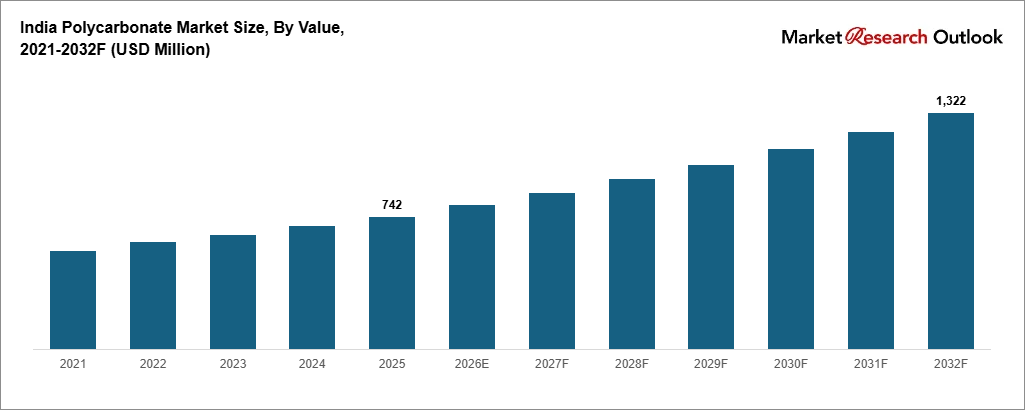
| Market Size (2025) | USD 742 Million |
| CAGR (2026-2032) | 8.6% |
| Leading Segment | Electrical & Electronics (General Purpose Grade) |
| Fastest Growing Segment | Automotive & EV (PC Blends) |
| Market Size (2032) | USD 1,322 Million |
Market Overview: India Polycarbonate Market
The India polycarbonate market size is witnessing rapid expansion, driven by the fast growth of electronics manufacturing, rising automotive and electric vehicle output, growing demand for polycarbonate sheets in construction, expanding LED lighting and smart meter rollouts, and the start of domestic resin capacity building. The India polycarbonate market was valued at USD 742 million in 2025 and is projected to reach USD 1,322 million by 2032, growing at a CAGR of 8.6%. India polycarbonate market growth is being fuelled by strong pull from component molders, appliance makers, automotive suppliers, and sheet extruders across Gujarat, Maharashtra, Tamil Nadu, Karnataka, and Uttar Pradesh. The India polycarbonate market consumed close to 330 kilo tonnes in 2025, and more than 95% of India polycarbonate market volume was imported from South Korea, China, Thailand, Saudi Arabia, Japan, and Taiwan. Electrical and electronics applications lead India polycarbonate market consumption, while automotive and EV uses based on PC blends are emerging as the fastest growing category. As global suppliers including Covestro, SABIC, Lotte Chemical, Mitsubishi Chemical, and Teijin deepen local technical service, and Deepak Chem Tech builds a 165 kilo tonne per annum plant at Dahej, the India polycarbonate market is evolving into a manufacturing-led, innovation-driven, and import-substituting ecosystem with strong long-term growth potential.
Key Report Takeaways: India Polycarbonate Market
- The India polycarbonate market size is projected to grow from USD 742 million in 2025 to USD 1,322 million by 2032, registering a strong CAGR of 8.6%, driven by electronics manufacturing, automotive lightweighting, EV adoption, and rising use of polycarbonate sheets across construction and infrastructure projects.
- Electrical and electronics applications dominate the India polycarbonate market share, accounting for over 31% of total volume in 2025, driven by smartphone, appliance, LED lighting, switchgear, and smart meter production under the PLI schemes and the Make in India programme.
- Automotive and EV applications using PC blends are emerging as the fastest growing segments in the India polycarbonate market, expected to grow at 11% to 13% annually as headlamp lenses, panoramic glazing, battery housings, and charging components reshape material choices.
- Near-total import dependence, with imports covering more than 95% of national demand in 2025, is shaping India polycarbonate market pricing and margins, while per-capita polycarbonate use of only about 0.23 kg against more than 2 kg in China points to large headroom for growth.
- The upcoming 165 kilo tonne per annum polycarbonate plant of Deepak Chem Tech at Dahej, backed by technology acquired from Trinseo, is set to strengthen India polycarbonate market supply, cut import reliance, and support the India polycarbonate market forecast 2032.
Key Market Drivers: India Polycarbonate Market
Electronics Manufacturing Growth, PLI Schemes, and Electrical Component Demand Driving Polycarbonate Consumption
Growth in the India polycarbonate market is being driven by the rapid rise of electronics manufacturing. India’s electronics production crossed USD 115 billion in FY24, and mobile phone output alone exceeded INR 4 lakh crore, supported by PLI schemes for smartphones, IT hardware, white goods, and electronic components. For the India polycarbonate market, this means steady orders for flame-retardant and general purpose grades used in phone frames, charger housings, laptop parts, switchgear, MCB enclosures, and connectors. For the polycarbonate market, the smart meter programme under the Revamped Distribution Sector Scheme targets more than 22 crore prepaid meters, each using polycarbonate covers and housings. LED lighting adds further India polycarbonate market volume through diffusers and lenses. Per-capita polycarbonate use in India remains near 0.23 kg per year against more than 2 kg in China, indicating significant long-term headroom for growth. India polycarbonate market buyers such as Dixon Technologies, Foxconn, Samsung, Havells, and Schneider Electric are creating strong structural pull-through demand across the India polycarbonate market.
Automotive Lightweighting, EV Adoption, and Safety Standards Fuelling Polycarbonate Demand in Transportation
The India polycarbonate market is benefiting from sustained growth in automotive production and the steady shift to electric vehicles. For the India polycarbonate market, passenger vehicle sales stayed above 4.3 million units in FY25, two-wheeler sales crossed 19 million units, and EV sales across all segments reached close to 2 million units in 2024. In the India polycarbonate market, automakers use polycarbonate and PC/ABS blends in headlamp lenses, tail lamps, instrument panels, sunroof modules, and interior trims, as polycarbonate is about 50% lighter than glass while offering far higher impact strength. EVs add new India polycarbonate market uses in battery module housings, charging guns, connectors, and display covers, with each electric car using an estimated 8 kg to 12 kg of polycarbonate and blends. Polycarbonate market suppliers such as Lumax, Uno Minda, Motherson, and Varroc are scaling lighting and interior capacity for Maruti Suzuki, Tata Motors, Mahindra, Hyundai, and Ola Electric. Bharat NCAP safety ratings and the FAME and PM E-DRIVE schemes are supporting consistent India polycarbonate market growth.
Construction, Infrastructure, and Solar Projects Strengthening Demand for Polycarbonate Sheets
Wider use of polycarbonate sheets is a major catalyst for the India polycarbonate market, with the sheets segment projected to grow at 8% to 10% annually through 2032. In the India polycarbonate market, solid and multiwall sheets are used in skylights, roofing, canopies, walkways, metro stations, airports, bus shelters, sports stadiums, and industrial sheds, as they transmit up to 90% of light while weighing about half as much as glass. Central capital expenditure of around INR 11.2 lakh crore budgeted for FY26 supports metro rail, railway station redevelopment, and airport projects, all of which specify polycarbonate glazing and roofing. Greenhouse farming, solar panel junction boxes, and rooftop solar structures add further India polycarbonate market volume. India polycarbonate market sheet brands and processors such as Palram, Gallina, Lexan-based sheet distributors, and domestic extruders have expanded production and dealer reach. These diverse uses are structurally expanding India polycarbonate market growth across all major end-use industries through 2032.
Key Market Challenges: India Polycarbonate Market
Near-Total Import Dependence and Currency and Freight Exposure Pressuring Polycarbonate Costs
The India polycarbonate market continues to face challenges from very high import dependence, with more than 95% of polycarbonate demand met through imports in 2025. India polycarbonate market supply comes mainly from South Korea, China, Thailand, Saudi Arabia, Japan, and Taiwan, which leaves Indian processors exposed to rupee movement, ocean freight swings, and supply decisions taken by overseas producers. In the India polycarbonate market, import prices fell from about USD 2.40 per kg in January 2023 to near USD 2.07 per kg by December 2023, before steadying around USD 2.10 to 2.14 per kg in 2024, as new Chinese capacity added global oversupply. Shipping disruptions in the Red Sea in 2024 also stretched polycarbonate market lead times by two to four weeks for some grades. Quality control orders affecting the polycarbonate market have been deferred or rolled back several times, adding policy uncertainty. This dependence limits supply security and planning visibility across the India polycarbonate market.
Volatility in BPA, Phenol, and Benzene Feedstock Prices and Rising Scrutiny of BPA Impacting Margins
The India polycarbonate market faces structural complexity from swings in bisphenol-A (BPA), phenol, acetone, and benzene prices, which together make up the bulk of polycarbonate production cost. Global BPA prices linked to the polycarbonate market moved in a wide band between 2022 and 2025, tracking crude oil, benzene, and propylene cycles. In the India polycarbonate market, compounders and sheet extruders often cannot pass on these swings quickly to OEM customers working on annual contracts. At the same time, regulatory attention on BPA migration in food contact uses has grown, as the European Union adopted a ban on BPA in food contact materials in December 2024 and BIS standards already bar BPA in baby feeding bottles. This has reduced India polycarbonate market use in water bottles, food containers, and baby products, pushing brands toward Tritan, PP, and glass. Feedstock volatility and BPA scrutiny therefore remain a near-term challenge for the India polycarbonate market.
Competition from Substitute Materials and Limited Recycling Infrastructure Restricting Polycarbonate Penetration
The India polycarbonate market faces practical constraints from substitute materials and weak recycling systems. PMMA (acrylic), ABS, PET, toughened glass, and polypropylene compete with polycarbonate in lighting, appliances, packaging, and glazing, often at 15% to 30% lower cost per kg. Price-sensitive India polycarbonate market buyers in tier-2 and tier-3 cities frequently choose cheaper materials even when polycarbonate offers better impact strength and heat resistance. In the India polycarbonate market, formal recycling rates for polycarbonate remain below 10%, as mixed plastic waste, poor segregation, and small recycler capacity make recovery difficult. Extended Producer Responsibility rules under the Plastic Waste Management Rules are raising polycarbonate market compliance costs for brand owners. Recycled and bio-attributed polycarbonate grades are emerging as polycarbonate market solutions, but premium pricing and limited awareness among small molders remain barriers to wider adoption across the India polycarbonate market.
Key Market Trends: India Polycarbonate Market
Domestic Polycarbonate Capacity Build-Out and Import Substitution in the India Polycarbonate Market
The India polycarbonate market is undergoing a clear supply shift as the country moves toward its first large-scale domestic resin production. Deepak Chem Tech, a subsidiary of Deepak Nitrite, acquired polycarbonate technology and assets from Trinseo in 2024 and is building a 165 kilo tonne per annum polycarbonate plant at Dahej, Gujarat, as part of an integrated programme covering phenol, acetone, and BPA. Commissioning is targeted for FY28 to FY29, marking a turning point for the India polycarbonate market. Once running at full rates, this single plant could meet close to 40% of current India polycarbonate market demand. To protect India polycarbonate market share, global producers including Covestro, SABIC, Lotte Chemical, and Mitsubishi Chemical are also widening local compounding, application development, and warehousing to stay close to Indian OEMs. Even with this capacity, India polycarbonate market demand near 560 kilo tonnes by 2032 means imports will still play a role. This capacity transition is reinforcing the India polycarbonate market forecast 2032 across the full value chain.
Rapid Adoption of PC Blends, Flame-Retardant, and Halogen-Free Grades for EV and Electronics
A clear shift toward PC/ABS and PC/PBT blends, flame-retardant grades, and halogen-free formulations is reshaping the India polycarbonate market, particularly in automotive, EV, and electronics segments. In the India polycarbonate market, PC/ABS blends combine the strength and heat resistance of polycarbonate with the easy processing of ABS, making them the material of choice for instrument panels, EV charger housings, and laptop enclosures. Flame-retardant polycarbonate rated UL94 V-0 is gaining polycarbonate market share and replacing older materials in switchgear, battery packs, and data centre equipment. India polycarbonate market compounders such as Kingfa, SABIC, Covestro, and LG Chem are expanding blend capacity in India to serve this need. In the India polycarbonate market, blends and specialty grades accounted for about 28% of volume in 2025, up from under 20% in 2020. Optical-grade polycarbonate for camera lenses, light guides, and automotive displays is also gaining traction, lifting value growth in the India polycarbonate market.
Growth of Sustainable, Recycled, and Bio-Attributed Polycarbonate Grades
A wave of sustainability-led product development is reshaping the India polycarbonate market. Global polycarbonate market producers including Covestro, SABIC, Teijin, and Mitsubishi Chemical have launched recycled-content and mass-balance bio-attributed polycarbonate grades, and Indian electronics and automotive brands are starting to specify them to meet ESG targets and export customer demands. In the India polycarbonate market, chemical recycling back to BPA, and mechanical recycling of water jars, optical discs, and automotive lamps, is being piloted by recyclers in Gujarat and Maharashtra. Across the India polycarbonate market, EPR obligations, green building ratings such as IGBC and GRIHA, and supplier sustainability scorecards from global OEMs have structurally favoured lower-carbon materials. Combined with growth in solar, LED, and smart meter applications, these developments are reinforcing the India polycarbonate market forecast 2032 across the entire value chain.
Segmental Insights: India Polycarbonate Market
By End-Use Industry: Electrical & Electronics Segment Dominates the India Polycarbonate Market
The electrical and electronics segment dominates the India polycarbonate market, accounting for an estimated 30% to 33% of total volume, driven by smartphone and appliance production, switchgear, LED lighting, smart meters, and connectors. General purpose and flame-retardant injection molding grades are the main India polycarbonate market types used in this segment. The automotive and transportation segment contributes another 20% to 22% of India polycarbonate market demand, driven by lighting, glazing, interiors, and EV components. Building and construction accounts for 18% to 20% of the polycarbonate market, led by solid and multiwall sheets for roofing, skylights, and canopies. In 2025, leading electronics and electrical makers including Dixon Technologies, Havells, Schneider Electric, Samsung, and Foxconn scaled up component sourcing in India, reinforcing segment dominance in the India polycarbonate market.
By Grade: General Purpose Leads While Flame-Retardant and Optical Grades Grow Fastest
General purpose polycarbonate leads the India polycarbonate market product landscape, accounting for approximately 46% of total India polycarbonate market volume, driven by its clarity, toughness, and wide use in sheets, appliances, consumer goods, and housings. Flame-retardant grades contribute another 22% to 25% of India polycarbonate market volume, primarily across electrical, electronics, and EV battery applications. Flame-retardant and optical grades are the fastest growing categories within the India polycarbonate market, expanding at 10% to 12% annually, driven by stricter fire safety rules, camera and display growth, and automotive lighting. Medical and UV-stabilized grades together account for 10% to 12% of the India polycarbonate market and are expected to grow steadily through 2032. Leading suppliers including Covestro, SABIC, Lotte Chemical, Mitsubishi Chemical, and Teijin have aligned product portfolios to this mix, driving value growth across the India polycarbonate market.
Regional Insights: India Polycarbonate Market
Regional analysis of the India polycarbonate market shows that West India and South India collectively account for approximately 70% to 74% of total polycarbonate volume, driven by Gujarat (Dahej and Vadodara chemical and sheet clusters), Maharashtra (Pune and Chakan automotive belt), Tamil Nadu (Chennai and Sriperumbudur electronics and auto hub), Karnataka, Telangana, and Andhra Pradesh (Sri City), supported by dense OEM and component supplier networks. North India contributes around 18% to 21% of India polycarbonate market demand, led by Noida and Greater Noida electronics clusters, Gurugram and Manesar automotive plants, and growing appliance production in Uttar Pradesh and Haryana. Central and East India together account for 7% to 9% of polycarbonate market demand, supported by Madhya Pradesh, West Bengal, and Odisha, where infrastructure projects and new manufacturing parks are accelerating. In 2025, Deepak Chem Tech’s project work at Dahej, Foxconn and Samsung electronics operations in Tamil Nadu and Uttar Pradesh, and automotive capacity additions in Gujarat and Maharashtra reinforced regional demand hubs, supporting closer execution of projects across the India polycarbonate market.
Recent Developments: India Polycarbonate Market
- The India polycarbonate market witnessed strong momentum in demand and capacity planning during 2024 and 2025. India polycarbonate market consumption reached close to 330 kilo tonnes in 2025, with monthly imports peaking above 35 kilo tonnes in August 2024. Polycarbonate market import prices stabilised around USD 2.10 to 2.14 per kg through 2024 after falling from USD 2.40 per kg in early 2023. India polycarbonate market demand is projected to reach about 560 kilo tonnes by 2032, growing at an average 7% to 8% annually.
- Domestic capacity planning in the India polycarbonate market gained pace. In November 2024, Deepak Chem Tech agreed to acquire polycarbonate technology and assets from Trinseo, and it committed close to INR 5,000 crore toward a 165 kilo tonne per annum polycarbonate plant at Dahej, part of a wider INR 11,500 crore integrated programme. Covestro, SABIC, and LG Chem strengthened compounding and application support in India. These developments are strengthening domestic supply and supporting the India polycarbonate market forecast 2032.
- OEM momentum has gained strong traction in the India polycarbonate market. In 2025, leading electronics and automotive players including Foxconn, Dixon Technologies, Samsung, Tata Motors, Mahindra, and Maruti Suzuki expanded local production, lifting demand for flame-retardant, optical, and PC blend grades. Strategic polycarbonate market partnerships between resin suppliers, compounders, and OEMs are positioning India as one of the fastest growing polycarbonate markets globally, strengthening long-term competitive positioning in the India polycarbonate market forecast 2032.
Key Market Players: India Polycarbonate Market
- Covestro AG
- SABIC (Saudi Basic Industries Corporation)
- Deepak Chem Tech Limited (Deepak Nitrite Limited)
- Lotte Chemical Corporation
- Mitsubishi Chemical Group Corporation
- Teijin Limited
- LG Chem Ltd.
- Idemitsu Kosan Co., Ltd.
- Chi Mei Corporation
- Wanhua Chemical Group Co., Ltd.
- Asahi Kasei Corporation
- Kingfa Science & Technology (India) Limited
- Palram Industries Ltd.
| By Product Form | By Grade | By Processing Method | By Sales Channel | By End-Use Industry |
| Sheets (Solid & Multiwall) Films Pellets & Granules PC Blends (PC/ABS, PC/PBT) Tubes & Rods Others |
General Purpose Flame Retardant Optical Medical UV Stabilized Others |
Injection Molding Extrusion Blow Molding Others |
Direct Sales Distributors & Traders Online B2B Platforms |
Electrical & Electronics Automotive & Transportation Building & Construction Consumer Goods & Appliances Medical & Healthcare Packaging Others |
Report Scope
In this report, the India Polycarbonate Market has been segmented into the following categories, in addition to detailed analysis of key industry trends, market dynamics, competitive landscape, and growth opportunities across the forecast period:
- By Product Form
- Sheets (Solid & Multiwall)
- Films
- Pellets & Granules
- PC Blends (PC/ABS, PC/PBT)
- Tubes & Rods
- Others
- By Grade
- General Purpose
- Flame Retardant
- Optical
- Medical
- UV Stabilized
- Others
- By Processing Method
- Injection Molding
- Extrusion
- Blow Molding
- Others
- By Sales Channel
- Direct Sales
- Distributors & Traders
- Online B2B Platforms
- By End-Use Industry
- Electrical & Electronics
- Automotive & Transportation
- Building & Construction
- Consumer Goods & Appliances
- Medical & Healthcare
- Packaging
- Others
- By Geography
- North India
- South India
- West India
- East India
- Central India
Competitive Landscape
Company Profiles:
Detailed analysis of the leading companies operating in the India Polycarbonate Market, including business overview, product portfolio, strategic initiatives, competitive positioning, and recent developments.
Company Information
Detailed profiling and strategic analysis of additional market players (up to five companies), including emerging domestic polycarbonate compounders, specialty sheet extruders, regional distributors, or niche recycled polycarbonate producers.
For a free sample of the India Polycarbonate Market report, customised insights or delivery timelines, submit your query here
India Polycarbonate Market, 2032
- Research Framework
- Market Segmentation
- Research Objective
- Research Methodology
- Qualitative Research
- Primary Research
- Secondary Research
- Quantitative Research
- Market Breakdown & Data Triangulation
- Demand Side
- Supply Side
- Primary Research Respondents
- Assumption & Limitation
- Executive Summary
- Market Overview, 2021-2032
- By Product Form
- By Grade
- By Processing Method
- By Sales Channel
- By End-Use Industry
- By Region
- Analyst Recommendations
- Geopolitical Impact on India Polycarbonate Market
- India Polycarbonate Market Insights
- Market Dynamics
- Growth Drivers
- Electronics manufacturing growth, PLI schemes, and electrical component demand driving polycarbonate consumption.
- Automotive lightweighting, EV adoption, and safety standards fuelling polycarbonate demand in transportation.
- Construction, infrastructure, and solar projects strengthening demand for polycarbonate sheets.
- Restraints
- Near-total import dependence and currency and freight exposure pressuring polycarbonate costs.
- Volatility in BPA, phenol, and benzene feedstock prices and rising scrutiny of BPA impacting margins.
- Competition from substitute materials and limited recycling infrastructure restricting polycarbonate penetration.
- Opportunities
- Domestic polycarbonate resin capacity creating strong import substitution opportunities across India.
- PC blends, flame-retardant, and optical grades supporting next-generation growth in EV and electronics.
- Recycled, bio-attributed, and medical-grade polycarbonate opening new value-added revenue pools.
- Challenges
- Intense competition from PMMA, ABS, PET, and glass in lighting, appliances, and glazing applications.
- Limited domestic technical know-how and shortage of skilled polycarbonate processing talent.
- Maintaining consistent quality, color, and optical clarity across imported polycarbonate grades.
- Technological Advancements
- Recent Technological Advancements
- Prior to 2020
- Porter’s Five Forces Analysis
- PESTLE Analysis
- Industry Value Chain & Entry Points
- Upstream Raw Materials (benzene, propylene, phenol, acetone, bisphenol-A, phosgene, diphenyl carbonate)
- Polycarbonate Resin Producers (Covestro, SABIC, Lotte Chemical, Mitsubishi Chemical, Deepak Chem Tech)
- Additive & Compound Suppliers (flame retardants, UV stabilizers, ABS, PBT, colour masterbatches)
- Compounders & Blend Makers (PC/ABS, PC/PBT, flame-retardant and glass-filled compounds)
- Quality Control, R&D & Testing Laboratories (BIS, CIPET, UL, ISO, NABL standards)
- Distributors, Traders & Importers (B2B resin trading and import networks)
- Sheet Extruders & Component Molders (Palram, Gallina, Lumax, Uno Minda, Motherson)
- OEMs & Brand Owners (Dixon, Samsung, Havells, Maruti Suzuki, Tata Motors, Mahindra)
- Retail Channels & Project Sales (dealers, fabricators, EPC contractors, government tenders)
- End-Users (households, automakers, electronics firms, builders, hospitals, utilities)
- India Polycarbonate Market: Regulatory Framework
- India Polycarbonate Market Overview
- Market Size & Forecast, 2021-2032
- By Value (USD Million)
- By Volume (Kilo Tonnes)
- Market Share & Forecast
- By Product Form
- Sheets (Solid & Multiwall)
- Films
- Pellets & Granules
- PC Blends (PC/ABS, PC/PBT)
- Tubes & Rods
- Others
- By Grade
- General Purpose
- Flame Retardant
- Optical
- Medical
- UV Stabilized
- Others
- By Processing Method
- Injection Molding
- Extrusion
- Blow Molding
- Others
- By Sales Channel
- Direct Sales
- Distributors & Traders
- Online B2B Platforms
- By End-Use Industry
- Electrical & Electronics
- Automotive & Transportation
- Building & Construction
- Consumer Goods & Appliances
- Medical & Healthcare
- Packaging
- Others
- By Geography
- North India
- South India
- West India
- East India
- Central India
- Competitive Landscape
- India Polycarbonate Market Company Market Share Analysis, 2025
- Competitive Benchmarking, By Operating Parameters
- Key Strategic Development (Mergers, Acquisitions, Partnerships, Etc.)
- List of Emerging Players
- Company Profile
- Covestro AG
- Introduction & Company Profile
- Product Benchmarking
- Strategic Outlook
- Key Competitors
- Financial Analysis
- SWOT Analysis
(Same Data Pointers Will Be Provided for The Below Companies)
- SABIC (Saudi Basic Industries Corporation)
- Deepak Chem Tech Limited (Deepak Nitrite Limited)
- Lotte Chemical Corporation
- Mitsubishi Chemical Group Corporation
- Teijin Limited
- LG Chem Ltd.
- Idemitsu Kosan Co., Ltd.
- Chi Mei Corporation
- Wanhua Chemical Group Co., Ltd.
- Asahi Kasei Corporation
- Kingfa Science & Technology (India) Limited
- Palram Industries Ltd.
- Other Prominent Players
* Financial information in case of non-listed companies will be provided as per availability
** The segmentation and the companies are subjected to modifications based on in-depth secondary for the final deliverable
Frequently Asked Questions
1. How large is the India polycarbonate market and what is its growth forecast?
Ans: The India polycarbonate market is valued at USD 742 million in 2025 and is projected to reach USD 1,322 million by 2032, growing at a CAGR of 8.6%, supported by electronics, automotive, and construction demand.
2. Which segments are driving demand in the India polycarbonate market?
Ans: Electrical and electronics leads with over 31% volume share, while automotive and EV applications using PC blends are the fastest growing segments, driven by lighting, glazing, and battery components.
3. What are the key drivers of growth in the India polycarbonate market?
Ans: Key drivers include electronics manufacturing under PLI schemes, automotive lightweighting, rising EV adoption, smart meter rollouts, and growing use of polycarbonate sheets in construction and infrastructure.
4. Which regions are driving growth in the India polycarbonate market?
Ans: West India and South India lead with around 70% to 74% of total volume, driven by Gujarat, Maharashtra, Tamil Nadu, and Karnataka. North India follows with strong electronics demand.
5. What are the latest trends in the India polycarbonate market?
Ans: Major trends include domestic capacity from Deepak Chem Tech, rapid adoption of PC blends and flame-retardant grades, and growing demand for recycled and bio-attributed polycarbonate.