

India Demi Fine Jewellery Market, 2032
- Consumer Goods & Retail, Retail & Lifestyle
- Nov 2026
- Pages 140
- Report Format: pdf
- Report Price: $2400 USD
India’s demi fine jewellery market is witnessing strong structural growth, driven by record gold prices, a fast-growing base of Gen-Z and working women buyers, rising self-purchase and everyday wear demand, the rapid scale-up of digital-first D2C brands, deeper social commerce and quick commerce reach, and rising venture and public market investment into organised brands building design capability, omnichannel stores, and lab-grown diamond collections.
| Study Duration | 2021-2032 |
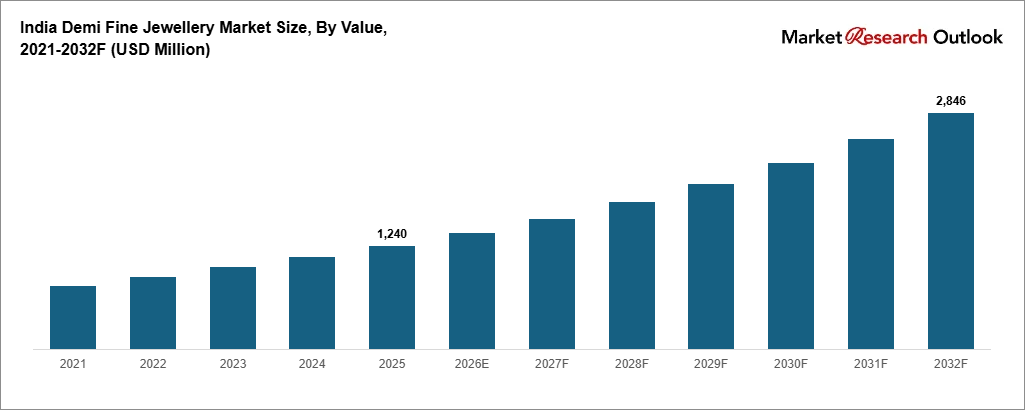
| Market Size (2025) | USD 1,240 Million |
| CAGR (2026-2032) | 12.6% |
| Leading Segment | Earrings (Gold-Plated Sterling Silver) |
| Fastest Growing Segment | Lab-Grown Diamond Demi Fine Jewellery |
| Market Size (2032) | USD 2,846 Million |
Market Overview: India Demi Fine Jewellery Market
The India demi fine jewellery market size is expanding quickly as buyers look for pieces that sit between costume jewellery and traditional gold. Valued at USD 1,240 million in 2025 and projected to reach USD 2,846 million by 2032, growing at a CAGR of 12.6%, the India demi fine jewellery market is being shaped by record gold prices, a young and digitally active consumer base, and a steady rise in self-purchase by working women. Demi fine jewellery pieces, typically made in 925 sterling silver, gold vermeil, or low-karat solid gold with real or lab-grown stones, usually retail between INR 2,000 and INR 50,000, which makes them easy to buy for daily wear, office looks, and gifting. Earrings in gold-plated sterling silver lead demand, while lab-grown diamond demi fine jewellery is the fastest growing category. Organised players such as Mia by Tanishq, CaratLane, GIVA, BlueStone, Palmonas, and Salty are scaling design teams, store networks, and online reach, while marketplaces such as Myntra, Nykaa Fashion, and Amazon widen access in tier-2 and tier-3 cities. Together, these shifts are turning the India demi fine jewellery market into a brand-led, design-driven, and digitally enabled category with strong long-term headroom.
Key Report Takeaways: India Demi Fine Jewellery Market
- The India demi fine jewellery market size is projected to grow from USD 1,240 million in 2025 to USD 2,846 million by 2032, registering a strong CAGR of 12.6%, supported by record gold prices, rising self-purchase among women, and fast growth of D2C jewellery brands.
- Earrings lead the India demi fine jewellery market share with about 34% of value in 2025, as studs, hoops, and huggies remain the most frequent everyday purchase, while gold-plated sterling silver accounts for around 46% of material demand.
- Lab-grown diamond demi fine jewellery is the fastest growing segment of the India demi fine jewellery market, expanding at 22% to 26% annually as lab-grown diamond prices have fallen by more than 70% since 2022.
- Online channels, including brand websites, apps, and marketplaces, contributed close to 58% of India demi fine jewellery market sales in 2025, up from about 38% in 2021, while exclusive brand outlets are now the fastest growing offline format.
- Fresh capital, including the INR 530 crore Series C raised by GIVA and the INR 55 crore Series A raised by Palmonas in 2025, along with the BlueStone stock market listing, is strengthening brand building and supporting the India demi fine jewellery market forecast 2032.
Key Market Drivers: India Demi Fine Jewellery Market
Record Gold Prices Pushing Indian Buyers Toward Affordable Demi Fine Jewellery
Growth in the India demi fine jewellery market is closely tied to the sharp rise in gold prices. Domestic gold crossed INR 1,00,000 per 10 grams in 2025 and stayed near record levels through the festive season, pushing a traditional 22K chain or pair of earrings well beyond the budget of many first-time and younger buyers. Demi fine jewellery solves this problem. A 925 silver pendant with 18K gold plating or a 9K gold stud can deliver the look of fine jewellery at one-fifth to one-tenth of the price. Industry estimates suggest that average demi fine jewellery ticket sizes in the demi fine jewellery category range between INR 2,500 and INR 6,000, against INR 40,000 to INR 70,000 for a typical gold purchase. Demi fine jewellery buyers are also shifting from one or two large purchases a year to four or five smaller ones, which raises purchase frequency and repeat rates. Large jewellers have recognised this shift toward demi fine jewellery, with Titan, CaratLane, and BlueStone widening lightweight and silver collections, creating strong pull-through demand across the India demi fine jewellery market.
Rising Gen-Z and Working Women Population Fuelling Self-Purchase and Everyday Wear Demand
The India demi fine jewellery market is benefiting from a large and young consumer base. India has more than 370 million people in the Gen-Z age group, and female labour force participation has climbed to close to 42% according to the latest Periodic Labour Force Survey. Working women in metros and tier-1 cities now buy demi fine jewellery for themselves, for office wear, travel, and social occasions, instead of waiting for weddings or festivals. Women account for an estimated 78% to 81% of demi fine jewellery spend, and buyers aged 18 to 34 contribute over 65% of online orders. These demi fine jewellery shoppers prefer minimal, stackable, and skin-friendly designs that can be worn daily, and they value hypoallergenic metals, certified silver, and easy exchange policies. Rising per-capita income, wider use of UPI and buy-now-pay-later options, and a strong gifting culture during Raksha Bandhan, Diwali, and Valentine’s Day further support repeat buying across the India demi fine jewellery market.
Rapid Growth of Digital-First D2C Brands, Social Commerce, and Venture Funding Expanding Market Reach
Rapid growth of digital-first demi fine jewellery brands is a major catalyst for the India demi fine jewellery market. Demi fine jewellery brands such as GIVA, Palmonas, Salty, Isharya, and Zariin have built direct relationships with buyers through Instagram, YouTube, influencer content, and celebrity partnerships, keeping design cycles short and launching new collections every few weeks. Capital is flowing in as well. GIVA raised INR 530 crore in a Series C round in 2025, Palmonas secured INR 55 crore in Series A funding from Vertex Ventures, and BlueStone listed on the stock exchanges in August 2025. This demi fine jewellery funding is being used for design teams, technology, and physical stores, with GIVA alone operating well over 200 outlets. Marketplaces such as Myntra, Nykaa Fashion, Ajio, Amazon, and Flipkart, along with quick commerce apps that deliver jewellery within 10 to 20 minutes in large cities, are bringing organised brands to new shoppers and expanding India demi fine jewellery market growth beyond the metros.
Key Market Challenges: India Demi Fine Jewellery Market
Intense Competition from Unorganised Imitation Jewellery and Low-Cost Counterfeits
The India demi fine jewellery market continues to face strong competition from unorganised imitation and fashion jewellery sellers. Brass and alloy pieces with thin plating sell for as little as INR 200 to INR 800 on street markets and low-cost online listings, and many of them use terms such as silver or gold-plated loosely. Price-sensitive demi fine jewellery buyers often find it hard to tell real 925 silver or vermeil from cheaper copies, especially when buying online. Unorganised players still hold an estimated 55% to 60% of the broader affordable jewellery space, and design copying by local workshops can bring a trending brand style to market within days. This keeps pressure on pricing and limits how far organised brands can raise margins across the India demi fine jewellery market.
Plating Durability, Tarnish Concerns, and Limited Quality Standardisation Affecting Consumer Trust
The India demi fine jewellery market also faces trust issues linked to plating quality and durability. Gold plating on demi fine jewellery made of silver or brass can wear off within months if the micron thickness is low, and exposure to sweat, perfume, and humidity speeds up tarnish. Return and complaint rates for plated demi fine jewellery bought online can reach 12% to 18% for some sellers. Demi fine jewellery standards are still developing. While gold hallmarking with HUID is mandatory, the Bureau of Indian Standards only introduced voluntary HUID hallmarking for silver jewellery in 2025, and there is no common rule for vermeil thickness or plating disclosure. Leading demi fine jewellery brands are responding with longer plating warranties, free re-plating, and lifetime exchange, but uneven standards across sellers remain a near-term challenge for the India demi fine jewellery market.
Volatile Silver and Gold Prices and Rising Customer Acquisition Costs Squeezing Margins
The India demi fine jewellery market faces practical cost pressures. Silver prices climbed sharply through 2025, crossing INR 1,50,000 per kilogram during the festive period, while gold stayed close to record levels, raising the input cost of sterling silver, vermeil, and 9K gold demi fine jewellery. At the same time, digital advertising costs have risen, and customer acquisition costs for D2C demi fine jewellery brands are estimated at INR 600 to INR 1,200 per new buyer. With average order values of INR 2,500 to INR 6,000 and gross margins of 55% to 70%, many smaller demi fine jewellery labels struggle to stay profitable after returns, discounts, and marketing spend. Brands that cannot pass on price increases or build repeat purchase risk losing ground, which keeps profitability uneven across the India demi fine jewellery market.
Key Market Trends: India Demi Fine Jewellery Market
Rapid Adoption of Lab-Grown Diamond Demi Fine Jewellery in India
The India demi fine jewellery market is seeing a clear shift toward lab-grown diamond pieces. India is one of the world’s largest producers of CVD lab-grown diamonds, and wholesale lab-grown prices have dropped by more than 70% since 2022, allowing brands to set demi fine jewellery solitaire studs, tennis bracelets, and pendants in silver or 9K and 14K gold at prices between INR 8,000 and INR 40,000. Lab-grown diamond demi fine jewellery is expected to account for over 18% of new demi fine jewellery collection launches by 2027. CaratLane, BlueStone, GIVA, and several new labels have expanded certified lab-grown lines, often with IGI or SGL grading, which builds trust among first-time diamond buyers. Younger couples are also choosing lab-grown demi fine jewellery for engagement and promise rings, and this product shift is reinforcing the India demi fine jewellery market forecast 2032.
Omnichannel Expansion Through Exclusive Brand Outlets and Quick Commerce
A clear move toward omnichannel retail is reshaping the India demi fine jewellery market. Demi fine jewellery brands that began online are now opening exclusive brand outlets in malls, high streets, and airports, because shoppers still like to see and try pieces before buying higher-value items. GIVA operates well over 200 stores, Palmonas has started a physical rollout after its 2025 funding, and Mia by Tanishq continues to expand both standalone stores and shop-in-shops inside Tanishq showrooms. At the same time, quick commerce platforms such as Blinkit, Zepto, and Swiggy Instamart now list demi fine jewellery earrings, pendants, and gift sets with delivery in 10 to 20 minutes, which supports last-minute gifting. Demi fine jewellery stores also lower return rates and raise average order values by 25% to 40% compared with online orders, strengthening unit economics across the India demi fine jewellery market.
Personalisation, Minimalist Designs, and Rising Demand for Men’s Demi Fine Jewellery
Personalisation and minimal design are becoming central to the India demi fine jewellery market. In demi fine jewellery, name necklaces, initial pendants, birthstone rings, and zodiac charms are among the fastest selling gift items, and many brands now offer engraving at no extra cost. Minimal, stackable demi fine jewellery designs that work with both western and ethnic wear remain the core of most collections. Men’s demand for demi fine jewellery is also rising, with chains, kadas, bracelets, rings, and single studs in oxidised or plated silver gaining traction among buyers aged 20 to 35. Men now contribute an estimated 10% to 12% of category spend and are growing faster than the overall market. Sustainability is a further demi fine jewellery theme, with some labels using recycled silver and plastic-free packaging, adding depth and new buyer groups to the India demi fine jewellery market.
Segmental Insights: India Demi Fine Jewellery Market
By End-User: Women Segment Dominates the India Demi Fine Jewellery Market
The women end-user segment dominates the India demi fine jewellery market, accounting for an estimated 78% to 81% of total value, driven by self-purchase, daily wear, office styling, and gifting by family and partners. Earrings and pendants are the leading demi fine jewellery products within this segment, with gold-plated sterling silver capturing over half of women’s purchases. The men segment contributes 10% to 12% of demand and is expanding quickly through chains, bracelets, and rings. Unisex and gender-neutral demi fine jewellery designs account for 6% to 8%, while kids and teens hold 2% to 3%, mainly through birthday and festive gifting. In 2025, leading brands including Mia by Tanishq, GIVA, Palmonas, Salty, and CaratLane widened women-focused everyday and occasion collections, reinforcing segment leadership in the India demi fine jewellery market.
By Material: Gold-Plated Sterling Silver Leads While Lab-Grown Diamond Grows Fastest
Gold-plated sterling silver leads the India demi fine jewellery market by material, accounting for about 46% of value, helped by its real precious metal content, skin-friendly nature, and accessible pricing. Gold vermeil contributes another 14% to 16%, mainly in premium earrings and layered necklaces. 9K and 14K solid gold demi fine jewellery pieces hold 12% to 14% and appeal to buyers who want real gold at lower weight. Plated brass and alloy demi fine jewellery accounts for 10% to 12%, largely at the entry price point. Lab-grown diamond demi fine jewellery is the fastest growing material segment, expanding at 22% to 26% annually through 2032. Leading brands including CaratLane, BlueStone, GIVA, Palmonas, and Isharya have aligned their portfolios to this mix, driving premiumisation across the India demi fine jewellery market.
Regional Insights: India Demi Fine Jewellery Market
Regional analysis of the India demi fine jewellery market shows that South India and West India together account for about 54% to 57% of total value, driven by Karnataka (Bengaluru), Maharashtra (Mumbai and Pune), Tamil Nadu (Chennai), Telangana (Hyderabad), and Gujarat, supported by high online shopping adoption and a large base of working women. North India contributes around 27% to 30% of demand, led by Delhi NCR, Punjab, Haryana, Rajasthan, and Uttar Pradesh, where Gurugram, Noida, Chandigarh, Jaipur, and Lucknow are seeing fast growth in mall and high-street stores. East and Central India together account for 14% to 17%, supported by West Bengal, Odisha, Madhya Pradesh, and Bihar, where tier-2 cities such as Kolkata, Bhubaneswar, Indore, and Patna are adopting branded demi fine jewellery through marketplaces. Jaipur, Mumbai, and Surat also serve as key demi fine jewellery manufacturing and sourcing hubs, supporting faster design-to-shelf cycles across the India demi fine jewellery market.
Recent Developments: India Demi Fine Jewellery Market
- The India demi fine jewellery market saw strong funding momentum during 2025. GIVA raised INR 530 crore in a Series C round led by Creaegis to expand its store network and product range, while Palmonas, co-founded by actor Shraddha Kapoor, raised INR 55 crore in a Series A round led by Vertex Ventures to fund store expansion and brand building.
- Public market interest has also deepened. BlueStone Jewellery and Lifestyle Limited listed on the Indian stock exchanges in August 2025, giving investors direct exposure to organised lightweight and demi fine jewellery. Titan continued to grow its demi fine jewellery brands Mia by Tanishq and CaratLane, and the Bureau of Indian Standards introduced voluntary HUID hallmarking for silver jewellery in 2025, supporting the India demi fine jewellery market forecast 2032.
- Omnichannel and quick commerce momentum has gained traction in the India demi fine jewellery market. In 2025, leading brands including GIVA, Salty, and Palmonas expanded offline stores and listed curated ranges on Blinkit, Zepto, and Swiggy Instamart, while Myntra and Nykaa Fashion widened their demi fine jewellery assortments, strengthening long-term competitive positioning in the India demi fine jewellery market.
Key Market Players: India Demi Fine Jewellery Market
- Titan Company Limited (Mia by Tanishq)
- CaratLane Trading Pvt. Ltd. (Shaya by CaratLane)
- GIVA Jewellery
- BlueStone Jewellery and Lifestyle Limited
- Palmonas
- Salty
- Isharya
- Outhouse Jewellery
- Pipa Bella (FSN E-Commerce Ventures Limited)
- Zariin
- Kushal’s Fashion Jewellery
- Swarovski India
- Pandora India
| By Product Type | By Material | By Price Range | By Distribution Channel | By End-User |
| Earrings Necklaces & Pendants Rings Bracelets & Bangles Anklets Others |
Gold-Plated Sterling Silver (925) Gold Vermeil 9K & 14K Solid Gold Lab-Grown Diamond Demi Fine Jewellery Plated Brass & Alloy Others |
Below INR 3,000 INR 3,000 to INR 10,000 INR 10,000 to INR 25,000 Above INR 25,000 |
Online D2C Websites & Apps E-Commerce Marketplaces Exclusive Brand Outlets Multi-Brand & Department Stores Shop-in-Shops & Kiosks Quick Commerce |
Women Men Unisex & Gender-Neutral Kids & Teens |
Report Scope
In this report, the India Demi Fine Jewellery Market has been segmented into the following categories, in addition to detailed analysis of key industry trends, market dynamics, competitive landscape, and growth opportunities across the forecast period:
- By Product Type
- Earrings
- Necklaces & Pendants
- Rings
- Bracelets & Bangles
- Anklets
- Others
- By Material
- Gold-Plated Sterling Silver (925)
- Gold Vermeil
- 9K & 14K Solid Gold
- Lab-Grown Diamond Demi Fine Jewellery
- Plated Brass & Alloy
- Others
- By Price Range
- Below INR 3,000
- INR 3,000 to INR 10,000
- INR 10,000 to INR 25,000
- Above INR 25,000
- By Distribution Channel
- Online D2C Websites & Apps
- E-Commerce Marketplaces
- Exclusive Brand Outlets
- Multi-Brand & Department Stores
- Shop-in-Shops & Kiosks
- Quick Commerce
- By End-User
- Women
- Men
- Unisex & Gender-Neutral
- Kids & Teens
- By Geography
- North India
- South India
- West India
- East India
- Central India
Competitive Landscape
Company Profiles:
Detailed analysis of the leading companies operating in the India Demi Fine Jewellery Market, including business overview, product portfolio, strategic initiatives, competitive positioning, and recent developments.
Company Information
Detailed profiling and strategic analysis of additional market players (up to five companies), including emerging D2C demi fine jewellery labels, lab-grown diamond jewellery specialists, regional silver jewellery brands, or niche designer labels.
For a free sample of the India Demi Fine Jewellery Market report, customised insights or delivery timelines, submit your query here
India Demi Fine Jewellery Market Size & Share, 2032
- Research Framework
- Market Segmentation
- Research Objective
- Research Methodology
- Qualitative Research
- Primary Research
- Secondary Research
- Quantitative Research
- Market Breakdown & Data Triangulation
- Demand Side
- Supply Side
- Primary Research Respondents
- Assumption & Limitation
- Executive Summary
- Market Overview, 2021-2032
- By Product Type
- By Material
- By Price Range
- By Distribution Channel
- By End-User
- By Region
- Analyst Recommendations
- Geopolitical Impact on India Demi Fine Jewellery Market
- India Demi Fine Jewellery Market Insights
- Market Dynamics
- Growth Drivers
- Record gold prices pushing Indian buyers toward affordable demi fine jewellery.
- Rising Gen-Z and working women population fuelling self-purchase and everyday wear demand.
- Rapid growth of digital-first D2C brands, social commerce, and venture funding expanding market reach.
- Restraints
- Intense competition from unorganised imitation jewellery and low-cost counterfeits.
- Plating durability, tarnish concerns, and limited quality standardisation affecting consumer trust.
- Volatile silver and gold prices and rising customer acquisition costs squeezing margins.
- Opportunities
- Lab-grown diamond demi fine jewellery opening premium yet affordable product lines.
- Demi fine jewellery omnichannel expansion through exclusive brand outlets and quick commerce in tier-2 and tier-3 cities.
- Personalised, minimalist, and men’s demi fine jewellery creating new consumer segments.
- Challenges
- Low brand loyalty and frequent switching among price-sensitive online demi fine jewellery shoppers.
- High return rates, reverse logistics costs, and inventory risk in fast-changing demi fine jewellery design cycles.
- Demi fine jewellery design imitation and weak intellectual property protection across online marketplaces.
- Technological Advancements
- Recent Technological Advancements
- Prior to 2020
- Porter’s Five Forces Analysis
- PESTLE Analysis
- Industry Value Chain & Entry Points
- Upstream Raw Materials for Demi Fine Jewellery (silver, gold, brass, lab-grown diamonds, gemstones, plating chemicals, packaging)
- Refiners, Bullion Suppliers & Diamond Growers (silver and gold refiners, CVD and HPHT lab-grown diamond producers for demi fine jewellery)
- Demi Fine Jewellery Designers, CAD Studios & 3D Printing Service Providers (design, prototyping, casting moulds)
- Demi Fine Jewellery Manufacturers & Karigar Clusters (Jaipur, Mumbai, Surat, Kolkata, Coimbatore, Thrissur)
- Demi Fine Jewellery Plating, Finishing & Quality Testing Laboratories (BIS, IGI, SGL, hallmarking centres)
- Brand Owners & D2C Demi Fine Jewellery Labels (Mia by Tanishq, CaratLane, GIVA, BlueStone, Palmonas, Salty)
- Online Marketplaces & Social Commerce Platforms for Demi Fine Jewellery (Myntra, Nykaa Fashion, Amazon, Flipkart, Ajio, Instagram)
- Quick Commerce & Last-Mile Partners (Blinkit, Zepto, Swiggy Instamart, Delhivery, Shiprocket)
- Offline Demi Fine Jewellery Retail Channels (exclusive brand outlets, shop-in-shops, malls, airport kiosks)
- Demi Fine Jewellery End-Users (working women, college students, men, gifting buyers, brides and bridesmaids)
- India Demi Fine Jewellery Market: Regulatory Framework
- India Demi Fine Jewellery Market Overview
- Market Size & Forecast, 2021-2032
- By Value (USD Million)
- By Volume (Million Units)
- Market Share & Forecast
- By Product Type
- Earrings
- Necklaces & Pendants
- Rings
- Bracelets & Bangles
- Anklets
- Others
- By Material
- Gold-Plated Sterling Silver (925)
- Gold Vermeil
- 9K & 14K Solid Gold
- Lab-Grown Diamond Demi Fine Jewellery
- Plated Brass & Alloy
- Others
- By Price Range
- Below INR 3,000
- INR 3,000 to INR 10,000
- INR 10,000 to INR 25,000
- Above INR 25,000
- By Distribution Channel
- Online D2C Websites & Apps
- E-Commerce Marketplaces
- Exclusive Brand Outlets
- Multi-Brand & Department Stores
- Shop-in-Shops & Kiosks
- Quick Commerce
- By End-User
- Women
- Men
- Unisex & Gender-Neutral
- Kids & Teens
- By Geography
- North India
- South India
- West India
- East India
- Central India
- Competitive Landscape
- India Demi Fine Jewellery Market Company Market Share Analysis, 2025
- Competitive Benchmarking, By Operating Parameters
- Key Strategic Development (Mergers, Acquisitions, Partnerships, Etc.)
- List of Emerging Demi Fine Jewellery Players
- Company Profile
- Titan Company Limited (Mia by Tanishq)
- Introduction & Company Profile
- Product Benchmarking
- Strategic Outlook
- Key Competitors
- Financial Analysis
- SWOT Analysis
(Same Data Pointers Will Be Provided for The Below Companies)
- CaratLane Trading Pvt. Ltd. (Shaya by CaratLane)
- GIVA Jewellery
- BlueStone Jewellery and Lifestyle Limited
- Palmonas
- Salty
- Isharya
- Outhouse Jewellery
- Pipa Bella (FSN E-Commerce Ventures Limited)
- Zariin
- Kushal’s Fashion Jewellery
- Swarovski India
- Pandora India
- Other Prominent Players
* Financial information in case of non-listed companies will be provided as per availability
** The segmentation and the companies are subjected to modifications based on in-depth secondary for the final deliverable
Frequently Asked Questions
1. How large is the India demi fine jewellery market and what is its growth forecast?
Ans: The India demi fine jewellery market is valued at USD 1,240 million in 2025 and is projected to reach USD 2,846 million by 2032, growing at a CAGR of 12.6%.
2. Which segments are driving demand in the India demi fine jewellery market?
Ans: Earrings lead with about 34% share and gold-plated sterling silver leads materials with around 46%, while lab-grown diamond demi fine jewellery is the fastest growing segment.
3. What are the key drivers of growth in the India demi fine jewellery market?
Ans: Key drivers include record gold prices, a growing base of Gen-Z and working women buyers, rising self-purchase, and the fast expansion of funded D2C jewellery brands.
4. Which regions are driving growth in the India demi fine jewellery market?
Ans: South India and West India lead with about 54% to 57% of value, driven by Bengaluru, Mumbai, Pune, Chennai, and Hyderabad, followed by Delhi NCR in North India.
5. What are the latest trends in the India demi fine jewellery market?
Ans: Major trends include lab-grown diamond collections, omnichannel store expansion, quick commerce delivery, personalised designs, and rising demand for men's demi fine jewellery.