

India Lab Grown Diamond Jewellery Market, 2032
- Consumer Goods & Retail, Retail & Lifestyle
- Nov 2026
- Pages 140
- Report Format: pdf
- Report Price: $2400 USD
India’s lab grown diamond jewellery market is witnessing strong structural growth, driven by pricing 80% to 90% below mined diamonds, record gold prices, rising demand from young and aspirational urban buyers, India’s leadership in CVD diamond growing, wider IGI and SGL certification, fast expansion of exclusive brand outlets and D2C platforms, and growing interest from large organized jewellers launching dedicated lab grown diamond jewellery brands.
| Study Duration | 2021-2032 |
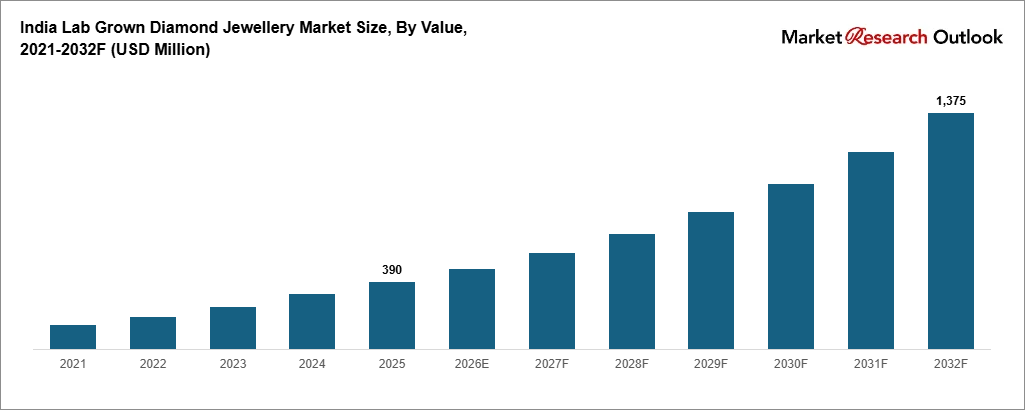
| Market Size (2025) | USD 390 Million |
| CAGR (2026-2032) | 19.7% |
| Leading Segment | Rings (CVD-Grown, Gold-Set) |
| Fastest Growing Segment | Online & D2C Platforms |
| Market Size (2032) | USD 1,375 Million |
Market Overview: India Lab Grown Diamond Jewellery Market
The India lab grown diamond jewellery market size is witnessing rapid expansion, driven by affordable pricing, record gold prices, a young and aspirational buyer base, India’s strong CVD diamond growing capacity, wider certification, and the entry of large organized jewellers. Valued at USD 390 million in 2025 and projected to reach USD 1,375 million by 2032, growing at a CAGR of 19.7%, the India lab grown diamond jewellery market growth is being fuelled by working women, young couples, and first-time diamond buyers across tier-1 and tier-2 cities. Rings lead lab grown diamond jewellery sales, while online and D2C platforms are emerging as the fastest growing channel. Shifting buyer preferences toward ethical sourcing, lightweight designs, and larger lab grown diamonds at lower prices are reshaping the retail landscape. As growers such as Ethereal Green Diamond, Greenlab Diamonds, and Bhanderi Lab Grown Diamonds expand CVD output, and brands such as Titan (beYon), Limelight, Avtaara, Fiona Diamonds, and Jewelbox scale store pipelines, the India lab grown diamond jewellery market is evolving into a brand-led, design-driven, and digitally enabled ecosystem with strong long-term growth potential.
Key Report Takeaways: India Lab Grown Diamond Jewellery Market
- The India lab grown diamond jewellery market size is projected to grow from USD 390 million in 2025 to USD 1,375 million by 2032, registering a strong CAGR of 19.7%, driven by affordable pricing, entry of organized jewellers, and the structural shift toward certified lab grown diamond jewellery across urban India.
- Rings dominate the India lab grown diamond jewellery market, accounting for about 36% of total value in 2025, supported by strong demand for solitaire and engagement rings, larger lab grown diamond sizes at lower prices, and the deep presence of brands such as Limelight, Avtaara, and Fiona Diamonds.
- Online and D2C platforms are emerging as the fastest growing channel in the India lab grown diamond jewellery market, expected to grow at 26% to 28% annually as young buyers prefer certified online purchases, virtual try-on, and easy exchange policies.
- CVD lab grown diamonds account for nearly 82% of lab grown diamond jewellery value in India, reflecting the strength of Surat and Mumbai growers and the higher clarity grades that CVD technology delivers.
- Rising investment by CVD growers and jewellery brands in reactor capacity, design studios, exclusive stores, and certification is strengthening domestic supply and supporting the India lab grown diamond jewellery market forecast 2032.
Key Market Drivers: India Lab Grown Diamond Jewellery Market
Lab Grown Diamond Jewellery Priced 80% to 90% Below Mined Diamond Equivalents, Widening Access for Middle-Income Indian Buyers
Growth in the India lab grown diamond jewellery market is being driven first by price. A certified one carat lab grown diamond solitaire ring sells between INR 50,000 and INR 1,20,000 in 2025, compared with INR 4,00,000 to INR 7,00,000 for a similar mined diamond ring. Wholesale lab grown diamond prices have fallen by more than 80% since 2018, and this saving is now reaching lab grown diamond jewellery shoppers. At the same time, gold prices crossed INR 1,00,000 per 10 grams in 2025, which pushed buyers toward lighter 14K and 18K settings where the lab grown diamond carries most of the visual value. Diamond jewellery penetration in India remains below 10% of total jewellery spend, showing large headroom. With an average lab grown diamond jewellery ticket of INR 25,000 to INR 45,000, a much wider middle-income group can now buy diamond jewellery, creating strong structural demand across the India lab grown diamond jewellery market.
Rising Young, Aspirational, and Sustainability-Aware Consumers Accelerating Lab Grown Diamond Jewellery Adoption
The India lab grown diamond jewellery market is benefiting from a very young buyer base, with over 65% of Indians below age 35 and per-capita income rising by over 70% between 2014 and 2024. Buyers aged 22 to 38 now account for about 62% of lab grown diamond jewellery purchases. Many of them value ethical sourcing, lower environmental impact, and transparency, and they prefer to spend on bigger, better-cut lab grown diamonds rather than on a mined label. Working women buying for themselves are a fast-rising group, choosing lab grown diamond earrings, pendants, and bracelets for office and daily wear. Social media, influencer content, and celebrity endorsements have also made lab grown diamond jewellery more visible and more acceptable, supporting faster adoption across metro and tier-2 cities.
India’s CVD Manufacturing Strength, Government Support, and Entry of Organized Jewellers Strengthening Lab Grown Diamond Supply
India is one of the world’s largest producers of CVD lab grown diamonds, with Surat and Mumbai hosting thousands of reactors, cutting units, and jewellery workshops. The Union Budget 2023-24 removed the customs duty on lab grown diamond seeds, and the government backed a dedicated research centre at IIT Madras with a grant of about INR 242 crore to build domestic seed and reactor technology. Lab grown diamond exports from India have stayed above USD 1.2 billion a year, giving the domestic jewellery trade a deep, low-cost lab grown diamond supply base. On the retail side, Titan entered the category with its beYon brand in 2025, while Limelight, Avtaara, Fiona Diamonds, Jewelbox, and Lucira are expanding stores and online reach. Wider IGI and SGL grading and BIS hallmarked gold settings are building buyer trust, structurally expanding India lab grown diamond jewellery market growth through 2032.
Key Market Challenges: India Lab Grown Diamond Jewellery Market
Consumer Perception Gaps and Uncertain Resale and Buyback Value Limiting Lab Grown Diamond Jewellery Purchases
The India lab grown diamond jewellery market continues to face a perception challenge. Many Indian families still link diamonds with heirloom value and resale, and lab grown diamonds do not yet have a deep secondary market. Most lab grown diamond brands offer 70% to 90% exchange value on upgrades, but cash buyback is often limited or much lower. Our surveys show that close to 45% of potential buyers in tier-2 cities still confuse lab grown diamonds with simulants such as cubic zirconia or moissanite. Older buyers and traditional wedding shoppers remain cautious, so bridal adoption beyond metros is slower. Until standard buyback policies and wider awareness take hold, this gap will continue to limit purchase frequency in parts of the India lab grown diamond jewellery market.
Rapid Price Erosion in Lab Grown Diamonds Squeezing Retailer Margins and Perceived Value
The India lab grown diamond jewellery market faces steady pressure from falling stone prices. Rough and polished lab grown diamond prices dropped by 25% to 35% between 2023 and 2025 as global CVD and HPHT capacity grew faster than demand. Falling lab grown diamond prices help shoppers, but they reduce the rupee margin per piece for jewellers and can make earlier buyers feel their purchase lost value. Gross margins for lab grown diamond jewellery retailers range between 35% and 55%, yet inventory written at older prices can cut realised margins by 5% to 12%. Smaller lab grown diamond brands also struggle to hold price points against heavy online discounting. Brands are responding with design-led pricing, fixed price lists, and lifetime exchange, but price erosion remains a near-term challenge for the India lab grown diamond jewellery market.
Disclosure, Certification, and Mixing Risks Affecting Trust in Lab Grown Diamond Jewellery
The India lab grown diamond jewellery market also faces trust risks around disclosure and grading. Undisclosed mixing of lab grown diamonds into natural diamond parcels, especially in small melee stones below 0.2 carat, has worried both the trade and buyers. While BIS terminology standards require clear “laboratory-grown” labelling and labs such as IGI, GIA, and SGL offer lab grown diamond reports, certification for small stones is still uneven among independent jewellers. Lab grown diamond screening machines cost INR 3 lakh to INR 15 lakh, which many small stores cannot afford. Mislabelling cases and lab grown diamond grading differences between labs create confusion at the counter. Wider screening, laser inscription, and strict enforcement are improving the picture, but trust gaps remain a barrier across the India lab grown diamond jewellery market.
Key Market Trends: India Lab Grown Diamond Jewellery Market
Entry of Organized Jewellers and Dedicated Lab Grown Diamond Jewellery Brands in India
The India lab grown diamond jewellery market is seeing a clear shift as large organized jewellers and dedicated brands enter with full collections and exclusive stores. Titan’s beYon launch in 2025 marked the entry of India’s largest jewellery retailer into the lab grown diamond category, while Limelight, Avtaara, Fiona Diamonds, Novita, and Solitario continue to add stores across metro and tier-2 cities. Exclusive brand outlets now account for about 41% of lab grown diamond jewellery value. These brands offer certified lab grown diamonds, BIS hallmarked gold, lifetime exchange, and transparent price cards, which reduce buyer doubt about lab grown diamonds. Brand campaigns built around self-purchase, modern bridal looks, and sustainability are reshaping how lab grown diamond jewellery is seen, reinforcing the India lab grown diamond jewellery market forecast 2032 across bridal and fashion categories.
Growth of Online, D2C, and Omnichannel Sales in the India Lab Grown Diamond Jewellery Market
A strong shift toward online, D2C, and omnichannel models is reshaping the India lab grown diamond jewellery market, especially among buyers under 35. D2C brands such as Jewelbox, Lucira, and Avtaara use virtual try-on, home trials, 15 to 30 day returns, and online certificate checks to build trust in lab grown diamonds. Online and D2C platforms accounted for about 22% of lab grown diamond jewellery sales in 2025, up from less than 8% in 2021, and are growing at 26% to 28% annually. Marketplaces and social commerce are also cutting customer acquisition costs and taking lab grown diamond jewellery into tier-2 and tier-3 towns without physical stores. Many brands now link online browsing with store pick-up and resizing, making omnichannel the default model for growth in the India lab grown diamond jewellery market.
Capacity Expansion by CVD Growers and Domestic Pivot of Surat Lab Grown Diamond Manufacturers
A wave of capacity expansion and a pivot toward the home market is reshaping lab grown diamond jewellery supply in India. CVD growers in Surat, including Ethereal Green Diamond, Greenlab Diamonds, and Bhanderi Lab Grown Diamonds, have expanded reactor capacity and moved into finished jewellery. Higher US tariffs on Indian goods in 2025 hit diamond exports and pushed many manufacturers to focus on domestic lab grown diamond jewellery, where margins are better. Lab grown diamond growers are integrating forward into CAD design, casting, and branded retail, cutting lead times and costs. Combined with seed duty removal, the IIT Madras research centre, and rising retail demand, these developments are reinforcing the India lab grown diamond jewellery market forecast 2032 across the full value chain.
Segmental Insights: India Lab Grown Diamond Jewellery Market
By Application: Daily Wear & Fashion Segment Dominates the India Lab Grown Diamond Jewellery Market
The daily wear and fashion segment dominates the India lab grown diamond jewellery market, accounting for about 44% of total value in 2025, driven by working women, self-purchase, and lightweight designs priced between INR 15,000 and INR 40,000. Lab grown diamond studs, pendants, tennis bracelets, and stack rings are the most popular pieces in this segment, with 14K and 18K gold settings making up over 70% of purchases. The bridal and engagement segment contributes about 33% of value, led by solitaire rings of 0.5 to 2 carats, couple bands, and bridal sets. Gifting and festive lab grown diamond purchases account for the remaining 23%, peaking during Akshaya Tritiya, Dhanteras, Diwali, and Valentine’s Day. In 2025, brands including Limelight, Avtaara, Jewelbox, and Titan (beYon) widened daily wear ranges, reinforcing segment dominance in the India lab grown diamond jewellery market.
By Product Type: Rings Lead While Earrings Grow Fastest
Rings lead the India lab grown diamond jewellery market by product type, accounting for about 36% of total value, driven by solitaire, engagement, and cocktail rings where larger lab grown diamonds offer the biggest saving. Earrings contribute about 24% and are the fastest growing product, expanding at 22% to 24% annually as studs and hoops become daily wear staples. Necklaces and pendants account for about 21%, bracelets and bangles for 12%, and other items such as nose pins, mangalsutras, and men’s jewellery for 7%. By production method, CVD lab grown diamonds hold nearly 82% of value, while HPHT lab grown diamonds are used mostly in melee and coloured lab grown diamonds. Gold settings account for about 74% of value, silver for 14%, and platinum for 9%, with silver lab grown diamond jewellery gaining share among Gen-Z buyers in the India lab grown diamond jewellery market.
Regional Insights: India Lab Grown Diamond Jewellery Market
Regional analysis of the India lab grown diamond jewellery market shows that West India leads with about 34% to 37% of total value, driven by Maharashtra (Mumbai and Pune) and Gujarat (Surat and Ahmedabad), where lab grown diamond growers, cutting units, and early adopter buyers are concentrated. South India contributes around 26% to 28%, led by Bengaluru, Chennai, and Hyderabad, where tech professionals and working women favour certified, design-led lab grown diamond jewellery. North India accounts for 22% to 24%, led by Delhi NCR, Chandigarh, Punjab, and Jaipur, supported by bridal and gifting demand. East and Central India together account for 13% to 15%, supported by Kolkata, Indore, Bhopal, and Bhubaneswar, where online and multi-brand jewellers are expanding. In 2025, store additions by Limelight, Avtaara, and Titan (beYon) in Mumbai, Bengaluru, and Delhi NCR, and wider D2C reach in tier-2 cities, strengthened regional demand across the India lab grown diamond jewellery market.
Recent Developments: India Lab Grown Diamond Jewellery Market
- The India lab grown diamond jewellery market saw strong momentum in launches and retail expansion during 2024 and 2025. Market Research Outlook estimates that organized brands opened more than 150 new lab grown diamond jewellery stores across India in 2025, about 40% more than in 2024. Lab grown diamond jewellery unit sales reached about 1.1 million pieces in 2025, with rings and earrings making up 60% of units, and volumes are expected to cross 1.6 million pieces by FY27.
- Organized jewellers and growers have deepened their focus on the domestic market. In 2025, Titan launched its beYon lab grown diamond brand, Limelight and Avtaara expanded exclusive stores, and Surat growers such as Ethereal Green Diamond, Greenlab Diamonds, and Bhanderi Lab Grown Diamonds moved further into finished jewellery after export demand softened. These moves are strengthening domestic lab grown diamond supply and supporting the India lab grown diamond jewellery market forecast 2032.
- Online and certification momentum has gained strong traction in the India lab grown diamond jewellery market. In 2025, D2C brands including Jewelbox, Lucira, and Fiona Diamonds expanded virtual try-on, home trials, and online certificate checks, while IGI and SGL widened lab grown diamond grading services. These steps are building buyer trust and strengthening long-term competitive positioning in the India lab grown diamond jewellery market forecast 2032.
Key Market Players: India Lab Grown Diamond Jewellery Market
- Titan Company Limited (beYon)
- Limelight Lab Grown Diamonds
- Ethereal Green Diamond LLP
- Greenlab Diamonds LLP
- Bhanderi Lab Grown Diamonds
- Fiona Diamonds
- Avtaara
- Jewelbox
- Lucira Jewelry
- Novita Diamonds
- Aukera Jewellery
- Solitario Diamonds
| By Product Type | By Production Method | By Metal Type | By Distribution Channel | By Application |
| Rings Earrings Necklaces & Pendants Bracelets & Bangles Others |
Chemical Vapor Deposition (CVD) High Pressure High Temperature (HPHT) |
Gold (Yellow, White, Rose) Platinum Silver Others |
Exclusive Brand Outlets Multi-Brand Jewellery Retailers Independent Jewellers Online & D2C Platforms |
Bridal & Engagement Daily Wear & Fashion Gifting & Festive |
Report Scope
In this report, the India Lab Grown Diamond Jewellery Market has been segmented into the following categories, in addition to detailed analysis of key industry trends, market dynamics, competitive landscape, and growth opportunities across the forecast period:
- By Product Type
- Rings
- Earrings
- Necklaces & Pendants
- Bracelets & Bangles
- Others
- By Production Method
- Chemical Vapor Deposition (CVD)
- High Pressure High Temperature (HPHT)
- By Metal Type
- Gold (Yellow, White, Rose)
- Platinum
- Silver
- Others
- By Distribution Channel
- Exclusive Brand Outlets
- Multi-Brand Jewellery Retailers
- Independent Jewellers
- Online & D2C Platforms
- By Application
- Bridal & Engagement
- Daily Wear & Fashion
- Gifting & Festive
- By Geography
- North India
- South India
- West India
- East India
- Central India
Competitive Landscape
Company Profiles:
Detailed analysis of the leading companies operating in the India Lab Grown Diamond Jewellery Market, including business overview, product portfolio, strategic initiatives, competitive positioning, and recent developments.
Company Information
Detailed profiling and strategic analysis of additional market players (up to five companies), including emerging D2C lab grown diamond jewellery brands, CVD growers moving into jewellery, regional jewellery chains, or niche designer labels.
For a free sample of the India Lab Grown Diamond Jewellery Market report, customised insights or delivery timelines, submit your query here
India Lab Grown Diamond Jewellery Market, 2032
- Research Framework
- Market Segmentation
- Research Objective
- Research Methodology
- Qualitative Research
- Primary Research
- Secondary Research
- Quantitative Research
- Market Breakdown & Data Triangulation
- Demand Side
- Supply Side
- Primary Research Respondents
- Assumption & Limitation
- Executive Summary
- Market Overview, 2021-2032
- By Product Type
- By Production Method
- By Metal Type
- By Distribution Channel
- By Application
- By Region
- Analyst Recommendations
- Geopolitical Impact on India Lab Grown Diamond Jewellery Market
- India Lab Grown Diamond Jewellery Market Insights
- Market Dynamics
- Growth Drivers
- Lab grown diamond jewellery priced 80% to 90% below mined diamond equivalents, widening access for middle-income Indian buyers.
- Rising young, aspirational, and sustainability-aware consumers accelerating lab grown diamond jewellery adoption.
- India’s CVD manufacturing strength, government support, and entry of organized jewellers strengthening lab grown diamond supply.
- Restraints
- Consumer perception gaps and uncertain resale and buyback value limiting lab grown diamond jewellery purchases.
- Rapid price erosion in lab grown diamonds squeezing retailer margins and perceived value.
- Disclosure, certification, and mixing risks affecting trust in lab grown diamond jewellery.
- Opportunities
- Bridal and engagement adoption of lab grown diamond solitaires opening high-value demand across metro cities.
- Lightweight 14K, 18K, and silver lab grown diamond jewellery lines supporting Gen-Z and daily wear growth.
- Online, D2C, and omnichannel brand building creating strong distribution opportunities across tier-2 cities.
- Challenges
- Lab grown diamond jewellery facing intense competition from natural diamond brands and unorganized local jewellers.
- Limited consumer awareness of lab grown diamonds across tier-2 and tier-3 cities.
- Maintaining lab grown diamond design quality, grading consistency, and certification standards at scale.
- Technological Advancements
- Recent Technological Advancements
- Prior to 2020
- Porter’s Five Forces Analysis
- PESTLE Analysis
- Industry Value Chain & Entry Points
- Upstream Raw Materials & Equipment (diamond seeds, methane, hydrogen, CVD reactors, HPHT presses)
- Lab Grown Diamond Growers (Ethereal Green Diamond, Greenlab Diamonds, Bhanderi Lab Grown Diamonds)
- Lab Grown Diamond Cutting & Polishing Units (Surat and Mumbai clusters)
- Precious Metal Suppliers (gold, platinum, silver refiners and bullion dealers)
- Grading, Certification & Testing Laboratories (IGI, GIA, SGL, BIS hallmarking centres)
- Lab Grown Diamond Jewellery Designers & Manufacturers (CAD design, casting, setting, and finishing units)
- Distributors, Wholesalers & Trade Exhibitions (B2B jewellery supply networks)
- Brand Owners & Retail Chains (Titan beYon, Limelight, Avtaara, Fiona Diamonds, Jewelbox)
- Retail Channels & Online Platforms (exclusive outlets, multi-brand stores, D2C websites, marketplaces)
- End-Users (brides and couples, working women, young professionals, gift buyers, men)
- India Lab Grown Diamond Jewellery Market: Regulatory Framework
- India Lab Grown Diamond Jewellery Market Overview
- Market Size & Forecast, 2021-2032
- By Value (USD Million)
- By Volume (Thousand Units)
- Market Share & Forecast
- By Product Type
- Rings
- Earrings
- Necklaces & Pendants
- Bracelets & Bangles
- Others
- By Production Method
- Chemical Vapor Deposition (CVD)
- High Pressure High Temperature (HPHT)
- By Metal Type
- Gold (Yellow, White, Rose)
- Platinum
- Silver
- Others
- By Distribution Channel
- Exclusive Brand Outlets
- Multi-Brand Jewellery Retailers
- Independent Jewellers
- Online & D2C Platforms
- By Application
- Bridal & Engagement
- Daily Wear & Fashion
- Gifting & Festive
- By Geography
- North India
- South India
- West India
- East India
- Central India
- Competitive Landscape
- India Lab Grown Diamond Jewellery Market Company Market Share Analysis, 2025
- Competitive Benchmarking, By Operating Parameters
- Key Strategic Development (Mergers, Acquisitions, Partnerships, Etc.)
- List of Emerging Players
- Company Profile
- Titan Company Limited (beYon)
- Introduction & Company Profile
- Product Benchmarking
- Strategic Outlook
- Key Competitors
- Financial Analysis
- SWOT Analysis
(Same Data Pointers Will Be Provided for The Below Companies)
- Limelight Lab Grown Diamonds
- Ethereal Green Diamond LLP
- Greenlab Diamonds LLP
- Bhanderi Lab Grown Diamonds
- Fiona Diamonds
- Avtaara
- Jewelbox
- Lucira Jewelry
- Novita Diamonds
- Aukera Jewellery
- Solitario Diamonds
- Other Prominent Players
* Financial information in case of non-listed companies will be provided as per availability
** The segmentation and the companies are subjected to modifications based on in-depth secondary for the final deliverable
Frequently Asked Questions
1. How large is the India lab grown diamond jewellery market and what is its growth forecast?
Ans: The India lab grown diamond jewellery market is valued at USD 390 million in 2025 and is projected to reach USD 1,375 million by 2032, growing at a CAGR of 19.7%.
2. Which segments are driving demand in the India lab grown diamond jewellery market?
Ans: Rings lead with about 36% value share, CVD lab grown diamonds account for nearly 82% of value, and online and D2C platforms are the fastest growing channel.
3. What are the key drivers of growth in the India lab grown diamond jewellery market?
Ans: Key drivers include pricing 80% to 90% below mined diamonds, record gold prices, young aspirational buyers, India's CVD manufacturing base, and entry of organized jewellery brands.
4. Which regions are driving growth in the India lab grown diamond jewellery market?
Ans: West India leads with 34% to 37% share, driven by Mumbai, Surat, and Ahmedabad, followed by South India at 26% to 28% and North India at 22% to 24%.
5. What are the latest trends in the India lab grown diamond jewellery market?
Ans: Major trends include new lab grown diamond brands from organized jewellers, rapid online and D2C growth, lightweight daily wear designs, and Surat growers pivoting toward domestic jewellery.