

India Air Conditioner Components Market, 2032
- Consumer Goods & Retail, Home Appliances & Durables
- Nov 2026
- Pages 140
- Report Format: pdf
- Report Price: $2400 USD
India’s air conditioner components market is witnessing strong structural growth, driven by rising temperatures, low household AC penetration, record room AC sales, the PLI scheme for white goods, the GST cut on air conditioners, a fast shift toward inverter technology and low-GWP refrigerants, and rising investment by domestic and global manufacturers in compressors, heat exchangers, BLDC motors, copper tubes, and control electronics.
| Study Duration | 2021-2032 |
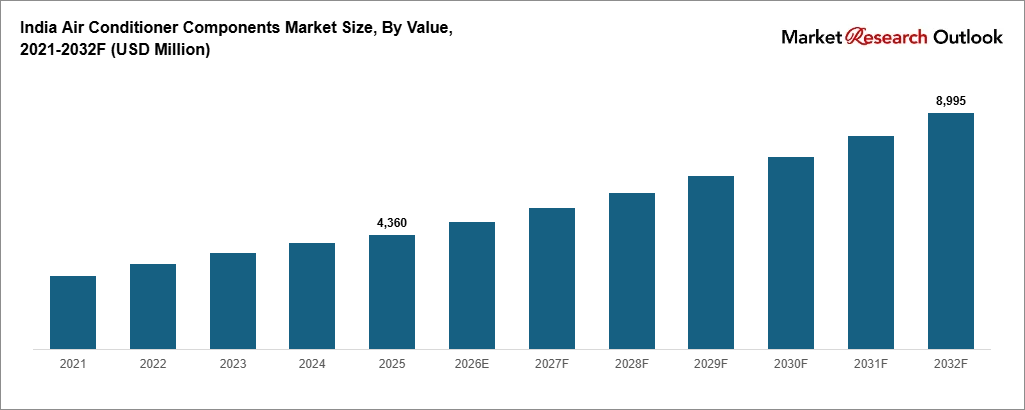
| Market Size (2025) | USD 4,360 Million |
| CAGR (2026-2032) | 10.9% |
| Leading Segment | Compressors (Rotary, Split AC) |
| Fastest Growing Segment | Control Boards, PCBs & BLDC Motors |
| Market Size (2032) | USD 8,995 Million |
Market Overview: India Air Conditioner Components Market
The India air conditioner components market size is growing quickly as the country builds a deeper local supply base for cooling products. Valued at USD 4,360 million in 2025 and projected to reach USD 8,995 million by 2032, growing at a CAGR of 10.9%, the India air conditioner components market is being supported by record room AC sales, harsher summers, and low household penetration that still sits below 10%. Air conditioner components such as compressors, condenser and evaporator coils, fan motors, control boards, copper tubes, and valves make up roughly 60% to 70% of the bill of materials of a split AC, so every new unit sold adds direct demand for air conditioner components. Compressors lead by value, while control boards, PCBs, and BLDC motors are the fastest growing air conditioner components, helped by the near-complete shift to inverter ACs. The PLI scheme for white goods, with an outlay of INR 6,238 crore, has pulled in 85 companies and committed investment of INR 11,198 crore, and contract manufacturers such as Amber Enterprises, EPACK Durable, and PG Electroplast are scaling fast. Together, these shifts are turning the India air conditioner components market into a localised, technology-led, and export-ready manufacturing base with strong long-term potential.
Key Report Takeaways: India Air Conditioner Components Market
- The India air conditioner components market size is projected to grow from USD 4,360 million in 2025 to USD 8,995 million by 2032, registering a strong CAGR of 10.9%, supported by record room AC sales, PLI-led localisation, and the shift toward inverter and energy-efficient ACs.
- Compressors lead the India air conditioner components market share with about 32% to 34% of value in 2025, while heat exchangers, the second largest group of air conditioner components, including condenser and evaporator coils, contribute another 22% to 24%.
- Control boards, PCBs, inverter drives, and BLDC motors are the fastest growing air conditioner components, expanding at 15% to 18% annually as inverter models now account for over 85% of split AC sales in India.
- Domestic value addition in air conditioner components has risen from about 20% to 25% before the PLI scheme to an estimated 50% to 60% today, with industry targets of 70% to 75% by FY28, structurally expanding the India air conditioner components market.
- Rising investment by Daikin, LG Electronics, Panasonic, Amber Enterprises, EPACK Durable, PG Electroplast, Hindalco, and other players in compressors, copper tubes, motors, and electronics is strengthening local supply of air conditioner components and supporting the India air conditioner components market forecast 2032.
Key Market Drivers: India Air Conditioner Components Market
Rising Temperatures, Low AC Penetration, and Record Room AC Sales Driving Air Conditioner Components Demand Across India
Growth in the India air conditioner components market is closely linked to strong demand for room air conditioners. India sold a record 12.5 to 13 million room ACs in FY25 as longer and more intense heatwaves pushed households in North and Central India to buy their first unit. Even so, household AC penetration remains below 10%, compared with more than 60% in China, which leaves large headroom for growth over the next decade. Affordability also improved when GST on air conditioners was cut from 28% to 18% in September 2025, lowering shelf prices by roughly INR 2,500 to INR 4,000 per unit. Industry AC assembly capacity of 24 to 26 million units is expected to rise by 40% to 50% within two years, backed by planned capital spending of INR 4,500 to INR 5,000 crore. Every split AC uses a compressor, two heat exchangers, two fan motors, control boards, and several metres of copper tubing, so higher unit sales translate directly into steady air conditioner components demand across the India air conditioner components market.
PLI Scheme for White Goods and Make in India Accelerating Domestic Air Conditioner Components Manufacturing
The India air conditioner components market is gaining strong support from government policy. The Production Linked Incentive scheme for white goods, approved with an outlay of INR 6,238 crore for FY22 to FY29, offers incentives of 4% to 6% on incremental sales of air conditioner components such as compressors, copper tubes, heat exchangers, BLDC motors, and control assemblies. Across four rounds, 85 companies have been selected with committed investment of INR 11,198 crore and expected cumulative production of about INR 1,90,050 crore. Before the scheme, domestic value addition in air conditioner components stood at only 20% to 25%. It has since climbed to an estimated 50% to 60%, with industry targets of 70% to 75% by FY28 and a long-term goal of 75% to 80%. Large air conditioner components manufacturing clusters in Sri City, Noida, Neemrana, Bhiwadi, Chennai, and Pune now host dedicated air conditioner components plants, reducing lead times and import costs and expanding India air conditioner components market growth.
Energy Efficiency Norms, Inverter Technology Shift, and Low-GWP Refrigerants Raising Component Value Per Unit
Stricter energy efficiency rules and new technology are lifting the value of air conditioner components in each unit in the India air conditioner components market. The Bureau of Energy Efficiency introduced a revised star label from January 2026, raising the efficiency bar and adding an estimated INR 500 to INR 2,500 to the cost of a room AC. Inverter models now make up over 85% of split AC sales, and each inverter AC needs a variable-speed compressor, an inverter drive board, and BLDC fan motors, which together raise air conditioner components value per unit by about 20% to 30% compared with fixed-speed models. India’s commitment under the Kigali Amendment to freeze HFC use from 2028, along with the India Cooling Action Plan, is speeding the move to R-32 and R-290 refrigerants, which need redesigned compressors, valves, and heat exchangers. These changes are pushing buyers toward higher-specification air conditioner components and supporting value growth across the India air conditioner components market through 2032.
Key Market Challenges: India Air Conditioner Components Market
High Import Dependence for Compressors, Electronic Parts, and Critical Sub-Components
The India air conditioner components market continues to depend heavily on imports for several critical parts. Rotary compressors, inverter drive chips, power modules, and some motor magnets used in air conditioner components are still sourced in large volumes from China, Thailand, and Malaysia, and industry estimates suggest that 40% to 50% of air conditioner components value in a typical inverter AC is still imported. Building a compressor plant needs high capital, precision machining, and years of process learning, so only a handful of players have scaled local output. Electronics makers have also asked for a separate incentive scheme for compressors and motors, two of the most critical air conditioner components, to deepen local supply. Currency swings, freight disruptions, and long supplier lead times can delay production during peak season, which makes import dependence a key near-term risk for the India air conditioner components market.
Volatile Copper, Aluminium, and Steel Prices Squeezing Air Conditioner Components Margins
The India air conditioner components market faces steady pressure from raw material price swings. Copper prices on the London Metal Exchange stayed above USD 10,000 per tonne for much of 2025, and copper and aluminium together can account for 35% to 45% of the material cost of heat exchangers, tubes, and motors. Steel used in air conditioner components such as compressor shells, chassis, and outdoor unit casings has also seen periodic price spikes. Air conditioner components makers, especially contract manufacturers working on thin EBITDA margins of 7% to 10%, often cannot pass these costs on fully to brands within the same season. Some air conditioner components players are shifting to aluminium micro-channel coils and thinner inner-grooved copper tubes to manage costs, but input volatility remains a clear margin risk across the India air conditioner components market.
Seasonal Demand Swings and Weather-Linked Volatility Affecting Capacity Utilisation
The India air conditioner components market is highly seasonal, which creates planning challenges for air conditioner components suppliers. More than half of annual room AC sales take place between February and June, and a weak or rainy summer can quickly change demand. Air conditioner components makers must build inventory months ahead of the season, so a sudden slowdown can leave high stocks of compressors, coils, and boards and push capacity utilisation down to 55% to 65% in lean months. Expansion into commercial ACs, VRF systems, and exports helps balance the cycle, but weather-linked volatility remains a near-term challenge for the India air conditioner components market.
Key Market Trends: India Air Conditioner Components Market
Rapid Localisation of Compressors, BLDC Motors, and Copper Tubes in India
The India air conditioner components market is seeing a clear move toward local production of high-value air conditioner components. Daikin has expanded its compressor and AC manufacturing in Neemrana and Sri City and aims to produce 40 lakh room ACs a year in India by 2030, while LG Electronics and Panasonic have added domestic compressor and motor capacity. Copper tube makers such as Hindalco and Mettube are scaling inner-grooved copper tube output for air conditioner components, and contract manufacturers are setting up in-house air conditioner components lines for heat exchangers, sheet metal, plastic parts, and motors. Local compressor capacity, the largest block of air conditioner components value, is expected to cover more than half of domestic demand by 2028. This shift is cutting lead times and freight costs, improving quality control for brands, and reinforcing the India air conditioner components market forecast 2032.
Shift Toward Low-GWP Refrigerants and Smart, IoT-Enabled Controls
A clear technology shift is reshaping the India air conditioner components market. R-32 has become the main refrigerant in new residential ACs, and several brands, led by Godrej, are using R-290 (propane) in selected models because of its very low global warming potential. These refrigerants require redesigned air conditioner components, including compressors, smaller-diameter heat exchangers, and new safety controls. At the same time, Wi-Fi modules, sensors, and smart controllers are becoming standard in mid and premium ACs, adding electronics content to the air conditioner components in each unit. The Electronics Component Manufacturing Scheme, with an outlay of INR 22,919 crore, is expected to support local PCB and module production. Smart and inverter control boards now account for an estimated 13% to 15% of air conditioner components value, strengthening growth across the India air conditioner components market.
Growth of ODM and EMS Contract Manufacturers Reshaping the Supply Chain
A wave of capacity expansion by contract manufacturers is reshaping the India air conditioner components market. Amber Enterprises, EPACK Durable, and PG Electroplast now produce complete ACs and key air conditioner components for many leading brands, and contract manufacturers are estimated to make 35% to 40% of room ACs sold in India. These players are moving up the value chain into air conditioner components such as heat exchangers, motors, PCBs, and cross-flow fans through new plants and joint ventures with global technology partners. Brands such as Voltas, Blue Star, and Panasonic use a mix of in-house and outsourced production to manage seasonal peaks. Combined with PLI incentives and rising export interest from the Middle East, Africa, and the United States, these developments are reinforcing the India air conditioner components market forecast 2032 across the entire value chain.
Segmental Insights: India Air Conditioner Components Market
By End-Use: Residential Segment Dominates the India Air Conditioner Components Market
The residential end-use segment dominates the India air conditioner components market, accounting for an estimated 62% to 65% of total value, driven by record room AC sales, rising incomes, and low household penetration. Split ACs are the main source of air conditioner components demand within this segment, making up close to 80% of room AC volumes, with inverter models taking over 85% of split AC sales. The commercial segment, covering offices, retail, hotels, and restaurants, contributes another 22% to 24% of air conditioner components demand through cassette, ductable, and VRF systems. Industrial applications account for 7% to 9% of air conditioner components demand, while institutional users and data centres hold 5% to 7% and are growing quickly. In 2025, leading players including Daikin, LG Electronics, Voltas, Blue Star, and Amber Enterprises expanded residential production lines, reinforcing segment leadership in the India air conditioner components market.
By Component: Compressors Lead While Control Boards and BLDC Motors Grow Fastest
Compressors lead the India air conditioner components market by component, accounting for about 32% to 34% of total value, because they are the most expensive single part among all air conditioner components. Heat exchangers, including condenser and evaporator coils, contribute another 22% to 24%. Among other air conditioner components, fan motors and blowers hold 11% to 13%, copper tubes, valves, and refrigerant lines account for 9% to 11%, and other parts such as sheet metal, plastic mouldings, and remotes make up 8% to 10%. Control boards, PCBs, and inverter drives, now 13% to 15% of value, are the fastest growing air conditioner components alongside BLDC motors, expanding at 15% to 18% annually through 2032. Leading suppliers including Daikin, Panasonic, Copeland, Tecumseh, and Danfoss have aligned their portfolios to this mix, driving higher-value air conditioner components demand across the India air conditioner components market.
Regional Insights: India Air Conditioner Components Market
Regional analysis of the India air conditioner components market shows that North India accounts for about 34% to 37% of total demand, driven by Delhi NCR, Uttar Pradesh, Rajasthan, Punjab, and Haryana, where long and intense summers support high AC sales. North India is also a major air conditioner components manufacturing hub, with clusters in Noida, Greater Noida, Neemrana, Bhiwadi, and Jhajjar. South India contributes around 28% to 31% of demand, led by Tamil Nadu, Andhra Pradesh, Telangana, and Karnataka, with Sri City and Chennai emerging as key bases for compressor, AC, and air conditioner components plants. West India accounts for 20% to 23%, supported by Maharashtra and Gujarat, where Pune, Mumbai, and Ahmedabad host commercial AC and air conditioner components makers. East and Central India together hold 12% to 15% of air conditioner components demand, led by West Bengal, Bihar, Odisha, and Madhya Pradesh, where first-time AC buying is rising fast. In 2025, capacity additions by Daikin in Rajasthan and Andhra Pradesh, Amber Enterprises and PG Electroplast in Uttar Pradesh and Rajasthan, and EPACK Durable in Andhra Pradesh reinforced regional supply hubs across the India air conditioner components market.
Recent Developments: India Air Conditioner Components Market
- The India air conditioner components market saw continued policy momentum in 2025 and early 2026. Under the fourth round of the PLI scheme for white goods, five companies were shortlisted with committed investment of INR 863 crore and expected production of about INR 8,337 crore, taking cumulative PLI participation to 85 companies and INR 11,198 crore of committed investment across AC and LED components.
- Leading manufacturers have deepened India-focused capacity expansion. Daikin announced plans to manufacture 40 lakh room ACs a year in India by 2030, supported by its compressor and component plants in Neemrana and Sri City. Amber Enterprises, EPACK Durable, and PG Electroplast continued to add capacity for ACs and air conditioner components such as heat exchangers, motors, and electronics, while industry-wide capital spending of INR 4,500 to INR 5,000 crore is planned over the next two to three years, supporting the India air conditioner components market forecast 2032.
- Demand-side reforms have also gained traction in the India air conditioner components market. The GST rate on air conditioners was cut from 28% to 18% in September 2025, and a revised BEE star labelling programme took effect from January 2026, pushing brands toward more efficient inverter models and higher-value air conditioner components, strengthening long-term competitive positioning in the India air conditioner components market.
Key Market Players: India Air Conditioner Components Market
- Amber Enterprises India Limited
- EPACK Durable Limited
- PG Electroplast Limited
- Daikin Airconditioning India Pvt. Ltd.
- LG Electronics India Limited
- Panasonic India Pvt. Ltd.
- Copeland India Pvt. Ltd.
- Tecumseh Products India Pvt. Ltd.
- Danfoss Industries Pvt. Ltd.
- Hindalco Industries Limited
- Mettube Copper India Pvt. Ltd.
- Blue Star Limited
- Voltas Limited
| By Component | By AC Type | By Refrigerant Type | By Sales Channel | By End-Use |
| Compressors (Rotary, Scroll, Reciprocating) Heat Exchangers (Condenser & Evaporator Coils) Fan Motors & Blowers (BLDC, PSC) Control Boards, PCBs & Inverter Drives Copper Tubes, Valves & Refrigerant Lines Others (Sheet Metal, Plastic Mouldings, Remotes) |
Split AC Window AC Cassette AC Tower & Floor-Standing AC Ductable & Packaged AC VRF/VRV Systems |
R-32 R-410A R-290 (Propane) R-22 & Others |
OEM (In-House Manufacturing) Contract Manufacturers (ODM & EMS) Aftermarket & Replacement |
Residential Commercial Industrial Institutional & Data Centres |
Report Scope
In this report, the India Air Conditioner Components Market has been segmented into the following categories, in addition to detailed analysis of key industry trends, market dynamics, competitive landscape, and growth opportunities across the forecast period:
- By Component
- Compressors (Rotary, Scroll, Reciprocating)
- Heat Exchangers (Condenser & Evaporator Coils)
- Fan Motors & Blowers (BLDC, PSC)
- Control Boards, PCBs & Inverter Drives
- Copper Tubes, Valves & Refrigerant Lines
- Others (Sheet Metal, Plastic Mouldings, Remotes)
- By AC Type
- Split AC
- Window AC
- Cassette AC
- Tower & Floor-Standing AC
- Ductable & Packaged AC
- VRF/VRV Systems
- By Refrigerant Type
- R-32
- R-410A
- R-290 (Propane)
- R-22 & Others
- By Sales Channel
- OEM (In-House Manufacturing)
- Contract Manufacturers (ODM & EMS)
- Aftermarket & Replacement
- By End-Use
- Residential
- Commercial
- Industrial
- Institutional & Data Centres
- By Geography
- North India
- South India
- West India
- East India
- Central India
Competitive Landscape
Company Profiles:
Detailed analysis of the leading companies operating in the India Air Conditioner Components Market, including business overview, product portfolio, strategic initiatives, competitive positioning, and recent developments.
Company Information
Detailed profiling and strategic analysis of additional market players (up to five companies), including emerging domestic air conditioner components makers, specialised compressor and motor suppliers, PCB and electronics manufacturers, or regional copper tube and heat exchanger producers.
For a free sample of the India Air Conditioner Components Market report, customised insights or delivery timelines, submit your query here
India Air Conditioner Components Market, 2032
- Research Framework
- Market Segmentation
- Research Objective
- Research Methodology
- Qualitative Research
- Primary Research
- Secondary Research
- Quantitative Research
- Market Breakdown & Data Triangulation
- Demand Side
- Supply Side
- Primary Research Respondents
- Assumption & Limitation
- Executive Summary
- Market Overview, 2021-2032
- By Component
- By AC Type
- By Refrigerant Type
- By Sales Channel
- By End-Use
- By Region
- Analyst Recommendations
- Geopolitical Impact on India Air Conditioner Components Market
- India Air Conditioner Components Market Insights
- Market Dynamics
- Growth Drivers
- Rising temperatures, low AC penetration, and record room AC sales driving air conditioner components demand across India.
- PLI scheme for white goods and Make in India accelerating domestic air conditioner components manufacturing.
- Energy efficiency norms, inverter technology shift, and low-GWP refrigerants raising component value per unit.
- Restraints
- High import dependence for compressors, electronic parts, and critical air conditioner components.
- Volatile copper, aluminium, and steel prices squeezing air conditioner components margins.
- Seasonal demand swings and weather-linked volatility affecting capacity utilisation.
- Opportunities
- Localisation of compressors, BLDC motors, and copper tubes creating import substitution opportunities for air conditioner components.
- Low-GWP refrigerants and smart, IoT-enabled controls opening higher-value air conditioner components demand.
- Growth of ODM and EMS contract manufacturing creating large-scale air conditioner components sourcing opportunities.
- Challenges
- Shortage of skilled technicians and tooling capability for precision air conditioner components manufacturing.
- Long qualification cycles and strict quality approvals for air conditioner components required by global AC brands.
- Competition from low-cost imported air conditioner components from China and Southeast Asia.
- Technological Advancements
- Recent Technological Advancements
- Prior to 2020
- Porter’s Five Forces Analysis
- PESTLE Analysis
- Industry Value Chain & Entry Points
- Upstream Raw Materials for Air Conditioner Components (copper, aluminium, steel, engineering plastics, refrigerants, semiconductors)
- Air Conditioner Components: Compressor & Motor Manufacturers (Daikin, LG Electronics, Panasonic, Copeland, Tecumseh)
- Air Conditioner Components: Heat Exchanger, Copper Tube & Coil Makers (Hindalco, Mettube, Amber Enterprises, EPACK Durable)
- Air Conditioner Components: Electronics, PCB & Inverter Drive Suppliers (EMS companies, semiconductor and module distributors)
- Air Conditioner Components: Valves, Controls & Refrigerant Line Suppliers (Danfoss and specialised valve makers)
- Air Conditioner Components Testing, Certification & Standards Bodies (BIS, BEE, NABL-accredited laboratories)
- Air Conditioner Components Contract Manufacturers & ODMs (Amber Enterprises, EPACK Durable, PG Electroplast)
- AC Brand Owners & OEMs (Voltas, Blue Star, Daikin, LG Electronics, Panasonic, Lloyd)
- Distribution, Aftermarket & Service Networks for Air Conditioner Components (dealers, spare parts distributors, service centres)
- End-Users (households, offices, retail, hospitality, factories, hospitals, data centres)
- India Air Conditioner Components Market: Regulatory Framework
- India Air Conditioner Components Market Overview
- Market Size & Forecast, 2021-2032
- By Value (USD Million)
- By Volume (Million Units)
- Market Share & Forecast
- By Component
- Compressors (Rotary, Scroll, Reciprocating)
- Heat Exchangers (Condenser & Evaporator Coils)
- Fan Motors & Blowers (BLDC, PSC)
- Control Boards, PCBs & Inverter Drives
- Copper Tubes, Valves & Refrigerant Lines
- Others (Sheet Metal, Plastic Mouldings, Remotes)
- By AC Type
- Split AC
- Window AC
- Cassette AC
- Tower & Floor-Standing AC
- Ductable & Packaged AC
- VRF/VRV Systems
- By Refrigerant Type
- R-32
- R-410A
- R-290 (Propane)
- R-22 & Others
- By Sales Channel
- OEM (In-House Manufacturing)
- Contract Manufacturers (ODM & EMS)
- Aftermarket & Replacement
- By End-Use
- Residential
- Commercial
- Industrial
- Institutional & Data Centres
- By Geography
- North India
- South India
- West India
- East India
- Central India
- Competitive Landscape
- India Air Conditioner Components Market Company Market Share Analysis, 2025
- Competitive Benchmarking, By Operating Parameters
- Key Strategic Development (Mergers, Acquisitions, Partnerships, Etc.)
- List of Emerging Air Conditioner Components Players
- Company Profile
- Amber Enterprises India Limited
- Introduction & Company Profile
- Product Benchmarking
- Strategic Outlook
- Key Competitors
- Financial Analysis
- SWOT Analysis
(Same Data Pointers Will Be Provided for The Below Companies)
- EPACK Durable Limited
- PG Electroplast Limited
- Daikin Airconditioning India Pvt. Ltd.
- LG Electronics India Limited
- Panasonic India Pvt. Ltd.
- Copeland India Pvt. Ltd.
- Tecumseh Products India Pvt. Ltd.
- Danfoss Industries Pvt. Ltd.
- Hindalco Industries Limited
- Mettube Copper India Pvt. Ltd.
- Blue Star Limited
- Voltas Limited
- Other Prominent Players
* Financial information in case of non-listed companies will be provided as per availability
** The segmentation and the companies are subjected to modifications based on in-depth secondary for the final deliverable
Frequently Asked Questions
1. How large is the India air conditioner components market and what is its growth forecast?
Ans: The India air conditioner components market is valued at USD 4,360 million in 2025 and is projected to reach USD 8,995 million by 2032, growing at a CAGR of 10.9%.
2. Which segments are driving demand in the India air conditioner components market?
Ans: Compressors lead with about 32% to 34% of value, residential ACs account for 62% to 65% of demand, and control boards and BLDC motors are the fastest growing segments.
3. What are the key drivers of growth in the India air conditioner components market?
Ans: Key drivers include record room AC sales, low household penetration, the PLI scheme for white goods, the GST cut on ACs, and the shift toward inverter technology.
4. Which regions are driving growth in the India air conditioner components market?
Ans: North India leads with about 34% to 37% of demand and major hubs in Noida and Neemrana, followed by South India, where Sri City and Chennai host key plants.
5. What are the latest trends in the India air conditioner components market?
Ans: Major trends include local production of compressors and motors, low-GWP refrigerants such as R-32 and R-290, smart IoT controls, and the rapid growth of contract manufacturers.