

India Wind Turbine Market, 2032
- Energy, Power & Storage, Renewables & Clean Fuels
- Nov 2026
- Pages 140
- Report Format: pdf
- Report Price: $2400 USD
India’s wind turbine market is witnessing strong structural growth, driven by the national target of 100 GW of wind capacity by 2030, record installations of 6.05 GW in FY2025-26, rising C&I and open access demand, hybrid, FDRE, and round-the-clock tenders, a shift toward 5 MW class turbines, and rising interest from domestic and global OEMs investing in India-specific turbine platforms, blade and tower capacity, and ALMM-compliant supply chains.
| Study Duration | 2021-2032 |
| Market Size (2025) | USD 3,945 Million |
| CAGR (2026-2032) | 11.2% |
| Leading Segment | 3.1 MW to 4 MW Turbines (Onshore Greenfield) |
| Fastest Growing Segment | 5.1 MW to 6 MW Turbines & Wind-Solar Hybrid Projects |
| Market Size (2032) | USD 8,295 Million |
Market Overview: India Wind Turbine Market
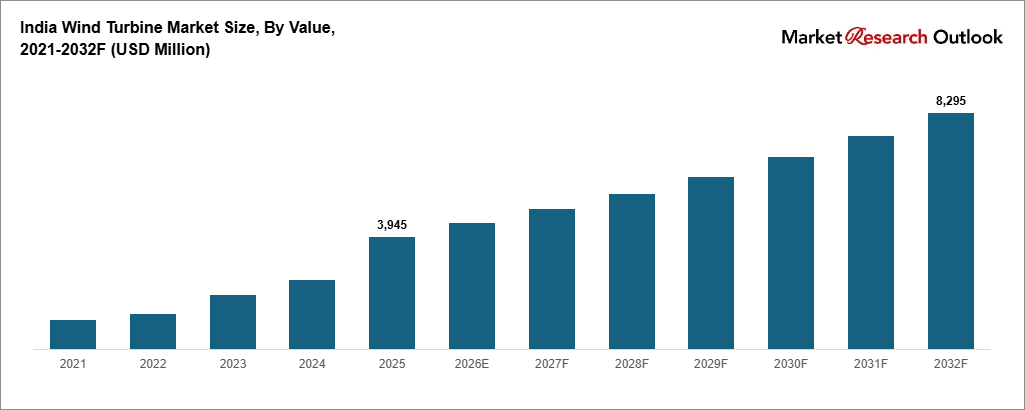
The India wind turbine market size is witnessing rapid expansion, driven by record capacity additions, rising C&I demand for green power, competitive central and state auctions, hybrid and FDRE tenders, and a steady move toward higher-rated turbines with longer blades and taller towers. Valued at USD 3,945 million in 2025 and projected to reach USD 8,295 million by 2032, growing at a CAGR of 11.2%, market growth is being fuelled by the national target of 100 GW of wind capacity by 2030 and 156 GW by 2036, a 28 GW project pipeline under implementation, and a domestic manufacturing base of 24 GW per year. Turbines in the 3.1 MW to 4 MW class lead current shipments, while the 5.1 MW to 6 MW class is emerging as the fastest growing category. Wind generation reached 106 billion units in FY2025-26, up from 83 billion units in FY2024-25, confirming the role of wind as the evening and night partner to solar power. As domestic OEMs including Suzlon Energy, Inox Wind, Adani Wind, and JSW Energy expand capacity, and global OEMs including Envision, GE Vernova, Vayona Energy, Vestas, and SANY localise blades, nacelles, and hubs, the sector is evolving into a localised, technology-led, and export-ready industry with strong long-term growth potential.
Key Report Takeaways: India Wind Turbine Market
- The India wind turbine market size is projected to grow from USD 3,945 million in 2025 to USD 8,295 million by 2032, registering a strong CAGR of 11.2%, driven by national capacity targets, record annual installations, and the structural shift toward hybrid, FDRE, and C&I-led wind projects across India.
- Turbines rated 3.1 MW to 4 MW dominate the market, accounting for 47% of total value in 2025, driven by proven platforms such as Suzlon’s S144, Vayona Energy’s SG 3.4-145, Inox Wind’s 3.3 MW, and GE Vernova’s 3.8 MW-154, which suit the moderate wind regimes of Gujarat, Karnataka, and Rajasthan.
- Turbines rated 5.1 MW to 6 MW are emerging as the fastest growing segment, expected to grow at a CAGR of 19.6% through 2032, as Adani Wind’s 5.2 MW and Venwind Refex’s 5.3 MW platforms gain ALMM-Wind listing and developers seek higher yield from limited land parcels.
- Record installations of 6,057 MW in FY2025-26, up 46% from 4,151 MW in FY2024-25, and a further 28 GW of capacity under implementation are structurally expanding turbine demand across utility, hybrid, and C&I project categories.
- Rising investments by domestic and global OEMs such as Suzlon Energy, Inox Wind, Adani Wind, Envision, and GE Vernova in blade, nacelle, and tower capacity, which has lifted national wind equipment manufacturing to 24 GW per year with localisation above 70% in blades, towers, and gearboxes, are strengthening local supply and supporting the India wind turbine market forecast 2032.
Key Market Drivers: India Wind Turbine Market
National Capacity Targets, Record Auctions, and Renewable Purchase Obligations Driving Wind Turbine Demand Across India
Growth in the India wind turbine market is being driven by firm national capacity targets, a steady pipeline of central and state auctions, and a dedicated wind component within Renewable Purchase Obligations. The government targets 100 GW of wind capacity by 2030 and 156 GW by 2036, against 58.14 GW installed as of 31 July 2026, which means annual additions must rise toward 10 GW. FY2025-26 already delivered a record 6,057 MW, the highest annual addition in nearly a decade and above the earlier peak of 5.5 GW in FY2016-17. Central agencies including SECI, NTPC, NHPC, and SJVN, along with state utilities such as GUVNL, continue to award wind, hybrid, and FDRE capacity, with SECI Tranche XIX alone covering 1,200 MW in February 2026. India’s wind potential is assessed at 1,164 GW at 150 m hub height, pointing to large long-term headroom. Gujarat, Tamil Nadu, and Karnataka hold 65% of installed capacity, while Rajasthan, Maharashtra, and Andhra Pradesh are adding new sites, creating strong structural pull-through demand across the sector.
Commercial and Industrial Open Access Demand, Hybrid Projects, and Round-the-Clock Green Power Fuelling Turbine Adoption
The India wind turbine market is benefiting from fast-rising demand from commercial and industrial buyers, who accounted for 4.5 GW, or 75%, of wind additions in FY2025-26. The Green Energy Open Access Rules lowered the open access threshold from 1 MW to 100 kW, allowing mid-sized factories, data centres, and commercial campuses to contract wind power directly. Steel, cement, chemicals, automotive, and data centre operators are signing long-term wind and wind-solar hybrid agreements to meet decarbonisation commitments and lower power bills. Because wind produces nearly 45% of its output during peak evening and night hours, it pairs well with solar in hybrid, FDRE, and round-the-clock contracts. The lowest recent L1 tariff of INR 3.43 per kWh, discovered in GUVNL Phase X in December 2025, keeps wind competitive against new thermal power. Developers such as Tata Power, Torrent Power, JSW Energy, and Sunsure have placed fresh turbine orders, including Tata Power’s 400 MW and Torrent Power’s 250 MW orders with Suzlon, strengthening the order pipeline for OEMs.
Larger Turbine Platforms, ALMM-Wind Localisation, and Domestic Manufacturing Strengthening Supply-Side Growth
Rapid growth in turbine size and domestic manufacturing is a major catalyst for the sector, with the 5.1 MW to 6 MW segment projected to grow at a CAGR of 19.6% through 2032. Rotor diameters above 140 m and hub heights up to 160 m are now standard on new onshore projects, lifting capacity utilisation at inland low-wind sites. National wind turbine manufacturing capacity rose from 10 GW in 2014 to 24 GW by March 2026, with blade capacity at 15.57 GW, led by Gujarat, Tamil Nadu, and Andhra Pradesh. The ALMM-Wind amendment of July 2025 made it mandatory for listed turbines to use major components, including blades, towers, gearboxes, generators, and special bearings, from listed manufacturers, while new models receive a two-year exemption up to 800 MW. Suzlon Energy delivered 2,456 MW in FY2025-26, Adani Wind runs a 2.25 GW plant at Mundra, Envision operates 3 GW of Indian capacity, and Inox Wind has 2.5 GW of annual capacity. These developments are structurally expanding turbine demand across all major end-user categories through 2032.
Key Market Challenges: India Wind Turbine Market
Land Acquisition, Transmission Delays, and Grid Curtailment Slowing Wind Project Execution
The India wind turbine market continues to face challenges around land acquisition, right-of-way, environmental clearances, and grid connectivity, which delay projects and raise costs for developers and turbine suppliers. Wind farms need large land parcels and long internal roads for blade and tower transport, which are hard to secure in densely farmed regions. More than 45 GW of awarded renewable capacity is still waiting for power purchase or power sale agreements, which delays the conversion of tenders into turbine orders. India also needs 10 GW of annual wind additions to meet the 2035-36 target, well above recent delivery levels. These execution bottlenecks hold back faster turbine shipments across the country.
Tariff Pressure, Tighter Deviation Settlement Rules, and Payment Risks Weighing on Project Economics
Turbine suppliers face margin pressure from competitive auction tariffs, tighter forecasting rules, and payment risks at the distribution utility level. Wind tariffs fell to a record low of INR 2.43 per kWh during the earlier reverse auction phase and stayed low until end-2022, which squeezed developer returns and turbine pricing. Although tariffs have recovered since 2023, the lowest recent L1 tariff of INR 3.43 per kWh still leaves limited room for cost increases in steel, copper, and resins. In April 2026, CERC narrowed the permitted deviation band from ±15% to ±10%, raising penalty exposure for wind projects whose output varies with weather. Late payments by some DISCOMs, partly addressed by the Late Payment Surcharge rules, continue to affect working capital. While a 500 MW Contracts for Difference pilot and blended finance frameworks are under development, revenue certainty remains a near-term challenge for the industry.
Supply Chain Gaps in Special Bearings, Offshore Tender Setbacks, and Low Factory Utilisation Impacting Turbine Margins
Turbine makers face practical constraints around component localisation, offshore project viability, and uneven factory loading. Special bearings for main shafts, pitch, and yaw systems still depend heavily on imports, and MNRE extended the bearing compliance deadline under ALMM-Wind in February 2026. Offshore wind has yet to see an awarded project, as SECI cancelled 4.5 GW of tenders in 2025, including 500 MW off Gujarat and 4,000 MW of seabed lease rights off Tamil Nadu, after receiving no bids. Estimated offshore tariffs of INR 10.50 per kWh in Gujarat and INR 9.60 per kWh in Tamil Nadu remain far above grid tariffs, despite viability gap funding of INR 6,853 crore for the first 1 GW. Domestic factories with 24 GW of turbine capacity also run below full utilisation, which pushes OEMs to seek exports. Domestic bearing lines, port upgrades, and repeat offshore tenders are emerging as solutions, but lead times remain long across the supply chain.
Key Market Trends: India Wind Turbine Market
Rapid Shift Toward 5 MW Class Turbines With Larger Rotors and Taller Hubs in India
The sector is undergoing a clear technology shift toward 5 MW class turbines with rotors above 170 m and hub heights up to 160 m, with these platforms expected to make up 54% of new turbine value by 2027. Suzlon’s S175 delivers 5 MW with a 175 m rotor on a 160 m hybrid lattice tower, Adani Wind has commissioned more than 2 GW of its 5.2 MW turbines at Khavda in Gujarat, and Venwind Refex’s 5.3 MW GWH182 gained ALMM-Wind listing in March 2026 with a 183.5 m rotor. Envision supplies 5 MW class machines, while Inox Wind is moving toward a 4.X MW platform. Larger turbines cut the number of foundations, roads, and land parcels needed per megawatt, which matters in states where land is the main constraint. Sunsure’s 105 MW order for 21 S175 units shows early commercial uptake. This product transition is reinforcing the India wind turbine market forecast 2032 across both utility and C&I project categories.
Growth of Wind-Solar Hybrid, FDRE, and Round-the-Clock Projects in the India Wind Turbine Market
A clear shift toward wind-solar hybrid, firm and dispatchable renewable energy (FDRE), and round-the-clock (RTC) projects is reshaping turbine demand, particularly in the utility and C&I segments. Central auctions by SECI, NTPC, NHPC, and SJVN now cover standalone wind, hybrid, FDRE, and RTC capacity, and SJVN’s 600 MW ISTS tender in March 2026 cleared at INR 3.64 per kWh. Because wind output peaks in the evening and at night, developers pair it with solar and battery storage to meet firm supply clauses, which raises the wind share in hybrid portfolios. Large IPPs such as ReNew, Adani Green Energy, JSW Energy, Tata Power, and Torrent Power are building multi-gigawatt hybrid parks in Gujarat, Rajasthan, Karnataka, and Andhra Pradesh. Wind-solar hybrid projects account for 13% of turbine demand in 2025 and are expected to reach 24% by 2032, with storage-linked tenders set to drive the next phase of turbine orders across India.
Repowering of Ageing Wind Fleets and Export-Oriented Turbine Manufacturing
A wave of repowering and export-led manufacturing is reshaping the turbine supply base. The National Repowering and Life Extension Policy of December 2023 estimates repowering potential at 25.4 GW across turbines below 2 MW, and requires repowered projects to raise annual generation by at least 1.5 times within three years. Repowering projects can borrow from REC, PFC, and IREDA on new-project terms, with an added 0.25% interest rebate from IREDA. Many early turbines in Tamil Nadu and Gujarat sit at the best wind sites, so replacing them with 3 MW to 5 MW machines can lift output sharply on the same land. On the export side, India is the second-largest onshore assembly and component hub in Asia-Pacific, and OEMs are using spare factory capacity to ship blades, towers, and nacelles abroad. Combined with the Green Energy Corridor build-out and offshore wind tenders expected in the second half of 2026, these developments are reinforcing the India wind turbine market forecast 2032 across the entire value chain.
Segmental Insights: India Wind Turbine Market
By End-User: Independent Power Producers Segment Dominates the India Wind Turbine Market
The independent power producers end-user segment dominates the India wind turbine market, accounting for 61% of total value in 2025, driven by large central auction wins, C&I power supply contracts, and hybrid park development. Turbines rated 3.1 MW to 4 MW are the dominant platform within this segment, with onshore greenfield projects capturing 84% of IPP turbine purchases. The commercial and industrial corporates segment contributes another 24% of demand, driven by captive and group captive projects for steel, cement, chemicals, and data centre operators. Public sector utilities and PSUs account for 13%, led by NTPC, NHPC, NLC India, SJVN, and Indian Oil, while other buyers make up the remaining 2%. In 2025 and 2026, leading developers including ReNew, Adani Green Energy, JSW Energy, Tata Power, and Torrent Power placed large turbine orders with Suzlon, Inox Wind, and Envision, reinforcing segment dominance.
By Turbine Capacity: 3.1 MW to 4 MW Leads While 5.1 MW to 6 MW Grows Fastest
Turbines rated 3.1 MW to 4 MW lead the product mix, accounting for 47% of total turbine value in 2025, driven by proven reliability, wide ALMM-Wind listing, and a strong fit with moderate wind sites. The 4.1 MW to 5 MW class contributes another 22%, led by Envision and Suzlon’s 5 MW S175, while the 2.1 MW to 3 MW class holds 11% across older platform orders and small C&I projects. Turbines rated 5.1 MW to 6 MW are the fastest growing category, expanding at a CAGR of 19.6%, driven by Adani Wind’s 5.2 MW and Venwind Refex’s 5.3 MW platforms and better energy yield per acre. The 5.1 MW to 6 MW class holds 19% of value today, while machines up to 2 MW hold 1%, limited to small distributed and hilly sites. Turbines above 6 MW are expected to enter with the first offshore projects after 2029. Leading OEMs including Suzlon, Inox Wind, Adani Wind, Envision, and GE Vernova have aligned product portfolios to this capacity mix, driving higher-rated turbine adoption across the country.
Regional Insights: India Wind Turbine Market
Regional analysis of the India wind turbine market shows that West India and South India together account for 80% of total turbine value in 2025, driven by Gujarat (Khavda and Kutch wind zones), Maharashtra, Tamil Nadu (Tirunelveli and Coimbatore belt), Karnataka, and Andhra Pradesh, supported by high wind potential, mature transmission links, and strong C&I demand. Gujarat leads with 16,086 MW of installed wind capacity, followed by Tamil Nadu with 12,273 MW and Karnataka with 8,896 MW as of June 2026. North India contributes 12% of demand, led by Rajasthan with 5,516 MW installed and new hybrid parks in the Fatehgarh and Jaisalmer region. Central and East India together account for 8% of demand, supported by Madhya Pradesh, where wind sites are being paired with solar under hybrid tenders. In 2025 and 2026, Adani Wind’s Mundra plant, Suzlon’s 1,325 MW Andhra Pradesh project, GE Vernova’s 163.4 MW Fatehgarh order, and Envision’s Indian plants reinforced regional supply hubs, supporting closer execution of utility and C&I projects across key wind states.
Recent Developments: India Wind Turbine Market
- India’s wind turbine industry witnessed strong momentum in installations and order intake during 2025 and 2026. India added a record 6,057 MW of wind capacity in FY2025-26, a 46% year-on-year increase from 4,151 MW in FY2024-25, according to MNRE data. Cumulative wind capacity reached 58.14 GW by 31 July 2026, with 28 GW under implementation, while wind generation rose to 106 billion units in FY2025-26 from 83 billion units a year earlier.
- Turbine OEMs have deepened India-focused capacity and order books. Suzlon Energy delivered 2,456 MW in FY2025-26 and held an order book of 6.1 GW at the end of Q1 FY2027, including orders from Tata Power, Waaree, Sunsure, and Torrent Power. Inox Wind built an order book of 4.7 GW and won a 200 MW turnkey project from NLC India in July 2026 and a 100 MW project from Indian Oil in September 2026. GE Vernova secured 263.4 MW of orders in 2026, and Siemens Gamesa’s Indian business relaunched as Vayona Energy after a majority stake sale to a TPG-led consortium. These developments are strengthening domestic supply and supporting long-term growth.
- Policy momentum has gained strong traction across the sector. In July 2025, MNRE amended the ALMM-Wind procedure to make listed sources mandatory for blades, towers, gearboxes, generators, and special bearings, followed by standard operating procedures for ALMM-Wind listing in late 2025. Offshore wind tenders backed by viability gap funding are expected in the second half of 2026, and a 500 MW Contracts for Difference pilot is under preparation. Together with the national target of 156 GW by 2036, these measures are positioning India as one of the most actively scaling onshore wind markets globally, strengthening long-term competitive positioning in the India wind turbine market forecast 2032.
Key Market Players: India Wind Turbine Market
- Suzlon Energy Limited
- Inox Wind Limited
- Envision Energy India Pvt. Ltd.
- Adani Wind (Adani New Industries Limited)
- GE Vernova India
- Vayona Energy (formerly Siemens Gamesa Renewable Power Pvt. Ltd.)
- Vestas Wind Technology India Pvt. Ltd.
- Senvion India Pvt. Ltd.
- SANY Renewable Energy India
- Venwind Refex Power Limited
- JSW Energy Limited (Wind Turbine Manufacturing)
- Windar Renewable Energy Pvt. Ltd.
- ZF Wind Power Coimbatore Pvt. Ltd.
| By Turbine Capacity | By Component | By Installation Type | By Offtake Model | By End-User |
| Up to 2 MW 2.1 MW to 3 MW 3.1 MW to 4 MW 4.1 MW to 5 MW 5.1 MW to 6 MW Above 6 MW |
Rotor Blades Gearbox & Drivetrain Generator Tower Nacelle & Hub Pitch & Yaw Systems Power Converters & Others |
Onshore Greenfield Onshore Repowering Wind-Solar Hybrid Offshore Fixed-Bottom Offshore Floating |
Central PSU Tenders (SECI, NTPC, NHPC, SJVN) State DISCOM Tenders C&I Open Access Captive & Group Captive Hybrid, FDRE & RTC Tenders Merchant & Exchange-Linked Projects |
Independent Power Producers Public Sector Utilities & PSUs Commercial & Industrial Corporates Others |
Report Scope
In this report, the India Wind Turbine Market has been segmented into the following categories, in addition to detailed analysis of key industry trends, market dynamics, competitive landscape, and growth opportunities across the forecast period:
- By Turbine Capacity
- Up to 2 MW
- 2.1 MW to 3 MW
- 3.1 MW to 4 MW
- 4.1 MW to 5 MW
- 5.1 MW to 6 MW
- Above 6 MW
- By Component
- Rotor Blades
- Gearbox & Drivetrain
- Generator
- Tower
- Nacelle & Hub
- Pitch & Yaw Systems
- Power Converters & Others
- By Installation Type
- Onshore Greenfield
- Onshore Repowering
- Wind-Solar Hybrid
- Offshore Fixed-Bottom
- Offshore Floating
- By Offtake Model
- Central PSU Tenders (SECI, NTPC, NHPC, SJVN)
- State DISCOM Tenders
- C&I Open Access
- Captive & Group Captive
- Hybrid, FDRE & RTC Tenders
- Merchant & Exchange-Linked Projects
- By End-User
- Independent Power Producers
- Public Sector Utilities & PSUs
- Commercial & Industrial Corporates
- Others
- By Geography
- North India
- South India
- West India
- East India
- Central India
Competitive Landscape
Company Profiles:
Detailed analysis of the leading companies operating in the India Wind Turbine Market, including business overview, product portfolio, strategic initiatives, competitive positioning, and recent developments.
Company Information
Detailed profiling and strategic analysis of additional market players (up to five companies), including emerging domestic turbine OEMs, blade and tower makers, drivetrain and bearing suppliers, or niche repowering and service providers.
For a free sample of the India Wind Turbine Market report, customised insights or delivery timelines, submit your query here
India Wind Turbine Market, 2032
- Research Framework
- Market Segmentation
- Research Objective
- Research Methodology
- Qualitative Research
- Primary Research
- Secondary Research
- Quantitative Research
- Market Breakdown & Data Triangulation
- Demand Side
- Supply Side
- Primary Research Respondents
- Assumption & Limitation
- Executive Summary
- Market Overview, 2021-2032
- By Turbine Capacity
- By Component
- By Installation Type
- By Offtake Model
- By End-User
- By Region
- Analyst Recommendations
- Geopolitical Impact on India Wind Turbine Market
- India Wind Turbine Market Insights
- Market Dynamics
- Growth Drivers
- National capacity targets, record auctions, and renewable purchase obligations driving wind turbine demand across India.
- Commercial and industrial open access demand, hybrid projects, and round-the-clock green power fuelling turbine adoption.
- Larger turbine platforms, ALMM-Wind localisation, and domestic manufacturing strengthening supply-side growth.
- Restraints
- Land acquisition, transmission delays, and grid curtailment slowing wind project execution.
- Tariff pressure, tighter deviation settlement rules, and payment risks weighing on project economics.
- Supply chain gaps in special bearings, offshore tender setbacks, and low factory utilisation impacting turbine margins.
- Opportunities
- Repowering of a 25.4 GW fleet of sub-2 MW turbines opening high-yield replacement demand at prime wind sites.
- Wind-solar hybrid, FDRE, and round-the-clock tenders supporting next-generation growth in firm green power supply.
- Offshore wind off Gujarat and Tamil Nadu and export-oriented manufacturing creating new turbine and component demand.
- Challenges
- Over 45 GW of awarded renewable capacity awaiting power purchase and power sale agreements.
- Narrower ±10% deviation band raising forecasting and penalty costs for variable wind generation.
- Import dependence for main, pitch, and yaw bearings and long lead times for heavy-lift turbine logistics.
- Technological Advancements
- Recent Technological Advancements
- Prior to 2020
- Porter’s Five Forces Analysis
- PESTLE Analysis
- Industry Value Chain & Entry Points
- Upstream Raw Materials (steel plates, glass fibre, epoxy resins, balsa and PET core, copper, rare earth magnets)
- Wind Turbine OEMs (Suzlon, Inox Wind, Envision, Adani Wind, GE Vernova)
- Component Suppliers (rotor blades, towers, castings, forgings, special bearings)
- Drivetrain & Electrical System Suppliers (gearboxes, generators, power converters, pitch and yaw systems)
- Testing, Certification & Standards (NIWE, ALMM-Wind, IEC 61400, BIS)
- Project Developers & IPPs (ReNew, Adani Green Energy, JSW Energy, Tata Power, Torrent Power)
- EPC, Logistics & Installation Contractors (turnkey EPC, heavy-lift cranes, blade and tower transport)
- Power Offtakers & Tender Agencies (SECI, NTPC, NHPC, SJVN, GUVNL, state DISCOMs)
- Operations, Maintenance & Repowering Service Providers (OEM O&M teams, independent service providers)
- End-Users (independent power producers, public sector utilities, C&I corporates, captive industrial producers)
- India Wind Turbine Market: Regulatory Framework
- India Wind Turbine Market Overview
- Market Size & Forecast, 2021-2032
- By Value (USD Million)
- By Volume (MW)
- Market Share & Forecast
- By Turbine Capacity
- Up to 2 MW
- 2.1 MW to 3 MW
- 3.1 MW to 4 MW
- 4.1 MW to 5 MW
- 5.1 MW to 6 MW
- Above 6 MW
- By Component
- Rotor Blades
- Gearbox & Drivetrain
- Generator
- Tower
- Nacelle & Hub
- Pitch & Yaw Systems
- Power Converters & Others
- By Installation Type
- Onshore Greenfield
- Onshore Repowering
- Wind-Solar Hybrid
- Offshore Fixed-Bottom
- Offshore Floating
- By Offtake Model
- Central PSU Tenders (SECI, NTPC, NHPC, SJVN)
- State DISCOM Tenders
- C&I Open Access
- Captive & Group Captive
- Hybrid, FDRE & RTC Tenders
- Merchant & Exchange-Linked Projects
- By End-User
- Independent Power Producers
- Public Sector Utilities & PSUs
- Commercial & Industrial Corporates
- Others
- By Geography
- North India
- South India
- West India
- East India
- Central India
- Competitive Landscape
- India Wind Turbine Market Company Market Share Analysis, 2025
- Competitive Benchmarking, By Operating Parameters
- Key Strategic Development (Mergers, Acquisitions, Partnerships, Etc.)
- List of Emerging Players
- Company Profile
- Suzlon Energy Limited
- Introduction & Company Profile
- Product Benchmarking
- Strategic Outlook
- Key Competitors
- Financial Analysis
- SWOT Analysis
(Same Data Pointers Will Be Provided for The Below Companies)
- Inox Wind Limited
- Envision Energy India Pvt. Ltd.
- Adani Wind (Adani New Industries Limited)
- GE Vernova India
- Vayona Energy (formerly Siemens Gamesa Renewable Power Pvt. Ltd.)
- Vestas Wind Technology India Pvt. Ltd.
- Senvion India Pvt. Ltd.
- SANY Renewable Energy India
- Venwind Refex Power Limited
- JSW Energy Limited (Wind Turbine Manufacturing)
- Windar Renewable Energy Pvt. Ltd.
- ZF Wind Power Coimbatore Pvt. Ltd.
- Other Prominent Players
* Financial information in case of non-listed companies will be provided as per availability
** The segmentation and the companies are subjected to modifications based on in-depth secondary for the final deliverable
Frequently Asked Questions
1. How large is the India wind turbine market and what is its growth forecast?
Ans: The India wind turbine market is valued at USD 3,945 million in 2025 and is projected to reach USD 8,295 million by 2032, growing at a CAGR of 11.2%, supported by national capacity targets and record installations.
2. Which segments are driving demand in the India wind turbine market?
Ans: Turbines rated 3.1 MW to 4 MW lead with 47% of 2025 value, while the 5.1 MW to 6 MW class grows fastest at a CAGR of 19.6%, driven by larger rotors and better energy yield per acre.
3. What are the key drivers of growth in the India wind turbine market?
Ans: Key drivers include the 100 GW wind target for 2030, record auctions, renewable purchase obligations, rising C&I open access demand, hybrid and FDRE tenders, larger turbine platforms, and 24 GW of domestic manufacturing capacity.
4. Which regions are driving growth in the India wind turbine market?
Ans: West India and South India lead with 80% of 2025 turbine value, driven by Gujarat, Tamil Nadu, Karnataka, Maharashtra, and Andhra Pradesh. North India, led by Rajasthan hybrid parks, also shows strong turbine demand.
5. What are the latest trends in the India wind turbine market?
Ans: The latest trends include the shift to 5 MW class turbines with larger rotors, growth in wind-solar hybrid and FDRE projects, repowering of ageing sub-2 MW fleets, ALMM-Wind localisation, and export-oriented turbine manufacturing.