

India Refrigerant Gas Market, 2032
- Chemicals & Advanced Materials, Specialty Chemicals
- Oct 2026
- Pages 140
- Report Format: pdf
- Report Price: $2400 USD
India’s refrigerant gas market is witnessing strong structural growth, driven by record room air conditioner sales, rising refrigerator and cold chain penetration, a growing passenger vehicle fleet, servicing demand from a large installed base, the transition from HCFC-22 to lower-GWP refrigerants, and rising interest from domestic and global fluorochemical producers investing in HFC capacity, HFO supply, cylinder filling, and refrigerant recovery networks.
| Study Duration | 2021-2032 |
| Market Size (2025) | USD 612 Million |
| CAGR (2026-2032) | 8.6% |
| Leading Segment | HFCs (R-32 for Residential Air Conditioning) |
| Fastest Growing Segment | HFOs & HFC/HFO Blends |
| Market Size (2032) | USD 1,090 Million |
Market Overview: India Refrigerant Gas Market
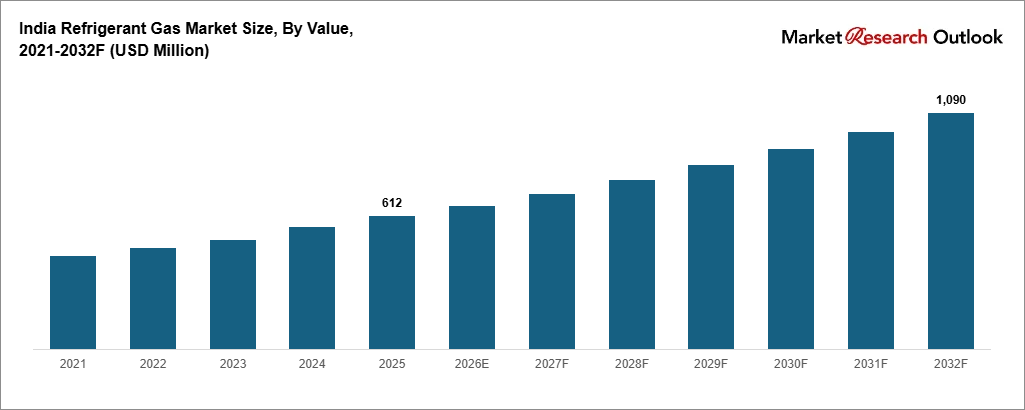
The India refrigerant gas market size is witnessing rapid expansion, driven by rising air conditioner and refrigerator ownership, fast growth in cold storage and pharmaceutical logistics, higher passenger vehicle output, and a steady move toward lower-GWP refrigerants. Valued at USD 612 million in 2025 and projected to reach USD 1,090 million by 2032, growing at a CAGR of 8.6%, market growth is being fuelled by heatwave-driven cooling demand, first-fill demand from appliance and vehicle makers, and recurring servicing demand from an installed base that keeps expanding every summer. HFCs lead consumption, while HFOs and HFC/HFO blends are emerging as the fastest growing category. India’s Kigali Amendment schedule, with an HFC freeze in 2028 and a first 10% cut in 2032, together with the HCFC phase-out by 2030, is reshaping product choices across residential, commercial, and automotive cooling. As domestic producers including SRF, Navin Fluorine, Gujarat Fluorochemicals, and Stallion India Fluorochemicals add capacity, and global suppliers including Chemours, Honeywell, Arkema, and Daikin widen low-GWP portfolios, the sector is evolving into a regulated, technology-led, and increasingly self-reliant industry with strong long-term growth potential.
Key Report Takeaways: India Refrigerant Gas Market
- The India refrigerant gas market size is projected to grow from USD 612 million in 2025 to USD 1,090 million by 2032, registering a strong CAGR of 8.6%, driven by rising cooling equipment ownership, cold chain expansion, and the structural shift toward lower-GWP refrigerants across India.
- HFCs dominate the market, accounting for 64% of total value in 2025, driven by R-32 in split air conditioners, R-134a in vehicles and refrigerators, and R-410A and R-404A in commercial cooling, supplied by SRF, Navin Fluorine, Gujarat Fluorochemicals, and importers of Chinese HFCs.
- HFOs and HFC/HFO blends are emerging as the fastest growing segment, expected to grow at a CAGR of 21.4% through 2032, as automotive OEMs adopt HFO-1234yf and chiller and supermarket system makers move to low-GWP blends ahead of the HFC freeze.
- Room air conditioner sales of a record 12.5 million units in FY2025, together with refrigerator, cold storage, and vehicle air conditioning demand, are structurally expanding refrigerant consumption across first-fill, servicing, and retrofit categories.
- Rising investments by domestic producers such as SRF, Navin Fluorine, and Gujarat Fluorochemicals in HFC and refrigerant raw material capacity, including SRF’s INR 678 crore Dahej expansion and Navin Fluorine’s additional 15,000 tonnes per annum of R-32, are strengthening local supply and supporting the India refrigerant gas market forecast 2032.
Key Market Drivers: India Refrigerant Gas Market
Rising Air Conditioner Penetration, Heatwaves, and Urban Cooling Demand Driving Refrigerant Consumption Across India
Growth in the India refrigerant gas market is being driven by rising air conditioner ownership, longer and hotter summers, and fast urban construction. Room air conditioner sales reached a record 12.5 million units in FY2025 after growth of 20% or more, and although unseasonal rain cut FY2026 volumes, demand recovered quickly in the next hot season. Voltas sold 1 million air conditioners in the first quarter of FY2027 alone, showing how fast demand returns in a hot season. Fewer than 10% of Indian households own an air conditioner, which points to large headroom as incomes rise and power supply improves. Every new split air conditioner needs a first fill of R-32 or R-410A at the factory, and the installed base then creates servicing demand for top-ups and gas recharges for 10 years or more. Heat-stressed cities in North and West India, rising office and retail space, and new data centres are adding commercial air conditioning and chiller loads, creating strong structural pull-through demand for refrigerant gases.
Cold Chain Expansion, Pharmaceutical Logistics, and Vehicle Air Conditioning Fuelling Refrigerant Demand
The refrigerant gas market in India is benefiting from sustained growth in cold storage, food processing, pharmaceutical logistics, and vehicle air conditioning. Frozen food, dairy, quick-commerce dark stores, and vaccine distribution all depend on refrigerated warehouses, reefer trucks, and display cabinets that use R-404A, R-407C, R-134a, ammonia, and CO2. The Production Linked Incentive scheme for white goods, with an outlay of INR 6,238 crore, is pulling air conditioner compressor, coil, and component manufacturing into India, which raises domestic first-fill volumes. Air conditioner manufacturing clusters at Sri City in Andhra Pradesh and Neemrana and Ghiloth in Rajasthan now supply both domestic and export markets. Passenger vehicles, buses, and rail coaches add steady demand for R-134a and HFO-1234yf in mobile air conditioning, while every new supermarket and quick service restaurant outlet adds commercial refrigeration load. These sectors broaden the customer base for refrigerant suppliers beyond the seasonal room air conditioner cycle and strengthen demand across the sector.
Kigali Amendment Transition and Domestic Fluorochemical Capacity Strengthening Low-GWP Refrigerant Supply
The transition under the Kigali Amendment is a major catalyst for the sector, with the HFO and HFC/HFO blends segment projected to grow at a CAGR of 21.4% through 2032. India’s HFC baseline is set on average consumption in 2024 to 2026, followed by a freeze in 2028 and a first 10% reduction in 2032, which encourages producers to build volume and secure quota positions now. SRF commissioned the final phase of its INR 678 crore fluorocarbon refrigerant expansion at Dahej in February 2025, Navin Fluorine approved an additional 15,000 tonnes per annum of R-32 capacity at a cost of INR 236.5 crore in November 2025, and Gujarat Fluorochemicals added R-134a in July 2026 to its existing R-32, R-22, R-125, and R-410A range. In December 2025, India imposed anti-dumping duties of up to USD 5,251 per tonne on R-134a from China for five years, improving price discipline for domestic producers. These developments are structurally expanding refrigerant gas supply across all major end-user categories through 2032.
Key Market Challenges: India Refrigerant Gas Market
HCFC Phase-Out Deadlines and the HFC Freeze Limiting Supply Growth and Raising Compliance Costs
The sector continues to face challenges around phase-out deadlines and quota limits, which affect both producers and users of older equipment. India must complete its HCFC phase-out by 2030, yet millions of older air conditioners and chillers still run on R-22 and need servicing gas for years. HFC consumption will be frozen in 2028 and cut by 10% in 2032, so producers, importers, and distributors must plan supply within fixed quotas while demand keeps rising. Equipment makers face redesign, testing, and safety certification costs when moving from R-410A to R-32 or R-290, and smaller OEMs and contractors have limited budgets for this work. Rules on import licences, labelling, and record keeping add administrative load for traders and service firms. These compliance pressures slow the move toward newer gases and raise costs across the value chain.
Price Volatility, Chinese Quota Effects, and Raw Material Costs Weighing on Refrigerant Margins
Refrigerant suppliers in India face margin pressure from volatile gas prices, Chinese production quotas, and rising raw material costs. China froze its HFC production capacity in 2024 and allocates annual quotas, which can tighten global supply and lift prices quickly, as seen when a US distributor raised R-32 prices by 200% in January 2025. Indian distributors and service contractors who buy from importers often cannot pass on such sudden increases to price-sensitive customers. Producers also face swings in the cost of fluorspar, anhydrous hydrogen fluoride, chloroform, and electricity, which feed directly into HFC production costs. HFOs remain expensive because key molecules are patented and largely imported, which slows their use outside premium vehicles and large chillers. While anti-dumping duties and new domestic capacity improve stability, price volatility remains a near-term challenge for the industry.
Illegal Trade, Counterfeit Cylinders, and Low Recovery Rates Impacting Servicing Quality and Safety
The refrigerant gas sector faces practical constraints around informal trade, servicing quality, and end-of-life handling. Refilled, mislabelled, and counterfeit cylinders enter the servicing market through unorganised channels, creating safety risks and loss of business for compliant suppliers. Most leaked or vented refrigerant is never recovered, because recovery machines, reclaim plants, and take-back schemes are still limited outside large cities. The shift to flammable A2L and A3 refrigerants such as R-32 and R-290 also requires trained technicians, proper tools, and leak checks, yet a large share of servicing is done by informal mechanics. The India Cooling Action Plan set a goal of training and certifying 100,000 servicing technicians, and progress is uneven across states. Cylinder tracking, certified reclaim, and OEM-led training are emerging as solutions, but adoption remains slow across the country.
Key Market Trends: India Refrigerant Gas Market
Rapid Shift Toward R-32, R-290, and R-600a in Air Conditioners and Refrigerators in India
The market is undergoing a clear technology shift toward lower-GWP refrigerants in household cooling, with R-32 now the standard choice in new split air conditioners and expected to account for 33% of refrigerant value by 2027. R-32 has a GWP of 675, about one-third of R-410A, and offers better energy efficiency at lower charge sizes. R-290 propane is gaining ground in room air conditioners, water coolers, and display freezers, while R-600a isobutane has replaced R-134a in most new domestic refrigerators. Leading OEMs including Daikin, Voltas, Blue Star, LG, and Godrej have widened R-32 and hydrocarbon product lines to meet star labelling norms and customer interest in greener products. This product transition is reinforcing the India refrigerant gas market forecast 2032 across both first-fill and servicing categories.
Growth of HFOs, HFC/HFO Blends, and Natural Refrigerants in the India Refrigerant Gas Market
A clear shift toward HFOs, HFC/HFO blends, and natural refrigerants is reshaping commercial and automotive demand. HFO-1234yf, with a GWP below 1, is entering passenger vehicle air conditioning through export-oriented and premium models, while blends based on HFO-1234ze and HFO-1234yf are being used in new chillers and heat pumps. Supermarkets, dairies, and cold storage operators are adopting ammonia and CO2 systems for large plants, and hydrocarbon-based display cabinets for retail outlets. Navin Fluorine produces HFO intermediates for Honeywell, and Chemours, Honeywell, and Arkema are expanding HFO sales to Indian OEMs. HFOs and HFC/HFO blends account for 7% of refrigerant value in 2025 and are expected to reach 16% by 2032, with low-GWP procurement by global brands set to drive the next phase of growth.
Refrigerant Recovery, Reclaim, and Export-Oriented Fluorochemical Capacity Building
A wave of recovery, reclaim, and export-led capacity building is reshaping the refrigerant supply base. With HFC quotas due from 2028, recovered and reclaimed gas is becoming a valuable source of supply, and producers, OEMs, and service companies are piloting take-back and reclaim programmes in large cities. Refex Industries and other cylinder filling firms are building traceable supply networks for servicing customers. On the export side, Indian producers supply HFCs and HCFCs to the Middle East, Africa, and the United States, and Stallion India Fluorochemicals listed in January 2025 to fund refrigerant processing and filling capacity. Combined with anti-dumping protection on R-134a and steady capacity additions at SRF, Navin Fluorine, and Gujarat Fluorochemicals, these developments are reinforcing the India refrigerant gas market forecast 2032 across the entire value chain.
Segmental Insights: India Refrigerant Gas Market
By End-User: Residential Segment Dominates the India Refrigerant Gas Market
The residential end-user segment dominates the market, accounting for 51% of total value in 2025, driven by first-fill and servicing demand from room air conditioners and domestic refrigerators. R-32 is the dominant refrigerant within this segment, with split air conditioners capturing 78% of residential refrigerant value. The commercial segment contributes another 21% of demand, driven by offices, malls, hospitals, hotels, data centres, and supermarket refrigeration. Automotive and transport accounts for 16%, led by passenger vehicles, buses, rail coaches, and reefer trucks, while industrial users make up the remaining 12% through cold storage, dairy, pharmaceutical, and process cooling. In 2025 and 2026, leading appliance makers including Voltas, Daikin, Blue Star, LG, and Godrej expanded R-32 and R-290 model ranges, reinforcing residential segment dominance.
By Product Type: HFCs Lead While HFOs and HFC/HFO Blends Grow Fastest
HFCs lead the product mix, accounting for 64% of total refrigerant value in 2025, driven by R-32, R-134a, R-410A, and R-404A across residential, automotive, and commercial uses. HCFCs contribute another 17%, almost entirely R-22 for servicing older air conditioners and chillers, and this share will fall sharply as the 2030 phase-out approaches. HFOs and HFC/HFO blends are the fastest growing category, together expanding at a CAGR of 21.4%, driven by HFO-1234yf in vehicles and low-GWP blends in chillers and heat pumps. Hydrocarbons such as R-290 and R-600a hold 9% of value, led by refrigerators, room air conditioners, and display coolers, while ammonia and CO2 account for 3%, mainly in cold storage and food processing plants. HFOs alone hold 3% and HFC/HFO blends 4% of value today. Leading producers including SRF, Navin Fluorine, Gujarat Fluorochemicals, Chemours, and Honeywell have aligned product portfolios to this mix, driving lower-GWP refrigerant adoption across the country.
Regional Insights: India Refrigerant Gas Market
Regional analysis shows that West India and North India together account for 63% of total refrigerant value in 2025, driven by Gujarat (Dahej and Bharuch fluorochemical belt), Maharashtra (Mumbai and Pune), Delhi NCR, Uttar Pradesh, and Rajasthan (Neemrana and Ghiloth air conditioner clusters), supported by hot summers, high air conditioner ownership, and large production bases. West India holds 36% and North India 27% of demand. South India contributes 25%, led by Tamil Nadu, Andhra Pradesh (Sri City air conditioner cluster), Karnataka, and Telangana, supported by automotive plants in Chennai and data centres in Chennai, Hyderabad, and Bengaluru. Central and East India together account for 12% of demand, supported by Madhya Pradesh, West Bengal, Bihar, and Odisha, where cold storage for potatoes, fish, and dairy is expanding. In 2025 and 2026, SRF’s Dahej expansion, Navin Fluorine’s Surat and Dahej operations, and Gujarat Fluorochemicals’ Gujarat plants reinforced regional supply hubs, supporting faster delivery to OEMs and service networks across the country.
Recent Developments: India Refrigerant Gas Market
- India’s refrigerant gas industry witnessed strong momentum in capacity and demand during 2025 and 2026. Room air conditioner sales reached a record 12.5 million units in FY2025, and although FY2026 volumes dipped on unseasonal rain, Voltas sold 1 million units in the first quarter of FY2027. SRF commissioned the final phase of its INR 678 crore refrigerant expansion at Dahej in February 2025, raising domestic HFC availability.
- Domestic producers have deepened India-focused refrigerant capacity. In November 2025, Navin Fluorine approved up to 15,000 tonnes per annum of additional R-32 capacity at a cost of INR 236.5 crore, and in July 2026 Gujarat Fluorochemicals added R-134a to its refrigerant range to make full use of its Kigali quota. Stallion India Fluorochemicals listed on the stock exchanges in January 2025 to fund refrigerant processing capacity. These developments are strengthening domestic supply and supporting long-term growth.
- Policy momentum has gained strong traction across the sector. In December 2025, India imposed anti-dumping duties of up to USD 5,251 per tonne on R-134a imports from China for five years, following representations from SRF, the only Indian producer of R-134a. With the HFC baseline years of 2024 to 2026 now closing and the 2028 freeze ahead, the Ozone Cell under the Ministry of Environment, Forest and Climate Change is managing HFC and HCFC import licensing. These measures are positioning India as one of the most actively developing refrigerant production bases globally, strengthening long-term competitive positioning in the India refrigerant gas market forecast 2032.
Key Market Players: India Refrigerant Gas Market
- SRF Limited
- Navin Fluorine International Limited
- Gujarat Fluorochemicals Limited (INOXGFL Group)
- Stallion India Fluorochemicals Limited
- Refex Industries Limited
- Chemours India Pvt. Ltd.
- Honeywell International (India) Pvt. Ltd.
- Arkema Chemicals India Pvt. Ltd.
- Daikin Airconditioning India Pvt. Ltd.
- Linde India Limited
- Dongyue Group Limited
- Zhejiang Juhua Co., Ltd.
- Zhejiang Sanmei Chemical Industry Co., Ltd.
| By Product Type | By Refrigerant Type | By Application | By Sales Channel | By End-User |
| Hydrofluorocarbons (HFCs) Hydrochlorofluorocarbons (HCFCs) Hydrofluoroolefins (HFOs) HFC/HFO Blends Hydrocarbons (R-290, R-600a) Others (Ammonia, CO2) |
R-32 R-410A R-134a R-22 R-404A & R-407C R-290 & R-600a Others |
Residential Air Conditioning Commercial Air Conditioning & Chillers Domestic Refrigeration Commercial & Industrial Refrigeration Mobile Air Conditioning |
OEM Direct Supply Authorised Distributors & Stockists HVAC&R Service Contractors Retail Service Shops & Refillers E-Commerce & B2B Platforms Institutional & Government Supply |
Residential Commercial Industrial Automotive & Transport |
Report Scope
In this report, the India Refrigerant Gas Market has been segmented into the following categories, in addition to detailed analysis of key industry trends, market dynamics, competitive landscape, and growth opportunities across the forecast period:
- By Product Type
- Hydrofluorocarbons (HFCs)
- Hydrochlorofluorocarbons (HCFCs)
- Hydrofluoroolefins (HFOs)
- HFC/HFO Blends
- Hydrocarbons (R-290, R-600a)
- Others (Ammonia, CO2)
- By Refrigerant Type
- R-32
- R-410A
- R-134a
- R-22
- R-404A & R-407C
- R-290 & R-600a
- Others
- By Application
- Residential Air Conditioning
- Commercial Air Conditioning & Chillers
- Domestic Refrigeration
- Commercial & Industrial Refrigeration
- Mobile Air Conditioning
- By Sales Channel
- OEM Direct Supply
- Authorised Distributors & Stockists
- HVAC&R Service Contractors
- Retail Service Shops & Refillers
- E-Commerce & B2B Platforms
- Institutional & Government Supply
- By End-User
- Residential
- Commercial
- Industrial
- Automotive & Transport
- By Geography
- North India
- South India
- West India
- East India
- Central India
Competitive Landscape
Company Profiles:
Detailed analysis of the leading companies operating in the India Refrigerant Gas Market, including business overview, product portfolio, strategic initiatives, competitive positioning, and recent developments.
Company Information
Detailed profiling and strategic analysis of additional market players (up to five companies), including emerging domestic refrigerant producers, cylinder filling and distribution companies, refrigerant reclaim firms, or niche regional servicing gas suppliers.
For a free sample of the India Refrigerant Gas Market report, customised insights or delivery timelines, submit your query here
India Refrigerant Gas Market, 2032
- Research Framework
- Market Segmentation
- Research Objective
- Research Methodology
- Qualitative Research
- Primary Research
- Secondary Research
- Quantitative Research
- Market Breakdown & Data Triangulation
- Demand Side
- Supply Side
- Primary Research Respondents
- Assumption & Limitation
- Executive Summary
- Market Overview, 2021-2032
- By Product Type
- By Refrigerant Type
- By Application
- By Sales Channel
- By End-User
- By Region
- Analyst Recommendations
- Geopolitical Impact on India Refrigerant Gas Market
- India Refrigerant Gas Market Insights
- Market Dynamics
- Growth Drivers
- Rising air conditioner penetration, heatwaves, and urban cooling demand driving refrigerant consumption across India.
- Cold chain expansion, pharmaceutical logistics, and vehicle air conditioning fuelling refrigerant demand.
- Kigali Amendment transition and domestic fluorochemical capacity strengthening low-GWP refrigerant supply.
- Restraints
- HCFC phase-out deadlines and the HFC freeze limiting supply growth and raising compliance costs.
- Price volatility, Chinese quota effects, and raw material costs weighing on refrigerant margins.
- Illegal trade, counterfeit cylinders, and low recovery rates impacting servicing quality and safety.
- Opportunities
- Low-GWP R-32, R-290, and R-600a refrigerants opening new demand in room air conditioners and refrigerators.
- HFOs, HFC/HFO blends, and natural refrigerants supporting next-generation growth in vehicles, chillers, and cold chain.
- Refrigerant recovery, reclaim, and export-oriented fluorochemical capacity creating new revenue streams.
- Challenges
- Fixed HFC quotas from 2028 against rising cooling demand from a fast-growing installed base.
- Sudden R-32 and R-134a price swings linked to Chinese production quotas and import dependence for HFOs.
- Shortage of trained technicians for flammable A2L and A3 refrigerants such as R-32 and R-290.
- Technological Advancements
- Recent Technological Advancements
- Prior to 2020
- Porter’s Five Forces Analysis
- PESTLE Analysis
- Industry Value Chain & Entry Points
- Upstream Raw Materials (fluorspar, anhydrous hydrogen fluoride, chloroform, methylene chloride, chlorine)
- Refrigerant Gas Producers (SRF, Navin Fluorine, Gujarat Fluorochemicals, Chemours, Honeywell)
- Importers & Bulk Traders (Chinese HFC suppliers, ISO tank and cylinder importers)
- Low-GWP & Natural Refrigerant Suppliers (HFOs, HFC/HFO blends, R-290, R-600a, ammonia, CO2)
- Quality Control, Testing & Standards (BIS, AHRI 700 purity norms, Ozone Cell licensing, PESO cylinder rules)
- Cylinder Filling, Packaging & Distribution (refillable and disposable cylinders, B2B distribution networks)
- Appliance & Equipment OEMs (Voltas, Daikin, Blue Star, LG, Godrej)
- Automotive OEMs & Mobile Air Conditioning System Makers (passenger vehicles, buses, rail coaches, reefer trucks)
- Servicing, Recovery & Reclaim Providers (HVAC&R contractors, service shops, reclaim plants)
- End-Users (households, commercial buildings, cold storage operators, industrial plants, vehicle owners)
- India Refrigerant Gas Market: Regulatory Framework
- India Refrigerant Gas Market Overview
- Market Size & Forecast, 2021-2032
- By Value (USD Million)
- By Volume (Thousand Tonnes)
- Market Share & Forecast
- By Product Type
- Hydrofluorocarbons (HFCs)
- Hydrochlorofluorocarbons (HCFCs)
- Hydrofluoroolefins (HFOs)
- HFC/HFO Blends
- Hydrocarbons (R-290, R-600a)
- Others (Ammonia, CO2)
- By Refrigerant Type
- R-32
- R-410A
- R-134a
- R-22
- R-404A & R-407C
- R-290 & R-600a
- Others
- By Application
- Residential Air Conditioning
- Commercial Air Conditioning & Chillers
- Domestic Refrigeration
- Commercial & Industrial Refrigeration
- Mobile Air Conditioning
- By Sales Channel
- OEM Direct Supply
- Authorised Distributors & Stockists
- HVAC&R Service Contractors
- Retail Service Shops & Refillers
- E-Commerce & B2B Platforms
- Institutional & Government Supply
- By End-User
- Residential
- Commercial
- Industrial
- Automotive & Transport
- By Geography
- North India
- South India
- West India
- East India
- Central India
- Competitive Landscape
- India Refrigerant Gas Market Company Market Share Analysis, 2025
- Competitive Benchmarking, By Operating Parameters
- Key Strategic Development (Mergers, Acquisitions, Partnerships, Etc.)
- List of Emerging Players
- Company Profile
- SRF Limited
- Introduction & Company Profile
- Product Benchmarking
- Strategic Outlook
- Key Competitors
- Financial Analysis
- SWOT Analysis
(Same Data Pointers Will Be Provided for The Below Companies)
- Navin Fluorine International Limited
- Gujarat Fluorochemicals Limited (INOXGFL Group)
- Stallion India Fluorochemicals Limited
- Refex Industries Limited
- Chemours India Pvt. Ltd.
- Honeywell International (India) Pvt. Ltd.
- Arkema Chemicals India Pvt. Ltd.
- Daikin Airconditioning India Pvt. Ltd.
- Linde India Limited
- Dongyue Group Limited
- Zhejiang Juhua Co., Ltd.
- Zhejiang Sanmei Chemical Industry Co., Ltd.
- Other Prominent Players
* Financial information in case of non-listed companies will be provided as per availability
** The segmentation and the companies are subjected to modifications based on in-depth secondary for the final deliverable
Frequently Asked Questions
1. How large is the India refrigerant gas market and what is its growth forecast?
Ans: The India refrigerant gas market is valued at USD 612 million in 2025 and is projected to reach USD 1,090 million by 2032, growing at a CAGR of 8.6%, supported by rising air conditioner sales and cold chain growth.
2. Which segments are driving demand in the India refrigerant gas market?
Ans: HFCs lead with 64% of 2025 value, driven by R-32 in split air conditioners, while HFOs and HFC/HFO blends grow fastest at a CAGR of 21.4% as vehicle and chiller makers adopt low-GWP options.
3. What are the key drivers of growth in the India refrigerant gas market?
Ans: Key drivers include record room air conditioner sales, heatwaves, cold chain and pharmaceutical logistics growth, vehicle air conditioning, the Kigali Amendment transition, and new domestic HFC capacity at SRF, Navin Fluorine, and GFL.
4. Which regions are driving growth in the India refrigerant gas market?
Ans: West India and North India lead with 63% of 2025 value, driven by Gujarat, Maharashtra, Delhi NCR, Uttar Pradesh, and Rajasthan. South India, led by Sri City and Chennai, also shows strong refrigerant demand.
5. What are the latest trends in the India refrigerant gas market?
Ans: The latest trends include the shift to R-32, R-290, and R-600a in household cooling, HFO-1234yf in vehicles, natural refrigerants in cold chain, refrigerant recovery and reclaim, and export-oriented fluorochemical capacity at Indian producers.