

India Polylactic Acid (PLA) Market, 2032
- Chemicals & Advanced Materials, Polymers, Plastics & Packaging
- Oct 2026
- Pages 140
- Report Format: pdf
- Report Price: $2400 USD
India’s polylactic acid market is witnessing strong structural growth, driven by the ban on identified single-use plastic items, EPR targets for brand owners, rising use of compostable packaging in food, retail and e-commerce, sugar mills moving into biopolymers, new state bioplastic policies, and growing commitment from domestic and global producers investing in India-based lactic acid, lactide and PLA capacity.
| Study Duration | 2021-2032 |
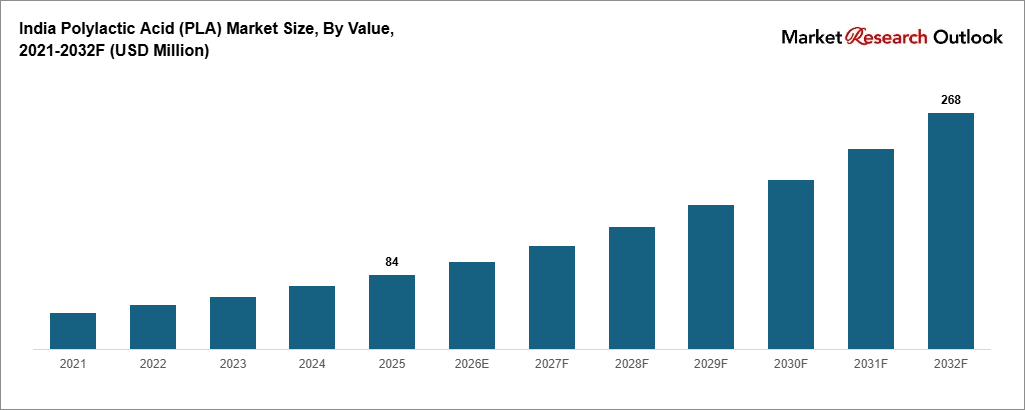
| Market Size (2025) | USD 84 Million |
| CAGR (2026-2032) | 18.0% |
| Leading Segment | PLA Compounds & Blends (Packaging) |
| Fastest Growing Segment | PLA Fibres & Nonwovens |
| Market Size (2032) | USD 268 Million |
Market Overview: India Polylactic Acid (PLA) Market
The India polylactic acid market size is expanding quickly, driven by plastic waste rules, brand owner sustainability goals, growing organised foodservice and e-commerce, rising use of compostable carry bags and films, and the arrival of domestic sugarcane-based production. Valued at USD 84 million in 2025 and projected to reach USD 268 million by 2032, growing at a CAGR of 18.0%, PLA market growth in India is supported by the ban on 19 single-use plastic items from July 2022, CPCB certification for compostable products, and the Uttar Pradesh bioplastic policy that offers capital subsidy and tax incentives for large projects. In volume terms, demand stood at 32.4 thousand tonnes in 2025. PLA compounds and blends lead demand by value, while PLA fibres and nonwovens form the fastest growing category. Food and beverage remains the largest end-user, but retail, e-commerce and textiles are adding a growing share. As Balrampur Chini Mills prepares its 80,000 tonne plant at Kumbhi and Praj Industries scales its lactide and PLA technology, and global suppliers including NatureWorks and TotalEnergies Corbion widen their distribution, PLA supply in India is becoming more local, more application-specific and better certified, with strong long-term growth potential.
Key Report Takeaways: India Polylactic Acid (PLA) Market
- The India polylactic acid market size is projected to grow from USD 84 million in 2025 to USD 268 million by 2032, registering a CAGR of 18.0%, driven by the single-use plastic ban, EPR obligations, domestic capacity additions and rising compostable packaging demand from food, retail and e-commerce.
- PLA compounds and blends lead the market with a 46% share of value in 2025, supported by high demand for PLA and PBAT carry bags, garbage bags and films that meet compostability norms, and by converters who prefer ready-to-use compounds over neat resin.
- PLA fibres and nonwovens form the fastest growing category, expanding at a CAGR of 22.6% through 2032 as textile mills, hygiene product makers and apparel brands look for bio-based alternatives to polyester in wipes, tea bags, apparel and home textiles.
- Food and beverage end-users account for 48% of PLA demand in 2025, led by cups, lids, cutlery, clamshells, trays and straws used by quick service restaurants, caterers, cloud kitchens and dairy and beverage brands.
- Investment by Balrampur Chini Mills, Praj Industries and Nirani Sugars in lactic acid, lactide and PLA capacity is building a sugarcane-based supply base, cutting import reliance and supporting long-term market growth.
Key Market Drivers: India Polylactic Acid (PLA) Market
Single-Use Plastic Ban, Plastic Waste Management Rules and EPR Targets Driving Demand for Compostable PLA Across India
Growth in the India polylactic acid market is closely linked to plastic regulation. Since 1 July 2022, India has banned the manufacture, import, sale and use of 19 identified single-use plastic items, including plastic cutlery, straws, stirrers, plates, cups, and wrapping films for sweet boxes and invitation cards, while plastic carry bags below 120 microns were banned from December 2022. Compostable plastic is one of the few permitted alternatives, and PLA is the most widely used bio-based polymer for cups, cutlery, straws and films. The Plastic Waste Management Amendment Rules of 2024 tightened the definition of biodegradable plastic to products that leave no microplastics and require producers of compostable and biodegradable items to obtain a CPCB certificate before sale. Extended producer responsibility targets now push FMCG, food and e-commerce brands to reduce virgin plastic and show credible alternatives. Each enforcement drive by state pollution control boards and municipal bodies pulls more certified compostable products into the supply chain, which keeps regulation the strongest demand trigger for PLA.
Sugarcane Feedstock Advantage and New Domestic PLA Capacity Backed by State Bioplastic Policies Strengthening Local Supply
India is one of the world’s largest sugar producers, which gives it a natural feedstock base for lactic acid and PLA. Balrampur Chini Mills laid the foundation stone of its PLA plant at Kumbhi in Lakhimpur Kheri in February 2025. The 80,000 tonne per year unit, branded Balrampur Bioyug, uses sugar from the adjacent mill, carries a gross investment of about Rs 2,850 crore and was targeted for commissioning in late 2026. The Uttar Pradesh bioplastic policy supports projects above Rs 1,000 crore with capital subsidy, State GST reimbursement and electricity duty exemption. Praj Industries inaugurated a demonstration plant at Jejuri in October 2024 with capacity of 100 tonnes of lactic acid and 60 tonnes of lactide a year, equal to 55 tonnes of PLA, to prove its technology for licensing. In February 2025, Nirani Sugars signed a Rs 2,000 crore MoU with Karnataka for a PLA facility at Bagalkot. These projects will shift PLA supply in India from import-led to locally supplied.
Rising Demand From Food and Beverage, Foodservice, Retail and E-Commerce Packaging Fuelling PLA Adoption
Packaging is the largest outlet for PLA in India, and it is growing fast. Industry estimates place India’s packaging market at about USD 101 billion in 2025, with food and beverage packaging at about USD 38 billion. Quick service restaurants, cloud kitchens, caterers, airlines and railways need compliant cups, lids, cutlery, clamshells and straws, and PLA offers clarity, stiffness and food contact approval that suit these uses. Dairy and beverage brands are trialling PLA cups and bottles, and personal care brands use PLA in jars and tubes. Quick-commerce and e-commerce players are switching to compostable mailers and bags, often made from PLA and PBAT blends. Hotels, corporate campuses and event organisers are also moving to compostable disposables to meet sustainability goals. Converters in Gujarat, Maharashtra, Tamil Nadu and Delhi NCR have added thermoforming and blown film lines for PLA grades, widening the customer base for PLA through 2032.
Key Market Challenges: India Polylactic Acid (PLA) Market
High Price of PLA Compared With Conventional Polyethylene and Polypropylene Limiting Adoption in Price-Led Segments
PLA adoption in India is held back by cost. PLA resin often sells at more than twice the price of commodity polyethylene and polypropylene, and finished compostable items such as carry bags and cutlery can cost several times more than banned plastic versions. Small retailers, street vendors and local caterers, who use the largest number of disposable items, are highly price sensitive and often turn back to cheaper plastic or paper when enforcement eases. Imported resin prices also move with freight costs and the rupee. Domestic plants using local sugar should reduce landed costs, but until volumes reach scale and converters run at high utilisation, the price gap will remain a real constraint on the sector.
Limited Industrial Composting Infrastructure and Confusion Between Biodegradable and Compostable Claims
PLA is designed to break down in industrial composting conditions, at higher temperature and humidity, rather than in home compost or open landfill. Most Indian cities still lack dedicated industrial composting and separate collection of compostable packaging, so many PLA products end up in mixed waste. This weakens the environmental case and makes some buyers question the value of switching. Confusion between biodegradable, oxo-degradable and compostable labels adds to the problem, and false claims by uncertified suppliers erode trust. The 2024 amendment requiring CPCB certification and a no-microplastic standard is helping to separate genuine products, but waste infrastructure gaps remain a structural challenge for the category.
Import Dependence and Competition for Sugar Feedstock From Ethanol Blending Affecting PLA Supply
Until domestic plants start commercial output, almost all PLA used in India is imported from producers in the United States, Thailand and China, which exposes buyers to freight costs, currency swings and long lead times. Domestic projects will rely on sugar and cane juice, the same feedstock that the ethanol blending programme uses. India reached 20% ethanol blending in petrol in 2025, and diversion of sugar to ethanol, combined with monsoon-driven swings in cane output, can tighten feedstock availability and raise input costs for lactic acid makers. Balancing sugar for food, fuel and polymers will shape supply security and pricing across the sector through the forecast period.
Key Market Trends: India Polylactic Acid (PLA) Market
Rapid Build-Out of Domestic Sugarcane-Based PLA Capacity in India
The India polylactic acid market is moving from import-led trading to local production. Sugar companies see PLA as a high-value use for cane that can lift margins beyond sugar and ethanol. Balrampur Chini Mills is the first to build at commercial scale, with an 80,000 tonne plant at Kumbhi using technology from global licensors and a plan to sell resin and compounds under the Balrampur Bioyug brand. The company has already secured an institutional order from the Lucknow Cantonment Board for compostable products such as garbage bags, bottles and pens. Praj Industries is offering its lactide and PLA process for licensing after its Jejuri demonstration plant, and Nirani Sugars is planning a facility in Karnataka. This shift toward local supply is improving delivery times and reinforcing long-term growth across packaging and fibres.
Growth of PLA and PBAT Compounds, Certified Films and Heat-Resistant Grades in the India Polylactic Acid Market
A clear move toward engineered PLA compounds is changing how converters buy material. Neat PLA is stiff and brittle, so it is often blended with PBAT and additives to make flexible carry bags, garbage bags, mulch films and mailers that meet IS 17088 and CPCB rules. Suppliers such as BASF, with its ecovio range, Kingfa and Natur-Tec, along with local compounders, offer ready-to-use certified grades. Heat-resistant crystallised PLA is being adopted for hot beverage lids, cutlery and microwaveable trays, while high-clarity sheet grades serve fresh produce and bakery packs. These compounds raise value per tonne and help converters switch lines with less trial and error, adding a specialty layer to the business.
Expansion of PLA Into Fibres, Nonwovens, 3D Printing and Medical Uses
PLA is moving beyond packaging into fibres, filaments and healthcare. Textile mills in Tamil Nadu, Gujarat and Maharashtra are testing PLA staple fibre and filament yarn for apparel, home textiles, tea bags and wipes, drawn by the bio-based label and easy dyeing at lower temperatures. Hygiene and nonwoven makers are trialling PLA spunbond for diapers, masks and agricultural covers. India’s 3D printing community, from schools and labs to product design firms, uses PLA as the default filament because it prints at low temperature with little warping. In healthcare, medical grade PLA and its copolymers, such as Evonik’s RESOMER range, are used in resorbable sutures, screws and drug delivery. These new uses spread demand across several industries and reinforce long-term growth.
Segmental Insights: India Polylactic Acid (PLA) Market
By End-User: Food & Beverage Segment Dominates the India Polylactic Acid (PLA) Market
The food and beverage segment dominates the India polylactic acid market, accounting for an estimated 48% of total value in 2025, driven by cups, lids, cutlery, straws, clamshells and trays used by quick service restaurants, cloud kitchens, caterers, dairies and beverage brands. The retail and e-commerce segment contributes another 24% of demand, led by compostable carry bags, mailers and produce bags. Textile and personal care accounts for 15%, including fibres, nonwovens, jars and tubes, while healthcare and others, which cover medical devices, agriculture and 3D printing, make up 13%. In 2025, NatureWorks, TotalEnergies Corbion, BASF and leading Indian compounders expanded food contact grades through local distributors, reinforcing segment leadership.
By Product Type: PLA Compounds & Blends Lead While PLA Fibres Grow Fastest
PLA compounds and blends lead the product mix with a 46% share of value, driven by PLA and PBAT carry bags, films and garbage bags. Neat PLA resins contribute 22%, mostly for injection moulding and thermoforming, while films and sheets account for 14%, fibres for 8%, filaments for 6%, and other products for the remaining 4%. PLA fibres and nonwovens are the fastest growing category at a CAGR of 22.6%, supported by textile and hygiene demand. By raw material, sugarcane and molasses will become the main feedstock once domestic plants start, while imported corn and cassava-based PLA dominate supply today. By application, packaging and foodservice together account for 64% of value. Leading suppliers including NatureWorks, TotalEnergies Corbion, BASF, Kingfa and Balrampur Chini Mills have aligned portfolios to this mix, driving higher-value adoption across the market.
Regional Insights: India Polylactic Acid (PLA) Market
Regional analysis shows that West India and South India together account for 58% of total value, led by Maharashtra, Gujarat, Tamil Nadu, Karnataka and Telangana, which host most converters, compounders, textile clusters and foodservice chains, along with ports that handle resin imports. North India contributes 27% of demand, led by Delhi NCR, Uttar Pradesh, Haryana and Punjab, supported by strict enforcement of plastic bans, large catering and wedding markets, and the upcoming Kumbhi plant in Uttar Pradesh. East and Central India together account for 15%, led by West Bengal, Odisha and Madhya Pradesh, where adoption is growing from a lower base. Domestic production at Kumbhi is expected to shift supply toward North India and shorten lead times for buyers across the country.
Recent Developments: India Polylactic Acid (PLA) Market
- The sector saw strong capacity and policy momentum during 2024 and 2025. In March 2024, the Plastic Waste Management Amendment Rules defined biodegradable plastics as products that leave no microplastics and made CPCB certification mandatory for compostable and biodegradable items. In October 2024, Praj Industries inaugurated its biopolymer demonstration plant at Jejuri near Pune, with capacity equal to 55 tonnes of PLA a year. In February 2025, the Uttar Pradesh Chief Minister laid the foundation stone of Balrampur Chini Mills’ PLA plant at Kumbhi.
- Producers have deepened India-focused capacity plans. Balrampur Chini Mills raised the planned size of its Kumbhi plant to 80,000 tonnes per year, with a gross investment of about Rs 2,850 crore, Alpine and Sulzer as technology providers, and commissioning targeted for late 2026. Nirani Sugars signed a Rs 2,000 crore MoU with the Karnataka government in February 2025 for a PLA plant at Bagalkot. These developments are strengthening domestic supply and supporting the 2032 outlook.
- Partnerships and market entry moves have also shaped competition in the PLA business in India. TotalEnergies Corbion has worked with Mangalore-based Konspec to develop Indian demand for its Luminy PLA, NatureWorks supplies Ingeo grades through local distributors, and BASF markets its ecovio compostable compounds to Indian converters. Balrampur Bioyug has begun building its customer base with institutional orders ahead of plant start-up, strengthening long-term competitive positioning in the India polylactic acid market forecast 2032.
Key Market Players: India Polylactic Acid (PLA) Market
- Balrampur Chini Mills Limited (Balrampur Bioyug)
- Praj Industries Limited
- NatureWorks LLC
- TotalEnergies Corbion
- BASF India Limited
- Kingfa Science & Technology (India) Limited
- Natur-Tec India Pvt. Ltd.
- Evonik India Pvt. Ltd.
- Earthsoul India Pvt. Ltd.
- Nirani Sugars Limited
- Zhejiang Hisun Biomaterials Co., Ltd.
- COFCO Biotechnology Co., Ltd.
- Futerro SA
| By Product Type | By Raw Material | By Grade | By Application | By End-User |
| PLA Resins (Neat) PLA Compounds & Blends PLA Films & Sheets PLA Fibres PLA Filaments Others |
Sugarcane & Molasses Corn (Maize) Cassava Sugar Beet Rice & Wheat Starch Agricultural Residue Others |
Injection Moulding Grade Extrusion Grade Thermoforming Grade Fibre Spinning Grade 3D Printing Grade |
Rigid Packaging Flexible Packaging & Carry Bags Foodservice Disposables Textiles & Nonwovens 3D Printing Others (Agriculture, Medical, Electronics) |
Food & Beverage Retail & E-Commerce Textile & Personal Care Healthcare & Others |
Report Scope
In this report, the India Polylactic Acid (PLA) Market has been segmented into the following categories, in addition to detailed analysis of key industry trends, market dynamics, competitive positioning and growth opportunities across the forecast period:
- By Product Type
- PLA Resins (Neat)
- PLA Compounds & Blends
- PLA Films & Sheets
- PLA Fibres
- PLA Filaments
- Others
- By Raw Material
- Sugarcane & Molasses
- Corn (Maize)
- Cassava
- Sugar Beet
- Rice & Wheat Starch
- Agricultural Residue
- Others
- By Grade
- Injection Moulding Grade
- Extrusion Grade
- Thermoforming Grade
- Fibre Spinning Grade
- 3D Printing Grade
- By Application
- Rigid Packaging
- Flexible Packaging & Carry Bags
- Foodservice Disposables
- Textiles & Nonwovens
- 3D Printing
- Others (Agriculture, Medical, Electronics)
- By End-User
- Food & Beverage
- Retail & E-Commerce
- Textile & Personal Care
- Healthcare & Others
- By Geography
- North India
- South India
- West India
- East India
- Central India
Competitive Landscape
Company Profiles:
Detailed analysis of the leading companies operating in the India Polylactic Acid (PLA) Market, including business overview, product portfolio, strategic initiatives, competitive positioning and recent developments.
Company Information
Detailed profiling and strategic analysis of additional market players (up to five companies), including emerging domestic PLA producers, specialty compounders, compostable product converters, or niche medical and 3D printing grade suppliers.
For a free sample of the India Polylactic Acid (PLA) Market report, customised insights or delivery timelines, submit your query here
India Polylactic Acid (PLA) Market, 2032
- Research Framework
- Market Segmentation
- Research Objective
- Research Methodology
- Qualitative Research
- Primary Research
- Secondary Research
- Quantitative Research
- Market Breakdown & Data Triangulation
- Demand Side
- Supply Side
- Primary Research Respondents
- Assumption & Limitation
- Executive Summary
- Market Overview, 2021-2032
- By Product Type
- By Raw Material
- By Grade
- By Application
- By End-User
- By Region
- Analyst Recommendations
- Geopolitical Impact on India Polylactic Acid (PLA) Market
- India Polylactic Acid (PLA) Market Insights
- Market Dynamics
- Growth Drivers
- Single-use plastic ban, plastic waste management rules and EPR targets driving demand for compostable PLA across India.
- Sugarcane feedstock advantage and new domestic PLA capacity backed by state bioplastic policies strengthening local supply.
- Rising demand from food and beverage, foodservice, retail and e-commerce packaging fuelling PLA adoption.
- Restraints
- High price of PLA compared with conventional polyethylene and polypropylene limiting adoption in price-led segments.
- Limited industrial composting infrastructure and confusion between biodegradable and compostable claims.
- Import dependence and competition for sugar feedstock from ethanol blending affecting PLA supply.
- Opportunities
- Domestic sugarcane-based PLA production opening import substitution and export opportunities.
- PLA fibres, nonwovens and 3D printing filaments supporting next-generation demand in textiles and manufacturing.
- Medical grade PLA, agricultural mulch films and specialty compounds creating new high-value applications.
- Challenges
- Performance limits of PLA, including low heat resistance, brittleness and moderate barrier properties.
- False biodegradability claims and uneven enforcement of certification for compostable products.
- Contamination of conventional plastic recycling streams by PLA in mixed waste collection.
- Technological Advancements
- Recent Technological Advancements
- Prior to 2020
- Porter’s Five Forces Analysis
- PESTLE Analysis
- Industry Value Chain & Entry Points
- Upstream Raw Materials (sugarcane, molasses, raw sugar, corn and cassava starch, dextrose)
- Lactic Acid & Lactide Producers (fermentation, purification and ring-opening polymerisation inputs)
- PLA Resin Manufacturers (Balrampur Chini Mills, Praj Industries, NatureWorks, TotalEnergies Corbion)
- Compounders & Masterbatch Makers (PLA-PBAT blends, heat-resistant and filled PLA compounds)
- Testing, Certification & R&D Laboratories (CPCB, CIPET, BIS IS 17088, ISO 17088, EN 13432)
- Distributors, Traders & Importers (B2B resin distribution and import networks)
- Converters & Product Makers (carry bags, cups, cutlery, trays, films, fibres, filaments)
- Brand Owners & Foodservice Operators (FMCG, QSR, catering, e-commerce and retail chains)
- Composting, Collection & End-of-Life Service Providers (industrial composting, municipal waste systems)
- End-Users (food and beverage, retail, textile, personal care, healthcare, agriculture)
- India Polylactic Acid (PLA) Market: Regulatory Framework
- India Polylactic Acid (PLA) Market Overview
- Market Size & Forecast, 2021-2032
- By Value (USD Million)
- By Volume (Thousand Tonnes)
- Market Share & Forecast
- By Product Type
- PLA Resins (Neat)
- PLA Compounds & Blends
- PLA Films & Sheets
- PLA Fibres
- PLA Filaments
- Others
- By Raw Material
- Sugarcane & Molasses
- Corn (Maize)
- Cassava
- Sugar Beet
- Rice & Wheat Starch
- Agricultural Residue
- Others
- By Grade
- Injection Moulding Grade
- Extrusion Grade
- Thermoforming Grade
- Fibre Spinning Grade
- 3D Printing Grade
- By Application
- Rigid Packaging
- Flexible Packaging & Carry Bags
- Foodservice Disposables
- Textiles & Nonwovens
- 3D Printing
- Others (Agriculture, Medical, Electronics)
- By End-User
- Food & Beverage
- Retail & E-Commerce
- Textile & Personal Care
- Healthcare & Others
- By Geography
- North India
- South India
- West India
- East India
- Central India
- Competitive Landscape
- India Polylactic Acid (PLA) Market Company Market Share Analysis, 2025
- Competitive Benchmarking, By Operating Parameters
- Key Strategic Development (Mergers, Acquisitions, Partnerships, Etc.)
- List of Emerging Players
- Company Profile
- Balrampur Chini Mills Limited (Balrampur Bioyug)
- Introduction & Company Profile
- Product Benchmarking
- Strategic Outlook
- Key Competitors
- Financial Analysis
- SWOT Analysis
(Same Data Pointers Will Be Provided for The Below Companies)
- Praj Industries Limited
- NatureWorks LLC
- TotalEnergies Corbion
- BASF India Limited
- Kingfa Science & Technology (India) Limited
- Natur-Tec India Pvt. Ltd.
- Evonik India Pvt. Ltd.
- Earthsoul India Pvt. Ltd.
- Nirani Sugars Limited
- Zhejiang Hisun Biomaterials Co., Ltd.
- COFCO Biotechnology Co., Ltd.
- Futerro SA
- Other Prominent Players
* Financial information in case of non-listed companies will be provided as per availability
** The segmentation and the companies are subjected to modifications based on in-depth secondary for the final deliverable
Frequently Asked Questions
1. How large is the India polylactic acid market and what is its growth forecast?
Ans: The India polylactic acid market is valued at USD 84 million in 2025 and is projected to reach USD 268 million by 2032, growing at a CAGR of 18.0%, backed by plastic rules, EPR targets and domestic capacity.
2. Which segments are driving demand in the India PLA market?
Ans: PLA compounds and blends lead with a 46% share of value and food and beverage is the largest end-user at 48%, while PLA fibres and nonwovens grow fastest at a CAGR of 22.6% through 2032.
3. What are the key drivers of growth in the India polylactic acid market?
Ans: Key drivers include the single-use plastic ban and EPR targets, new sugarcane-based PLA capacity backed by state bioplastic policies, and rising compostable packaging demand from food, foodservice, retail and e-commerce buyers.
4. Which regions are driving growth in the India PLA market?
Ans: West India and South India lead with a combined 58% share, driven by Maharashtra, Gujarat, Tamil Nadu and Karnataka. North India follows at 27%, supported by Delhi NCR, Uttar Pradesh and strict plastic ban enforcement.
5. What are the latest trends in the India polylactic acid market?
Ans: Major trends include the build-out of domestic sugarcane-based PLA capacity, wider use of certified PLA and PBAT compounds and heat-resistant grades, and expansion of PLA into fibres, 3D printing and medical uses.