

India Rubber Accelerators Market, 2032
- Chemicals & Advanced Materials, Specialty Chemicals
- Oct 2026
- Pages 140
- Report Format: pdf
- Report Price: $2400 USD
India’s rubber accelerators market is witnessing strong structural growth, driven by tyre capacity additions, record tyre exports, rising replacement and OEM demand, growth in belts, hoses, footwear and latex goods, anti-dumping duties on key sulfenamide imports, and growing commitment from domestic and global producers investing in backward-integrated, nitrosamine-safe and pre-dispersed accelerator capacity.
| Study Duration | 2021-2032 |
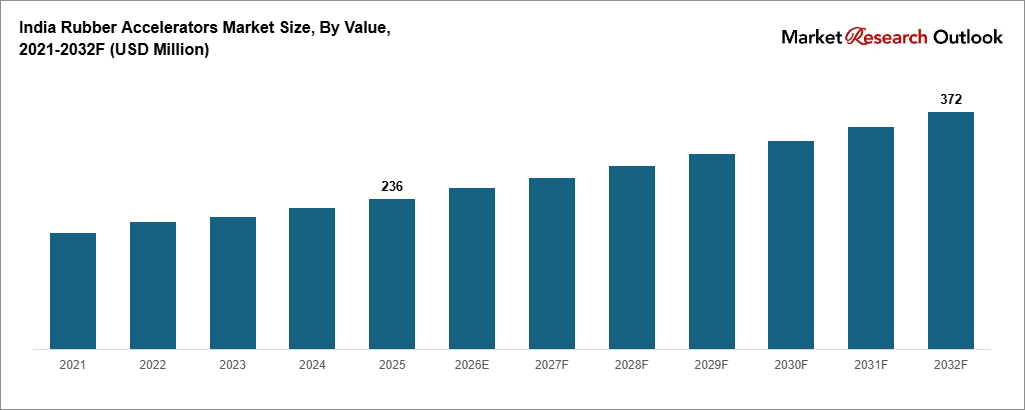
| Market Size (2025) | USD 236 Million |
| CAGR (2026-2032) | 6.7% |
| Leading Segment | Sulfenamides (CBS & TBBS for Tyres) |
| Fastest Growing Segment | Nitrosamine-Safe & Pre-Dispersed Accelerators |
| Market Size (2032) | USD 372 Million |
Market Overview: India Rubber Accelerators Market
The India rubber accelerators market size is expanding steadily, driven by tyre capacity growth, rising vehicle output, strong replacement demand, record tyre exports, wider use of rubber in industrial and consumer goods, and new investment by domestic producers. Valued at USD 236 million in 2025 and projected to reach USD 372 million by 2032, growing at a CAGR of 6.7%, accelerator market growth in India is supported by a tyre industry with turnover of about Rs 1 lakh crore, tyre exports of Rs 25,051 crore in FY25, and about Rs 27,000 crore of tyre capex over the last three to four years. In volume terms, demand stood at 74.5 thousand tonnes in 2025. Sulfenamides lead demand by value, while nitrosamine-safe and pre-dispersed accelerators form the fastest growing category. Tyres remain the main application, but belts, hoses, footwear and latex goods add a growing share. As NOCIL expands at Dahej, LANXESS India widens its tyre additive range and duties curb dumped imports, accelerator supply in India is becoming more local, more specialised and better qualified, with strong long-term growth potential.
Key Report Takeaways: India Rubber Accelerators Market
- The India rubber accelerators market size is projected to grow from USD 236 million in 2025 to USD 372 million by 2032, registering a CAGR of 6.7%, driven by tyre capacity additions, growth in non-tyre rubber goods, trade defence against dumped imports and the shift to safer, pre-dispersed grades.
- Sulfenamides lead the market with a 46% share of value in 2025, supported by heavy use of CBS and TBBS as primary accelerators in tyre treads, sidewalls and carcass compounds, where delayed action and scorch safety are critical.
- Nitrosamine-safe and pre-dispersed accelerators form the fastest growing category, expanding at a CAGR of 9.4% through 2032 as tyre makers, glove producers and automotive part suppliers replace older thiuram and dithiocarbamate systems and move to dust-free, automated mixing.
- Tyres account for 68% of accelerator demand by value in 2025, led by passenger car, two-wheeler, truck and bus radial and farm and off-the-road tyres, with farm and OTR tyres making up nearly 60% of India’s tyre export value.
- Investment by NOCIL in Rs 250 crore and Rs 130 crore Dahej programmes, along with specialty supply from LANXESS India and Merchem, is strengthening local supply, cutting import reliance and supporting long-term market growth.
Key Market Drivers: India Rubber Accelerators Market
Tyre Industry Capacity Additions, Record Tyre Exports and Rising Replacement Demand Driving Accelerator Consumption Across India
Growth in the India rubber accelerators market is closely linked to the tyre industry, which uses most accelerators produced or imported into the country. ATMA estimates tyre sector turnover at about Rs 1 lakh crore, with exports making up over 25% of revenue. Tyre exports rose 9% to Rs 25,051 crore in FY25, reaching over 170 countries, with the United States taking 17% of export value. Indian tyre makers invested around Rs 27,000 crore in greenfield and brownfield projects over the last three to four years, adding radial, truck and bus, and off-the-road capacity. Every tonne of rubber compound needs a carefully balanced cure system, usually a sulfenamide primary accelerator with thiazole or guanidine secondary accelerators, so each new mixing line adds direct accelerator demand. Rising radialisation in trucks and buses, larger rim sizes in passenger cars and a growing replacement market keep tyres the strongest demand engine for accelerators.
Source:
Growth in Vehicle Production and Domestic Demand After GST 2.0 Lifting Tyre and Automotive Rubber Parts Output
India produced over 3 crore vehicles in FY25, including two-wheelers, passenger vehicles, three-wheelers, tractors and commercial vehicles, making it one of the largest vehicle producers in the world. Each vehicle carries tyres, tubes, hoses, belts, seals, gaskets, anti-vibration mounts and wiper blades, all made with accelerator-cured compounds. GST 2.0 rate changes from September 2025 improved vehicle affordability, and NOCIL reported double-digit domestic volume growth after GST 2.0 in the June 2026 quarter, with overall volumes up 9% year on year. Electric two-wheelers, cars and buses need low rolling resistance tyres with silica-rich treads, which use more secondary accelerators such as DPG and specialty grades. Farm mechanisation is also lifting tractor and implement tyre demand. Together, rising OEM fitment and a large vehicle parc for replacement keep automotive demand the main growth base for accelerator makers.
Expansion of Non-Tyre Rubber Goods, Including Belts, Hoses, Footwear, Latex Products and Cables, Fuelling Accelerator Adoption
Non-tyre rubber goods form the second large outlet for accelerators. Conveyor belts for mining, cement, steel and ports, power transmission belts, and hydraulic and industrial hoses all need thiazole, thiuram and sulfenamide cure systems. India’s footwear industry, centred in Agra, Kanpur, Chennai, Kolkata and Delhi NCR, uses accelerators in rubber soles and moulded footwear. Latex product makers in Kerala and Tamil Nadu use dithiocarbamates and thiurams for gloves, balloons, threads and medical devices. Cables, seals, gaskets and moulded parts for railways, defence, appliances and construction add further volume. Infrastructure spending on roads, metros, ports and mining raises demand for industrial belts and hoses, while healthcare growth supports gloves and catheters. Producers such as LANXESS India and Merchem supply pre-dispersed and latex-grade accelerators to these buyers, widening the customer base for accelerators through 2032.
Key Market Challenges: India Rubber Accelerators Market
Low-Priced Imports From China Pressuring Prices and Margins of Domestic Accelerator Producers
The India rubber accelerators market has long faced pressure from low-priced imports, mainly from China, which hosts the largest accelerator capacity in the world. India imported about 26,000 tonnes of prepared rubber accelerators in 2023, up 24% from 2022, with China supplying about 81% of the volume. The average import price fell 26.3% that year to about USD 3,373 per tonne, which forced domestic producers to cut prices and accept lower utilisation. NOCIL ran its 115 kilotonne capacity at around 70% utilisation. In June 2026, India imposed anti-dumping duty of USD 974 per tonne on CBS and NS accelerators from China, with separate rates for the EU and US, for five years. The duty supports sulfenamide pricing, but other chemistries remain exposed, keeping import pressure a real constraint on the sector.
Volatility in Aniline, Carbon Disulfide, Amine and Sulphur Prices Raising Accelerator Production Costs
Accelerators are made from petrochemical and specialty intermediates such as aniline, carbon disulfide, sulphur, cyclohexylamine, tert-butylamine and morpholine. Prices of these inputs move with crude oil, benzene, natural gas and global chemical supply, and several amines are imported. Sharp input swings can erode margins because tyre makers negotiate quarterly or half-yearly contracts and resist sudden price increases. NOCIL noted that its revenue growth in the June 2026 quarter came mainly from higher selling prices after a sharp rise in input costs. Smaller accelerator and compounding units with limited backward integration feel this most. Backward-integrated plants, such as the new Rs 130 crore Dahej project, are designed to cut this exposure, but raw material volatility remains a structural challenge for accelerator makers in India.
Nitrosamine Concerns and Strict Effluent Norms Limiting Use of Certain Accelerator Chemistries
Some thiuram and dithiocarbamate accelerators, such as TMTD and ZDEC, can form nitrosamines during vulcanisation, which are classed as probable carcinogens. European rules on rubber articles, food contact and toys, and global tyre makers’ own chemical policies, push compounders to switch to safer grades such as TBBS and TBzTD. This raises costs and requires new compound trials. Accelerator plants also generate high-load effluents with sulphur compounds and amines, and must meet strict CPCB and state pollution control norms, often including zero liquid discharge. Compliance adds capital and operating costs, delays approvals for new capacity and has forced some small units to close, shaping supply and pricing across the sector.
Key Market Trends: India Rubber Accelerators Market
Rapid Shift Toward Nitrosamine-Safe, Dust-Free and Pre-Dispersed Accelerators in India
The India rubber accelerators market is seeing a clear technology shift toward safer and cleaner forms. Tyre majors and export-focused rubber goods makers increasingly specify nitrosamine-safe accelerators such as TBBS in place of older MBS, and TBzTD in place of TMTD, to meet customer and regulatory standards. Dust-free granules, oiled powders and polymer-bound pre-dispersed masterbatches are replacing loose powders because they improve weighing accuracy, reduce worker exposure and suit automated mixing lines. LANXESS showcased its Vulkacit, Rhenogran and Vulcuren ranges for crosslinking efficiency and low rolling resistance tyres at India Rubber Expo 2026 in New Delhi. This transition lifts value per tonne and reinforces long-term growth across tyre and non-tyre segments.
Capacity Expansion and Backward Integration by Domestic Rubber Accelerator Producers
A wave of investment is strengthening domestic supply. NOCIL, which runs plants at Navi Mumbai and Dahej, has an installed rubber chemicals capacity of 115 kilotonnes per year. In April 2026, it commissioned a new plant at Dahej as part of a Rs 250 crore investment programme, and in March 2026 its board approved a further Rs 130 crore brownfield expansion at Dahej for peak utilisation products, with backward integration of inputs and completion targeted for the first half of FY28. Merchem continues to expand latex and specialty accelerator supply from Kerala, while global producers serve Indian tyre makers through local warehouses and distributors. Backward integration improves cost control and supply security, giving domestic producers a stronger position in tyre maker approvals and adding resilience to the business.
Trade Defence and China Plus One Sourcing Reshaping Accelerator Supply Chains
Trade policy is changing how tyre and rubber goods makers source accelerators. In June 2026, India notified anti-dumping duty on CBS and NS sulphenamide accelerators from China, the EU and the US for five years, following DGTR final findings in March 2026. In the United States, producers filed anti-dumping and countervailing duty petitions on CBS from China in 2026, which opens space for Indian exporters. Global tyre majors with plants in India, Thailand and Europe are diversifying away from single-country sourcing and qualifying Indian suppliers. NOCIL has highlighted steady conversion of its export pipeline and growing interest in India as a reliable manufacturing partner. These shifts favour qualified domestic producers and strengthen the 2032 outlook for local suppliers.
Segmental Insights: India Rubber Accelerators Market
By End-User: Automotive Segment Dominates the India Rubber Accelerators Market
The automotive segment dominates the India rubber accelerators market, accounting for an estimated 66% of total value in 2025, driven by tyres, tubes, hoses, belts, seals and anti-vibration parts for two-wheelers, passenger vehicles, commercial vehicles and tractors. The industrial segment contributes another 17% of demand, led by conveyor belts, industrial hoses, rollers, cables and moulded goods for mining, cement, steel and infrastructure. Consumer goods account for 11%, including footwear, sports goods and household items, while healthcare makes up 6%, mainly through gloves, catheters and medical tubing. In 2025, NOCIL, LANXESS India and global producers deepened tyre maker supply agreements, reinforcing segment leadership.
By Product Type: Sulfenamides Lead While Nitrosamine-Safe and Pre-Dispersed Accelerators Grow Fastest
Sulfenamides lead the product mix with a 46% share of value, driven by CBS and TBBS as primary accelerators in tyre compounds. Thiazoles such as MBT, MBTS and ZMBT contribute 21%, thiurams 11%, dithiocarbamates 9% and guanidines 8%, with thioureas, xanthates and other products making up the remaining 5%. Nitrosamine-safe and pre-dispersed accelerators are the fastest growing category at a CAGR of 9.4%, supported by tyre maker chemical policies and automated mixing. By rubber type, natural rubber compounds account for the largest share, followed by SBR and polybutadiene in tyres, and EPDM and nitrile in automotive and industrial parts. By form, powder still leads, but granules and pre-dispersed masterbatch are gaining share. Leading producers including NOCIL, LANXESS India, Merchem and global suppliers have aligned portfolios to this mix, driving higher-value adoption across the market.
Regional Insights: India Rubber Accelerators Market
Regional analysis shows that West India and South India together account for 57% of total value, led by Tamil Nadu, Gujarat, Maharashtra, Kerala and Karnataka, which host major tyre plants around Chennai, Vadodara, Pune and Bengaluru, latex and rubber goods units in Kerala, and accelerator production at Navi Mumbai and Dahej. North India contributes 26% of demand, led by Haryana, Uttarakhand, Punjab and Uttar Pradesh, supported by tyre plants, automotive part clusters around Gurugram, Manesar and Pantnagar, and footwear centres in Agra and Kanpur. East and Central India together account for 17%, led by West Bengal, Odisha and Madhya Pradesh, where tyre, conveyor belt and industrial rubber units serve mining and steel. Domestic supply from Gujarat and Maharashtra shortens lead times for buyers across the country.
Recent Developments: India Rubber Accelerators Market
- The sector saw strong policy and capacity momentum during 2025 and 2026. India’s tyre exports rose 9% to Rs 25,051 crore in FY25, keeping accelerator demand firm. In March 2026, DGTR issued final findings on sulphenamide accelerators, and in June 2026 the government notified anti-dumping duty on CBS and NS imports from China, the EU and the US for five years. In April 2026, LANXESS presented its full rubber additives range, including Vulkacit accelerators, at India Rubber Expo 2026 in New Delhi.
- Producers have deepened India-focused capacity. In April 2026, NOCIL commissioned a new rubber chemicals plant at Dahej under its Rs 250 crore programme, and its board approved a Rs 130 crore brownfield expansion at the same site for peak utilisation products, targeted for completion in the first half of FY28. NOCIL reported a 9% rise in volumes and a 20% rise in revenue to Rs 403 crore in the June 2026 quarter. These developments are strengthening domestic supply and supporting the 2032 outlook.
- Trade and sourcing moves have also shaped competition in the accelerator business in India. US producers filed anti-dumping and countervailing duty petitions on CBS from China in 2026, global tyre makers continued to qualify Indian suppliers under China plus one strategies, and specialty producers widened pre-dispersed and nitrosamine-safe ranges for Indian compounders, strengthening long-term competitive positioning in the India rubber accelerators market forecast 2032.
Key Market Players: India Rubber Accelerators Market
- NOCIL Limited
- LANXESS India Pvt. Ltd.
- Merchem Limited
- Shandong Sunsine Chemical Co., Ltd.
- Kemai Chemical Co., Ltd.
- Shandong Yanggu Huatai Chemical Co., Ltd.
- Flexsys Inc.
- Kumho Petrochemical Co., Ltd.
- Ouchi Shinko Chemical Industrial Co., Ltd.
- Kawaguchi Chemical Industry Co., Ltd.
- Vanderbilt Chemicals, LLC
- Duslo, a.s.
- Puyang Willing Chemical Co., Ltd.
| By Product Type | By Rubber Type | By Form | By Application | By End-User |
| Sulfenamides (CBS, TBBS, MBS) Thiazoles (MBT, MBTS, ZMBT) Thiurams (TMTD, TMTM, TBzTD) Dithiocarbamates (ZDEC, ZDBC, ZDMC) Guanidines (DPG, DOTG) Others |
Natural Rubber Styrene Butadiene Rubber (SBR) Polybutadiene Rubber (BR) Ethylene Propylene Diene Monomer (EPDM) Nitrile Butadiene Rubber (NBR) Chloroprene Rubber (CR) Others |
Powder Oiled Powder Granules & Pellets Pre-Dispersed Masterbatch Liquid & Others |
Tyres Belts & Hoses Footwear Latex Products (Gloves, Balloons, Threads) Moulded & Extruded Goods Wires, Cables & Others |
Automotive Industrial Consumer Goods Healthcare |
Report Scope
In this report, the India Rubber Accelerators Market has been segmented into the following categories, in addition to detailed analysis of key industry trends, market dynamics, competitive positioning and growth opportunities across the forecast period:
- By Product Type
- Sulfenamides (CBS, TBBS, MBS)
- Thiazoles (MBT, MBTS, ZMBT)
- Thiurams (TMTD, TMTM, TBzTD)
- Dithiocarbamates (ZDEC, ZDBC, ZDMC)
- Guanidines (DPG, DOTG)
- Others
- By Rubber Type
- Natural Rubber
- Styrene Butadiene Rubber (SBR)
- Polybutadiene Rubber (BR)
- Ethylene Propylene Diene Monomer (EPDM)
- Nitrile Butadiene Rubber (NBR)
- Chloroprene Rubber (CR)
- Others
- By Form
- Powder
- Oiled Powder
- Granules & Pellets
- Pre-Dispersed Masterbatch
- Liquid & Others
- By Application
- Tyres
- Belts & Hoses
- Footwear
- Latex Products (Gloves, Balloons, Threads)
- Moulded & Extruded Goods
- Wires, Cables & Others
- By End-User
- Automotive
- Industrial
- Consumer Goods
- Healthcare
- By Geography
- North India
- South India
- West India
- East India
- Central India
Competitive Landscape
Company Profiles:
Detailed analysis of the leading companies operating in the India Rubber Accelerators Market, including business overview, product portfolio, strategic initiatives, competitive positioning and recent developments.
Company Information
Detailed profiling and strategic analysis of additional market players (up to five companies), including emerging domestic accelerator producers, pre-dispersion specialists, regional distributors, or niche latex accelerator manufacturers.
For a free sample of the India Rubber Accelerators Market report, customised insights or delivery timelines, submit your query here
India Rubber Accelerators Market, 2032
- Research Framework
- Market Segmentation
- Research Objective
- Research Methodology
- Qualitative Research
- Primary Research
- Secondary Research
- Quantitative Research
- Market Breakdown & Data Triangulation
- Demand Side
- Supply Side
- Primary Research Respondents
- Assumption & Limitation
- Executive Summary
- Market Overview, 2021-2032
- By Product Type
- By Rubber Type
- By Form
- By Application
- By End-User
- By Region
- Analyst Recommendations
- Geopolitical Impact on India Rubber Accelerators Market
- India Rubber Accelerators Market Insights
- Market Dynamics
- Growth Drivers
- Tyre industry capacity additions, record tyre exports and rising replacement demand driving accelerator consumption across India.
- Growth in vehicle production and domestic demand after GST 2.0 lifting tyre and automotive rubber parts output.
- Expansion of non-tyre rubber goods, including belts, hoses, footwear, latex products and cables, fuelling accelerator adoption.
- Restraints
- Low-priced imports from China pressuring prices and margins of domestic accelerator producers.
- Volatility in aniline, carbon disulfide, amine and sulphur prices raising accelerator production costs.
- Nitrosamine concerns and strict effluent norms limiting use of certain accelerator chemistries.
- Opportunities
- Anti-dumping duties and China plus one sourcing opening import substitution and export opportunities.
- Accelerator systems for silica-based green tyres and EV tyres supporting next-generation demand.
- Nitrosamine-safe and pre-dispersed accelerators creating high-value demand in latex, healthcare and automated mixing.
- Challenges
- Long qualification cycles with tyre makers delaying adoption of new accelerator suppliers and grades.
- High cost of effluent treatment and zero liquid discharge compliance for accelerator plants.
- Global overcapacity in commodity accelerators keeping export prices under pressure.
- Technological Advancements
- Recent Technological Advancements
- Prior to 2020
- Porter’s Five Forces Analysis
- PESTLE Analysis
- Industry Value Chain & Entry Points
- Upstream Raw Materials (aniline, carbon disulfide, sulphur, cyclohexylamine, tert-butylamine, morpholine, zinc oxide)
- Intermediate Producers (MBT, diphenylguanidine precursors, dithiocarbamate salts)
- Accelerator Manufacturers (NOCIL, LANXESS India, Merchem, global producers in China, Japan, Korea and Europe)
- Pre-Dispersion & Masterbatch Makers (polymer-bound and oiled accelerator forms)
- Testing, Certification & R&D Laboratories (BIS, NABL, tyre OEM approval and REACH compliance)
- Distributors, Traders & Importers (B2B chemical distribution and import networks)
- Rubber Compounders & Custom Mixers (masterbatch and finished compound suppliers)
- Tyre Manufacturers (MRF, Apollo Tyres, CEAT, JK Tyre, BKT, Bridgestone India, Michelin India)
- Non-Tyre Rubber Goods Makers (belts, hoses, footwear, gloves, seals, cables, moulded parts)
- End-Users (automotive, industrial, consumer goods, healthcare)
- India Rubber Accelerators Market: Regulatory Framework
- India Rubber Accelerators Market Overview
- Market Size & Forecast, 2021-2032
- By Value (USD Million)
- By Volume (Thousand Tonnes)
- Market Share & Forecast
- By Product Type
- Sulfenamides (CBS, TBBS, MBS)
- Thiazoles (MBT, MBTS, ZMBT)
- Thiurams (TMTD, TMTM, TBzTD)
- Dithiocarbamates (ZDEC, ZDBC, ZDMC)
- Guanidines (DPG, DOTG)
- Others
- By Rubber Type
- Natural Rubber
- Styrene Butadiene Rubber (SBR)
- Polybutadiene Rubber (BR)
- Ethylene Propylene Diene Monomer (EPDM)
- Nitrile Butadiene Rubber (NBR)
- Chloroprene Rubber (CR)
- Others
- By Form
- Powder
- Oiled Powder
- Granules & Pellets
- Pre-Dispersed Masterbatch
- Liquid & Others
- By Application
- Tyres
- Belts & Hoses
- Footwear
- Latex Products (Gloves, Balloons, Threads)
- Moulded & Extruded Goods
- Wires, Cables & Others
- By End-User
- Automotive
- Industrial
- Consumer Goods
- Healthcare
- By Geography
- North India
- South India
- West India
- East India
- Central India
- Competitive Landscape
- India Rubber Accelerators Market Company Market Share Analysis, 2025
- Competitive Benchmarking, By Operating Parameters
- Key Strategic Development (Mergers, Acquisitions, Partnerships, Etc.)
- List of Emerging Players
- Company Profile
- NOCIL Limited
- Introduction & Company Profile
- Product Benchmarking
- Strategic Outlook
- Key Competitors
- Financial Analysis
- SWOT Analysis
(Same Data Pointers Will Be Provided for The Below Companies)
- LANXESS India Pvt. Ltd.
- Merchem Limited
- Shandong Sunsine Chemical Co., Ltd.
- Kemai Chemical Co., Ltd.
- Shandong Yanggu Huatai Chemical Co., Ltd.
- Flexsys Inc.
- Kumho Petrochemical Co., Ltd.
- Ouchi Shinko Chemical Industrial Co., Ltd.
- Kawaguchi Chemical Industry Co., Ltd.
- Vanderbilt Chemicals, LLC
- Duslo, a.s.
- Puyang Willing Chemical Co., Ltd.
- Other Prominent Players
* Financial information in case of non-listed companies will be provided as per availability
** The segmentation and the companies are subjected to modifications based on in-depth secondary for the final deliverable
Frequently Asked Questions
1. How large is the India rubber accelerators market and what is its growth forecast?
Ans: The India rubber accelerators market is valued at USD 236 million in 2025 and is projected to reach USD 372 million by 2032, growing at a CAGR of 6.7%, backed by tyre capacity, exports and non-tyre rubber goods.
2. Which segments are driving demand in the India rubber accelerators market?
Ans: Sulfenamides lead with a 46% share of value and tyres account for 68% of demand, while nitrosamine-safe and pre-dispersed accelerators grow fastest at a CAGR of 9.4% through 2032 as tyre makers tighten chemical policies.
3. What are the key drivers of growth in the India rubber accelerators market?
Ans: Key drivers include tyre capacity additions and record exports, higher vehicle production and domestic demand after GST 2.0, and expansion of belts, hoses, footwear, latex products and cables across India.
4. Which regions are driving growth in the India rubber accelerators market?
Ans: West India and South India lead with a combined 57% share, driven by Tamil Nadu, Gujarat, Maharashtra and Kerala. North India follows at 26%, supported by tyre and auto part plants in Haryana and Uttarakhand.
5. What are the latest trends in the India rubber accelerators market?
Ans: Major trends include the shift toward nitrosamine-safe, dust-free and pre-dispersed accelerators, backward-integrated capacity expansion by domestic producers such as NOCIL at Dahej, and anti-dumping duties reshaping how tyre makers source accelerators in India.