

India Glufosinate Market, 2032
- Chemicals & Advanced Materials, Specialty Chemicals
- Oct 2026
- Pages 140
- Report Format: pdf
- Report Price: $2400 USD
India’s glufosinate market is witnessing strong structural growth, driven by the nationwide prohibition of paraquat, the restriction of glyphosate to pest control operators, rising farm labour costs, wider chemical weeding in cotton, tea, and plantations, the arrival of L-glufosinate and premix products, and growing investment by domestic agrochemical companies in glufosinate formulation, branding, and rural distribution.
| Study Duration | 2021-2032 |
| Market Size (2025) | USD 104.8 Million |
| CAGR (2026-2032) | 12.7% |
| Leading Segment | Racemic Glufosinate Ammonium (Cotton) |
| Fastest Growing Segment | Glufosinate-P (L-Glufosinate) & Plantation Crops |
| Market Size (2032) | USD 241.6 Million |
Market Overview: India Glufosinate Market
The India glufosinate market size is expanding quickly, driven by regulatory curbs on older non-selective herbicides, rising labour costs, wider use of chemical weeding, and steady brand launches by domestic agrochemical companies. Valued at USD 104.8 million in 2025 and projected to reach USD 241.6 million by 2032, growing at a CAGR of 12.7%, India glufosinate market growth rests on the restriction of glyphosate to pest control operators since October 2022 and the final prohibition of paraquat dichloride in September 2026. Racemic glufosinate ammonium 13.5% SL leads consumption, while L-glufosinate and plantation crop demand are the fastest growing pockets. Growers value glufosinate for its fast contact action, its separate mode of action as a glutamine synthetase inhibitor, and its fit for directed sprays around standing cotton and tea bushes. As UPL, SWAL, Insecticides (India), Best Agrolife, Indofil, HPM Chemicals, and Aimco Pesticides widen their glufosinate portfolios, and global technical producers such as Lier Chemical and Zhejiang Yongnong scale supply, the India glufosinate market is turning into a brand-led, regulation-driven segment with strong long-term growth potential.
Key Report Takeaways: India Glufosinate Market
- The India glufosinate market size is projected to grow from USD 104.8 million in 2025 to USD 241.6 million by 2032, registering a CAGR of 12.7%, driven by the paraquat ban, glyphosate restrictions, labour shortages, and the steady shift toward branded non-selective herbicides.
- Racemic glufosinate ammonium dominates demand, accounting for 71% of market value in 2025, driven by the wide availability of 13.5% SL brands from UPL, SWAL, Insecticides (India), Best Agrolife, and Indofil, and strong uptake in cotton and tea.
- Glufosinate-P (L-glufosinate) is the fastest growing product segment, expected to expand at a CAGR of 24.8% through 2032, as its lower use rate and stronger per-gram activity attract plantation estates and large commercial farms.
- Cotton is the largest crop segment with 29% of 2025 value, followed by tea at 18% and plantation crops at 14%, while plantations and orchards are gaining share fastest as paraquat stocks are withdrawn.
- Rising activity by domestic formulators, a growing number of 13.5% SL brands, and stronger dealer and online reach across cotton belts and tea districts are strengthening local supply and supporting the India glufosinate market forecast 2032.
Key Market Drivers: India Glufosinate Market
Paraquat Prohibition and Glyphosate Use Restrictions Shifting Non-Selective Weed Control Demand to Glufosinate
Growth in the India glufosinate market is driven first by regulatory change in non-selective herbicides. The Restriction on Use of Glyphosate Order, notified on 21 October 2022, limited glyphosate use to pest control operators and asked registration holders to return their certificates for further processing. In 2026, the Ministry of Agriculture and Farmers Welfare went further, issuing a draft order on 10 July 2026 and then a final order on 22 September 2026 that prohibited paraquat dichloride and cancelled all existing registrations. Paraquat had been a low-cost, fast-acting burndown option for tea estates, orchards, and cotton growers. With both older molecules curbed, glufosinate ammonium is the most widely registered and available non-selective alternative, with fast contact action and good safety around directed sprays. This regulatory shift is moving a large pool of existing demand toward glufosinate and supports strong volume growth across the category.
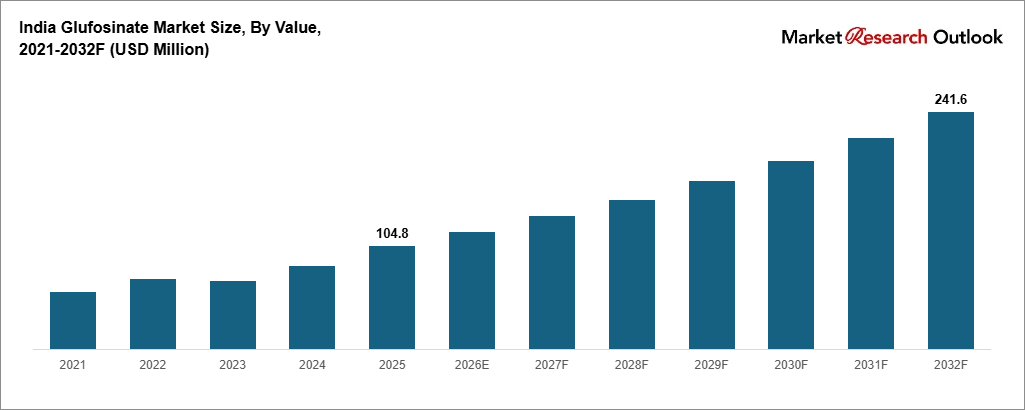
Source:
Rising Farm Labour Costs and the Shift From Manual to Chemical Weeding in Cotton, Tea, and Plantation Crops
The India glufosinate market is benefiting from a steady shift away from manual weeding. Rural wages have risen as workers move to construction, services, and urban jobs, and hand weeding during peak season is now hard to arrange and costly. Cotton growers in Maharashtra, Gujarat, and Telangana need several weeding rounds each season, while tea estates in Assam, West Bengal, and the Nilgiris must keep weeds down through the year to protect yields. Herbicide sprays cut weeding cost and time sharply compared with manual labour. Glufosinate fits these systems well because it works as a directed spray between crop rows and around bushes, acts within days, and leaves no soil residual that could harm the next crop. Herbicides have become the fastest growing class in Indian agrochemicals, and their share of agrochemical exports rose from 31% to 37% between FY2020 and FY2025. This labour-driven shift adds steady demand for the molecule.
Product Innovation in L-Glufosinate, Premix Combinations, and Smallholder Pack Sizes Strengthening Market Growth
Product innovation is lifting both volume and value. L-glufosinate, also called glufosinate-P, contains only the active isomer of the molecule, so it delivers comparable weed control at roughly half the dose of racemic glufosinate ammonium. BASF, which acquired the global glufosinate business from Bayer, and leading Chinese technical producers are investing in L-glufosinate supply, and Indian formulators are preparing registrations and launches. Companies are also developing ready-mix products that add residual partners for longer weed-free periods, and improved adjuvant systems that speed up uptake in humid tea and coffee estates. Smaller packs of 250 ml and 500 ml help smallholders try the product at low cost, while 5 litre and bulk packs serve estates. Brands such as Sweep Power from UPL, Himax from Insecticides (India), Bestie from Best Agrolife, and Smack from Indofil show how wide the branded 13.5% SL range has become.
Key Market Challenges: India Glufosinate Market
Heavy Reliance on Imported Technical Grade Glufosinate Exposing Formulators to Supply and Price Shocks
The industry continues to depend heavily on imported technical grade material, most of it from China, where producers such as Lier Chemical, Zhejiang Yongnong, and Rainbow Chemical run large plants. Most Indian companies formulate and pack glufosinate locally but buy the active ingredient from overseas. This leaves them exposed to Chinese production cuts, environmental shutdowns, export rules, freight costs, and currency moves. Technical prices fell sharply in 2023 as Chinese capacity grew, and the resulting stock write-downs and price cuts hurt formulator margins and slowed market value growth that year. Building domestic technical capacity requires complex phosphorus chemistry and large investment, so self-sufficiency remains some years away. Until local technical production scales, supply and price risk will remain a key concern.
Higher Per-Acre Cost and Weaker Control of Deep-Rooted Perennial Weeds Limiting Repeat Use
Glufosinate faces practical limits on farm. It is a contact herbicide with limited movement inside the plant, so it kills green tissue quickly but often fails to destroy the underground roots and rhizomes of perennial weeds such as Cynodon dactylon, Cyperus rotundus, and Imperata cylindrica. These weeds regrow, and farmers may need repeat sprays within a season, which raises the cost per acre. Per-litre prices of glufosinate brands are also higher than the older molecules they replace, which matters to smallholders with tight budgets. Good results need correct dose, full spray coverage, and spraying in bright, warm conditions, and poor practice leads to weak control and lower farmer trust. Training by companies and agriculture departments helps, but cost and performance gaps remain a near-term challenge for the segment.
Spurious and Counterfeit Herbicides in Rural Markets Eroding Farmer Trust and Branded Product Sales
The segment also faces a serious problem with fake, mislabelled, and substandard products. As demand for glufosinate rises after the paraquat ban, unregistered sellers and small unbranded packers are trying to cash in with low-strength or adulterated formulations sold at deep discounts. Farmers who buy these products see poor weed control and often blame the molecule rather than the seller. This hurts sales of genuine brands and slows wider adoption. State pesticide testing laboratories, CIB&RC registration checks, and company-led anti-counterfeit packaging such as QR codes and holograms are helping, and online agri-input platforms offer more traceable supply. Even so, enforcement in remote districts is uneven, and product quality concerns are likely to weigh on branded sales in the near term.
Key Market Trends: India Glufosinate Market
Rapid Adoption of Glufosinate as the Main Paraquat Replacement in Tea, Coffee, Rubber, and Orchards in India
The category is seeing a clear shift in plantation weed control. Tea estates in Assam, West Bengal, Kerala, and Tamil Nadu, coffee and arecanut gardens in Karnataka, rubber holdings in Kerala, and mango, banana, and citrus orchards across Maharashtra and Andhra Pradesh have long relied on paraquat for quick burndown between rows. With paraquat now prohibited, these growers are moving to glufosinate, often in rotation with selective and residual herbicides. Plantation crops and orchards together already account for 26% of market value in 2025, and plantation crop demand is expected to grow at a CAGR of 16.9% through 2032. Estates also prefer 5 litre and bulk packs bought through direct supply contracts, which favours companies with strong plantation sales teams. This shift is reinforcing the India glufosinate market forecast 2032 across both plantation and horticulture segments.
Growth of Online Agri-Input Platforms and Wider Rural Retail Reach in the India Glufosinate Market
A clear shift toward digital and organised retail is changing how glufosinate reaches farmers. Online agri-input platforms such as BigHaat, AgroStar, and DeHaat list a wide range of glufosinate ammonium 13.5% SL brands, including Sweep Power, Himax, Bestie, Aimco Power, Oryx Gold, and JU-Glunate, with home delivery to villages and crop advice in local languages. Company-owned outlets, farmer producer organisations, and cooperatives are also adding herbicide ranges and helping farmers compare products and prices. These channels improve product authenticity, widen choice, and cut the reach gap between large brands and remote districts. They also let companies run targeted promotions for cotton and tea seasons. This growing digital and retail reach is expanding the customer base for branded products and lifting adoption among smallholders.
Rising Use of Glufosinate in Zero-Tillage, Pre-Sowing Burndown, and Non-Crop Vegetation Management
New use patterns are widening the demand base. In the rice-wheat belt of Punjab, Haryana, and Uttar Pradesh, and in cotton and pulse systems in central and western India, farmers using zero-tillage or reduced-tillage methods need a burndown spray to clear weeds before sowing, and glufosinate is gaining ground in this role as glyphosate use is restricted. Railways, highway authorities, industrial parks, power substations, and solar plants also need regular vegetation control, and contractors are turning to glufosinate for fast, visible results. These non-crop users buy in bulk and value quick action and low soil carryover. Field crops and non-crop areas together account for 18% of market value in 2025, and both segments are adding new volume. These uses are supporting the India glufosinate market forecast 2032 beyond cotton and tea.
Segmental Insights: India Glufosinate Market
By End-User: Smallholder Farmers Segment Dominates the India Glufosinate Market
The smallholder farmers segment dominates demand, accounting for 46% of market value in 2025, driven by cotton, vegetable, and field crop growers who buy through local agri-input dealers, cooperatives, and online platforms. Glufosinate ammonium 13.5% SL in 500 ml and 1 litre packs is the dominant product in this segment. Plantation estates contribute 26% of value, led by tea, coffee, and rubber estates buying 5 litre and bulk packs under direct supply contracts. Large commercial farms hold 21%, mainly in orchards, sugarcane, and large cotton holdings, while non-agricultural users such as railways and industrial sites account for the remaining 7%. In 2025, leading brands from UPL, SWAL, Insecticides (India), Best Agrolife, and Indofil widened smallholder reach through dealer schemes and digital channels, reinforcing segment dominance in the India glufosinate market.
By Product Type: Racemic Glufosinate Ammonium Leads While L-Glufosinate Grows Fastest
Racemic glufosinate ammonium leads the product mix, accounting for 71% of market value in 2025, driven by its long registration history, wide range of 13.5% SL brands, and proven results in cotton and tea. Glufosinate-P, or L-glufosinate, accounts for 11% of value and is the fastest growing type, expanding at a CAGR of 24.8%, supported by lower use rates and stronger activity per gram. Premix combinations hold 9%, while technical grade material sold to formulators accounts for 5%. Ready-to-use formulations for home gardens and small sites hold 2%, with others making up the remaining 2%. Leading companies including BASF, UPL, SWAL, Best Agrolife, and Indofil are aligning portfolios with this product mix, lifting average value per litre across the India glufosinate market.
Regional Insights: India Glufosinate Market
Regional analysis shows that South India accounts for 34% of market value in 2025, driven by Andhra Pradesh, Telangana, Karnataka, Tamil Nadu, and Kerala, where cotton, chilli, coffee, rubber, tea, and orchards create year-round herbicide demand. West India contributes 31%, led by Maharashtra and Gujarat, the country’s main cotton belts, along with large orchard areas. East India accounts for 15%, driven by the tea estates of Assam and West Bengal, where paraquat replacement is moving fastest. North India holds 13%, led by Punjab, Haryana, and Uttar Pradesh, where zero-tillage burndown and sugarcane create new demand. Central India, mainly Madhya Pradesh and Chhattisgarh, accounts for the remaining 7%. Strong dealer networks in Gujarat, Maharashtra, and Telangana, where many formulation plants are located, support fast product availability across the India glufosinate market.
Recent Developments: India Glufosinate Market
- The India glufosinate market saw strong regulatory momentum during 2025 and 2026. The Ministry of Agriculture and Farmers Welfare issued a draft order to ban paraquat dichloride on 10 July 2026, followed by the final order, S.O. 5234(E), dated 22 September 2026, which prohibited new registrations and cancelled all existing certificates. This came on top of the Restriction on Use of Glyphosate Order of 21 October 2022, which limited glyphosate to pest control operators.
- Domestic brand activity has deepened. UPL markets Sweep Power, SWAL sells Ferio and a 50% WG glufosinate product, Insecticides (India) offers Himax, Best Agrolife sells Bestie, Indofil markets Smack for cotton and tea, and HPM Chemicals, Aimco Pesticides, Sudarshan Farm Chemicals, and Farm Chem India have added their own 13.5% SL brands. These launches are widening choice and supporting the India glufosinate market forecast 2032.
- Agrochemical sector momentum has also stayed strong. India’s agrochemical market reached USD 11.2 billion in FY2025, up 8.7% year on year, and herbicides rose to 37% of agrochemical exports. Global technical producers are expanding glufosinate and L-glufosinate capacity, while Indian formulators are building plantation and dealer sales teams to capture paraquat replacement demand, strengthening long-term positioning in the India glufosinate market forecast 2032.
Key Market Players: India Glufosinate Market
- BASF India Limited
- UPL Limited
- SWAL Corporation Limited
- Insecticides (India) Limited
- Best Agrolife Limited
- Indofil Industries Limited
- HPM Chemicals & Fertilizers Ltd.
- Aimco Pesticides Limited
- Sudarshan Farm Chemicals India Pvt. Ltd.
- Farm Chem India Pvt. Ltd. (JU Agri Science)
- Lier Chemical Co., Ltd.
- Zhejiang Yongnong Biosciences Co., Ltd.
- Shandong Weifang Rainbow Chemical Co., Ltd.
| By Product Type | By Crop Type | By Pack Size | By Distribution | By End-User |
| Racemic Glufosinate Ammonium Glufosinate-P (L-Glufosinate) Premix Combinations Technical Grade Ready-to-Use Formulations Others |
Cotton Tea Plantation Crops (Coffee, Rubber, Arecanut) Fruits & Orchards Vegetables Field Crops (Pre-Sowing Burndown) Non-Crop Areas |
Below 250 ml 250-500 ml 1 Litre 5 Litre Bulk Packs (Above 5 Litre) |
Agri-Input Retailers & Dealers Company-Owned Outlets Cooperatives & FPOs Plantation & Estate Direct Sales Online Agri-Input Platforms Government & Institutional |
Smallholder Farmers Large Commercial Farms Plantation Estates Non-Agricultural Users |
Report Scope
In this report, the India Glufosinate Market has been segmented into the following categories, in addition to detailed analysis of key industry trends, market dynamics, competitive landscape, and growth opportunities across the forecast period:
- By Product Type
- Racemic Glufosinate Ammonium
- Glufosinate-P (L-Glufosinate)
- Premix Combinations
- Technical Grade
- Ready-to-Use Formulations
- Others
- By Crop Type
- Cotton
- Tea
- Plantation Crops (Coffee, Rubber, Arecanut)
- Fruits & Orchards
- Vegetables
- Field Crops (Pre-Sowing Burndown)
- Non-Crop Areas
- By Pack Size
- Below 250 ml
- 250-500 ml
- 1 Litre
- 5 Litre
- Bulk Packs (Above 5 Litre)
- By Distribution Channel
- Agri-Input Retailers & Dealers
- Company-Owned Outlets
- Cooperatives & FPOs
- Plantation & Estate Direct Sales
- Online Agri-Input Platforms
- Government & Institutional
- By End-User
- Smallholder Farmers
- Large Commercial Farms
- Plantation Estates
- Non-Agricultural Users
- By Geography
- North India
- South India
- West India
- East India
- Central India
Competitive Landscape
Company Profiles:
Detailed analysis of the leading companies operating in the India Glufosinate Market, including business overview, product portfolio, brand range, strategic initiatives, competitive positioning, and recent developments.
Company Information
Detailed profiling and strategic analysis of additional market players (up to five companies), including emerging glufosinate formulators, L-glufosinate suppliers, regional agrochemical brands, or niche plantation and non-crop herbicide specialists.
For a free sample of the India Glufosinate Market report, customised insights or delivery timelines, submit your query here
India Glufosinate Market, 2032
- Research Framework
- Market Segmentation
- Research Objective
- Research Methodology
- Qualitative Research
- Primary Research
- Secondary Research
- Quantitative Research
- Market Breakdown & Data Triangulation
- Demand Side
- Supply Side
- Primary Research Respondents
- Assumption & Limitation
- Executive Summary
- Market Overview, 2021-2032
- By Product Type
- By Crop Type
- By Pack Size
- By Distribution Channel
- By End-User
- By Region
- Analyst Recommendations
- Geopolitical Impact on India Glufosinate Market
- India Glufosinate Market Insights
- Market Dynamics
- Growth Drivers
- Paraquat prohibition and glyphosate use restrictions shifting non-selective weed control demand to glufosinate.
- Rising farm labour costs and the shift from manual to chemical weeding in cotton, tea, and plantation crops expanding the India glufosinate market.
- Product innovation in L-glufosinate, premix combinations, and smallholder pack sizes strengthening the India glufosinate market.
- Restraints
- Heavy reliance on imported technical grade glufosinate exposing formulators to supply and price shocks.
- Higher per-acre cost and weaker control of deep-rooted perennial weeds limiting repeat use among price-sensitive farmers.
- Spurious and counterfeit herbicides in rural markets eroding farmer trust and branded product sales.
- Opportunities
- Paraquat replacement in tea, coffee, rubber, and fruit plantations opening large untapped demand pools.
- Zero-tillage and pre-sowing burndown in rice-wheat, cotton, and pulse systems supporting next-generation growth.
- Non-crop vegetation management across railways, highways, industrial sites, and solar parks creating new demand.
- Challenges
- Intense price competition among generic 13.5% SL brands compressing formulator margins.
- Weed resistance risk and limited farmer awareness of correct dose, timing, and spray coverage.
- Regulatory scrutiny of herbicide safety and the need for strong stewardship as use spreads to new crops.
- Technological Advancements
- Recent Technological Advancements
- Prior to 2020
- Porter’s Five Forces Analysis
- PESTLE Analysis
- Industry Value Chain & Entry Points
- Upstream Raw Materials (phosphorus intermediates, methyl phosphonous dichloride, acrolein, ammonia, solvents, surfactants)
- Technical Grade Manufacturers (Lier Chemical, Zhejiang Yongnong, Rainbow Chemical, BASF)
- Formulators & Brand Owners (UPL, SWAL, Insecticides (India), Best Agrolife, Indofil, HPM Chemicals, Aimco)
- Adjuvant, Surfactant & Packaging Suppliers (wetting agents, HDPE bottles, cans, labels)
- Registration, Testing & Quality Bodies (CIB&RC, state pesticide testing laboratories, BIS)
- Distributors, Wholesalers & Agri-Input Dealers (B2B and B2C distribution networks)
- Cooperatives, FPOs & Plantation Procurement Desks (tea, coffee, rubber estates)
- Online Agri-Input Platforms & Retail Chains (BigHaat, AgroStar, DeHaat, company outlets)
- Extension & Advisory Services (state agriculture departments, KVKs, company field teams)
- End-Users (smallholder farmers, commercial farms, plantation estates, railways, industrial sites)
- India Glufosinate Market: Regulatory Framework
- India Glufosinate Market Overview
- Market Size & Forecast, 2021-2032
- By Value (USD Million)
- By Volume (Tonnes)
- Market Share & Forecast
- By Product Type
- Racemic Glufosinate Ammonium
- Glufosinate-P (L-Glufosinate)
- Premix Combinations
- Technical Grade
- Ready-to-Use Formulations
- Others
- By Crop Type
- Cotton
- Tea
- Plantation Crops (Coffee, Rubber, Arecanut)
- Fruits & Orchards
- Vegetables
- Field Crops (Pre-Sowing Burndown)
- Non-Crop Areas
- By Pack Size
- Below 250 ml
- 250-500 ml
- 1 Litre
- 5 Litre
- Bulk Packs (Above 5 Litre)
- By Distribution Channel
- Agri-Input Retailers & Dealers
- Company-Owned Outlets
- Cooperatives & FPOs
- Plantation & Estate Direct Sales
- Online Agri-Input Platforms
- Government & Institutional
- By End-User
- Smallholder Farmers
- Large Commercial Farms
- Plantation Estates
- Non-Agricultural Users
- By Geography
- North India
- South India
- West India
- East India
- Central India
- Competitive Landscape
- India Glufosinate Market Company Market Share Analysis, 2025
- Competitive Benchmarking, By Operating Parameters
- Key Strategic Development (Mergers, Acquisitions, Partnerships, Etc.)
- List of Emerging Players
- Company Profile
- BASF India Limited
- Introduction & Company Profile
- Product Benchmarking
- Strategic Outlook
- Key Competitors
- Financial Analysis
- SWOT Analysis
(Same Data Pointers Will Be Provided for The Below Companies)
- UPL Limited
- SWAL Corporation Limited
- Insecticides (India) Limited
- Best Agrolife Limited
- Indofil Industries Limited
- HPM Chemicals & Fertilizers Ltd.
- Aimco Pesticides Limited
- Sudarshan Farm Chemicals India Pvt. Ltd.
- Farm Chem India Pvt. Ltd. (JU Agri Science)
- Lier Chemical Co., Ltd.
- Zhejiang Yongnong Biosciences Co., Ltd.
- Shandong Weifang Rainbow Chemical Co., Ltd.
- Other Prominent Players
* Financial information in case of non-listed companies will be provided as per availability
** The segmentation and the companies are subjected to modifications based on in-depth secondary for the final deliverable
Frequently Asked Questions
1. How large is the India glufosinate market and what is its growth forecast?
Ans: The India glufosinate market is valued at USD 104.8 million in 2025 and is projected to reach USD 241.6 million by 2032, growing at a CAGR of 12.7%, supported by the paraquat ban, glyphosate restrictions, and labour shortages.
2. Which segments are driving demand in the India glufosinate market?
Ans: Racemic glufosinate ammonium leads with 71% of 2025 value and cotton is the largest crop at 29%. L-glufosinate and plantation crops are the fastest growing segments as estates replace paraquat with glufosinate.
3. What are the key drivers of growth in the India glufosinate market?
Ans: Key drivers include the paraquat prohibition of September 2026, the 2022 glyphosate restriction, rising farm labour costs, the shift to chemical weeding in cotton and tea, and new L-glufosinate and premix products.
4. Which regions are driving growth in the India glufosinate market?
Ans: South India leads with 34% of 2025 value, driven by Andhra Pradesh, Telangana, Karnataka, and Kerala. West India follows with 31% from the Maharashtra and Gujarat cotton belts, while Assam tea estates grow fast.
5. What are the latest trends in the India glufosinate market?
Ans: Key trends include glufosinate replacing paraquat in tea and plantations, growth of online agri-input platforms, rising L-glufosinate interest, zero-tillage burndown use, and wider non-crop vegetation control on railways and industrial sites.