

India Ethanol Market Size, Share & Outlook 2032
- Chemicals & Advanced Materials, Energy, Power & Storage, Renewables & Clean Fuels
- Apr 2026
- Pages 140
- Report Format: pdf
- Report Price: $2400 USD
India’s ethanol market is witnessing strong growth, driven by the accelerated rollout of the E20 ethanol blending program under the National Biofuels Policy, rapid expansion of dedicated grain-based and sugarcane-based distillation capacity, rising demand from beverage alcohol, pharmaceuticals, sanitisers, and industrial solvent applications, government-led PM JI-VAN, EBP, and interest subvention schemes for distilleries, and rising interest from global energy and chemical majors investing in India-specific ethanol production capacity and second-generation technology.
Report Description
| Study Duration | 2021-2032 |
| Market Size (2025) | USD 5.42 Billion |
| CAGR (2026-2032) | 11.8% |
| Leading Segment | Bioethanol / Fuel-Grade Ethanol |
| Fastest Growing Segment | Grain-Based & Second-Generation (2G) Ethanol for E20 Blending |
| Market Size (2032) | USD 11.86 Billion |
Source:
India Ethanol Market Overview
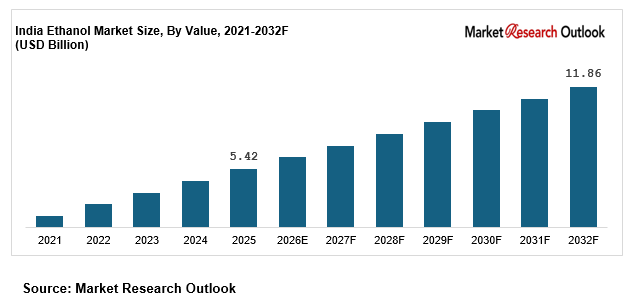
The India ethanol market size is witnessing rapid expansion, driven by accelerated rollout of the E20 ethanol blending program, large-scale grain-based and second-generation distillery commissioning, expanding non-fuel demand from beverage alcohol, pharmaceuticals, sanitisers, and industrial solvents, and capacity investments by global energy and chemical majors. Valued at USD 5.42 Billion in 2025 and projected to reach USD 11.86 Billion by 2032, growing at a CAGR of 11.8%, the India ethanol market growth is being fuelled by strong demand from oil marketing companies, beverage manufacturers, pharmaceutical formulators, sanitiser producers, and chemical and bio-ethylene downstream users. Bioethanol and fuel-grade ethanol lead consumption, while grain-based and second-generation (2G) ethanol for E20 blending are emerging as the fastest-growing segments. Tightening BIS specifications for fuel-grade ethanol, ZLD norms for spent wash management, sustainability and low-carbon-intensity certification under ISCC and CARB LCFS, and corporate ESG commitments are reshaping the supply landscape. As Praj Industries scales 2G technology licensing, OMCs commission dedicated bio-refineries, and integrated sugar and grain players including Triveni, Bajaj Hindusthan, Balrampur Chini, Shree Renuka, EID Parry, Dalmia Bharat, Dhampur, and DCM Shriram expand multi-feedstock capacity, the India ethanol market is evolving into a sustainability-led, multi-feedstock, and export-competitive ecosystem with strong long-term growth potential.
Related research: India Branded Sugar Market, India Hydrogen Market and India Biofuel Market.
Key Report Takeaways: India Ethanol Market
- The India ethanol market is projected to grow from USD 5.42 billion in 2025 to USD 11.86 billion by 2032, registering a strong CAGR of 11.8%, driven by the accelerated rollout of the E20 blending programme, rapid expansion of grain-based and second-generation distillery capacity, and increasing demand from non-fuel applications.
- Bioethanol and fuel-grade ethanol currently dominate the market, accounting for over 70% of total demand, supported by large-scale procurement by oil marketing companies under the Ethanol Blended Petrol programme and the gradual expansion of E20 fuel availability across key states.
- Grain-based ethanol and second-generation ethanol are emerging as the fastest-growing segments, expected to expand at 14% to 18% annually, as policy support, feedstock diversification, and technology adoption reduce dependence on sugar-based production.
- Strong policy backing through the National Biofuels Policy, PM JI-VAN scheme, and interest subvention programmes for grain-based distilleries, along with expanded ethanol evacuation and storage infrastructure by Indian Oil Corporation Limited, Bharat Petroleum Corporation Limited, and Hindustan Petroleum Corporation Limited, is structurally strengthening demand visibility across the country.
- Rising investments by domestic leaders such as Praj Industries, Triveni Engineering & Industries, Bajaj Hindusthan Sugar, Balrampur Chini Mills, Shree Renuka Sugars, and Dalmia Bharat Sugar and Industries in multi-feedstock distillation capacity and second-generation technologies are reinforcing domestic supply capabilities and supporting long-term market growth.
Key Drivers of the India Ethanol Market
Accelerated Rollout of the E20 Ethanol Blending Program
Growth in the India ethanol market is being driven by the rapid rollout of the E20 blending programme under the National Policy on Biofuels, with the 20% target advanced to 2025–26. Ethanol demand has already crossed 10 billion litres for ESY 2024–25, supported by large-scale procurement from over 400 distilleries.
The Ethanol Blended Petrol (EBP) Programme has increased blending levels from under 2% in 2014 to over 15% in 2024, creating strong and recurring demand for fuel-grade ethanol.
As blending rises, compliance with standards such as BIS IS 15464 and ASTM D4806 is becoming critical, reinforcing a structured, policy-driven growth cycle in the India ethanol market.
Rapid Expansion of Grain-Based and Sugarcane-Based Distillation Capacity
The India ethanol market is witnessing a clear shift toward grain-based and second-generation (2G) distillation capacity, growing at 14% to 18% annually—significantly outpacing traditional molasses-based production. Policy support through the Pradhan Mantri JI-VAN Yojana and interest subvention schemes for grain-based distilleries is accelerating this transition, with over USD 1.6 billion in approved investments across 200+ projects.
Grain-based units offer 1.5x to 2x higher utilisation than seasonal molasses plants and provide flexibility across feedstocks such as maize, surplus rice, and damaged food grains, improving supply reliability.
Leading players including Praj Industries, Triveni Engineering & Industries, Bajaj Hindusthan Sugar, and Balrampur Chini Mills are expanding dual-feedstock capacity, while bio-refineries from Indian Oil Corporation Limited, Bharat Petroleum Corporation Limited, and Hindustan Petroleum Corporation Limited are scaling 2G ethanol production—reinforcing a structural shift toward a more flexible and resilient supply base.
Rising Demand from Beverage Alcohol, Pharmaceuticals, Sanitisers, and Industrial Solvents
Non-fuel demand is emerging as a strong growth driver for the India ethanol market, supported by expansion in beverage alcohol, pharmaceuticals, personal care, and industrial solvent applications. India’s Extra Neutral Alcohol (ENA) capacity continues to scale alongside a USD 50 billion+ IMFL and beer industry, while pharmaceutical and personal care production is growing at 9% to 11% annually.
Ethanol derivatives such as ENA, rectified spirit, and denatured ethanol remain critical inputs across these sectors, with demand sustaining even after the pandemic-led surge in sanitisers and disinfectants.
Major consumers including United Spirits, Pernod Ricard, Radico Khaitan, Hindustan Unilever, Procter & Gamble, Dr. Reddy’s Laboratories, Cipla, and Asian Paints are strengthening long-term sourcing from domestic distilleries.
This diversified, non-fuel demand base is reducing dependence on fuel blending cycles and creating a more stable, multi-sector growth trajectory for the India ethanol market.
India Ethanol Market Challenges
Feedstock Price Volatility Linked to Sugarcane FRP, Maize, and Grain Availability
The India ethanol market remains highly sensitive to feedstock price fluctuations, with sugarcane Fair and Remunerative Price (FRP), maize prices, and availability of damaged food grains accounting for 60% to 75% of total production costs. Over the past decade, cumulative increases in FRP exceeding 35%, along with maize price volatility in the INR 17,000 to INR 26,000 per tonne range, have led to 15% to 25% swings in distillery operating margins.
This exposure is further amplified by India’s reliance on monsoon-driven harvest cycles and policy-led grain allocations by the Food Corporation of India, creating uncertainty in feedstock supply.
To manage this risk, leading producers are increasingly adopting multi-feedstock distillery models, securing captive grain sourcing, and accelerating second-generation ethanol integration—shifting the market toward greater operational flexibility and cost resilience.
Heavy Dependence on Monsoon-Driven Sugarcane and Grain Supply Cycles
The India ethanol market remains structurally dependent on monsoon-driven sugarcane and grain availability, with 60% to 65% of production linked to molasses, sugar juice, and syrup, and another 25% to 30% dependent on maize and damaged food grains. Availability of these feedstocks is closely tied to rainfall patterns and surplus allocations by the Food Corporation of India.
Below-normal monsoons or diversion of sugarcane toward sugar production have historically reduced ethanol output by 10% to 20% in individual years, disrupting procurement for oil marketing companies and downstream users.
While companies such as Praj Industries, Triveni Engineering & Industries, and Bajaj Hindusthan Sugar are expanding multi-feedstock and 2G capacity to reduce this dependence, supply cyclicality remains a near-term structural challenge.
Environmental Compliance, Spent Wash Management, and ZLD Complexity
The India ethanol market is facing rising compliance pressure around spent wash treatment, Zero Liquid Discharge (ZLD), and emission norms. Each kilolitre of ethanol production generates 8 to 15 kilolitres of spent wash, and stringent mandates from the Central Pollution Control Board require distilleries to invest in bio-composting, concentration, and incineration systems, increasing project capex by 8% to 12%.
Export markets such as the EU and US are adding further compliance layers through certifications like International Sustainability and Carbon Certification, Renewable Energy Directive II, and Low Carbon Fuel Standard, pushing producers toward low-carbon and traceable ethanol supply chains.
At the same time, sustainability disclosure requirements from oil marketing companies and large industrial buyers are cascading upstream to distilleries. While this increases operational complexity and costs, it is also creating a clear advantage for organised, integrated, and 2G-enabled players in the market.
India Ethanol Market Trends
Rapid Indigenisation and Capacity Build-Out of Grain-Based and Second-Generation (2G) Ethanol
The India ethanol market is undergoing a clear shift toward indigenous grain-based and second-generation (2G) production, supported by policy initiatives such as the Pradhan Mantri JI-VAN Yojana and interest subvention schemes, with over USD 2.5 billion allocated toward new capacity.
Praj Industries is leading technology indigenisation, including commissioning the IOCL Panipat 2G bio-refinery, while Triveni Engineering & Industries and Bajaj Hindusthan Sugar are expanding grain-based capacity targeting 800,000 to 1.2 million litres per day by 2027.
At the same time, bio-refineries from Indian Oil Corporation Limited, Bharat Petroleum Corporation Limited, and Hindustan Petroleum Corporation Limited are scaling 2G ethanol output for fuel blending.
This shift is reducing reliance on molasses-based production, strengthening domestic technology capabilities, and supporting higher-quality, BIS-compliant fuel-grade ethanol—marking a structural transition toward a more resilient and self-sufficient supply ecosystem.
Capacity Expansion by Domestic Majors and OMC Bio-Refineries in the India Ethanol Market
A strong wave of domestic capacity expansion and OMC bio-refinery investment is reshaping the India ethanol market supply landscape. Combined India-focused capital expenditure in ethanol distillation and 2G bio-refineries exceeded USD 4.5 billion between 2023 and 2025, reflecting sustained long-term commitment across the value chain.
Key players including Praj Industries are scaling engineering and licensing capabilities, while Triveni Engineering & Industries is expanding grain-based distillation capacity. Bajaj Hindusthan Sugar and Balrampur Chini Mills are commissioning dual-feedstock units, and Shree Renuka Sugars along with EID Parry are strengthening molasses and syrup-based output.
At the same time, bio-refinery investments from Indian Oil Corporation Limited, Bharat Petroleum Corporation Limited, and Hindustan Petroleum Corporation Limited are expanding 2G ethanol production and lifting infrastructure.
The alignment of this capacity build-out with long-term procurement contracts under the Ethanol Blended Petrol programme, along with rising ENA and IMFL demand, is structurally reinforcing demand visibility and long-term growth in the India ethanol market.
Rising Role of SAF, Bio-Ethylene, and Green Chemicals in Driving Demand
Sustainable aviation fuel (SAF), bio-ethylene, and green chemicals are emerging as high-growth demand drivers for the India ethanol market, expected to contribute over 12% of incremental demand by 2032. This shift is expanding ethanol’s role beyond fuel blending into low-carbon fuels and bio-based chemical value chains.
India’s SAF roadmap targets 1% blending by 2027 and 5% by 2030, creating a long-term demand pipeline aligned with global mandates such as Renewable Energy Directive II and Carbon Offsetting and Reduction Scheme for International Aviation. At the same time, ethanol-to-olefin pathways are gaining traction, with Reliance Industries Limited, Indian Oil Corporation Limited, and GAIL evaluating bio-ethylene production.
Praj Industries is advancing SAF and ethanol-to-jet technologies through global partnerships, while domestic chemical players are exploring bio-MEG and bio-acetic acid applications.
This structural shift toward high-value, low-carbon applications is strengthening the India ethanol market forecast 2032, improving margins and supporting both domestic and export-led growth.
India Ethanol Market Share by Segment
By Application: Fuel Blending Leads, Beverage Alcohol Provides Stability, SAF Emerging Fastest
Fuel blending remains the dominant application in the India ethanol market, accounting for approximately 70% to 73% of total consumption. This is driven by strong procurement from OMC blending pools under the Ethanol Blended Petrol (EBP) Programme, the accelerated rollout of E20 fuel, and early-stage adoption of flex-fuel vehicles. Bioethanol and anhydrous fuel-grade ethanol are the primary grades used in this segment.
Beverage alcohol represents a stable 15% to 18% share of demand, supported by consistent consumption of Extra Neutral Alcohol (ENA) across IMFL and beer production. Pharmaceuticals, sanitisers, and personal care applications contribute an additional 6% to 8%, driven by steady demand for rectified spirit and denatured ethanol.
In 2025, leading OMCs including Indian Oil Corporation Limited, Bharat Petroleum Corporation Limited, and Hindustan Petroleum Corporation Limited strengthened this dominance through multi-year ethanol procurement contracts linked to new grain-based and 2G capacity additions.
While fuel blending will continue to anchor demand, emerging applications such as sustainable aviation fuel are expected to record the fastest growth, gradually diversifying the application mix in the India ethanol market.
By Feedstock: Sugarcane Molasses Leads While Grain-Based and 2G Feedstocks Grow Fastest
Sugarcane-derived feedstock continues to dominate the India ethanol market, accounting for around 55% to 60% of total production. This is driven by strong integration with the sugar industry across key states such as Uttar Pradesh, Maharashtra, and Karnataka, where molasses, sugar juice, and syrup are primary inputs.
Grain-based feedstocks, including maize and damaged food grains, contribute 25% to 30%, followed by surplus rice allocations from the Food Corporation of India at 8% to 10%. Second-generation (2G) feedstocks based on agricultural residue currently account for 2% to 4% but are expanding rapidly.
Grain-based and 2G ethanol are the fastest-growing segments, with growth rates of 14% to 18% annually. This expansion is supported by year-round production flexibility, policy incentives such as the Pradhan Mantri JI-VAN Yojana, and increasing focus on low-carbon and export-compliant ethanol production.
This shift is gradually reducing dependence on seasonal sugarcane cycles and moving the India ethanol market toward a more diversified and resilient feedstock base.
India Ethanol Market by Region
North and West India dominate the India ethanol market, accounting for nearly 55% to 60% of total production and consumption. This is driven by the concentration of large sugar mills and grain-based distilleries across Uttar Pradesh, Maharashtra, and Madhya Pradesh, supported by strong sugarcane and maize availability and established supply chains.
South India contributes around 22% to 25% of demand, led by Karnataka, Tamil Nadu, and Andhra Pradesh. The region benefits from integrated sugar mills, strong Extra Neutral Alcohol (ENA) capacity, and a well-developed beverage alcohol ecosystem.
East and Central India account for 18% to 22% of demand, with emerging growth in Bihar, Jharkhand, Odisha, and Chhattisgarh. These regions are seeing increasing investments in grain-based distilleries and second-generation ethanol capacity, improving regional balance.
Recent capacity additions have further strengthened these hubs, with Praj Industries-licensed plants in Maharashtra, expansions by Triveni Engineering & Industries and Balrampur Chini Mills in Uttar Pradesh, and the Panipat 2G bio-refinery by Indian Oil Corporation Limited in Haryana.
This regional concentration is enabling closer integration between distilleries, oil marketing companies, beverage manufacturers, and farmer networks, improving supply efficiency and supporting sustained growth across the India ethanol market.
Recent Developments in the India Ethanol Market
- The India ethanol market has seen strong momentum in capacity expansion and 2G innovation during 2024–2025. Praj Industries commissioned commercial-scale 2G bio-refineries and expanded SAF and ethanol-to-jet partnerships, while Triveni Engineering & Industries scaled grain-based capacity. Bajaj Hindusthan Sugar, Balrampur Chini Mills, and Shree Renuka Sugars advanced dual-feedstock investments. At the same time, 2G plants from Indian Oil Corporation Limited, Bharat Petroleum Corporation Limited, and Hindustan Petroleum Corporation Limited, along with capacity additions by EID Parry, Dalmia Bharat Sugar and Industries, Dhampur Sugar Mills, and DCM Shriram, are strengthening India’s position as a competitive ethanol hub.
- Downstream demand has deepened, with procurement scaled by Indian Oil Corporation Limited, Bharat Petroleum Corporation Limited, Hindustan Petroleum Corporation Limited, United Spirits, Pernod Ricard, Radico Khaitan, Hindustan Unilever, and Asian Paints through long-term contracts in 2025. Record procurement under ESY 2024–25, along with logistics expansion by Indian Railways and port terminals at Kandla and Tuticorin, is reinforcing downstream linkages.
- Sustainability-led innovation is gaining pace, with Praj Industries, Triveni Engineering & Industries, and OMC bio-refineries advancing 2G, SAF-precursor, and low-carbon ethanol solutions. Growing partnerships between distilleries, OMCs, technology providers, and farmer networks are positioning India as an emerging hub for sustainable ethanol, strengthening long-term competitiveness through 2032.
Key Companies in the India Ethanol Market
- Praj Industries Limited
- Triveni Engineering & Industries Limited
- Bajaj Hindusthan Sugar Limited
- Balrampur Chini Mills Limited
- Shree Renuka Sugars Limited
- Dalmia Bharat Sugar and Industries Limited
- EID Parry (India) Limited
- Dhampur Sugar Mills Limited
- DCM Shriram Limited
- Indian Oil Corporation Limited (Bio-Refineries Division)
- Bharat Petroleum Corporation Limited (BPCL Bio-Refineries)
- Hindustan Petroleum Corporation Limited (HPCL Bio-Refineries)
Report Scope
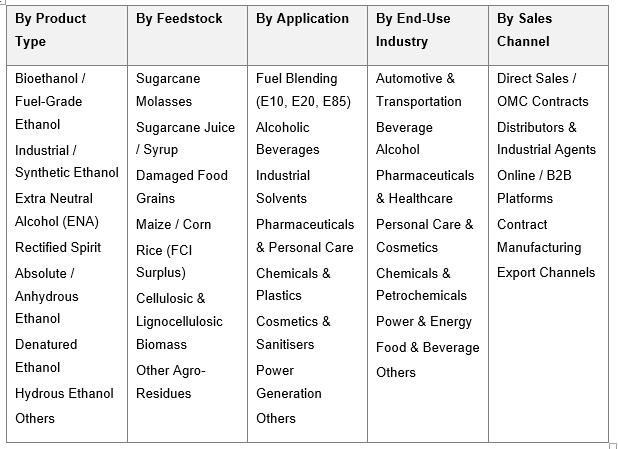
In this report, the India Ethanol Market has been segmented into the following categories, in addition to detailed analysis of key industry trends, market dynamics, competitive landscape, and growth opportunities across the forecast period:
- By Product Type
- Bioethanol / Fuel-Grade Ethanol
- Industrial / Synthetic Ethanol
- Extra Neutral Alcohol (ENA)
- Rectified Spirit
- Absolute / Anhydrous Ethanol
- Denatured Ethanol
- Hydrous Ethanol
- Others
- By Feedstock
- Sugarcane Molasses
- Sugarcane Juice / Syrup
- Damaged Food Grains
- Maize / Corn
- Rice (FCI Surplus)
- Cellulosic & Lignocellulosic Biomass
- Other Agro-Residues
- By Production Process
- First-Generation (1G)
- Second-Generation (2G)
- Third-Generation (3G)
- Synthetic / Petrochemical Route
- By Purity / Grade
- Below 95%
- 95% to 99%
- 99% to 99.5%
- Above 99.5%
- By Application
- Fuel Blending (E10, E20, E85)
- Alcoholic Beverages
- Industrial Solvents
- Pharmaceuticals & Personal Care
- Chemicals & Plastics
- Cosmetics & Sanitisers
- Power Generation
- Others
- By End-Use Industry
- Automotive & Transportation
- Beverage Alcohol
- Pharmaceuticals & Healthcare
- Personal Care & Cosmetics
- Chemicals & Petrochemicals
- Power & Energy
- Food & Beverage
- Others
- By Sales Channel
- Direct Sales / OMC Contracts
- Distributors & Industrial Agents
- Online / B2B Platforms
- Contract Manufacturing
- Export Channels
- By Geography
- North India
- South India
- West India
- East India
- Central India
Competitive Landscape
Company Profiles:
Detailed analysis of the leading companies operating in the India Ethanol Market, including business overview, product portfolio, strategic initiatives, competitive positioning, and recent developments.
Company Information
Detailed profiling and strategic analysis of additional market players (up to five companies), including emerging grain-based ethanol producers, second-generation bio-refinery specialists, global technology entrants, or niche segment leaders.
For a free sample of the India Ethanol Market report, customised insights or delivery timelines, submit your query hereresearch@marketresearchoutlook.com
Table of Contents
- Research Framework
- Market Segmentation
- Research Objective
- Research Methodology
- Qualitative Research
- Primary Research
- Secondary Research
- Quantitative Research
- Market Breakdown & Data Triangulation
- Demand Side
- Supply Side
- Primary Research Respondents
- Assumption & Limitation
- Executive Summary
- Market Overview, 2021-2032
- By Product Type
- By Application
- By End-Use Industry
- By Feedstock
- By Sales Channel
- By Region
- Analyst Recommendations
- Geopolitical Impact on India Ethanol Market
- India Ethanol Market Insights
- Market Dynamics
- Growth Drivers
- Accelerated rollout of the E20 ethanol blending program under the National Biofuels Policy driving large-scale fuel-grade ethanol consumption.
- Rapid expansion of dedicated grain-based and sugarcane-based distillation capacity supported by interest subvention and PM JI-VAN schemes for second-generation bio-refineries.
- Rising demand from beverage alcohol, pharmaceuticals, sanitisers, and industrial solvent applications structurally expanding ethanol consumption across non-fuel segments.
- Restraints
- Feedstock price volatility linked to sugarcane FRP, maize, and damaged food grain availability pressuring distillery margins.
- Heavy dependence on monsoon-driven sugarcane and grain supply creating cyclical production and procurement risk.
- Environmental compliance, spent wash management, and tightening Zero Liquid Discharge (ZLD) regulatory complexity raising compliance costs.
- Opportunities
- Rapid scale-up of second-generation (2G) and cellulosic ethanol capacity aligned with PM JI-VAN, agro-residue valorisation, and net-zero mandates.
- High-growth demand from E20 fuel blending, sustainable aviation fuel (SAF), green chemicals, and bio-ethylene applications supporting bio-refinery build-out.
- Emerging export opportunity for fuel-grade and specialty ethanol to Middle East, Southeast Asia, and Africa with growing biofuel mandates and beverage demand.
- Challenges
- Intense price-led competition between integrated sugar mills, grain-based distilleries, and OMC-led bio-refineries compressing margins on commodity grades.
- Shortage of skilled fermentation engineers, distillation operators, and bio-process scientists limiting scale-up speed of new ethanol capacity.
- Fragmented downstream OMC, beverage, and chemical customer base with diverse purity, denaturation, and quality specifications increasing inventory and logistics complexity.
- Technological Advancements
- Recent Technological Advancements
- Prior to 2020
- Porter’s Five Forces Analysis
- PESTLE Analysis
- Growth Drivers
- Industry Value Chain & Entry Points
- Upstream Feedstock Producers (sugarcane growers, maize and rice farmers, FCI grain depots, agro-residue aggregators)
- Sugar Mills & Integrated Distilleries (molasses, juice, syrup-based ethanol production)
- Grain-Based & 2G Bio-Refinery Operators (maize, damaged grain, lignocellulosic feedstock)
- Fermentation, Distillation & Dehydration Operations (continuous, multi-pressure, molecular sieve)
- Quality Control, R&D & Application Laboratories (BIS, FSSAI, IS 15464, ASTM D4806 standards)
- Distributors, Industrial Agents & B2B Marketplaces
- Oil Marketing Companies (IOCL, BPCL, HPCL ethanol blending and lifting depots)
- Beverage, Pharmaceutical, & Chemical Formulators (ENA, IMFL, sanitisers, solvents)
- Logistics, Tankage & Handling Infrastructure (rail rakes, road tankers, port terminals)
- End-Use Industries (automotive, beverage alcohol, pharmaceuticals, chemicals, power, food)
- India Ethanol Market: Regulatory Framework
- India Ethanol Market Overview
- Market Size & Forecast, 2021-2032
- By Value (USD Million)
- By Volume (‘000 Kilolitres)
- Market Share & Forecast
- By Product Type
- Bioethanol / Fuel-Grade Ethanol
- Industrial / Synthetic Ethanol
- Extra Neutral Alcohol (ENA)
- Rectified Spirit
- Absolute / Anhydrous Ethanol
- Denatured Ethanol
- Hydrous Ethanol
- Others
- By Feedstock
- Sugarcane Molasses
- Sugarcane Juice / Syrup
- Damaged Food Grains
- Maize / Corn
- Rice (FCI Surplus)
- Cellulosic & Lignocellulosic Biomass
- Other Agro-Residues
- By Production Process
- First-Generation (1G)
- Second-Generation (2G)
- Third-Generation (3G)
- Synthetic / Petrochemical Route
- By Purity / Grade
- Below 95%
- 95% to 99%
- 99% to 99.5%
- Above 99.5%
- By Application
- Fuel Blending (E10, E20, E85)
- Alcoholic Beverages
- Industrial Solvents
- Pharmaceuticals & Personal Care
- Chemicals & Plastics
- Cosmetics & Sanitisers
- Power Generation
- Others
- By End-Use Industry
- Automotive & Transportation
- Beverage Alcohol
- Pharmaceuticals & Healthcare
- Personal Care & Cosmetics
- Chemicals & Petrochemicals
- Power & Energy
- Food & Beverage
- Others
- By Sales Channel
- Direct Sales / OMC Contracts
- Distributors & Industrial Agents
- Online / B2B Platforms
- Contract Manufacturing
- Export Channels
- By Geography
- North India
- South India
- West India
- East India
- Central India
- Competitive Landscape
- India Ethanol Market Company Market Share Analysis, 2025
- Competitive Benchmarking, By Operating Parameters
- Key Strategic Development (Mergers, Acquisitions, Partnerships, Etc.)
- List of Emerging Players
- Company Profile
- Praj Industries Limited
- Introduction & Company Profile
- Product Benchmarking
- Strategic Outlook
- Key Competitors
- Financial Analysis
- Swot Analysis
- Praj Industries Limited
- Market Size & Forecast, 2021-2032
- Market Dynamics
(Same Data Pointers Will Be Provided for the Below Companies):
- Triveni Engineering & Industries Limited
- Bajaj Hindusthan Sugar Limited
- Balrampur Chini Mills Limited
- Shree Renuka Sugars Limited
- Dalmia Bharat Sugar and Industries Limited
- EID Parry (India) Limited
- Dhampur Sugar Mills Limited
- DCM Shriram Limited
- Indian Oil Corporation Limited (Bio-Refineries Division)
- Bharat Petroleum Corporation Limited (BPCL Bio-Refineries)
- Hindustan Petroleum Corporation Limited (HPCL Bio-Refineries)
- Other Prominent Players
* Financial information in case of non-listed companies will be provided as per availability.
** The segmentation and the companies are subjected to modifications based on in-depth secondary research for the final deliverable.
Frequently Asked Questions
1. How large is the India ethanol market and what is its growth forecast?
Ans: The India ethanol market size is valued at USD 5.42 Billion in 2025 and is projected to reach USD 11.86 Billion by 2032, growing at a CAGR of around 11.8%. This strong India ethanol market growth is driven by accelerated rollout of the E20 ethanol blending program, large-scale capacity expansion in grain-based and second-generation distilleries, rising non-fuel demand from beverage alcohol and pharmaceuticals, and major domestic and OMC bio-refinery investments. The report provides detailed market sizing, forecast modelling, and segment-wise growth analysis across value and volume terms, helping businesses identify high-opportunity areas and plan long-term strategies.
2. Which segments are driving demand in the India ethanol market?
Ans: The India ethanol market segmentation shows that fuel blending dominates with approximately 70% to 73% share, followed by beverage alcohol at 15% to 18% and pharmaceuticals, sanitisers, and personal care at 6% to 8%. Bioethanol and fuel-grade ethanol lead by product type with over 70% share, while grain-based and 2G ethanol for E20 blending are the fastest-growing segments, expanding at 14% to 18% annually. The report breaks down demand across product types, feedstocks, production processes, purity grades, applications, end-use industries, and sales channels, helping businesses understand where growth is accelerating across the India ethanol market.
3. What are the key drivers of growth in the India ethanol market?
Ans: Key India ethanol market drivers include accelerated rollout of the E20 ethanol blending program under the National Biofuels Policy, rapid expansion of grain-based and sugarcane-based distillation capacity supported by PM JI-VAN and interest subvention schemes, and rising demand from beverage alcohol, pharmaceuticals, sanitisers, and industrial solvent applications. Domestic majors such as Praj Industries, Triveni Engineering, Bajaj Hindusthan, Balrampur Chini, and Shree Renuka Sugars are investing in distillation capacity, multi-feedstock flexibility, and 2G technology. The report provides in-depth analysis of growth drivers, supported by data-backed insights and real market trends shaping the India ethanol market.
4. Which regions are driving growth in the India ethanol market?
Ans: Regional analysis of the India ethanol market shows that North and West India together account for nearly 55% to 60% of total demand, driven by sugar mills and grain-based distilleries in Uttar Pradesh, Maharashtra, and Madhya Pradesh, along with strong cane and maize feedstock bases. South India contributes around 22% to 25%, supported by integrated sugar mills, ENA capacity, and beverage alcohol distilleries in Karnataka, Tamil Nadu, and Andhra Pradesh. East and Central India together account for 18% to 22%, supported by grain-based capacity and 2G bio-refinery investments in Bihar, Jharkhand, Odisha, and Chhattisgarh. The report offers state-level and regional insights, helping businesses identify high-growth markets and optimise expansion strategies.
5. What are the latest trends in the India ethanol market?
Ans: Key India ethanol market trends include rapid indigenisation and capacity build-out of grain-based and second-generation (2G) ethanol, capacity expansion by domestic majors including Praj Industries, Triveni Engineering, Bajaj Hindusthan Sugar, Balrampur Chini Mills, and Shree Renuka Sugars, and rising importance of sustainable aviation fuel (SAF), bio-ethylene, and green chemicals applications. Multi-feedstock distillery design, low-carbon-intensity certification under ISCC and CARB LCFS, and OMC bio-refinery integration are reshaping competitive dynamics. The report provides comprehensive trend analysis, supported by company-level developments and forecast insights, helping businesses align strategy with the structural growth of the India ethanol market.