

GCC Smart Home Appliances Market, Size & Forecast 2021-2032
- Global Markets
- Mar 2026
- Pages 200
- Report Format: pdf
- Report Price: $3000 USD
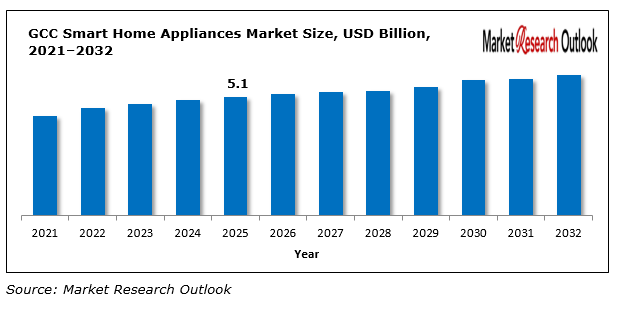
The GCC Smart Home Appliances Market size was estimated at USD 5.1 Billion in 2025. During the forecast period, the GCC Smart Home Appliances Market size is projected to grow at a CAGR of 9.3% reaching a value of USD 9.5 Billion by 2032. Market expansion gets its backing from growing smart home usage and developing e-commerce platforms and strong customer interest in connected home devices. The smart home market in Saudi Arabia and the United Arab Emirates experiences rapid expansion because urban populations grow and countries increase their spending on smart city initiatives. The government programs that support digital infrastructure development together with technological innovation drive the adoption of smart appliances. The hospitality sector throughout Gulf Cooperation Council countries now uses smart appliances to enhance operational performance and provide better guest services in hotels and serviced apartments.
GCC Smart Home Appliances Market – Overview
Market Trends
- Home devices in the Gulf Cooperation Council now come with advanced features which include artificial intelligence and Internet of Things connectivity and voice assistant support for Alexa and Google Assistant. Users can use mobile applications or voice commands to remotely control and monitor their appliances which include refrigerators and washing machines and air conditioners through these functions.
- Consumers across GCC countries are showing a strong preference for energy-efficient and high-end smart appliances that offer long-term cost savings and sustainability benefits. Government initiatives promote energy conservation while eco-labeling and efficiency standards create a framework which drives adoption.
Geopolitical Impact on GCC Smart Home Appliances Market
The GCC Smart Home Appliances Market gets affected by geopolitical factors which include global supply chain disruptions and semiconductor shortages and changes in international trade policies. Many smart appliances depend on electronic components and sensors which manufacturers obtain from suppliers around the world. The supply chain disruptions will result in product unavailability and price changes throughout the region. The GCC countries currently invest in digital infrastructure development which supports their technology-driven sectors and helps establish a smart home ecosystem.
| Attributes | Details |
| Years Considered | Historical Data – 2021–2025
Base Year – 2025 Estimated Year – 2026 Forecast Period – 2026–2032 |
| Facts Covered | Revenue in USD Billion |
| Market Coverage | Saudi Arabia, United Arab Emirates, Qatar, Kuwait, Oman, Bahrain, Rest of GCC |
| Segmentation | Product Type, Connectivity Technology, Control Interface, Distribution Channel, End User, Geography |
Segmental Coverage
By Product Type
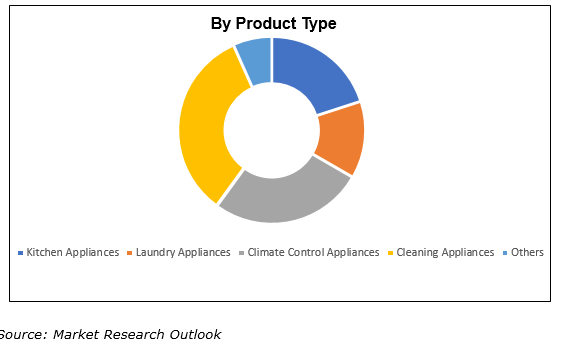
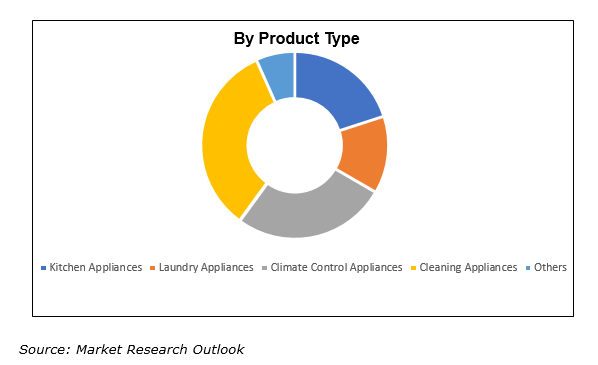
On the basis of product type the GCC smart home appliances market is segmented into Kitchen Appliances, Laundry Appliances, Climate Control Appliances, Cleaning Appliances, Others. The GCC Smart Home Appliances Market will experience its highest growth from Climate Control Appliances. The extreme climate conditions that affect the entire GCC region make air conditioners and smart HVAC systems into essential requirements for people living there which create this need. The market shows rapid growth because people want energy-efficient cooling products and smart thermostat technology becomes integrated and government energy rules become more stringent. The rising trend of building connected homes and smart buildings creates higher requirements for advanced climate control systems which enable remote energy-saving monitoring and system optimization.
By End User
Based on end user, the market is segmented into Residential Households, Hospitality Sector, and Luxury Real Estate & Smart Homes. The Residential Households segment will lead the market because urban consumers are increasingly adopting smart home technologies. Households are choosing to buy smart appliances because their disposable income has increased and they understand technology better and they can access connected home devices. The hospitality industry is using more smart appliances because hotels and serviced apartments want to achieve better energy savings and provide improved guest services through their automated and connected home systems.
Regional Analysis
On the basis of geography, the market is divided into Saudi Arabia, United Arab Emirates, Qatar, Kuwait, Oman, Bahrain, Rest of GCC. Sub-Saharan GCC will achieve the highest growth rate for the GCC Smart Home Appliances market during the forecast period. The GCC Smart Home Appliances Market in Saudi Arabia is projected to experience substantial growth. The market growth occurs because urban areas expand and people’s income rises plus the Saudi government implements its Vision 2030 plan that creates smart cities and digital infrastructure. The market expansion receives support from consumers who adopt smart home technologies and residential projects plus their preference for energy-efficient appliances which have connectivity features. The young population who use technology and the growing availability of e-commerce platforms drive the nationwide adoption of smart appliances in the country.
Recent Development
- In November 2025- Schneider Electric leads the digital transformation of energy management and automation systems through its new partnership with LG Electronics which will establish the LG Showroom in Riyadh to showcase cutting-edge smart home technology that optimizes energy usage while providing environmentally sustainable solutions through advanced automated systems.
Competitive Landscape
In the competitive landscape of the GCC Smart Home Appliances market, the organisation has covered major players of the market and their details.
Here are some of the leading players that are playing a major role in the GCC Smart Home Appliances market:
- Samsung Electronics Co., Ltd.
- Introduction & Company Profile
- Product Benchmarking
- Strategic Outlook
- Key Competitors
- Financial Analysis
- Swot Analysis
**(Same Data Pointers Will Be Provided for The Below Companies)
- LG Electronics Inc.
- Whirlpool Corporation
- Electrolux AB
- Haier Smart Home Co., Ltd.
- Midea Group Co., Ltd.
- Panasonic Corporation
- Bosch Home Appliances
- Siemens AG
- Arçelik A.Ş.
- Other Prominent Players
Segmentation
By Product Type
- Kitchen Appliances
- Smart refrigerators (largest share)
- Smart ovens & microwaves
- Smart dishwashers
- Smart coffee machines
- Laundry Appliances
- Smart washing machines
- Smart dryers
- Climate Control Appliances
- Smart air conditioners (critical in GCC)
- Smart thermostats
- Smart air purifiers
- Cleaning Appliances
- Robotic vacuum cleaners
- Smart mops
- Others
By Connectivity Technology
- Wi-Fi Enabled Appliances
- Bluetooth Enabled Appliances
- Zigbee / Z-Wave Enabled Appliances
- Others
By Control Interface
- Smartphone / Mobile App Control
- Voice Assistant Control
- Touch Panel / Smart Display Control
By Distribution Channel
- Online Retail
- Electronics & Appliance Stores
- Brand Exclusive Stores
- Hypermarkets & Supermarkets
By End User
- Residential Households
- Hospitality Sector
- Luxury Real Estate & Smart Homes
By Geography
- Saudi Arabia
- United Arab Emirates
- Qatar
- Kuwait
- Oman
- Bahrain
- Rest of GCC
GCC Smart Home Appliances Market, 2032
- Research Framework
- Market Segmentation
- Research Objective
- Research Methodology
- Qualitative Research
- Primary Research
- Secondary Research
- Quantitative Research
- Market Breakdown & Data Triangulation
- Demand Side
- Supply Side
- Breakdown Of Primary Research Respondents, By Region
- Saudi Arabia
- United Arab Emirates
- Qatar
- Kuwait
- Oman
- Bahrain
- Rest of GCC
- Assumption & Limitation
- Qualitative Research
- Executive Summary
- Market Overview, 2021–2032
- By Product Type
- By Connectivity Technology
- By Control Interface
- By Distribution Channel
- By End User
- By Geography
- Analyst Recommendations
- Market Overview, 2021–2032
- Geopolitical Impact on GCC Smart Home Appliances Market
- GCC Smart Home Appliances Market Insights
- Market Dynamics
- Growth Drivers
- Rising smart home adoption and increasing internet penetration across GCC countries
- Growing disposable income and demand for premium, connected lifestyles
- Government smart city initiatives (e.g., Saudi Vision 2030, UAE Smart City programs)
- Restraints
- High cost of smart appliances compared to conventional products
- Data privacy and cybersecurity concerns among consumers
- Compatibility issues between different smart home ecosystems
- Opportunities
- Expansion of 5G and IoT infrastructure enabling seamless connectivity
- Growth of e-commerce and omnichannel retail distribution
- Increasing demand for energy-efficient and sustainable appliances
- Challenges
- Rapid technology obsolescence and need for continuous upgrades
- Fragmented ecosystem and lack of standardization
- High competition among global and regional brands
- Technological Advancements
- Recent Technological Advancements
- Prior to 2020
- Porter’s Five Forces Analysis
- PESTLE Analysis
- Trade Analysis
- Top 3 Importing Countries
- Top 3 Exporting Countries
- Growth Drivers
- Market Dynamics
- Industry Value Chain & Entry Points
- Raw Material & Component Supply
- Electronics & IoT Module Manufacturing
- Appliance Manufacturing & Assembly
- Software Development & Integration (Apps, AI, Connectivity)
- Distribution & Logistics
- Retail & Sales Channels (Online & Offline)
- Installation & After-Sales Services
- End Consumers
- GCC Smart Home Appliances Market: Regulatory Framework
- Saudi Arabia
- United Arab Emirates
- Qatar
- Kuwait
- Oman
- Bahrain
- Rest of GCC
- GCC Smart Home Appliances Market Overview
- Market Size & Forecast, 2021-2032
- By Value (USD Billion)
- Market Share & Forecast
- By Product Type
- Kitchen Appliances
- Smart refrigerators (largest share)
- Smart ovens & microwaves
- Smart dishwashers
- Smart coffee machines
- Laundry Appliances
- Smart washing machines
- Smart dryers
- Climate Control Appliances
- Smart air conditioners (critical in GCC)
- Smart thermostats
- Smart air purifiers
- Cleaning Appliances
- Robotic vacuum cleaners
- Smart mops
- Others
- Kitchen Appliances
- By Connectivity Technology
- Wi-Fi Enabled Appliances
- Bluetooth Enabled Appliances
- Zigbee / Z-Wave Enabled Appliances
- Others
- By Control Interface
- Smartphone / Mobile App Control
- Voice Assistant Control
- Touch Panel / Smart Display Control
- By Distribution Channel
- Online Retail
- Electronics & Appliance Stores
- Brand Exclusive Stores
- Hypermarkets & Supermarkets
- By End User
- Residential Households
- Hospitality Sector
- Luxury Real Estate & Smart Homes
- By Geography
- Saudi Arabia
- United Arab Emirates
- Qatar
- Kuwait
- Oman
- Bahrain
- Rest of GCC
- By Product Type
- Market Size & Forecast, 2021-2032
- Competitive Landscape
- GCC Smart Home Appliances Company Market Share Analysis, 2025
- By Geography
- Saudi Arabia
- United Arab Emirates
- Qatar
- Kuwait
- Oman
- Bahrain
- Rest of GCC
- Competitive Benchmarking, By Operating Parameters
- Key Strategic Development (Mergers, Acquisitions, Partnerships, Etc.)
- List of Emerging players
- By Geography
- GCC Smart Home Appliances Company Market Share Analysis, 2025
- Company Profile
- Samsung Electronics Co., Ltd.
- Introduction & Company Profile
- Product Benchmarking
- Strategic Outlook
- Key Competitors
- Financial Analysis
- Swot Analysis
- Samsung Electronics Co., Ltd.
**(Same Data Pointers Will Be Provided for The Below Companies)
- LG Electronics Inc.
- Whirlpool Corporation
- Electrolux AB
- Haier Smart Home Co., Ltd.
- Midea Group Co., Ltd.
- Panasonic Corporation
- Bosch Home Appliances
- Siemens AG
- Arçelik A.Ş.
- Other Prominent Players
* Financial information in case of non-listed companies will be provided as per availability
**The segmentation and the companies are subjected to modifications based on in-depth secondary for the final deliverable
Frequently Asked Questions
1. What is the market size of the GCC Smart Home Appliances Market in 2025?
Ans: The GCC Smart Home Appliances market is projected to reach approximately USD 5.1 billion by 2032.
2. What is the expected growth rate of the GCC Smart Home Appliances Market during the forecast period?
Ans: The GCC Smart Home Appliances market is expected to grow at a CAGR of around 7.5% during the forecast period between 2026 and 2032.
3. What is the forecast value of the GCC Smart Home Appliances Market by 2032?
Ans: The GCC Smart Home Appliances market is projected to reach approximately USD 9.5 billion by 2032.
4. What are the major factors driving the growth of the GCC Smart Home Appliances Market?
Ans: Market expansion gets its backing from growing smart home usage and developing e-commerce platforms and strong customer interest in connected home devices.
5. Name the key players operating in the GCC Smart Home Appliances Market.
Ans: Key players operating in the GCC Smart Home Appliances market include Samsung Electronics Co., Ltd., LG Electronics Inc., Whirlpool Corporation, Electrolux AB, Haier Smart Home Co., Ltd., Midea Group Co., Ltd., Panasonic Corporation, Bosch Home Appliances, Siemens AG, Arçelik A.Ş., and Other Prominent Players.
6. Which Country is expected to dominate the GCC Smart Home Appliances Market?
Ans: The GCC Smart Home Appliances Market in Saudi Arabia is projected to experience substantial growth.