

India Refurbished Smartphone Market, 2032
- Consumer Goods & Retail, Home Appliances & Durables
- Nov 2026
- Pages 140
- Report Format: pdf
- Report Price: $2400 USD
India’s refurbished smartphone market is witnessing strong structural growth, driven by rising new smartphone prices, memory cost inflation, growing acceptance of certified pre-owned devices, rapid expansion of organized recommerce platforms, easy EMI financing, faster 5G upgrade cycles, and rising interest from e-commerce majors, retail chains, and OEMs investing in trade-in programmes, refurbishment centres, and warranty-backed refurbished smartphone resale across tier-1, tier-2, and tier-3 cities.
| Study Duration | 2021-2032 |
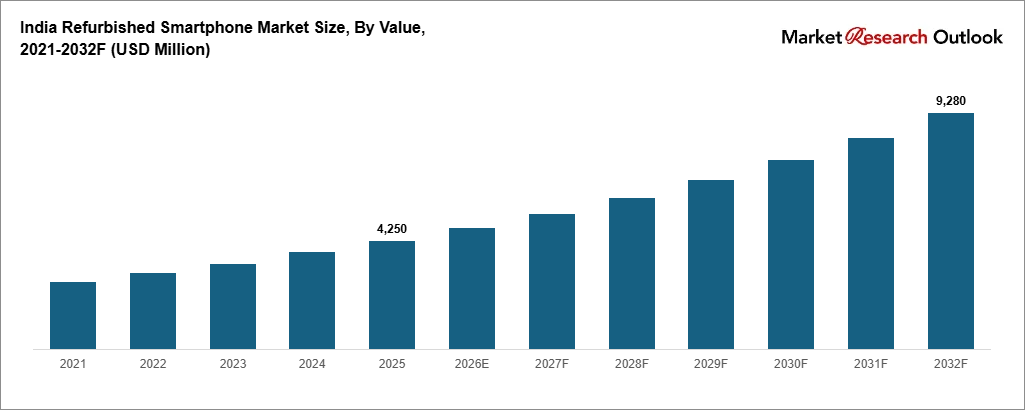
| Market Size (2025) | USD 4,250 Million |
| CAGR (2026-2032) | 11.8% |
| Leading Segment | INR 20,000-30,000 Range (Samsung Devices) |
| Fastest Growing Segment | Premium Refurbished iPhones (Above INR 45,000) |
| Market Size (2032) | USD 9,280 Million |
Market Overview: India Refurbished Smartphone Market
The India refurbished smartphone market size is witnessing rapid expansion, driven by rising prices of new phones, a strong shift toward premium devices, growing trust in certified refurbished smartphones, and the fast scaling of organized recommerce platforms. Valued at USD 4,250 million in 2025 and projected to reach USD 9,280 million by 2032, growing at a CAGR of 11.8%, the India refurbished smartphone market growth is being fuelled by young, value-conscious buyers who want flagship features at mid-range prices through a refurbished smartphone. Annual refurbished smartphone sales stood at around 21 million units in 2025 and are expected to cross 40 million units by 2032. The INR 20,000 to 30,000 price band leads refurbished smartphone consumption, while premium refurbished iPhones above INR 45,000 are emerging as the fastest growing category. Rising memory and component costs, easy EMI options, and wider 5G adoption are reshaping refurbished smartphone supply and demand. As platforms such as Cashify, Flipkart, Amazon, and Yaantra expand certified refurbishment capacity, and retail chains such as Croma and Reliance Digital scale exchange programmes, the India refurbished smartphone market is evolving into a trust-led, organized, and digitally enabled ecosystem with strong long-term growth potential.
Key Report Takeaways: India Refurbished Smartphone Market
- The India refurbished smartphone market size is projected to grow from USD 4,250 million in 2025 to USD 9,280 million by 2032, registering a strong CAGR of 11.8%, driven by rising new phone prices, organized recommerce growth, and the steady shift toward premium pre-owned devices across urban and semi-urban India.
- The INR 20,000 to 30,000 price range dominates the India refurbished smartphone market, accounting for around 30% of total volume in 2025, driven by strong demand for refurbished Samsung Galaxy S and A series phones, older iPhone models, and OnePlus flagships among students and young professionals.
- Premium refurbished iPhones priced above INR 45,000 are emerging as the fastest growing segment in the India refurbished smartphone market, expected to grow at 16% to 19% annually as buyers seek Pro models, better cameras, and longer software support at 35% to 50% below new prices.
- Organized players held around 30% of the India refurbished smartphone market in 2025, and this share is projected to reach 45% by 2032 as certified grading, 6 to 12 month warranties, and doorstep buybacks win over buyers who once relied on local dealers.
- Rising investments by recommerce leaders such as Cashify, Flipkart, Amazon, Yaantra, and Servify in refurbishment labs, offline stores, and warranty services are strengthening organized refurbished smartphone supply and supporting the India refurbished smartphone market forecast 2032.
Key Market Drivers: India Refurbished Smartphone Market
Rising New Smartphone Prices, Memory Cost Inflation, and Premiumisation Driving Refurbished Smartphone Demand Across India
Growth in the India refurbished smartphone market is being driven by the rising cost of new devices, which makes a refurbished smartphone an easy value choice, the ongoing premiumisation of India’s phone market, and a growing preference for value. The average selling price of new smartphones in India crossed INR 22,000 in 2025, up by over 40% since 2020, while memory and component cost inflation pushed prices higher again in 2026. Buyers increasingly choose a refurbished smartphone, often a one or two year old flagship, over a new entry-level phone, getting better cameras, displays, and processors at 30% to 50% lower prices. India has over 700 million smartphone users, and replacement cycles have stretched to 30 to 36 months, creating a large pool of devices for the refurbished smartphone trade. With over 65% of Indians below age 35, rising aspirational demand is creating strong structural pull across the India refurbished smartphone market.
Growth of Organized Recommerce Platforms, Certified Warranties, and Easy EMI Financing Fuelling Consumer Trust
The India refurbished smartphone market is benefiting from the rise of organized recommerce platforms that bring testing, grading, and warranties to a category once dominated by roadside dealers. Leading refurbished smartphone platforms run 30 to 70 point quality checks, offer 6 to 12 month warranties, and provide easy returns, which has narrowed the trust gap between a refurbished smartphone and a new one. Cashify operates over 200 retail stores along with its online channel, while Flipkart, through Yaantra, and Amazon Renewed have widened certified refurbished smartphone listings across thousands of pin codes. No-cost EMI, Buy Now Pay Later, and card offers now cover a large share of organized purchases above INR 15,000, making premium refurbished smartphones affordable for students and first-time buyers. Average refurbished smartphone prices in India range between INR 12,000 and INR 25,000, and buyers between 18 and 34 years account for over 60% of purchases, with Gen-Z buyers preferring verified, app-based buying with doorstep delivery.
Expanding Trade-In, Buyback, and 5G Upgrade Cycles Strengthening Refurbished Smartphone Supply
Rapid growth in trade-in and buyback programmes is a major catalyst for the India refurbished smartphone market, with organized buyback volumes growing by about 29% year-on-year in 2025, according to Cashify. Mobile exchange offers on Flipkart, Amazon, Croma, Reliance Digital, and brand stores now feed a steady flow of good quality devices into refurbished smartphone supply chains. The share of 5G devices among phones sold to Cashify rose from about 5% in 2022 to over 54% in 2025, which means the refurbished smartphone pool is getting newer and more capable. Cashify data also suggests that seven in ten Indians keep two to three unused phones at home, a large untapped supply source. The average buyback value rose by about 34% to INR 8,573 in 2025, showing that higher-value devices are entering the refurbished smartphone chain. Together, these trends are expanding India refurbished smartphone market growth across all major end-user categories through 2032.
Key Market Challenges: India Refurbished Smartphone Market
Trust Deficit, Quality Inconsistency, and Dominance of Unorganized Sellers Limiting Organized Growth
The India refurbished smartphone market continues to face challenges around buyer trust and uneven quality, with unorganized dealers still handling around 70% of refurbished smartphone and used phone volumes in 2025. Many local refurbished smartphone sellers do not follow standard grading, use non-original displays and batteries, and offer little or no warranty, which leads to early failures and a poor buyer experience. Industry surveys suggest that 35% to 45% of potential buyers in India still worry about hidden defects, tampered parts, or stolen devices. While organized platforms have improved transparency through multi-point testing and IMEI verification, the lack of a national grading standard makes it hard for buyers to compare a refurbished smartphone across sellers. Continued reliance on informal dealer networks in tier-2 and tier-3 cities limits faster adoption of certified refurbished smartphones across the India refurbished smartphone market.
Limited Supply of Quality Devices, Spare Parts Constraints, and Restrictions on Used Phone Imports
The India refurbished smartphone market faces structural limits on supply. Import of used and refurbished phones into India is restricted under the E-Waste (Management) Rules and DGFT policy, so refurbished smartphone sellers depend almost fully on domestic buybacks. Refurbished smartphone demand for recent premium models often outpaces supply, especially for iPhone 13 to iPhone 15 and Samsung Galaxy S series devices. Genuine spare parts such as OLED displays, batteries, and camera modules are costly and not always available through authorised channels, which pushes some refurbished smartphone repairers toward lower quality parts. An original display can make up 35% to 50% of the total refurbishment cost of a premium phone. Differences in parts availability, repair skills, and logistics across states create operational complexity for players such as Cashify, Yaantra, and Servify that operate pan-India. While the Right to Repair portal and OEM spare part programmes are improving access, supply bottlenecks remain a near-term challenge for the India refurbished smartphone market.
Battery Degradation, Software Support Limits, and Data Security Concerns Impacting Resale Value
The India refurbished smartphone market faces practical constraints around device ageing, software support, and data privacy. Smartphone batteries typically lose 15% to 25% of their capacity after two years of use, and refurbished smartphone buyers often demand battery health above 85% for premium devices. Android phones from several brands receive only two to four years of OS updates, which cuts the refurbished smartphone resale value of older mid-range models by 20% to 35% compared with devices that still have long update windows. Concerns about leftover personal data, cloned IMEI numbers, and blacklisted devices also weigh on buyer confidence. Average gross margins for organized refurbished smartphone sellers in India range between 15% and 25%, and the cost of new batteries, certified data wiping, and warranty claims can reduce this by 3% to 7%. Longer software support from Samsung, Apple, and Google, along with certified data erasure, is emerging as a solution, but awareness remains limited across the India refurbished smartphone market.
Key Market Trends: India Refurbished Smartphone Market
Rapid Shift Toward Premium Refurbished iPhones and 5G Devices in India
The India refurbished smartphone market is undergoing a clear shift toward premium and 5G devices, with refurbished smartphones priced above INR 45,000 accounting for about 17.4% of organized refurbished smartphone sales on Cashify in 2025. The iPhone 13 was the most bought-back and most purchased refurbished smartphone on Cashify, with the iPhone 14 and iPhone 15 following the same path. Refurbished smartphone buyers are moving from base models to Pro variants, attracted by better cameras, higher refresh rate displays, and longer software support. Sales of refurbished laptops, tablets, and smartwatches are also rising, reaching 16.7% of Cashify’s refurbished smartphone sales in 2025 from 8% in 2024, which points to a wider shift toward pre-owned premium electronics. This product transition is reinforcing the India refurbished smartphone market forecast 2032 across both online and offline channels.
Growth of Online Recommerce, Quick Delivery, and Omnichannel Retail in the India Refurbished Smartphone Market
A clear shift toward online recommerce, faster delivery, and omnichannel retail is reshaping the India refurbished smartphone market, particularly in metro and tier-1 cities. Buyers can now sell an old phone through an app, get a doorstep pickup within 24 to 48 hours, and receive a certified refurbished smartphone in one to three days. Amazon Renewed, Flipkart, Cashify, and Yaantra now deliver to nearly every serviceable pin code in India, while Cashify, Croma, and Reliance Digital stores let buyers check a refurbished smartphone in person before buying. Online channels accounted for around 38% of organized refurbished smartphone sales in 2025, up from less than 20% in 2020, and video-based device inspection and AI-led diagnostics are helping reduce refurbished smartphone returns. Lower customer acquisition costs and better price discovery are also speeding up adoption across both retail and B2B segments of the India refurbished smartphone market.
Right to Repair, E-Waste Rules, and Circular Economy Policies Supporting Organized Refurbishment
A wave of policy support and circular economy measures is reshaping the India refurbished smartphone market supply landscape. The Department of Consumer Affairs launched the Right to Repair portal in 2022, with major smartphone brands joining to share repair information and spare part access. The E-Waste (Management) Rules, 2022 introduced Extended Producer Responsibility targets that push brands to take back old devices, adding to refurbished smartphone supply, and India generated over 14 lakh tonnes of e-waste in FY2025-26, of which about 70% was recycled. The government’s Electronics Repair Services Outsourcing pilot, under which firms such as Lenovo and Flex tested repairing imported electronics in India for re-export, signals India’s potential as a global refurbished smartphone hub. A base of over 300 mobile manufacturing units and mobile phone exports of about INR 2 lakh crore in FY2024-25 also add to repair skills and parts supply. Combined with rising trade-in volumes and growing ESG focus among enterprises, these developments are reinforcing the India refurbished smartphone market forecast 2032 across the entire value chain.
Segmental Insights: India Refurbished Smartphone Market
By End-User: Students & Young Consumers Segment Dominates the India Refurbished Smartphone Market
The students and young consumers end-user segment dominates the India refurbished smartphone market, accounting for an estimated 40% to 43% of total volume, driven by tight budgets, strong brand awareness, and a desire for premium features. Refurbished smartphones from Samsung and Apple in the INR 15,000 to 35,000 range are the dominant choices within this segment, with online channels capturing over 55% of youth refurbished smartphone purchases. The working professionals segment contributes another 31% to 34% of refurbished smartphone demand, driven by upgrades to premium refurbished iPhones and Galaxy S series phones paid through EMI. The rural and tier-3 consumer segment accounts for 15% to 17%, led by first-time smartphone buyers and second-device purchases, while enterprises and SMEs account for 8% to 10%, led by refurbished smartphone fleets for field staff and delivery partners. In 2025, leading players including Cashify, Flipkart, Amazon, Yaantra, and Croma scaled up youth-focused offers, student discounts, and campus campaigns, reinforcing segment dominance in the India refurbished smartphone market.
By Price Range: INR 20,000 to 30,000 Leads While Premium Above INR 45,000 Grows Fastest
The INR 20,000 to 30,000 price range leads the India refurbished smartphone market price landscape, accounting for approximately 30% of total refurbished smartphone volume, driven by strong demand for older flagships and upper mid-range phones from Samsung, Apple, and OnePlus. The INR 10,000 to 20,000 range contributes another 25% to 27%, mainly across tier-2 cities and first-time refurbished smartphone buyers. Refurbished smartphones above INR 45,000 are the fastest growing category within the India refurbished smartphone market, expanding at 16% to 19% annually, driven by demand for iPhone Pro models, Galaxy S series flagships, and foldable devices. The INR 30,000 to 45,000 range accounts for 18% to 20% of the market, while refurbished smartphones below INR 10,000 have fallen to about 8% as low-cost new phones compete strongly in that band. Leading platforms including Cashify, Flipkart, Amazon, Yaantra, and Servify have aligned sourcing and pricing to this mix, driving premium refurbished smartphone adoption across the India refurbished smartphone market.
Regional Insights: India Refurbished Smartphone Market
Regional analysis of the India refurbished smartphone market shows that South India and West India together account for approximately 52% to 55% of total refurbished smartphone volume, driven by Karnataka (Bengaluru tech workforce), Tamil Nadu (Chennai electronics belt), Telangana (Hyderabad IT corridor), Maharashtra (Mumbai and Pune), and Gujarat, supported by high smartphone penetration and strong digital payment use. North India contributes around 26% to 29% of demand, led by Delhi NCR, Punjab, Haryana, and Uttar Pradesh, where Delhi’s Gaffar Market and Karol Bagh remain large used phone hubs alongside fast-growing organized stores in Gurugram, Noida, and Lucknow. Central and East India together account for 18% to 21% of demand, supported by Madhya Pradesh, West Bengal, Bihar, and Odisha, where affordable refurbished smartphones are drawing first-time buyers. In 2025, store additions by Cashify across North and West India, Yaantra’s expanded refurbishment operations, and exchange programmes by Croma and Reliance Digital across metro cities reinforced regional supply hubs, supporting faster delivery of certified refurbished smartphones across the India refurbished smartphone market.
Recent Developments: India Refurbished Smartphone Market
- The India refurbished smartphone market witnessed strong momentum in sales and platform growth during 2025 and 2026. Refurbished smartphone demand on Cashify grew by 30.8% in 2025, while organized buybacks rose by 29% year-on-year. Total refurbished smartphone sales in India are projected to reach 25 to 27 million units by 2027 from about 21 million units in 2025.
- Recommerce leaders have deepened India-focused expansion. In 2025, Cashify widened its offline store network and refurbishment capacity, Flipkart expanded certified refurbished smartphone listings through Yaantra, Amazon Renewed added more refurbished smartphone models, including premium iPhone and Galaxy devices, with extended warranties, and Servify grew device protection and buyback partnerships with leading brands. Croma and Reliance Digital also strengthened in-store exchange programmes that feed refurbished smartphone supply. These developments are strengthening organized supply and supporting the India refurbished smartphone market forecast 2032.
- Policy and circular economy momentum has gained strong traction in the India refurbished smartphone market. India ranked among the top two countries globally for refurbished smartphone growth in 2025, and the government advanced Right to Repair initiatives, EPR targets under the E-Waste (Management) Rules, 2022, and an Electronics Repair Services Outsourcing pilot with firms such as Lenovo and Flex. Strategic partnerships between OEMs, recommerce platforms, and retailers are positioning India as one of the fastest growing refurbished smartphone markets globally, strengthening long-term competitive positioning in the India refurbished smartphone market forecast 2032.
Key Market Players: India Refurbished Smartphone Market
- Cashify (Manak Waste Management Pvt. Ltd.)
- Flipkart Internet Pvt. Ltd. (Flipkart Refurbished)
- Amazon Seller Services Pvt. Ltd. (Amazon Renewed)
- Yaantra Retail Services Pvt. Ltd.
- Servify (Servntire Global Pvt. Ltd.)
- InstaCash
- Budli.in
- Togofogo
- Refit Global Pvt. Ltd.
- OLX India Pvt. Ltd.
- Croma (Infiniti Retail Limited)
- Reliance Digital (Reliance Retail Limited)
- Samsung India Electronics Pvt. Ltd.
| By Price Range | By Brand | By Condition Grade | By Distribution Channel | By End-User |
| Below INR 10,000 INR 10,000-20,000 INR 20,000-30,000 INR 30,000-45,000 INR 45,000-60,000 Above INR 60,000 |
Apple Samsung OnePlus Xiaomi Vivo Oppo Others |
Like New (Grade A+) Excellent (Grade A) Good (Grade B) Fair (Grade C) Open-Box & Unboxed |
Online Recommerce Platforms E-commerce Marketplaces Organized Offline Retail Stores Brand & OEM Exchange Programs Telecom & Trade-In Partners Unorganized Local Dealers |
Students & Young Consumers Working Professionals Rural & Tier-3 Consumers Enterprises & SMEs |
Report Scope
In this report, the India Refurbished Smartphone Market has been segmented into the following categories, in addition to detailed analysis of key industry trends, market dynamics, competitive landscape, and growth opportunities across the forecast period:
- By Price Range
- Below INR 10,000
- INR 10,000-20,000
- INR 20,000-30,000
- INR 30,000-45,000
- INR 45,000-60,000
- Above INR 60,000
- By Brand
- Apple
- Samsung
- OnePlus
- Xiaomi
- Vivo
- Oppo
- Others
- By Condition Grade
- Like New (Grade A+)
- Excellent (Grade A)
- Good (Grade B)
- Fair (Grade C)
- Open-Box & Unboxed
- By Distribution Channel
- Online Recommerce Platforms
- E-commerce Marketplaces
- Organized Offline Retail Stores
- Brand & OEM Exchange Programs
- Telecom & Trade-In Partners
- Unorganized Local Dealers
- By End-User
- Students & Young Consumers
- Working Professionals
- Rural & Tier-3 Consumers
- Enterprises & SMEs
- By Geography
- North India
- South India
- West India
- East India
- Central India
Competitive Landscape
Company Profiles:
Detailed analysis of the leading companies operating in the India Refurbished Smartphone Market, including business overview, product portfolio, strategic initiatives, competitive positioning, and recent developments.
Company Information
Detailed profiling and strategic analysis of additional market players (up to five companies), including emerging recommerce startups, regional refurbishment centres, B2B device sourcing firms, or niche state-level refurbished smartphone retailers.
For a free sample of the India Refurbished Smartphone Market report, customised insights or delivery timelines, submit your query here
India Refurbished Smartphone Market, 2032
- Research Framework
- Market Segmentation
- Research Objective
- Research Methodology
- Qualitative Research
- Primary Research
- Secondary Research
- Quantitative Research
- Market Breakdown & Data Triangulation
- Demand Side
- Supply Side
- Primary Research Respondents
- Assumption & Limitation
- Executive Summary
- Market Overview, 2021-2032
- By Price Range
- By Brand
- By Condition Grade
- By Distribution Channel
- By End-User
- By Region
- Analyst Recommendations
- Geopolitical Impact on India Refurbished Smartphone Market
- India Refurbished Smartphone Market Insights
- Market Dynamics
- Growth Drivers
- Rising new smartphone prices, memory cost inflation, and premiumisation driving refurbished smartphone demand across India.
- Growth of organized recommerce platforms, certified warranties, and easy EMI financing fuelling consumer trust.
- Expanding trade-in, buyback, and 5G upgrade cycles strengthening refurbished smartphone supply.
- Restraints
- Trust deficit, quality inconsistency, and dominance of unorganized sellers limiting organized refurbished smartphone growth.
- Limited supply of quality devices, spare parts constraints, and restrictions on used phone imports.
- Battery degradation, software support limits, and data security concerns impacting refurbished smartphone resale value.
- Opportunities
- Tier-2, tier-3, and rural expansion opening untapped buyer pools for certified refurbished smartphones.
- Device-as-a-service, leasing, and enterprise fleet refurbishment supporting next-generation B2B growth.
- Export-oriented refurbishment hubs and repair services creating new revenue opportunities for India.
- Challenges
- Intense competition from low-cost new smartphones, festive discounts, and easy financing on new devices.
- Stolen device risks, IMEI tampering, and data privacy concerns affecting buyer confidence.
- Shortage of skilled repair technicians and inconsistent grading standards across refurbished smartphone sellers.
- Technological Advancements
- Recent Technological Advancements
- Prior to 2020
- Porter’s Five Forces Analysis
- PESTLE Analysis
- Industry Value Chain & Entry Points
- Device Sourcing (consumer buybacks, trade-ins, enterprise disposals, insurance replacements)
- Recommerce & Buyback Platforms (Cashify, InstaCash, Flipkart, Amazon, OEM exchange programs)
- Spare Parts & Component Suppliers (displays, batteries, cameras, back panels, chargers)
- Refurbishment & Repair Centres (diagnostics, part replacement, data wiping, cleaning)
- Quality Control, Grading & Certification (IMEI checks, multi-point testing, BIS and ISO standards)
- Distributors, Wholesalers & Trade Partners (B2B and regional distribution networks)
- Online Marketplaces (Amazon Renewed, Flipkart Refurbished, Cashify online store)
- Offline Retail Chains & Franchise Stores (Cashify stores, Croma, Reliance Digital, local dealers)
- Warranty, Insurance & Financing Providers (Servify, EMI and Buy Now Pay Later partners)
- End-Users (students, working professionals, rural consumers, enterprises and SMEs)
- India Refurbished Smartphone Market: Regulatory Framework
- India Refurbished Smartphone Market Overview
- Market Size & Forecast, 2021-2032
- By Value (USD Million)
- By Volume (Million Units)
- Market Share & Forecast
- By Price Range
- Below INR 10,000
- INR 10,000-20,000
- INR 20,000-30,000
- INR 30,000-45,000
- INR 45,000-60,000
- Above INR 60,000
- By Brand
- Apple
- Samsung
- OnePlus
- Xiaomi
- Vivo
- Oppo
- Others
- By Condition Grade
- Like New (Grade A+)
- Excellent (Grade A)
- Good (Grade B)
- Fair (Grade C)
- Open-Box & Unboxed
- By Distribution Channel
- Online Recommerce Platforms
- E-commerce Marketplaces
- Organized Offline Retail Stores
- Brand & OEM Exchange Programs
- Telecom & Trade-In Partners
- Unorganized Local Dealers
- By End-User
- Students & Young Consumers
- Working Professionals
- Rural & Tier-3 Consumers
- Enterprises & SMEs
- By Geography
- North India
- South India
- West India
- East India
- Central India
- Competitive Landscape
- India Refurbished Smartphone Market Company Market Share Analysis, 2025
- Competitive Benchmarking, By Operating Parameters
- Key Strategic Development (Mergers, Acquisitions, Partnerships, Etc.)
- List of Emerging Players
- Company Profile
- Cashify (Manak Waste Management Pvt. Ltd.)
- Introduction & Company Profile
- Product Benchmarking
- Strategic Outlook
- Key Competitors
- Financial Analysis
- SWOT Analysis
(Same Data Pointers Will Be Provided for The Below Companies)
- Flipkart Internet Pvt. Ltd. (Flipkart Refurbished)
- Amazon Seller Services Pvt. Ltd. (Amazon Renewed)
- Yaantra Retail Services Pvt. Ltd.
- Servify (Servntire Global Pvt. Ltd.)
- InstaCash
- Budli.in
- Togofogo
- Refit Global Pvt. Ltd.
- OLX India Pvt. Ltd.
- Croma (Infiniti Retail Limited)
- Reliance Digital (Reliance Retail Limited)
- Samsung India Electronics Pvt. Ltd.
- Other Prominent Players
* Financial information in case of non-listed companies will be provided as per availability
** The segmentation and the companies are subjected to modifications based on in-depth secondary for the final deliverable
Frequently Asked Questions
1. How large is the India refurbished smartphone market and what is its growth forecast?
Ans: The India refurbished smartphone market is valued at USD 4,250 million in 2025 and is projected to reach USD 9,280 million by 2032, growing at a CAGR of 11.8%, led by rising new phone prices.
2. Which segments are driving demand in the India refurbished smartphone market?
Ans: The INR 20,000 to 30,000 range leads with around 30% volume share, while premium refurbished iPhones above INR 45,000 grow fastest. Students and young consumers remain the largest end-user group.
3. What are the key drivers of growth in the India refurbished smartphone market?
Ans: Key drivers include rising new smartphone prices, memory cost inflation, organized recommerce platforms with warranties and EMI, and expanding trade-in, buyback, and 5G upgrade cycles.
4. Which regions are driving growth in the India refurbished smartphone market?
Ans: South India and West India lead with around 52% to 55% of total volume, driven by Karnataka, Tamil Nadu, Telangana, Maharashtra, and Gujarat. North India and Delhi NCR also show strong demand.
5. What are the latest trends in the India refurbished smartphone market?
Ans: Latest trends include rising demand for premium refurbished iPhones and 5G devices, growth of online recommerce and omnichannel retail, and supportive Right to Repair and e-waste policies.