

India PVC Market, 2032
- Chemicals & Advanced Materials, Polymers, Plastics & Packaging
- Nov 2026
- Pages 140
- Report Format: pdf
- Report Price: $2400 USD
India’s PVC market is witnessing strong structural growth, driven by large-scale water supply and irrigation programmes, rapid urban housing construction, rising infrastructure spending, growing demand for PVC pipes, fittings, profiles, wires and cables, wider adoption of CPVC and lead-free formulations, and major capacity investments by Reliance Industries, Adani Group, and Indian Oil aimed at reducing import dependence and strengthening domestic PVC resin supply.
| Study Duration | 2021-2032 |
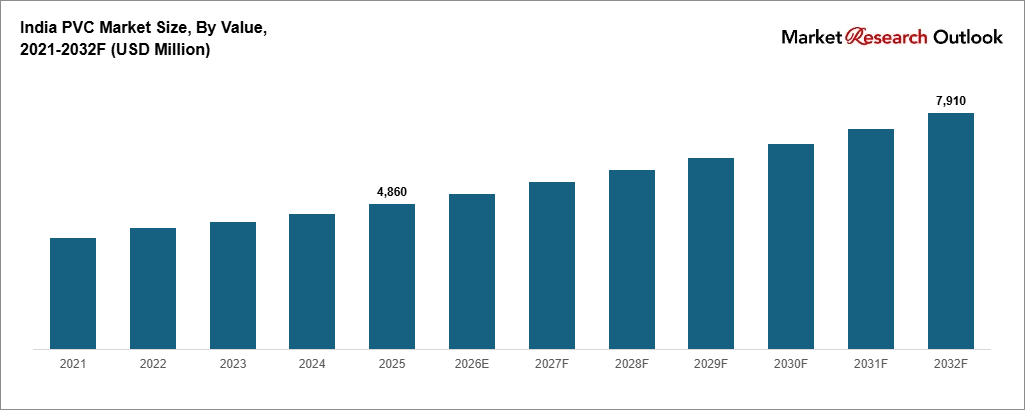
| Market Size (2025) | USD 4,860 Million |
| CAGR (2026-2032) | 7.2% |
| Leading Segment | Rigid PVC (Pipes & Fittings) |
| Fastest Growing Segment | Chlorinated PVC (CPVC) & Low-Smoke PVC |
| Market Size (2032) | USD 7,910 Million |
Market Overview: India PVC Market
The India PVC market size is witnessing rapid expansion, driven by large water supply and irrigation programmes, rising housing construction, expanding urban infrastructure, steady growth in electrical wiring and cable demand, and major capacity additions planned by domestic petrochemical majors. The India PVC market was valued at USD 4,860 million in 2025 and is projected to reach USD 7,910 million by 2032, growing at a CAGR of 7.2%. India PVC market growth is being fuelled by strong pull from pipe and fitting manufacturers, government spending on rural water connections, and the steady rise of organized building material brands across tier-1, tier-2, and tier-3 cities. The India PVC market consumed close to 4.9 million tonnes of PVC resin in 2025, while domestic capacity stood near 1.7 million tonnes per annum, which left imports of more than 3.1 million tonnes to fill the gap in the India PVC market. Rigid PVC used in pipes and fittings leads India PVC market consumption, while chlorinated PVC and low-smoke PVC are emerging as the fastest growing categories. As domestic producers including Reliance Industries, Finolex Industries, Chemplast Sanmar, DCW, and DCM Shriram expand output, and new entrants such as Adani Petrochemicals and Indian Oil build fresh capacity, the India PVC market is evolving into an infrastructure-led, capacity-driven, and import-substituting ecosystem with strong long-term growth potential.
Key Report Takeaways: India PVC Market
- The India PVC market size is projected to grow from USD 4,860 million in 2025 to USD 7,910 million by 2032, registering a strong CAGR of 7.2%, driven by water supply and irrigation projects, rising housing construction, and growing use of PVC in electrical, packaging, and healthcare applications across India.
- Rigid PVC dominates the India PVC market share, accounting for over 74% of total volume in 2025, driven by heavy use in pipes, fittings, window profiles, and conduits, and backed by the deep presence of pipe brands such as Supreme Industries, Astral, Finolex Industries, Prince Pipes, and Ashirvad.
- Chlorinated PVC and low-smoke PVC are emerging as the fastest growing segments in the India PVC market, expected to grow at 10% to 13% annually as hot and cold water plumbing, fire-safe cabling, and premium residential projects reshape material choices across metro and tier-1 cities.
- Heavy import dependence, with imports crossing 3.1 million tonnes in 2025 and covering about 63% of national demand, is shaping India PVC market pricing and margins, while per-capita PVC consumption of only about 3 kg against 16.5 kg in China points to large headroom for the India PVC market.
- Planned capacity additions of more than 3 million tonnes per annum by Reliance Industries, Adani Petrochemicals, and Indian Oil through 2029 are set to strengthen India PVC market supply, cut import reliance, and support the India PVC market forecast 2032.
Key Market Drivers: India PVC Market
Jal Jeevan Mission, Irrigation Expansion, and Agricultural Pipe Demand Driving PVC Consumption Across India
Growth in the India PVC market is being driven by large public spending on drinking water, irrigation, and rural infrastructure. Under the Jal Jeevan Mission, tap water connections have reached more than 15 crore rural households, and the programme has been extended to 2028, which keeps orders flowing for PVC pipes and fittings in states such as Uttar Pradesh, Rajasthan, Madhya Pradesh, Bihar, and Maharashtra. Pipes and fittings account for close to 70% of India PVC market volume, making water programmes the single largest demand lever for the PVC market. Farm demand adds further support to the India PVC market, as micro-irrigation, borewell casing, and PM-KUSUM solar pump installations all rely on PVC column and suction pipes. Per-capita PVC consumption in the India PVC market remains near 3 kg per year against 16.5 kg in China and above 10 kg in developed economies, indicating significant long-term headroom for growth. Rising replacement of metal and cement pipes in the India PVC market, faster project execution by state water boards, and steady monsoon-linked farm spending are creating strong structural pull-through demand across the India PVC market.
Rapid Urbanization, Housing Construction, and Infrastructure Spending Fuelling PVC Pipes, Profiles, and Cables Demand
The India PVC market is benefiting from sustained growth in housing and urban infrastructure. India’s urban population crossed 510 million in 2025, and central capital expenditure was budgeted at about INR 11.2 lakh crore for FY26, supporting roads, metro rail, smart city works, and urban sewerage. For the India PVC market, housing schemes such as PMAY-Urban 2.0 and PMAY-Gramin, along with a strong private real estate cycle in cities such as Mumbai, Pune, Bengaluru, Hyderabad, and Delhi NCR, are lifting demand for PVC plumbing pipes, drainage systems, uPVC window and door profiles, false ceilings, and electrical conduits. In the India PVC market, a typical urban apartment uses between 350 kg and 500 kg of PVC-based building products, covering pipes, conduits, cables, and profiles. Organized pipe brands now hold more than 65% of the Indian pipes market, and their steady capacity additions keep India PVC market resin offtake high. Young homebuyers, growing preference for corrosion-free and low-maintenance materials, and wider retail reach of building material brands are supporting consistent India PVC market growth.
Expanding Electrical, Packaging, Healthcare, and Automotive Applications Broadening PVC Demand Beyond Pipes
Wider use of PVC outside the pipe segment is a major catalyst for the India PVC market, with non-pipe applications projected to grow at 6% to 8% annually through 2032. For the India PVC market, power sector reforms under the Revamped Distribution Sector Scheme, a rising base of solar and wind capacity, and fast growth in data centres are lifting demand for PVC-insulated wires and cables from makers such as Polycab, KEI Industries, Havells, and Finolex Cables. Flexible PVC is gaining ground in the India PVC market through medical tubing, blood bags, IV sets, and disposable devices, helped by rising hospital capacity and medical device production under the PLI scheme. Within the India PVC market, PVC films and sheets serve pharmaceutical blister packaging, an area where India ranks among the largest generic drug exporters globally. Automotive uses in the India PVC market such as wire harness insulation, underbody coatings, and synthetic leather add further volume as passenger vehicle sales stay above 4 million units per year. These diverse PVC market end uses are structurally expanding India PVC market growth across all major end-use industries through 2032.
Key Market Challenges: India PVC Market
Heavy Import Dependence and Low-Priced Imports Pressuring Domestic PVC Prices and Margins
The India PVC market continues to face challenges from high import dependence and sharp price competition, with imports crossing 3.1 million tonnes in 2025, nearly double the 2022 level, and covering about 63% of national demand. For the India PVC market, China alone exported more than 3 million tonnes of suspension PVC in the first ten months of 2025, with roughly 42% shipped to India. While the DGTR recommended anti-dumping duties to protect the India PVC market in August 2025, the duties were not notified within the deadline, and the BIS quality control order for PVC resin was deferred several times before being withdrawn in November 2025. PVC market import prices slid from about USD 757 per tonne in January 2025 to near USD 600 per tonne by December, forcing domestic producers in the India PVC market to cut list prices. This pressure limits PVC market investment returns and margin visibility across the India PVC market.
Volatility in Feedstock, Energy, and Freight Costs Impacting PVC Producer Margins
The India PVC market faces structural complexity from swings in ethylene, ethylene dichloride (EDC), vinyl chloride monomer (VCM), and carbide feedstock prices. Most producers in the India PVC market depend on imported EDC or VCM, which links their cost base to global crude, naphtha, and chlor-alkali cycles. Between 2022 and 2025, India PVC market prices on a CIF basis moved in a band of more than USD 500 per tonne, while power and caustic soda prices also shifted sharply. Shipping disruptions affecting the PVC market in the Red Sea and changing freight rates add further uncertainty for both resin imports and feedstock supply. Integrated India PVC market players such as Reliance Industries and DCM Shriram are better placed to absorb these swings, while smaller producers and downstream pipe processors such as regional converters face inventory losses during price falls. Feedstock volatility therefore remains a near-term PVC market challenge for the India PVC market.
Environmental Concerns, Plastic Waste Rules, and Low Recycling Rates Limiting Flexible PVC Applications
The India PVC market faces practical constraints around environmental scrutiny, waste management rules, and limited recycling infrastructure. PVC contains around 57% chlorine by weight, and in the India PVC market and concerns over phthalate plasticizers, lead stabilizers, and residual VCM in low-grade imported resin continue to draw attention from regulators and consumer groups. In the India PVC market, Extended Producer Responsibility rules under the Plastic Waste Management Rules place recycling targets on brand owners, raising costs for flexible PVC packaging and films. Formal recycling rates in the India PVC market remain below 15%, as mixed waste streams and poor segregation make recovery difficult. Lead-free stabilizers, phthalate-free plasticizers, and closed-loop recycling are emerging as PVC market solutions, but higher costs and limited awareness among small processors remain barriers to wider adoption across the India PVC market.
Key Market Trends: India PVC Market
Large-Scale Domestic Capacity Expansion and Import Substitution in the India PVC Market
The India PVC market is undergoing a clear supply shift as new domestic capacity moves toward start-up. Adani Petrochemicals is building a 1 million tonne per annum acetylene-based PVC unit at Mundra, with the first phase expected around late 2026 to early 2027. Reliance Industries plans about 1.5 million tonnes per annum of new PVC capacity across Dahej and Jamnagar, while Indian Oil has announced additions including a unit at its Paradip complex. Combined, these projects could add more than 3 million tonnes per annum by 2029 and lift India PVC market capacity toward 4.5 to 5 million tonnes. To defend India PVC market share, Chemplast Sanmar, Finolex Industries, and DCW are also improving plant efficiency and debottlenecking existing lines. Even with these additions, India PVC market demand near 6 million tonnes by 2030 means imports will still play a role in the PVC market. This capacity transition is reinforcing the India PVC market forecast 2032 across the full value chain.
Shift Toward CPVC, Lead-Free Stabilizers, and High-Performance PVC Compounds
A clear shift toward CPVC, lead-free stabilizer systems, and high-performance compounds is reshaping the India PVC market, particularly in plumbing, fire safety, and cable segments. In the India PVC market, CPVC pipes handle water temperatures up to 93 degrees Celsius and are replacing GI and copper pipes in hot water lines across new apartments, hotels, and hospitals. The India PVC market still imports most of its CPVC resin from suppliers such as Lubrizol, Kaneka, and Sekisui, but domestic players including DCW and Reliance are building local capability. Across the India PVC market, calcium-zinc stabilizers are rapidly replacing lead-based systems, as BIS standards for potable water pipes and brand owner commitments push toward lead-free products. Low-smoke, zero-halogen and flame-retardant PVC compounds are also gaining PVC market traction in metro rail, airports, and data centres. By 2025, lead-free formulations account for more than 55% of organized PVC pipe output, up from under 25% in 2020, lifting value growth in the India PVC market.
Downstream Pipe Capacity Expansion and Organized Brand Consolidation
A wave of downstream capacity expansion is reshaping the India PVC market demand landscape. Leading pipe makers in the India PVC market including Supreme Industries, Astral, Finolex Industries, Prince Pipes, Ashirvad, and Apollo Pipes have announced new plants and brownfield expansions across Uttar Pradesh, Odisha, Telangana, Bihar, and Gujarat between 2023 and 2025, adding several lakh tonnes of combined pipe capacity. Organized players are gaining India PVC market share from small unorganized processors through wider dealer networks, stronger brands, and better quality assurance. Across the India PVC market, GST formalization, e-way bill tracking, and government tender norms that favour BIS-certified pipes have structurally favoured organized supply. Combined with steady water infrastructure orders and housing demand, these developments are reinforcing the India PVC market forecast 2032 across the entire value chain.
Segmental Insights: India PVC Market
By Application: Pipes & Fittings Segment Dominates the India PVC Market
The pipes and fittings segment dominates the India PVC market, accounting for an estimated 68% to 72% of total volume, driven by water supply programmes, irrigation, sewerage, and housing plumbing. In the India PVC market, suspension PVC with K-values of 65 to 67 is the main grade used in this segment, with rigid pipes for agriculture and water supply making up most of the volume. The profiles and tubes segment contributes another 8% to 10% of India PVC market demand, driven by uPVC windows, doors, and ceiling panels in urban homes. Wires and cables account for 7% to 9% of India PVC market volume, led by power distribution, renewable energy, and building wiring. In 2025, leading PVC market pipe makers including Supreme Industries, Astral, Finolex Industries, Prince Pipes, and Ashirvad scaled up capacity to serve Jal Jeevan Mission and housing demand, reinforcing segment dominance in the India PVC market.
By Product Type: Rigid PVC Leads While CPVC and Low-Smoke PVC Grow Fastest
Rigid PVC leads the India PVC market product landscape, accounting for approximately 74% of total India PVC market volume, driven by its strength, low cost, corrosion resistance, and long service life in pipes, profiles, and conduits. Flexible PVC contributes another 18% to 20% of the PVC market, primarily across cables, films, flooring, medical products, and synthetic leather. Chlorinated PVC and low-smoke PVC are the fastest growing categories within the India PVC market, expanding at 10% to 13% annually, driven by hot water plumbing, fire sprinkler systems, and fire-safe cabling in commercial buildings. Other specialty grades together account for 2% to 4% of the India PVC market and are expected to grow steadily through 2032. Leading India PVC market producers including Reliance Industries, Chemplast Sanmar, Finolex Industries, DCW, and DCM Shriram have aligned product portfolios to this mix, driving value growth across the India PVC market.
Regional Insights: India PVC Market
Regional analysis of the India PVC market shows that West India and North India collectively account for approximately 60% to 64% of total PVC volume, driven by Gujarat (Dahej, Hazira, and Mundra production hubs), Maharashtra (Mumbai and Pune construction belt), Rajasthan, Uttar Pradesh, Punjab, and Haryana, supported by large water supply projects and strong farm pipe demand. South India contributes around 22% to 25% of India PVC market demand, led by Tamil Nadu, Telangana, Karnataka, and Andhra Pradesh, supported by Chemplast Sanmar at Cuddalore, DCW at Sahupuram, and dense pipe processing clusters around Chennai and Hyderabad. Central and East India together account for 13% to 16% of PVC market demand, supported by Madhya Pradesh, Bihar, West Bengal, and Odisha, where Jal Jeevan Mission works and new pipe plants are accelerating. In 2025, capacity work by Adani Petrochemicals at Mundra, Reliance Industries at Dahej and Jamnagar, Finolex Industries at Ratnagiri, and Indian Oil at Paradip reinforced regional supply hubs, supporting closer execution of infrastructure and housing projects across the India PVC market.
Recent Developments: India PVC Market
- The India PVC market witnessed strong momentum in demand and trade during 2024 and 2025. India imported a record of more than 3.1 million tonnes of PVC resin in calendar year 2025, nearly double the 2022 level, making it the largest PVC importer in the world. India PVC market prices for suspension PVC on a CIF basis eased from about USD 757 per tonne in January 2025 to near USD 600 per tonne by December 2025. India PVC market demand is projected to reach about 6 million tonnes by 2030, growing at an average 5% to 7% annually.
- Domestic producers in the India PVC market have deepened India-focused capacity expansion. Adani Petrochemicals advanced work on its 1 million tonne per annum acetylene-based PVC plant at Mundra, Reliance Industries progressed its PVC expansions at Dahej and Jamnagar, and Indian Oil moved ahead with planned PVC capacity linked to its Paradip complex. Chemplast Sanmar, Finolex Industries, DCW, and DCM Shriram focused on PVC market efficiency, specialty grades, and CPVC capability. These developments are strengthening domestic supply and supporting the India PVC market forecast 2032.
- Trade policy remained a key theme in the India PVC market. In August 2025, the DGTR issued a final recommendation for anti-dumping duties on suspension PVC from several countries, but the duties were not notified within the deadline. The BIS quality control order for PVC homopolymers was deferred several times and withdrawn in November 2025. These policy shifts in the India PVC market kept import flows strong and shaped pricing, strengthening the case for domestic capacity in the India PVC market forecast 2032.
Key Market Players: India PVC Market
- Reliance Industries Limited
- Finolex Industries Limited
- Chemplast Sanmar Limited
- DCW Limited
- DCM Shriram Limited
- Adani Petrochemicals Limited (Adani Enterprises Ltd.)
- Indian Oil Corporation Limited
- Formosa Plastics Corporation
- LG Chem Ltd.
- Shin-Etsu Chemical Co., Ltd.
- Westlake Corporation
- Hanwha Solutions Corporation
- Kaneka Corporation
| By Product Type | By Resin Type | By Stabilizer Type | By Application | By End-Use Industry |
| Rigid PVC Flexible PVC Chlorinated PVC (CPVC) Low-Smoke PVC Others |
Suspension PVC Emulsion PVC (Paste) Bulk PVC Others |
Calcium-Zinc Stabilizers Lead-Based Stabilizers Tin & Organotin Stabilizers Barium-Based Stabilizers Others |
Pipes & Fittings Profiles & Tubes Films & Sheets Wires & Cables Flooring & Wall Coverings Bottles & Packaging Others |
Building & Construction Agriculture & Irrigation Electrical & Electronics Packaging Automotive Healthcare Others |
Report Scope
In this report, the India PVC Market has been segmented into the following categories, in addition to detailed analysis of key industry trends, market dynamics, competitive landscape, and growth opportunities across the forecast period:
- By Product Type
- Rigid PVC
- Flexible PVC
- Chlorinated PVC (CPVC)
- Low-Smoke PVC
- Others
- By Resin Type
- Suspension PVC
- Emulsion PVC (Paste)
- Bulk PVC
- Others
- By Stabilizer Type
- Calcium-Zinc Stabilizers
- Lead-Based Stabilizers
- Tin & Organotin Stabilizers
- Barium-Based Stabilizers
- Others
- By Application
- Pipes & Fittings
- Profiles & Tubes
- Films & Sheets
- Wires & Cables
- Flooring & Wall Coverings
- Bottles & Packaging
- Others
- By End-Use Industry
- Building & Construction
- Agriculture & Irrigation
- Electrical & Electronics
- Packaging
- Automotive
- Healthcare
- Others
- By Geography
- North India
- South India
- West India
- East India
- Central India
Competitive Landscape
Company Profiles:
Detailed analysis of the leading companies operating in the India PVC Market, including business overview, product portfolio, strategic initiatives, competitive positioning, and recent developments.
Company Information
Detailed profiling and strategic analysis of additional market players (up to five companies), including emerging domestic PVC producers, CPVC compound makers, regional pipe processors, or specialty PVC stabilizer and additive suppliers.
For a free sample of the India PVC Market report, customised insights or delivery timelines, submit your query here
India PVC Market, 2032
- Research Framework
- Market Segmentation
- Research Objective
- Research Methodology
- Qualitative Research
- Primary Research
- Secondary Research
- Quantitative Research
- Market Breakdown & Data Triangulation
- Demand Side
- Supply Side
- Primary Research Respondents
- Assumption & Limitation
- Executive Summary
- Market Overview, 2021-2032
- By Product Type
- By Resin Type
- By Stabilizer Type
- By Application
- By End-Use Industry
- By Region
- Analyst Recommendations
- Geopolitical Impact on India PVC Market
- India PVC Market Insights
- Market Dynamics
- Growth Drivers
- Jal Jeevan Mission, irrigation expansion, and agricultural pipe demand driving PVC consumption across India.
- Rapid urbanization, housing construction, and infrastructure spending fuelling PVC pipes, profiles, and cables demand.
- Expanding electrical, packaging, healthcare, and automotive applications broadening PVC demand beyond pipes.
- Restraints
- Heavy import dependence and low-priced imports pressuring domestic PVC prices and margins.
- Volatility in feedstock, energy, and freight costs impacting PVC producer margins.
- Environmental concerns, plastic waste rules, and low recycling rates limiting flexible PVC applications.
- Opportunities
- Large-scale domestic capacity additions creating strong import substitution opportunities across India.
- CPVC, lead-free, and low-smoke PVC products supporting next-generation growth in premium construction.
- Recycled PVC, specialty compounds, and medical-grade PVC opening new value-added revenue pools.
- Challenges
- Intense competition from HDPE, PPR, and ductile iron pipes in water supply and plumbing projects.
- Fragmented downstream processing base with many small and unorganized PVC converters.
- Maintaining resin quality consistency and low residual VCM levels in imported PVC supply.
- Technological Advancements
- Recent Technological Advancements
- Prior to 2020
- Porter’s Five Forces Analysis
- PESTLE Analysis
- Industry Value Chain & Entry Points
- Upstream Raw Materials (ethylene, EDC, VCM, calcium carbide, salt, chlorine, plasticizers, stabilizers)
- PVC Resin Producers (Reliance Industries, Finolex Industries, Chemplast Sanmar, DCW, DCM Shriram)
- Additive & Compound Suppliers (calcium-zinc stabilizers, plasticizers, impact modifiers, CPVC compounds)
- Specialty & CPVC Resin Makers (CPVC resin, paste PVC, low-smoke and flame-retardant compounds)
- Quality Control, R&D & Testing Laboratories (BIS, CIPET, ISO, NABL standards)
- Distributors, Traders & Importers (B2B resin trading and import networks)
- Pipe, Profile & Cable Processors (Supreme Industries, Astral, Prince Pipes, Ashirvad, Polycab)
- Brand Owners & Building Product Companies (pipes, windows, flooring, wires, packaging films)
- Retail Channels & Project Sales (dealers, hardware stores, EPC contractors, government tenders)
- End-Users (households, farmers, builders, utilities, hospitals, packaging firms)
- India PVC Market: Regulatory Framework
- India PVC Market Overview
- Market Size & Forecast, 2021-2032
- By Value (USD Million)
- By Volume (Kilo Tonnes)
- Market Share & Forecast
- By Product Type
- Rigid PVC
- Flexible PVC
- Chlorinated PVC (CPVC)
- Low-Smoke PVC
- Others
- By Resin Type
- Suspension PVC
- Emulsion PVC (Paste)
- Bulk PVC
- Others
- By Stabilizer Type
- Calcium-Zinc Stabilizers
- Lead-Based Stabilizers
- Tin & Organotin Stabilizers
- Barium-Based Stabilizers
- Others
- By Application
- Pipes & Fittings
- Profiles & Tubes
- Films & Sheets
- Wires & Cables
- Flooring & Wall Coverings
- Bottles & Packaging
- Others
- By End-Use Industry
- Building & Construction
- Agriculture & Irrigation
- Electrical & Electronics
- Packaging
- Automotive
- Healthcare
- Others
- By Geography
- North India
- South India
- West India
- East India
- Central India
- Competitive Landscape
- India PVC Market Company Market Share Analysis, 2025
- Competitive Benchmarking, By Operating Parameters
- Key Strategic Development (Mergers, Acquisitions, Partnerships, Etc.)
- List of Emerging Players
- Company Profile
- Reliance Industries Limited
- Introduction & Company Profile
- Product Benchmarking
- Strategic Outlook
- Key Competitors
- Financial Analysis
- SWOT Analysis
(Same Data Pointers Will Be Provided for The Below Companies)
- Finolex Industries Limited
- Chemplast Sanmar Limited
- DCW Limited
- DCM Shriram Limited
- Adani Petrochemicals Limited (Adani Enterprises Ltd.)
- Indian Oil Corporation Limited
- Formosa Plastics Corporation
- LG Chem Ltd.
- Shin-Etsu Chemical Co., Ltd.
- Westlake Corporation
- Hanwha Solutions Corporation
- Kaneka Corporation
- Other Prominent Players
* Financial information in case of non-listed companies will be provided as per availability
** The segmentation and the companies are subjected to modifications based on in-depth secondary for the final deliverable
Frequently Asked Questions
1. How large is the India PVC market and what is its growth forecast?
Ans: The India PVC market is valued at USD 4,860 million in 2025 and is projected to reach USD 7,910 million by 2032, growing at a CAGR of 7.2%, supported by water projects, housing, and infrastructure.
2. Which segments are driving demand in the India PVC market?
Ans: Rigid PVC leads with over 74% volume share, mainly through pipes and fittings, while CPVC and low-smoke PVC are the fastest growing segments, driven by plumbing and fire-safe cabling needs.
3. What are the key drivers of growth in the India PVC market?
Ans: Key drivers include the Jal Jeevan Mission, irrigation expansion, rising housing construction, higher infrastructure spending, and growing PVC use in wires, cables, packaging, and healthcare.
4. Which regions are driving growth in the India PVC market?
Ans: West India and North India lead with around 60% to 64% of total volume, driven by Gujarat, Maharashtra, Rajasthan, Uttar Pradesh, and Punjab. South India follows with strong pipe demand.
5. What are the latest trends in the India PVC market?
Ans: Major trends include new domestic capacity from Reliance, Adani, and Indian Oil, a shift to CPVC and lead-free stabilizers, and rapid capacity expansion by organized pipe brands.