

India BOPET Film Market, 2032
- Chemicals & Advanced Materials, Polymers, Plastics & Packaging
- Oct 2026
- Pages 140
- Report Format: pdf
- Report Price: $2400 USD
India’s polyester film sector is witnessing steady structural growth, driven by rising packaged food, beverage and FMCG consumption, growth in solar module manufacturing and electrical insulation, expansion of e-commerce and quick commerce, large domestic production capacity, and a gradual shift from plain commodity films toward metallised, chemical-coated, barrier and thick specialty BOPET films.
| Study Duration | 2021-2032 |
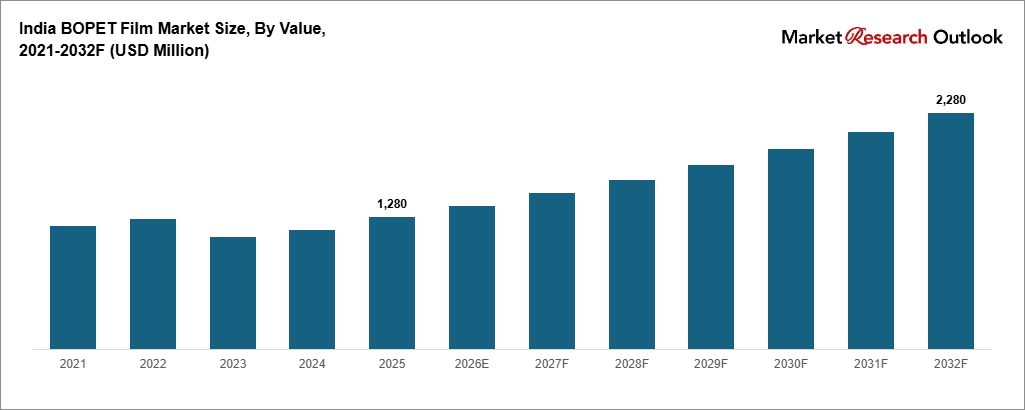
| Market Size (2025) | USD 1,280 Million |
| CAGR (2026-2032) | 8.6% |
| Leading Segment | Plain BOPET Films (Flexible Packaging) |
| Fastest Growing Segment | Solar Backsheet & Barrier Films |
| Market Size (2032) | USD 2,280 Million |
Market Overview: India BOPET Film Market
The India BOPET film market size is witnessing steady expansion, driven by flexible packaging demand from food, beverage, personal care and pharmaceutical brands, growth in solar module and backsheet manufacturing, rising use of labels, tapes and release liners, and the spread of e-commerce and quick commerce. Valued at USD 1,280 million in 2025 and projected to reach USD 2,280 million by 2032, growing at a CAGR of 8.6%, India BOPET film market growth is recovering from a period of low prices that followed heavy capacity addition, with nameplate capacity projected to reach 1.65 million tonnes by 2026. Plain BOPET films lead the product mix, while barrier films and solar backsheet applications form the fastest growing categories. Turnover of 12 biaxial film makers fell from INR 32,685 crore in FY22 to INR 26,933 crore in FY24, mainly due to low BOPET price realisation, which is pushing producers toward value-added grades. As Polyplex, JPFL Films, SRF, UFlex, Garware Hi-Tech Films and Ester Industries widen specialty ranges, the sector is evolving into a quality-led, application-driven and sustainability-focused industry with strong long-term potential.
Key Report Takeaways: India BOPET Film Market
- The India BOPET film market size is projected to grow from USD 1,280 million in 2025 to USD 2,280 million by 2032, registering a CAGR of 8.6%, driven by packaged food demand, solar and electrical uses, and the structural shift toward metallised, coated and barrier film grades.
- Plain BOPET films dominate the product mix, accounting for 46% of total value in 2025, driven by their wide use as the outer print layer in flexible packaging laminates, with large supply from Polyplex, JPFL Films, SRF, UFlex and Vacmet.
- Solar backsheets are emerging as the fastest growing application, expected to grow at a CAGR of 14.2% through 2032, as domestic solar module manufacturing expands under the PLI scheme for high-efficiency solar PV modules and module makers look for local thick polyester films.
- BOPET nameplate capacity in India is projected to reach 1.65 million tonnes by 2026, and about a dozen more biaxial film lines, including two BOPET lines, are expected to be commissioned by the end of 2026.
- Rising investment in value-added capacity, including Polyplex’s INR 558 crore BOPET line of 52,400 tonnes per year and Cosmo First’s specialised BOPET line at Aurangabad, is strengthening domestic supply and supporting the India BOPET film market forecast 2032.
Key Market Drivers: India BOPET Film Market
Rising Packaged Food, Beverage and FMCG Consumption Driving Flexible Packaging Demand for BOPET Films
Growth in the India BOPET film market is driven first by flexible packaging. BOPET film is the standard outer layer in laminates for snacks, biscuits, tea, coffee, spices, ready-to-eat meals, detergents and personal care products, as it offers high clarity, print quality, stiffness and heat resistance. Flexible packaging laminates accounted for 58% of application value in 2025, and food and beverages for 54% of end-user value. Growth in branded packaged food in tier-2 and tier-3 towns, smaller pack sizes for rural buyers and the shift from loose to packaged staples keep adding demand. Thin films of 12 to 23 microns hold 52% of thickness value, reflecting their use in standard laminates. Globally, packaging accounts for over 60% of thin BOPET film volume, and the same pattern holds in India. Large converters in Gujarat, Maharashtra, Uttar Pradesh and Haryana continue to add printing and lamination lines, creating steady pull-through demand for BOPET films.
Growth in Solar Module Manufacturing, Electrical Insulation and Electronics Lifting Demand for Thick and Specialty BOPET Films
The sector benefits from rising industrial demand for thick and specialty films. Solar module makers use thick polyester films in backsheets, and domestic module output is rising under the Production Linked Incentive scheme for high-efficiency solar PV modules, which carries a total outlay of INR 24,000 crore. Electrical and electronics makers use BOPET films for motor and transformer insulation, cable wrapping, flexible circuits and membrane switches. Electrical, electronics and solar users accounted for 18% of end-user value in 2025, and films above 51 microns held 21% of thickness value. Release liners for labels and tapes add further industrial demand. These grades carry higher prices and better margins than thin packaging films, which is drawing producers such as Garware Hi-Tech Films, SRF, Ester Industries and Polyplex toward thick and coated films, supporting steady growth in the India BOPET film market.
Expansion of E-Commerce, Quick Commerce and Modern Retail Increasing Demand for Printed, Metallised and Barrier Laminates
Rapid growth in e-commerce, quick commerce and modern retail is a major catalyst for value-added polyester films in India. Products sold online and through quick delivery apps need packs that look good on screen, survive handling and keep products fresh for longer, which raises demand for metallised films, high-barrier films and premium printed laminates. Metallised BOPET films accounted for 24% of product value in 2025, while barrier and high-barrier films held 9% and are growing at a CAGR of 12.1% through 2032. Brand owners in snacks, coffee, dry fruits, pet food and personal care are moving to stand-up pouches, zipper pouches and high-barrier laminates that use metallised or coated BOPET. Holographic and twist films add decorative value in confectionery and gifting. These shifts are structurally expanding India BOPET film market growth across food, personal care and pharmaceutical categories through 2032.
Key Market Challenges: India BOPET Film Market
Overcapacity and Low Price Realisation Pressuring Margins as Nameplate Capacity Heads Toward 1.65 Million Tonnes
The sector faces a clear oversupply challenge. About two dozen BOPET and BOPP lines were installed in the four years to early 2025, and BOPET nameplate capacity is projected to reach 1.65 million tonnes by 2026, well above domestic consumption. Turnover of 12 biaxial film makers fell from INR 32,685 crore in FY22 to INR 32,373 crore in FY23 and INR 26,933 crore in FY24, mainly due to low BOPET price realisation. Polyplex reported a normalised EBITDA margin of 8% and a normalised ROCE of 3% in FY26, showing the pressure on returns across the industry. Producers have pushed more volume into exports and value-added grades, but plain thin films remain highly commoditised, and new capacity coming on stream through 2026 and 2027 may keep prices under pressure in the near term.
Volatility in PTA, MEG and PET Chip Prices Raising Input Cost Uncertainty for Film Producers
Raw material costs form the largest part of BOPET film cost, and PTA and MEG prices move with crude oil, paraxylene and global supply conditions. Sudden swings in PET chip costs affect film pricing and margins, as producers pass through raw material changes with a lag, while converters often resist price increases in a market with ample supply. Global shipping disruptions and Middle East tensions have added short-term volatility to petrochemical prices. Integrated producers that make their own PET chips are better placed to manage these swings, but smaller and non-integrated makers face sharper margin swings, keeping input cost uncertainty a near-term challenge for polyester film makers in India.
Recyclability Concerns over Multi-Layer Laminates and EPR Obligations Under the Plastic Waste Management Rules
Polyester film faces rising scrutiny over end-of-life recycling. Most BOPET is used in multi-layer laminates bonded with PE, aluminium foil or other films, which are hard to separate and recycle. The Plastic Waste Management Rules and the guidelines on extended producer responsibility require brand owners and importers to meet collection and recycling targets for plastic packaging, including multi-layer packaging, and the ban on identified single-use plastic items from 1 July 2022 has raised awareness of plastic waste. Some brand owners are testing mono-material PE and BOPP structures that compete with BOPET laminates. Recycle-ready designs, recycled PET content films and chemical recycling are emerging as solutions, but cost and limited collection systems remain barriers in the India BOPET film market.
Key Market Trends: India BOPET Film Market
Rapid Shift Toward Metallised, Chemical-Coated and High-Barrier BOPET Films
The sector is undergoing a clear shift from plain films toward value-added grades. Metallised, chemical-coated and barrier films together accounted for 44% of product value in 2025, as converters look for films with better printability, adhesion, oxygen and moisture barrier, and foil replacement capability. Chemical-coated films improve ink and adhesive bonding, while high-barrier metallised and aluminium oxide coated films can replace aluminium foil in snacks, coffee and pharmaceutical packs. Producers are adding metallisers and coaters, with Polyplex investing USD 7 million in two metallisers in India alongside its new film line. This product shift lifts value per tonne, reinforcing the India BOPET film market forecast 2032 across packaging and industrial categories.
Rising Use of Thick and Specialty BOPET Films in Solar Backsheets, Electrical Insulation and Release Liners
A clear shift toward thick and specialty films is reshaping the product mix. Solar backsheets accounted for 6% of application value in 2025 and form the fastest growing application, with a CAGR of 14.2% through 2032, as module makers expand domestic capacity. Electrical and electronics insulation held 9% of application value, and industrial tapes and release liners another 9%, supported by growth in labels, adhesive tapes and electronics assembly. Films above 125 microns accounted for 9% of thickness value and command much higher prices than thin packaging grades. Producers including Garware Hi-Tech Films, SRF, Ester Industries and Polyplex are widening thick film, UV-resistant and release film ranges, raising the value of each tonne sold across the sector.
Capacity Expansion and Value-Added Line Additions by Domestic Producers
A new wave of investment is reshaping the supply side of the sector, with a sharper focus on specialty films. Polyplex approved an INR 558 crore BOPET line with capacity of 52,400 tonnes per year in January 2025, along with two metallisers, with start-up targeted in 2027. Cosmo First commissioned a specialised BOPET line at Aurangabad in June 2024. About a dozen more biaxial film lines with nameplate capacity of about 600,000 tonnes, including two BOPET lines, are expected to be commissioned by the end of 2026. Producers are also adding coating, metallising and recycled PET film capability to move away from plain commodity grades. These developments are reinforcing the India BOPET film market forecast 2032 across the value chain.
Segmental Insights: India BOPET Film Market
By End-User: Food & Beverages Segment Dominates BOPET Film Demand in India
The food and beverages end-user segment dominates the market, accounting for 54% of total value in 2025, driven by snacks, biscuits, confectionery, tea, coffee, spices, dairy and ready-to-eat foods. Plain and metallised BOPET films are the main products within this segment, used as print and barrier layers in laminates and pouches. The electrical, electronics and solar segment contributes 18% of demand, led by solar backsheets, insulation films and electronics uses. Personal care and pharmaceuticals account for 15%, supported by shampoo sachets, cosmetics packs, blister lidding and medical packaging, while industrial and other uses contribute 13%. In 2025 and 2026, leading converters expanded high-barrier and stand-up pouch capacity for food brands, reinforcing food segment leadership.
By Product Type: Plain BOPET Films Lead While Barrier Films Grow Fastest
Plain BOPET films lead the product mix, accounting for 46% of total value in 2025, driven by their wide use as the outer print layer in flexible packaging laminates. Metallised BOPET films contribute 24%, mainly in snacks, confectionery and coffee packs, while chemical-coated films hold 11% for better ink and adhesive bonding. Barrier and high-barrier films account for 9% and form the fastest growing product segment, with a CAGR of 12.1% through 2032, as they replace aluminium foil in food and pharmaceutical packs. Holographic and twist films hold 4%, and others, including matte, heat-sealable and specialty films, account for 6%. By sales channel, direct sales to converters account for 61% of value. Leading producers including Polyplex, JPFL Films, SRF, UFlex and Garware Hi-Tech Films have aligned product portfolios to this mix across the sector.
Regional Insights: India BOPET Film Market
Regional analysis shows that West India leads with 38% of total market value in 2025, driven by Gujarat and Maharashtra, which host large flexible packaging converters, label makers, solar module plants and film production sites. North India contributes 30%, led by Uttar Pradesh, Haryana, Uttarakhand, Delhi NCR and Punjab, supported by large converter clusters around Noida, Greater Noida and Rudrapur and major film plants in the region. South India accounts for 18%, supported by Tamil Nadu, Karnataka, Telangana and Andhra Pradesh, where food processing, pharmaceuticals and solar module manufacturing are expanding. East India holds 9%, led by West Bengal and Odisha, while Central India accounts for 5%, led by Madhya Pradesh. Growing converter capacity in tier-2 cities is gradually spreading BOPET film demand across all regions of India.
Recent Developments: India BOPET Film Market
- The sector recorded steady volume growth through 2025 and 2026, even as prices stayed under pressure. BOPET nameplate capacity is projected to reach 1.65 million tonnes by 2026, while about a dozen more biaxial film lines, including two BOPET lines, are expected by the end of 2026. Polyplex reported FY26 production of 248 kilo tonnes across its global operations and sees Indian PET film demand growing at over 10%.
- Domestic producers deepened investment in value-added capacity. Polyplex approved an INR 558 crore BOPET line with capacity of 52,400 tonnes per year and two metallisers in India, and Cosmo First commissioned a specialised BOPET line at Aurangabad. These developments are strengthening domestic supply and supporting sector growth through 2032.
- Sustainability and specialty grades gained traction across the sector. Producers are developing recycled PET content films, recycle-ready laminate structures and high-barrier coated films to help brand owners meet EPR targets under the Plastic Waste Management Rules, while thick film demand from solar module makers continues to rise. These shifts are strengthening long-term competitive positioning for the sector through 2032.
Key Market Players: India BOPET Film Market
- Polyplex Corporation Limited
- JPFL Films Private Limited (Jindal Poly Films)
- SRF Limited
- UFlex Limited
- Garware Hi-Tech Films Limited
- Ester Industries Limited
- Vacmet India Limited
- Chiripal Poly Films Limited
- Cosmo First Limited
- Toppan Speciality Films Private Limited
- Reliance Industries Limited (PTA, MEG & PET Chips)
- Indian Oil Corporation Limited (PTA & MEG)
- Brückner Maschinenbau GmbH (Film Line Technology)
| By Product Type | By Application | By Thickness | By Sales Channel | By End-User |
| Plain BOPET Films Metallised BOPET Films Chemical-Coated BOPET Films Barrier & High-Barrier BOPET Films Holographic & Twist Films Others (Matte, Heat-Sealable & Specialty) |
Flexible Packaging Laminates Labels & Sleeves Electrical & Electronics Insulation Solar Backsheets Industrial Tapes & Release Liners Imaging, Graphics & Lamination Others |
Below 12 Microns 12 to 23 Microns 24 to 50 Microns 51 to 125 Microns Above 125 Microns |
Direct Sales to Converters Distributors & Traders Brand Owner Tie-Ups OEM & Institutional Supply Metallisers & Coaters Online B2B Platforms |
Food & Beverages Personal Care & Pharmaceuticals Electrical, Electronics & Solar Industrial & Others |
Report Scope
In this report, the India BOPET Film Market has been segmented into the following categories, in addition to detailed analysis of key industry trends, market dynamics, competitive landscape and growth opportunities across the forecast period:
- By Product Type
- Plain BOPET Films
- Metallised BOPET Films
- Chemical-Coated BOPET Films
- Barrier & High-Barrier BOPET Films
- Holographic & Twist Films
- Others (Matte, Heat-Sealable & Specialty)
- By Application
- Flexible Packaging Laminates
- Labels & Sleeves
- Electrical & Electronics Insulation
- Solar Backsheets
- Industrial Tapes & Release Liners
- Imaging, Graphics & Lamination
- Others
- By Thickness
- Below 12 Microns
- 12 to 23 Microns
- 24 to 50 Microns
- 51 to 125 Microns
- Above 125 Microns
- By Sales Channel
- Direct Sales to Converters
- Distributors & Traders
- Brand Owner Tie-Ups
- OEM & Institutional Supply
- Metallisers & Coaters
- Online B2B Platforms
- By End-User
- Food & Beverages
- Personal Care & Pharmaceuticals
- Electrical, Electronics & Solar
- Industrial & Others
- By Geography
- North India
- South India
- West India
- East India
- Central India
Competitive Landscape
Company Profiles:
Detailed analysis of the leading companies operating in the BOPET film industry in India, including business overview, product portfolio, strategic initiatives, competitive positioning and recent developments.
Company Information
Detailed profiling and strategic analysis of additional market players (up to five companies), including emerging film producers, specialty coaters and metallisers, regional converters with film lines, or niche thick film and release liner producers.
For a free sample of the India BOPET Film Market report, customised insights or delivery timelines, submit your query here
India BOPET Film Market, 2032
- Research Framework
- Market Segmentation
- Research Objective
- Research Methodology
- Qualitative Research
- Primary Research
- Secondary Research
- Quantitative Research
- Market Breakdown & Data Triangulation
- Demand Side
- Supply Side
- Primary Research Respondents
- Assumption & Limitation
- Executive Summary
- Market Overview, 2021-2032
- By Product Type
- By Application
- By Thickness
- By Sales Channel
- By End-User
- By Region
- Analyst Recommendations
- Geopolitical Impact on India BOPET Film Market
- India BOPET Film Market Insights
- Market Dynamics
- Growth Drivers
- Rising packaged food, beverage and FMCG consumption driving flexible packaging demand for BOPET films.
- Growth in solar module manufacturing, electrical insulation and electronics lifting demand for thick and specialty BOPET films.
- Expansion of e-commerce, quick commerce and modern retail increasing demand for printed, metallised and barrier laminates.
- Restraints
- Overcapacity and low price realisation pressuring margins as nameplate capacity heads toward 1.65 million tonnes.
- Volatility in PTA, MEG and PET chip prices raising input cost uncertainty for film producers.
- Recyclability concerns over multi-layer laminates and EPR obligations under the Plastic Waste Management Rules.
- Opportunities
- Solar backsheets, release liners and electrical films opening high-margin specialty demand.
- Chemical-coated and high-barrier films replacing aluminium foil in food and pharmaceutical packaging.
- Recycled PET content films and recycle-ready laminates meeting brand owner sustainability goals.
- Challenges
- Competition from BOPP, CPP and PE-based mono-material films in flexible packaging.
- Exposure of film exports to trade remedies and tariffs in the US, the EU and other markets.
- High capital cost and technical expertise needed for specialty, thick and coated film lines.
- Technological Advancements
- Recent Technological Advancements
- Prior to 2020
- Porter’s Five Forces Analysis
- PESTLE Analysis
- Industry Value Chain & Entry Points
- Upstream Raw Materials (PTA, MEG, PET chips, additives, slip and anti-block masterbatches)
- PET Resin & Chip Producers (polycondensation, bottle and film grade chips)
- BOPET Film Manufacturers (Polyplex, JPFL Films, SRF, UFlex, Garware, Ester, Vacmet)
- Metallisers, Coaters & Specialty Processors (metallising, chemical coating, holography)
- Quality Control, R&D & Testing Laboratories (BIS, FSSAI food contact norms, ISO standards)
- Distributors, Traders & Film Stockists (B2B distribution networks)
- Flexible Packaging Converters (printing, lamination, pouch making)
- Brand Owners & FMCG Companies (food, beverages, personal care, pharmaceuticals)
- Industrial & OEM Buyers (solar module, electrical, tape, label and release liner makers)
- End-Users & Recycling Channels (consumers, waste collectors, PET recyclers)
- India BOPET Film Market: Regulatory Framework
- India BOPET Film Market Overview
- Market Size & Forecast, 2021-2032
- By Value (USD Million)
- By Volume (Kilo Tonnes)
- Market Share & Forecast
- By Product Type
- Plain BOPET Films
- Metallised BOPET Films
- Chemical-Coated BOPET Films
- Barrier & High-Barrier BOPET Films
- Holographic & Twist Films
- Others (Matte, Heat-Sealable & Specialty)
- By Application
- Flexible Packaging Laminates
- Labels & Sleeves
- Electrical & Electronics Insulation
- Solar Backsheets
- Industrial Tapes & Release Liners
- Imaging, Graphics & Lamination
- Others
- By Thickness
- Below 12 Microns
- 12 to 23 Microns
- 24 to 50 Microns
- 51 to 125 Microns
- Above 125 Microns
- By Sales Channel
- Direct Sales to Converters
- Distributors & Traders
- Brand Owner Tie-Ups
- OEM & Institutional Supply
- Metallisers & Coaters
- Online B2B Platforms
- By End-User
- Food & Beverages
- Personal Care & Pharmaceuticals
- Electrical, Electronics & Solar
- Industrial & Others
- By Geography
- North India
- South India
- West India
- East India
- Central India
- Competitive Landscape
- India BOPET Film Market Company Market Share Analysis, 2025
- Competitive Benchmarking, By Operating Parameters
- Key Strategic Development (Mergers, Acquisitions, Partnerships, Etc.)
- List of Emerging Players
- Company Profile
- Polyplex Corporation Limited
- Introduction & Company Profile
- Product Benchmarking
- Strategic Outlook
- Key Competitors
- Financial Analysis
- SWOT Analysis
(Same Data Pointers Will Be Provided for The Below Companies)
- JPFL Films Private Limited (Jindal Poly Films)
- SRF Limited
- UFlex Limited
- Garware Hi-Tech Films Limited
- Ester Industries Limited
- Vacmet India Limited
- Chiripal Poly Films Limited
- Cosmo First Limited
- Toppan Speciality Films Private Limited
- Reliance Industries Limited (PTA, MEG & PET Chips)
- Indian Oil Corporation Limited (PTA & MEG)
- Brückner Maschinenbau GmbH (Film Line Technology)
- Other Prominent Players
* Financial information in case of non-listed companies will be provided as per availability
** The segmentation and the companies are subjected to modifications based on in-depth secondary for the final deliverable
Frequently Asked Questions
1. How large is the India BOPET film market and what is its growth forecast?
Ans: The India BOPET film market is valued at USD 1,280 million in 2025 and is projected to reach USD 2,280 million by 2032, growing at a CAGR of 8.6%, supported by packaged food, solar and electrical demand.
2. Which segments are driving BOPET film demand in India?
Ans: Plain BOPET films lead with 46% of 2025 value and food and beverages hold 54% of end-user demand, while solar backsheets are the fastest growing application at a CAGR of 14.2% through 2032.
3. What are the key drivers of growth for BOPET films in India?
Ans: Key drivers include rising packaged food and FMCG consumption, growth in solar module manufacturing and electrical insulation, and expansion of e-commerce and quick commerce that needs printed, metallised and barrier laminates.
4. Which regions are driving BOPET film demand in India?
Ans: West India leads with 38% of 2025 value, driven by Gujarat and Maharashtra, followed by North India at 30%, led by Uttar Pradesh, Haryana and Uttarakhand, and South India at 18%.
5. What are the latest trends in the BOPET film industry in India?
Ans: Latest trends include a shift toward metallised, chemical-coated and high-barrier films, rising use of thick films in solar backsheets and electrical insulation, recycled PET content films, and new value-added production lines.