

India Glass Wool Insulation Market, 2032
- Chemicals & Advanced Materials, Specialty Chemicals
- Nov 2026
- Pages 140
- Report Format: pdf
- Report Price: $2400 USD
India’s glass wool insulation market is witnessing steady structural growth, driven by rapid commercial construction, expanding warehousing and pre-engineered buildings, stricter energy efficiency codes, rising green building certifications, fast growing HVAC and data centre demand, metro and airport infrastructure, and rising investment by global and domestic insulation majors in India-specific capacity, low-emission products, and project-led distribution networks.
| Study Duration | 2021-2032 |
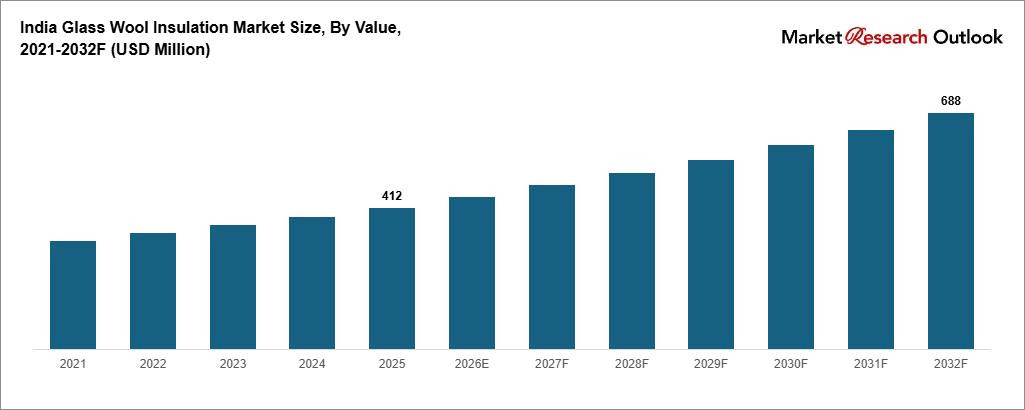
| Market Size (2025) | USD 412 Million |
| CAGR (2026-2032) | 7.6% |
| Leading Segment | Blankets & Rolls (Commercial Buildings) |
| Fastest Growing Segment | HVAC & Acoustic Applications |
| Market Size (2032) | USD 688 Million |
Market Overview: India Glass Wool Insulation Market
The India glass wool insulation market is expanding at a steady pace, supported by rapid commercial construction, the boom in warehousing and pre-engineered buildings, stricter building energy codes, rising green building certifications, and fast growing demand for HVAC, acoustic, and industrial glass wool insulation. Valued at USD 412 million in 2025 and projected to reach USD 688 million by 2032, growing at a CAGR of 7.6%, the India glass wool insulation market is drawing strong demand from offices, malls, hospitals, data centres, factories, metro stations, and airports across tier-1 and tier-2 cities. Glass wool blankets and rolls remain the largest product form, while HVAC and acoustic applications are emerging as the fastest growing glass wool category. Rising cooling loads, higher commercial power tariffs, and growing awareness of thermal comfort and noise control are reshaping how builders and consultants specify glass wool insulation. As Saint-Gobain India (ISOVER and U.P. Twiga Fiberglass), Owens Corning, Knauf Insulation, ROCKWOOL India, Lloyd Insulations, and Kingspan Jindal scale capacity, product ranges, and project networks, the India glass wool insulation market is evolving into a specification-led, energy-efficiency-driven, and sustainability-focused building materials segment with strong long-term growth potential.
Key Report Takeaways: India Glass Wool Insulation Market
- The India glass wool insulation market size is projected to grow from USD 412 million in 2025 to USD 688 million by 2032, registering a strong CAGR of 7.6%, driven by commercial and industrial construction, wider enforcement of energy efficiency codes, and the structural shift toward certified green buildings across urban India.
- Glass wool blankets and rolls dominate the India glass wool insulation market, accounting for around 47% of total value in 2025, driven by their low installed cost, easy handling across roofs, ceilings, and metal buildings, and deep usage in pre-engineered buildings, warehouses, and factory sheds.
- HVAC and acoustic glass wool applications are emerging as the fastest growing segments in the India glass wool insulation market, expected to grow at 9.5% to 11% annually as data centres, hospitals, metro stations, auditoriums, and premium offices demand better thermal and sound performance.
- India’s IGBC green building footprint has crossed 13 billion sq ft and grade A warehousing stock moved past 420 million sq ft in 2025, steadily widening the addressable base for glass wool insulation across commercial, logistics, and industrial projects.
- Capacity investments by Saint-Gobain India, including the integration of U.P. Twiga Fiberglass and a new 50,000 tonne per year mineral wool line at Oragadam near Chennai, along with wider product launches by global brands, are strengthening local supply and supporting the India glass wool insulation market forecast 2032.
Key Market Drivers: India Glass Wool Insulation Market
Rising Commercial Construction, Warehousing, and Pre-Engineered Building Expansion Driving Glass Wool Insulation Demand Across India
Growth in the India glass wool insulation market is being driven by rapid commercial construction, the expansion of grade A warehousing, and wider adoption of pre-engineered buildings across tier-1, tier-2, and tier-3 cities. Office leasing across India’s top cities stayed above 70 million sq ft in 2025, while grade A warehousing stock crossed 420 million sq ft, led by e-commerce, 3PL, manufacturing, and cold-chain operators. Most of these buildings use metal roofing and cladding, where glass wool blankets and rolls are the default choice for heat control, condensation management, and rain noise reduction. Pre-engineered building suppliers now bundle glass wool with roofing systems as a standard specification, with typical installed costs of INR 90 to INR 220 per sq m depending on thickness and facing. Glass wool insulation penetration in Indian commercial roofing is still estimated below 45%, compared with more than 80% in developed markets, which leaves wide headroom for growth. Rising factory construction under PLI schemes, new hospitals and schools, and the growing share of steel-framed buildings that need glass wool roof insulation are creating strong structural pull-through demand across the India glass wool insulation market.
Energy Efficiency Codes, Green Building Certifications, and Rising Cooling Demand Fuelling Glass Wool Insulation Adoption
The India glass wool insulation market is benefiting from tighter building energy rules and a fast rise in cooling demand. The Energy Conservation and Sustainable Building Code (ECSBC) for commercial buildings and Eco Niwas Samhita for residential projects set clear limits on roof and wall heat gain, which glass wool meets at a competitive cost per unit of thermal resistance. The India Cooling Action Plan expects national cooling demand to grow around eight times by 2037-38 compared with 2017-18, and buildings with proper glass wool roof and wall insulation can cut cooling energy use by 20% to 30%. India’s IGBC green building footprint has crossed 13 billion sq ft, while GRIHA, LEED, and EDGE rated projects continue to rise in metro markets, each favouring tested, low-emission glass wool insulation with verified thermal values. States such as Karnataka, Telangana, Kerala, Punjab, and Haryana have notified energy codes, pushing developers and architects to specify glass wool insulation early in the design stage. Higher commercial power tariffs, ESG reporting by listed developers, and tenant demand for green-certified offices are steadily expanding the India glass wool insulation market across all major end-use categories.
Growth in HVAC, Data Centres, and Industrial Process Insulation Strengthening High-Performance Glass Wool Demand
Rapid growth in HVAC systems, data centres, and process industries is a major catalyst for the India glass wool insulation market, with HVAC and acoustic applications projected to grow at 9.5% to 11% annually through 2032. India’s operational data centre capacity reached about 1.3 GW in 2025 and is expected to cross 4 GW by 2030, and each new facility needs large volumes of glass wool duct wrap, duct board, and acoustic lining. Hospitals, malls, airports, and offices are moving to central air conditioning, where glass wool duct insulation limits energy loss and condensation. In the industrial segment, refineries, power plants, pharmaceutical units, and food processing plants use high-density glass wool pipe sections and slabs for hot and cold service lines up to about 250°C. Leading suppliers such as Saint-Gobain India (ISOVER and Twiga), Owens Corning, Knauf Insulation, and Kingspan Jindal have widened their ranges of foil-faced glass wool boards, black-tissue acoustic boards, and pre-formed pipe sections for these users. Project demand from metro rail, semiconductor fabs, and electronics plants is structurally expanding India glass wool insulation market growth across all major application categories through 2032.
Key Market Challenges: India Glass Wool Insulation Market
Competition from Low-Cost Foam Insulation and High Price Sensitivity Limiting Glass Wool Insulation Uptake
The India glass wool insulation market continues to face strong competition from expanded polystyrene (EPS), extruded polystyrene (XPS), polyurethane foam (PUF), and nitrile rubber, each competing with glass wool in specific applications. EPS and PUF sandwich panels are widely used in cold storage and prefabricated structures, while nitrile rubber dominates small-diameter chilled water piping. In cost-driven residential and small commercial projects, glass wool insulation is often treated as an optional add-on, and buyers frequently pick the lowest first cost over long-term energy savings. Glass wool prices in India typically range between INR 110 and INR 180 per kg depending on density and facing, and unbranded local material is often sold 15% to 25% cheaper with no tested thermal values. Small contractors still prefer lighter, simpler options that need less skilled handling than glass wool, while developers in tier-2 cities rarely budget for roof or wall insulation at all. This price-led buying behaviour limits glass wool adoption among small builders and households across the India glass wool insulation market.
Low Awareness, Installation Skill Gaps, and Weak Code Enforcement Across Tier-2 and Tier-3 Cities
The India glass wool insulation market faces structural complexity from uneven awareness, a shortage of trained installers, and patchy enforcement of energy codes across states and cities. While metros such as Mumbai, Delhi NCR, Bengaluru, Chennai, Hyderabad, and Pune have established consultant networks and specialist contractors, smaller cities depend on general contractors with limited knowledge of correct glass wool installation, vapour barriers, and joint sealing. Poor installation can cut real thermal performance by 20% to 40%, which harms the reputation of glass wool insulation even when the material is sound. Although many states have notified energy codes, compliance checks at the building permit stage remain limited, and glass wool insulation penetration in new homes is still estimated below 5%. Concerns around skin irritation and dust, along with the need for gloves, masks, and safe handling, further discourage small builders from using glass wool. Saint-Gobain India, Owens Corning, Knauf Insulation, and ROCKWOOL India run applicator training and architect outreach programmes, yet the skills and awareness gap remains a near-term challenge for the India glass wool insulation market.
Volatility in Raw Material and Energy Costs Impacting Glass Wool Insulation Margins
The India glass wool insulation market faces practical constraints around raw material price swings, high energy use, and margin pressure across the value chain. Glass wool is made by melting silica sand, soda ash, borax, limestone, and recycled glass cullet at temperatures above 1,400°C, and energy alone accounts for 20% to 25% of production cost. Domestic soda ash prices moved up by 15% to 25% between 2022 and 2024, while natural gas and power costs for continuous furnaces have stayed volatile. Imported borates and binder chemicals add currency risk, and freight costs remain high because glass wool is a bulky, low-density product that is costly to ship over long distances. Average EBITDA margins for glass wool insulation makers in India range between 12% and 18%, and smaller converters struggle to pass on cost increases to project buyers who lock prices months in advance. Higher cullet use, compression packing, and regional plants close to demand centres are helping glass wool manufacturers manage costs, but cost volatility remains a barrier across the India glass wool insulation market.
Key Market Trends: India Glass Wool Insulation Market
Shift Toward Formaldehyde-Free Binders, Higher Recycled Content, and Low-Emission Glass Wool in India
The India glass wool insulation market is going through a clear product shift toward formaldehyde-free bio-based binders, higher recycled glass content, and low-emission certifications, with these advanced variants expected to account for over 35% of new glass wool launches in India by 2028. Modern glass wool lines can use 60% to 80% recycled cullet, which cuts energy use and embodied carbon while helping projects score green building points. Leading brands including Saint-Gobain ISOVER, Knauf Insulation (ECOSE Technology), Owens Corning, and URSA have promoted bio-based binder ranges and products with indoor air quality certifications such as GREENGUARD and Eurofins Indoor Air Comfort. Environmental Product Declarations (EPDs) for glass wool insulation are also gaining traction, particularly in Bengaluru, Hyderabad, Pune, and Delhi NCR, where multinational tenants ask for verified carbon data on every major building material. This sustainability-led glass wool product transition is reinforcing the India glass wool insulation market forecast 2032 across both commercial and industrial categories.
Rising Use of Acoustic Glass Wool in Offices, Metros, Data Centres, and Hospitality Projects
A clear shift toward acoustic comfort is reshaping the India glass wool insulation market, particularly in the commercial and infrastructure segments. Glass wool boards and rolls with noise reduction coefficient (NRC) values between 0.70 and 1.00 are now widely used in ceilings, drywall partitions, auditoriums, studios, and HVAC plant rooms. India’s operational metro rail network crossed about 1,000 km in 2025, with stations, tunnels, and depots using acoustic and thermal glass wool insulation in ceilings, ducts, and equipment rooms. Drywall and gypsum partition systems, which usually include a glass wool infill, are growing quickly in offices, hospitals, hotels, and co-working spaces as builders look for faster, lighter, and cleaner construction. Leading suppliers such as Saint-Gobain India (Gyproc and ISOVER), Knauf, and ROCKWOOL India now sell complete glass wool wall and ceiling systems with tested acoustic ratings. By 2025, acoustic uses accounted for an estimated 14% of glass wool demand in India, up from about 9% in 2020, as premium office and hospitality projects increasingly treat sound control as a standard design requirement.
Capacity Expansion, Consolidation, and Local Manufacturing by Leading Insulation Players
A wave of capacity expansion and industry consolidation is reshaping the India glass wool insulation market supply landscape. Saint-Gobain acquired U.P. Twiga Fiberglass, India’s largest glass wool supplier with plants at Ambernath in Maharashtra and Sikandrabad in Uttar Pradesh, to consolidate its insulation business in the country. In August 2025, Saint-Gobain began construction of a 50,000 tonne per year mineral wool insulation line at Oragadam near Chennai, its fifth insulation line in India and its largest insulation investment in Asia Pacific. Global brands such as Owens Corning, Knauf Insulation, and URSA are strengthening glass wool distribution and technical service networks, while domestic players including Lloyd Insulations, Thermocare Rockwool, and Hindustan Fibre Glass Works serve industrial and regional glass wool buyers. BIS standard IS 8183 for bonded mineral wool, rising preference for locally made products in public tenders, and high freight costs for imported glass wool insulation have structurally favoured domestic supply. Combined with data centre construction and metro expansion driving project demand, these developments are reinforcing the India glass wool insulation market forecast 2032 across the entire value chain.
Segmental Insights: India Glass Wool Insulation Market
By End-Use: Commercial Segment Dominates the India Glass Wool Insulation Market
The commercial end-use segment dominates the India glass wool insulation market, accounting for an estimated 40% to 44% of total value, driven by office parks, malls, hospitals, hotels, data centres, and educational campuses that rely on central air conditioning and acoustic ceilings. Glass wool blankets, rolls, and duct boards are the dominant formats within this segment, with HVAC and roof applications capturing over 65% of commercial glass wool purchases. The industrial segment contributes another 26% to 29% of demand, driven by warehouses, factory sheds, refineries, power plants, and process industries using glass wool pipe sections and high-density slabs. The residential segment accounts for 14% to 16%, led by premium apartments, villas, and roof insulation in hot climate zones, while infrastructure, including metro rail, airports, and railway stations, holds 13% to 15%. In 2025, leading players including Saint-Gobain India, Owens Corning, Knauf Insulation, Kingspan Jindal, and ROCKWOOL India scaled up commercial and data centre glass wool supply programmes, reinforcing segment dominance in the India glass wool insulation market.
By Product Form: Blankets & Rolls Lead While Boards and Pipe Sections Grow Fastest
Blankets and rolls lead the India glass wool insulation market product landscape, accounting for approximately 47% of total value, driven by their low installed cost, light weight, and wide use under metal roofs, in false ceilings, and around ducts. Glass wool boards and slabs contribute another 22% to 25%, primarily in HVAC duct lining, acoustic panels, and drywall partitions. Pipe sections account for 13% to 15% of demand and, together with boards, are the fastest growing formats within the India glass wool insulation market, expanding at 9.5% to 11% annually on the back of HVAC, data centre, and process industry projects. Medium density glass wool grades between 24 and 48 kg/m³ hold the largest share by density, while high density grades above 48 kg/m³ are growing quickly in industrial and acoustic uses. Loose fill and other formats together account for 13% to 15% of the market. Leading manufacturers including Saint-Gobain India, U.P. Twiga Fiberglass, Owens Corning, and Knauf Insulation have aligned product portfolios to this mix, driving premium glass wool adoption across the India glass wool insulation market.
Regional Insights: India Glass Wool Insulation Market
Regional analysis of the India glass wool insulation market shows that West India and South India collectively account for approximately 55% to 59% of total glass wool demand, driven by Maharashtra (Mumbai, Pune, and the Bhiwandi logistics belt), Gujarat (industrial corridors and PEB fabrication), Karnataka (Bengaluru offices and data centres), Tamil Nadu (Chennai manufacturing and data centre cluster), and Telangana (Hyderabad commercial market), supported by strong commercial construction and early adoption of energy codes. North India contributes around 25% to 28% of demand, led by Delhi NCR, Haryana, Uttar Pradesh, and Punjab, supported by warehousing growth, metro expansion, and factory construction around Gurugram, Noida, Greater Noida, and Lucknow. East and Central India together account for 15% to 18% of demand, supported by West Bengal, Odisha, Madhya Pradesh, and Chhattisgarh, where steel, power, and cement projects drive industrial glass wool insulation use. In 2025, plant operations by Saint-Gobain and U.P. Twiga at Ambernath and Sikandrabad, the new Oragadam line near Chennai, and expanding dealer networks of Owens Corning, Knauf Insulation, and ROCKWOOL India reinforced regional supply hubs, supporting faster glass wool project delivery across the India glass wool insulation market.
Recent Developments: India Glass Wool Insulation Market
- The India glass wool insulation market witnessed strong momentum in construction activity and capacity progress during 2024 and 2025. Grade A warehousing stock crossed 420 million sq ft in 2025, data centre capacity reached about 1.3 GW, and India’s operational metro network passed roughly 1,000 km, each adding steady demand for roof, duct, and acoustic glass wool insulation. Glass wool consumption in India is estimated at around 215,000 tonnes in 2025 and is projected to reach 250,000 to 265,000 tonnes by FY28, growing at an average 6% to 7% annually.
- Leading manufacturers have deepened India-focused capacity and consolidation. Saint-Gobain acquired U.P. Twiga Fiberglass, adding Twiga’s Ambernath and Sikandrabad glass wool plants to its India insulation business, and in August 2025 began construction of a 50,000 tonne per year mineral wool line at Oragadam near Chennai, its fifth insulation line in India. Knauf Insulation, Owens Corning, and URSA widened their low-emission glass wool product ranges for Indian projects. These developments are strengthening domestic supply and supporting the India glass wool insulation market forecast 2032.
- Green building and energy code momentum has gained strong traction in the India glass wool insulation market. The Energy Conservation and Sustainable Building Code (ECSBC) widened the scope of efficiency rules for commercial buildings, while IGBC, GRIHA, LEED, and EDGE rated projects kept rising across metro cities. Partnerships between glass wool insulation makers, PEB suppliers, HVAC contractors, and green building consultants are positioning India as one of the fastest scaling insulation markets in Asia, strengthening long-term competitive positioning in the India glass wool insulation market forecast 2032.
Key Market Players: India Glass Wool Insulation Market
- Saint-Gobain India Pvt. Ltd. (ISOVER)
- U.P. Twiga Fiberglass Limited
- Owens Corning (India) Pvt. Ltd.
- Knauf Insulation
- ROCKWOOL India Pvt. Ltd.
- Kingspan Jindal Pvt. Ltd.
- Lloyd Insulations (India) Limited
- Thermocare Rockwool (India) Pvt. Ltd.
- Johns Manville (Berkshire Hathaway Inc.)
- URSA Insulation S.A.
- Hindustan Fibre Glass Works
- Beardsell Limited
| By Product Form | By Density | By Application | By Distribution Channel | By End-Use |
| Blankets & Rolls Boards & Slabs Pipe Sections Loose Fill Others |
Low Density (Below 24 kg/m³) Medium Density (24 to 48 kg/m³) High Density (Above 48 kg/m³) |
Roofs & Ceilings Walls & Partitions HVAC & Ducting Industrial Equipment & Pipes Acoustic Panels Others |
Direct Project Sales OEM Supply Distributors & Dealers Online B2B Platforms |
Residential Commercial Industrial Infrastructure |
Report Scope
In this report, the India Glass Wool Insulation Market has been segmented into the following categories, in addition to detailed analysis of key industry trends, market dynamics, competitive landscape, and growth opportunities across the forecast period:
- By Product Form
- Blankets & Rolls
- Boards & Slabs
- Pipe Sections
- Loose Fill
- Others
- By Density
- Low Density (Below 24 kg/m³)
- Medium Density (24 to 48 kg/m³)
- High Density (Above 48 kg/m³)
- By Application
- Roofs & Ceilings
- Walls & Partitions
- HVAC & Ducting
- Industrial Equipment & Pipes
- Acoustic Panels
- Others
- By Distribution Channel
- Direct Project Sales
- OEM Supply
- Distributors & Dealers
- Online B2B Platforms
- By End-Use
- Residential
- Commercial
- Industrial
- Infrastructure
- By Geography
- North India
- South India
- West India
- East India
- Central India
Competitive Landscape
Company Profiles:
Detailed analysis of the leading companies operating in the India Glass Wool Insulation Market, including business overview, product portfolio, strategic initiatives, competitive positioning, and recent developments.
Company Information
Detailed profiling and strategic analysis of additional market players (up to five companies), including emerging domestic glass wool manufacturers, specialty acoustic and HVAC insulation suppliers, regional insulation converters, or state-level applicators and PEB system integrators.
For a free sample of the India Glass Wool Insulation Market report, customised insights or delivery timelines, submit your query here
India Glass Wool Insulation Market, 2032
- Research Framework
- Market Segmentation
- Research Objective
- Research Methodology
- Qualitative Research
- Primary Research
- Secondary Research
- Quantitative Research
- Market Breakdown & Data Triangulation
- Demand Side
- Supply Side
- Primary Research Respondents
- Assumption & Limitation
- Executive Summary
- Market Overview, 2021-2032
- By Product Form
- By Density
- By Application
- By Distribution Channel
- By End-Use
- By Region
- Analyst Recommendations
- Geopolitical Impact on India Glass Wool Insulation Market
- India Glass Wool Insulation Market Insights
- Market Dynamics
- Growth Drivers
- Rising commercial construction, warehousing, and pre-engineered building expansion driving glass wool insulation demand across India.
- Energy efficiency codes, green building certifications, and rising cooling demand fuelling glass wool insulation adoption.
- Growth in HVAC, data centres, and industrial process insulation strengthening high-performance glass wool demand.
- Restraints
- Competition from low-cost foam insulation and high price sensitivity limiting glass wool insulation uptake.
- Low awareness, installation skill gaps, and weak code enforcement across tier-2 and tier-3 cities.
- Volatility in raw material and energy costs impacting glass wool insulation margins.
- Opportunities
- Formaldehyde-free, bio-based binder, and high recycled content glass wool opening new green building demand.
- Acoustic insulation in offices, metros, data centres, and hospitality projects supporting next-generation growth.
- Residential roof insulation, affordable housing, and cold-chain infrastructure creating large untapped demand.
- Challenges
- Intense competition from unorganized local suppliers and unbranded, untested insulation material.
- Health and handling perceptions, dust concerns, and safe installation needs on construction sites.
- High freight costs and logistics complexity for bulky, low-density insulation across smaller Indian cities.
- Technological Advancements
- Recent Technological Advancements
- Prior to 2020
- Porter’s Five Forces Analysis
- PESTLE Analysis
- Industry Value Chain & Entry Points
- Upstream Raw Materials (silica sand, soda ash, borax, limestone, recycled glass cullet, binders, facing materials)
- Glass Wool Manufacturers (Saint-Gobain India, U.P. Twiga Fiberglass, Owens Corning, Knauf Insulation, URSA)
- Facing, Foil & Binder Suppliers (aluminium foil, FSK, black tissue, glass tissue, bio-based binders)
- Converters & Fabricators (duct boards, pipe sections, acoustic panels, pre-cut insulation kits)
- Quality Control, Testing & Certification (BIS IS 8183, ASTM, NABL labs, GREENGUARD, EPD)
- Distributors, Dealers & Building Material Stockists (B2B and project supply networks)
- PEB, HVAC & Drywall System Integrators (Tata BlueScope, Kirby, Blue Star, Voltas, Gyproc)
- Architects, MEP Consultants & Green Building Advisors (IGBC, GRIHA, LEED, EDGE projects)
- Insulation Applicators & Contractors (thermal, acoustic, and industrial insulation installers)
- End-Users (commercial developers, factories, data centres, infrastructure agencies, homeowners)
- India Glass Wool Insulation Market: Regulatory Framework
- India Glass Wool Insulation Market Overview
- Market Size & Forecast, 2021-2032
- By Value (USD Million)
- By Volume (Thousand Tonnes)
- Market Share & Forecast
- By Product Form
- Blankets & Rolls
- Boards & Slabs
- Pipe Sections
- Loose Fill
- Others
- By Density
- Low Density (Below 24 kg/m³)
- Medium Density (24 to 48 kg/m³)
- High Density (Above 48 kg/m³)
- By Application
- Roofs & Ceilings
- Walls & Partitions
- HVAC & Ducting
- Industrial Equipment & Pipes
- Acoustic Panels
- Others
- By Distribution Channel
- Direct Project Sales
- OEM Supply
- Distributors & Dealers
- Online B2B Platforms
- By End-Use
- Residential
- Commercial
- Industrial
- Infrastructure
- By Geography
- North India
- South India
- West India
- East India
- Central India
- Competitive Landscape
- India Glass Wool Insulation Market Company Market Share Analysis, 2025
- Competitive Benchmarking, By Operating Parameters
- Key Strategic Development (Mergers, Acquisitions, Partnerships, Etc.)
- List of Emerging Players
- Company Profile
- Saint-Gobain India Pvt. Ltd. (ISOVER)
- Introduction & Company Profile
- Product Benchmarking
- Strategic Outlook
- Key Competitors
- Financial Analysis
- SWOT Analysis
(Same Data Pointers Will Be Provided for The Below Companies)
- U.P. Twiga Fiberglass Limited
- Owens Corning (India) Pvt. Ltd.
- Knauf Insulation
- ROCKWOOL India Pvt. Ltd.
- Kingspan Jindal Pvt. Ltd.
- Lloyd Insulations (India) Limited
- Thermocare Rockwool (India) Pvt. Ltd.
- Johns Manville (Berkshire Hathaway Inc.)
- URSA Insulation S.A.
- Hindustan Fibre Glass Works
- Beardsell Limited
- Other Prominent Players
* Financial information in case of non-listed companies will be provided as per availability
** The segmentation and the companies are subjected to modifications based on in-depth secondary for the final deliverable
Frequently Asked Questions
1. How large is the India glass wool insulation market and what is its growth forecast?
Ans: The India glass wool insulation market is valued at USD 412 million in 2025 and is projected to reach USD 688 million by 2032, growing at a CAGR of 7.6%, supported by commercial construction and energy codes.
2. Which segments are driving demand in the India glass wool insulation market?
Ans: Blankets and rolls lead with around 47% value share, while HVAC and acoustic applications grow fastest at 9.5% to 11% annually, driven by data centres, hospitals, metro projects, and premium offices.
3. What are the key drivers of growth in the India glass wool insulation market?
Ans: Key drivers include rising commercial construction, warehousing and PEB growth, stricter energy codes, green building certifications, rising cooling demand, and fast growing HVAC, data centre, and industrial insulation needs.
4. Which regions are driving growth in the India glass wool insulation market?
Ans: West and South India lead with about 55% to 59% of demand, driven by Maharashtra, Gujarat, Karnataka, Tamil Nadu, and Telangana. North India, led by Delhi NCR, also shows strong warehousing demand.
5. What are the latest trends in the India glass wool insulation market?
Ans: Key trends include formaldehyde-free binders, higher recycled glass content, rising acoustic insulation use, drywall system growth, and capacity expansion by Saint-Gobain, including a new 50,000 tonne line near Chennai.