

India Solar Panel Market, 2032
- Energy, Power & Storage, Renewables & Clean Fuels
- Nov 2026
- Pages 140
- Report Format: pdf
- Report Price: $2400 USD
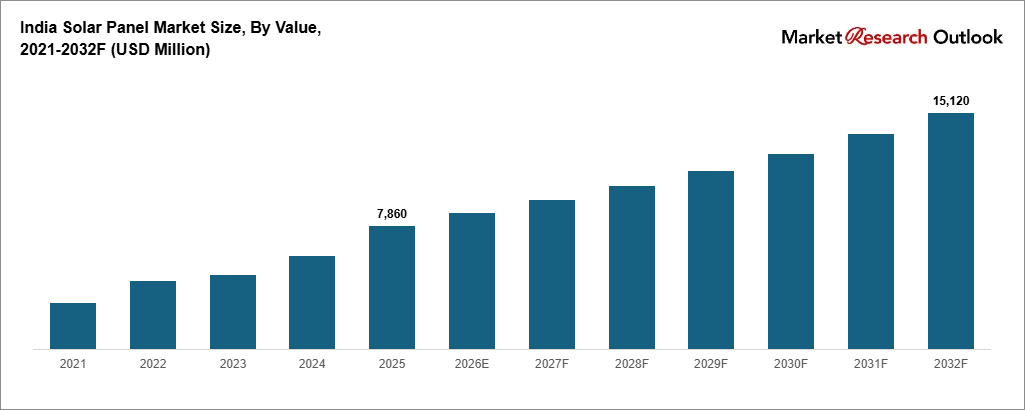
India’s solar panel market was worth USD 7.86 billion in 2025 and is projected to reach USD 15.12 billion by 2032, growing at a CAGR of 9.8% between 2026 and 2032. TOPCon modules for utility scale projects lead the market. Growth is driven by the 500 GW non fossil capacity goal, record utility scale tenders, rooftop adoption under PM Surya Ghar, ALMM sourcing rules, PLI support for integrated manufacturing, and the shift to TOPCon and bifacial modules.
| Study Duration | 2021-2032 |
| Market Size (2025) | USD 7,860 Million |
| CAGR (2026-2032) | 9.8% |
| Leading Segment | TOPCon Modules (Utility-Scale) |
| Fastest Growing Segment | Heterojunction (HJT) & Residential Rooftop |
| Market Size (2032) | USD 15,120 Million |
Market Overview: India Solar Panel Market
The India solar panel market size is expanding quickly, driven by record utility-scale additions, rising rooftop adoption, open access buying by industry, strict domestic sourcing rules, and large capacity additions by Indian module makers. Valued at USD 7,860 million in 2025 and projected to reach USD 15,120 million by 2032, growing at a CAGR of 9.8%, India solar panel market growth rests on a deep project pipeline from SECI, NTPC, NHPC, and SJVN tenders, the PM Surya Ghar rooftop scheme, and PM-KUSUM solar pumps. India’s cumulative installed solar capacity reached 150.26 GW on 31 March 2026, after a record 44.6 GW was added in FY2026. TOPCon modules lead demand, while heterojunction panels and residential rooftop systems are the fastest growing pockets. Buyers now judge panels on wattage, bifaciality, and lifetime yield rather than upfront price alone. As Waaree Energies, Adani Solar, Premier Energies, Vikram Solar, and Tata Power Solar add integrated cell and module capacity, and developers such as NTPC Green, Adani Green, ReNew, and Avaada scale their portfolios, the sector is turning into a domestically supplied, technology-led industry with strong long-term growth potential.
Key Report Takeaways: India Solar Panel Market
- The India solar panel market size is projected to grow from USD 7,860 million in 2025 to USD 15,120 million by 2032, registering a CAGR of 9.8%, driven by record utility-scale tendering, rooftop programmes, and the shift toward high-efficiency, domestically made modules.
- TOPCon modules dominate demand, accounting for 58% of market value in 2025, supported by their higher efficiency and bifacial gain, and by the fact that TOPCon now makes up 70% of India’s module manufacturing capacity across makers such as Waaree, Adani Solar, and Premier Energies.
- Heterojunction modules are the fastest growing product segment, expected to expand at a CAGR of 26.4% through 2032, as developers chasing lower temperature losses, higher bifaciality, and better yields in hot regions test HJT across Rajasthan, Gujarat, and Karnataka.
- Installation momentum keeps the order book full, with India adding 44.6 GW of solar capacity in FY2026, including 34.8 GW of utility-scale and 8.7 GW of rooftop capacity, and a further 26 GW in the first half of calendar 2026.
- Domestic manufacturing is scaling fast, with ALMM List-I module capacity reaching 228,524 MW in September 2026 and ALMM List-II cell capacity at 35,467 MW, strengthening local supply and supporting the India solar panel market forecast 2032.
Key Market Drivers: India Solar Panel Market
500 GW Non-Fossil Capacity Target and Record Utility-Scale Tendering Driving Solar Panel Demand Across India
Growth in the India solar panel market is driven first by the national target of 500 GW of non-fossil power capacity by 2030, with solar carrying the largest share of new additions. India added a record 44.6 GW of solar capacity in FY2026, up 87.2% from the year before, and cumulative solar capacity reached 150.26 GW on 31 March 2026, about 55% of the country’s 275 GW renewable base. Utility-scale ground-mounted plants made up 34.8 GW of FY2026 additions, led by large parks in Rajasthan, Gujarat, Karnataka, Andhra Pradesh, and Maharashtra. Central agencies such as SECI, NTPC, NHPC, and SJVN continue to issue solar, hybrid, and firm and dispatchable power tenders, while state utilities run their own auctions. Every gigawatt of new AC capacity needs about 1.35 GW of DC panels at typical inverter loading ratios, which multiplies module demand. This steady tender flow gives module makers clear order visibility and supports capacity planning across the industry.
Rooftop Solar Adoption Under PM Surya Ghar, C&I Open Access, and PM-KUSUM Expanding Distributed Solar Panel Demand
Distributed solar is the second big demand engine. The PM Surya Ghar Muft Bijli Yojana, with a central outlay of INR 75,021 crore, aims to put rooftop solar on 1 crore homes, and the scheme crossed 50 lakh installations by October 2026. Rooftop additions reached 8.7 GW in FY2026, up 69% year on year, and 6.4 GW in the first half of calendar 2026 alone. Subsidised residential systems must use DCR panels made from Indian cells, which lifts value per watt for local makers. Commercial and industrial users are also signing open access and captive deals under the Green Energy Open Access Rules to cut power bills and meet emission targets. Under PM-KUSUM, farmers install standalone solar pumps and solarise grid-connected feeders, adding a steady base of small-format demand. Together, these programmes spread demand across thousands of small buyers, cut reliance on a few large tenders, and widen demand well beyond utility parks.
ALMM Mandates, PLI Incentives, and Import Duties Strengthening Domestic Cell and Module Manufacturing
Policy support for local manufacturing is reshaping supply. The Approved List of Models and Manufacturers (ALMM) List-I for modules reached 228,524 MW of enlisted capacity in September 2026, and ALMM List-II for cells came into force on 1 June 2026, with 35,467 MW of cell capacity listed by August 2026. From that date, government-backed and net-metered projects must use modules built with listed Indian cells. The PLI scheme for high-efficiency solar PV modules, with an outlay of INR 24,000 crore, supports integrated plants that run from polysilicon or wafers through to finished panels. Basic customs duty of 40% on modules and 25% on cells keeps imported products costlier in many segments. India added 119 GW of module capacity and 9 GW of cell capacity in calendar 2025, taking module capacity to 210 GW and cell capacity to 27 GW, with Gujarat hosting 45% of both. These measures give domestic makers a protected and growing home base.
Key Market Challenges: India Solar Panel Market
Heavy Reliance on Imported Cells, Wafers, and Polysilicon Exposing Module Makers to Supply and Price Shocks
The industry still depends heavily on imported upstream inputs. India imported 99 GW of solar modules and cells in 2025, and cells made up 75% of that volume. Module capacity of 210 GW at the end of 2025 compares with only 27 GW of cell capacity, and wafer and polysilicon output remains at an early stage. This gap leaves many assemblers exposed to export curbs, freight swings, and sudden price moves in China. It also limits how much DCR supply the industry can deliver while ALMM List-II scales up, keeping DCR panels at a premium to non-DCR panels. Until integrated ingot, wafer, and cell lines reach full output, upstream exposure will remain a key risk for the sector.
Transmission Bottlenecks and Delayed Power Sale Agreements Slowing the Execution of Tendered Solar Capacity
Grid access is now a binding constraint. Large solar parks in Rajasthan and Gujarat often finish ahead of the interstate transmission lines meant to evacuate their power, which leads to curtailment and delayed commissioning. Several gigawatts of capacity awarded through central tenders have also waited months for power sale agreements with state DISCOMs, as utilities hesitate to sign at fixed tariffs while prices keep falling. Land acquisition and right-of-way issues for both plants and lines add further delays. When projects slip, module orders get rescheduled, and makers holding stock face working capital strain. The Green Energy Corridor programme and new interstate lines are adding capacity, but the gap between tendering and execution remains a near-term challenge for the sector.
Module Price Volatility and Surplus Manufacturing Capacity Squeezing Margins Across the Solar Panel Value Chain
The sector faces margin pressure from rapid capacity growth. India’s module capacity of 210 GW at the end of 2025 is several times annual domestic installations, so makers compete hard on price in non-DCR segments. Global module prices remain close to cost, and Indian non-DCR panels must compete with imports from China and Southeast Asia. Exports, which gave Indian makers strong margins in recent years, now face trade remedy actions in the United States. Older mono PERC lines risk early write-downs as buyers move to TOPCon, and smaller assemblers without cell capacity face the sharpest squeeze. Consolidation, technology upgrades, and backward integration are the main responses, but price volatility is likely to weigh on profitability in the near term.
Key Market Trends: India Solar Panel Market
Rapid Shift to TOPCon, Bifacial Glass-Glass, and 600 W Plus High-Wattage Modules in India
The industry is moving quickly from p-type mono PERC to n-type technology. TOPCon now accounts for 70% of India’s module manufacturing capacity, and new utility tenders mostly specify bifacial glass-glass panels rated above 580 W. Bifacial modules add extra energy from reflected light, which suits the sandy and high-albedo sites of Rajasthan and Gujarat. Makers including Waaree Energies, Adani Solar, Premier Energies, Vikram Solar, and ReNew have added or announced TOPCon cell lines, while heterojunction is close to 1% of new capacity and is being trialled for hot-climate sites. Half-cut cells, multi-busbar designs, and larger wafer formats are becoming standard. This technology upgrade lifts output per panel and value per watt, reinforcing the India solar panel market forecast 2032 across utility and rooftop buyers.
Backward Integration Into Cells, Wafers, and Ingots by Leading Indian Module Makers
Leading makers are moving upstream to secure supply and meet ALMM List-II rules. Adani Solar runs an integrated plant at Mundra that spans polysilicon to modules, Tata Power Solar operates an integrated 4.3 GW cell and module facility at Tirunelveli in Tamil Nadu, and Waaree Energies, Premier Energies, and ReNew have commissioned cell lines in Gujarat and Telangana. Cell capacity rose by 9 GW in 2025 to 27 GW, and listed cell capacity under ALMM List-II reached 35,467 MW by August 2026 after a further 3,709 MW of TOPCon cell capacity was added. PLI support is helping several groups plan wafer and ingot capacity. This shift is narrowing the import gap, raising domestic value addition, and giving integrated players a cost and compliance edge.
Growth of Floating Solar, Agrivoltaics, and Solar Plus Storage Hybrid Projects
New project formats are widening the use cases for solar panels. Floating solar plants on reservoirs in Madhya Pradesh, Telangana, and Kerala save land and reduce evaporation, and they need panels with high moisture and PID resistance. Agrivoltaic pilots allow crops to grow under raised, widely spaced bifacial modules, opening a new path for land-constrained states. Round-the-clock and firm and dispatchable renewable energy tenders pair solar with battery storage and wind, raising DC oversizing ratios and lifting panel volumes per project. BIPV and lightweight flexible panels are finding early use on metro stations, airports, and warehouses with weak roofs. These formats add higher-value demand pockets and support the India solar panel market forecast 2032 beyond conventional ground-mounted parks.
Segmental Insights: India Solar Panel Market
By End-User: Utilities & IPPs Segment Dominates the India Solar Panel Market
The utilities and independent power producers segment dominates demand, accounting for 64% of market value in 2025, driven by central and state tenders, hybrid and round-the-clock projects, and large parks in high-irradiance states. Bifacial TOPCon glass-glass modules rated above 550 W are the standard choice in this segment. Commercial and industrial users contribute 18% of value, led by factories, data centres, and warehouses buying through rooftop and open access routes. The residential segment holds 14% and is the fastest growing end-user group, expanding at a CAGR of 14.7% under PM Surya Ghar. Agricultural users account for the remaining 4%, mainly through PM-KUSUM solar pumps. In 2025, developers such as NTPC Green, Adani Green, ReNew, Avaada, and Tata Power Renewable scaled their solar portfolios, keeping utility demand at the centre of the market.
By Product Type: TOPCon Leads While Heterojunction Grows Fastest
TOPCon modules lead the product mix, accounting for 58% of market value in 2025, supported by cell efficiencies above 25%, bifaciality near 80%, and low light-induced degradation. Mono PERC modules hold 31% of value but are losing share quickly as lines are converted or retired, and this segment is set to decline at a CAGR of 9.2% through 2032. Heterojunction modules hold 4% of value today but are the fastest growing type, expanding at a CAGR of 26.4%, thanks to strong performance in high temperatures. Polycrystalline and thin-film panels together account for 6%, serving small off-grid and niche utility uses, with others making up the remaining 1%. Leading makers including Waaree Energies, Adani Solar, Premier Energies, Vikram Solar, and Goldi Solar have aligned their capacity with this n-type shift, lifting average module efficiency nationwide.
Regional Insights: India Solar Panel Market
Regional analysis shows that West India accounts for 44% of solar panel demand in 2025, led by Rajasthan, Gujarat, and Maharashtra, which host the largest solar parks, the best irradiance, and strong rooftop programmes. South India contributes 26%, driven by Karnataka, Tamil Nadu, Andhra Pradesh, and Telangana, where utility parks and C&I open access deals are both well established. North India accounts for 15% of demand, led by Uttar Pradesh, Punjab, Haryana, and Delhi NCR, with fast rooftop growth under PM Surya Ghar. Central India, mainly Madhya Pradesh and Chhattisgarh, holds 10%, supported by large parks and floating solar, while East India accounts for the remaining 5%, led by Odisha, West Bengal, Bihar, and Jharkhand. Gujarat also hosts 45% of India’s module and cell manufacturing capacity, placing supply close to the largest demand centres.
Recent Developments: India Solar Panel Market
- The sector saw record activity in installations and capacity during 2025 and 2026. India added 44.6 GW of solar capacity in FY2026, up 87.2% year on year, and a further 26 GW in the first half of calendar 2026, including 19 GW of utility-scale and 6.4 GW of rooftop capacity. Cumulative installed solar capacity reached 150.26 GW on 31 March 2026, close to 55% of India’s renewable energy base.
- Domestic manufacturing kept scaling. India added 119 GW of module capacity and 9 GW of cell capacity in 2025. In September 2026, MNRE added 12,256 MW of module capacity to ALMM List-I, taking the total to 228,524 MW, with new plants including Vikram Solar’s facility in Tamil Nadu. ALMM List-II for cells came into force on 1 June 2026, and listed cell capacity reached 35,467 MW. These steps are deepening local supply and supporting the India solar panel market forecast 2032.
- Rooftop momentum has also gained strong traction. The PM Surya Ghar scheme crossed 50 lakh rooftop installations by October 2026 against its target of 1 crore homes, backed by a central outlay of INR 75,021 crore. Empanelled vendors, DISCOMs, and banks have simplified approvals and loans, and DCR panel demand from homes is now a major order stream for makers such as Waaree, Premier Energies, Rayzon, and Saatvik, strengthening long-term positioning for domestic makers.
Key Market Players: India Solar Panel Market
- Waaree Energies Limited
- Adani Solar (Mundra Solar PV Limited)
- Premier Energies Limited
- Vikram Solar Limited
- Tata Power Solar Systems Limited
- ReNew Photovoltaics Private Limited
- Goldi Solar Private Limited
- Rayzon Solar Limited
- Saatvik Green Energy Limited
- Emmvee Photovoltaic Power Limited
- Avaada Electro Private Limited
- Insolation Energy Limited (INA Solar)
- Websol Energy System Limited
| By Product Type | By Power Rating | By Module Design | By Installation Type | By End-User |
| Mono PERC Modules TOPCon Modules Heterojunction (HJT) Modules Polycrystalline Modules Thin-Film Modules Others |
Below 100 W 100-300 W 301-450 W 451-550 W 551-600 W 601-700 W Above 700 W |
Bifacial Glass-Glass Monofacial Glass-Backsheet Bifacial Transparent Backsheet Flexible & Lightweight Building-Integrated (BIPV) |
Utility-Scale Ground-Mounted Commercial & Industrial Rooftop Residential Rooftop Open Access & Captive Floating Solar Off-Grid & Solar Pumps |
Utilities & IPPs Commercial & Industrial Residential Agricultural |
Report Scope
In this report, the India Solar Panel Market has been segmented into the following categories, in addition to detailed analysis of key industry trends, market dynamics, competitive landscape, and growth opportunities across the forecast period:
- By Product Type
- Mono PERC Modules
- TOPCon Modules
- Heterojunction (HJT) Modules
- Polycrystalline Modules
- Thin-Film Modules
- Others
- By Power Rating
- Below 100 W
- 100-300 W
- 301-450 W
- 451-550 W
- 551-600 W
- 601-700 W
- Above 700 W
- By Module Design
- Bifacial Glass-Glass
- Monofacial Glass-Backsheet
- Bifacial Transparent Backsheet
- Flexible & Lightweight
- Building-Integrated (BIPV)
- By Installation Type
- Utility-Scale Ground-Mounted
- Commercial & Industrial Rooftop
- Residential Rooftop
- Open Access & Captive
- Floating Solar
- Off-Grid & Solar Pumps
- By End-User
- Utilities & IPPs
- Commercial & Industrial
- Residential
- Agricultural
- By Geography
- North India
- South India
- West India
- East India
- Central India
Competitive Landscape
Company Profiles:
Detailed analysis of the leading companies operating in the India Solar Panel Market, including business overview, product portfolio, manufacturing capacity, strategic initiatives, competitive positioning, and recent developments.
Company Information
Detailed profiling and strategic analysis of additional market players (up to five companies), including emerging module assemblers, specialty bifacial and HJT panel producers, regional manufacturers, or niche BIPV and off-grid panel brands.
For a free sample of the India Solar Panel Market report, customised insights or delivery timelines, submit your query here
India Solar Panel Market, 2032
- Research Framework
- Market Segmentation
- Research Objective
- Research Methodology
- Qualitative Research
- Primary Research
- Secondary Research
- Quantitative Research
- Market Breakdown & Data Triangulation
- Demand Side
- Supply Side
- Primary Research Respondents
- Assumption & Limitation
- Executive Summary
- Market Overview, 2021-2032
- By Product Type
- By Power Rating
- By Module Design
- By Installation Type
- By End-User
- By Region
- Analyst Recommendations
- Geopolitical Impact on India Solar Panel Market
- India Solar Panel Market Insights
- Market Dynamics
- Growth Drivers
- 500 GW non-fossil capacity target and record utility-scale tendering driving solar panel demand across India.
- Rooftop solar adoption under PM Surya Ghar, C&I open access, and PM-KUSUM expanding distributed solar panel demand.
- ALMM mandates, PLI incentives, and import duties strengthening domestic cell and module manufacturing.
- Restraints
- Heavy reliance on imported cells, wafers, and polysilicon exposing module makers to supply and price shocks.
- Transmission bottlenecks and delayed power sale agreements slowing the execution of tendered solar capacity.
- Module price volatility and surplus manufacturing capacity squeezing margins across the solar panel value chain.
- Opportunities
- Residential and C&I rooftop solar opening large untapped demand pools across tier-1 and tier-2 cities.
- Floating solar, agrivoltaics, and solar plus storage hybrids creating new high-value panel applications.
- Backward integration into cells, wafers, and ingots, plus exports, opening new revenue streams for Indian makers.
- Challenges
- Price competition from low-cost Chinese and Southeast Asian modules in non-DCR project segments.
- Land acquisition, right-of-way issues, and evacuation delays in high-irradiance states.
- Maintaining quality, low degradation, and bankability as many new module lines scale up at once.
- Technological Advancements
- Recent Technological Advancements
- Prior to 2020
- Porter’s Five Forces Analysis
- PESTLE Analysis
- Industry Value Chain & Entry Points
- Upstream Raw Materials (polysilicon, wafers, solar glass, EVA and POE encapsulants, backsheets, aluminium frames, silver paste)
- Solar Cell Manufacturers (Waaree, Premier Energies, Tata Power Solar, Adani Solar, ReNew)
- Solar Module Manufacturers & Assemblers (Waaree, Adani Solar, Vikram Solar, Goldi, Rayzon, Saatvik)
- Balance of System Suppliers (inverters, mounting structures, trackers, cables, junction boxes)
- Testing, Certification & Quality Bodies (BIS, MNRE ALMM, NISE, IEC 61215 and IEC 61730 standards)
- Distributors, Dealers & Channel Partners (B2B and B2C distribution networks)
- EPC Contractors & Project Developers (NTPC Green, Adani Green, ReNew, Avaada, Tata Power Renewable)
- Rooftop Installers & Solar Service Providers (residential, commercial, and PM Surya Ghar empanelled vendors)
- Power Offtakers & Financiers (SECI, NTPC, NHPC, SJVN, state DISCOMs, IREDA)
- End-Users (utilities, IPPs, factories, commercial buildings, households, farmers)
- India Solar Panel Market: Regulatory Framework
- India Solar Panel Market Overview
- Market Size & Forecast, 2021-2032
- By Value (USD Million)
- By Volume (MW)
- Market Share & Forecast
- By Product Type
- Mono PERC Modules
- TOPCon Modules
- Heterojunction (HJT) Modules
- Polycrystalline Modules
- Thin-Film Modules
- Others
- By Power Rating
- Below 100 W
- 100-300 W
- 301-450 W
- 451-550 W
- 551-600 W
- 601-700 W
- Above 700 W
- By Module Design
- Bifacial Glass-Glass
- Monofacial Glass-Backsheet
- Bifacial Transparent Backsheet
- Flexible & Lightweight
- Building-Integrated (BIPV)
- By Installation Type
- Utility-Scale Ground-Mounted
- Commercial & Industrial Rooftop
- Residential Rooftop
- Open Access & Captive
- Floating Solar
- Off-Grid & Solar Pumps
- By End-User
- Utilities & IPPs
- Commercial & Industrial
- Residential
- Agricultural
- By Geography
- North India
- South India
- West India
- East India
- Central India
- Competitive Landscape
- India Solar Panel Market Company Market Share Analysis, 2025
- Competitive Benchmarking, By Operating Parameters
- Key Strategic Development (Mergers, Acquisitions, Partnerships, Etc.)
- List of Emerging Players
- Company Profile
- Waaree Energies Limited
- Introduction & Company Profile
- Product Benchmarking
- Strategic Outlook
- Key Competitors
- Financial Analysis
- SWOT Analysis
(Same Data Pointers Will Be Provided for The Below Companies)
- Adani Solar (Mundra Solar PV Limited)
- Premier Energies Limited
- Vikram Solar Limited
- Tata Power Solar Systems Limited
- ReNew Photovoltaics Private Limited
- Goldi Solar Private Limited
- Rayzon Solar Limited
- Saatvik Green Energy Limited
- Emmvee Photovoltaic Power Limited
- Avaada Electro Private Limited
- Insolation Energy Limited (INA Solar)
- Websol Energy System Limited
- Other Prominent Players
* Financial information in case of non-listed companies will be provided as per availability
** The segmentation and the companies are subjected to modifications based on in-depth secondary for the final deliverable
Frequently Asked Questions
1. How large is the India solar panel market and what is its growth forecast?
Ans: The India solar panel market is valued at USD 7,860 million in 2025 and is projected to reach USD 15,120 million by 2032, growing at a CAGR of 9.8%, supported by record utility tenders, rooftop schemes, and domestic manufacturing.
2. Which segments are driving demand in the India solar panel market?
Ans: TOPCon modules lead with 58% of 2025 value and utilities hold 64% of demand. Heterojunction panels and residential rooftop systems are the fastest growing segments, helped by hot-climate performance and the PM Surya Ghar subsidy.
3. What are the key drivers of growth in the India solar panel market?
Ans: Key drivers include the 500 GW non-fossil capacity target, record utility-scale tendering, rooftop adoption under PM Surya Ghar, C&I open access, PM-KUSUM solar pumps, and ALMM and PLI support for domestic cell and module manufacturing.
4. Which regions are driving growth in the India solar panel market?
Ans: West India leads with 44% of 2025 demand, driven by Rajasthan, Gujarat, and Maharashtra. South India follows with 26%, while North India shows fast rooftop growth across Uttar Pradesh, Punjab, Haryana, and Delhi NCR.
5. What are the latest trends in the India solar panel market?
Ans: Key trends include the shift to TOPCon and bifacial glass-glass panels above 580 W, backward integration into cells and wafers, ALMM List-II enforcement from June 2026, and growth in floating solar and agrivoltaic projects.