
India Caprolactam Market Size Booming 1.5X to Surpass USD 525 Million by 2032
- Chemicals & Advanced Materials
- Published : 28 Jul 2026
India’s caprolactam market is undergoing a structural transformation, shifting away from import-led spot supply toward domestically produced, contract-secured, and polymer grade caprolactam across textile, tyre cord, and engineering plastics value chains, supported by rising nylon 6 demand, anti-dumping protection, and improving plant reliability at Indian caprolactam producers.
According to Market Research Outlook’s latest research report, the “India Caprolactam Market“ is expected to grow from USD 342 million in 2025 to USD 525 million by 2032, at a CAGR of 6.3%, supported by expanding nylon 6 fibre and tyre cord fabric demand, rising automotive engineering plastics consumption, sustained import substitution, and India’s growing technical textile and electric vehicle component base.
India’s caprolactam market is moving into a new phase of growth, with demand shifting away from spot imports toward contracted domestic caprolactam supply, polymer grade material for fine denier filament yarn, and glass-filled nylon 6 grades for automotive and electrical applications.
What is changing is not just the scale, but the nature of demand. Textile mills, tyre cord fabric producers, engineering plastics compounders, and electrical component makers are increasingly treating caprolactam as a specification-led input tied to end-product performance, rather than a commodity purchased on price alone.
This shift is being reinforced by expanding nylon 6 conversion capacity across Gujarat, Maharashtra, Tamil Nadu, and Punjab, anti-dumping duties on imported caprolactam, rising automotive polyamide content, and growing buyer mandates for recycled polyamide content in export textiles. As a result, caprolactam is increasingly positioned as a strategic petrochemical input, tailored to specific downstream applications rather than a uniform commodity offering.
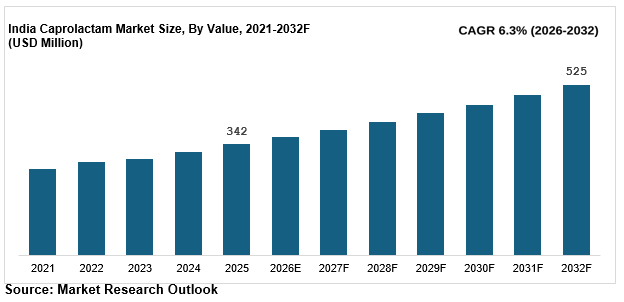
The growth of the India caprolactam market is closely linked to expanding nylon 6 conversion capacity, with Indian caprolactam consumption reaching 152 thousand tonnes in 2025 against 118 thousand tonnes in 2021, alongside domestic installed capacity of 120 thousand tonnes per annum. Gujarat State Fertilizers & Chemicals Limited operates 70 thousand tonnes per annum of caprolactam capacity across two Vadodara plants, while Fertilisers and Chemicals Travancore Limited operates 50 thousand tonnes per annum at Udyogamandal, and global suppliers including BASF, Domo Chemicals, Grupa Azoty, UBE Corporation, and Highsun Group compete for the balance of Indian offtake.
At the same time, downstream converters across Gujarat, Maharashtra, Tamil Nadu, Punjab, Kerala, and Delhi NCR are raising nylon 6 chip, filament yarn, and tyre cord fabric output, supported by Production Linked Incentive allocations for textiles, port-linked bonded stocking at Mundra, Nhava Sheva, and Chennai, and anti-dumping duties on caprolactam from the European Union, South Korea, Russia, and Thailand, creating steady structural demand across the India caprolactam market.
Product development is increasingly focused on higher-specification caprolactam grades, including polymer grade material with a permanganate absorption number below 3, low-sulphate process routes that cut ammonium sulphate co-production from 4.0 tonnes to 1.8 tonnes per tonne of caprolactam, recycled caprolactam recovered from post-consumer nylon 6 waste, and bio-based feedstock routes under evaluation. As a result, demand is gradually shifting toward specification-led caprolactam offering purity, consistency, and sustainability credentials together, supporting higher value realisation in fibre and engineering plastics segments.
Despite this momentum, the India caprolactam market continues to face challenges. Import dependence at 41% of national demand, volatile benzene feedstock costs, ammonium sulphate by-product handling, and substitution by polyester tyre cord and nylon 66 remain key concerns. Ageing plant infrastructure and unplanned shutdowns add further complexity. However, anti-dumping protection, capacity debottlenecking, and rising investment in low-sulphate and recycled caprolactam routes are gradually easing these pressures over time.
Looking ahead, opportunities are emerging across chemical recycling and bio-based caprolactam routes, PLI-backed technical textile demand, electric vehicle component localisation raising glass-filled nylon 6 offtake, and brownfield capacity expansion narrowing India’s import gap. Increasing collaboration between domestic producers, nylon 6 chip makers, tyre cord fabric converters, and global caprolactam suppliers is also accelerating grade innovation, supply security, and contract coverage, positioning the India caprolactam market for sustained, value-driven, and integrated growth through 2032.
Major companies operating in India Caprolactam Market are:
- Gujarat State Fertilizers & Chemicals Limited (GSFC)
- Fertilisers and Chemicals Travancore Limited (FACT)
- BASF SE
- AdvanSix Inc.
- Domo Chemicals
- Grupa Azoty S.A.
- UBE Corporation
- Sumitomo Chemical Co. Ltd.
- Highsun Group
- China Petrochemical Corporation (Sinopec)
- LANXESS AG
- Aquafil S.p.A.
- KuibyshevAzot PJSC
The India caprolactam market is entering a structural upcycle where security of supply, grade leadership in polymer and recycled caprolactam, and the ability to serve diverse converters across textile, tyre, and engineering plastics channels will increasingly separate long-term leaders from the rest. As nylon 6 conversion capacity deepens and trade remedies reshape import economics, demand is shifting toward higher-specification, contract-secured, and sustainability-linked caprolactam supply, noted a senior analyst at Market Research Outlook.
India Caprolactam Market, provides a detailed assessment of the India caprolactam market, covering market size, structure, and long-term growth dynamics. It includes comprehensive segmentation across product types, applications, feedstock routes, sales channels, end-use industries, and regional markets, along with analysis of key trends, growth drivers, challenges, and emerging opportunities shaping the caprolactam market in India.
Don’t Miss the Business Opportunity in the India Caprolactam Market
Consult our analysts to gain critical insights and accelerate your business growth. The report’s in-depth analysis provides comprehensive information on growth potential, emerging trends, and key market statistics. It also highlights the factors influencing future market size and delivers insights into product innovation, industry demand drivers, regulatory framework, growth opportunities, challenges, and competitive dynamics to support informed strategic decision-making across the India caprolactam market.
About Us
Market Research Outlook delivers market intelligence and data-driven insights across chemicals, petrochemicals, polymers, and industrial materials markets.
Contact Us:
Market Research Outlook
Phone: +91-9457319032