

South Korea Fab Expansion Infrastructure Constraints Market, By Infrastructure Constraint Type (Power Supply & Grid Capacity Limitations, Water Supply & Wastewater Treatment Constraints, Land Availability & Zoning Restrictions, Environmental & Emission Compliance Regulations, Others); By Fab Type (Logic Semiconductor Fabs, Memory Semiconductor Fabs, Foundry Fabs, Advanced Packaging & Testing Facilities); By Node Technology (Leading-Edge Nodes (Below 7nm), Advanced Nodes (7nm–14nm), Mature Nodes (Above 14nm)); By Capacity Expansion Type (Greenfield Expansion, Brownfield Expansion, Capacity Optimization & Retrofitting); By End-Use Industry (Consumer Electronics, Automotive Electronics, AI & High-Performance Computing (HPC), Telecommunications (5G & 6G), Industrial & IoT Applications); By Trend Analysis, Competitive Landscape & Forecast, 2021-2032
- Chemicals & Advanced Materials
- Mar 2026
- Pages 120
- Report Format: pdf
- Report Price: $2500 USD
South Korea Fab Expansion Infrastructure Constraints Market, Size & Forecast 2021-2032
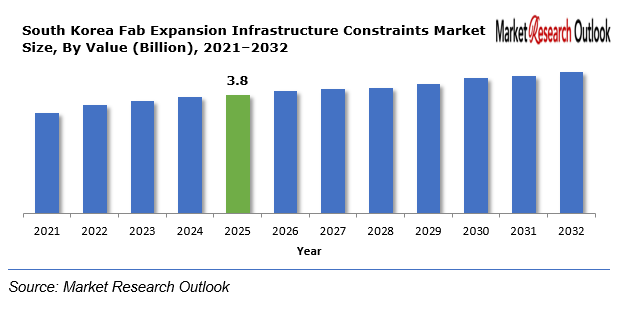
The South Korea Fab Expansion Infrastructure Constraints Market size was estimated at USD 3.8 Billion in 2025. During the forecast period, the South Korea Fab Expansion Infrastructure Constraints Market size is projected to grow at a CAGR of 11.6% reaching a value of USD 8.2 Billion by 2032. The growth of the industry depends on major investments which support the construction of advanced semiconductor manufacturing facilities that produce cutting-edge logic and memory products. The ongoing expansion of South Korea’s semiconductor production facilities results from the country’s semiconductor exports which remain vital to its gross domestic product. The construction of high-performance fabrication facilities needs substantial electrical power together with specialized water purification systems and advanced waste management systems and all necessary environmental control procedures. The increasing complexity of chips together with the rising worldwide demand for artificial intelligence technology has made infrastructure limitations a top priority for both government agencies and business partners.
Fab Expansion Infrastructure Constraints – Overview
The planning of semiconductor fabrication facilities and their construction and operational processes are restricted by Fab expansion infrastructure constraints which identify three types of limitations: structural, environmental, and utility-related. Modern semiconductor fabs require continuous access to high-voltage electricity together with their need for large quantities of ultrapure water and their requirement for advanced chemical handling systems and environmental compliance systems. The most advanced semiconductor facilities which operate under 7nm nodes require a high level of resources because they consume large amounts of power and water while needing sophisticated systems to control emissions.
South Korea Fab Expansion Infrastructure Constraints Market
Growth Drivers
Rising Demand for Advanced Semiconductors
The rapid expansion of AI and high-performance computing (HPC) and 5G infrastructure and electric vehicles and advanced consumer electronics creates strong demand for high-end semiconductors. The memory chip dominance of South Korea and its growing advanced logic manufacturing capabilities drive new semiconductor fabrication plant investments. Chip manufacturers require infrastructure upgrades to accommodate their production capacity expansion needs.
Challenges
Power and Water Resource Limitations
The primary obstacle which prevents semiconductor manufacturing facilities from expanding their operations in South Korea. Semiconductor manufacturing facilities need continuous power supply which maintains high voltage levels and operates without interruptions. The existing grid capacity in the region will delay new fabrication plant approvals while requiring expensive network enhancements.
Geopolitical Impact on South Korea Fab Expansion Infrastructure Constraints Market
The South Korea Fab Expansion Infrastructure Constraints Market experiences major effects from geopolitical factors which include U.S.-China trade conflicts and semiconductor supply chain changes and international technology protection regulations. The implementation of export restrictions on advanced semiconductor equipment and materials will create delays in the expansion process and hinder technology implementation. The United States and Japan and European partners establish strategic partnerships which develop new supply chain resilience methods that promote local manufacturing and infrastructure development.
South Korea Fab Expansion Infrastructure Constraints Market
Segmental Coverage
South Korea Fab Expansion Infrastructure Constraints Market – By Infrastructure Constraint Type
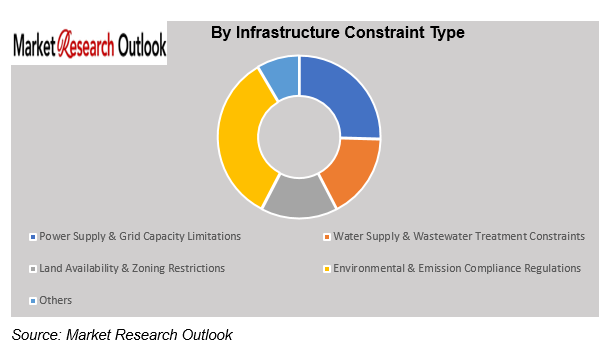
Based on infrastructure constraint type, the market is segmented into Power Supply & Grid Capacity Limitations, Water Supply & Wastewater Treatment Constraints, Land Availability & Zoning Restrictions, Environmental & Emission Compliance Regulations, and Others. Power Supply & Grid Capacity Limitations will account for a major share of advanced semiconductor fabrication plants because these facilities consume large amounts of electricity. The need to maintain grid stability while integrating renewable energy sources has reached critical levels. Fabs need continuous access to ultrapure water systems and advanced recycling facilities, which results in Water Supply & Wastewater Treatment Constraints becoming a major operational requirement. Environmental & Emission Compliance Regulations have become more important because sustainability mandates and carbon neutrality goals require organizations to meet these standards.
South Korea Fab Expansion Infrastructure Constraints Market – By Fab Type
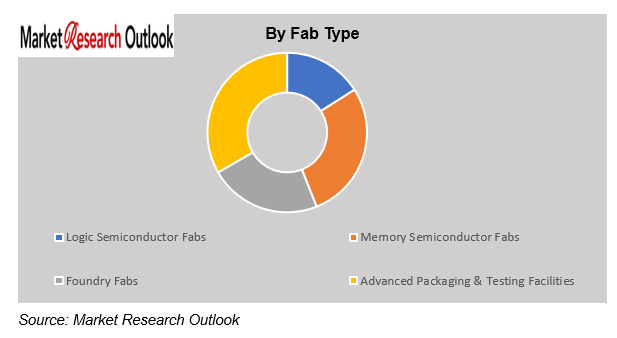
Based on fab type, the market is segmented into Logic Semiconductor Fabs, Memory Semiconductor Fabs, Foundry Fabs, and Advanced Packaging & Testing Facilities. The memory semiconductor fabrication plants control the market because South Korea holds a dominant position in both DRAM and NAND manufacturing. However, companies invest more in Logic Semiconductor Fabs and Foundry Fabs because they want to develop advanced processing nodes and AI chip production capabilities. The Advanced Packaging and Testing Facilities expansion project needs new utility and environmental systems because it will accommodate heterogeneous integration and chiplet architecture development.
Competitive Landscape
Key participants in the South Korea Fab Expansion Infrastructure Constraints market include Samsung Electronics Co., Ltd., SK hynix Inc., DB HiTek Co., Ltd., Samsung Engineering Co., Ltd., Hyundai Engineering Co., Ltd., GS Engineering & Construction, POSCO E&C, KEPCO, Korea Water Resources Corporation, SEMI Korea, and Other Prominent Players. These companies are implementing strategic growth initiatives in order to gain a competitive advantage. The strategies being largely adopted include mergers and acquisitions, strategic alliances, joint ventures, licensing agreements, and new product launches. With the implementation of these strategies, the market participants aim to increase product portfolios, as well as enhance regional presence for long-term sustainable business growth in the Fab Expansion Infrastructure Constraints industry of South Korea.
Scope of the Report
| Attributes | Details |
| Years Considered | Historical Data – 2021–2025
Base Year – 2025 Estimated Year – 2026 Forecast Period – 2026–2032 |
| Facts Covered | Revenue in USD Billion |
| Market Coverage | South Korea |
| Product/ Service Segmentation | Infrastructure Constraint Type, Fab Type, Node Technology, Capacity Expansion Type, End-Use Industry |
| Key Players | Samsung Electronics Co., Ltd., SK hynix Inc., DB HiTek Co., Ltd., Samsung Engineering Co., Ltd., Hyundai Engineering Co., Ltd., GS Engineering & Construction, POSCO E&C, KEPCO, Korea Water Resources Corporation, SEMI Korea, and Other Prominent Players. |
Market Segmentation
- By Infrastructure Constraint Type
- Power Supply & Grid Capacity Limitations
- Water Supply & Wastewater Treatment Constraints
- Land Availability & Zoning Restrictions
- Environmental & Emission Compliance Regulations
- Others
- By Fab Type
- Logic Semiconductor Fabs
- Memory Semiconductor Fabs
- Foundry Fabs
- Advanced Packaging & Testing Facilities
- By Node Technology
- Leading-Edge Nodes (Below 7nm)
- Advanced Nodes (7nm–14nm)
- Mature Nodes (Above 14nm)
- By Capacity Expansion Type
- Greenfield Expansion
- Brownfield Expansion
- Capacity Optimization & Retrofitting
- By End-Use Industry
- Consumer Electronics
- Automotive Electronics
- AI & High-Performance Computing (HPC)
- Telecommunications (5G & 6G)
- Industrial & IoT Applications
- Research Framework
- Research Objective
- Product Overview
- Market Segmentation
- Executive Summary
- South Korea Fab Expansion Infrastructure Constraints Market Insights
- Growth Drivers
- Restraints
- Opportunities
- Challenges
- Power & Water Dependency Risks Analysis
- Technological Advancements/Recent Developments
- Porter’s Five Forces Analysis
- Industry Value Chain & Entry Points
- South Korea Fab Expansion Infrastructure Constraints Market: Regulatory Framework
- South Korea Fab Expansion Infrastructure Constraints Market: Marketing Strategies
- South Korea Fab Expansion Infrastructure Constraints Market Overview
- Market Size & Forecast, 2021-2032
- By Value (USD Billion)
- Market Share & Forecast
- By Infrastructure Constraint Type
- Power Supply & Grid Capacity Limitations
- Water Supply & Wastewater Treatment Constraints
- Land Availability & Zoning Restrictions
- Environmental & Emission Compliance Regulations
- Others
- By Fab Type
- Logic Semiconductor Fabs
- Memory Semiconductor Fabs
- Foundry Fabs
- Advanced Packaging & Testing Facilities
- By Node Technology
- Leading-Edge Nodes (Below 7nm)
- Advanced Nodes (7nm–14nm)
- Mature Nodes (Above 14nm)
- By Capacity Expansion Type
- Greenfield Expansion
- Brownfield Expansion
- Capacity Optimization & Retrofitting
- By End-Use Industry
- Consumer Electronics
- Automotive Electronics
- AI & High-Performance Computing (HPC)
- Telecommunications (5G & 6G)
- Industrial & IoT Applications
- By Infrastructure Constraint Type
- Market Size & Forecast, 2021-2032
- Demand Outlook & Customer Adoption Dynamics
- Demand Evolution By End-Use Industry
- Purchasing Behavior & Supplier Selection Criteria
- Demand Visibility & Contracting Trends
- Regional Demand Concentration & Customer Clusters
- Competitive Landscape
- List Of Key Players And Their Offerings
- South Korea Fab Expansion Infrastructure Constraints Company Market Share Analysis, 2025
- Competitive Benchmarking, By Operating Parameters
- Key Strategic Development (Mergers, Acquisitions, Partnerships, Etc.)
- Geopolitical Impact On South Korea Fab Expansion Infrastructure Constraints Market
- Company Profile
- Samsung Electronics Co., Ltd.
- Introduction & Company Profile
- Product Benchmarking
- Strategic Outlook
- Key Personals
- Key Competitors
- Financial Analysis
- Swot Analysis
- Samsung Electronics Co., Ltd.
**(Same Data Pointers Will Be Provided For The Below Companies)
- SK hynix Inc.
- DB HiTek Co., Ltd.
- Samsung Engineering Co., Ltd.
- Hyundai Engineering Co., Ltd.
- GS Engineering & Construction
- POSCO E&C
- KEPCO
- Korea Water Resources Corporation
- SEMI Korea
- Other Prominent Players
- Key Strategic Recommendations
- Research Methodology
- Qualitative Research
- Primary & Secondary Research
- Quantitative Research
- Market Breakdown & Data Triangulation
- Secondary Research
- Primary Research
- Breakdown Of Primary Research Respondents, By Country
- Assumption & Limitation
- Qualitative Research
* Financial information in case of non-listed companies will be provided as per availability
**The segmentation and the companies are subjected to modifications based on in-depth secondary for the final deliverable
Frequently Asked Questions
1. What is the expected growth rate of the South Korea Fab Expansion Infrastructure Constraints Market during the forecast period?
Ans: The South Korea Fab Expansion Infrastructure Constraints Market size was estimated at USD 3.8 billion in 2025.
2. What is the expected growth rate of the South Korea Fab Expansion Infrastructure Constraints Market during the forecast period?
Ans: South Korea Fab Expansion Infrastructure Constraints Market is expected to grow at a CAGR of around 11.6% during the forecast period between 2026 and 2032.
3. What is the forecast value of the South Korea Fab Expansion Infrastructure Constraints Market by 2032?
Ans: The South Korea Fab Expansion Infrastructure Constraints Market is projected to reach a value of approximately USD 8.2 billion by 2032.
4. What are the major factors driving the growth of the South Korea Fab Expansion Infrastructure Constraints Market?
Ans: The growth of the industry depends on major investments which support the construction of advanced semiconductor manufacturing facilities that produce cutting-edge logic and memory products.
5. Name the key players operating in the South Korea Fab Expansion Infrastructure Constraints Market.
Ans: The key players of South Korea Fab Expansion Infrastructure Constraints Market are Samsung Electronics Co., Ltd., SK hynix Inc., DB HiTek Co., Ltd., Samsung Engineering Co., Ltd., Hyundai Engineering Co., Ltd., GS Engineering & Construction, POSCO E&C, KEPCO, Korea Water Resources Corporation, SEMI Korea, and Other Prominent Players.
6. Which is the fastest-growing fab type segment in the South Korea Fab Expansion Infrastructure Constraints Market?
Ans: The memory semiconductor fabrication plants control the market because South Korea holds a dominant position in both DRAM and NAND manufacturing.
Frequently Asked Questions
1. What is the expected growth rate of the South Korea Fab Expansion Infrastructure Constraints Market during the forecast period?
Ans: The South Korea Fab Expansion Infrastructure Constraints Market size was estimated at USD 3.8 billion in 2025.
2. What is the expected growth rate of the South Korea Fab Expansion Infrastructure Constraints Market during the forecast period?
Ans: South Korea Fab Expansion Infrastructure Constraints Market is expected to grow at a CAGR of around 11.6% during the forecast period between 2026 and 2032.
3. What is the forecast value of the South Korea Fab Expansion Infrastructure Constraints Market by 2032?
Ans: The South Korea Fab Expansion Infrastructure Constraints Market is projected to reach a value of approximately USD 8.2 billion by 2032.
4. What are the major factors driving the growth of the South Korea Fab Expansion Infrastructure Constraints Market?
Ans: The growth of the industry depends on major investments which support the construction of advanced semiconductor manufacturing facilities that produce cutting-edge logic and memory products.
5. Name the key players operating in the South Korea Fab Expansion Infrastructure Constraints Market.
Ans: The key players of South Korea Fab Expansion Infrastructure Constraints Market are Samsung Electronics Co., Ltd., SK hynix Inc., DB HiTek Co., Ltd., Samsung Engineering Co., Ltd., Hyundai Engineering Co., Ltd., GS Engineering & Construction, POSCO E&C, KEPCO, Korea Water Resources Corporation, SEMI Korea, and Other Prominent Players.
6. Which is the fastest-growing fab type segment in the South Korea Fab Expansion Infrastructure Constraints Market?
Ans: The memory semiconductor fabrication plants control the market because South Korea holds a dominant position in both DRAM and NAND manufacturing.