

Poland Warehouse Automation Market, By Component (Hardware, Software, Services); By Automation Level (Manual Warehouses, Semi-Automated Warehouses, Fully Automated Warehouses); By Deployment Mode (On-Premise, Cloud-Based); By Application (Order Picking & Sorting, Packaging & Palletizing, Transportation & Distribution, Inventory & Storage Management, Kitting & Assembly); By End User Industry (E-commerce & Retail, Third-Party Logistics (3PL), Manufacturing, Food & Beverage, Pharmaceuticals, Automotive, Electronics, FMCG); By Trend Analysis, Competitive Landscape & Forecast, 2021-2032
- AI and Automation
- Feb 2026
- Pages 140
- Report Format: pdf
- Report Price: $2500 USD
Poland Warehouse Automation Market, Size & Forecast 2021-2032
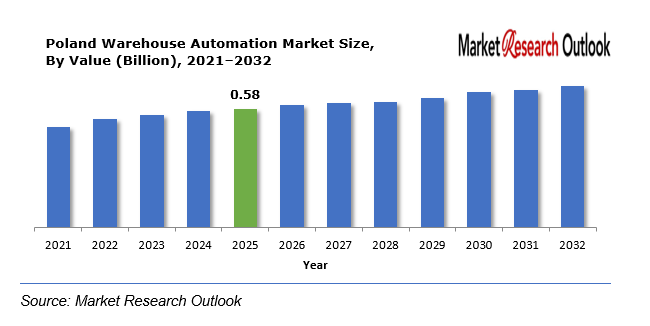
The Poland Warehouse Automation Market size was estimated at USD 0.58 Billion in 2025. During the forecast period, the Poland Warehouse Automation Market size is projected to grow at a CAGR of 16.1% reaching a value of USD 1.64 Billion by 2032. The Poland Warehouse Automation Market will experience significant growth between 2026 and 2032 because digitalization of logistics and supply chain operations grows and e-commerce and third-party logistics sectors expand. The warehouse capacity of Polish companies increased because people wanted quick product delivery and better inventory control. The manufacturing, automotive, and retail sectors require advanced automated systems which include robotics and conveyor systems and warehouse management software. Enterprises are increasingly focusing on improving warehouse productivity and accuracy while minimizing operational costs and human errors. The implementation of cloud-based warehouse management systems together with real-time analytics allows organizations to improve supply chain operations and better decision-making processes. The increasing need for effective storage and distribution systems combined with investments in intelligent logistics infrastructure will create high demand for warehouse automation technologies throughout Poland during the upcoming period.
Warehouse Automation – Overview
Warehouse Automation uses advanced technology and automated systems to control and improve all warehouse processes which include inventory storage and material handling and order fulfillment and packaging and distribution operations. The system combines hardware elements like robots and automated guided vehicles (AGVs) and conveyors and sorting systems with software solutions that include warehouse management systems (WMS) and analytics platforms. The systems provide warehouses with efficient solutions for moving and storing products while they track inventory and need less human help and make fewer operational mistakes.
Poland Warehouse Automation Market
Growth Drivers
Rapid Expansion of E-commerce and Logistics Sector
The demand for warehouse automation solutions in Poland is increasing due to the rapid growth of e-commerce and logistics industries. The requirements for online retail platforms and omnichannel distribution models create a need for distribution systems that can process orders quickly while maintaining precise inventory records. E-commerce companies and third-party logistics providers are investing in automated warehouses to handle large volumes of orders and ensure timely delivery. The integration of robotics systems together with automated picking systems and smart inventory management solutions enables warehouses to achieve higher operational efficiency while decreasing their operational expenses. The status of Poland as a European logistics hub attracts multinational companies to build distribution centers and fulfillment facilities that feature cutting-edge automation systems.
Challenges
High Initial Investment and Integration Costs
The deployment of warehouse automation systems requires multiple upfront costs which include expenses for hardware and software and infrastructure needs. Advanced automation technology adoption presents financial challenges for Polish small and medium-sized enterprises because of its high capital requirements and integration difficulties. The implementation of robotics and automated storage systems and warehouse management software requires businesses to pay for both equipment and installation and maintenance and employee training costs. The process of integrating new automation systems into existing warehouse systems and older IT systems presents businesses with both difficulty and time requirements.
Geopolitical Impact on Poland Warehouse Automation Market
The Poland Warehouse Automation Market is affected by multiple geopolitical factors which include the economic performance of different regions and the existing trade regulations and the European supply chain operations. The European Union membership of Poland together with its location as a Western to Eastern European crossroad creates fundamental elements which determine how the country develops its logistics and warehousing systems. The need for better warehouse automation solutions and distribution systems arises from the international trade relationship between countries and the growth of online shopping that crosses national borders. Warehouse operations and investment choices face impacts from global supply chain changes and increasing shipping expenses and new import-export regulations. The government policies that create support for industrial automation and digital transformation and smart manufacturing programs enable companies to implement warehouse automation technologies.
Poland Warehouse Automation Market
Segmental Coverage
Poland Warehouse Automation Market – By Component
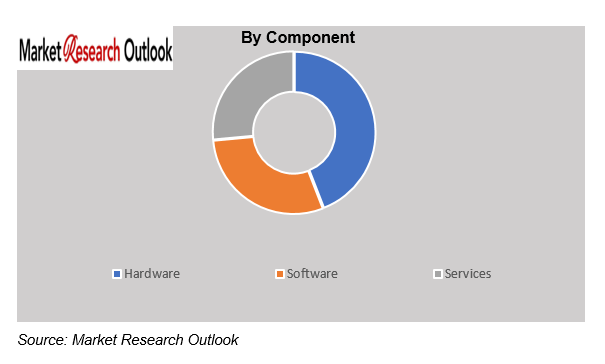
Based on component, the Poland Warehouse Automation Market is segmented into Hardware, Software, and Services. The hardware segment will experience substantial expansion from 2026 to 2032 because warehouses and distribution centers are increasingly implementing robotics and automated storage and retrieval systems and conveyor systems and sorting equipment. Companies are investing in advanced hardware solutions to enhance operational performance while minimizing their need for manual work. Organizations are increasingly adopting software solutions like warehouse management systems (WMS) and warehouse control systems (WCS) and analytics platforms to achieve real-time inventory tracking and process optimization. Automated warehouse systems depend on service offerings which include system integration and maintenance and consulting services to achieve successful implementation and operational efficiency.
Poland Warehouse Automation Market – By End User Industry
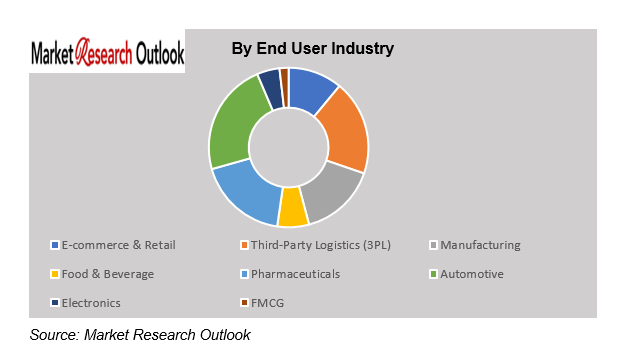
Based on end user industry, the Poland Warehouse Automation Market is segmented into E-commerce & Retail, Third-Party Logistics (3PL), Manufacturing, Food & Beverage, Pharmaceuticals, Automotive, Electronics, and FMCG. E-commerce and retail businesses will grow significantly between 2026 and 2032 because online shopping will increase and customers will demand faster and more precise order delivery. Retailers and e-commerce companies use automated systems for picking and sorting and packaging to improve their operational efficiency and deliver better customer experiences. The third-party logistics and manufacturing sectors are also investing in warehouse automation solutions to streamline supply chain operations and improve productivity. The food and beverage industry together with the pharmaceutical industry needs automated storage and handling systems to maintain product quality while meeting regulatory compliance requirements.
Competitive Landscape
Key participants in the Poland Warehouse Automation market include Dematic, SSI Schaefer, Daifuku Co., Ltd., TGW Logistics Group, Vanderlande Industries, KNAPP AG, Swisslog Holding AG (KUKA Group), Murata Machinery Ltd. (Muratec), Mecalux S.A., Honeywell Intelligrated and other prominent players.
These companies are implementing strategic growth initiatives in order to gain a competitive advantage. The strategies being largely adopted include mergers and acquisitions, strategic alliances, joint ventures, licensing agreements, and new product launches. With the implementation of these strategies, the market participants aim to increase product portfolios, as well as enhance regional presence for long-term sustainable business growth in the Warehouse Automation industry of Poland.
Scope of the Report
| Attributes | Details |
| Years Considered | Historical Data – 2021–2025
Base Year – 2025 Estimated Year – 2026 Forecast Period – 2026–2032 |
| Facts Covered | Revenue in USD Billion |
| Market Coverage | Poland |
| Product/ Service Segmentation | Component, Automation Level, Deployment Mode, Application, End User Industry |
| Key Players | Dematic, SSI Schaefer, Daifuku Co., Ltd., TGW Logistics Group, Vanderlande Industries, KNAPP AG, Swisslog Holding AG (KUKA Group), Murata Machinery Ltd. (Muratec), Mecalux S.A., Honeywell Intelligrated and other prominent players. |
Market Segmentation
- By Component
- Hardware
- Software
- Services
- By Automation Level
- Manual Warehouses
- Semi-Automated Warehouses
- Fully Automated Warehouses
- By Deployment Mode
- On-Premise
- Cloud-Based
- By Application
- Order Picking & Sorting
- Packaging & Palletizing
- Transportation & Distribution
- Inventory & Storage Management
- Kitting & Assembly
- By End User Industry
- E-commerce & Retail
- Third-Party Logistics (3PL)
- Manufacturing
- Food & Beverage
- Pharmaceuticals
- Automotive
- Electronics
- FMCG
- Research Framework
- Research Objective
- Product Overview
- Market Segmentation
- Executive Summary
- Poland Warehouse Automation Market Insights
- Growth Drivers
- Restraints
- Opportunities
- Challenges
- Technological Advancements/Recent Developments
- Porter’s Five Forces Analysis
- Industry Value Chain & Entry Points
- Poland Warehouse Automation Market: Regulatory Framework
- Poland Warehouse Automation Market: Marketing Strategies
- Poland Warehouse Automation Market Overview
- Market Size & Forecast, 2021-2032
- By Value (USD Billion)
- Market Share & Forecast
- By Component
- Hardware
- Software
- Services
- By Automation Level
- Manual Warehouses
- Semi-Automated Warehouses
- Fully Automated Warehouses
- By Deployment Mode
- On-Premise
- Cloud-Based
- By Application
- Order Picking & Sorting
- Packaging & Palletizing
- Transportation & Distribution
- Inventory & Storage Management
- Kitting & Assembly
- By End User Industry
- E-commerce & Retail
- Third-Party Logistics (3PL)
- Manufacturing
- Food & Beverage
- Pharmaceuticals
- Automotive
- Electronics
- FMCG
- By Component
- Market Size & Forecast, 2021-2032
- Demand Outlook & Customer Adoption Dynamics
- Demand Evolution By End-Use Industry
- Purchasing Behavior & Supplier Selection Criteria
- Demand Visibility & Contracting Trends
- Regional Demand Concentration & Customer Clusters
- Competitive Landscape
- List Of Key Players And Their Offerings
- Poland Warehouse Automation Company Market Share Analysis, 2025
- Competitive Benchmarking, By Operating Parameters
- Key Strategic Development (Mergers, Acquisitions, Partnerships, Etc.)
- Geopolitical Impact On Poland Warehouse Automation Market
- Company Profile
- Dematic
- Introduction & Company Profile
- Product Benchmarking
- Strategic Outlook
- Key Personals
- Key Competitors
- Financial Analysis
- Swot Analysis
- Dematic
**(Same Data Pointers Will Be Provided For The Below Companies)
- SSI Schaefer
- Daifuku Co., Ltd.
- TGW Logistics Group
- Vanderlande Industries
- KNAPP AG
- Swisslog Holding AG (KUKA Group)
- Murata Machinery Ltd. (Muratec)
- Mecalux S.A.
- Honeywell Intelligrated
- Other Prominent Players
- Key Strategic Recommendations
- Research Methodology
- Qualitative Research
- Primary & Secondary Research
- Quantitative Research
- Market Breakdown & Data Triangulation
- Secondary Research
- Primary Research
- Breakdown Of Primary Research Respondents, By Country
- Assumption & Limitation
- Qualitative Research
* Financial information in case of non-listed companies will be provided as per availability
**The segmentation and the companies are subjected to modifications based on in-depth secondary for the final deliverable
Frequently Asked Questions
1. What is the expected growth rate of the Poland Warehouse Automation Market during the forecast period?
Ans: The Poland Warehouse Automation Market size was estimated at USD 0.58 billion in 2025.
2. What is the expected growth rate of the Poland Warehouse Automation Market during the forecast period?
Ans: Poland Warehouse Automation Market is expected to grow at a CAGR of around 16.1% during the forecast period between 2026 and 2032.
3. What is the forecast value of the Poland Warehouse Automation Market by 2032?
Ans: The Poland Warehouse Automation Market is projected to reach a value of approximately USD 1.64 billion by 2032.
4. What are the major factors driving the growth of the Poland Warehouse Automation Market?
Ans: The Poland Warehouse Automation Market will experience significant growth between 2026 and 2032 because digitalization of logistics and supply chain operations grows and e-commerce and third-party logistics sectors expand.
5. Name the key players operating in the Poland Warehouse Automation Market.
Ans: The key players of Poland Warehouse Automation Market are Dematic, SSI Schaefer, Daifuku Co., Ltd., TGW Logistics Group, Vanderlande Industries, KNAPP AG, Swisslog Holding AG (KUKA Group), Murata Machinery Ltd. (Muratec), Mecalux S.A., Honeywell Intelligrated and other prominent players.
6. Which is the fastest-growing end user industry segment in the Poland Warehouse Automation Market?
Ans: E-commerce and retail businesses will grow significantly between 2026 and 2032 because online shopping will increase and customers will demand faster and more precise order delivery.
Frequently Asked Questions
1. What is the expected growth rate of the Poland Warehouse Automation Market during the forecast period?
Ans: The Poland Warehouse Automation Market size was estimated at USD 0.58 billion in 2025.
2. What is the expected growth rate of the Poland Warehouse Automation Market during the forecast period?
Ans: Poland Warehouse Automation Market is expected to grow at a CAGR of around 16.1% during the forecast period between 2026 and 2032.
3. What is the forecast value of the Poland Warehouse Automation Market by 2032?
Ans: The Poland Warehouse Automation Market is projected to reach a value of approximately USD 1.64 billion by 2032.
4. What are the major factors driving the growth of the Poland Warehouse Automation Market?
Ans: The Poland Warehouse Automation Market will experience significant growth between 2026 and 2032 because digitalization of logistics and supply chain operations grows and e-commerce and third-party logistics sectors expand.
5. Name the key players operating in the Poland Warehouse Automation Market.
Ans: The key players of Poland Warehouse Automation Market are Dematic, SSI Schaefer, Daifuku Co., Ltd., TGW Logistics Group, Vanderlande Industries, KNAPP AG, Swisslog Holding AG (KUKA Group), Murata Machinery Ltd. (Muratec), Mecalux S.A., Honeywell Intelligrated and other prominent players.
6. Which is the fastest-growing end user industry segment in the Poland Warehouse Automation Market?
Ans: E-commerce and retail businesses will grow significantly between 2026 and 2032 because online shopping will increase and customers will demand faster and more precise order delivery.