

Middle East & Africa Functional Food Ingredients Market, By Ingredient Type (Vitamins & Minerals, Proteins & Amino Acids, Prebiotics & Probiotics, Omega-3 & Omega-6 Fatty Acids, Carotenoids & Antioxidants, Dietary Fibers, Phytochemicals & Plant Extracts, Enzymes, Others); By Function (Immune Health, Digestive Health, Cardiovascular Health, Bone & Joint Health, Weight Management, Cognitive Health & Brain Function, Others); By Application (Dairy & Dairy Alternatives, Bakery & Confectionery, Beverages, Infant Formula & Baby Food, Snacks & Convenience Foods, Dietary Supplements, Others); By Form (Dry/Powder, Liquid, Encapsulated, Others); By Distribution Channel (B2B/Direct Sales, Specialty Stores, Pharmacies & Drug Stores, Online Platforms & E-commerce, Others); By Country (Saudi Arabia, UAE, Qatar, Kuwait, Bahrain, Oman, Egypt, Algeria, Nigeria, South Africa, Rest of MEA); By Trend Analysis, Competitive Landscape & Forecast, 2021–2032
- Food, Beverage & Nutrition
- Mar 2026
- Pages 250
- Report Format: pdf
- Report Price: $3000 USD
Middle East & Africa Functional Food Ingredients Market, Size & Forecast 2021-2032
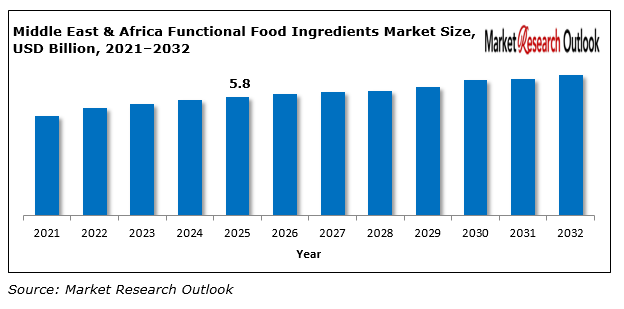
The Middle East & Africa Functional Food Ingredients Market size was estimated at USD 5.8 Billion in 2025. During the forecast period, the Middle East & Africa Functional Food Ingredients Market size is projected to grow at a CAGR of 7.6% reaching a value of USD 9.7 Billion by 2032. The rising need for fortified foods and dietary supplements and functional beverages drives the current market growth. The nutraceutical industry expansion together with ingredient processing technology advancements creates conditions which support market development. Food innovation investments and product development investments enable manufacturers to create specialized health products which include immunity-boosting and gut-health solutions.
Middle East & Africa Functional Food Ingredients Market – Overview
Market Trends
- The MEA functional food ingredients market experiences a main trend which shows growing demand for immunity-boosting ingredients after people became more health-conscious in the past few years. The food and beverage industry uses vitamins C and D and zinc and probiotics and plant extracts as common ingredients to create products that enhance immune health.
- Another important trend shows that consumers now prefer plant-based products and clean-label ingredients more than ever before. Consumers are increasingly demanding natural organic and minimally processed ingredients which has resulted in increased demand for plant-based proteins and fibers and phytochemical compounds. The market for functional beverages and fortified dairy alternatives is expanding because they serve as accessible methods to deliver functional ingredients.
Geopolitical Impact on Middle East & Africa Functional Food Ingredients Market
The MEA functional food ingredients market depends on geopolitical factors because the market needs specialized ingredients which require importation. The pricing and availability of essential components like probiotics and omega fatty acids and specialty proteins get affected by trade rules and tariffs and supply chain interruptions. The different political stability conditions in MEA countries create various effects on investment patterns and market development. The GCC countries maintain stable trade conditions which enable them to import goods through reliable networks, but some African markets struggle with their logistics and infrastructure problems. The production expenses and pricing methods of businesses get affected by changes in currency values and worldwide commodity price fluctuations.
| Attributes | Details |
| Years Considered | Historical Data – 2021–2025
Base Year – 2025 Estimated Year – 2026 Forecast Period – 2026–2032 |
| Facts Covered | Revenue in USD Billion |
| Market Coverage | Saudi Arabia, UAE, Qatar, Kuwait, Bahrain, Oman, Egypt, Algeria, Nigeria, South Africa, Rest of MEA |
| Segmentation | Ingredient Type, Function, Application, Form, Distribution Channel, Country |
Segmental Coverage
By Ingredient Type
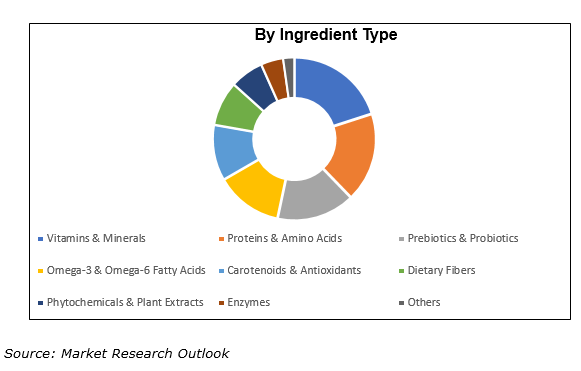
Based on ingredient type, the market is segmented into vitamins & minerals, proteins & amino acids, prebiotics & probiotics, omega-3 & omega-6 fatty acids, carotenoids & antioxidants, dietary fibers, phytochemicals & plant extracts, enzymes, and others. Vitamins and minerals hold a significant share because people use them in fortified foods. Proteins and amino acids receive increasing recognition because they benefit both sports nutrition and plant-based products. Prebiotics and probiotics create a fast-expanding market which results from people becoming more conscious about their gut health. Dietary fibers and plant extracts are also gaining importance as consumers seek natural and functional benefits in their diets. People commonly use omega fatty acids and antioxidants to achieve cardiovascular protection and anti-aging effects.
By Function
Based on function, the market is segmented into immune health, digestive health, cardiovascular health, bone & joint health, weight management, cognitive health & brain function, and others. The market is primarily controlled by immune health products which rely on strong consumer demand for fortified foods and dietary supplements. The digestive health market has developed into a major business area because of growing consumer demand for probiotics and dietary fibers. The weight management market and cardiovascular health market have both expanded because of increasing public awareness about health issues. Cognitive health has developed into a specialized market that continues to expand among elderly people and health-conscious consumers.
Regional Analysis
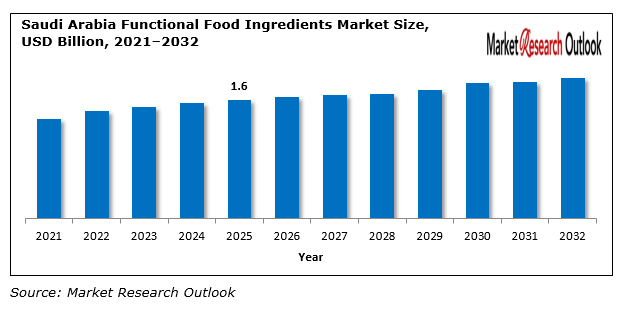
On the basis of country, the market is divided into Saudi Arabia, UAE, Qatar, Kuwait, Bahrain, Oman, Egypt, Algeria, Nigeria, South Africa, and Rest of MEA. GCC countries, especially Saudi Arabia and the UAE, dominate the market because customers understand products better and retail stores operate more effectively and customers have greater spending capacity. The African market depends on South Africa and Egypt as two essential markets which experience urban growth and developing food processing facilities. The rising population in Nigeria and Algeria creates new market opportunities for affordable functional food products which people demand. The MEA market shows different growth prospects because of the various economic development patterns and consumer behavior differences between regions.
Competitive Landscape
In the competitive landscape of the Middle East & Africa Functional Food Ingredients market, the organisation has covered major players of the market and their details.
Here are some of the leading players that are playing a major role in the Middle East & Africa Functional Food Ingredients market:
- dsm-firmenich AG
- Introduction & Company Profile
- Product Benchmarking
- Strategic Outlook
- Key Competitors
- Financial Analysis
- Swot Analysis
**(Same Data Pointers Will Be Provided for The Below Companies)
- BASF SE
- Cargill, Incorporated
- Archer Daniels Midland Company (ADM)
- Kerry Group plc
- Ingredion Incorporated
- Tate & Lyle PLC
- International Flavors & Fragrances Inc. (IFF)
- Lonza Group AG
- Hansen Holding A/S
- Roquette Frères
- Other Prominent Players
Segmentation
- By Ingredient Type
- Vitamins & Minerals
- Proteins & Amino Acids
- Prebiotics & Probiotics
- Omega-3 & Omega-6 Fatty Acids
- Carotenoids & Antioxidants
- Dietary Fibers
- Phytochemicals & Plant Extracts
- Enzymes
- Others
- By Function
- Immune Health
- Digestive Health
- Cardiovascular Health
- Bone & Joint Health
- Weight Management
- Cognitive Health & Brain Function
- Others
- By Application
- Dairy & Dairy Alternatives
- Bakery & Confectionery
- Beverages (Functional Drinks, Juices)
- Infant Formula & Baby Food
- Snacks & Convenience Foods
- Dietary Supplements
- Others
- By Form
- Dry / Powder
- Liquid
- Encapsulated
- Others
- By Distribution Channel
- Business-to-Business (B2B) / Direct Sales
- Specialty Health & Wellness Stores
- Pharmacies & Drug Stores
- Online Platforms & E-commerce
- Others
- By Country
- Saudi Arabia
- United Arab Emirates (UAE)
- Qatar
- Kuwait
- Bahrain
- Oman
- Egypt
- Algeria
- Nigeria
- South Africa
- Rest of MEA
Middle East & Africa Functional Food Ingredients Market, 2032
- Research Framework
- Market Segmentation
- Research Objective
- Research Methodology
- Qualitative Research
- Primary Research
- Secondary Research
- Quantitative Research
- Market Breakdown & Data Triangulation
- Demand Side
- Supply Side
- Breakdown Of Primary Research Respondents, By Region
- Saudi Arabia
- United Arab Emirates (UAE)
- Qatar
- Kuwait
- Bahrain
- Oman
- Egypt
- Algeria
- Nigeria
- South Africa
- Rest of Middle East and Africa
- Assumption & Limitation
- Qualitative Research
- Executive Summary
- Market Overview, 2021–2032
- By Ingredient Type
- By Function
- By Application
- By Form
- By Distribution Channel
- By Country
- Analyst Recommendations
- Market Overview, 2021–2032
- Geopolitical Impact on Middle East & Africa Functional Food Ingredients Market
- Middle East & Africa Functional Food Ingredients Market Insights
- Market Dynamics
- Growth Drivers
- Rising health consciousness and growing demand for fortified food & beverages across the region
- Increasing prevalence of lifestyle diseases driving nutraceutical and functional ingredient consumption
- Expanding halal-certified functional food sector and government-backed nutrition initiatives
- Restraints
- High cost of functional ingredients limiting adoption among price-sensitive consumers
- Limited consumer awareness and regulatory inconsistencies across African markets
- Complex supply chain and heavy dependence on imports for key functional ingredients
- Opportunities
- Growing demand for plant-based and clean-label functional ingredients
- Expansion of sports nutrition and dietary supplement segments in GCC countries
- Rising investments in food fortification programs by governments and international organizations
- Challenges
- Stringent and inconsistent regulatory frameworks for health claims across MEA countries
- Lack of standardized testing and certification infrastructure in several African markets
- Competition from unregulated or counterfeit functional food products in the region
- Technological Advancements
- Recent Technological Advancements
- Prior to 2020
- Porter’s Five Forces Analysis
- PESTLE Analysis
- Trade Analysis
- Top 3 Importing Countries
- Top 3 Exporting Countries
- Growth Drivers
- Market Dynamics
- Industry Value Chain & Entry Points
- Raw material & botanical ingredient suppliers
- Ingredient extraction & processing manufacturers
- Ingredient formulators & blenders
- Quality testing & certification bodies
- Functional food & beverage manufacturers
- Distributors & logistics providers
- End users (food & beverage companies, nutraceutical producers, pharmaceutical firms)
- Retail & e-commerce channels
- Middle East & Africa Functional Food Ingredients Market: Regulatory Framework
- Saudi Arabia
- United Arab Emirates (UAE)
- Qatar
- Kuwait
- Bahrain
- Oman
- Egypt
- Algeria
- Nigeria
- South Africa
- Rest of Middle East and Africa
- Middle East & Africa Functional Food Ingredients Market Overview
- Market Size & Forecast, 2021-2032
- By Value (USD Billion)
- Market Share & Forecast
- By Ingredient Type
- Vitamins & Minerals
- Proteins & Amino Acids
- Prebiotics & Probiotics
- Omega-3 & Omega-6 Fatty Acids
- Carotenoids & Antioxidants
- Dietary Fibers
- Phytochemicals & Plant Extracts
- Enzymes
- Others
- By Function
- Immune Health
- Digestive Health
- Cardiovascular Health
- Bone & Joint Health
- Weight Management
- Cognitive Health & Brain Function
- Others
- By Application
- Dairy & Dairy Alternatives
- Bakery & Confectionery
- Beverages (Functional Drinks, Juices)
- Infant Formula & Baby Food
- Snacks & Convenience Foods
- Dietary Supplements
- Others
- By Form
- Dry / Powder
- Liquid
- Encapsulated
- Others
- By Distribution Channel
- Business-to-Business (B2B) / Direct Sales
- Specialty Health & Wellness Stores
- Pharmacies & Drug Stores
- Online Platforms & E-commerce
- Others
- By Country
- Saudi Arabia
- United Arab Emirates (UAE)
- Qatar
- Kuwait
- Bahrain
- Oman
- Egypt
- Algeria
- Nigeria
- South Africa
- Rest of MEA
- By Ingredient Type
- Market Size & Forecast, 2021-2032
- Competitive Landscape
- Middle East & Africa Functional Food Ingredients Company Market Share Analysis, 2025
- By Country
- Saudi Arabia
- United Arab Emirates (UAE)
- Qatar
- Kuwait
- Bahrain
- Oman
- Egypt
- Algeria
- Nigeria
- South Africa
- Rest of MEA
- Competitive Benchmarking, By Operating Parameters
- Key Strategic Development (Mergers, Acquisitions, Partnerships, Etc.)
- List of Emerging players
- By Country
- Middle East & Africa Functional Food Ingredients Company Market Share Analysis, 2025
- Company Profile
- dsm-firmenich AG
- Introduction & Company Profile
- Product Benchmarking
- Strategic Outlook
- Key Competitors
- Financial Analysis
- Swot Analysis
- dsm-firmenich AG
**(Same Data Pointers Will Be Provided for The Below Companies)
- BASF SE
- Cargill, Incorporated
- Archer Daniels Midland Company (ADM)
- Kerry Group plc
- Ingredion Incorporated
- Tate & Lyle PLC
- International Flavors & Fragrances Inc. (IFF)
- Lonza Group AG
- Hansen Holding A/S
- Roquette Frères
- Other Prominent Players
* Financial information in case of non-listed companies will be provided as per availability
**The segmentation and the companies are subjected to modifications based on in-depth secondary for the final deliverable
Frequently Asked Questions
1. What is the market size of the Middle East & Africa Functional Food Ingredients Market in 2025?
Ans: The Middle East & Africa Functional Food Ingredients market is projected to reach approximately USD 5.8 Billion by 2032.
2. What is the expected growth rate of the Middle East & Africa Functional Food Ingredients Market during the forecast period?
Ans: The Middle East & Africa Functional Food Ingredients market is expected to grow at a CAGR of around 7.5% during the forecast period between 2026 and 2032.
3. What is the forecast value of the Middle East & Africa Functional Food Ingredients Market by 2032?
Ans: The Middle East & Africa Functional Food Ingredients market is projected to reach approximately USD 9.7 Billion by 2032.
4. What are the major factors driving the growth of the Middle East & Africa Functional Food Ingredients Market?
Ans: The rising need for fortified foods and dietary supplements and functional beverages drives the current market growth.
5. Name the key players operating in the Middle East & Africa Functional Food Ingredients Market.
Ans: Key players operating in the Middle East & Africa Functional Food Ingredients market include dsm-firmenich AG, BASF SE, Cargill, Incorporated, Archer Daniels Midland Company (ADM), Kerry Group plc, Ingredion Incorporated, Tate & Lyle PLC, International Flavors & Fragrances Inc. (IFF), Lonza Group AG, Chr. Hansen Holding A/S, Roquette Frères, and other prominent players.
6. Which Country is Expected to grow in the Middle East & Africa Functional Food Ingredients Market.
Ans: GCC countries, especially Saudi Arabia and the UAE, dominate the market because customers understand products better and retail stores operate more effectively and customers have greater spending capacity.
Frequently Asked Questions
1. What is the market size of the Middle East & Africa Functional Food Ingredients Market in 2025?
Ans: The Middle East & Africa Functional Food Ingredients market is projected to reach approximately USD 5.8 Billion by 2032.
2. What is the expected growth rate of the Middle East & Africa Functional Food Ingredients Market during the forecast period?
Ans: The Middle East & Africa Functional Food Ingredients market is expected to grow at a CAGR of around 7.5% during the forecast period between 2026 and 2032.
3. What is the forecast value of the Middle East & Africa Functional Food Ingredients Market by 2032?
Ans: The Middle East & Africa Functional Food Ingredients market is projected to reach approximately USD 9.7 Billion by 2032.
4. What are the major factors driving the growth of the Middle East & Africa Functional Food Ingredients Market?
Ans: The rising need for fortified foods and dietary supplements and functional beverages drives the current market growth.
5. Name the key players operating in the Middle East & Africa Functional Food Ingredients Market.
Ans: Key players operating in the Middle East & Africa Functional Food Ingredients market include dsm-firmenich AG, BASF SE, Cargill, Incorporated, Archer Daniels Midland Company (ADM), Kerry Group plc, Ingredion Incorporated, Tate & Lyle PLC, International Flavors & Fragrances Inc. (IFF), Lonza Group AG, Chr. Hansen Holding A/S, Roquette Frères, and other prominent players.
6. Which Country is Expected to grow in the Middle East & Africa Functional Food Ingredients Market.
Ans: GCC countries, especially Saudi Arabia and the UAE, dominate the market because customers understand products better and retail stores operate more effectively and customers have greater spending capacity.