

India Sugar Free Foods Market Size, Share & Forecast 2032
- Food, Beverage & Nutrition, Health, Wellness & Nutrition
- Jun 2026
- Pages 140
- Report Format: pdf
- Report Price: $2400 USD
India’s sugar free foods market is witnessing strong structural growth, driven by rising diabetes and obesity prevalence, expanding modern retail and pharmacy penetration, accelerating quick-commerce adoption across tier-1 and tier-2 cities, rising disposable incomes, growing demand for natural-sweetener and low-calorie products, expansion of organized retail networks, and rising interest from domestic and global food majors investing in India-specific product innovation, manufacturing capacity, and digital distribution platforms.
Report Description
| Study Duration | 2021-2032 |
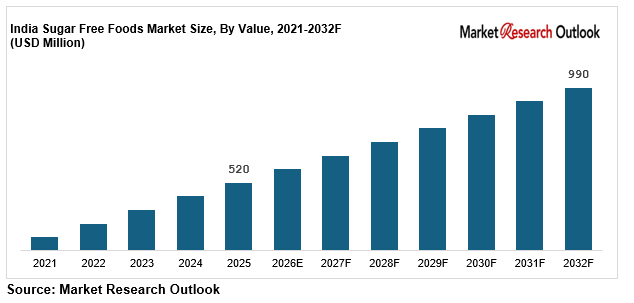
| Market Size (2025) | USD 520 Million |
| CAGR (2026-2032) | 9.6% |
| Leading Segment | Sugar-Free Sweeteners & Tabletop |
| Fastest Growing Segment | Sugar-Free Beverages |
| Market Size (2032) | USD 990 Million |
Source:
Market Overview: India Sugar Free Foods Market
The India sugar free foods market size is witnessing rapid expansion, driven by accelerating health consciousness, growing modern retail and pharmacy penetration, rising diabetes and obesity prevalence, expanding online retail networks, increasing demand for natural-sweetener and low-calorie products, and major capacity additions by domestic and global food majors. Valued at USD 520 million in 2025 and projected to reach USD 990 million by 2032, growing at a CAGR of 9.6%, the India sugar free foods market growth is being fuelled by strong demand from diabetic and health-conscious consumers, rising disposable incomes, and the rapid scaling of online retail and quick-commerce platforms across tier-1 and tier-2 cities. Sugar-free sweeteners and tabletop products lead consumption, while the sugar-free beverages segment is emerging as the fastest growing category. Shifting consumer preferences toward healthier diets, growing wellness awareness, and rising demand for tasty yet low-calorie products are reshaping the supply landscape. As domestic and global majors including Zydus Wellness, Cargill, Tata Consumer Products, Dabur, and Mondelez expand integrated formulation-to-shelf capacity, and modern retail and e-commerce chains including Reliance Retail, DMart, Blinkit, and Zepto scale distribution pipelines, the India sugar free foods market is evolving into a consumer-led, innovation-driven, and digitally enabled ecosystem with strong long-term growth potential.
Related research: India Health and Wellness Food Market, India Organic Snacks Market and India Healthy Snacks Market.
Key Report Takeaways: India Sugar Free Foods Market
- The India sugar free foods market size is projected to grow from USD 520 million in 2025 to USD 990 million by 2032, registering a strong CAGR of 9.6%, driven by accelerated modern retail and pharmacy penetration, rising natural-sweetener adoption, and the structural shift toward packaged sugar-free foods across urban India.
- Sugar-free sweeteners and tabletop products dominate the India sugar free foods market, accounting for over 40% of total value in 2025, driven by strong consumer preference for established sweetener brands, the deep presence of brands such as Sugar Free Gold, Tata Nx, and Zerose, and rising demand across modern retail and pharmacy channels.
- Sugar-free beverages and confectionery are emerging as the fastest growing segments in the India sugar free foods market, expected to grow at 12% to 16% annually as health-conscious consumers, working professionals, and diabetic households reshape sourcing strategies across metro and tier-1 markets.
- Rising diabetes and obesity prevalence, with over 101 million diagnosed diabetic patients across India by 2025 and a prediabetic pool exceeding 136 million, is structurally expanding the India sugar free foods market across household, retail, and online delivery categories.
- Rising investments by domestic and global food majors such as Zydus Wellness, Cargill, Tata Consumer Products, Dabur, and Mondelez in manufacturing infrastructure, natural-sweetener research, and innovative sugar-free variants are strengthening local supply and supporting the India sugar free foods market forecast 2032.
Key Market Drivers: India Sugar Free Foods Market
Rising Diabetes and Obesity Prevalence, Growing Health Consciousness, and Demand for Low-Calorie Diets Driving Demand Across India
Growth in the India sugar free foods market is being driven by rising diabetes and obesity prevalence, growing health consciousness, and aggressive expansion of modern retail and pharmacy distribution across tier-1, tier-2, and tier-3 cities. India’s diagnosed diabetic population crossed 101 million in 2025, with prevalence and obesity rates climbing among adults and projected to rise further by 2030. Modern retail and pharmacy networks have expanded steadily, led by chains such as Reliance Retail, DMart, Apollo Pharmacy, MedPlus, and BigBasket. Sugar-free foods have become a core health category in these outlets, with average sugar-free product prices ranging between INR 100 and INR 400 per pack. Per-capita spending on sugar-free foods in India remains well below developed markets, indicating significant long-term headroom for growth. Rising health awareness, falling delivery times under 15 minutes via quick-commerce, and growing physician and dietitian recommendations are creating strong structural pull-through demand across the India sugar free foods market.
Expanding Modern Retail and Online Channels, Rising Disposable Incomes, and Shifting Preferences Fuelling Premium Sugar-Free Food Adoption
The India sugar free foods market is benefiting from sustained growth in disposable incomes, with per-capita income rising by over 70% between 2014 and 2024 according to MOSPI, alongside continued cost reductions in modern food processing, sweetener blending, and packaging. Average retail sugar-free food prices in India now range between INR 100 and INR 400 per pack, with premium variants commanding INR 400 to INR 800 per pack. Domestic sugar-free food manufacturing capacity has scaled rapidly, with organized sugar-free output exceeding 40 thousand tonnes by 2025, led by Zydus Wellness, Cargill, Tata Consumer Products, Dabur, and Mondelez. FSSAI labelling reforms, BIS quality standards, and growing trust in branded sugar-free foods have further strengthened organized supply, supporting price competitiveness across the India sugar free foods market. Health-conscious consumers between 25 and 54 years now account for over 60% of sugar-free food consumption, with millennial and Gen-Z buyers preferring natural sweeteners, premium packaging, and on-the-go convenience.
Product Innovation in Natural Sweeteners, Stevia-Based, and Low-Glycemic Sugar-Free Foods Strengthening Packaged Segment Growth
Rapid growth in natural-sweetener and stevia-based sugar-free foods is a major catalyst for the India sugar free foods market, with the natural-sweetener segment projected to grow at 12% to 16% annually through 2032. Rising lifestyle disease awareness across roughly 60% of urban Indian adults is creating strong demand for stevia, monk fruit, and plant-derived sugar-free foods. Health-conscious consumer behavior under fitness and wellness trends, science-based nutrition targets, and growing low-calorie awareness are driving consumers toward sugar-free food consumption. The FSSAI’s clean-label labelling guidelines in 2024 have increased transparency for sugar-free food buyers, accelerating premium sugar-free adoption to hedge against rising health concerns. Leading innovators such as Zydus Wellness, Cargill, Tata Consumer Products, Dabur, and IFF have scaled natural, stevia-based, and low-glycemic sugar-free pipelines, with the stevia-based sugar-free segment alone representing an estimated USD 90 million addressable opportunity within Indian wellness markets. Government health programs combined with corporate health-led procurement are structurally expanding India sugar free foods market growth across all major end-user categories through 2032.
Key Market Challenges: India Sugar Free Foods Market
Taste and Aftertaste Concerns with Artificial Sweeteners Limiting Frequency of Sugar-Free Food Consumption
The India sugar free foods market continues to face challenges around taste and aftertaste concerns with artificial sweeteners and limited consumption frequency among consumers, with many products carrying a perceptible aftertaste that affects repeat purchase. While clean-label reforms by FSSAI and growing demand for natural and stevia-based variants have improved transparency, organized sugar-free food consumption frequency outside metro cities remains modest, reflecting bottlenecks in taste perception, affordability concerns, and dietary patterns. Doctors and dietitians continue to recommend sugar-free foods for diabetic and weight-conscious households, while affordable, natural-sweetener, and clean-label sugar-free variants remain underdeveloped. India’s continued dependence on traditional sugar-heavy diets limits adoption among middle-income and rural households across the India sugar free foods market.
High Product Cost and Limited Awareness Among Rural and Middle-Income Consumers Across Tier-2 and Tier-3 Cities
The India sugar free foods market faces structural complexity from variations in retail coverage, awareness levels, and last-mile reach across different cities. While metros such as Delhi, Mumbai, Bengaluru, Chennai, and Hyderabad have well-established modern retail and pharmacy frameworks with organized trade penetration above 30%, others remain dominated by fragmented kirana and wholesale networks. Average shelf life for packaged sugar-free foods ranges between 9 and 18 months, but high product cost and low awareness remain a key bottleneck in tier-2 and tier-3 rollout. Differential availability of organized retail shelves, distributor networks, and last-mile reach across states creates operational complexity for players such as Zydus Wellness, Cargill, Tata Consumer Products, and Dabur operating pan-India. While the Ministry of Health and Family Welfare has launched health-awareness schemes, distribution fragmentation remains a near-term challenge for the India sugar free foods market.
Regulatory Complexity Around Sweetener Approvals and Raw Material Cost Pressures Impacting Overall Margins
The India sugar free foods market faces practical constraints around regulatory complexity, raw material price volatility, and margin compression across the value chain. Indian sweetener and ingredient input prices have risen by 12% to 18% between 2022 and 2025, while packaging input costs including sachets, jars, and aluminium have moved up by 8% to 14% over the same period. Smaller sugar-free brands face additional governance complexity in meeting FSSAI sweetener approval and labelling requirements without losing volume. Average gross margins for branded sugar-free foods in India range between 28% and 40%, reducing the effective profitability of new launches by 4% to 10%. Natural sweeteners, clean-label reformulation, and stevia-based blends are emerging as solutions to differentiate, but premium pricing and limited consumer awareness remain barriers to widespread adoption across the India sugar free foods market.
Key Market Trends: India Sugar Free Foods Market
Rapid Adoption of Natural, Stevia-Based, and Plant-Derived Sugar-Free Foods in India
The India sugar free foods market is undergoing a clear shift toward natural, stevia-based, and plant-derived sugar-free foods, with these advanced variants expected to capture over 18% of new sugar-free launches by 2027. Stevia and monk-fruit-based products deliver zero-calorie sweetness with cleaner labels, compared to earlier artificial-sweetener variants, while fiber-enriched blends add functional benefits. Leading domestic and global brands including Zydus Wellness, Cargill, Tata Consumer Products, Dabur, and IFF have scaled natural and stevia-based sugar-free production capacity through 2024 and 2025. Functional sugar-free foods with added fiber, vitamins, and minerals are also gaining traction, particularly in metro cities such as Mumbai and Bengaluru where wellness consumers are rising, with brands like Sugar Free Natura, Tata Nx, and Truvia offering health-positioned sugar-free variants for health-focused buyers. This product transition is reinforcing the India sugar free foods market forecast 2032 across both retail and foodservice categories.
Growth of Quick-Commerce, Online Retail, and Digital Distribution in the India Sugar Free Foods Market
A clear shift toward quick-commerce, online retail, and digital distribution models is reshaping the India sugar free foods market, particularly in the urban and metro segment. Under quick-commerce platforms such as Blinkit, Zepto, Instamart, and BigBasket, sugar-free foods are delivered within 10 to 20 minutes at prices typically in line with or slightly above MRP. Leading e-commerce platforms including Amazon and Flipkart have built combined operational reach exceeding 800 Indian cities, with sugar-free foods ranking among the top health-food categories ordered. Online aggregators and digital platforms such as Amazon Fresh, Flipkart Grocery, and BigBasket are also reducing customer acquisition costs and accelerating sugar-free food adoption across both retail and quick-commerce segments of the India sugar free foods market. By 2025, online channels account for over 16% of packaged sugar-free food sales in India, up from less than 4% in 2020, with metro buyers increasingly preferring same-day delivery convenience over in-store purchase.
Capacity Expansion by Domestic and Global Food Majors and Natural-Sweetener Investments
A wave of domestic capacity expansion and natural-sweetener investments is reshaping the India sugar free foods market supply landscape. Combined India-focused capital expenditure announcements in sugar-free food manufacturing, sweetener blending, and packaging exceeded USD 280 million across 2023 to 2025. Zydus Wellness expanded Sugar Free production capacity, Cargill scaled Zerose and Truvia supply, Tata Consumer Products expanded its Tata Nx portfolio, Dabur grew its health-food lines, and Mondelez expanded sugar-free confectionery ranges. FSSAI clean-label reforms, Production Linked Incentive (PLI) scheme allocations for food processing exceeding INR 10,900 crore, and a stable regulatory structure on sweeteners have structurally favoured organized supply. Combined with modern retail expansion driving demand and quick-commerce procurement scaling rapidly, these developments are reinforcing the India sugar free foods market forecast 2032 across the entire value chain.
Segmental Insights: India Sugar Free Foods Market
By End-User: Households Segment Dominates the India Sugar Free Foods Market
The households end-user segment dominates the India sugar free foods market, accounting for an estimated 58% to 62% of total value, driven by rising health consciousness, growing at-home consumption, and improving sugar-free food economics. Sweetener and confectionery formats are the dominant variants within this segment, with sachet and tabletop-jar formats capturing over 70% of household sugar-free purchases. The foodservice and HoReCa segment contributes another 16% to 19% of demand, driven by cafes, hotels, and bakeries adopting sugar-free options as a standard offering. The diabetic and health-conscious consumer segment accounts for 14% to 16%, led by pharmacy and specialty-store purchases. In 2025, leading players including Zydus Wellness, Cargill, Tata Consumer Products, Dabur, and Mondelez scaled up household and foodservice-focused sugar-free deployment under modern retail and quick-commerce expansion, reinforcing segment dominance in the India sugar free foods market.
By Product Type: Sweeteners Lead While Beverages and Confectionery Grow Fastest
Sugar-free sweeteners and tabletop products lead the India sugar free foods market product landscape, accounting for approximately 40% of total value, driven by their established usage, deep distribution presence, and improving cost economics. Sugar-free confectionery and bakery contribute another 28% to 32%, primarily across modern retail and tier-1 cities. Sugar-free beverages and confectionery are the fastest growing categories within the India sugar free foods market, expanding at 12% to 16% annually, driven by superior convenience and health positioning, additional functional benefits, and growing adoption in health-conscious and premium urban segments. Sugar-free dairy and desserts together account for 12% to 16% of the market, with the natural-sweetener segment expected to grow rapidly through 2032 in metro markets. Leading manufacturers including Zydus Wellness, Cargill, Tata Consumer Products, Dabur, and Mondelez have aligned product portfolios to this product mix, driving premium sugar-free adoption across the India sugar free foods market.
Regional Insights: India Sugar Free Foods Market
Regional analysis of the India sugar free foods market shows that South India and West India collectively account for approximately 54% to 58% of total value, driven by Karnataka (Bengaluru health-food market), Tamil Nadu (Chennai retail belt), Telangana, Maharashtra (Mumbai and Pune urban belt), and Gujarat, supported by strong organized retail and high health awareness levels. North India contributes around 24% to 27% of demand, led by Delhi NCR, Punjab, Haryana, and Uttar Pradesh, supported by household and pharmacy sugar-free adoption in metro and tier-1 clusters around Delhi, Gurugram, Noida, and Lucknow. Central and East India together account for 15% to 18% of demand, supported by Madhya Pradesh, West Bengal, Bihar, and Odisha, where modern retail adoption is accelerating. In 2025, capacity additions and distribution operations by Zydus Wellness across West and South India, Tata Consumer Products across pan-India networks, Cargill across South India, and Dabur across North India reinforced regional supply hubs, supporting closer execution of retail and foodservice projects across the India sugar free foods market.
Recent Developments: India Sugar Free Foods Market
- The India sugar free foods market witnessed strong momentum in launches and capacity progress during 2024 and 2025. India added a record 240 new sugar-free food SKUs in calendar year 2025, representing a 38% year-on-year increase from 174 SKUs in 2024, according to industry tracking. Quick-commerce platforms recorded over 60 million sugar-free food orders by mid-2025, with the sweetener segment accounting for 58% of new orders. Cumulative organized sugar-free food volume in India is projected to reach 48 to 54 thousand tonnes by FY27 from 40 thousand tonnes in FY25, growing at an average 13% annually.
- Domestic and global food majors have deepened India-focused capacity expansion. In 2025, Zydus Wellness scaled Sugar Free production capacity, Cargill expanded Zerose and Truvia supply, Tata Consumer Products expanded its Tata Nx portfolio, Dabur grew its health-food lines, and Mondelez expanded sugar-free confectionery ranges. IFF entered new stevia-based sweetener ranges. These developments are strengthening domestic supply and supporting the India sugar free foods market forecast 2032.
- Modern retail and quick-commerce sugar-free momentum has gained strong traction in the India sugar free foods market. In 2025, leading retail and e-commerce players including Reliance Retail, DMart, BigBasket, Blinkit, and Zepto expanded sugar-free food assortments. Strategic partnerships between sugar-free brands and modern retail chains are positioning India as one of the most actively scaling sugar-free foods markets globally, strengthening long-term competitive positioning in the India sugar free foods market forecast 2032.
Key Market Players: India Sugar Free Foods Market
- Zydus Wellness Limited (Sugar Free Gold, Sugar Free Natura)
- Cargill India Pvt. Ltd. (Zerose, Truvia)
- Tata Consumer Products Limited (Tata Nx)
- Mars International India Pvt. Ltd. (Orbit)
- Mondelez India Foods Pvt. Ltd.
- Dabur India Limited
- Wholesome Sweeteners India
- IFF India Pvt. Ltd. (Danisco)
- Macleods Pharmaceuticals Limited
- Hexagon Nutrition Limited
- Patanjali Ayurved Limited
- Nestlé India Limited
- Britannia Industries Limited (NutriChoice)
Report Scope
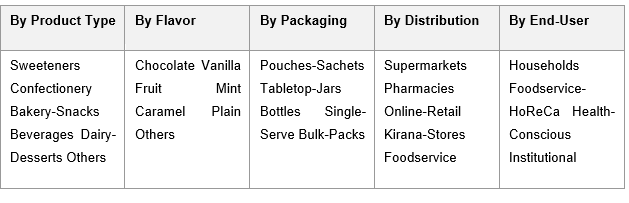
In this report, the India Sugar Free Foods Market has been segmented into the following categories, in addition to detailed analysis of key industry trends, market dynamics, competitive landscape, and growth opportunities across the forecast period:
- By Product Type
- Sugar-Free Sweeteners & Tabletop
- Sugar-Free Confectionery & Chocolates
- Sugar-Free Bakery & Snacks
- Sugar-Free Beverages
- Sugar-Free Dairy & Desserts
- Others
- By Flavor
- Chocolate
- Vanilla
- Fruit
- Mint
- Caramel
- Plain & Unflavored
- Others
- By Packaging
- Pouches & Sachets
- Tabletop Dispensers & Jars
- Bottles & Tetra Packs
- Single-Serve Packs
- Bulk & Institutional Packs
- By Distribution Channel
- Supermarkets & Hypermarkets
- Pharmacies & Chemists
- Online Retail & Quick Commerce
- Convenience & Kirana Stores
- Specialty Health Stores
- Foodservice & Institutional
- By End-User
- Households
- Foodservice & HoReCa
- Diabetic & Health-Conscious Consumers
- Institutional & Bulk Buyers
- By Geography
- North India
- South India
- West India
- East India
- Central India
Competitive Landscape
Company Profiles:
Detailed analysis of the leading companies operating in the India Sugar Free Foods Market, including business overview, product portfolio, strategic initiatives, competitive positioning, and recent developments.
Company Information
Detailed profiling and strategic analysis of additional market players (up to five companies), including emerging domestic sugar-free brands, specialty natural-sweetener and clean-label producers, regional health-food players, or niche sugar-free brands.
For a free sample of the India Sugar Free Foods Market report, customised insights or delivery timelines, submit your query here
Table of Contents
- Research Framework
- Market Segmentation
- Research Objective
- Research Methodology
- Qualitative Research
- Primary Research
- Secondary Research
- Quantitative Research
- Market Breakdown & Data Triangulation
- Demand Side
- Supply Side
- Primary Research Respondents
- Assumption & Limitation
- Executive Summary
- Market Overview, 2021-2032
- By Product Type
- By Flavor
- By Packaging
- By Distribution Channel
- By End-User
- By Region
- Analyst Recommendations
- Geopolitical Impact on India Sugar Free Foods Market
- India Sugar Free Foods Market Insights
- Market Dynamics
- Growth Drivers
- Rising diabetes and obesity prevalence, growing health consciousness, and increasing demand for low-calorie diets driving sugar-free foods demand across India.
- Expanding modern retail and online channels, rising disposable incomes, and shifting consumer preferences fuelling premium sugar-free food adoption.
- Product innovation in natural, stevia-based, and low-glycemic sugar-free foods strengthening packaged segment growth.
- Restraints
- Taste and aftertaste concerns with artificial sweeteners limiting frequency of sugar-free food consumption among consumers.
- High product cost and limited awareness among rural and middle-income consumers restricting penetration across India.
- Regulatory complexity around sweetener approvals and labelling and raw material cost pressures impacting overall margins.
- Opportunities
- Natural, stevia-based, and plant-derived sweetener innovation opening untapped consumer pools across metro and tier-1 cities.
- Sugar-free bakery, confectionery, and beverage expansion supporting next-generation growth in wellness and premium segments.
- Online retail, quick-commerce, and pharmacy-led distribution creating massive distribution opportunities.
- Challenges
- Intense competition from unorganized local products, generic sweeteners, and unbranded sugar-free offerings.
- Counterfeiting, mislabeling, and inconsistent quality across smaller Indian cities.
- Maintaining taste, texture, and quality consistency at scale across diverse Indian regional markets.
- Technological Advancements
- Recent Technological Advancements
- Prior to 2020
- Porter’s Five Forces Analysis
- PESTLE Analysis
- Industry Value Chain & Entry Points
- Upstream Raw Materials (natural and artificial sweeteners, stevia, sucralose, fiber, flavors, bulking agents, packaging materials)
- Sugar-Free Food Manufacturers & Processors (Zydus Wellness, Cargill, Tata Consumer, Dabur, Mondelez)
- Flavor & Ingredient Suppliers (chocolate, vanilla, fruit, mint, sweetener blends)
- Natural & Specialty Sweetener Makers (stevia, monk fruit, erythritol, plant-based blends)
- Quality Control, R&D & Testing Laboratories (FSSAI, BIS, ISO food safety standards)
- Distributors, Wholesalers & Modern Trade (B2B and B2C distribution networks)
- Modern Retail & Quick Commerce (Reliance Retail, DMart, BigBasket, Blinkit, Zepto)
- Brand Owners & Food Companies (Zydus Wellness, Tata Consumer, Dabur, Mondelez, Nestlé)
- Retail Channels & Online Delivery (Blinkit, Zepto, Instamart, BigBasket, Amazon, Flipkart)
- End-Users (households, diabetic consumers, health-conscious buyers, foodservice, institutional buyers)
- India Sugar Free Foods Market: Regulatory Framework
- India Sugar Free Foods Market Overview
- Market Size & Forecast, 2021-2032
- By Value (USD Million)
- By Volume (Thousand Tonnes)
- Market Share & Forecast
- By Product Type
- Sugar-Free Sweeteners & Tabletop
- Sugar-Free Confectionery & Chocolates
- Sugar-Free Bakery & Snacks
- Sugar-Free Beverages
- Sugar-Free Dairy & Desserts
- Others
- By Flavor
- Chocolate
- Vanilla
- Fruit
- Mint
- Caramel
- Plain & Unflavored
- Others
- By Packaging
- Pouches & Sachets
- Tabletop Dispensers & Jars
- Bottles & Tetra Packs
- Single-Serve Packs
- Bulk & Institutional Packs
- By Distribution Channel
- Supermarkets & Hypermarkets
- Pharmacies & Chemists
- Online Retail & Quick Commerce
- Convenience & Kirana Stores
- Specialty Health Stores
- Foodservice & Institutional
- By End-User
- Households
- Foodservice & HoReCa
- Diabetic & Health-Conscious Consumers
- Institutional & Bulk Buyers
- By Geography
- North India
- South India
- West India
- East India
- Central India
- Competitive Landscape
- India Sugar Free Foods Market Company Market Share Analysis, 2025
- Competitive Benchmarking, By Operating Parameters
- Key Strategic Development (Mergers, Acquisitions, Partnerships, Etc.)
- List of Emerging Players
- Company Profile
- Zydus Wellness Limited (Sugar Free Gold, Sugar Free Natura)
- Introduction & Company Profile
- Product Benchmarking
- Strategic Outlook
- Key Competitors
- Financial Analysis
- SWOT Analysis
(Same Data Pointers Will Be Provided for The Below Companies)
- Cargill India Pvt. Ltd. (Zerose, Truvia)
- Tata Consumer Products Limited (Tata Nx)
- Mars International India Pvt. Ltd. (Orbit)
- Mondelez India Foods Pvt. Ltd.
- Dabur India Limited
- Wholesome Sweeteners India
- IFF India Pvt. Ltd. (Danisco)
- Macleods Pharmaceuticals Limited
- Hexagon Nutrition Limited
- Patanjali Ayurved Limited
- Nestlé India Limited
- Britannia Industries Limited (NutriChoice)
- Other Prominent Players
* Financial information in case of non-listed companies will be provided as per availability
** The segmentation and the companies are subjected to modifications based on in-depth secondary for the final deliverable
Frequently Asked Questions
1. How large is the India sugar free foods market and what is its growth forecast?
Ans: The India sugar free foods market is valued at USD 520 million in 2025 and projected to reach USD 990 million by 2032, growing at a CAGR of 9.6% on rising health consciousness and diabetes prevalence.
2. Which segments are driving demand in the India sugar free foods market?
Ans: Sugar-free sweeteners and tabletop products lead with over 40% value share, while sugar-free beverages and confectionery are the fastest-growing segments, driven by diabetic, weight-conscious, and health-focused urban consumers.
3. What are the key drivers of growth in the India sugar free foods market?
Ans: Key drivers include rising diabetes and obesity prevalence, growing health consciousness, expanding modern retail and pharmacy channels, rising disposable incomes, product innovation in natural and stevia-based sweeteners, and rapid online retail scaling.
4. Which regions are driving growth in the India sugar free foods market?
Ans: South India and West India lead with around 54% to 58% of total value, driven by Karnataka, Tamil Nadu, Telangana, Maharashtra, and Gujarat. North India and Delhi NCR also show strong demand.
5. What are the latest trends in the India sugar free foods market?
Ans: The latest trends include rapid adoption of natural, stevia-based, and plant-derived sugar-free foods, growth in quick-commerce delivery, rising demand for clean-label variants, and functional sugar-free product innovation.