

India Spices Market Size, Share & Demand Outlook 2032
- Food, Beverage & Nutrition, Packaged Food
- Jul 2026
- Pages 140
- Report Format: pdf
- Report Price: $2400 USD
India’s spices market is witnessing strong structural growth, driven by deep culinary heritage, the shift from loose to branded packaged spices, rising health awareness, expanding food processing, growing demand for organic and GI-tagged products, expansion of e-commerce delivery platforms, and rising investment from domestic and global players in India-specific product innovation, certified supply chains, and export-oriented processing.
Report Description
| Study Duration | 2021-2032 |
| Market Size (2025) | USD 12.5 Billion |
| CAGR (2026-2032) | 8.5% |
| Leading Segment | Pure Spices |
| Fastest Growing Segment | Blended Spices & Masala |
| Market Size (2032) | USD 22.1 Billion |
Market Overview: India Spices Market
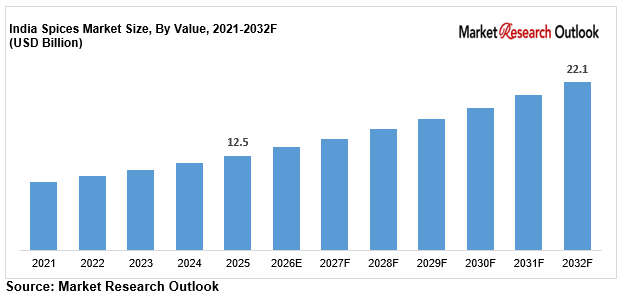
The India spices market size is witnessing steady expansion, driven by deep culinary heritage, the accelerating shift from loose to branded packaged spices, rising health awareness, expanding food processing, growing demand for organic and GI-tagged products, and major capacity additions by domestic majors. Valued at USD 12.5 billion in 2025 and projected to reach USD 22.1 billion by 2032, growing at a CAGR of 8.5%, the India spices market growth is being fuelled by strong household demand, rising disposable incomes, and the rapid scaling of e-commerce and quick-commerce platforms across metro and Tier-2 cities. Pure spices lead consumption, while the blended spices and masala segment is emerging as the fastest growing category. Shifting consumer preferences toward hygienic, branded, and value-added spices, growing wellness awareness, and rising demand for clean-label products are reshaping the supply landscape of the India spices market. As domestic majors including Everest, MDH, Catch, ITC, and Tata Consumer Products expand integrated farm-to-shelf capacity, and specialty players including Eastern Condiments, Zoff Foods, and Synthite Industries scale value-added pipelines, the India spices market is evolving into a consumer-led, innovation-driven, and digitally enabled ecosystem with strong long-term growth potential.
Related research: India Frozen Food Market, India Spreads Market and India Edible Oil Market.
Key Report Takeaways: India Spices Market
- The India spices market size is projected to grow from USD 12.5 billion in 2025 to USD 22.1 billion by 2032, registering a strong CAGR of 8.5%, driven by the accelerated shift to branded packaged spices, rising blended masala demand, and the structural move toward hygienic value-added products across urban India.
- Pure spices dominate the India spices market, accounting for 64% of total value in 2025, driven by strong household usage, deep export demand, and the widespread culinary role of chilli, turmeric, cumin, and coriander across organized retail and foodservice channels.
- Blended spices and masala are emerging as the fastest growing segments in the India spices market, expected to grow at 12% annually as ready-to-cook habits, smaller urban kitchens, and standardized cuisine blends reshape sourcing strategies across metro and Tier-2 markets.
- Rapid scaling of organized retail and e-commerce, with 24,000 organized spice outlets across India by 2025 and projected expansion to 36,000 by 2030, is structurally expanding the India spices market across modern retail, specialty, and online delivery categories.
- Rising investments by domestic majors such as Everest, MDH, ITC, and Tata Consumer Products in certified supply chains, grinding and packing capacity, and value-added variants are strengthening local supply and supporting the India spices market forecast 2032.
Key Market Drivers: India Spices Market
Deep Culinary Heritage, Rising Household Consumption, and the Shift from Loose to Branded Packaged Spices
Growth in the India spices market is being driven by deep culinary heritage, rising household consumption, and the structural shift from loose to branded packaged spices across metro, Tier-1, and Tier-2 cities. India is the world’s largest producer, consumer, and exporter of spices, accounting for over 70% of global spice exports and growing more than 75 varieties across diverse agro-climatic zones. An average Indian household consumes nearly 3 kg of spices every year, reflecting the indispensable daily role of spices in Indian cooking. The unorganized sector still accounts for 70% of the India spices market, indicating significant long-term headroom for branded conversion. Rising food-safety concerns, growing awareness of adulteration, and expanding FSSAI standardization are accelerating the shift toward hygienic, tamper-proof, and trusted branded spices, creating strong structural pull-through demand across the India spices market.
Rising Health Consciousness, Clean-Label Demand, and Premium Organic Spice Adoption Driving Value Growth
The India spices market is benefiting from rising health consciousness, growing clean-label demand, and accelerating premium organic spice adoption. Certified organic and clean-label spices command a 40% price premium over conventional products, yet rising affordability and wellness awareness are driving adoption among urban households. According to ASSOCHAM, organic produce purchases in Indian cities have risen sharply, with 62% of metro consumers now buying organic products. Turmeric, cumin, and coriander are among the fastest-growing organic spices, supported by their medicinal value in Ayurveda and rising demand for natural flavoring over synthetic additives. India contributes over 80% of global turmeric production, with the domestic turmeric segment valued at USD 1.4 billion in 2025. Domestic processing and value-added capacity has scaled rapidly, led by Everest, MDH, Catch, ITC, and Tata Consumer Products. FSSAI labelling reforms, GI tagging, and growing trust in certified spices have further strengthened organized supply, supporting value realisation across the India spices market. Young consumers between 25 and 44 years now account for 55% of branded spice consumption, preferring clean-label products, premium packaging, and traceable sourcing.
Food Processing Expansion, E-Commerce Growth, and Government Export Promotion Strengthening Organized Spices Demand
Strong food processing expansion, rapid e-commerce growth, and active government export promotion are major catalysts for the India spices market, with the blended spices segment projected to grow at 12% annually through 2032. The Ministry of Food Processing Industries approved 1,608 projects, including 41 Mega Food Parks and 394 cold-chain projects, structurally supporting spice processing and value addition. India’s e-commerce industry, valued at USD 125 billion in 2024, is projected to reach USD 345 billion by 2030 at a CAGR of 15%, rapidly expanding digital spice distribution. India’s spice exports reached USD 4.45 billion in FY2024-25, with the Spices Board of India’s SPICED scheme carrying an INR 422.30 crore outlay to support export promotion, quality upgradation, and processing infrastructure. Gujarat’s Mehsana region alone exported INR 3,995 crore of cumin and fennel in 2025, reflecting the depth of India’s spice export base. Leading players including Everest, MDH, ITC, and Tata Consumer Products have scaled branded and value-added pipelines, with the blended spices segment representing an estimated USD 2.5 billion addressable opportunity in India. Food processing growth combined with corporate investment is structurally expanding India spices market growth across all major categories through 2032.
Key Market Challenges: India Spices Market
Climate Change, Monsoon Variability, and Price Volatility Affecting Spice Crop Yields and Margins
The India spices market continues to face challenges around climate change, monsoon variability, and price volatility, which directly affect spice crop yields and margins. Spice cultivation depends heavily on monsoon patterns, and extreme weather events such as droughts, floods, or unseasonal rainfall can significantly reduce crop yields. This imbalance between supply and demand often leads to sharp fluctuations in spice prices, affecting farmers, manufacturers, and exporters across the value chain. Since a large portion of spice production is handled by small-scale farmers, they remain particularly vulnerable to climate risks and price swings. India’s continued dependence on rain-fed spice cultivation and the fragmented nature of upstream supply limit price stability and predictable sourcing across the India spices market.
Market Fragmentation, Quality Control, and Food-Safety Compliance Across Tier-2 and Tier-3 Cities
The India spices market faces structural complexity from market fragmentation, quality control gaps, and food-safety compliance requirements across different cities. While metros such as Delhi, Mumbai, Bengaluru, Chennai, and Hyderabad have well-established branded spice retail and testing frameworks, smaller cities maintain limited certified supply and infrastructure. The unorganized sector accounts for 70% of the India spices market, with local chakkis and regional brands holding significant volumes, creating supply fragmentation. Rising FSSAI scrutiny and past export quality flags in overseas markets have increased compliance requirements for grinding, testing, and traceability. Differential availability of certified supply, testing labs, and traceability across states creates operational complexity for players such as Everest, MDH, Catch, and Tata Consumer Products operating pan-India. While government schemes support processing infrastructure development, fragmentation remains a near-term challenge for the India spices market.
Adulteration Concerns, Certification Gaps, and Export Quality Rejections Impacting Trust
The India spices market faces practical constraints around adulteration concerns, certification gaps, and export quality rejections that impact consumer and buyer trust. Adulteration and contamination risks raise food-safety concerns and can trigger export rejections in premium markets, affecting brand reputation and realisation. Smaller spice brands face additional complexity in maintaining consistent certified and residue-compliant supply without losing volume. Average gross margins for branded spices in India stand near 32%, reducing the effective profitability of new launches amid raw material and compliance costs. Certified supply expansion, farmer producer organizations, cold-ground processing, and investment in testing and traceability infrastructure are emerging as solutions to differentiate, but purity assurance and certification coverage remain barriers to widespread branded adoption across the India spices market.
Key Market Trends: India Spices Market
Structural Shift from Loose to Branded, Packaged, and Value-Added Spices in India
The India spices market is undergoing a clear shift from loose to branded, packaged, and value-added spices, with branded formats expected to capture 40% of the market by 2032, up from 30% in 2025. Packets and pouches dominate the packaging form at 67% in 2025, driven by consumer preference for hygienic, tamper-proof, portion-controlled packaging with standardized quality and extended shelf life. Ready-to-cook masala blends, cold-ground spices, and GI-tagged premium variants deliver higher value realisation, while clean-label and traceable products serve health-conscious consumers. Leading domestic brands including Everest, MDH, Catch, ITC, and Tata Sampann have scaled branded and value-added spice production capacity through 2024 and 2025. Functional and organic spices with medicinal positioning are also gaining traction, particularly in metro cities such as Mumbai and Bengaluru, with brands like Zoff Foods, Badshah, and Aachi offering value-positioned spice variants. This product transition is reinforcing the India spices market forecast 2032 across both retail and specialty categories.
Growth of E-Commerce, Quick-Commerce, and Digital Distribution in the India Spices Market
A clear shift toward e-commerce, quick-commerce, and digital distribution models is reshaping the India spices market, particularly in the urban and metro segment. Under quick-commerce platforms such as Blinkit, Zepto, BigBasket, and Instamart, packaged spices are delivered within 20 minutes at prices competitive with kirana stores. Leading e-commerce platforms including Amazon India and Flipkart have built combined operational reach across more than 100 Indian cities, with spices ranking among the fastest-growing grocery categories ordered online. In May 2025, Everest deepened its presence on Blinkit, Zepto, and Amazon, rolling out sprinkler-pack SKUs and bundled cuisine kits to convert unbranded household demand into branded category sales. Digital platforms are also reducing customer acquisition costs and accelerating branded adoption across both retail and quick-commerce segments of the India spices market. By 2025, online channels account for 11% of packaged spice sales in India, up from 4% in 2020, with metro buyers increasingly preferring same-day delivery convenience over loose in-store purchase.
Premiumization, Organic, GI-Tagged Products, and Corporate Consolidation Across India
A wave of premiumization, organic and GI-tagged product growth, and corporate consolidation is reshaping the India spices market supply landscape. Combined India-focused capital and acquisition activity in spices and allied categories exceeded USD 500 million across 2023 to 2025. In June 2025, ITC acquired Sresta Natural Bioproducts, the company behind 24 Mantra Organic, in an INR 472.5 crore all-cash deal, strengthening its organic and spices presence. In September 2025, MDH commissioned new automated grinding and nitrogen-flushed packing lines to lift throughput and strengthen export compliance. The increasing focus on high-potency GI-tagged spices such as Byadgi chilli and Lakadong turmeric is unlocking niche export potential. Government schemes, Spices Board certification, and growing farmer producer organizations have structurally favoured organized supply. Combined with specialty retail expansion driving demand and e-commerce procurement scaling rapidly, these developments are reinforcing the India spices market forecast 2032 across the entire value chain.
Segmental Insights: India Spices Market
By Application: Household Segment Dominates the India Spices Market
The household and retail application segment dominates the India spices market, accounting for 55% of total consumption, driven by deep culinary heritage, daily home cooking, and improving branded retail access. Chilli, turmeric, cumin, coriander, and blended masala capture the majority of household spice purchases. The foodservice segment covering hotels, restaurants, and cafés contributes 22% of demand, driven by QSR chains, cloud kitchens, and premium hospitality adopting standardized masala blends. Food processing and manufacturing accounts for 15%, led by packaged food, snacks, and ready-to-cook producers sourcing bulk spices. Industrial applications across pharmaceutical, nutraceutical, and cosmetic uses account for 8%, supported by spice extracts and oleoresins. In 2025, leading players including Everest, MDH, Catch, and Tata Consumer Products scaled up household and foodservice spice deployment under modern retail and e-commerce expansion, reinforcing segment dominance in the India spices market.
By Category: Pure Spices Lead While Blended Spices and Masala Grow Fastest
Pure spices lead the India spices market category landscape, accounting for 64% of total value, driven by strong household usage, deep export demand, and the widespread culinary role of chilli, turmeric, cumin, and coriander. Powdered spice formats lead by form with a 58% share, driven by convenience, ease of storage, and uniform dosage control. Blended spices and masala are the fastest growing category within the India spices market, expanding at 12% annually, driven by ready-to-cook habits, smaller urban kitchens, and standardized cuisine blends. Spice extracts, oleoresins, and organic spices are also gaining share, supported by industrial and premium demand through 2032. Leading manufacturers including Everest, MDH, Catch, ITC, and Tata Consumer Products have aligned product portfolios to this category mix, driving branded and value-added adoption across the India spices market.
Regional Insights: India Spices Market
Regional analysis of the India spices market shows that South India and North India collectively account for 59% of total spices value, driven by Kerala, Tamil Nadu, Karnataka, Andhra Pradesh, Telangana, Delhi NCR, Punjab, and Uttar Pradesh, supported by deep spice cultivation heritage, established retail infrastructure, and strong household demand. South India alone contributes 31% of demand, anchored by Kerala’s pepper and cardamom belts, Tamil Nadu turmeric, and Guntur chilli, making it the leading production and consumption hub. North India contributes 28% of demand, led by Delhi NCR, Punjab, Haryana, and Uttar Pradesh, supported by household and branded masala adoption. West India adds 23%, anchored by Maharashtra and Gujarat, while East and Central India together account for 18%, supported by West Bengal, Odisha, and Madhya Pradesh, where spice farming and modern retail adoption are accelerating. In 2025, capacity additions and distribution operations by Everest across West India, MDH across North India, and Synthite across South India reinforced regional supply hubs, supporting closer execution of retail and export projects across the India spices market.
Recent Developments: India Spices Market
- The India spices market witnessed strong momentum in launches and capacity progress during 2024 and 2025. India’s spice exports reached USD 4.45 billion in FY2024-25, supplying China, Bangladesh, the UAE, the U.S., and Europe. E-commerce platforms recorded strong double-digit growth in branded spice orders, with the blended masala segment accounting for a rising share of new online purchases. The domestic turmeric segment alone was valued at USD 1.4 billion in 2025, reflecting India’s dominance in global turmeric production.
- Domestic majors have deepened India-focused capacity and consolidation. In June 2025, ITC acquired Sresta Natural Bioproducts, the company behind 24 Mantra Organic, in an INR 472.5 crore all-cash deal, and in September 2025, MDH commissioned new automated grinding and nitrogen-flushed packing lines, while Everest and Tata Sampann scaled branded and value-added portfolios. These developments are strengthening domestic supply and supporting the India spices market forecast 2032.
- Specialty retail and e-commerce momentum has gained strong traction in the India spices market. In 2025, leading players including Everest, MDH, Catch, ITC, and Tata Consumer Products expanded branded offerings and quick-commerce distribution across Blinkit, Zepto, and Amazon. Strategic partnerships between domestic brands and e-commerce platforms are positioning India as one of the most actively scaling spice markets globally, strengthening long-term competitive positioning in the India spices market forecast 2032.
Key Market Players: India Spices Market
- Everest Food Products Pvt. Ltd.
- Mahashian Di Hatti Pvt. Ltd. (MDH)
- DS Group (Catch Foods)
- ITC Limited (Aashirvaad Spices)
- Tata Consumer Products Limited (Tata Sampann)
- Eastern Condiments Pvt. Ltd.
- Aachi Masala Foods Pvt. Ltd.
- Orkla India (MTR Foods)
- Badshah Masala Pvt. Ltd.
- Ramdev Food Products Pvt. Ltd.
- Patanjali Ayurved Limited
- Synthite Industries Ltd.
- Zoff Foods Pvt. Ltd.
Report Scope
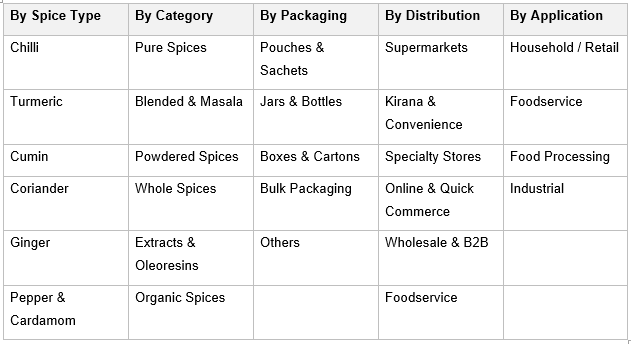
In this report, the India Spices Market has been segmented into the following categories, in addition to detailed analysis of key industry trends, market dynamics, competitive landscape, and growth opportunities across the forecast period:
- By Spice Type
- Chilli
- Turmeric
- Cumin
- Coriander
- Ginger
- Pepper & Cardamom
- By Category
- Pure Spices
- Blended Spices & Masala
- Powdered Spices
- Whole Spices
- Crushed & Cracked
- Spice Extracts & Oleoresins
- Organic Spices
- By Packaging
- Pouches & Sachets
- Jars & Bottles
- Boxes & Cartons
- Bulk Packaging
- Others
- By Distribution Channel
- Supermarkets & Hypermarkets
- Kirana & Convenience Stores
- Specialty Stores
- Online Retail & Quick Commerce
- Wholesale & B2B
- Foodservice & Institutional
- By Application
- Household / Retail
- Foodservice (Hotels, Restaurants, Cafés)
- Food Processing & Manufacturing
- Industrial (Pharma, Nutraceutical, Cosmetics)
- By Geography
- North India
- South India
- West India
- East India
- Central India
Competitive Landscape
Company Profiles:
Detailed analysis of the leading companies operating in the India Spices Market, including business overview, product portfolio, strategic initiatives, competitive positioning, and recent developments.
Company Information
Detailed profiling and strategic analysis of additional market players (up to five companies), including emerging spice brands, specialty value-added producers, regional masala players, or niche direct-to-consumer spice brands.
For a free sample of the India Spices Market report, customised insights or delivery timelines, submit your query hereresearch@marketresearchoutlook.com
Table of Contents
- Research Framework
- Market Segmentation
- Research Objective
- Research Methodology
- Qualitative Research
- Primary Research
- Secondary Research
- Quantitative Research
- Market Breakdown & Data Triangulation
- Demand Side
- Supply Side
- Primary Research Respondents
- Assumption & Limitation
- Executive Summary
- Market Overview, 2021-2032
- By Spice Type
- By Category
- By Packaging
- By Distribution Channel
- By Application
- By Region
- Analyst Recommendations
- Geopolitical Impact on India Spices Market
- India Spices Market Insights
- Market Dynamics
- Growth Drivers
- Deep culinary heritage, rising household consumption, and the structural shift from loose to branded packaged spices across India.
- Rising health consciousness, clean-label demand, and premium organic spice adoption driving value growth.
- Food processing expansion, e-commerce and quick-commerce growth, and government export promotion strengthening organized spices demand.
- Restraints
- Climate change, monsoon variability, and price volatility affecting spice crop yields and margins.
- Market fragmentation with a large unorganized base, quality control, and food-safety compliance restricting branded spices growth.
- Adulteration concerns, certification gaps, and export quality rejections impacting trust across the spices value chain.
- Opportunities
- Branded, packaged, and ready-to-cook masala innovation converting unbranded household spices demand.
- Certified organic and GI-tagged premium spices unlocking domestic and export value.
- E-commerce, quick-commerce, and value-added extracts and oleoresins expanding distribution reach.
- Challenges
- Intense competition from unorganized players, local chakkis, and uncertified regional spice brands.
- Limited cold-chain, testing, and traceability infrastructure across smaller Indian markets.
- Maintaining purity, authenticity, and quality consistency at scale across diverse spice supply chains.
- Technological Advancements
- Recent Technological Advancements
- Prior to 2020
- Porter’s Five Forces Analysis
- PESTLE Analysis
- Industry Value Chain & Entry Points
- Upstream Inputs (spice seeds, saplings, bio-inputs, agri-inputs, farm equipment)
- Spice Farmers & Farmer Producer Organizations (FPOs, cooperatives, grower clusters)
- Spices Board of India & Certification (GI tags, organic certification, quality standards)
- Aggregators, Traders & Auction Centres (spice mandis, e-auctions, commission agents)
- Processing, Grinding & Blending (cleaning, drying, grinding, blending, sterilization)
- Quality Control, Testing & Food-Safety Laboratories (FSSAI, Spices Board labs, residue testing)
- Packaging & Value Addition (powders, blends, extracts, oleoresins, seasonings)
- Brand Owners & Packaged Spice Companies (Everest, MDH, Catch, Tata Sampann, ITC)
- Distribution, Modern Trade & E-Commerce (BigBasket, Amazon India, Blinkit, Zepto, kirana)
- End-Consumers & Export Markets (households, HoReCa, food processing, global buyers)
- India Spices Market: Regulatory Framework
- India Spices Market Overview
- Market Size & Forecast, 2021-2032
- By Value (USD Billion)
- By Volume (Million Tonnes)
- Market Share & Forecast
- By Spice Type
- Chilli
- Turmeric
- Cumin
- Coriander
- Ginger
- Pepper & Cardamom
- By Category
- Pure Spices
- Blended Spices & Masala
- Powdered Spices
- Whole Spices
- Crushed & Cracked
- Spice Extracts & Oleoresins
- Organic Spices
- By Packaging
- Pouches & Sachets
- Jars & Bottles
- Boxes & Cartons
- Bulk Packaging
- Others
- By Distribution Channel
- Supermarkets & Hypermarkets
- Kirana & Convenience Stores
- Specialty Stores
- Online Retail & Quick Commerce
- Wholesale & B2B
- Foodservice & Institutional
- By Application
- Household / Retail
- Foodservice (Hotels, Restaurants, Cafés)
- Food Processing & Manufacturing
- Industrial (Pharma, Nutraceutical, Cosmetics)
- By Geography
- North India
- South India
- West India
- East India
- Central India
- Competitive Landscape
- India Spices Market Company Market Share Analysis, 2025
- Competitive Benchmarking, By Operating Parameters
- Key Strategic Development (Mergers, Acquisitions, Partnerships, Etc.)
- List of Emerging Players
- Company Profile
- Everest Food Products Pvt. Ltd.
- Introduction & Company Profile
- Product Benchmarking
- Strategic Outlook
- Key Competitors
- Financial Analysis
- SWOT Analysis
(Same Data Pointers Will Be Provided for The Below Companies)
- Mahashian Di Hatti Pvt. Ltd. (MDH)
- DS Group (Catch Foods)
- ITC Limited (Aashirvaad Spices)
- Tata Consumer Products Limited (Tata Sampann)
- Eastern Condiments Pvt. Ltd.
- Aachi Masala Foods Pvt. Ltd.
- Orkla India (MTR Foods)
- Badshah Masala Pvt. Ltd.
- Ramdev Food Products Pvt. Ltd.
- Patanjali Ayurved Limited
- Synthite Industries Ltd.
- Zoff Foods Pvt. Ltd.
- Other Prominent Players
* Financial information in case of non-listed companies will be provided as per availability
** The segmentation and the companies are subjected to modifications based on in-depth secondary for the final deliverable
Frequently Asked Questions
1. How large is the India spices market and what is its growth forecast?
Ans: The India spices market is valued at USD 12.5 billion in 2025 and is projected to reach USD 22.1 billion by 2032, growing at a CAGR of 8.5%.
2. Which segments are driving demand in the India spices market?
Ans: Pure spices lead with a 64% value share, while blended spices and masala are the fastest-growing segments, driven by ready-to-cook habits and standardized cuisine blends.
3. What are the key drivers of growth in the India spices market?
Ans: Key drivers include deep culinary heritage, the shift from loose to branded spices, rising health and organic demand, food processing expansion, and e-commerce and export growth.
4. Which regions are driving growth in the India spices market?
Ans: South India and North India lead with around 59% of total value. South India alone contributes 31%, anchored by Kerala, Tamil Nadu, and Andhra Pradesh spice belts.
5. What are the latest trends in the India spices market?
Ans: Latest trends include the shift to branded packaged spices, growth in e-commerce delivery, premium organic and GI-tagged products, and rising blended masala and value-added launches.