

India Ready to Eat Food Market Size, Share & Forecast 2032
- Food, Beverage & Nutrition, Packaged Food
- Apr 2026
- Pages 120
- Report Format: pdf
- Report Price: $2400 USD
India’s ready to eat food market is growing strongly, driven by convenience demand, urban lifestyles, premium offerings, e-commerce expansion, regional taste innovation, and increasing adoption of packaged meal solutions.
Report Description
| Study Duration | 2021-2032 |
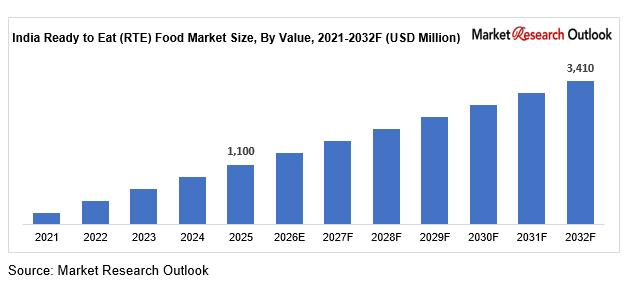
| Market Size (2025) | USD 1,100 Million |
| CAGR (2026-2032) | 18% |
| Leading Segment | Ready Meals & Meal Kits |
| Fastest Growing Segment | Instant Noodles & Pasta |
| Market Size (2032) | USD 3,410 Million |
Market Overview
The India Ready to Eat (RTE) Food market has transitioned from a specialized dietary niche into a commercially significant USD 1,100 Million industrial segment by the end of the 2032 strategic horizon. Having established a baseline valuation of USD 3,410 Million in 2025, the market is currently expanding at a robust and consistent CAGR of 18%. The current urban growth pattern receives its primary driving force from changing city living standards and rising employment rates and the increasing demand for efficient meal solutions. RTE products have transformed from being treated as temporary food alternatives to becoming essential components of everyday eating habits among people who live in urban and semi-urban areas of India.
The market research shows that Ready Meals and Meal Kits have reached market leadership because they provide complete meal solutions which require almost no time to prepare. The market shows rapid growth for Instant Noodles and Pasta and Frozen Foods because these products offer low prices and extended shelf life and they remain popular with young consumers. The demand for Soups and Broths together with Breakfast Cereals and Desserts has increased because consumers want to have different meal options that they can easily prepare for their daily dining needs.
Related research: India Packaged Food Market, India Biscuits Market and India Confectionery Market.
The competitive landscape is becoming increasingly dynamic, The market benefits from active participation from both FMCG corporations and food startups and D2C companies. FSSAI regulatory oversight requires food businesses to follow strict standards for food safety and product labeling and nutritional requirements, which results in increased consumer trust. RTE food innovation now focuses on developing healthy products that feature transparent ingredient lists and authentic regional dishes as the market approaches its 2032 maturity point.
Market Drivers
The Urban Time Crunch: Demand for Convenience Foods
The RTE market in India experiences growth because of the country’s fast-moving urban lifestyle. The rising workforce participation among women together with nuclear family growth has led consumers to search for meal options that need minimal cooking time. RTE products address this need by offering ready-to-consume or easy-to-prepare options which time-constrained consumers find highly appealing.
The Youth Factor: Changing Consumption Habits
The total number of people who need immediate food delivery services includes both students and working professionals because they make up the largest part of the young population demographic. The combination of international food exposure and online content and changing consumer taste patterns has led to increased testing of new ready-to-eat food products.
Market Challenges
Perception of Preservatives and Health Concerns
A portion of consumers still holds back on purchasing RTE foods because they worry about the sodium content and nutritional value and the presence of preservatives. The manufacturers face an obstacle because the public perception demands that they develop products with clean labels and provide complete information about their ingredients.
Cold Chain and Storage Limitations
The market offers many ready-to-eat products that do not require refrigeration but frozen and chilled food items need refrigerated supply chains to remain available. In Tier-2 and Tier-3 markets which have only minimal refrigeration capacity stores face challenges because their products become unavailable while their distribution expenses rise, which hinders their ability to reach customers.
Segmental Analysis
Indian RTE food market currently operates under the dominance of Ready Meals and Meal Kits which provide customers with complete meal solutions that can be prepared easily. Instant Noodles and Pasta maintain their strong market presence because they are both inexpensive and highly preferred by young consumers while Frozen Foods are becoming increasingly popular as a high-end convenient meal solution. The total market share of Snacks and Savories along with Breakfast Cereals and Oats products reaches substantial levels because they provide customers with quick meal options that they can consume throughout their day. Soups and Broths together with Desserts and Sweet Snacks have developed into supplementary product categories which contribute to the overall product range.
By cuisine type, Indian Cuisine dominates the market, The public clearly shows their preference for well-known flavors which they can find in traditional dishes. However, Chinese Asian Cuisine and Continental Western Cuisine are experiencing rapid growth because of international trade and shifts in consumer tastes. The popularity of Multi-Cuisine Fusion products is increasing because they provide new taste experiences which suit the preferences of Indian customers.
Regional Analysis
The India RTE food market develops from urban centers because West India leads market growth through its high disposable income and fast lifestyle of its Mumbai and Pune residents. The area serves as a center for creating new products and selling high-end products. South India emerges as a major growth market because its urban areas expand and its people become more familiar with technology in Bengaluru and Hyderabad and Chennai. The area shows high customer interest in both traditional RTE products and RTE products that combine different culinary styles.
Recent Developments
- On March 2024, SATS Food Solutions India (SFSI), a wholly owned subsidiary of SATS Ltd (SATS) opened its largest international food solutions facility in Bengaluru, India. The facility which covers 221000 square feet at its location near Kempegowda International Airport will function as the main kitchen for the company’s newly established ready-to-eat RTE business in India. “Our discovery of India’s diverse cultural heritage together with its fast-paced development has become an excellent business opportunity for the company.
Key Market Players
- Nestlé India Ltd.
- ITC Limited
- MTR Foods Pvt. Ltd.
- Haldiram’s Snacks Pvt. Ltd.
- Britannia Industries Ltd.
- Tata Consumer Products Ltd.
- Amul (GCMMF)
- Godrej Agrovet Ltd. (Godrej Yummiez)
- McCain Foods India Pvt. Ltd.
- Gits Food Products Pvt. Ltd.
Segmentation
- Product Type
- Ready Meals & Meal Kits
- Instant Noodles & Pasta
- Frozen Foods
- Canned & Preserved Foods
- Snacks & Savories
- Breakfast Cereals & Oats
- Soups & Broths
- Desserts & Sweet Snacks
- Others
- Cuisine Type
- Indian Cuisine
- Continental / Western Cuisine
- Chinese & Asian Cuisine
- Multi-Cuisine / Fusion
- Others
- Dietary Type
- Vegetarian
- Non-Vegetarian
- Vegan
- Gluten-Free
- Low-Calorie / Diet
- Others
- Packaging Type
- Pouches & Sachets
- Trays & Bowls
- Cans & Tins
- Boxes & Cartons
- Cups & Containers
- Others
- Storage Type
- Ambient / Shelf-Stable
- Chilled / Refrigerated
- Frozen
- End User
- Working Professionals
- Students & Youth
- Households
- HoReCa (Hotels, Restaurants & Catering)
- Others
- Distribution Channel
- Supermarkets & Hypermarkets
- Convenience Stores & Kirana Stores
- Online Retail / E-commerce
- Quick Commerce (Q-Commerce)
- Direct-to-Consumer (D2C)
- Foodservice / HoReCa
- Others
- Region
- East India
- West India
- North India
- South India
Table of Contents:
- Executive Summary
- Research Methodology
- Report Scope
- Market Definition
- Inclusions & Exclusions
- Research Methodology
- India RTE Food Market Overview
- Market Evolution in India
- Industry Value Chain Overview
- Ecosystem Mapping
- Pricing Analysis Overview
- Market Dynamics
- Drivers
- Challenges
- Opportunities
- Emerging Trends
- Market Attractiveness Index
- Consumer Behaviour Analysis
- Buying Patterns
- Price Sensitivity
- Urban vs Tier 2 Demand
- Policy & Regulatory Landscape
- India RTE Food Market Outlook
- Market Size & Forecast, 2021-2032
- By Value
- By Volume
- Market Share & Forecast by Product Type
- Ready Meals & Meal Kits
- Instant Noodles & Pasta
- Frozen Foods
- Canned & Preserved Foods
- Snacks & Savories
- Breakfast Cereals & Oats
- Soups & Broths
- Desserts & Sweet Snacks
- Others
- Market Share & Forecast by Cuisine Type
- Indian Cuisine
- Continental / Western Cuisine
- Chinese & Asian Cuisine
- Multi-Cuisine / Fusion
- Others
- Market Share & Forecast by Dietary Type
- Vegetarian
- Non-Vegetarian
- Vegan
- Gluten-Free
- Low-Calorie / Diet
- Others
- Market Share & Forecast by Packaging Type
- Pouches & Sachets
- Trays & Bowls
- Cans & Tins
- Boxes & Cartons
- Cups & Containers
- Others
- Market Share & Forecast by Storage Type
- Ambient / Shelf-Stable
- Chilled / Refrigerated
- Frozen
- Market Share & Forecast by End User
- Working Professionals
- Students & Youth
- Households
- HoReCa (Hotels, Restaurants & Catering)
- Others
- Market Share & Forecast by Distribution Channel
- Supermarkets & Hypermarkets
- Convenience Stores & Kirana Stores
- Online Retail / E-commerce
- Quick Commerce (Q-Commerce)
- Direct-to-Consumer (D2C)
- Foodservice / HoReCa
- Others
- Market Share & Forecast by Region
- North India
- South India
- West India
- East India
- Market Size & Forecast, 2021-2032
- Competitive Landscape
- Market Share Analysis
- Competitive Benchmarking
- Company Profiles
- Product Portfolio Comparison
- Strategic Developments
- Strategic Recommendations
- Growth Strategies for New Entrants
- Expansion Strategies for Existing Players
- Investment Opportunities
Frequently Asked Questions
1. What is the projected market size of the India Ready to Eat (RTE) Food Market in 2025?
Ans: The India Ready to Eat (RTE) Food market is estimated to be valued at approximately USD 1,100 Million in 2025.
2. What is the expected growth rate (CAGR) of the India Ready to Eat (RTE) Food Market during the forecast period?
Ans: The market is expected to exhibit a robust CAGR of 18% during the forecast period between 2026 and 2032.
3. What is the forecast value of the India Ready to Eat (RTE) Food Market by 2032?
Ans: By the end of the strategic horizon in 2032, the India Ready to Eat (RTE) Food market is projected to reach a valuation of approximately USD 3,410 Million.
4. What are the major factors driving the growth of the India Ready to Eat (RTE) Food Market?
Ans: The current urban growth pattern receives its primary driving force from changing city living standards and rising employment rates and the increasing demand for efficient meal solutions.
5. Name the key players operating in the India Ready to Eat (RTE) Food Market.
Ans: Prominent players shaping the Indian landscape include Nestlé India Ltd., ITC Limited, MTR Foods Pvt. Ltd., Haldiram’s Snacks Pvt. Ltd., Britannia Industries Ltd., Tata Consumer Products Ltd., Amul (GCMMF), Godrej Agrovet Ltd. (Godrej Yummiez), McCain Foods India Pvt. Ltd., Gits Food Products Pvt. Ltd. and other prominent players.