

India Ortho Xylene Market Size & Demand Outlook 2032
- Chemicals & Advanced Materials, Petrochemicals & Intermediates
- Apr 2026
- Pages 121
- Report Format: pdf
- Report Price: $2400 USD
India’s ortho xylene market is growing steadily, driven by phthalic anhydride demand, solvent usage, petrochemical expansion, and downstream industrial applications across plastics, coatings, resins, and agrochemicals.
Report Descripton
| Study Duration | 2021-2032 |
| Market Size (2025) | USD 175 Million |
| CAGR (2026-2032) | 3% |
| Leading Segment | Pure / Refined Ortho Xylene |
| Fastest Growing Segment | Technical Grade Ortho Xylene |
| Market Size (2032) | USD 215 Million |
Market Overview
The India ortho xylene market is valued at USD 175 Million in 2025 and is projected to reach USD 215 Million by 2032, growing at a steady CAGR of 3%. Demand comes mainly from phthalic anhydride (PA) production, which feeds plasticizers, resins and coatings. As India builds out its infrastructure, automotive and manufacturing base, that downstream demand keeps ortho xylene consumption on a stable upward path.
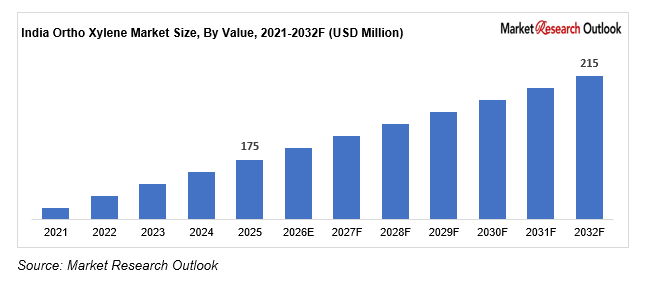
The market for Pure and Refined Ortho Xylene exists because its high purity levels meet the essential needs of PA production and specialty chemical production. The Technical Grade Ortho Xylene product persists in receiving consistent demand from industrial applications that prioritize cost efficiency. Phthalic Anhydride Production stands as the largest application segment while Plasticizers and Alkyd Resins showcase rapid growth because of their rising usage in flexible plastics and coatings.
Related research: India Specialty Chemicals Market, India Phenol Market and India Caprolactam Market.
The competitive landscape is characterized by large integrated petrochemical players with strong refining capabilities and backward integration into feedstocks like naphtha. The current market situation requires regulatory frameworks which establish environmental safety standards and emission control requirements to govern both production and usage practices. The market will reach its mature stage in 2032 which will drive innovation efforts toward developing process efficiency improvements and cleaner production methods and specialty chemical production technologies.
Market Drivers
The Downstream Pull: Growth in Phthalic Anhydride and Plasticizers
The demand for ortho xylene depends on phthalic anhydride production because phthalic anhydride serves as a main ingredient in plasticizers and alkyd resins and coatings. The construction and automotive and packaging industries are expanding their operations which creates a growing requirement for flexible plastics and high-performance coatings that results in increased ortho xylene consumption.
Infrastructure and Industrial Expansion
India needs paints and coatings and adhesives and construction chemicals because its current infrastructure development work needs housing and transportation and industrial projects. The industries depend on ortho xylene derivatives as their main raw material for production needs.
Market Challenges
Feedstock Price Volatility and Import Dependence
The ortho xylene market requires naphtha which comes from crude oil as its main production material. The oil price changes throughout the world create production cost problems which affect both manufacturers and end users.
Environmental and Regulatory Pressures
Environmental concerns about volatile organic compounds (VOCs) and chemical emissions have created demand for stricter regulations. Environmental standards compliance will raise operational costs while it affects material selection decisions for specific applications.
Segmental Analysis
The 99%plus purity level holds the highest market share because downstream applications, especially phthalic anhydride production, demand strict quality standards. The 98%–99% segment serves mid-range applications, while Below 98% purity is limited to niche industrial uses.
The production process of Catalytic Reforming exists as the primary method because it performs better and combines seamlessly with refinery operations. Toluene Disproportionation and Coal Tar Distillation provide minor contributions which serve particular production requirements.
Regional Analysis
The India ortho xylene market demonstrates geographic distribution through locations that possess robust petrochemical and industrial facilities. The West Indian market exists in Gujarat and Maharashtra because these areas contain major refineries and chemical production facilities. The area functions as a primary site for both production and consumption activities. The industrial growth and textile, coatings, and paints sector needs drive South India’s paint consumption. States like Tamil Nadu and Karnataka are key contributors.
Recent Developments
- On December 2025, Petrochemical production has become the latest essential energy project that multiple countries across the globe now pursue as their energy requirement. India has demonstrated its high aspirations for the petrochemical industry by announcing that Haldia Petrochemicals plans to restore the Nagrajuna refinery which will be constructed together with a new petrochemical plant in the upcoming future.
Key Market Players
- Reliance Industries Limited
- Indian Oil Corporation Ltd.
- Bharat Petroleum Corporation Ltd.
- Hindustan Petroleum Corporation Ltd.
- ONGC Petro Additions Ltd. (OPaL)
- GAIL (India) Ltd.
- Deepak Nitrite Ltd.
- Lotte Chemical India Pvt. Ltd.
- Aditya Birla Chemicals (India) Ltd.
- Mangalore Refinery and Petrochemicals Ltd. (MRPL)
Segmentation
- Product Type
- Pure / Refined Ortho Xylene
- Technical Grade Ortho Xylene
- Purity Level
- 99%+ Purity
- 98% – 99% Purity
- Below 98% Purity
- Production Process
- Catalytic Reforming
- Toluene Disproportionation
- Coal Tar Distillation
- Others
- Feedstock
- Naphtha-Based
- Coal Tar-Based
- Others
- Application
- Phthalic Anhydride (PA) Production
- Plasticizers (Phthalate Plasticizers)
- Alkyd Resins & Paints
- Dyes & Pigments
- Agrochemicals & Pesticides
- Pharmaceuticals & Fine Chemicals
- Solvents
- Others
- End-Use Industry
- Paints, Coatings & Varnishes
- Plastics & Polymers
- Textile & Fiber (PET Fiber)
- Agrochemicals
- Pharmaceuticals
- Rubber & Adhesives
- Construction Chemicals
- Others
- Physical Form
- Liquid
- Gas (Vapour Phase)
- Packaging Type
- ISO Tank Containers
- Drums (200 Litre)
- Flexi Bags
- Bulk Tankers
- Others
- Distribution Channel
- Direct Sales (Manufacturer to End User)
- Distributors & Chemical Traders
- Online Chemical Procurement Platforms
- Others
- Region
- East India
- West India
- North India
- South India
Table of Contents:
- Executive Summary
- Research Methodology
- Report Scope
- Market Definition
- Inclusions & Exclusions
- Research Methodology
- India Ortho Xylene Market Overview
- Market Evolution in India
- Industry Value Chain Overview
- Ecosystem Mapping
- Pricing Analysis Overview
- Market Dynamics
- Drivers
- Challenges
- Opportunities
- Emerging Trends
- Market Attractiveness Index
- Consumer Behaviour Analysis
- Buying Patterns
- Price Sensitivity
- Urban vs Tier 2 Demand
- Policy & Regulatory Landscape
- India Ortho Xylene Market Outlook
- Market Size & Forecast, 2021-2032
- By Value
- By Volume
- Market Share & Forecast by Product Type
- Pure / Refined Ortho Xylene
- Technical Grade Ortho Xylene
- Market Share & Forecast by Purity Level
- 99%+ Purity
- 98% – 99% Purity
- Below 98% Purity
- Market Share & Forecast by Production Process
- Catalytic Reforming
- Toluene Disproportionation
- Coal Tar Distillation
- Others
- Market Share & Forecast by Feedstock
- Naphtha-Based
- Coal Tar-Based
- Others
- Market Share & Forecast by Application
- Phthalic Anhydride (PA) Production
- Plasticizers (Phthalate Plasticizers)
- Alkyd Resins & Paints
- Dyes & Pigments
- Agrochemicals & Pesticides
- Pharmaceuticals & Fine Chemicals
- Solvents
- Others
- Market Share & Forecast by End-Use Industry
- Paints, Coatings & Varnishes
- Plastics & Polymers
- Textile & Fiber (PET Fiber)
- Agrochemicals
- Pharmaceuticals
- Rubber & Adhesives
- Construction Chemicals
- Others
- Market Share & Forecast by Physical Form
- Liquid
- Gas (Vapour Phase)
- Market Share & Forecast by Packaging Type
- ISO Tank Containers
- Drums (200 Litre)
- Flexi Bags
- Bulk Tankers
- Others
- Market Share & Forecast by Distribution Channel
- Direct Sales (Manufacturer to End User)
- Distributors & Chemical Traders
- Online Chemical Procurement Platforms
- Others
- Market Share & Forecast by Region
- North India
- South India
- West India
- East India
- Market Size & Forecast, 2021-2032
- Competitive Landscape
- Market Share Analysis
- Competitive Benchmarking
- Company Profiles
- Product Portfolio Comparison
- Strategic Developments
- Strategic Recommendations
- Growth Strategies for New Entrants
- Expansion Strategies for Existing Players
- Investment Opportunities
Frequently Asked Questions
1. What is the projected market size of the India Ortho Xylene Market in 2025?
Ans: The India Ortho Xylene market is estimated to be valued at approximately USD 175 Million in 2025.
2. What is the expected growth rate (CAGR) of the India Ortho Xylene Market during the forecast period?
Ans: The market is expected to exhibit a robust CAGR of 3% during the forecast period between 2026 and 2032.
3. What is the forecast value of the India Ortho Xylene Market by 2032?
Ans: By the end of the strategic horizon in 2032, the India Ortho Xylene market is projected to reach a valuation of approximately USD 215 Million.
4. What are the major factors driving the growth of the India Ortho Xylene Market?
Ans: The growth of this industry occurs because the demand for phthalic anhydride (PA) production which provides an essential component for plasticizers and resins and coatings continues to increase.
5. Name the key players operating in the India Ortho Xylene Market.
Ans: Prominent players shaping the Indian landscape include Reliance Industries Limited, Indian Oil Corporation Ltd., Bharat Petroleum Corporation Ltd., Hindustan Petroleum Corporation Ltd., ONGC Petro Additions Ltd. (OPaL), GAIL (India) Ltd., Deepak Nitrite Ltd., Lotte Chemical India Pvt. Ltd., Aditya Birla Chemicals (India) Ltd., Mangalore Refinery and Petrochemicals Ltd. (MRPL), and other prominent players.
6. Which regions/cities are expected to lead the growth in the India Ortho Xylene Market?
Ans: The West Indian market exists in Gujarat and Maharashtra because these areas contain major refineries and chemical production facilities.