

India Edible Oil Market, By Product Type (Palm Oil, Soybean Oil, Mustard Oil, Sunflower Oil, Groundnut Oil, Rice Bran Oil, Olive Oil, Others); By Packaging Type (Pouches, Bottles, Jars, Tins, Others); By Application (Household Consumption, Food Processing Industry, Foodservice/HoReCa, Others); By Distribution Channel (Supermarkets & Hypermarkets, Convenience Stores, Traditional Retail/Kirana Stores, Online Platforms, Others); By Trend Analysis, Competitive Landscape & Forecast, 2021–2032
- Food, Beverage & Nutrition
- Apr 2026
- Pages 110
- Report Format: pdf
- Report Price: $2500 USD
India Edible Oil Market, Size & Forecast 2021-2032
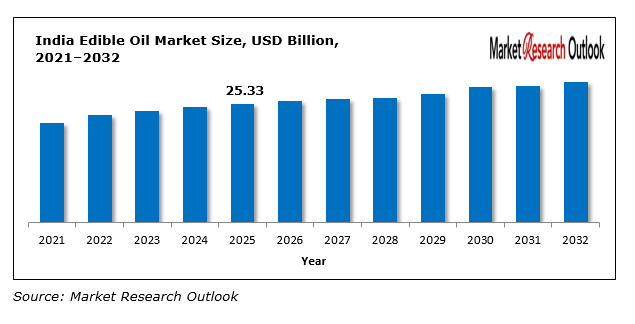
The India Edible Oil Market size was estimated at USD 25.33 Billion in 2025. During the forecast period, the India Edible Oil Market size is projected to grow at a CAGR of 4.2% reaching a value of USD 34.12 Billion by 2032. The India edible oil market exists as one of the world’s largest markets because India’s massive population base and its diverse culinary traditions create a high demand for edible oils. Indian households use edible oils as essential cooking ingredients which food processing facilities and foodservice businesses also utilize. The market displays elevated consumption levels because local manufacturing combined with imported products creates a supply of both established and new market players. The demand for edible oil keeps increasing because population numbers rise and more people move to cities and disposable income levels grow.
India Edible Oil Market – Overview
Market Trends
- The market currently shows a major trend that leads people to select healthier options of premium edible oils. Consumers are becoming more aware of the health impacts of different oils and they are choosing products that have better nutritional profiles which include low cholesterol and high unsaturated fat content.
- The demand for branded packaged oils has transformed into a significant market trend. Consumers are moving away from loose and unbranded oils due to concerns about quality and adulteration. The popularity of fortified edible oils which contain vitamin A and D content has increased among consumers.
Geopolitical Impact on India Edible Oil Market
The Indian edible oil market experiences major market shifts because of geopolitical events which disrupt multiple supply chains that depend on palm oil imports from Indonesia and Malaysia. The domestic market experiences supply and price changes because global trade policy adjustments and export bans and import tariffs affect market conditions. Price changes occur because of three factors which include shifts in worldwide commodities pricing and foreign currency exchange rates and international political conflicts. Climate conditions in key oil-producing nations have the power to disrupt both their production activities and their entire supply chain operations.
| Attributes | Details |
| Years Considered | Historical Data – 2021–2025
Base Year – 2025 Estimated Year – 2026 Forecast Period – 2026–2032 |
| Facts Covered | Revenue in USD Billion |
| Market Coverage | India |
| Segmentation | Product Type, Packaging Type, Application, Distribution Channel |
Segmental Coverage
By Product Type
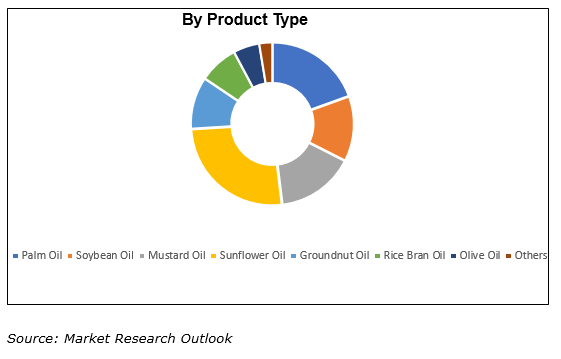
Based on product type, the market is segmented into palm oil, soybean oil, mustard oil, sunflower oil, groundnut oil, rice bran oil, olive oil, and others. The market shows palm oil as its leading product because it remains cost-effective and adaptable to various uses. The northern and eastern regions of India show strong demand for mustard oil because it matches their traditional cooking practices, while sunflower and soybean oils serve as popular cooking oils throughout the entire nation. Health-conscious consumers show increasing interest in premium oils which include olive oil and rice bran oil.
By Form
Based on packaging type, the market includes pouches, bottles, jars, tins, and others. Pouches have become the leading product in the market because they provide low-cost solutions which customers use throughout their homes. The preferred packaging for premium oils consists of bottles and jars because they provide consumers with both convenience and superior storage capabilities. Tins serve as the ideal packaging solution for bulk buying and commercial applications.
Recent Trends:
On October 2025, The Ministry of Consumer Affairs, Food and Public Distribution has announced a major change to the Vegetable Oil Products Production and Availability Regulation Order from 2011. The Ministry stated that the revised VOPPA Order from 2025 will establish enhanced regulatory control and transparent operations throughout the Indian edible oil industry.
Competitive Landscape
In the competitive landscape of the India Edible Oil market, the organisation has covered major players of the market and their details.
Here are some of the leading players that are playing a major role in the India Edible Oil market:
- Adani Wilmar Limited
- Introduction & Company Profile
- Product Benchmarking
- Strategic Outlook
- Key Competitors
- Financial Analysis
- Swot Analysis
**(Same Data Pointers Will Be Provided for The Below Companies)
- Marico Limited
- Ruchi Soya Industries Limited (Patanjali Foods Ltd.)
- Emami Agrotech Limited
- Cargill India Pvt. Ltd.
- ITC Limited
- Bunge India Pvt. Ltd.
- Godrej Agrovet Limited
- Vimal Oil & Foods Limited
- Gemini Edibles & Fats India Ltd.
- Other Prominent Players
Segmentation
By Product Type
- Palm Oil
- Soybean Oil
- Mustard Oil
- Sunflower Oil
- Groundnut Oil
- Rice Bran Oil
- Olive Oil
- Others
By Packaging Type
- Pouches
- Bottles
- Jars
- Tins
- Others
By Application
- Household Consumption
- Food Processing Industry
- Foodservice / HoReCa
- Others
By Distribution Channel
- Supermarkets & Hypermarkets
- Convenience Stores
- Traditional Retail / Kirana Stores
- Online Platforms
- Others
India Edible Oil Market, 2032
- Research Framework
- Market Segmentation
- Research Objective
- Research Methodology
- Qualitative Research
- Primary Research
- Secondary Research
- Quantitative Research
- Market Breakdown & Data Triangulation
- Demand Side
- Supply Side
- Primary Research Respondents
- Assumption & Limitation
- Qualitative Research
- Executive Summary
- Market Overview, 2021–2032
- By Product Type
- By Packaging Type
- By Application
- By Distribution Channel
- Analyst Recommendations
- Market Overview, 2021–2032
- Geopolitical Impact on India Edible Oil Market
- India Edible Oil Market Insights
- Market Dynamics
- Growth Drivers
- Large and growing population driving high consumption
- Rising demand for packaged and branded edible oils
- Increasing health awareness leading to shift toward healthier oils (olive, sunflower, rice bran)
- Restraints
- High dependence on imports (especially palm oil)
- Price volatility due to global commodity fluctuations
- Availability of low-cost unbranded oils
- Opportunities
- Increasing demand for premium and healthy edible oils
- Growth in fortified and value-added oils
- Expansion of organized retail and e-commerce
- Challenges
- Intense competition among brands
- Maintaining price stability amid global fluctuations
- Quality and adulteration concerns
- Technological Advancements
- Recent Technological Advancements
- Prior to 2020
- Porter’s Five Forces Analysis
- PESTLE Analysis
- Growth Drivers
- Market Dynamics
- Industry Value Chain & Entry Points
- Oilseed cultivation (soybean, mustard, sunflower, palm, groundnut)
- Procurement & aggregation
- Oil extraction & refining (crushing, solvent extraction, refining)
- Processing & fortification
- Packaging & branding
- Distribution (wholesalers, retailers, e-commerce)
- End consumers (households, foodservice, food processing industry)
- India Edible Oil Market: Regulatory Framework
- India Edible Oil Market Overview
- Market Size & Forecast, 2021-2032
- By Value (USD Billion)
- Market Share & Forecast
- By Product Type
- Palm Oil
- Soybean Oil
- Mustard Oil
- Sunflower Oil
- Groundnut Oil
- Rice Bran Oil
- Olive Oil
- Others
- By Packaging Type
- Pouches
- Bottles
- Jars
- Tins
- Others
- By Application
- Household Consumption
- Food Processing Industry
- Foodservice / HoReCa
- Others
- By Distribution Channel
- Supermarkets & Hypermarkets
- Convenience Stores
- Traditional Retail / Kirana Stores
- Online Platforms
- Others
- By Product Type
- Market Size & Forecast, 2021-2032
- Competitive Landscape
- India Edible Oil Company Market Share Analysis, 2025
- Competitive Benchmarking, By Operating Parameters
- Key Strategic Development (Mergers, Acquisitions, Partnerships, Etc.)
- List of Emerging players
- Company Profile
- Adani Wilmar Limited
- Introduction & Company Profile
- Product Benchmarking
- Strategic Outlook
- Key Competitors
- Financial Analysis
- Swot Analysis
- Adani Wilmar Limited
**(Same Data Pointers Will Be Provided for The Below Companies)
- Marico Limited
- Ruchi Soya Industries Limited (Patanjali Foods Ltd.)
- Emami Agrotech Limited
- Cargill India Pvt. Ltd.
- ITC Limited
- Bunge India Pvt. Ltd.
- Godrej Agrovet Limited
- Vimal Oil & Foods Limited
- Gemini Edibles & Fats India Ltd.
- Other Prominent Players
* Financial information in case of non-listed companies will be provided as per availability
**The segmentation and the companies are subjected to modifications based on in-depth secondary for the final deliverable
Frequently Asked Questions
1. What is the market size of the India Edible Oil Market in 2025?
Ans: The India Edible Oil market is projected to reach approximately USD 25.33 Billion by 2032.
2. What is the expected growth rate of the India Edible Oil Market during the forecast period?
Ans: The India Edible Oil market is expected to grow at a CAGR of around 7.5% during the forecast period between 2026 and 2032.
3. What is the forecast value of the India Edible Oil Market by 2032?
Ans: The India Edible Oil market is projected to reach approximately USD 34.12 Billion by 2032.
4. What are the major factors driving the growth of the India Edible Oil Market?
Ans: The India edible oil market exists as one of the world's largest markets because India's massive population base and its diverse culinary traditions create a high demand for edible oils.
5. Name the key players operating in the India Edible Oil Market.
Ans: Key players operating in the India Edible Oil market include Adani Wilmar Limited, Marico Limited, Ruchi Soya Industries Limited (Patanjali Foods Ltd.), Emami Agrotech Limited, Cargill India Pvt. Ltd., ITC Limited, Bunge India Pvt. Ltd., Godrej Agrovet Limited, Vimal Oil & Foods Limited, Gemini Edibles & Fats India Ltd., and other prominent players.
Frequently Asked Questions
1. What is the market size of the India Edible Oil Market in 2025?
Ans: The India Edible Oil market is projected to reach approximately USD 25.33 Billion by 2032.
2. What is the expected growth rate of the India Edible Oil Market during the forecast period?
Ans: The India Edible Oil market is expected to grow at a CAGR of around 7.5% during the forecast period between 2026 and 2032.
3. What is the forecast value of the India Edible Oil Market by 2032?
Ans: The India Edible Oil market is projected to reach approximately USD 34.12 Billion by 2032.
4. What are the major factors driving the growth of the India Edible Oil Market?
Ans: The India edible oil market exists as one of the world's largest markets because India's massive population base and its diverse culinary traditions create a high demand for edible oils.
5. Name the key players operating in the India Edible Oil Market.
Ans: Key players operating in the India Edible Oil market include Adani Wilmar Limited, Marico Limited, Ruchi Soya Industries Limited (Patanjali Foods Ltd.), Emami Agrotech Limited, Cargill India Pvt. Ltd., ITC Limited, Bunge India Pvt. Ltd., Godrej Agrovet Limited, Vimal Oil & Foods Limited, Gemini Edibles & Fats India Ltd., and other prominent players.