

India Bath & Shower Products Market Size & Forecast 2032
- Beauty & Personal Care, Consumer Goods & Retail
- May 2026
- Pages 140
- Report Format: pdf
- Report Price: $2400 USD
India bath & shower products market is witnessing strong structural growth, driven by rising hygiene awareness, premiumisation of body wash and shower gel categories, growing demand for ayurvedic and natural formulations, rapid e-commerce penetration, expansion of D2C personal-care brands, and rising spending power across urban and Tier 1 households, supported by both legacy FMCG majors and digital-first challenger brands.
Report Description
| Study Duration | 2021-2032 |
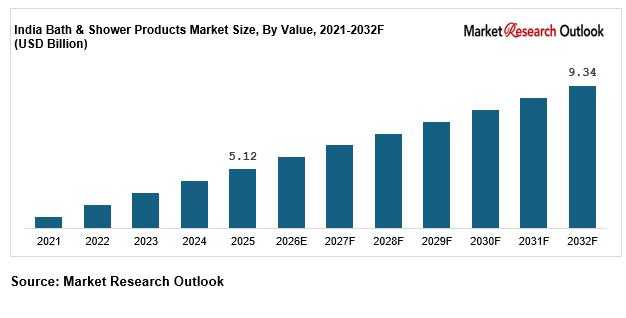
| Market Size (2025) | USD 5.12 Billion |
| CAGR (2026-2032) | 8.9% |
| Leading Segment | Bar Soap (Mass & Premium Combined) |
| Fastest Growing Segment | Body Wash & Shower Gel |
| Market Size (2032) | USD 9.34 Billion |
Source:
Market Overview: India Bath & Shower Products Market
The India bath & shower products market size is going through a phase of healthy, premium-led expansion, supported by rising hygiene awareness, growing acceptance of body wash and shower gel formats, fast-growing demand for ayurvedic and natural bath products, and the steady rise of D2C and digital-first personal care brands. Valued at USD 5.12 billion in 2025 and projected to reach USD 9.34 billion by 2032, growing at a CAGR of 8.9%, the India bath & shower products market growth is being fuelled by strong urban demand for premium body washes, expansion of organised retail and quick commerce, and increasing usage of dedicated bath products for men, kids, and skincare-focused women. Bar soap continues to dominate volumes across mass and economy categories, while body wash and shower gels are emerging as the fastest growing product type. Premiumisation, clean-beauty positioning, and rising spending power are reshaping the supply landscape. As FMCG majors including Hindustan Unilever, ITC, Godrej Consumer Products, Wipro Consumer Care, and Reckitt expand their bath and shower portfolios, and challenger D2C brands such as Mamaearth, Plum, Forest Essentials, and Khadi Natural scale up rapidly, the India bath & shower products market is evolving into a multi-tier, ingredient-led, and digitally driven ecosystem with strong long-term growth potential.
Related research: India Beauty and Personal Care Products Market, India Male Grooming Products Market and India Razor Market.
Key Report Takeaways: India Bath & Shower Products Market
- The India bath & shower products market size is projected to grow from USD 5.12 billion in 2025 to USD 9.34 billion by 2032, registering a strong CAGR of 8.9%, supported by rising hygiene awareness, premium body wash adoption, and the steady rise of natural and ayurvedic bath formulations across urban India.
- Bar soap continues to dominate the India bath & shower products market, accounting for over 55% of total volume in 2025, driven by mass-market brands like Lux, Lifebuoy, Cinthol, Santoor, and Godrej No.1, though its share is gradually softening as urban consumers shift toward body washes and premium shower gels.
- Body wash and shower gel is emerging as the fastest growing segment of the India bath & shower products market, expected to grow at 12% to 14% annually through 2032, supported by rising disposable incomes, fragrance-led innovation, and aggressive D2C launches across Mamaearth, Plum, The Derma Co., and Nivea.
- Rapid scaling of natural, ayurvedic, and clean-label positioning, with over 38% of new product launches in 2024-25 carrying “sulphate-free”, “paraben-free”, or “ayurvedic” claims, is structurally expanding the India bath & shower products market across premium and mid-range price tiers.
- Rising investments by Hindustan Unilever, ITC, Godrej Consumer Products, Honasa Consumer (Mamaearth), and Reckitt in R&D, premium variants, kids’ bath ranges, and sustainable packaging are strengthening competitive intensity and supporting the India bath & shower products market forecast 2032.
Key Market Drivers: India Bath & Shower Products Market
Rising Hygiene Awareness and the Shift from Bar Soap to Body Wash Driving Urban Demand
Growth in the India bath & shower products market is being driven by rising hygiene awareness across urban and semi-urban households, with consumers steadily shifting from traditional bar soap to body wash, shower gel, and dedicated bath cleansers. Post-pandemic behaviour has fundamentally changed how Indians approach personal cleanliness, with daily bathing now treated as a small wellness routine rather than a quick chore. Body wash penetration in urban India crossed 28% of households in 2025, up from around 14% in 2019, with metros such as Mumbai, Bengaluru, Delhi NCR, Hyderabad, and Pune leading adoption. Average per capita spend on bath and shower products in urban India has grown to nearly INR 720 per year, almost 2.4 times the rural per capita spend. Higher in-shower fragrance preference, growing usage of loofahs and shower pouffes, and increased acceptance of family-size body wash bottles are creating steady volume pull across the India bath & shower products market.
Premiumisation, Natural & Ayurvedic Positioning and the Rise of D2C Personal-Care Brands
The India bath & shower products market is benefiting from a sharp premiumisation wave, with consumers willing to pay 2 to 4 times more for body washes and bathing bars positioned around natural, ayurvedic, sulphate-free, or dermatologist-tested claims. Honasa Consumer’s Mamaearth, Plum, The Derma Co., Forest Essentials, Khadi Natural, and Wow Skin Science have built strong urban franchises by combining clean ingredient stories with influencer-led marketing and direct-to-consumer pricing. Legacy giants like Hindustan Unilever (Dove, Pears, Liril), ITC (Fiama, Engage), Godrej Consumer Products (Cinthol), and Wipro (Santoor, Chandrika) have responded with premium variants, ayurvedic SKUs, and limited-edition fragrances. New launches with “clean” claims grew at over 22% CAGR between 2021 and 2025, well ahead of the broader category, and now contribute close to 18% of total category value sales across the India bath & shower products market.
Rising Disposable Incomes, Urbanisation, and Rapid E-commerce Penetration Across Tier 1 and Tier 2 Cities
Strong growth in disposable incomes, accelerating urbanisation, and the rapid spread of e-commerce and quick-commerce platforms are major catalysts for the India bath & shower products market. Per capita disposable income in urban India has grown at over 9% CAGR between 2019 and 2025, while online channels including Amazon, Flipkart, Nykaa, Myntra, Blinkit, Zepto, and Instamart now contribute close to 19% of premium bath and shower product sales. Quick-commerce in particular is helping fragrance-led shower gels, scented bath salts, and bath bombs reach urban consumers within minutes. Modern trade chains such as DMart, Reliance Retail, Spencer’s, and More are also expanding shelf space for premium body washes, kids’ bath ranges, and ayurvedic soaps. Combined with growing influence of Instagram and YouTube beauty creators, these channels are structurally expanding the India bath & shower products market growth across all major end-user categories through 2032.
Key Market Challenges: India Bath & Shower Products Market
Persistent Price Sensitivity and the Strong Hold of Mass-Market Bar Soap in Rural India
The India bath & shower products market continues to face challenges around persistent price sensitivity, with over 60% of bath product volumes in Tier 3 to Tier 5 towns and rural areas still concentrated in economy bar soaps priced below INR 30. Brands like Lifebuoy, Lux, Godrej No.1, Santoor, and Nirma still anchor everyday consumption in non-metro India, where bath soap is often shared by the entire household. Body wash penetration in rural India remains below 4%, with consumers viewing it as an urban, premium, and wasteful format. While companies such as Hindustan Unilever, ITC, and Godrej Consumer Products have introduced smaller, more affordable shower gel SKUs and sachet formats, scaling premium bath and shower products beyond Tier 1 cities continues to be a slow process across the India bath & shower products market.
Volatility in Raw Material Prices Including Palm Oil, Surfactants, and Essential Oils
The India bath & shower products market is exposed to significant volatility in key raw materials such as palm oil, tallow, glycerine, SLES and other surfactants, fragrance compounds, and essential oils. Palm oil prices alone have seen swings of 30% to 45% between 2022 and 2025, directly impacting cost structures of bar soap and body wash manufacturers. Imported fragrances, natural extracts, and speciality actives often face additional pressure from currency fluctuations and global supply chain delays. While players like Hindustan Unilever, ITC, Godrej Consumer Products, and Wipro Consumer Care use backward integration and long-term sourcing contracts to soften these shocks, smaller D2C brands and contract manufacturers find it harder to absorb input cost spikes without raising prices, putting pressure on margins across the India bath & shower products market.
Competition from Counterfeits, Unorganised Players and Aggressive Private Labels
Counterfeits, unbranded local soap makers, and fast-growing private labels remain a structural challenge for the India bath & shower products market. Across Tier 2 to Tier 5 towns, look-alike packaging and copycat brand names continue to confuse consumers and dilute brand equity for leaders such as Lifebuoy, Cinthol, Santoor, and Dettol. Private label bath and shower products from DMart, Reliance Retail, Amazon Basics, and Flipkart’s SuperSavers are also gaining shelf share, especially in family bar soap and value body wash categories. While government enforcement through BIS standards and online platforms’ anti-counterfeit programs has improved, the cost of fighting fakes, protecting trademarks, and educating consumers continues to weigh on brand-building budgets across the India bath & shower products market.
Key Market Trends: India Bath & Shower Products Market
Rapid Shift Toward Natural, Ayurvedic, and Clean-Label Bath Formulations
The India bath & shower products market is going through a clear shift toward natural, ayurvedic, and clean-label formulations, with these positioning claims now influencing nearly 40% of new product launches between 2023 and 2025. Ingredients such as neem, turmeric, sandalwood, ubtan, charcoal, goat milk, aloe vera, and coffee are now widely used across body washes, bathing bars, and scrubs. Brands like Mamaearth, Forest Essentials, Khadi Natural, Himalaya, Patanjali, and Dabur are aggressively scaling ayurvedic and herbal bath ranges, while legacy names such as Hindustan Unilever (Dove, Pears, Lux Botanicals), ITC (Fiama Naturals), and Godrej (Cinthol Confidence+) have launched parallel naturals SKUs. Sulphate-free, paraben-free, vegan, and cruelty-free labels are emerging as standard expectations among urban premium buyers across the India bath & shower products market.
Growth of D2C and Digital-First Brands Reshaping the Premium Bath & Shower Segment
A wave of D2C and digital-first brands is reshaping the India bath & shower products market, especially in the premium and luxury tiers. Honasa Consumer (Mamaearth, The Derma Co., Aqualogica), Plum, Wow Skin Science, Bombay Shaving Company, Beardo, Pilgrim, and mCaffeine have built strong online-first franchises in body wash, shower gels, scrubs, and bath oils. These brands typically launch products faster, lean heavily on influencer marketing, and use platforms like Nykaa, Myntra, Amazon, Flipkart, Tira, and their own apps as primary discovery channels. Quick-commerce players including Blinkit, Zepto, and Swiggy Instamart have further compressed the distance between launch and trial. Combined online and quick-commerce channels now contribute close to 19% of premium bath product sales in urban India and continue to grow at double-digit rates across the India bath & shower products market.
Premium Body Wash, Men’s Grooming, and Kids’ Bath Ranges Replacing Traditional Bar Soap in Urban Households
A clear consumer migration is reshaping the India bath & shower products market, with urban households progressively replacing traditional family bar soaps with category-specific products. Premium body washes for women, masculine fragrance-led shower gels for men, and gentle, tear-free baby bath formulations are now common in urban bathrooms. Engage, Wild Stone, Park Avenue, Beardo, Bombay Shaving Company, and Old Spice are driving men’s shower gel growth, while Johnson’s Baby, Himalaya Baby, Mamaearth Baby, Mother Sparsh, and The Moms Co. are leading kids’ bath. Differentiated SKUs for dry skin, oily skin, sensitive skin, and anti-acne body cleansers have emerged across Cetaphil, Sebamed, Dove, Nivea, and Plum, supporting better value realisation and reinforcing the India bath & shower products market forecast 2032 across both mass and premium price tiers.
Segmental Insights: India Bath & Shower Products Market
By Product Type: Bar Soap Leads While Body Wash & Shower Gel Grows Fastest
Bar soap continues to lead the India bath & shower products market product landscape, accounting for nearly 55% of total volume in 2025, supported by deep distribution, affordability, and decades of brand recall built by Lifebuoy, Lux, Cinthol, Santoor, Dove, Godrej No.1, Pears, Mysore Sandal, and Margo. Body wash and shower gel, while smaller in volume, is the fastest growing category and is projected to expand at 12% to 14% annually through 2032, driven by urban demand, gifting, and skin-type-specific formulations. Bath oils, bath salts, scrubs, and bath bombs together contribute another 6% to 8% of market value, with strong growth coming from spa-inspired and self-care positioning. Premium body wash currently accounts for around 22% of category value and is expected to cross 30% by 2032, supporting strong value expansion across the India bath & shower products market.
By Ingredient Type: Ayurvedic and Natural Formulations Capturing Premium Mind-Share
Ayurvedic and natural formulations now account for an estimated 32% of value sales in the India bath & shower products market, up from less than 18% in 2019. Patanjali, Himalaya, Khadi Natural, Forest Essentials, Mamaearth, Biotique, and Dabur lead this segment, with synthetic mainstream brands also launching parallel natural lines. Medicated bath products from Cetaphil, Sebamed, Dettol, Savlon, and Margo continue to grow on the back of dermatologist recommendations and rising awareness of skin sensitivity. Synthetic mass-market formulations still dominate volumes, especially in budget bar soap, but premium ingredient-led claims are commanding higher gross margins. The shift toward clean, transparent, and traceable ingredients is structurally favouring D2C and naturals-led brands across the India bath & shower products market.
Regional Insights: India Bath & Shower Products Market
Regional analysis of the India bath & shower products market shows that West India and South India together account for nearly 56% of total category value, driven by Maharashtra, Gujarat, Karnataka, Tamil Nadu, Telangana, and Kerala, supported by higher urbanisation, strong organised retail, and faster D2C and quick-commerce adoption. Cities such as Mumbai, Pune, Bengaluru, Hyderabad, Chennai, and Kochi are the strongest premium body wash and shower gel markets, while smaller towns in these states continue to anchor bar soap volumes. North India contributes around 26% of demand, led by Delhi NCR, Punjab, Haryana, Uttar Pradesh, and Rajasthan, supported by rising disposable incomes and growing male grooming adoption. East and Central India together account for the remaining 18% of demand, with West Bengal, Bihar, Odisha, Madhya Pradesh, and Chhattisgarh emerging as the next wave of growth markets, where mass-market bar soap and value body wash remain dominant. In 2025, capacity additions and distribution moves by Hindustan Unilever, ITC, Godrej Consumer Products, Wipro Consumer Care, and Mamaearth across these regions reinforced supply networks and supported deeper penetration across the India bath & shower products market.
Recent Developments: India Bath & Shower Products Market
- The India bath & shower products market saw strong momentum through 2024 and 2025. Premium body wash value grew at over 13% in 2025, ayurvedic bath bars expanded at nearly 16%, and kids’ bath SKUs grew at over 18%, well ahead of total category growth. Quick-commerce contribution to premium bath product sales doubled between 2023 and 2025, reshaping urban distribution economics across the India bath & shower products market.
- Major FMCG players continued to deepen India-focused investments. Hindustan Unilever expanded its premium body wash portfolio under Dove and Pears, ITC scaled Fiama and Engage with new gel and naturals variants, Godrej Consumer Products refreshed Cinthol with confidence-plus and deo bar formats, Wipro Consumer Care extended Santoor and Chandrika ranges, and Reckitt pushed Dettol body wash and bathing bar variants deeper into urban India. Honasa Consumer’s Mamaearth, after its 2023 IPO, accelerated body wash, scrubs, and kids’ bath launches.
- D2C and naturals-led players gained meaningful share in the India bath & shower products market. Plum, Forest Essentials, Khadi Natural, Wow Skin Science, mCaffeine, Pilgrim, and The Derma Co. scaled body washes, scrubs, bath oils, and bath bombs across e-commerce and modern trade. Beiersdorf India (Nivea), L’Oréal India, and Himalaya Wellness expanded premium body wash distribution, strengthening long-term competitive positioning in the India bath & shower products market forecast 2032.
Key Market Players: India Bath & Shower Products Market
- Hindustan Unilever Limited
- ITC Limited
- Godrej Consumer Products Limited
- Wipro Enterprises Limited (Consumer Care)
- Reckitt Benckiser (India) Limited
- Dabur India Limited
- Patanjali Ayurved Limited
- Beiersdorf India Pvt. Ltd. (Nivea)
- L’Oréal India Pvt. Ltd.
- Himalaya Wellness Company
- Honasa Consumer Limited (Mamaearth, The Derma Co.)
- Forest Essentials Cosmetics Pvt. Ltd.
- Plum (Pureplay Skin Sciences Pvt. Ltd.)
- Khadi Natural Healthcare
Report Scope
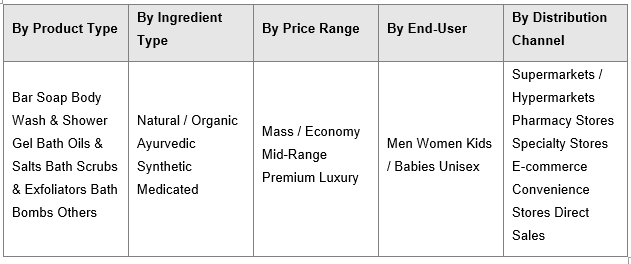
In this report, the India Bath & Shower Products Market has been segmented into the following categories, in addition to detailed analysis of key industry trends, market dynamics, competitive landscape, and growth opportunities across the forecast period:
- By Product Type
- Bar Soap
- Body Wash & Shower Gel
- Bath Oils & Salts
- Bath Scrubs & Exfoliators
- Bath Bombs & Effervescents
- Others
- By Form
- Liquid
- Solid
- Powder
- Gel / Cream
- By Ingredient Type
- Natural / Organic
- Ayurvedic
- Synthetic
- Medicated
- By Price Range
- Mass / Economy
- Mid-Range
- Premium
- Luxury
- By End-User
- Men
- Women
- Kids / Babies
- Unisex
- By Distribution Channel
- Supermarkets / Hypermarkets
- Pharmacy / Drug Stores
- Specialty Stores
- E-commerce
- Convenience Stores
- Direct Sales
- By Geography
- North India
- South India
- West India
- East India
- Central India
Competitive Landscape
Company Profiles:
Detailed analysis of the leading companies operating in the India Bath & Shower Products Market, including business overview, product portfolio, strategic initiatives, competitive positioning, and recent developments.
Company Information
Detailed profiling and strategic analysis of additional market players (up to five companies), including emerging D2C personal-care brands, premium ayurvedic bath specialists, men’s grooming and shower gel-focused players, or niche regional bath product manufacturers.
For a free sample of the India Bath & Shower Products Market report, customised insights or delivery timelines, submit your query here
Table of Contents
- Research Framework
- Market Segmentation
- Research Objective
- Research Methodology
- Qualitative Research
- Primary Research
- Secondary Research
- Quantitative Research
- Market Breakdown & Data Triangulation
- Demand Side
- Supply Side
- Primary Research Respondents
- Assumption & Limitation
- Executive Summary
- Market Overview, 2021-2032
- By Product Type
- By Ingredient Type
- By Price Range
- By End-User
- By Distribution Channel
- By Region
- Analyst Recommendations
- Geopolitical & Macroeconomic Impact on India Bath & Shower Products Market
- India Bath & Shower Products Market Insights
- Market Dynamics
- Growth Drivers
- Rising hygiene awareness and shift from bar soap to body wash driving urban demand.
- Premiumisation, natural and ayurvedic positioning, and rise of D2C personal-care brands.
- Rising disposable incomes, urbanisation, and rapid e-commerce penetration.
- Restraints
- Persistent price sensitivity and strong hold of mass-market bar soap in rural India.
- Volatility in raw material prices including palm oil, surfactants, and essential oils.
- Competition from counterfeits, unorganised players, and aggressive private labels.
- Opportunities
- Premium and luxury bath product expansion in metro cities and HENRY consumers.
- Men’s grooming, kids and baby care offering underpenetrated white spaces.
- Clean beauty, sustainable packaging, and refill formats opening new value pools.
- Challenges
- Limited shelf-life infrastructure for natural and preservative-free formulations.
- Skilled R&D and formulation talent shortage for clean-label and ayurvedic products.
- Rural distribution complexity and last-mile logistics across smaller towns.
- Technological & Product Advancements
- Recent Innovations
- Prior to 2020
- Porter’s Five Forces Analysis
- PESTLE Analysis
- Industry Value Chain & Entry Points
- Upstream Raw Materials (palm oil, glycerine, SLES, fragrances, essential oils, herbal extracts, packaging)
- Contract Manufacturers & Formulators (bar soap, body wash, gels, scrubs)
- Brand Owners & FMCG Majors (Hindustan Unilever, ITC, Godrej, Wipro, Reckitt)
- D2C & Naturals-Led Brands (Mamaearth, Plum, Forest Essentials, Khadi, Wow)
- Quality Control, R&D & Testing Laboratories (BIS, FDA, FSSAI, dermat panels)
- Distributors, Dealers & Modern Trade (DMart, Reliance Retail, Spencer’s)
- E-commerce & Quick Commerce (Amazon, Flipkart, Nykaa, Blinkit, Zepto, Instamart)
- End-Users (men, women, kids, families, hotels, salons, spas)
- India Bath & Shower Products Market: Regulatory Framework
- India Bath & Shower Products Market Overview
- Market Size & Forecast, 2021-2032
- By Value (USD Million)
- By Volume (Units / Tonnes)
- Market Share & Forecast
- By Product Type
- Bar Soap
- Body Wash & Shower Gel
- Bath Oils & Salts
- Bath Scrubs & Exfoliators
- Bath Bombs & Effervescents
- Others
- By Form
- Liquid
- Solid
- Powder
- Gel / Cream
- By Ingredient Type
- Natural / Organic
- Ayurvedic
- Synthetic
- Medicated
- By Price Range
- Mass / Economy
- Mid-Range
- Premium
- Luxury
- By End-User
- Men
- Women
- Kids / Babies
- Unisex
- By Distribution Channel
- Supermarkets / Hypermarkets
- Pharmacy / Drug Stores
- Specialty Stores
- E-commerce
- Convenience Stores
- Direct Sales
- By Geography
- North India
- South India
- West India
- East India
- Central India
- Competitive Landscape
- India Bath & Shower Products Market Company Market Share Analysis, 2025
- Competitive Benchmarking, By Operating Parameters
- Key Strategic Development (Mergers, Acquisitions, Partnerships, Etc.)
- List of Emerging Players
- Company Profile
- Hindustan Unilever Limited
- Introduction & Company Profile
- Product Benchmarking
- Strategic Outlook
- Key Competitors
- Financial Analysis
- SWOT Analysis
- (Same Data Pointers Will Be Provided for The Below Companies)
- ITC Limited
- Godrej Consumer Products Limited
- Wipro Enterprises Limited (Consumer Care)
- Reckitt Benckiser (India) Limited
- Dabur India Limited
- Patanjali Ayurved Limited
- Beiersdorf India Pvt. Ltd. (Nivea)
- L’Oréal India Pvt. Ltd.
- Himalaya Wellness Company
- Honasa Consumer Limited (Mamaearth, The Derma Co.)
- Forest Essentials Cosmetics Pvt. Ltd.
- Plum (Pureplay Skin Sciences Pvt. Ltd.)
- Khadi Natural Healthcare
- Other Prominent Players
- Hindustan Unilever Limited
- By Product Type
- Market Size & Forecast, 2021-2032
- Growth Drivers
* Financial information in case of non-listed companies will be provided as per availability
** The segmentation and the companies are subjected to modifications based on in-depth secondary for the final deliverable
Frequently Asked Questions
1. How large is the India bath & shower products market and what is its growth forecast?
Ans: The India bath & shower products market is valued at USD 5.12 billion in 2025 and is projected to reach USD 9.34 billion by 2032, growing at a CAGR of 8.9% on rising hygiene and premium adoption.
2. Which segments are driving demand in the India bath & shower products market?
Ans: Bar soap leads volumes, but body wash and shower gel is the fastest growing category. Ayurvedic, natural, men’s grooming, and kids’ bath SKUs are also key demand drivers in the India bath & shower products market.
3. What are the key drivers of growth in the India bath & shower products market?
Ans: Key drivers include rising hygiene awareness, premiumisation, natural and ayurvedic positioning, rising disposable incomes, urbanisation, growth of D2C brands, and rapid e-commerce and quick-commerce penetration across urban India.
4. Which regions are driving growth in the India bath & shower products market?
Ans: West and South India lead value sales, supported by Maharashtra, Gujarat, Karnataka, and Tamil Nadu. North India follows, while East and Central India are emerging growth pockets with strong upside potential.
5. What are the latest trends in the India bath & shower products market?
Ans: Top trends include natural and ayurvedic formulations, sulphate-free body washes, D2C and digital-first brands, men’s and kids’ bath ranges, premium shower gels, and sustainable refill packaging across urban India.