

Global Green Solvents Market, By Solvent Type (Bio-Alcohols, Esters & Lactates, Glycols & Glycol Ethers, Terpenes & Bio-Based Hydrocarbons, Water-Based & Others); By Source (Bio-Based, Renewable Synthetic); By Application (Paints & Coatings, Adhesives & Sealants, Pharmaceuticals, Agrochemicals, Cosmetics & Personal Care, Printing Inks, Industrial & Precision Cleaning, Others); By Distribution Channel (Direct Sales, Distributors/Traders, Online Chemical Platforms, Others), Trend Analysis, Competitive Landscape & Forecast, 2020–2030
- Chemicals and Material
- Jan 2026
- Pages 300
- Report Format: pdf
- Report Price: $3500 USD
Global Green Solvents Market Size & Forecast, 2020–2030
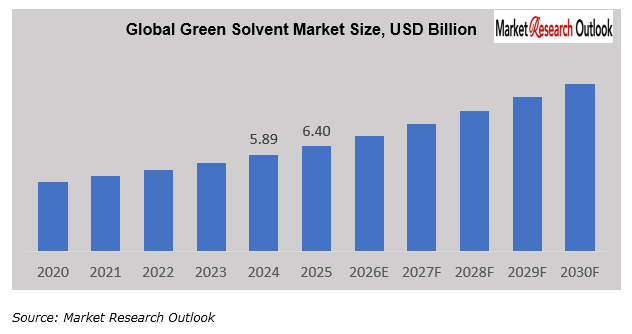
The Global Green Solvents Market was estimated at USD 6.4 billion in 2025 and is projected to reach USD 10.2 billion by 2030. The market’s growth is primarily driven by increasing regulatory pressure to reduce hazardous and high-VOC chemicals, rising adoption of sustainable and bio-based formulations, and continuous innovation in green chemistry.
Demand for green solvents is accelerating across paints & coatings, pharmaceuticals, agrochemicals, cosmetics & personal care, adhesives, printing inks, and industrial cleaning applications, as manufacturers seek safer, environmentally compliant alternatives to conventional petrochemical solvents. Growing awareness around human health, workplace safety, and lifecycle environmental impact is further reinforcing this shift.
In addition, corporate ESG commitments, circular economy initiatives, and advancements in bio-based feedstocks and fermentation technologies are enabling wider commercialization of high-performance green solvents. These factors, combined with expanding end-use industries and stricter global environmental regulations, are expected to sustain strong growth in the Global Green Solvents Market between 2025 and 2030.
Green Solvents – Overview
Green solvents refer to environmentally friendly solvents designed to reduce human health risks and environmental impact compared to conventional petrochemical solvents. They are typically derived from renewable or bio-based feedstocks or engineered to be low-toxicity, biodegradable, and low in volatile organic compounds (VOCs). Green solvents are used across a wide range of industrial and commercial applications where traditional solvents are being phased out due to regulatory and sustainability concerns.
Green solvent products are formulated to deliver effective solvency, compatibility, and performance while meeting stringent environmental, safety, and regulatory requirements. They support sustainable manufacturing by enabling cleaner formulations, safer working environments, and reduced lifecycle environmental footprint across industries such as paints & coatings, pharmaceuticals, agrochemicals, personal care, printing inks, electronics, and industrial cleaning.
Global Green Solvents Market
Growth Drivers
Increasing Regulatory Pressure for Sustainable Chemicals
Rising regulatory scrutiny on hazardous chemicals and volatile organic compounds (VOCs) is a key factor driving the growth of the Global Green Solvents Market. Governments and regulatory bodies across North America, Europe, and Asia-Pacific are enforcing stricter environmental, health, and safety standards, encouraging manufacturers to shift toward safer and more sustainable solvent alternatives. Policies focused on emission reduction, workplace safety, and environmental protection are accelerating the adoption of green solvents across multiple end-use industries. These regulatory initiatives not only restrict the use of conventional petrochemical solvents but also create a supportive ecosystem for the development and commercialization of bio-based and low-toxicity solvent solutions, contributing significantly to overall market growth.
Challenges
Cost Sensitivity and Performance Trade-Off Concerns
Cost competitiveness remains a key challenge restraining the growth of the Global Green Solvents Market. Many end users continue to rely on conventional solvents due to their lower cost, established supply chains, and proven performance. Green solvents, particularly those derived from bio-based feedstocks, often involve higher production costs and may require formulation adjustments, which can deter adoption in price-sensitive applications. Additionally, concerns around performance parity, availability, and scalability continue to limit faster penetration in certain industrial segments.
Impact of Escalating Geopolitical Tensions on Global Green Solvents Market
Escalating geopolitical tensions across regions can have a notable impact on the growth of the Global Green Solvents Market. Disruptions in global trade routes, sanctions, and geopolitical instability can affect the supply of raw materials, particularly bio-based feedstocks and specialty intermediates used in green solvent production. These disruptions may lead to price volatility, supply chain delays, and increased production costs. Furthermore, fluctuating exchange rates and trade restrictions can impact cross-border chemical trade, limiting market expansion opportunities. Prolonged geopolitical uncertainty could therefore pose challenges to the stable growth of the global green solvents industry.
Global Green Solvents Market
Segmental Coverage
Global Green Solvents Market – By Solvent Type
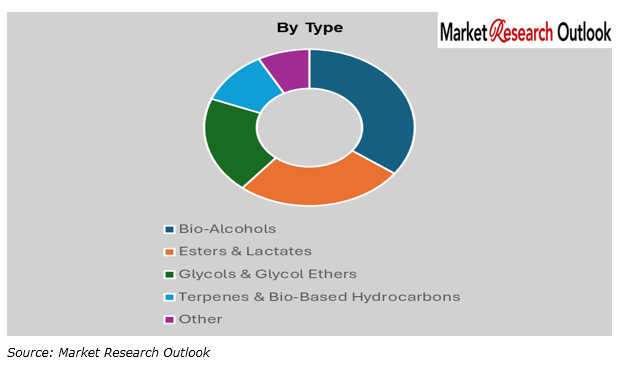
Based on solvent type, the Global Green Solvents Market is segmented into Bio-Alcohols, Esters & Lactates, Glycols & Glycol Ethers, Terpenes & Bio-Based Hydrocarbons, and other green solvent types. The bio-alcohols and ester-based solvents segments account for a significant share of the market, driven by their broad applicability across paints & coatings, pharmaceuticals, personal care, and industrial cleaning applications. These solvents offer favorable solvency, lower toxicity, and improved biodegradability, making them suitable replacements for conventional solvents. Continuous product innovation and increasing regulatory acceptance are further strengthening demand across end-use industries.
Global Green Solvents Market – By Source
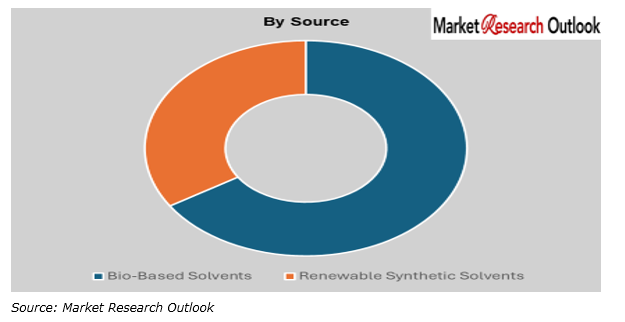
Based on source, the Global Green Solvents Market is divided into Bio-Based and Renewable Synthetic segments. The bio-based segment holds a dominant share of the market, supported by growing demand for solvents derived from renewable feedstocks such as biomass, fermentation-based intermediates, and natural extracts. Increasing emphasis on sustainability, lifecycle emissions reduction, and circular economy principles is expected to further drive growth of the bio-based segment during the forecast period.
Global Green Solvents Market – By Application
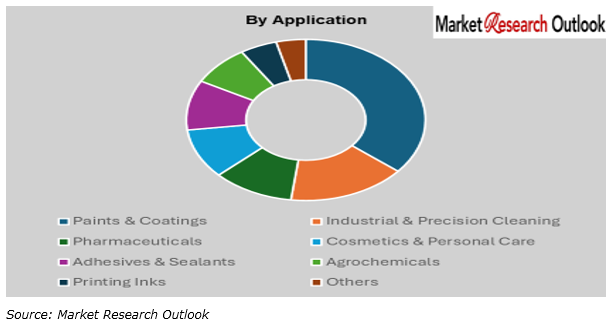
By application, the Global Green Solvents Market is categorized into Paints & Coatings, Adhesives & Sealants, Pharmaceuticals, Agrochemicals, Cosmetics & Personal Care, Printing Inks, Industrial & Precision Cleaning, and others. Paints & coatings represent the largest application segment, driven by stringent VOC regulations, rapid infrastructure development, and increasing adoption of water-based and low-emission formulations. Pharmaceutical and personal care applications are also witnessing strong growth due to rising focus on product safety and regulatory compliance.
Global Green Solvents Market – By Distribution Channel
Based on distribution channel, the Global Green Solvents Market is segmented into Direct Sales, Distributors & Traders, Online Chemical Platforms, and others. The direct sales segment accounts for the largest market share, as major industrial buyers and formulators prefer direct sourcing from manufacturers to ensure consistent quality, technical support, and supply reliability. Distributors play a crucial role in serving small and mid-sized customers by offering logistical flexibility and regional reach.
Competitive Landscape
Major players operating in the Global Green Solvents Market include multinational specialty chemical companies, bio-based chemical manufacturers, and regional solvent producers. To strengthen their market position, these companies are adopting strategies such as mergers and acquisitions, strategic partnerships, capacity expansions, licensing agreements, and new product launches. Continuous investment in R&D, sustainability certifications, and feedstock integration remains central to maintaining competitive advantage in the global green solvents industry.
Scope of the Report
| Attributes | Details |
| Years Considered | Historical Data – 2020–2024
Base Year – 2025 Estimated Year – 2026 Forecast Period – 2027–2030 |
| Facts Covered | Revenue in USD Million |
| Market Coverage | Global |
| Product/ Service Segmentation | Solvent Type, Source, Application, Distribution Channel |
| Key Players | BASF SE, Dow Inc., Solvay SA, Eastman Chemical Company, DuPont, Huntsman Corporation, LyondellBasell Industries, Archer Daniels Midland Company, Cargill Incorporated, Corbion, GF Biochemicals, Vertec BioSolvents, Elevance Renewable Sciences, Florida Chemical Company, Cremer Oleo |
- By Solvent Type
- Bio-Alcohols (Ethanol, Bio-Butanol, etc.)
- Esters & Lactates
- Glycols & Glycol Ethers
- Terpenes & Hydrocarbon-Based Green Solvents
- Water-Based & Other Emerging Green Solvents
- By Source
- Bio-Based
- Renewable Synthetic
- By Application
- Paints & Coatings
- Adhesives & Sealants
- Pharmaceuticals
- Agrochemicals
- Cosmetics & Personal Care
- Printing Inks
- Industrial & Precision Cleaning
- Others
- By End-Use Industry
- Construction & Infrastructure
- Automotive & Transportation
- Pharmaceuticals & Life Sciences
- Agriculture
- Consumer Goods & Personal Care
- Electronics & Electrical
- Industrial Manufacturing
Global Green Solvent Market – Table of Contents
- Introduction
- Market Overview
- Green Solvent Definition & Classification
- Research Methodology
- Key Assumptions
- Executive Summary
- Market Snapshot (2025)
- Key Insights & Emerging Trends
- Strategic Takeaways
- Regulatory, Environmental & Sustainability Landscape
- Green Solvent Ecosystem & Value Chain Analysis
- Market Dynamics
- Growth Drivers
- Market Challenges
- Emerging Opportunities
- Regional Demand Hotspots
- Key Market Trends & Developments
- Global Green Solvent Market Outlook (2026–2030)
- Market Size & Forecast (USD Million)
- Historical Analysis (2020–2025) vs Forecast (2026–2030)
- By Solvent Type
- Bio-Alcohols (Ethanol, Bio-Butanol, etc.)
- Esters & Lactates
- Glycols & Glycol Ethers
- Terpenes & Hydrocarbon-Based Green Solvents
- Water-Based & Other Emerging Green Solvents
- By Source
- Bio-Based
- Renewable Synthetic
- By Application
- Paints & Coatings
- Adhesives & Sealants
- Pharmaceuticals
- Agrochemicals
- Cosmetics & Personal Care
- Printing Inks
- Industrial & Precision Cleaning
- Others
- By End-Use Industry
- Construction & Infrastructure
- Automotive & Transportation
- Pharmaceuticals & Life Sciences
- Agriculture
- Consumer Goods & Personal Care
- Electronics & Electrical
- Industrial Manufacturing
- By Region
- North America
- Europe
- Asia-Pacific
- Latin America
- Middle East & Africa
- Asia-Pacific Green Solvent Market Outlook (2026–2030)
- Market Size & Forecast (USD Million)
- Historical Analysis (2020–2025) vs Forecast (2026–2030)
- By Solvent Type
- By Source
- By Application
- By End-Use Industry
- By Country
- Europe Green Solvent Market Outlook (2026–2030)
- Market Size & Forecast (USD Million)
- Historical Analysis (2020–2025) vs Forecast (2026–2030)
- By Solvent Type
- By Source
- By Application
- By End-Use Industry
- By Country
- North America Green Solvent Market Outlook (2026–2030)
- Market Size & Forecast (USD Million)
- Historical Analysis (2020–2025) vs Forecast (2026–2030)
- By Solvent Type
- By Source
- By Application
- By End-Use Industry
- By Country
- Latin America Green Solvent Market Outlook (2026–2030)
- Market Size & Forecast (USD Million)
- Historical Analysis (2020–2025) vs Forecast (2026–2030)
- By Solvent Type
- By Source
- By Application
- By End-Use Industry
- By Country
- Middle East & Africa Green Solvent Market Outlook (2026–2030)
- Market Size & Forecast (USD Million)
- Historical Analysis (2020–2025) vs Forecast (2026–2030)
- By Solvent Type
- By Source
- By Application
- By End-Use Industry
- By Country
- Competitive Landscape
- Competitive Characteristics
- Market Share Analysis
- Company Benchmarking
- Competitive Strategies
- Company Profiles
- Business Overview
- Product Portfolio & Green Chemistry Capabilities
- Manufacturing Footprint & Capacity
- Geographic Presence
- Sustainability Initiatives & Certifications
- Strategic Partnerships & Alliances
- Recent Developments
- Financial Overview
- Regulatory & Compliance Strategy
- Product Innovation & Cost Optimization
- Feedstock Security & Supply Chain Strategy
- Go-to-Market & Customer Positioning
- Conclusion & Key Takeaways
- Disclaimer
Frequently Asked Questions
1. What is the current market size of the Global Green Solvents Market?
Ans: The Global Green Solvents Market size by value was estimated at USD 6.4 billion in 2025.
2. What is the expected growth rate of the Global Green Solvents Market by value during the forecast period?
Ans: The Global Green Solvents Market is expected to grow at a CAGR of around 9.8% during the forecast period between 2025 and 2030.
3. What is the forecast value of the Global Green Solvents Market size by the end of the forecast period?
Ans: By 2030, the Global Green Solvents Market size is forecast to reach a value of approximately USD 10.2 billion.
4. What are the major factors driving the growth of the Global Green Solvents Market?
Ans: The growth of the Global Green Solvents Market is primarily driven by stringent environmental regulations, increasing focus on VOC reduction and workplace safety, rising adoption of bio-based and sustainable formulations, and growing ESG commitments across end-use industries such as paints & coatings, pharmaceuticals, personal care, and industrial cleaning.
5. Name the key players in the Global Green Solvents Market.
Ans: Key players operating in the Global Green Solvents Market include BASF SE, Dow Inc., Solvay SA, Eastman Chemical Company, DuPont, Corbion, GF Biochemicals, Vertec BioSolvents, and Elevance Renewable Sciences, among others.
6. Which is a faster-growing segment in the Global Green Solvents Market by source?
Ans: The bio-based solvents segment is expected to grow at a faster CAGR in the Global Green Solvents Market during the forecast period, driven by increasing demand for renewable feedstocks, lower lifecycle emissions, and stronger regulatory and customer preference for sustainable chemical solutions.
Frequently Asked Questions
1. What is the current market size of the Global Green Solvents Market?
Ans: The Global Green Solvents Market size by value was estimated at USD 6.4 billion in 2025.
2. What is the expected growth rate of the Global Green Solvents Market by value during the forecast period?
Ans: The Global Green Solvents Market is expected to grow at a CAGR of around 9.8% during the forecast period between 2025 and 2030.
3. What is the forecast value of the Global Green Solvents Market size by the end of the forecast period?
Ans: By 2030, the Global Green Solvents Market size is forecast to reach a value of approximately USD 10.2 billion.
4. What are the major factors driving the growth of the Global Green Solvents Market?
Ans: The growth of the Global Green Solvents Market is primarily driven by stringent environmental regulations, increasing focus on VOC reduction and workplace safety, rising adoption of bio-based and sustainable formulations, and growing ESG commitments across end-use industries such as paints & coatings, pharmaceuticals, personal care, and industrial cleaning.
5. Name the key players in the Global Green Solvents Market.
Ans: Key players operating in the Global Green Solvents Market include BASF SE, Dow Inc., Solvay SA, Eastman Chemical Company, DuPont, Corbion, GF Biochemicals, Vertec BioSolvents, and Elevance Renewable Sciences, among others.
6. Which is a faster-growing segment in the Global Green Solvents Market by source?
Ans: The bio-based solvents segment is expected to grow at a faster CAGR in the Global Green Solvents Market during the forecast period, driven by increasing demand for renewable feedstocks, lower lifecycle emissions, and stronger regulatory and customer preference for sustainable chemical solutions.