

Global Green Ammonia Market, By Solvent Type (Bio-Alcohols, Esters & Lactates, Glycols & Glycol Ethers, Terpenes & Bio-Based Hydrocarbons, Water-Based & Others); By Source (Bio-Based, Renewable Synthetic); By Application (Paints & Coatings, Adhesives & Sealants, Pharmaceuticals, Agrochemicals, Cosmetics & Personal Care, Printing Inks, Industrial & Precision Cleaning, Others); By End-Use Industry (Construction & Infrastructure, Automotive & Transportation, Pharmaceuticals & Life Sciences, Agriculture, Consumer Goods & Personal Care, Electronics & Electrical, Industrial Manufacturing), Trend Analysis, Competitive Landscape & Forecast, 2021–2031
- Chemicals and Material
- Jan 2026
- Pages 250
- Report Format: pdf
- Report Price: $3500 USD
Global Green Ammonia Market Size & Forecast, 2021–2031
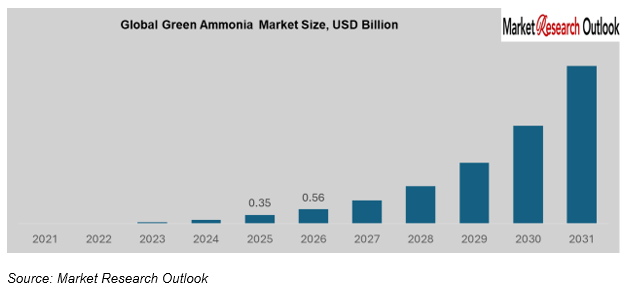
The Global Green Ammonia Market was estimated at around USD 0.35 billion in 2025 and is projected to reach over USD 6 billion by 2031. Market growth is primarily driven by increasing regulatory pressure to reduce hazardous and high-VOC chemicals, rising adoption of sustainable and bio-based ammonia alternatives, and continuous innovation in green chemistry across multiple end-use industries.
Demand for green ammonia is accelerating across paints & coatings, pharmaceuticals, agrochemicals, cosmetics & personal care, adhesives, printing inks, and industrial cleaning, as manufacturers seek environmentally compliant and safer alternatives to conventional petrochemical solvents. Growing awareness of human health, workplace safety, and lifecycle environmental impact is further reinforcing this shift.
In addition, expanding corporate ESG commitments, circular economy initiatives, and advancements in bio-based feedstocks, fermentation processes, and renewable chemical technologies are improving the performance and commercial viability of green solvents. These factors, combined with expanding end-use industries and tightening global environmental regulations, are expected to sustain strong growth in the Global Green Solvents Market between 2026 and 2031.
Green Ammonia– Overview
Green ammonia refers to ammonia produced using renewable energy sources, where hydrogen is generated through water electrolysis powered by renewable electricity (such as solar, wind, or hydropower) and subsequently combined with nitrogen from the air via the Haber–Bosch process. Unlike conventional grey or blue ammonia, green ammonia production does not rely on fossil fuels and results in near-zero carbon emissions, making it a critical component of global decarbonization strategies.
Green ammonia is increasingly recognized as a versatile, carbon-free energy carrier and industrial feedstock. It plays a vital role in sustainable fertilizer production, long-duration energy storage, hydrogen transportation, power generation, and low-emission fuels for maritime shipping and heavy industry. By enabling the decarbonization of hard-to-abate sectors, green ammonia supports energy transition goals, enhances energy security, and contributes to reduced lifecycle greenhouse gas emissions across agriculture, chemicals, power, and transportation value chains.
Global Green Ammonia Market
Growth Drivers
Rising Global Decarbonization Targets and Energy Transition Initiatives
Increasing pressure on governments and industries to reduce carbon emissions is a key factor driving the growth of the Global Green Ammonia Market. National net-zero commitments, hydrogen strategies, and clean energy policies across North America, Europe, Asia-Pacific, and the Middle East are accelerating investments in green hydrogen and downstream green ammonia projects. Green ammonia is gaining traction as a low-carbon alternative for fertilizer production, power generation, shipping fuel, and hydrogen transport, supported by policy incentives, subsidies, and long-term offtake agreements.
Challenges
High Production Costs and Infrastructure Constraints
High capital expenditure and production costs remain major challenges restraining the growth of the Global Green Ammonia Market. Green ammonia production requires large-scale renewable energy capacity, electrolyzers, and supporting infrastructure, which significantly increases upfront investment compared to conventional ammonia. In addition, limited availability of electrolyzers, grid connectivity challenges, and lack of large-scale storage and transport infrastructure can slow project execution and commercialization, particularly in emerging markets.
Impact of Escalating Geopolitical Tensions on Global Green Ammonia Market
Escalating geopolitical tensions can have a notable impact on the growth of the Global Green Ammonia Market. Supply chain disruptions affecting electrolyzers, renewable energy equipment, and critical raw materials may lead to project delays and cost escalation. Volatility in global energy markets, trade restrictions, and currency fluctuations can also influence investment decisions and cross-border project development. However, at the same time, heightened energy security concerns and efforts to reduce dependence on fossil fuel imports may accelerate domestic green ammonia investments in certain regions. Overall, prolonged geopolitical instability may create short-term challenges while reinforcing the long-term strategic importance of green ammonia in global energy systems.
Global Facility Management Market
Segmental Coverage
Global Green Ammonia Market – By Application
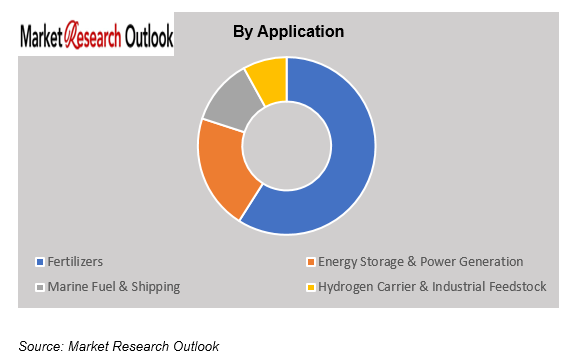
Based on application, the Global Green Ammonia Market is segmented into Fertilizers, Power Generation & Energy Storage, Marine Fuel & Shipping, Hydrogen Carrier, Industrial Feedstock, and Others.
The fertilizer segment accounts for the largest share of the market, driven by the urgent need to decarbonize conventional ammonia-based fertilizer production, which is one of the most carbon-intensive chemical processes globally. Green ammonia enables a direct reduction in Scope 1 and Scope 2 emissions for fertilizer producers while maintaining compatibility with existing downstream infrastructure.
In addition, energy and shipping applications are gaining traction as green ammonia is increasingly adopted as a carbon-free fuel and long-duration energy storage medium. Continuous pilot projects, government-backed initiatives, and long-term offtake agreements are strengthening demand across multiple end-use sectors.
Global Green Ammonia Market – By Production Technology
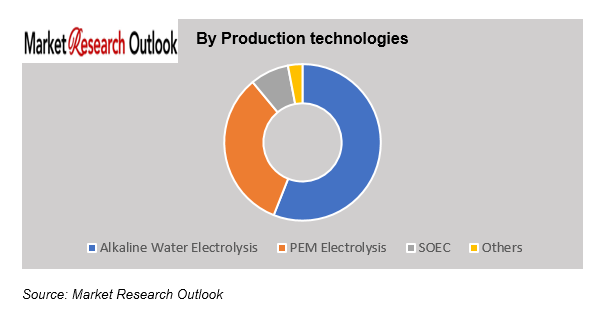
Based on production technology, the Global Green Ammonia Market is segmented into Alkaline Water Electrolysis, Proton Exchange Membrane (PEM) Electrolysis, Solid Oxide Electrolysis (SOEC), and other emerging electrolysis technologies. Technology selection is primarily influenced by project scale, renewable power profile, capital cost, efficiency, and commercialization maturity.
Alkaline electrolysis currently accounts for the largest share of green ammonia projects due to its proven technology, lower capital cost, and suitability for large-scale, baseload operations. It is widely adopted in early commercial projects linked to utility-scale renewable energy, particularly in fertilizer decarbonization initiatives.
PEM electrolysis holds a significant and fast-growing share of the market, driven by its high efficiency, compact footprint, and superior operational flexibility, making it well-suited for variable renewable energy sources such as wind and solar.
Competitive Landscape
The Global Green Ammonia Market is characterized by the presence of energy majors, fertilizer producers, renewable energy developers, electrolyzer manufacturers, and technology startups engaged across the value chain. Market participants are actively positioning themselves through large-scale project development, strategic partnerships, joint ventures, and long-term offtake agreements to secure early-mover advantage in this emerging market.
To strengthen their market position, companies are focusing on capacity expansion of green hydrogen and ammonia plants, integration with renewable energy assets, and collaboration with electrolyzer technology providers. Strategic alliances with shipping companies, utilities, and industrial end users are also gaining prominence to ensure demand security and accelerate commercialization. Continuous investment in electrolyzer efficiency, cost reduction, renewable integration, and ammonia storage and transportation infrastructure remains central to maintaining a competitive edge in the global green ammonia industry.
Scope of the Report
| Attributes | Details |
| Years Considered | Historical Data – 2021–2025
Base Year – 2026 Estimated Year – 2027 Forecast Period – 2028–2031 |
| Facts Covered | Revenue in USD Billion |
| Market Coverage | Global |
| Product/ Service Segmentation | Production Technology, Renewable Energy Source, Application, End-Use Industry, Distribution & Offtake Model |
| Key Players | Yara International, CF Industries, OCI Global, Fertiglobe, Saudi Aramco, ACWA Power, Ørsted, Siemens Energy, thyssenkrupp Uhde, Nel ASA, Air Products & Chemicals, Linde plc, Iberdrola, TotalEnergies, Engie |
- By Production Technology
- Alkaline Water Electrolysis
- Proton Exchange Membrane (PEM) Electrolysis
- Solid Oxide Electrolysis (SOEC)
- Other Emerging Electrolysis Technologies
- By Renewable Energy Source
- Solar
- Wind
- Hydropower
- Hybrid Renewable Systems
- By Application
- Fertilizers
- Power Generation & Energy Storage
- Marine Fuel & Shipping
- Hydrogen Carrier
- Industrial Feedstock
- Others
- By End-Use Industry
- Agriculture
- Energy & Utilities
- Chemicals & Petrochemicals
- Transportation & Shipping
- Heavy Industry (Steel, Cement, Mining)
Global Green Ammonia Market – Table of Contents
- Introduction
- Market Overview
- Green Ammonia Definition & Classification
- Research Methodology
- Key Assumptions
- Executive Summary
- Market Snapshot (2025)
- Key Insights & Emerging Trends
- Strategic Takeaways
- Policy, Regulatory & Decarbonization Landscape
- Green Ammonia Ecosystem & Value Chain Analysis
- Market Dynamics
- Growth Drivers
- Market Challenges
- Emerging Opportunities
- Regional Demand Hotspots
- Key Market Trends & Developments
- Global Green Ammonia Market Outlook (2026–2030)
- Market Size & Forecast (USD Million / Million Tons)
- Historical Analysis (2020–2025) vs Forecast (2026–2030)
- By Production Technology
- Alkaline Water Electrolysis
- Proton Exchange Membrane (PEM) Electrolysis
- Solid Oxide Electrolysis (SOEC)
- Other Emerging Electrolysis Technologies
- By Renewable Energy Source
- Solar
- Wind
- Hydropower
- Hybrid Renewable Systems
- By Application
- Fertilizers
- Power Generation & Energy Storage
- Marine Fuel & Shipping
- Hydrogen Carrier
- Industrial Feedstock
- Others
- By End-Use Industry
- Agriculture
- Energy & Utilities
- Chemicals & Petrochemicals
- Transportation & Shipping
- Heavy Industry (Steel, Cement, Mining)
- By Region
- North America
- Europe
- Asia-Pacific
- Latin America
- Middle East & Africa
- Asia-Pacific Green Ammonia Market Outlook (2026–2030)
- Market Size & Forecast (USD Million / Million Tons)
- Historical Analysis (2020–2025) vs Forecast (2026–2030)
- By Production Technology
- By Renewable Energy Source
- By Application
- By End-Use Industry
- By Country
- North America Green Ammonia Market Outlook (2026–2030)
- Market Size & Forecast (USD Million / Million Tons)
- Historical Analysis (2020–2025) vs Forecast (2026–2030)
- By Production Technology
- By Renewable Energy Source
- By Application
- By End-Use Industry
- By Country
- Europe Green Ammonia Market Outlook (2026–2030)
- Market Size & Forecast (USD Million / Million Tons)
- Historical Analysis (2020–2025) vs Forecast (2026–2030)
- By Production Technology
- By Renewable Energy Source
- By Application
- By End-Use Industry
- By Country
- South America Green Ammonia Market Outlook (2026–2030)
- Market Size & Forecast (USD Million / Million Tons)
- Historical Analysis (2020–2025) vs Forecast (2026–2030)
- By Production Technology
- By Renewable Energy Source
- By Application
- By End-Use Industry
- By Country
- Middle East & Africa Green Ammonia Market Outlook (2026–2030)
- Market Size & Forecast (USD Million / Million Tons)
- Historical Analysis (2020–2025) vs Forecast (2026–2030)
- By Production Technology
- By Renewable Energy Source
- By Application
- By End-Use Industry
- By Country
- Competitive Landscape
- Competitive Characteristics
- Market Share Analysis
- Company Benchmarking
- Competitive Strategies
- Company Profiles
- Business Overview
- Project Portfolio & Production Capacity
- Technology & Electrolyzer Partnerships
- Geographic Presence
- Sustainability & Net-Zero Commitments
- Strategic Partnerships & Offtake Agreements
- Recent Developments
- Financial Overview
- Policy, Incentives & Carbon Regulation Framework
- Technology Roadmap & Cost Reduction Pathways
- Renewable Power Availability & Supply Chain Strategy
- Go-to-Market, Offtake & Export Strategy
- Conclusion & Key Takeaways
- Disclaimer
Frequently Asked Questions
1. What is the current market size of the Global Green Ammonia Market?
Ans: The Global Green Ammonia Market size by value was estimated at around USD 0.35 billion in 2025, driven by early-stage commercialization, pilot-scale projects, and initial large-scale capacity announcements across key regions.
2. What is the expected growth rate of the Global Green Ammonia Market by value during the forecast period?
Ans: The Global Green Ammonia Market is expected to grow at a strong CAGR of approximately 60% during the forecast period between 2026 and 2031, supported by rapid capacity additions and increasing policy support for low-carbon fuels.
3. What is the forecast value of the Global Green Ammonia Market size by the end of the forecast period?
Ans: By 2031, the Global Green Ammonia Market size is forecast to reach USD 30–35 billion, as multiple large-scale green ammonia projects move from development to commercial operations.
4. What are the major factors driving the growth of the Global Green Ammonia Market?
Ans: The growth of the Global Green Ammonia Market is primarily driven by global decarbonization targets, rising adoption of green hydrogen derivatives, increasing demand for low-carbon fertilizers, growing interest in green ammonia as a shipping fuel and energy carrier, and strong government incentives, subsidies, and long-term offtake agreements supporting clean energy transition.
5. Name the key players in the Global Green Ammonia Market.
Ans: Key players operating in the Global Green Ammonia Market include Yara International, CF Industries, OCI Global, Fertiglobe, Saudi Aramco, ACWA Power, Ørsted, Siemens Energy, thyssenkrupp Uhde, Nel ASA, Air Products & Chemicals, Linde plc, Iberdrola, TotalEnergies, and Engie, among others.
6. Which is a faster-growing segment in the Global Green Ammonia Market by production technology?
Ans: The PEM electrolysis-based green ammonia segment is expected to grow at a faster CAGR during the forecast period, driven by its operational flexibility, compatibility with variable renewable energy sources, and increasing deployment in large-scale renewable-integrated projects, while SOEC-based technologies are expected to gain traction post-2030 as commercialization advances.
Frequently Asked Questions
1. What is the current market size of the Global Green Ammonia Market?
Ans: The Global Green Ammonia Market size by value was estimated at around USD 0.35 billion in 2025, driven by early-stage commercialization, pilot-scale projects, and initial large-scale capacity announcements across key regions.
2. What is the expected growth rate of the Global Green Ammonia Market by value during the forecast period?
Ans: The Global Green Ammonia Market is expected to grow at a strong CAGR of approximately 60% during the forecast period between 2026 and 2031, supported by rapid capacity additions and increasing policy support for low-carbon fuels.
3. What is the forecast value of the Global Green Ammonia Market size by the end of the forecast period?
Ans: By 2031, the Global Green Ammonia Market size is forecast to reach USD 30–35 billion, as multiple large-scale green ammonia projects move from development to commercial operations.
4. What are the major factors driving the growth of the Global Green Ammonia Market?
Ans: The growth of the Global Green Ammonia Market is primarily driven by global decarbonization targets, rising adoption of green hydrogen derivatives, increasing demand for low-carbon fertilizers, growing interest in green ammonia as a shipping fuel and energy carrier, and strong government incentives, subsidies, and long-term offtake agreements supporting clean energy transition.
5. Name the key players in the Global Green Ammonia Market.
Ans: Key players operating in the Global Green Ammonia Market include Yara International, CF Industries, OCI Global, Fertiglobe, Saudi Aramco, ACWA Power, Ørsted, Siemens Energy, thyssenkrupp Uhde, Nel ASA, Air Products & Chemicals, Linde plc, Iberdrola, TotalEnergies, and Engie, among others.
6. Which is a faster-growing segment in the Global Green Ammonia Market by production technology?
Ans: The PEM electrolysis-based green ammonia segment is expected to grow at a faster CAGR during the forecast period, driven by its operational flexibility, compatibility with variable renewable energy sources, and increasing deployment in large-scale renewable-integrated projects, while SOEC-based technologies are expected to gain traction post-2030 as commercialization advances.