

Asia-Pacific Induction Cooktops Market, By Product Type (Built-in Induction Cooktops, Freestanding / Portable Induction Cooktops); By Burner (Single Burner, Double Burner, Multi-Burner); By Power Rating (Below 1500 Watts, 1500–2000 Watts, Above 2000 Watts); By Control Type (Touch Control, Push Button Control, Knob Control); By End User (Residential Households, Commercial Kitchens, Hospitality Sector); By Country (China, India, Japan, South Korea, Australia & New Zealand, Indonesia, Malaysia, Singapore, Vietnam, Rest of Asia Pacific); By Trend Analysis, Competitive Landscape & Forecast, 2021–2032
- Consumer Goods & Retail
- Mar 2026
- Pages 250
- Report Format: pdf
- Report Price: $3000 USD
Asia-Pacific Induction Cooktops Market, Size & Forecast 2021-2032
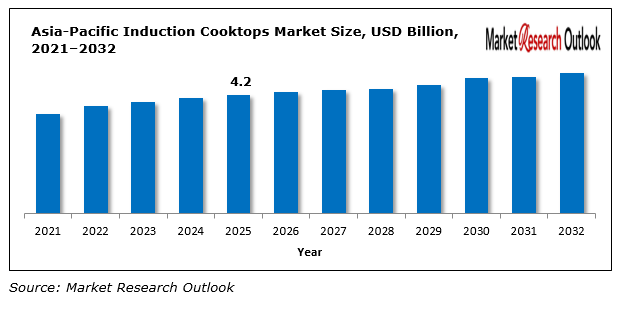
The Asia-Pacific Induction Cooktops Market size was estimated at USD 4.2 Billion in 2025. During the forecast period, the Asia-Pacific Induction Cooktops Market size is projected to grow at a CAGR of 9.1% reaching a value of USD 7.8 Billion by 2032. The rising need for energy-saving cooking devices and the growing number of middle-class citizens throughout the area drive market expansion. The induction cooktop market in Asia includes China, India, Japan, and South Korea because these countries have developed consumer electronics sectors and their people use advanced home appliances. The Southeast Asian nations of Indonesia, Malaysia, and Vietnam currently experience increasing interest in budget-friendly cooking devices that can be easily transported.
Asia-Pacific Induction Cooktops Market – Overview
Market Trends
- The Asia Pacific induction cooktop market experiences growth because of two main factors which include developing urban areas and increasing use of contemporary kitchen equipment in countries like China India and Southeast Asia. The rising disposable income together with shifting consumer habits is driving people to prefer cooking solutions which provide both time-saving benefits and energy-efficient performance.
- The market development is influenced by increasing demand for smart appliances which consume less energy. The manufacturers develop new induction cooktops which include touch control systems and IoT connectivity and multiple cooking presets to meet the needs of tech-savvy users while helping to grow the smart kitchen market throughout the region.
Geopolitical Impact on Asia-Pacific Induction Cooktops Market
The Asia-Pacific Induction Cooktops Market gets affected by geopolitical factors which include global supply chain disruptions and trade policy changes. The production of induction cooktops depends on electronic components which include semiconductors and control systems that manufacturers obtain from worldwide suppliers. The manufacturing costs and availability of products get affected by semiconductor supply chain disruptions and international trade regulation changes. The Asia-Pacific region sees multiple countries developing their domestic electronics manufacturing capabilities to decrease supply chain risks over time.
| Attributes | Details |
| Years Considered | Historical Data – 2021–2025
Base Year – 2025 Estimated Year – 2026 Forecast Period – 2026–2032 |
| Facts Covered | Revenue in USD Billion |
| Market Coverage | China, India, Japan, South Korea, Australia & New Zealand, Indonesia, Malaysia, Singapore, Vietnam, Rest of Asia Pacific |
| Segmentation | Product Type, Burner, Power Rating, Control Type, End User, Country |
Segmental Coverage
By Product Type
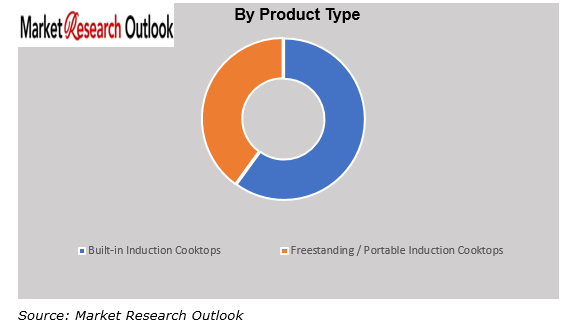
Based on product type, the Asia-Pacific Induction Cooktops Market is segmented into Built-in Induction Cooktops and Freestanding / Portable Induction Cooktops. The Freestanding / Portable Induction Cooktops segment will lead the market because it provides customers with affordable and easily movable cooktops that require no special installation process. The Asia-Pacificn market widely uses these cooktops because their design enables simple movement and they do not need fixed installation. Students and small households choose portable induction cooktops because these appliances offer space-saving cooking options which work well in their rental apartments.
By End User
Based on end user, the Asia-Pacific Induction Cooktops Market is segmented into Residential Households, Commercial Kitchens, and Hospitality Sector. The Residential Households segment will become the most dominant market segment because urban consumers are increasingly adopting modern kitchen appliances. Households are now shifting away from traditional cooking methods because their disposable income has increased and they know about energy-efficient cooking technologies and induction cooktops provide them with cooking convenience. The rising availability of induction cooktops through online and offline retail channels allows consumers throughout Asia-Pacific to access these cooking appliances more easily.
Competitive Landscape
In the competitive landscape of the Asia-Pacific Induction Cooktops market, the organisation has covered major players of the market and their details.
Here are some of the leading players that are playing a major role in the Asia-Pacific Induction Cooktops market:
- Philips Electronics N.V.
- Introduction & Company Profile
- Product Benchmarking
- Strategic Outlook
- Key Competitors
- Financial Analysis
- Swot Analysis
**(Same Data Pointers Will Be Provided for The Below Companies)
- Panasonic Corporation
- LG Electronics Inc.
- Samsung Electronics Co., Ltd.
- Midea Group Co., Ltd.
- Haier Smart Home Co., Ltd.
- TTK Prestige Ltd.
- Bajaj Electricals Ltd.
- Havells India Ltd.
- Stovekraft Ltd. (Pigeon)
- Zhejiang Supor Co., Ltd.
- Joyoung Co., Ltd.
- Other Prominent Players
Segmentation
By Product Type
- Built-in Induction Cooktops
- Freestanding / Portable Induction Cooktops
By Burner
- Single Burner
- Double Burner
- Multi-Burner
By Power Rating
- Below 1500 Watts
- 1500–2000 Watts
- Above 2000 Watts
By Control Type
- Touch Control
- Push Button Control
- Knob Control
By End User
- Residential Households
- Commercial Kitchens
- Hospitality Sector
Asia-Pacific Induction Cooktops Market, 2032
- Research Framework
- Market Segmentation
- Research Objective
- Research Methodology
- Qualitative Research
- Primary Research
- Secondary Research
- Quantitative Research
- Market Breakdown & Data Triangulation
- Demand Side
- Supply Side
- Breakdown Of Primary Research Respondents, By Region
- China
- India
- Japan
- South Korea
- Australia & New Zealand
- Indonesia
- Malaysia
- Singapore
- Vietnam
- Rest of Asia-Pacific
- Assumption & Limitation
- Qualitative Research
- Executive Summary
- Market Overview, 2021–2032
- By Product Type
- By Burner
- By Power Rating
- By Control Type
- By End User
- By Country
- Analyst Recommendations
- Market Overview, 2021–2032
- Geopolitical Impact on Asia-Pacific Induction Cooktops Market
- Asia-Pacific Induction Cooktops Market Insights
- Market Dynamics
- Growth Drivers
- Rising adoption of smart and energy-efficient kitchen appliances
- Increasing urbanization and disposable income in Asia Pacific
- Growing preference for safe and convenient cooking solutions
- Restraints
- High cost compared to traditional cooking appliances
- Dependence on stable electricity supply
- Limited adoption in rural areas
- Opportunities
- Expansion of e-commerce and online appliance sales
- Introduction of advanced and IoT-enabled induction cooktops
- Growing demand in emerging economies across Asia Pacific
- Challenges
- Competition from LPG and gas-based cooking methods
- Price sensitivity in developing markets
- Intense competition among regional and global brands
- Technological Advancements
- Recent Technological Advancements
- Prior to 2020
- Porter’s Five Forces Analysis
- PESTLE Analysis
- Trade Analysis
- Top 3 Importing Countries
- Top 3 Exporting Countries
- Growth Drivers
- Market Dynamics
- Industry Value Chain & Entry Points
- Raw Material & Component Supply
- Component Manufacturing
- Induction Cooktop Assembly
- Branding & Product Innovation
- Distribution & Sales Channels
- End Users
- After-Sales Service & Support
- Asia-Pacific Induction Cooktops Market: Regulatory Framework
- China
- India
- Japan
- South Korea
- Australia & New Zealand
- Indonesia
- Malaysia
- Singapore
- Vietnam
- Rest of Asia-Pacific
- Asia-Pacific Induction Cooktops Market Overview
- Market Size & Forecast, 2021-2032
- By Value (USD Million)
- Market Share & Forecast
- By Product Type
- Built-in Induction Cooktops
- Freestanding / Portable Induction Cooktops
- By Burner
- Single Burner
- Double Burner
- Multi-Burner
- By Power Rating
- Below 1500 Watts
- 1500–2000 Watts
- Above 2000 Watts
- By Control Type
- Touch Control
- Push Button Control
- Knob Control
- By End User
- Residential Households
- Commercial Kitchens
- Hospitality Sector
- By Country
- China
- India
- Japan
- South Korea
- Australia & New Zealand
- Indonesia
- Malaysia
- Singapore
- Vietnam
- Rest of Asia-Pacific
- By Product Type
- Market Size & Forecast, 2021-2032
- Competitive Landscape
- Asia-Pacific Induction Cooktops Company Market Share Analysis, 2025
- By Country
- China
- India
- Japan
- South Korea
- Australia & New Zealand
- Indonesia
- Malaysia
- Singapore
- Vietnam
- Rest of Asia-Pacific
- Competitive Benchmarking, By Operating Parameters
- Key Strategic Development (Mergers, Acquisitions, Partnerships, Etc.)
- List of Emerging players
- By Country
- Asia-Pacific Induction Cooktops Company Market Share Analysis, 2025
- Company Profile
- Philips Electronics N.V.
- Introduction & Company Profile
- Product Benchmarking
- Strategic Outlook
- Key Competitors
- Financial Analysis
- Swot Analysis
- Philips Electronics N.V.
**(Same Data Pointers Will Be Provided for The Below Companies)
- Panasonic Corporation
- LG Electronics Inc.
- Samsung Electronics Co., Ltd.
- Midea Group Co., Ltd.
- Haier Smart Home Co., Ltd.
- TTK Prestige Ltd.
- Bajaj Electricals Ltd.
- Havells India Ltd.
- Stovekraft Ltd. (Pigeon)
- Zhejiang Supor Co., Ltd.
- Joyoung Co., Ltd.
- Other Prominent Players
* Financial information in case of non-listed companies will be provided as per availability
**The segmentation and the companies are subjected to modifications based on in-depth secondary for the final deliverable
Frequently Asked Questions
1. What is the market size of the Asia-Pacific Induction Cooktops Market in 2025?
Ans: The Asia-Pacific Induction Cooktops market is projected to reach approximately USD 4.2 billion by 2032.
2. What is the expected growth rate of the Asia-Pacific Induction Cooktops Market during the forecast period?
Ans: The Asia-Pacific Induction Cooktops market is expected to grow at a CAGR of around 7.5% during the forecast period between 2026 and 2032.
3. What is the forecast value of the Asia-Pacific Induction Cooktops Market by 2032?
Ans: The Asia-Pacific Induction Cooktops market is projected to reach approximately USD 7.8 billion by 2032.
4. What are the major factors driving the growth of the Asia-Pacific Induction Cooktops Market?
Ans: The rising need for energy-saving cooking devices and the growing number of middle-class citizens throughout the area drive market expansion.
5. Name the key players operating in the Asia-Pacific Induction Cooktops Market.
Ans: Key players operating in the Asia-Pacific Induction Cooktops market include Philips Electronics N.V., Panasonic Corporation, LG Electronics Inc., Samsung Electronics Co., Ltd., Midea Group Co., Ltd., Haier Smart Home Co., Ltd., TTK Prestige Ltd., Bajaj Electricals Ltd., Havells India Ltd., Stovekraft Ltd. (Pigeon), Zhejiang Supor Co., Ltd., Joyoung Co., Ltd., and Other Prominent Players.
Frequently Asked Questions
1. What is the market size of the Asia-Pacific Induction Cooktops Market in 2025?
Ans: The Asia-Pacific Induction Cooktops market is projected to reach approximately USD 4.2 billion by 2032.
2. What is the expected growth rate of the Asia-Pacific Induction Cooktops Market during the forecast period?
Ans: The Asia-Pacific Induction Cooktops market is expected to grow at a CAGR of around 7.5% during the forecast period between 2026 and 2032.
3. What is the forecast value of the Asia-Pacific Induction Cooktops Market by 2032?
Ans: The Asia-Pacific Induction Cooktops market is projected to reach approximately USD 7.8 billion by 2032.
4. What are the major factors driving the growth of the Asia-Pacific Induction Cooktops Market?
Ans: The rising need for energy-saving cooking devices and the growing number of middle-class citizens throughout the area drive market expansion.
5. Name the key players operating in the Asia-Pacific Induction Cooktops Market.
Ans: Key players operating in the Asia-Pacific Induction Cooktops market include Philips Electronics N.V., Panasonic Corporation, LG Electronics Inc., Samsung Electronics Co., Ltd., Midea Group Co., Ltd., Haier Smart Home Co., Ltd., TTK Prestige Ltd., Bajaj Electricals Ltd., Havells India Ltd., Stovekraft Ltd. (Pigeon), Zhejiang Supor Co., Ltd., Joyoung Co., Ltd., and Other Prominent Players.