

India Industrial Aerosol Market Size, Share & Forecast 2032
- Chemicals & Advanced Materials, Specialty Chemicals
- Jul 2026
- Pages 140
- Report Format: pdf
- Report Price: $2400 USD
India’s industrial aerosol market is witnessing strong structural growth, driven by expanding automotive aftermarket and vehicle servicing networks, rising manufacturing output, accelerating adoption of preventive maintenance practices, growing electronics and renewable energy servicing activity, widening organised MRO distribution, expanding domestic contract filling capacity, and rising interest from global maintenance chemistry brands targeting India as a long-term growth market.
Report Description
| Study Duration | 2021-2032 |
| Market Size (2025) | USD 96.5 Million |
| CAGR (2026-2032) | 7.2% |
| Leading Segment | Cleaners & Degreasers |
| Fastest Growing Segment | Lubricants & Penetrating Oils |
| Market Size (2032) | USD 157 Million |
Market Overview: India Industrial Aerosol Market
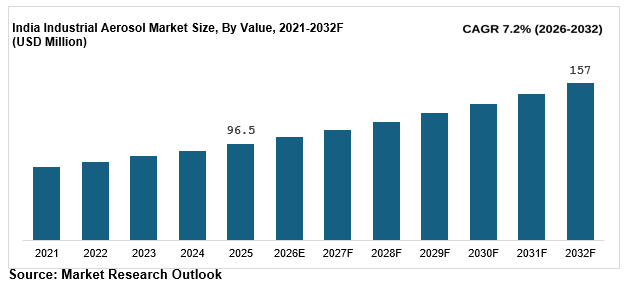
The India industrial aerosol market size is witnessing rapid expansion, driven by rising vehicle servicing volumes, growing plant maintenance activity, accelerating metal fabrication output, expanding facility management coverage, and a steady shift from decanted bulk chemistry toward ready-to-use spray formats. Valued at USD 96.5 million in 2025 and projected to reach USD 157 million by 2032, growing at a CAGR of 7.2%, the India industrial aerosol market growth is being fuelled by strong demand from automotive, manufacturing, construction, and utilities end-use industries across tier-1 and tier-2 industrial clusters. Cleaners and degreasers lead consumption, while lubricants and penetrating oils are emerging as the fastest growing category. India consumed 44 million units in 2025 against 34 million units in 2021, at an average realisation of USD 2.20 per unit. As domestic contract fillers including Twin Tech India, Indian Aerosols, and S. S. Aerosols scale filling capacity, and global brands including WD-40, 3M, Henkel, Illinois Tool Works, and CRC Industries deepen technical distribution, the India industrial aerosol market is evolving into an organised, specification-led, and safety-regulated market with strong long-term growth potential.
Related research: India Specialty Chemicals Market, India Nanochemicals Market and India Carbon Nanotubes Market.
Key Report Takeaways: India Industrial Aerosol Market
- The India industrial aerosol market size is projected to grow from USD 96.5 million in 2025 to USD 157 million by 2032, registering a strong CAGR of 7.2%, driven by expanding vehicle servicing networks, rising preventive maintenance adoption, and the structural shift toward branded spray formats across Indian workshops and plants.
- Cleaners and degreasers dominate the India industrial aerosol market, accounting for 28% of total consumption in 2025, driven by engine, brake, carburettor, and contact cleaning demand from workshops, fabrication shops, and plant maintenance teams concentrated across Maharashtra, Tamil Nadu, Gujarat, and Delhi NCR.
- Lubricants and penetrating oils are emerging as the fastest growing category in the India industrial aerosol market, expected to grow at 8.4% annually as silicone maintenance sprays combining lubrication, corrosion resistance, and mould release performance reshape purchasing across metro and tier-1 industrial clusters.
- Rapid scaling of organised MRO distribution and domestic contract filling capacity is structurally expanding the India industrial aerosol market across vehicle servicing, equipment maintenance, fabrication, and facility care categories, with industrial distributors and dealers handling 34% of national volume in 2025.
- Rising investments by domestic fillers such as Twin Tech India, Indian Aerosols, S. S. Aerosols, and Stanvac Chemicals in filling lines, propellant handling infrastructure, and private label capability are strengthening local supply and supporting the India industrial aerosol market forecast 2032.
Key Market Drivers: India Industrial Aerosol Market
Expanding Automotive Aftermarket and Vehicle Servicing Networks Driving Industrial Aerosol Consumption Across India
Growth in the India industrial aerosol market is being driven by an expanding vehicle parc, widening organised service networks, and rising aftermarket spend across tier-1, tier-2, and tier-3 cities. Vehicle servicing and aftermarket applications absorbed 31% of Indian consumption in 2025, while equipment maintenance and repair accounted for a further 24%, together representing 55% of national offtake. India consumed 44 million units in 2025 against 34 million units in 2021, an average annual increase of 6.7%. Vehicle production reached 28 million units in 2023-24, and the resulting service population sustains recurring demand for engine cleaners, brake cleaners, chain lubricants, rust preventives, and tyre care sprays. Automotive and transportation represents 38% of Indian end-use demand, the largest share of any category. Per-capita consumption in India stands at 0.03 units per year against a global average of 0.19 units, indicating substantial long-term headroom across the India industrial aerosol market.
Growing Manufacturing Base and Preventive Maintenance Culture Lifting Equipment Care Spray Demand
The India industrial aerosol market is benefiting from expanding manufacturing output and a measurable shift from breakdown repair toward planned preventive maintenance. Manufacturing and heavy engineering absorbed 31% of Indian end-use demand in 2025, second only to automotive, and metal fabrication and machining alone accounted for 15% of application volume. Ready-to-use spray formats cut application time by 62% against brush or decanted delivery, reduce material waste, and improve consistency in hard-to-reach assemblies, economics that maintenance managers increasingly recognise. Anti-corrosion and rust preventives account for 14% of Indian volume and are gaining share as plants formalise asset care schedules under quality certification requirements. Mould release agents represent a further 9% of volume, driven by plastics, rubber, and die-casting operations. Government support for domestic manufacturing and rising factory investment continue to create structural pull-through demand across the India industrial aerosol market.
Rising Organised MRO Distribution and Contract Filling Capacity Strengthening Domestic Supply
Channel formalisation is a major catalyst for the India industrial aerosol market, with industrial distributors and dealers handling 34% of national volume in 2025 against 27% in 2021. Direct sales from manufacturers to industrial users accounted for a further 23%, automotive aftermarket channels for 18%, MRO retail and hardware outlets for 13%, imports and trading houses for 8%, and online marketplaces for 4%. Domestic contract fillers including Twin Tech India, Indian Aerosols, S. S. Aerosols, and Stanvac Chemicals have expanded filling capacity, allowing brand owners to localise production rather than import finished goods, and supporting private label programmes for distributors and workshop chains. Hindustan Tin Works and global valve suppliers including AptarGroup underpin the packaging supply base. Imports met 21% of Indian requirement in 2025, principally from China, Germany, Belgium, and the United States, structurally expanding India industrial aerosol market growth through 2032.
Key Market Challenges: India Industrial Aerosol Market
Flammable Propellant Handling, Storage, and Transport Rules Raising Compliance and Logistics Costs
The India industrial aerosol market continues to face challenges around safety compliance and hazardous goods logistics. Hydrocarbon propellants covering propane, butane, and isobutane account for 71% of Indian formulations, making finished goods flammable and subject to Petroleum and Explosives Safety Organisation licensing, dedicated storage licensing, and restricted transport routing. Licensed hazardous goods warehousing costs 2.4 times ordinary warehousing per pallet position, and insurance premiums run materially higher. Filling lines require explosion-proof electricals, gassing rooms, and continuous gas detection, so greenfield capital intensity per line is high relative to conventional liquid filling. Air freight restrictions on pressurised goods limit rapid replenishment and force sea and road logistics with longer lead times, a persistent operational constraint across the India industrial aerosol market.
Import Dependence for Valves, Actuators, and Specialty Propellants Exposing Fillers to Supply Volatility
The India industrial aerosol market faces structural complexity from component sourcing and input dependence. Valves and actuators, which determine spray pattern, flow rate, and shelf performance, are largely imported or supplied by multinational manufacturers, and precision domestic capability remains limited. Imports met 21% of Indian requirement in 2025, covering both finished goods and critical components sourced from China, Germany, Belgium, and the United States. Low-GWP hydrofluoroolefin propellants carry landed cost 4.1 times hydrocarbon alternatives, restricting their use to applications where flammability must be eliminated. Tinplate and aluminium can prices move with global metal cycles, and currency movement feeds directly into filler economics. Average gross margins for Indian contract fillers stood at 17% in 2025, leaving limited room to absorb input swings across the India industrial aerosol market.
Fragmented Small-Scale Manufacturing and Counterfeit Products Eroding Pricing Power for Organised Suppliers
The India industrial aerosol market faces practical constraints from fragmentation and counterfeiting. The market remains highly fragmented, with numerous small-scale manufacturers producing maintenance sprays alongside a smaller organised segment, and quality varies widely on spray rate, pressure retention, and shelf life. Unbranded and counterfeit products sold through informal hardware channels undercut organised suppliers by 45% on shelf price while delivering inconsistent performance, damaging category trust among workshop buyers. Price sensitivity remains acute in small garages and job-work shops, where decanted bulk chemistry applied by brush still substitutes for spray formats. Building consistent spray pattern, pressure, and shelf-life performance across high-volume filling lines requires investment in testing and process control that fragmented producers cannot justify, a continuing barrier across the India industrial aerosol market.
Key Market Trends: India Industrial Aerosol Market
Rapid Shift Toward Low-GWP Propellants, Bag-on-Valve Systems, and Silicone Maintenance Chemistry
The India industrial aerosol market is undergoing a clear technology shift toward low-GWP propellants, bag-on-valve delivery, and multifunctional silicone chemistry, with these advanced formats expected to account for 23% of Indian consumption by 2030 against 14% in 2025. Bag-on-valve systems separate product from propellant, allowing compressed nitrogen or air to drive delivery, eliminating flammability, achieving evacuation above 98%, and permitting any orientation spraying, capabilities that matter in confined plant environments. Hydrofluoroolefin propellants with global warming potential below 1 are gaining evaluation as India progresses its hydrofluorocarbon phasedown commitments. Silicone maintenance sprays that combine lubrication, corrosion resistance, and mould release in a single product are the fastest growing chemistry, and dielectric contact cleaners are scaling alongside electronics servicing. This transition is reinforcing the India industrial aerosol market forecast 2032 across both automotive and plant maintenance categories.
Growth of Technical Distribution, Private Label Programmes, and Digital B2B Procurement in the India Industrial Aerosol Market
A clear shift toward organised and digital procurement is reshaping the India industrial aerosol market, particularly among mid-sized plants and workshop chains. Industrial distributors and dealers accounted for 34% of Indian volume in 2025, direct sales for 23%, and automotive aftermarket channels for 18%, with the balance moving through MRO retail, importers, and online marketplaces. Technical distributors offering on-site application training, consumption audits, and consolidated MRO supply now serve 41% of organised plant accounts, converting product sales into service relationships. Private label programmes have expanded as contract fillers offer distributors and workshop chains branded ranges without capital investment. Online B2B marketplaces handle 4% of Indian volume and are growing quickly among small workshops, though hazardous goods shipping rules limit last-mile options and keep physical stockists central to the India industrial aerosol market.
Contract Filling Capacity Expansion and Localisation by Global Maintenance Chemistry Brands
A wave of localisation and capacity creation is reshaping the India industrial aerosol market supply landscape. Global maintenance chemistry brands including WD-40, 3M, Henkel, Illinois Tool Works, CRC Industries, and Fuchs Lubricants have deepened Indian distribution and increasingly source filling locally rather than importing finished goods, cutting landed cost and shortening replenishment cycles. Domestic contract fillers such as Twin Tech India, Indian Aerosols, S. S. Aerosols, and Stanvac Chemicals have added filling lines, gassing capacity, and quality laboratories to support this shift. Hindustan Tin Works and global valve suppliers including AptarGroup have expanded packaging supply into the segment. Tightening Petroleum and Explosives Safety Organisation enforcement has raised the compliance bar, favouring organised producers over informal units and reinforcing the India industrial aerosol market forecast 2032 across the entire value chain.
Segmental Insights: India Industrial Aerosol Market
By End-Use Industry: Automotive & Transportation Segment Dominates the India Industrial Aerosol Market
The automotive and transportation end-use industry dominates the India industrial aerosol market, accounting for 38% of total consumption in 2025, driven by engine and brake cleaning, chain and cable lubrication, rust prevention, and tyre care demand from dealer workshops, independent garages, and fleet depots concentrated across Maharashtra, Tamil Nadu, Gujarat, Haryana, and Delhi NCR. Cleaners and degreasers are the dominant product within this segment, capturing 36% of automotive-linked purchases. Manufacturing and heavy engineering contributes a further 31% of demand, driven by machine maintenance, mould release, fabrication marking, and assembly line adhesives. Construction and infrastructure accounts for 17%, led by line marking, formwork release, and site equipment care, while energy, utilities, and electronics represent 14%, supported by dielectric contact cleaners, switchgear maintenance, and renewable asset servicing. In 2025, leading suppliers including WD-40, 3M, Henkel, Illinois Tool Works, and CRC Industries scaled deliveries into automotive and plant accounts, reinforcing segment dominance in the India industrial aerosol market.
By Product Type: Cleaners & Degreasers Lead While Lubricants Grow Fastest
Cleaners and degreasers lead the India industrial aerosol market product mix, accounting for 28% of total volume in 2025, driven by recurring workshop and plant cleaning tasks, broad substrate compatibility, and established purchasing habits across organised and informal channels. Lubricants and penetrating oils contribute a further 26% and form the fastest growing category within the India industrial aerosol market, expanding at 8.4% annually on the back of silicone maintenance chemistry that delivers lubrication, corrosion resistance, and mould release performance in a single product. Industrial coatings and marking paints account for 17% of volume, anti-corrosion and rust preventives for 14%, mould release agents for 9%, and other categories covering adhesives, non-destructive testing sprays, and welding sprays for the remaining 6%. Measured by propellant, hydrocarbon systems represent 71% of Indian volume, dimethyl ether 12%, compressed gases 9%, hydrofluoroolefin and low-GWP systems 6%, and other routes 2%. Leading suppliers have aligned portfolios to this mix, driving specification-led adoption across the India industrial aerosol market.
Regional Insights: India Industrial Aerosol Market
Regional analysis of the India industrial aerosol market shows that West India and South India collectively account for 60% of total consumption, driven by Maharashtra (Mumbai, Pune, and Nashik automotive and engineering clusters), Gujarat (Ahmedabad, Vadodara, and Rajkot fabrication and chemical belt), Tamil Nadu (Chennai and Coimbatore automotive and machine tool corridors), and Karnataka (Bengaluru electronics and aerospace base), supported by dense workshop networks and organised distributor coverage. West India alone contributes 33% of demand and South India 27%, reflecting the concentration of both vehicle service infrastructure and manufacturing capacity. North India contributes 24% of demand, led by Haryana, Punjab, Uttar Pradesh, Rajasthan, and Delhi NCR, supported by automotive component, agricultural machinery, and fabrication clusters around Gurugram, Faridabad, Ludhiana, and Bhiwadi. East and Central India together account for 16% of demand, supported by West Bengal, Odisha, Chhattisgarh, and Madhya Pradesh, where mining, steel, and heavy engineering maintenance activity is expanding. In 2025, distribution expansion by organised suppliers across these clusters reinforced regional supply hubs, supporting closer execution of maintenance contracts across the India industrial aerosol market.
Recent Developments: India Industrial Aerosol Market
- The India industrial aerosol market recorded steady momentum in demand and channel development during 2024 and 2025. Indian consumption reached 44 million units in 2025 against 41 million units in 2024, an increase of 7.3%, at an average realisation of USD 2.20 per unit. Imports met 21% of national requirement, principally from China, Germany, Belgium, and the United States. Low-GWP and bag-on-valve formats accounted for 14% of consumption in 2025 against 7% in 2021, and cumulative Indian volume is projected to reach 52 million units by FY28.
- Domestic contract fillers have deepened India-focused capacity programmes. Twin Tech India, Indian Aerosols, S. S. Aerosols, and Stanvac Chemicals added filling lines, gassing capacity, and quality laboratories through 2024 and 2025, enabling global brands to localise production rather than import finished goods. Hindustan Tin Works and global valve suppliers including AptarGroup expanded packaging supply into the segment. These developments are strengthening domestic supply and supporting the India industrial aerosol market forecast 2032.
- Sustainability and safety momentum has gained traction in the India industrial aerosol market. Producers have advanced low-GWP hydrofluoroolefin propellant evaluation and bag-on-valve systems delivering evacuation above 98% with compressed gas, aligning with India’s hydrofluorocarbon phasedown commitments and tightening Petroleum and Explosives Safety Organisation enforcement. Global brands including WD-40, 3M, Henkel, Illinois Tool Works, CRC Industries, and Fuchs Lubricants continue to target Indian offtake through technical distribution and local filling partnerships, positioning India as one of the fastest scaling maintenance chemistry markets in Asia and strengthening long-term competitive positioning in the India industrial aerosol market forecast 2032.
Key Market Players: India Industrial Aerosol Market
- Twin Tech India Private Limited
- Indian Aerosols Private Limited
- S. Aerosols Private Limited
- Stanvac Chemicals India Limited
- WD-40 Company India Private Limited
- 3M India Limited
- Henkel Adhesives Technologies India Private Limited
- Illinois Tool Works Inc.
- CRC Industries Inc.
- Fuchs Lubricants
- AptarGroup Inc.
- Hindustan Tin Works Limited
- Nippon Paint India Private Limited
Report Scope
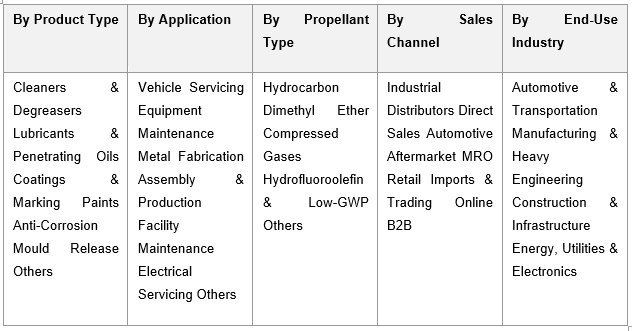
In this report, the India Industrial Aerosol Market has been segmented into the following categories, in addition to detailed analysis of key industry trends, market dynamics, competitive landscape, and growth opportunities across the forecast period:
- By Product Type
- Cleaners & Degreasers
- Lubricants & Penetrating Oils
- Industrial Coatings & Marking Paints
- Anti-Corrosion & Rust Preventives
- Mould Release Agents
- Others (Adhesives, NDT Sprays, Welding Sprays)
- By Application
- Vehicle Servicing & Aftermarket
- Equipment Maintenance & Repair
- Metal Fabrication & Machining
- Assembly & Production Line
- Building & Facility Maintenance
- Electrical & Electronics Servicing
- Others
- By Propellant Type
- Hydrocarbon (Propane, Butane, Isobutane)
- Dimethyl Ether (DME)
- Compressed Gases (Nitrogen, Carbon Dioxide)
- Hydrofluoroolefin & Low-GWP
- Others
- By Sales Channel
- Industrial Distributors & Dealers
- Direct Sales (Manufacturer to Industrial User)
- Automotive Aftermarket Channels
- MRO Retail & Hardware Outlets
- Imports & Trading Houses
- Online & B2B Marketplaces
- By End-Use Industry
- Automotive & Transportation
- Manufacturing & Heavy Engineering
- Construction & Infrastructure
- Energy, Utilities & Electronics
- By Geography
- North India
- South India
- West India
- East India
- Central India
Competitive Landscape
Company Profiles:
Detailed analysis of the leading companies operating in the India Industrial Aerosol Market, including business overview, product portfolio, strategic initiatives, competitive positioning, and recent developments.
Company Information
Detailed profiling and strategic analysis of additional market players (up to five companies), including emerging contract fillers, specialty maintenance chemistry formulators, regional distributors, or niche valve and actuator suppliers.
For a free sample of the India Industrial Aerosol Market report, customised insights or delivery timelines, submit your query here
Table of Contents
- Research Framework
- Market Segmentation
- Research Objective
- Research Methodology
- Qualitative Research
- Primary Research
- Secondary Research
- Quantitative Research
- Market Breakdown & Data Triangulation
- Demand Side
- Supply Side
- Primary Research Respondents
- Assumption & Limitation
- Executive Summary
- Market Overview, 2021-2032
- By Product Type
- By Application
- By Propellant Type
- By Sales Channel
- By End-Use Industry
- By Region
- Analyst Recommendations
- Geopolitical Impact on India Industrial Aerosol Market
- India Industrial Aerosol Market Insights
- Market Dynamics
- Growth Drivers
- Expanding automotive aftermarket and vehicle servicing networks driving industrial aerosol consumption across India.
- Growing manufacturing base and preventive maintenance culture lifting equipment care spray demand.
- Rising organised MRO distribution and contract filling capacity strengthening domestic supply.
- Restraints
- Flammable propellant handling, storage, and transport rules raising compliance and logistics costs.
- Import dependence for valves, actuators, and specialty propellants exposing fillers to supply volatility.
- Price sensitivity and bulk pack substitution limiting adoption across small workshops.
- Opportunities
- Low-GWP propellants and bag-on-valve systems meeting tightening environmental and safety expectations.
- Electric vehicle servicing, electronics cleaning, and renewable energy maintenance creating new demand pools.
- Contract filling and private label manufacturing positioning India as a regional supply base.
- Challenges
- Fragmented small-scale manufacturing limiting consistent quality and brand trust across the market.
- Counterfeit and unbranded products eroding pricing power for organised suppliers.
- Maintaining spray pattern, pressure, and shelf-life consistency across high-volume filling lines.
- Technological Advancements
- Recent Technological Advancements
- Prior to 2020
- Porter’s Five Forces Analysis
- PESTLE Analysis
- Industry Value Chain & Entry Points
- Upstream Raw Materials (base oils, solvents, silicones, resins, corrosion inhibitors, pigments)
- Propellant Suppliers (LPG, dimethyl ether, compressed nitrogen and carbon dioxide, low-GWP HFO)
- Can, Valve & Actuator Manufacturers (Hindustan Tin Works, AptarGroup, Lindal, Precision Valve)
- Industrial Aerosol Formulators & Brand Owners (WD-40, 3M, Henkel, Illinois Tool Works, CRC Industries, Fuchs)
- Industrial Aerosol Contract Filling & Private Label Manufacturers (Twin Tech India, Indian Aerosols)
- Quality Control, R&D & Testing Laboratories (BIS, PESO conformity, spray rate and leak testing)
- Warehousing & Hazardous Goods Logistics (licensed storage and transport of pressurised goods)
- Industrial Aerosol Distributors, Dealers & MRO Channels (regional stockists and technical distributors)
- Automotive Aftermarket & Workshop Networks (service centres, garages, dealer workshops)
- End-Users (automotive OEMs, manufacturing plants, construction contractors, utilities, electronics)
- India Industrial Aerosol Market: Regulatory Framework
- India Industrial Aerosol Market Overview
- Market Size & Forecast, 2021-2032
- By Value (USD Million)
- By Volume (Million Units)
- Market Share & Forecast
- By Product Type
- Cleaners & Degreasers
- Lubricants & Penetrating Oils
- Industrial Coatings & Marking Paints
- Anti-Corrosion & Rust Preventives
- Mould Release Agents
- Others (Adhesives, NDT Sprays, Welding Sprays)
- By Application
- Vehicle Servicing & Aftermarket
- Equipment Maintenance & Repair
- Metal Fabrication & Machining
- Assembly & Production Line
- Building & Facility Maintenance
- Electrical & Electronics Servicing
- Others
- By Propellant Type
- Hydrocarbon (Propane, Butane, Isobutane)
- Dimethyl Ether (DME)
- Compressed Gases (Nitrogen, Carbon Dioxide)
- Hydrofluoroolefin & Low-GWP
- Others
- By Sales Channel
- Industrial Distributors & Dealers
- Direct Sales (Manufacturer to Industrial User)
- Automotive Aftermarket Channels
- MRO Retail & Hardware Outlets
- Imports & Trading Houses
- Online & B2B Marketplaces
- By End-Use Industry
- Automotive & Transportation
- Manufacturing & Heavy Engineering
- Construction & Infrastructure
- Energy, Utilities & Electronics
- By Geography
- North India
- South India
- West India
- East India
- Central India
- Competitive Landscape
- India Industrial Aerosol Market Company Market Share Analysis, 2025
- Competitive Benchmarking, By Operating Parameters
- Key Strategic Development (Mergers, Acquisitions, Partnerships, Etc.)
- List of Emerging Players
- Company Profile
- Twin Tech India Private Limited
- Introduction & Company Profile
- Product Benchmarking
- Strategic Outlook
- Key Competitors
- Financial Analysis
- SWOT Analysis
(Same Data Pointers Will Be Provided for The Below Companies)
- Indian Aerosols Private Limited
- S. Aerosols Private Limited
- Stanvac Chemicals India Limited
- WD-40 Company India Private Limited
- 3M India Limited
- Henkel Adhesives Technologies India Private Limited
- Illinois Tool Works Inc.
- CRC Industries Inc.
- Fuchs Lubricants
- AptarGroup Inc.
- Hindustan Tin Works Limited
- Nippon Paint India Private Limited
- Other Prominent Players
* Financial information in case of non-listed companies will be provided as per availability
** The segmentation and the companies are subjected to modifications based on in-depth secondary for the final deliverable
Frequently Asked Questions
1. How large is the India industrial aerosol market and what is its growth forecast?
Ans: The India industrial aerosol market is valued at USD 96.5 million in 2025 and is projected to reach USD 157 million by 2032, growing at a CAGR of 7.2%.
2. Which product types are driving demand in the India industrial aerosol market?
Ans: Cleaners and degreasers lead with 28% share, while lubricants and penetrating oils grow fastest at 8.4% annually, driven by silicone maintenance spray adoption.
3. What are the key drivers of growth in the India industrial aerosol market?
Ans: Key drivers include expanding automotive aftermarket networks, rising manufacturing output and preventive maintenance adoption, and growing organised MRO distribution and contract filling capacity.
4. Which regions are driving growth in the India industrial aerosol market?
Ans: West India and South India lead with 60% of consumption, driven by Maharashtra, Gujarat, Tamil Nadu, and Karnataka. North India contributes 24% of national demand.
5. What are the latest trends in the India industrial aerosol market?
Ans: Latest trends include low-GWP propellant adoption, bag-on-valve systems, silicone maintenance chemistry, technical distribution models, and private label contract filling programmes.