

India Biofuel Market Size, Share & Forecast 2032
- Energy, Power & Storage, Renewables & Clean Fuels
- Jul 2026
- Pages 140
- Report Format: pdf
- Report Price: $2400 USD
India’s biofuel market is witnessing strong structural growth, driven by the Ethanol Blended Petrol programme reaching its 20% milestone ahead of schedule, rapid feedstock diversification into maize and damaged food grains, large-scale biofuel biofuel biofuel biofuel biofuel distillery capacity creation, the SATAT compressed biogas rollout, an emerging sustainable aviation fuel roadmap, and sustained policy support aimed at cutting crude import dependence while raising farm incomes.
Report Description
| Study Duration | 2021-2032 |
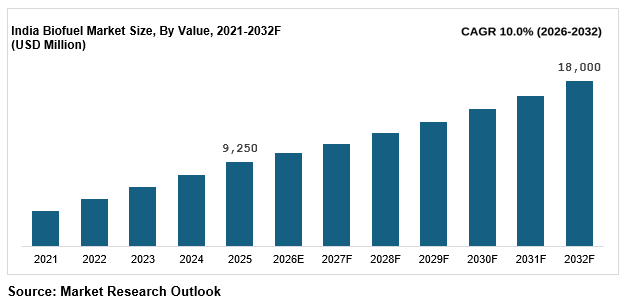
| Market Size (2025) | USD 9,250 Million |
| CAGR (2026-2032) | 10.0% |
| Leading Segment | Ethanol (Bioethanol) for Petrol Blending |
| Fastest Growing Segment | Compressed Biogas (CBG) |
| Market Size (2032) | USD 18,000 Million |
Source:
India Biofuel Market Overview
The India biofuel market size is witnessing rapid expansion, driven by the Ethanol Blended Petrol programme, accelerating feedstock diversification, expanding compressed biogas capacity, growing biodiesel procurement, and an emerging sustainable aviation fuel pathway. Valued at USD 9,250 million in 2025 and projected to reach USD 18,000 million by 2032, growing at a CAGR of 10.0%, the India biofuel market growth is being fuelled by firm offtake from oil marketing companies, city gas distributors, and industrial energy users across every major producing state. Ethanol leads consumption, while compressed biogas is emerging as the fastest growing fuel type. India consumed 12,650 million litres of biofuel in 2025 against 5,400 million litres in 2021, with ethanol supply alone reaching 11,000 million litres and national biofuel blending crossing the 20% mark ahead of the ESY 2025-26 target. As sugar and distillery majors including Balrampur Chini Mills, Shree Renuka Sugars, Triveni Engineering, and Godavari Biorefineries expand capacity, and Indian Oil, Bharat Petroleum, and Hindustan Petroleum anchor procurement, the India biofuel market is evolving into a policy-driven, feedstock-sensitive, and increasingly diversified market with strong long-term growth potential.
Related research: India Hydrogen Market, India Biogas Market and India Ammonia Market.
Key Report Takeaways: India Biofuel Market
- The India biofuel market size is projected to grow from USD 9,250 million in 2025 to USD 18,000 million by 2032, registering a CAGR of 10.0%, driven by higher blending ambition beyond E20, compressed biogas expansion, and the structural shift toward advanced biofuel routes across Indian transport and industrial energy value chains.
- Ethanol dominates the India biofuel market, accounting for 87% of total biofuel consumption in 2025, driven by the Ethanol Blended Petrol programme, deep distillery capacity across Uttar Pradesh, Maharashtra, and Karnataka, and E20 availability at more than 17,400 retail outlets nationwide.
- Compressed biogas is emerging as the fastest growing fuel type in the India biofuel market, expected to grow at 22.6% annually as the SATAT initiative, municipal waste monetisation, and city gas distribution networks reshape supply across metro and agricultural clusters.
- Rapid scaling of distillery capacity, with national biofuel production capacity for ethanol reaching roughly 20,000 million litres by late 2025 against E20 demand of about 11,000 million litres, is structurally expanding the India biofuel market while creating urgency around higher blending targets.
- Rising investments by Indian biofuel producers such as Balrampur Chini Mills, Shree Renuka Sugars, Triveni Engineering, Dalmia Bharat Sugar, and Godavari Biorefineries in dual-feed distilleries, grain-based capacity, and compressed biogas plants are strengthening supply and supporting the India biofuel market forecast 2032.
Key Drivers of the India Biofuel Market
Ethanol Blended Petrol Programme and the E20 Milestone Driving Nationwide Biofuel Demand Across India
Growth in the India biofuel market is being driven by the Ethanol Blended Petrol programme, which delivered 20% national biofuel blending in 2025, ahead of the ESY 2025-26 target set under the National Policy on Biofuels. Ethanol absorbed 87% of Indian biofuel consumption in 2025, while compressed biogas accounted for a further 5%, together representing 92% of national biofuel offtake. Ethanol supply reached 11,000 million litres in 2025 against 7,074 million litres in the 2023-24 supply year and only 380 million litres in 2013-14, a near thirtyfold expansion over a decade. Oil marketing companies now dispense E20 at more than 17,400 retail outlets and E100 at over 400 locations. Transportation fuel blending represents 88% of Indian biofuel end-use demand, the largest share of any category. Each additional point of blending displaces crude imports and channels payment to farmers, an alignment of energy security and rural income that continues to sustain policy commitment across the India biofuel market.
Feedstock Diversification Into Maize, Damaged Grains, and Sugarcane Juice Expanding Biofuel Production Capacity
The India biofuel market is benefiting from a decisive move away from single-feedstock dependence. Sugarcane molasses supplied 42% of Indian biofuel feedstock in 2025, maize and damaged food grains 31%, and sugarcane juice and syrup 12%, together covering 85% of national biofuel requirement. Grain-based routes have expanded fastest, with maize acreage and output rising 12% across 2024 and 2025 in response to procurement incentives, giving distilleries a monsoon-independent alternative to cane. Dual-feed distilleries capable of switching between sugar and grain streams have become the standard configuration for new biofuel capacity, reducing seasonal idle time. Municipal, agricultural, and cattle waste supplied a further 8% of feedstock, principally into compressed biogas. First-generation routes still represent 86% of Indian biofuel output, but feedstock flexibility has materially reduced biofuel supply risk and supported consistent offtake across the India biofuel market.
SATAT Compressed Biogas Rollout and Sustainable Aviation Fuel Roadmap Opening New Consumption Channels
Diversification beyond road transport blending is a major catalyst for the India biofuel market. The SATAT initiative had roughly 170 functional compressed biogas plants operating by 2025 with close to 300 more under construction, against a long-term ambition of 5,000 plants, and compressed biogas is growing at 22.6% annually, the fastest of any fuel type in the India biofuel market. Biodiesel blending rose to 0.6% in 2025 from 0.4% in 2024, with procurement reaching 489.3 million litres during 2024 and more than 80 certified producers now operating, though the 5% target for 2030 would require around 5,000 million litres. Sustainable aviation fuel and second-generation cellulosic projects, supported under the Pradhan Mantri JI-VAN Yojana, are creating premium advanced biofuel pathways. Aviation and marine applications represent 2% of demand today but carry disproportionate long-term significance, structurally expanding India biofuel market growth through 2032.
India Biofuel Market Challenges
Feedstock Availability, Monsoon Variability, and Crop Diversion Pressures Constraining Sustained Supply
The India biofuel market continues to face challenges around biofuel feedstock security and agricultural variability. Drought conditions during the E20 acceleration forced restrictions on cane juice diversion to ethanol, demonstrating how quickly weather can override policy intent. La Nina conditions in 2025 delivered above-average rainfall and lifted sugarcane and rice availability, but the underlying exposure remains. Procurement incentives that succeeded in lifting maize output also pulled acreage away from millets, pulses, and oilseeds, deepening edible oil import dependence and drawing scrutiny over food-versus-fuel trade-offs. Corn prices subsequently fell as production outran demand, squeezing the farmers the policy intended to support. Balancing feedstock cost, farm income, and food security remains the central structural tension across the India biofuel market.
Surplus Distillery Capacity and Absent Post-E20 Blending Targets Leaving Assets Underutilised
The India biofuel market faces structural complexity from the very success of its blending programme. National ethanol production capacity expanded from under 2,000 million litres in 2014 to roughly 20,000 million litres by late 2025, while E20 blending absorbs only around 11,000 million litres annually, leaving close to half of installed biofuel capacity idle. Capacity utilisation across Indian distilleries stood at 55% in 2025. Without firm blending targets beyond E20, this underutilisation threatens returns on recent investment, weakens mill cash flow, and delays cane payments to farmers. Policy discussion has turned to E30 blending expected between 2028 and 2030, ethanol-diesel blends, and a 27% ambition by 2030, but engine compatibility validation, retail infrastructure, and vehicle fleet turnover all constrain the pace at which surplus can be absorbed across the India biofuel market.
Sugar Mill Financial Stress and Used Cooking Oil Collection Gaps Limiting Scale-Up
The India biofuel market faces practical constraints from biofuel producer economics and collection infrastructure. The minimum support price for sugarcane has risen by close to 30% since 2019 while the sugar minimum selling price has remained fixed at INR 3,100 per quintal, so production cost now exceeds realisation for many mills and ethanol revenue has become the margin of survival rather than a bonus. On the biodiesel side, more than 80 certified producers operate but combined capacity remains small relative to the roughly 5,000 million litres needed for a 5% blend by 2030, and progress is held back by fragmented used cooking oil collection from restaurants, hotels, and food processors. Maintaining specification consistency, storage integrity, and moisture control across dispersed distilleries adds further operational burden across the India biofuel market.
India Biofuel Market Trends
Rapid Shift Toward Second-Generation, Drop-In, and Sustainable Aviation Fuel Routes in India
The India biofuel market is undergoing a clear technology shift toward second-generation, drop-in, and aviation-grade routes, with these advanced categories expected to account for 21% of Indian biofuel consumption by 2030 against 13% in 2025. Second-generation cellulosic plants converting rice straw, bagasse, and wood biomass address both the surplus feedstock question and the stubble burning problem, and most new biorefinery announcements now specify lignocellulosic capability. Advanced drop-in fuels compatible with existing engines and pipelines avoid the blend wall entirely, a decisive advantage as ethanol approaches its practical ceiling in the legacy fleet. Sustainable aviation fuel has moved from concept to roadmap as domestic carriers face international carbon obligations. Technology providers including Praj Industries have built process capability tailored to Indian biomass, reinforcing the India biofuel market forecast 2032 across both transport and aviation categories.
Growth of Long-Term Offtake Contracts, Oil Marketing Company Procurement, and Dedicated Blending Infrastructure
A clear shift toward contracted and infrastructure-backed supply is reshaping the India biofuel market. Oil marketing company procurement accounted for 71% of Indian biofuel volume in 2025, long-term offtake contracts for 12%, direct supply agreements for 8%, captive and industrial use for 5%, distributors and traders for 3%, and exports for 1%. Multi-year offtake commitments from Indian Oil, Bharat Petroleum, and Hindustan Petroleum have become the financing precondition for new distillery projects, transferring demand risk from producers to the programme and unlocking bank lending. Dedicated ethanol tankage, rail movement, and blending infrastructure investment by the oil marketing companies has cut supply disruption materially. City gas distributors including Gujarat Gas and Adani Total Gas are building parallel offtake for compressed biogas, extending the contracting model into gaseous fuel across the India biofuel market.
Dual-Feed Distillery Capacity, Compressed Biogas Plants, and Advanced Biofuel Investment Programmes
A wave of capacity creation is reshaping the India biofuel market supply landscape. Combined India-focused capital expenditure announced across distillery, compressed biogas, and advanced biofuel capacity exceeded USD 6,800 million between 2023 and 2025. Balrampur Chini Mills, Shree Renuka Sugars, Triveni Engineering, Bajaj Hindusthan Sugar, Dalmia Bharat Sugar, EID Parry, and Godavari Biorefineries expanded dual-feed capacity able to run on molasses, juice, or grain according to season and price. Compressed biogas developers advanced close to 300 plants under construction alongside the roughly 170 already functional. Praj Industries deepened process technology for second-generation and sustainable aviation routes. The Pradhan Mantri JI-VAN Yojana extension to advanced biofuels and continued biofuel procurement price support have structurally favoured organised supply, reinforcing the India biofuel market forecast 2032 across the entire value chain.
India Biofuel Market Share by Segment
By End-Use Industry: Transportation Fuel Blending Dominates the India Biofuel Market
Transportation fuel blending dominates the India biofuel market, accounting for 88% of total biofuel consumption in 2025, driven by the Ethanol Blended Petrol programme, expanding biodiesel procurement, and compressed biogas uptake across commercial vehicle fleets in Uttar Pradesh, Maharashtra, Karnataka, and Gujarat. Ethanol is the dominant fuel within this segment, reflecting E20 availability at more than 17,400 retail outlets. Industrial and commercial energy contributes a further 6% of biofuel demand, driven by compressed biogas replacing piped natural gas and furnace oil in process heating. Power generation accounts for 4%, supported by biogas and biomass-linked generation at mills and agricultural clusters, while aviation and marine represent 2%, an early but strategically significant pool as sustainable aviation fuel obligations approach. In 2025, leading suppliers including Balrampur Chini Mills, Shree Renuka Sugars, Triveni Engineering, Dalmia Bharat Sugar, and Godavari Biorefineries scaled deliveries into oil marketing company accounts, reinforcing segment dominance in the India biofuel market.
By Fuel Type: Ethanol Leads While Compressed Biogas Grows Fastest
Ethanol leads the India biofuel market fuel mix, accounting for 87% of total biofuel volume in 2025, driven by the blending programme, established distillery capacity, assured oil marketing company offtake, and administered procurement pricing that underwrites producer economics. Compressed biogas contributes a further 5% and is the fastest growing fuel type within the India biofuel market, expanding at 22.6% annually on the back of the SATAT initiative, waste monetisation economics, and city gas distribution offtake. Biodiesel accounts for 4% of volume with blending at 0.6% in 2025, second-generation cellulosic routes for 2%, sustainable aviation fuel for 1%, and other categories covering bio-oil, biobutanol, and bio-LNG for the remaining 1%. Measured by generation, first-generation routes represent 86% of Indian biofuel output, second-generation 10%, advanced drop-in 2%, third-generation 1%, and other pathways 1%. Leading suppliers have aligned portfolios to this mix, driving diversification across the India biofuel market.
India Biofuel Market by Region
Regional analysis of the India biofuel market shows that North India and West India collectively account for 55% of total biofuel consumption and production, driven by Uttar Pradesh (the largest sugarcane and distillery base), Punjab and Haryana (grain-based capacity and biomass availability), Maharashtra (cooperative sugar belt across Kolhapur, Solapur, and Ahmednagar), and Gujarat (compressed biogas and city gas distribution networks), supported by dense blending and tankage infrastructure. North India alone contributes 29% of demand and West India 26%, reflecting the concentration of both cane crushing and grain-based distillery capacity. South India contributes 23% of biofuel demand, led by Karnataka, Tamil Nadu, Andhra Pradesh, and Telangana, supported by established sugar mills and growing compressed biogas projects. Central and East India together account for 22% of biofuel demand, supported by Madhya Pradesh, Chhattisgarh, Bihar, and Odisha, where grain-based distilleries and biomass aggregation have expanded rapidly. In 2025, capacity additions across these clusters reinforced regional supply hubs, supporting closer execution of blending and offtake commitments across the India biofuel market.
Recent Developments in the India Biofuel Market
- The India biofuel market recorded strong momentum in blending and capacity during 2024 and 2025. India crossed the 20% ethanol blending milestone in 2025, ahead of the ESY 2025-26 target, with blending running consistently above 19.5% from January 2025. Ethanol supply reached 11,000 million litres in 2025 against 7,074 million litres in the 2023-24 supply year, when average blending stood at 14.6%. Total biofuel consumption reached 12,650 million litres in 2025 against 10,700 million litres in 2024, an increase of 18.2%, and is projected to reach 15,800 million litres by FY28.
- Domestic producers have deepened capacity and feedstock flexibility programmes. Sugar and distillery majors including Balrampur Chini Mills, Shree Renuka Sugars, Triveni Engineering, Bajaj Hindusthan Sugar, Dalmia Bharat Sugar, EID Parry, and Godavari Biorefineries expanded dual-feed capacity across molasses, juice, and grain streams, lifting national biofuel production capacity for ethanol to roughly 20,000 million litres by late 2025 against E20 demand of about 11,000 million litres. Compressed biogas developers advanced close to 300 plants under construction alongside roughly 170 already functional. These developments are strengthening supply and supporting the India biofuel market forecast 2032.
- Policy momentum has gained strong traction in the India biofuel market. The Ministry of Petroleum and Natural Gas has opened discussion on a post-E20 roadmap, with E30 blending expected between 2028 and 2030 and a longer-term 27% ambition by 2030, alongside plans for a formal biodiesel blending mandate. The Pradhan Mantri JI-VAN Yojana has been extended to advanced biofuels, and the GOBARdhan and SATAT schemes continue to widen compressed biogas participation. Oil marketing companies including Indian Oil, Bharat Petroleum, and Hindustan Petroleum continue to anchor procurement and blending infrastructure, positioning India as one of the fastest scaling biofuel markets globally and strengthening long-term competitive positioning in the India biofuel market forecast 2032.
Key Companies in the India Biofuel Market
- Indian Oil Corporation Limited
- Bharat Petroleum Corporation Limited
- Hindustan Petroleum Corporation Limited
- Praj Industries Limited
- Balrampur Chini Mills Limited
- Shree Renuka Sugars Limited
- Triveni Engineering & Industries Limited
- Bajaj Hindusthan Sugar Limited
- Dalmia Bharat Sugar and Industries Limited
- EID Parry (India) Limited
- Godavari Biorefineries Limited
- Gujarat Gas Limited
- Adani Total Gas Limited
Report Scope
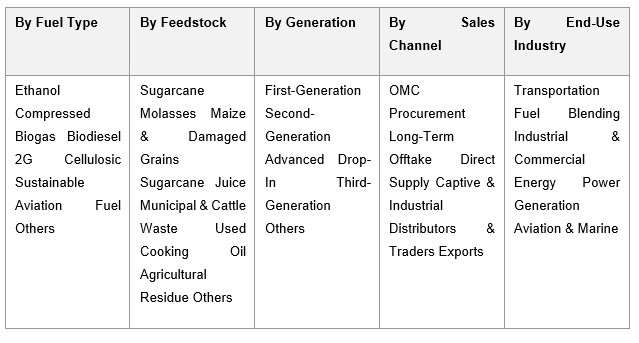
In this report, the India Biofuel Market has been segmented into the following categories, in addition to detailed analysis of key industry trends, market dynamics, competitive landscape, and growth opportunities across the forecast period:
- By Fuel Type
- Ethanol (Bioethanol)
- Compressed Biogas (CBG)
- Biodiesel
- Second-Generation (2G) Cellulosic Biofuel
- Sustainable Aviation Fuel (SAF)
- Others (Bio-Oil, Biobutanol, Bio-LNG)
- By Feedstock
- Sugarcane Molasses (B-Heavy & C-Heavy)
- Maize & Damaged Food Grains
- Sugarcane Juice & Syrup
- Municipal, Agricultural & Cattle Waste
- Used Cooking Oil & Non-Edible Oils
- Agricultural Residue & Lignocellulosic Biomass
- Others
- By Generation
- First-Generation (1G) Biofuel
- Second-Generation (2G) Biofuel
- Advanced Drop-In Biofuel
- Third-Generation (3G) Biofuel
- Others
- By Sales Channel
- Oil Marketing Company Procurement
- Long-Term Offtake Contracts
- Direct Supply Agreements
- Captive & Industrial Use
- Distributors & Traders
- Exports
- By End-Use Industry
- Transportation Fuel Blending
- Industrial & Commercial Energy
- Power Generation
- Aviation & Marine
- By Geography
- North India
- South India
- West India
- East India
- Central India
Competitive Landscape
Company Profiles:
Detailed analysis of the leading companies operating in the India Biofuel Market, including business overview, product portfolio, strategic initiatives, competitive positioning, and recent developments.
Company Information
Detailed profiling and strategic analysis of additional market players (up to five companies), including emerging compressed biogas developers, second-generation technology providers, regional distillery operators, or niche sustainable aviation fuel suppliers.
For a free sample of the India Biofuel Market report, customised insights or delivery timelines, submit your query here
Table of Contents
- Research Framework
- Market Segmentation
- Research Objective
- Research Methodology
- Qualitative Research
- Primary Research
- Secondary Research
- Quantitative Research
- Market Breakdown & Data Triangulation
- Demand Side
- Supply Side
- Primary Research Respondents
- Assumption & Limitation
- Executive Summary
- Market Overview, 2021-2032
- By Fuel Type
- By Feedstock
- By Generation
- By Sales Channel
- By End-Use Industry
- By Region
- Analyst Recommendations
- Geopolitical Impact on India Biofuel Market
- India Biofuel Market Insights
- Market Dynamics
- Growth Drivers
- Ethanol Blended Petrol programme and the E20 milestone driving nationwide biofuel demand across India.
- Feedstock diversification into maize, damaged grains, and sugarcane juice expanding biofuel production capacity.
- SATAT compressed biogas rollout and sustainable aviation fuel roadmap opening new consumption channels.
- Restraints
- Feedstock availability, monsoon variability, and crop diversion pressures constraining sustained biofuel supply.
- Surplus distillery capacity and absent post-E20 blending targets leaving assets underutilised.
- Blend wall limits, engine compatibility, and retail infrastructure gaps restricting higher biofuel blend adoption.
- Opportunities
- E30 blending, ethanol-diesel blends, and flex-fuel vehicles unlocking demand for surplus biofuel capacity.
- Second-generation cellulosic and sustainable aviation fuel projects creating premium advanced value pools.
- Compressed biogas expansion under SATAT converting agricultural and municipal waste into transport fuel.
- Challenges
- Sugar mill financial stress from rising cane support prices against fixed sugar realisation.
- Used cooking oil collection gaps limiting biodiesel scale-up toward the 5% blending target.
- Maintaining biofuel supply consistency, storage integrity, and quality specification across distilleries.
- Technological Advancements
- Recent Technological Advancements
- Prior to 2020
- Porter’s Five Forces Analysis
- PESTLE Analysis
- Industry Value Chain & Entry Points
- Upstream Biofuel Feedstock (sugarcane, maize, damaged food grains, agricultural residue, used cooking oil, cattle waste)
- Farmers, Cooperatives & Aggregators (cane societies, grain procurement, biomass collection networks)
- Sugar Mills & Standalone Biofuel Distilleries (molasses, juice, and grain-based ethanol production)
- Biodiesel & Compressed Biogas Producers (transesterification units and SATAT plants)
- Biofuel Technology Providers & EPC Contractors (Praj Industries, fermentation and 2G process licensors)
- Quality Control, R&D & Testing Laboratories (BIS biofuel specification, blend ratio and moisture testing)
- Biofuel Storage, Blending & Logistics Infrastructure (dedicated tankage, rail and road movement)
- Oil Marketing Companies (Indian Oil, Bharat Petroleum, Hindustan Petroleum procurement and blending)
- Retail Outlets & City Gas Distribution Networks (E20 and E100 dispensing, CBG stations)
- End-Users (vehicle owners, fleet operators, industry, aviation, power generation)
- India Biofuel Market: Regulatory Framework
- India Biofuel Market Overview
- Market Size & Forecast, 2021-2032
- By Value (USD Million)
- By Volume (Million Litres)
- Market Share & Forecast
- By Fuel Type
- Ethanol (Bioethanol)
- Compressed Biogas (CBG)
- Biodiesel
- Second-Generation (2G) Cellulosic Biofuel
- Sustainable Aviation Fuel (SAF)
- Others (Bio-Oil, Biobutanol, Bio-LNG)
- By Feedstock
- Sugarcane Molasses (B-Heavy & C-Heavy)
- Maize & Damaged Food Grains
- Sugarcane Juice & Syrup
- Municipal, Agricultural & Cattle Waste
- Used Cooking Oil & Non-Edible Oils
- Agricultural Residue & Lignocellulosic Biomass
- Others
- By Generation
- First-Generation (1G) Biofuel
- Second-Generation (2G) Biofuel
- Advanced Drop-In Biofuel
- Third-Generation (3G) Biofuel
- Others
- By Sales Channel
- Oil Marketing Company Procurement
- Long-Term Offtake Contracts
- Direct Supply Agreements
- Captive & Industrial Use
- Distributors & Traders
- Exports
- By End-Use Industry
- Transportation Fuel Blending
- Industrial & Commercial Energy
- Power Generation
- Aviation & Marine
- By Geography
- North India
- South India
- West India
- East India
- Central India
- Competitive Landscape
- India Biofuel Market Company Market Share Analysis, 2025
- Competitive Benchmarking, By Operating Parameters
- Key Strategic Development (Mergers, Acquisitions, Partnerships, Etc.)
- List of Emerging Players
- Company Profile
- Indian Oil Corporation Limited
- Introduction & Company Profile
- Product Benchmarking
- Strategic Outlook
- Key Competitors
- Financial Analysis
- SWOT Analysis
(Same Data Pointers Will Be Provided for The Below Companies)
- Bharat Petroleum Corporation Limited
- Hindustan Petroleum Corporation Limited
- Praj Industries Limited
- Balrampur Chini Mills Limited
- Shree Renuka Sugars Limited
- Triveni Engineering & Industries Limited
- Bajaj Hindusthan Sugar Limited
- Dalmia Bharat Sugar and Industries Limited
- EID Parry (India) Limited
- Godavari Biorefineries Limited
- Gujarat Gas Limited
- Adani Total Gas Limited
- Other Prominent Players
* Financial information in case of non-listed companies will be provided as per availability
** The segmentation and the companies are subjected to modifications based on in-depth secondary for the final deliverable
Frequently Asked Questions
1. How large is the India biofuel market and what is its growth forecast?
Ans: The India biofuel market is valued at USD 9,250 million in 2025 and is projected to reach USD 18,000 million by 2032, growing at a CAGR of 10.0%.
2. Which fuel types are driving demand in the India biofuel market?
Ans: Ethanol leads with 87% share, while compressed biogas grows fastest at 22.6% annually, driven by the SATAT initiative and city gas distribution offtake.
3. What are the key drivers of growth in the India biofuel market?
Ans: Key drivers include the Ethanol Blended Petrol programme and E20 milestone, feedstock diversification into maize and damaged grains, and compressed biogas rollout under SATAT.
4. Which regions are driving growth in the India biofuel market?
Ans: North India and West India lead with 55% of consumption, driven by Uttar Pradesh, Maharashtra, Punjab, and Gujarat. South India contributes 23% of national demand.
5. What are the latest trends in the India biofuel market?
Ans: Latest trends include second-generation cellulosic routes, sustainable aviation fuel, ethanol-diesel blending, dual-feed distilleries, and long-term offtake contracting with oil marketing companies.