

South Africa Beer Market: Premiumization, Craft Innovation and On-Trade Expansion Power Structural Growth, Forecasts 2032
- Global Markets
- Jul 2026
- Pages 140
- Report Format: pdf
- Report Price: $2400 USD
South Africa’s beer market is witnessing steady structural growth, driven by rising urbanization, expanding social drinking culture, accelerating premiumization across metro and township markets, rising disposable incomes, growing demand for craft and low & no-alcohol beers, expansion of online liquor delivery platforms, and rising investment from domestic and multinational brewers in South Africa-specific product innovation, local malting capacity, and digital distribution.
Report Description
| Study Duration | 2021-2032 |
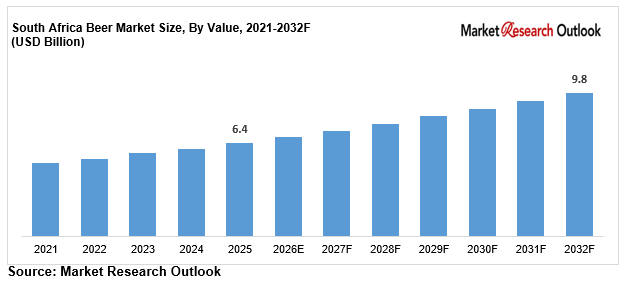
| Market Size (2025) | USD 6.4 Billion |
| CAGR (2026-2032) | 6.3% |
| Leading Segment | Lager (Mainstream Category) |
| Fastest Growing Segment | Craft & Low/No-Alcohol Beer |
| Market Size (2032) | USD 9.8 Billion |
Source:
Market Overview: South Africa Beer Market
The South Africa beer market size is witnessing steady expansion, driven by accelerating premiumization, growing on-trade consumption, rising urbanization, expanding modern retail networks, increasing demand for craft and low & no-alcohol beers, and major capacity additions by domestic and multinational brewers. Valued at USD 6.4 billion in 2025 and projected to reach USD 9.8 billion by 2032, growing at a CAGR of 6.3%, the South Africa beer market growth is being fuelled by strong demand from young urban consumers, rising disposable incomes, and the rapid scaling of online liquor delivery and e-commerce platforms across metro and provincial markets. Lager leads consumption with a 62% volume share, while the craft and low & no-alcohol beer segment is emerging as the fastest growing category. Shifting consumer preferences toward premium and moderation-focused beverages, growing wellness awareness, and rising demand for differentiated beers are reshaping the supply landscape of the South Africa beer market. As domestic and multinational majors including The South African Breweries, Heineken Beverages South Africa, Diageo South Africa, United National Breweries, and Namibia Breweries expand integrated brewing-to-shelf capacity, and craft brewers including Devil’s Peak, Jack Black’s, Darling Brew, and Cape Brewing Company scale premium pipelines, the South Africa beer market is evolving into a consumer-led, innovation-driven, and digitally enabled ecosystem with strong long-term growth potential.
Key Report Takeaways: South Africa Beer Market
- The South Africa beer market size is projected to grow from USD 6.4 billion in 2025 to USD 9.8 billion by 2032, registering a steady CAGR of 6.3%, driven by accelerated premiumization, rising craft and low-alcohol beer adoption, and the structural shift toward premium packaged beer across urban South Africa.
- Lager dominates the South Africa beer market, accounting for 62% of total volume in 2025, driven by strong consumer preference for mainstream affordable brands, the deep presence of brewers such as The South African Breweries and Heineken Beverages, and rising urban demand across organized retail and on-trade channels.
- Craft and low & no-alcohol beers are emerging as the fastest growing segments in the South Africa beer market, expected to grow at 9% annually as premiumization, wellness-focused consumers, and moderation trends reshape sourcing strategies across metro and provincial markets.
- Rapid scaling of licensed liquor outlets, with 42,000 outlets across South Africa by 2025 and projected expansion to 55,000 by 2030, is structurally expanding the South Africa beer market across modern retail, on-trade, and online delivery categories.
- Rising investments by brewers such as The South African Breweries, Heineken Beverages, Namibia Breweries, and United National Breweries in local malting capacity, premium packaging, and craft beer variants are strengthening local supply and supporting the South Africa beer market forecast 2032.
Key Market Drivers: South Africa Beer Market
Rising Urbanization, Growing Young-Adult Population, and Expanding Social Drinking Culture Driving Beer Demand Across South Africa
Growth in the South Africa beer market is being driven by rising urbanization, an expanding young-adult population, and a deep-rooted social drinking culture across metro, peri-urban, and township markets. South Africa’s urban population share crossed 68% in 2025 and is projected to reach 71% by 2030. Licensed liquor and beer retail outlets have expanded from 32,000 in 2020 to 42,000 in 2025, led by supermarkets, liquor stores, taverns, and on-trade venues. Beer accounts for 55% of total alcohol consumption by volume in South Africa, making it the dominant alcoholic beverage category. Per-capita beer consumption in South Africa stands at 53 litres per person per year, among the highest in Africa, indicating a mature yet resilient demand base. Young adults between 18 and 34 years account for 55% of beer consumption, with average on-trade beer prices near ZAR 32 per 340 ml serving, creating strong structural pull-through demand across the South Africa beer market.
Rising Disposable Incomes, Premiumization, and Shifting Consumer Preferences Fuelling Premium and Craft Beer Adoption
The South Africa beer market is benefiting from rising disposable incomes, a growing middle class, and accelerating premiumization across the beer category. Premium and super-premium beers now account for 28% of total beer value in South Africa, up from 21% in 2020, as aspirational consumers trade up from economy brands. Average retail beer prices range near ZAR 18 per 440 ml economy can, while premium variants command ZAR 35 per serving. South Africa hosts 210 operating craft breweries in 2025, supported by growing taproom culture, beer festivals, and social-media-led branding. NRCS quality standards, SABS certification, and growing trust in branded packaged beer have further strengthened organized supply, supporting value realisation across the South Africa beer market. Millennial and Gen-Z consumers now account for 55% of premium beer consumption, preferring distinctive flavors, premium packaging, and moderation-focused options across the South Africa beer market.
Product Innovation in Craft, Flavored, and Low & No-Alcohol Beers Strengthening Packaged Segment Growth
Rapid growth in craft, flavored, and low & no-alcohol beers is a major catalyst for the South Africa beer market, with the craft segment projected to grow at 9% annually and the low & no-alcohol segment at 12% annually through 2032. No-alcohol beers below 0.5% ABV are gaining strong traction among wellness-focused and moderation-led consumers. Health-conscious consumer behavior under wellness trends, responsible-drinking awareness, and rising demand for lower-calorie options are driving consumers toward low-alcohol beer consumption. The National Liquor Policy reforms and clearer labelling guidelines have increased transparency for packaged beer buyers, accelerating premium and moderation-focused beer adoption. Leading brewers such as The South African Breweries, Heineken Beverages, and Namibia Breweries have scaled low-alcohol and craft pipelines through brands including Castle Free, Heineken 0.0, and Corona Cero, with the low & no-alcohol beer segment representing an estimated USD 340 million addressable opportunity in South Africa. Rising retail and on-trade procurement is structurally expanding South Africa beer market growth across all major segments through 2032.
Key Market Challenges: South Africa Beer Market
Rising Excise Duties and Regulatory Restrictions Limiting Affordability and Frequency of Beer Consumption
The South Africa beer market continues to face challenges around rising excise duties, regulatory restrictions, and limited consumption frequency among price-sensitive consumers. The excise duty on beer was raised by 6.7% in the 2025 national budget, with excise now accounting for 35% of the retail price of a standard beer. While premiumization and craft demand have improved value, organized beer consumption frequency among lower-income households remains constrained, reflecting affordability pressures, responsible-drinking campaigns, and shifting spending patterns. The National Liquor Policy Review, trading-hour restrictions, and proposed advertising limits continue to shape the operating environment for brewers and on-trade venues. South Africa’s continued dependence on affordable mainstream lager limits premium adoption among lower-income households across the South Africa beer market.
Macroeconomic Headwinds, High Unemployment, and Constrained Household Spending Restricting Beer Volume Growth
The South Africa beer market faces structural complexity from macroeconomic headwinds, high unemployment, and constrained household spending power across the country. With unemployment near 32% and persistent inflation limiting real disposable income, overall beer volumes have remained largely flat, with growth increasingly driven by value rather than volume. Price-sensitive consumers continue to prioritise affordability, with downtrading toward economy and mainstream lager during periods of household budget pressure. Load-shedding and electricity supply disruptions add operational complexity for refrigerated retail, brewing, and cold storage across the value chain. Differential purchasing power across Gauteng, the Western Cape, KwaZulu-Natal, and rural provinces creates uneven demand for premium beer, and macroeconomic fragility remains a near-term challenge for the South Africa beer market.
Volatility in Malted Barley, Hops, and Packaging Costs Impacting Overall Beer Margins
The South Africa beer market faces practical constraints around raw material price volatility, packaging cost inflation, and margin compression across the value chain. South African malted barley procurement prices have risen 14% between 2022 and 2025, while packaging input costs including glass, aluminium, and PET have moved up 11% over the same period. Smaller craft brewers face additional complexity in passing through cost increases without losing volume. Average gross margins for branded beer in South Africa stand near 36%, reducing the effective profitability of new launches. Local malting investment, aseptic and can-line upgrades, and localized barley sourcing are emerging as solutions to differentiate, but premium pricing and limited consumer awareness remain barriers to widespread adoption across the South Africa beer market.
Key Market Trends: South Africa Beer Market
Rapid Adoption of Craft, Flavored, and Low & No-Alcohol Beers in South Africa
The South Africa beer market is undergoing a clear product shift toward craft, flavored, and low & no-alcohol beers, with these variants expected to capture 8% of new packaged beer launches by 2027. Craft beers deliver distinctive flavor profiles and higher price realisation, while no-alcohol beers below 0.5% ABV serve moderation-focused consumers. Leading domestic and multinational brewers including The South African Breweries, Heineken Beverages, Namibia Breweries, and Devil’s Peak have scaled craft and low-alcohol production capacity through 2024 and 2025. Functional and low-calorie beers with reduced sugar and carbohydrates are also gaining traction, particularly in metro cities such as Cape Town and Johannesburg where wellness consumers are rising, with brands like Castle Free, Heineken 0.0, and Corona Cero offering moderation-positioned beer variants. This product transition is reinforcing the South Africa beer market forecast 2032 across both retail and on-trade categories.
Growth of E-Commerce, On-Demand Liquor Delivery, and Digital Distribution in the South Africa Beer Market
A clear shift toward e-commerce, on-demand liquor delivery, and digital distribution models is reshaping the South Africa beer market, particularly in the urban and metro segment. Under on-demand liquor platforms such as Bottles, Checkers Sixty60, Pick n Pay asap!, and Takealot, packaged beer is delivered within 60 minutes at prices typically 6% above shelf price. Leading retail and delivery platforms including Makro and One Cart have built combined operational reach across more than 60 South African cities, with beer ranking among the top three alcoholic beverage categories ordered online. Digital platforms and app-based aggregators are also reducing customer acquisition costs and accelerating premium beer adoption across both retail and on-trade segments of the South Africa beer market. By 2025, online channels account for 4% of off-trade beer sales in South Africa, up from 1% in 2020, with metro buyers increasingly preferring same-day delivery convenience over in-store purchase.
Capacity Expansion by Brewers and Local Malting Investments Across South Africa
A wave of brewing capacity expansion and local malting investment is reshaping the South Africa beer market supply landscape. Combined South Africa-focused capital expenditure announcements in brewing, packaging, and malting exceeded USD 500 million across 2023 to 2025. Heineken Beverages partnered to build a EUR 100 million low-emission local malting facility with Soufflet Malt, The South African Breweries scaled canning and packaging capacity, Namibia Breweries expanded regional distribution, and United National Breweries grew its traditional sorghum beer portfolio. National Liquor Policy reforms, localized barley and hops sourcing, and reduced import dependence have structurally favoured organized supply. Combined with on-trade expansion driving foodservice demand and e-commerce procurement scaling rapidly, these developments are reinforcing the South Africa beer market forecast 2032 across the entire value chain.
Segmental Insights: South Africa Beer Market
By Application: Home & Off-Premise Segment Dominates the South Africa Beer Market
The home and off-premise application segment dominates the South Africa beer market, accounting for 58% of total volume, driven by strong liquor store and supermarket penetration, growing online delivery, and improving packaged beer economics. Mainstream lager in cans and returnable glass bottles captures the majority of off-premise beer purchases. The on-trade segment covering bars, taverns, shebeens, and pubs contributes 42% of demand, driven by social drinking culture, sports events, and entertainment venues adopting beer as a core offering. Restaurants and hotels account for a growing share of premium and craft beer consumption, while events and institutional channels support seasonal demand. In 2025, leading brewers including The South African Breweries, Heineken Beverages, Namibia Breweries, and Diageo scaled up off-premise and on-trade beer deployment under modern retail and hospitality expansion, reinforcing segment dominance in the South Africa beer market.
By Beer Type: Lager Leads While Craft and Low & No-Alcohol Grow Fastest
Lager leads the South Africa beer market product landscape, accounting for 62% of total beer volume, driven by its mass-market appeal, affordability, deep distribution presence, and long-standing consumer familiarity. Ale contributes 12% of volume, primarily across mainstream retail and metro markets, while stout and porter add 9%, supported by loyal traditional consumers. Craft and low & no-alcohol beers are the fastest growing categories within the South Africa beer market, expanding at 9% annually, driven by premiumization, distinctive flavor profiles, moderation trends, and growing adoption in fitness and premium urban segments. Non-alcoholic beer accounts for 5% of the market and is expected to grow at 12% annually through 2032. Leading brewers including The South African Breweries, Heineken Beverages, Namibia Breweries, and United National Breweries have aligned product portfolios to this product mix, driving premium beer adoption across the South Africa beer market.
Regional Insights: South Africa Beer Market
Regional analysis of the South Africa beer market shows that Gauteng, the Western Cape, and KwaZulu-Natal collectively account for 68% of total beer volume, driven by Gauteng (Johannesburg and Pretoria metro belt), the Western Cape (Cape Town craft and premium hub), and KwaZulu-Natal (Durban coastal market), supported by strong urban consumption and dense retail networks. Gauteng alone contributes 30% of demand, led by Johannesburg, Pretoria, and Ekurhuleni, supported by household and on-trade beer adoption across metro and township clusters. The Western Cape contributes 20% of demand, anchored by Cape Town’s craft beer ecosystem, while KwaZulu-Natal adds 18%. The Eastern Cape, Free State, and remaining provinces together account for 32% of demand, where modern retail adoption is accelerating. In 2025, capacity additions and distribution operations by The South African Breweries across Gauteng, Heineken Beverages across the Western Cape, and Namibia Breweries across northern provinces reinforced regional supply hubs, supporting closer execution of retail and on-trade projects across the South Africa beer market.
Recent Developments: South Africa Beer Market
- The South Africa beer market witnessed strong momentum in launches and capacity progress during 2024 and 2025. South Africa added 190 new packaged beer SKUs in calendar year 2025, representing a 24% year-on-year increase from 153 SKUs in 2024, according to industry tracking. Online liquor platforms recorded over 40 million beer orders by mid-2025, with the lager segment accounting for 64% of new orders. Cumulative organized beer volume in South Africa is projected to reach 4.9 billion litres by 2032 from 3.5 billion litres in 2025, growing at a steady annual pace.
- Brewers have deepened South Africa-focused capacity expansion. In 2025, Heineken Beverages partnered to build a EUR 100 million low-emission local malting facility with Soufflet Malt, The South African Breweries scaled canning and packaging capacity, Namibia Breweries expanded regional distribution, and United National Breweries grew its traditional sorghum beer portfolio. The South African Breweries also launched a new low-alcohol beer during 2025. These developments are strengthening domestic supply and supporting the South Africa beer market forecast 2032.
- On-trade and premium beer momentum has gained strong traction in the South Africa beer market. In 2025, leading brewers and craft players including The South African Breweries, Heineken Beverages, Diageo, Devil’s Peak, and Darling Brew expanded premium and craft beer offerings. Strategic partnerships between brewers and on-trade venues are positioning South Africa as one of the most actively scaling beer markets in Africa, strengthening long-term competitive positioning in the South Africa beer market forecast 2032.
Key Market Players: South Africa Beer Market
- The South African Breweries (Pty) Ltd (Anheuser-Busch InBev)
- Heineken Beverages South Africa (Pty) Ltd
- Diageo South Africa (Pty) Ltd
- Namibia Breweries Limited
- United National Breweries (SA) (Pty) Ltd
- Devil’s Peak Brewing Company
- Jack Black’s Brewing Company
- Cape Brewing Company (CBC)
- Darling Brew (Pty) Ltd
- Soweto Gold (Heineken Beverages)
- Poison City Brewing
- Drifter Brewing Company
- Aegir Project Brewery
Report Scope
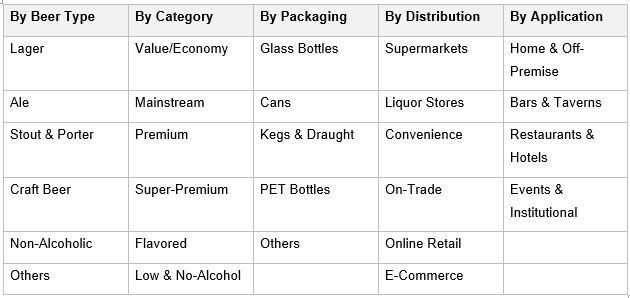
In this report, the South Africa Beer Market has been segmented into the following categories, in addition to detailed analysis of key industry trends, market dynamics, competitive landscape, and growth opportunities across the forecast period:
- By Beer Type
- Lager
- Ale
- Stout & Porter
- Craft Beer
- Non-Alcoholic Beer
- Others
- By Category
- Value / Economy
- Mainstream
- Premium
- Super-Premium
- Flavored Beer
- Low & No-Alcohol
- Others
- By Packaging
- Glass Bottles
- Cans
- Kegs & Draught
- PET Bottles
- Others
- By Distribution Channel
- Supermarkets & Hypermarkets
- Liquor & Bottle Stores
- Convenience Stores
- On-Trade (Bars, Taverns & Shebeens)
- On-Trade (Restaurants & Hotels)
- Online Retail & E-Commerce
- By Application
- Home & Off-Premise Consumption
- Bars, Taverns & Pubs
- Restaurants & Hotels
- Events & Institutional
- By Geography
- Gauteng
- Western Cape
- KwaZulu-Natal
- Eastern Cape
- Rest of South Africa
Competitive Landscape
Company Profiles:
Detailed analysis of the leading companies operating in the South Africa Beer Market, including business overview, product portfolio, strategic initiatives, competitive positioning, and recent developments.
Company Information
Detailed profiling and strategic analysis of additional market players (up to five companies), including emerging craft breweries, specialty and low-alcohol beer producers, regional brewers, or niche provincial on-trade brands.
For a free sample of the South Africa Beer Market report, customised insights or delivery timelines, submit your query hereresearch@marketresearchoutlook.com
Table of Contents
- Research Framework
- Market Segmentation
- Research Objective
- Research Methodology
- Qualitative Research
- Primary Research
- Secondary Research
- Quantitative Research
- Market Breakdown & Data Triangulation
- Demand Side
- Supply Side
- Primary Research Respondents
- Assumption & Limitation
- Executive Summary
- Market Overview, 2021-2032
- By Beer Type
- By Category
- By Packaging
- By Distribution Channel
- By Application
- By Region
- Analyst Recommendations
- Geopolitical Impact on South Africa Beer Market
- South Africa Beer Market Insights
- Market Dynamics
- Growth Drivers
- Rising urbanization, growing young-adult population, and expanding social drinking culture driving beer demand across South Africa.
- Rising disposable incomes, premiumization, and shifting consumer preferences fuelling premium and craft beer adoption.
- Product innovation in craft, flavored, and low & no-alcohol beers strengthening packaged and on-trade segment growth.
- Restraints
- Rising excise duties and regulatory restrictions limiting affordability and frequency of beer consumption among consumers.
- Macroeconomic headwinds, high unemployment, and constrained household spending power restricting beer volume growth.
- Volatility in malted barley, hops, and packaging costs impacting overall beer margins.
- Opportunities
- Craft, flavored, and low & no-alcohol beer innovation opening untapped consumer pools across urban centres.
- Premium and super-premium beer supporting next-generation growth among higher-income and younger consumers.
- E-commerce, on-demand liquor delivery, and modern retail expansion creating massive distribution opportunities.
- Challenges
- Intense competition from informal traders, illicit alcohol, and unrecorded home-brewed beer.
- Fragmented cold-chain, refrigeration, and distribution coverage across rural and township markets.
- Maintaining brand consistency, quality, and responsible-drinking compliance at scale across diverse provincial markets.
- Technological Advancements
- Recent Technological Advancements
- Prior to 2020
- Porter’s Five Forces Analysis
- PESTLE Analysis
- Industry Value Chain & Entry Points
- Upstream Raw Materials (malted barley, hops, maize, water, yeast, sugar, packaging materials)
- Maltsters & Brewers (South African Breweries, Heineken Beverages, United National Breweries, Namibia Breweries)
- Hops, Malt & Ingredient Suppliers (barley, hops, adjuncts, brewing enzymes)
- Craft & Specialty Brewers (Devil’s Peak, Jack Black’s, Darling Brew, Cape Brewing Company)
- Quality Control, R&D & Testing Laboratories (SABS, NRCS, ISO food safety standards)
- Distributors, Wholesalers & Modern Trade (B2B and B2C distribution networks)
- On-Trade Outlets (bars, taverns, shebeens, restaurants, hotels, clubs)
- Brand Owners & Beverage Service Providers (SAB, Heineken Beverages, Diageo, Namibia Breweries)
- Retail Channels & Online Delivery (Takealot, Bottles, Checkers Sixty60, Pick n Pay asap!, Makro)
- End-Consumers (households, on-premise patrons, social drinkers, event attendees)
- South Africa Beer Market: Regulatory Framework
- South Africa Beer Market Overview
- Market Size & Forecast, 2021-2032
- By Value (USD Billion)
- By Volume (Million Litres)
- Market Share & Forecast
- By Beer Type
- Lager
- Ale
- Stout & Porter
- Craft Beer
- Non-Alcoholic Beer
- Others
- By Category
- Value / Economy
- Mainstream
- Premium
- Super-Premium
- Flavored Beer
- Low & No-Alcohol
- Others
- By Packaging
- Glass Bottles
- Cans
- Kegs & Draught
- PET Bottles
- Others
- By Distribution Channel
- Supermarkets & Hypermarkets
- Liquor & Bottle Stores
- Convenience Stores
- On-Trade (Bars, Taverns & Shebeens)
- On-Trade (Restaurants & Hotels)
- Online Retail & E-Commerce
- By Application
- Home & Off-Premise Consumption
- Bars, Taverns & Pubs
- Restaurants & Hotels
- Events & Institutional
- By Geography
- Gauteng
- Western Cape
- KwaZulu-Natal
- Eastern Cape
- Rest of South Africa
- Competitive Landscape
- South Africa Beer Market Company Market Share Analysis, 2025
- Competitive Benchmarking, By Operating Parameters
- Key Strategic Development (Mergers, Acquisitions, Partnerships, Etc.)
- List of Emerging Players
- Company Profile
- The South African Breweries (Pty) Ltd (Anheuser-Busch InBev)
- Introduction & Company Profile
- Product Benchmarking
- Strategic Outlook
- Key Competitors
- Financial Analysis
- SWOT Analysis
(Same Data Pointers Will Be Provided for The Below Companies)
- Heineken Beverages South Africa (Pty) Ltd
- Diageo South Africa (Pty) Ltd
- Namibia Breweries Limited
- United National Breweries (SA) (Pty) Ltd
- Devil’s Peak Brewing Company
- Jack Black’s Brewing Company
- Cape Brewing Company (CBC)
- Darling Brew (Pty) Ltd
- Soweto Gold (Heineken Beverages)
- Poison City Brewing
- Drifter Brewing Company
- Aegir Project Brewery
- Other Prominent Players
* Financial information in case of non-listed companies will be provided as per availability
** The segmentation and the companies are subjected to modifications based on in-depth secondary for the final deliverable
Frequently Asked Questions
1. How large is the South Africa beer market and what is its growth forecast?
Ans: The South Africa beer market is valued at USD 6.4 billion in 2025 and is projected to reach USD 9.8 billion by 2032, growing at a CAGR of 6.3%.
2. Which segments are driving demand in the South Africa beer market?
Ans: Lager leads with a 62% volume share, while craft and low & no-alcohol beers are the fastest-growing segments, driven by premiumization and moderation-focused consumers.
3. What are the key drivers of growth in the South Africa beer market?
Ans: Key drivers include rising urbanization, expanding social drinking culture, premiumization, rising disposable incomes, craft beer innovation, and rapid scaling of online liquor delivery platforms.
4. Which regions are driving growth in the South Africa beer market?
Ans: Gauteng, the Western Cape, and KwaZulu-Natal lead with around 68% of total volume. Gauteng alone contributes 30% of demand across metro and township markets.
5. What are the latest trends in the South Africa beer market?
Ans: Latest trends include rapid adoption of craft and low & no-alcohol beers, growth in online liquor delivery, premium packaging innovation, and expanding e-commerce driving beer sales.