

India Robotic Vacuum Cleaner Market: Urbanization, Smart-Home Adoption and E-Commerce Expansion Power Structural Growth, Forecasts 2032
- Consumer Goods & Retail
- Jul 2026
- Pages 140
- Report Format: pdf
- Report Price: $1800 USD
India’s robotic vacuum cleaner market is witnessing strong structural growth, driven by rapid urbanization, rising disposable incomes, growing smart-home adoption, the shift from manual to autonomous cleaning, rising hygiene awareness, expansion of e-commerce platforms, and rising investment from global and domestic players in India-specific product innovation, AI navigation, and after-sales service networks.
Report Description
| Study Duration | 2021-2032 |
| Market Size (2025) | USD 300 Million |
| CAGR (2026-2032) | 18.0% |
| Leading Segment | Floor Vacuum Robots |
| Fastest Growing Segment | Vacuum-and-Mop Robots |
| Market Size (2032) | USD 955 Million |
Source: Market Research Outlook
Market Overview: India Robotic Vacuum Cleaner Market
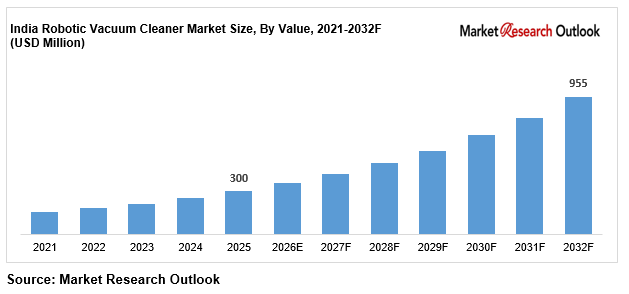
The India robotic vacuum cleaner market size is witnessing rapid expansion, driven by accelerating urbanization, rising disposable incomes, growing smart-home adoption, expanding e-commerce, rising hygiene awareness, and continuous product innovation by global and domestic players. Valued at USD 300 million in 2025 and projected to reach USD 955 million by 2032, growing at a CAGR of 18.0%, the India robotic vacuum cleaner market growth is being fuelled by strong demand from urban households, nuclear and dual-income families, and the rapid scaling of e-commerce and modern retail platforms across metro and Tier-2 cities. Floor vacuum robots lead consumption, while the vacuum-and-mop hybrid segment is emerging as the fastest growing category. Shifting consumer preferences toward smart, autonomous, and AI-powered cleaning, growing time-pressed lifestyles, and rising demand for hygiene are reshaping the supply landscape of the India robotic vacuum cleaner market. As global majors including iRobot, Ecovacs, Roborock, Xiaomi, and Dreame expand AI-powered portfolios, and domestic players including Eureka Forbes, Milagrow, and Kent scale robotic cleaning ranges, the India robotic vacuum cleaner market is evolving into a consumer-led, innovation-driven, and digitally enabled ecosystem with strong long-term growth potential.
Key Report Takeaways: India Robotic Vacuum Cleaner Market
- The India robotic vacuum cleaner market size is projected to grow from USD 300 million in 2025 to USD 955 million by 2032, registering a strong CAGR of 18.0%, driven by accelerated smart-home adoption, rising AI-powered model demand, and the structural shift from manual to autonomous cleaning across urban India.
- Floor vacuum robots dominate the India robotic vacuum cleaner market, accounting for 60% of total value in 2025, driven by strong consumer preference for automated floor cleaning, the deep presence of brands such as iRobot, Ecovacs, and Xiaomi, and rising urban demand across e-commerce and electronics retail channels.
- Vacuum-and-mop hybrid robots are emerging as the fastest growing segments in the India robotic vacuum cleaner market, expected to grow at 22% annually as smart-home adoption, AI navigation, and convenience trends reshape purchasing strategies across metro and Tier-2 markets.
- Rapid scaling of e-commerce and electronics retail, with India’s urban population crossing 510 million in 2025 and cities projected to contribute 75% of national income by 2031, is structurally expanding the India robotic vacuum cleaner market across online, modern retail, and specialty categories.
- Rising investments by global and domestic majors such as iRobot, Ecovacs, Eureka Forbes, and Xiaomi in AI navigation, self-emptying technology, and after-sales networks are strengthening supply and supporting the India robotic vacuum cleaner market forecast 2032.
Key Market Drivers: India Robotic Vacuum Cleaner Market
Rapid Urbanization, Nuclear Families, Dual-Income Households, and Time-Pressed Lifestyles Driving Demand
Growth in the India robotic vacuum cleaner market is being driven by rapid urbanization, growing nuclear families, dual-income households, and time-pressed lifestyles across metro, Tier-1, and Tier-2 cities. India’s urban population crossed 510 million in 2025, up from 461 million in 2024, with cities projected to contribute 75% of national income by 2031. Compact living spaces, dual-income families, and rising time constraints are increasing demand for automated, hassle-free cleaning solutions. The rising number of nuclear families and tech-savvy individuals in metro cities is driving adoption of robotic vacuum cleaners, increasingly viewed as essential smart-home appliances. India currently accounts for only 6% of the global robotic vacuum cleaner market, indicating significant long-term headroom for growth. Growing awareness of cleanliness, indoor air quality, and touch-free cleaning is creating strong structural pull-through demand across the India robotic vacuum cleaner market.
Rising Disposable Incomes, Smart-Home Adoption, and Demand for AI-Powered Convenience Appliances
The India robotic vacuum cleaner market is benefiting from rising disposable incomes, accelerating smart-home adoption, and growing demand for AI-powered convenience appliances. Per-capita income reached USD 3,200 in 2024, expanding the middle class and accelerating demand for premium, technologically advanced appliances. Technological innovations, including AI-powered navigation, LiDAR mapping, app-based controls, and voice-assistant integration, are enhancing user experience and expanding product appeal. Rising adoption of smart-home devices and voice assistants such as Alexa and Google Home is driving demand for connected robotic vacuum cleaners. Global and domestic supply has scaled rapidly, led by iRobot, Ecovacs, Roborock, Xiaomi, and Eureka Forbes. In March 2023, Samsung introduced the Bespoke Jet cordless vacuum and Jet Bot+ robot vacuum in India, reflecting rising premium innovation. Growing middle-class demand for premium, hands-free products has further strengthened organized supply, supporting value realisation across the India robotic vacuum cleaner market. Young, tech-savvy consumers between 25 and 44 years now account for the majority of robotic vacuum cleaner demand, preferring AI-powered models, premium features, and app-based controls.
Growing Hygiene Awareness, E-Commerce Expansion, and Falling Price Points Accelerating Adoption
Strong hygiene awareness, rapid e-commerce growth, and falling price points are major catalysts for the India robotic vacuum cleaner market, with the vacuum-and-mop segment projected to grow at 22% annually through 2032. Post-pandemic emphasis on hygiene, sanitation, and touch-free cleaning has structurally increased demand for robotic vacuum cleaners. India’s e-commerce industry, valued at USD 125 billion in 2024, is projected to reach USD 345 billion by 2030 at a CAGR of 15%, rapidly expanding online robotic appliance distribution. Online channels remain the dominant and fastest-growing distribution route for robotic vacuum cleaners, led by Amazon India, Flipkart, Croma, and Reliance Digital. Falling entry-level price points, with models available under INR 15,000, are expanding the addressable market beyond premium buyers. Leading players including iRobot, Ecovacs, Xiaomi, and Eureka Forbes have scaled online and offline pipelines, with the premium AI-powered segment representing an estimated USD 180 million addressable opportunity in India. Hygiene awareness combined with e-commerce growth is structurally expanding India robotic vacuum cleaner market growth across all major categories through 2032.
Key Market Challenges: India Robotic Vacuum Cleaner Market
High Price Premiums, Limited Affordability, and Easy Availability of Domestic Help
The India robotic vacuum cleaner market continues to face challenges around high price premiums, limited affordability, and the easy availability of low-cost domestic help. Robotic vacuum cleaners are typically priced between INR 15,000 and INR 80,000, positioning them as premium purchases for many households. The widespread availability of affordable domestic help across Indian cities offers a low-cost cleaning alternative, limiting adoption among price-sensitive consumers. Households outside metro cities continue to prioritise cost over automation, limiting adoption among middle-income and rural consumers. India’s price sensitivity and the established habit of manual and assisted cleaning limit adoption among cost-conscious households across the India robotic vacuum cleaner market.
Limited Awareness, After-Sales Service Gaps, and Performance Concerns on Varied Indian Home Layouts
The India robotic vacuum cleaner market faces structural complexity from limited awareness, after-sales service gaps, and performance concerns across different cities. While metros such as Delhi, Mumbai, Bengaluru, Chennai, and Hyderabad have strong product awareness and service access, smaller cities maintain limited awareness and support infrastructure. Varied Indian home layouts, thresholds, floor types, and clutter can affect navigation and cleaning performance, creating adoption hesitancy. Limited service centres, spare-parts availability, and repair support in smaller cities further constrain adoption. Differential availability of demonstration, service, and support across states creates operational complexity for players such as iRobot, Ecovacs, Eureka Forbes, and Milagrow operating pan-India. While awareness is rising, service and performance concerns remain a near-term challenge for the India robotic vacuum cleaner market.
Import Dependence, Currency Volatility, and Certification-Compliance Costs Impacting Margins
The India robotic vacuum cleaner market faces practical constraints around import dependence, currency volatility, and certification-compliance costs across the value chain. A large share of robotic vacuum cleaners and key components are imported, primarily from China, exposing the market to currency fluctuations and supply-chain risks. Rupee volatility and import duties raise landed costs and squeeze margins for brands and distributors. Mandatory BIS registration, safety certification, and wireless compliance add to time and cost, particularly for smaller players. Average gross margins for robotic vacuum cleaners in India stand near 35%, reducing the effective profitability of new launches amid import and compliance costs. Local assembly under Make-in-India, component localisation, and investment in service infrastructure are emerging as solutions to differentiate, but import reliance and compliance costs remain barriers to widespread adoption across the India robotic vacuum cleaner market.
Key Market Trends: India Robotic Vacuum Cleaner Market
Rapid Shift to AI-Powered, LiDAR-Navigation, Self-Emptying, and Vacuum-Mop Hybrid Robots in India
The India robotic vacuum cleaner market is undergoing a clear shift toward AI-powered, LiDAR-navigation, self-emptying, and vacuum-mop hybrid robots, with these premium variants expected to capture 45% of new launches by 2027. Vacuum-and-mop hybrids, self-emptying docks, and AI-mapping models deliver strong convenience value, while advanced navigation serves performance-focused buyers. Leading brands including iRobot, Ecovacs, Roborock, Xiaomi, and Dreame have scaled AI-powered and self-emptying production and design capacity through 2024 and 2025. Premium, connected, and feature-rich robotic vacuum cleaners with advanced mapping are also gaining traction, particularly in metro cities such as Mumbai and Bengaluru where smart-home consumers are rising, with brands like Eureka Forbes, Milagrow, and Kent offering value-positioned robotic variants. This product transition is reinforcing the India robotic vacuum cleaner market forecast 2032 across both online and offline categories.
Growth of Smart-Home and Voice-Assistant Integration in the India Robotic Vacuum Cleaner Market
A clear shift toward smart-home and voice-assistant integration is reshaping the India robotic vacuum cleaner market, particularly in the urban and metro segment. Robotic vacuum cleaners increasingly integrate with smart-home platforms and voice assistants such as Amazon Alexa and Google Home, enabling app control, scheduling, and voice-activated cleaning. Leading e-commerce platforms including Amazon India and Flipkart, alongside electronics retailers Croma and Reliance Digital, have built combined operational reach across more than 100 Indian cities, with robotic vacuum cleaners ranking among the fastest-growing smart-appliance categories ordered online. Real-time mapping, app-based scheduling, and AI-driven navigation are enhancing the ownership experience and accelerating adoption across both retail and online segments of the India robotic vacuum cleaner market. Smart-home adoption combined with connected-appliance demand is structurally expanding the India robotic vacuum cleaner market across metro and Tier-1 clusters.
Premiumization, E-Commerce Dominance, and New Brand and Model Launches Across India
A wave of premiumization, e-commerce dominance, and new brand and model launches is reshaping the India robotic vacuum cleaner market supply landscape. Combined India-focused capital and product activity in robotic cleaning exceeded USD 150 million across 2023 to 2025. Global brands including iRobot, Ecovacs, Roborock, and Dreame expanded premium AI-powered portfolios, Xiaomi scaled value models, and domestic players such as Eureka Forbes, Milagrow, and Kent broadened robotic ranges. Online channels remain the dominant route to market, structurally favouring digitally native and premium-led supply. Combined with rising smart-home adoption driving demand and e-commerce procurement scaling rapidly, these developments are reinforcing the India robotic vacuum cleaner market forecast 2032 across the entire value chain.
Segmental Insights: India Robotic Vacuum Cleaner Market
By Application: Residential Segment Dominates the India Robotic Vacuum Cleaner Market
The residential application segment dominates the India robotic vacuum cleaner market, accounting for 82% of total consumption, driven by rising smart-home adoption, growing hygiene awareness, and improving e-commerce access. Urban households, nuclear families, and dual-income professionals capture the majority of robotic vacuum cleaner purchases. The commercial segment covering offices and retail contributes 10% of demand, driven by automated cleaning in workspaces and stores. The hospitality segment covering hotels and restaurants accounts for 5%, supported by premium guest-experience cleaning, while institutional applications account for 3%, supported by healthcare and other facilities. In 2025, leading players including iRobot, Ecovacs, Xiaomi, and Eureka Forbes scaled up residential and commercial robotic vacuum cleaner deployment under e-commerce and modern retail expansion, reinforcing segment dominance in the India robotic vacuum cleaner market.
By Product Type: Floor Vacuum Robots Lead While Vacuum-Mop Hybrids Grow Fastest
Floor vacuum robots lead the India robotic vacuum cleaner market product landscape, accounting for 60% of total value, driven by strong consumer preference for automated floor cleaning, deep distribution presence, and rising urban demand. Vacuum-and-mop hybrid robots are the fastest growing category within the India robotic vacuum cleaner market, expanding at 22% annually, driven by convenience, AI navigation, and growing adoption in metro and premium urban segments. Self-emptying robots account for a rising share, supported by premium and hands-free demand, while pool and window-cleaning robots add niche volume. LiDAR and AI-powered navigation models are increasingly preferred over random-navigation units. Leading manufacturers including iRobot, Ecovacs, Roborock, Xiaomi, and Dreame have aligned product portfolios to this product mix, driving premium robotic adoption across the India robotic vacuum cleaner market.
Regional Insights: India Robotic Vacuum Cleaner Market
Regional analysis of the India robotic vacuum cleaner market shows that North India and West India collectively account for 59% of total robotic vacuum cleaner value, driven by Delhi NCR, Punjab, Uttar Pradesh, Maharashtra (Mumbai and Pune belt), and Gujarat, supported by higher disposable incomes, established electronics retail, and strong smart-home adoption. North India alone contributes 31% of demand, led by Delhi NCR, Punjab, Haryana, and Uttar Pradesh, supported by high-income households and premium appliance adoption in metro and Tier-1 clusters. West India adds 28%, anchored by Maharashtra and Gujarat, major metro consumption hubs. South India contributes 27% of demand, anchored by Karnataka, Tamil Nadu, and Telangana, driven by tech-savvy early adopters in Bengaluru, Chennai, and Hyderabad, while East and Central India together account for 14%, supported by West Bengal, Odisha, and Madhya Pradesh, where smart-appliance adoption is accelerating. In 2025, distribution and service operations by iRobot and Eureka Forbes across North and West India, and by Xiaomi across South India, reinforced regional supply, supporting closer execution of retail and service projects across the India robotic vacuum cleaner market.
Recent Developments: India Robotic Vacuum Cleaner Market
- The India robotic vacuum cleaner market witnessed strong momentum in launches and adoption during 2024 and 2025. India accounts for around 6% of the global robotic vacuum cleaner market, reflecting significant long-term growth headroom. E-commerce platforms recorded strong double-digit growth in robotic vacuum cleaner orders, with the vacuum-and-mop hybrid segment accounting for a rising share of new online purchases. Falling entry-level price points, with models available under INR 15,000, expanded the addressable base.
- Global and domestic majors have deepened India-focused product and distribution activity. Global brands including iRobot, Ecovacs, Roborock, and Dreame expanded premium AI-powered and self-emptying portfolios, Xiaomi scaled value models, and Eureka Forbes, Milagrow, and Kent broadened robotic ranges. Following Samsung’s Jet Bot+ launch, these developments are strengthening supply and supporting the India robotic vacuum cleaner market forecast 2032.
- E-commerce and smart-home momentum has gained strong traction in the India robotic vacuum cleaner market. In 2025, leading players including iRobot, Ecovacs, Xiaomi, and Eureka Forbes expanded offerings and distribution across Amazon, Flipkart, Croma, and Reliance Digital. Strategic focus on AI navigation and smart-home integration is positioning India as one of the fastest scaling robotic vacuum cleaner markets globally, strengthening long-term competitive positioning in the India robotic vacuum cleaner market forecast 2032.
Key Market Players: India Robotic Vacuum Cleaner Market
- iRobot Corporation (Roomba)
- Ecovacs Robotics
- Roborock (Beijing Roborock)
- Xiaomi India (Mi Robot Vacuum)
- Eureka Forbes Ltd.
- Samsung India Electronics Pvt. Ltd.
- LG Electronics India Pvt. Ltd.
- Dreame Technology
- ILIFE Robotics
- Milagrow Business & Knowledge Solutions
- Panasonic India Pvt. Ltd.
- Kent RO Systems Ltd.
- Havells India Ltd.
Report Scope
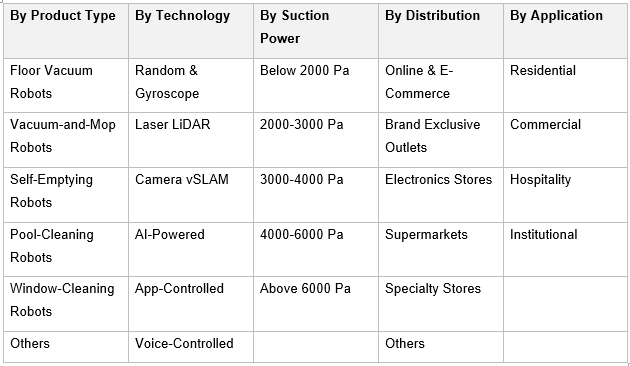
In this report, the India Robotic Vacuum Cleaner Market has been segmented into the following categories, in addition to detailed analysis of key industry trends, market dynamics, competitive landscape, and growth opportunities across the forecast period:
- By Product Type
- Floor Vacuum Robots
- Vacuum-and-Mop Robots
- Self-Emptying Robots
- Pool-Cleaning Robots
- Window-Cleaning Robots
- Others
- By Technology
- Random & Gyroscope Navigation
- Laser LiDAR Navigation
- Camera vSLAM Navigation
- AI-Powered Navigation
- App-Controlled
- Voice-Controlled
- Self-Charging & Auto-Empty
- By Suction Power
- Below 2000 Pa
- 2000-3000 Pa
- 3000-4000 Pa
- 4000-6000 Pa
- Above 6000 Pa
- By Distribution Channel
- Online Retail & E-Commerce
- Brand Exclusive Outlets
- Electronics & Appliance Stores
- Supermarkets & Hypermarkets
- Specialty Stores
- Others
- By Application
- Residential
- Commercial
- Hospitality
- Institutional
- By Geography
- North India
- South India
- West India
- East India
- Central India
Competitive Landscape
Company Profiles:
Detailed analysis of the leading companies operating in the India Robotic Vacuum Cleaner Market, including business overview, product portfolio, strategic initiatives, competitive positioning, and recent developments.
Company Information
Detailed profiling and strategic analysis of additional market players (up to five companies), including emerging robotic cleaning brands, specialty smart-appliance producers, regional players, or niche direct-to-consumer robotic vacuum brands.
The India Robotic Vacuum Cleaner Market report is part of our ongoing research coverage. For early access, customised insights, or to confirm the release timeline, please contact our team at sarita@marketresearchoutlook.com
Table of Contents
- Research Framework
- Market Segmentation
- Research Objective
- Research Methodology
- Qualitative Research
- Primary Research
- Secondary Research
- Quantitative Research
- Market Breakdown & Data Triangulation
- Demand Side
- Supply Side
- Primary Research Respondents
- Assumption & Limitation
- Executive Summary
- Market Overview, 2021-2032
- By Product Type
- By Technology
- By Suction Power
- By Distribution Channel
- By Application
- By Region
- Analyst Recommendations
- Geopolitical Impact on India Robotic Vacuum Cleaner Market
- India Robotic Vacuum Cleaner Market Insights
- Market Dynamics
- Growth Drivers
- Rapid urbanization, nuclear families, dual-income households, and time-pressed lifestyles driving robotic vacuum cleaner demand across India.
- Rising disposable incomes, smart-home adoption, and demand for AI-powered convenience appliances strengthening robotic vacuum cleaner consumption.
- Growing hygiene awareness, e-commerce expansion, and falling price points accelerating robotic vacuum cleaner adoption.
- Restraints
- High price premiums, limited affordability, and easy availability of domestic help restricting robotic vacuum cleaner adoption.
- Limited awareness, after-sales service gaps, and performance concerns on varied Indian home layouts restricting robotic vacuum cleaner penetration.
- Import dependence, currency volatility, and certification-compliance costs impacting overall robotic vacuum cleaner margins.
- Opportunities
- Premium AI, LiDAR, self-emptying, and vacuum-mop hybrid innovation for urban homes.
- E-commerce, D2C, and modern retail expansion unlocking Tier-2 and Tier-3 robotic vacuum cleaner reach.
- Commercial, hospitality, and institutional adoption, plus local assembly under Make-in-India.
- Challenges
- Intense competition from traditional vacuum cleaners, manual cleaning, and low-cost imports across price-sensitive markets.
- Limited service, spare-parts, and support infrastructure across smaller Indian cities.
- Maintaining navigation accuracy, reliability, and performance consistency across diverse home environments.
- Technological Advancements
- Recent Technological Advancements
- Prior to 2020
- Porter’s Five Forces Analysis
- PESTLE Analysis
- Industry Value Chain & Entry Points
- Component & Sensor Suppliers (LiDAR, cameras, sensors, motors, batteries, chipsets)
- Battery & Electronics Manufacturers (lithium-ion, PCBs, brushes, filters)
- Robotics & Software Developers (SLAM navigation, AI, app ecosystems, voice integration)
- OEM / ODM Manufacturers (contract manufacturing, assembly, local production)
- Brand Owners & Robotic Vacuum Manufacturers (iRobot, Ecovacs, Roborock, Xiaomi, Eureka Forbes)
- Quality Control & Testing (BIS standards, safety certification, testing laboratories)
- Importers & Distributors (import, wholesale, distribution networks)
- Retail, Electronics Stores & E-Commerce (Amazon, Flipkart, Croma, Reliance Digital)
- After-Sales Service & Support (installation, spares, warranty, service centres)
- End-Consumers (residential, commercial, hospitality, institutional buyers)
- India Robotic Vacuum Cleaner Market: Regulatory Framework
- India Robotic Vacuum Cleaner Market Overview
- Market Size & Forecast, 2021-2032
- By Value (USD Million)
- By Volume (Thousand Units)
- Market Share & Forecast
- By Product Type
- Floor Vacuum Robots
- Vacuum-and-Mop Robots
- Self-Emptying Robots
- Pool-Cleaning Robots
- Window-Cleaning Robots
- Others
- By Technology
- Random & Gyroscope Navigation
- Laser LiDAR Navigation
- Camera vSLAM Navigation
- AI-Powered Navigation
- App-Controlled
- Voice-Controlled
- Self-Charging & Auto-Empty
- By Suction Power
- Below 2000 Pa
- 2000-3000 Pa
- 3000-4000 Pa
- 4000-6000 Pa
- Above 6000 Pa
- By Distribution Channel
- Online Retail & E-Commerce
- Brand Exclusive Outlets
- Electronics & Appliance Stores
- Supermarkets & Hypermarkets
- Specialty Stores
- Others
- By Application
- Residential
- Commercial
- Hospitality
- Institutional
- By Geography
- North India
- South India
- West India
- East India
- Central India
- Competitive Landscape
- India Robotic Vacuum Cleaner Market Company Market Share Analysis, 2025
- Competitive Benchmarking, By Operating Parameters
- Key Strategic Development (Mergers, Acquisitions, Partnerships, Etc.)
- List of Emerging Players
- Company Profile
- iRobot Corporation (Roomba)
- Introduction & Company Profile
- Product Benchmarking
- Strategic Outlook
- Key Competitors
- Financial Analysis
- SWOT Analysis
(Same Data Pointers Will Be Provided for The Below Companies)
- Ecovacs Robotics
- Roborock (Beijing Roborock)
- Xiaomi India (Mi Robot Vacuum)
- Eureka Forbes Ltd.
- Samsung India Electronics Pvt. Ltd.
- LG Electronics India Pvt. Ltd.
- Dreame Technology
- ILIFE Robotics
- Milagrow Business & Knowledge Solutions
- Panasonic India Pvt. Ltd.
- Kent RO Systems Ltd.
- Havells India Ltd.
- Other Prominent Players
* Financial information in case of non-listed companies will be provided as per availability
** The segmentation and the companies are subjected to modifications based on in-depth secondary for the final deliverable
Frequently Asked Questions
1. How large is the India robotic vacuum cleaner market and what is its growth forecast?
Ans: The India robotic vacuum cleaner market is valued at USD 300 million in 2025 and is projected to reach USD 955 million by 2032, growing at a CAGR of 18.0%.
2. Which segments are driving demand in the India robotic vacuum cleaner market?
Ans: Floor vacuum robots lead with a 60% value share, while vacuum-and-mop hybrid robots are the fastest-growing segment, driven by convenience and AI navigation.
3. What are the key drivers of growth in the India robotic vacuum cleaner market?
Ans: Key drivers include rapid urbanization, nuclear families, rising incomes, smart-home adoption, hygiene awareness, e-commerce expansion, and falling price points.
4. Which regions are driving growth in the India robotic vacuum cleaner market?
Ans: North India and West India lead with around 59% of total value. North India alone contributes 31%, driven by Delhi NCR and high-income metro households.
5. What are the latest trends in the India robotic vacuum cleaner market?
Ans: Latest trends include AI-powered and LiDAR navigation, self-emptying and vacuum-mop hybrids, smart-home and voice integration, and e-commerce dominance.
Frequently Asked Questions
1. How large is the India robotic vacuum cleaner market and what is its growth forecast?
Ans: The India robotic vacuum cleaner market is valued at USD 300 million in 2025 and is projected to reach USD 955 million by 2032, growing at a CAGR of 18.0%.
2. Which segments are driving demand in the India robotic vacuum cleaner market?
Ans: Floor vacuum robots lead with a 60% value share, while vacuum-and-mop hybrid robots are the fastest-growing segment, driven by convenience and AI navigation.
3. What are the key drivers of growth in the India robotic vacuum cleaner market?
Ans: Key drivers include rapid urbanization, nuclear families, rising incomes, smart-home adoption, hygiene awareness, e-commerce expansion, and falling price points.
4. Which regions are driving growth in the India robotic vacuum cleaner market?
Ans: North India and West India lead with around 59% of total value. North India alone contributes 31%, driven by Delhi NCR and high-income metro households.
5. What are the latest trends in the India robotic vacuum cleaner market?
Ans: Latest trends include AI-powered and LiDAR navigation, self-emptying and vacuum-mop hybrids, smart-home and voice integration, and e-commerce dominance.