

India Liquid Oxygen Market Size, Share & Demand Outlook 2032
- Chemicals & Advanced Materials, Specialty Chemicals
- Jun 2026
- Pages 140
- Report Format: pdf
- Report Price: $2400 USD
India’s liquid oxygen market is witnessing strong structural growth, driven by rapid expansion of steel and metallurgy capacity, growing healthcare infrastructure and medical oxygen preparedness, rising demand from chemicals, glass, and water treatment industries, accelerating aerospace and space launch programs, expansion of cryogenic storage and distribution networks, and rising interest from domestic and global industrial gas majors investing in India-specific air separation capacity, merchant supply models, and digital tank monitoring platforms.
Report Description
| Study Duration | 2021-2032 |
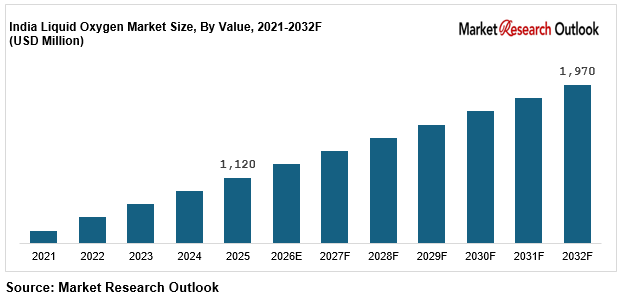
| Market Size (2025) | USD 1,120 Million |
| CAGR (2026-2032) | 8.4% |
| Leading Segment | Industrial Grade Liquid Oxygen (Metallurgy & Steel) |
| Fastest Growing Segment | Medical Grade & Aerospace Grade Liquid Oxygen |
| Market Size (2032) | USD 1,970 Million |
Market Overview: India Liquid Oxygen Market
The India liquid oxygen market size is witnessing rapid expansion, driven by accelerating steel and metallurgy capacity addition, growing healthcare infrastructure and medical oxygen preparedness, rising demand from chemicals, glass, and water treatment industries, expanding aerospace and space launch programs, and major capacity additions by industrial gas majors. Valued at USD 1,120 million in 2025 and projected to reach USD 1,970 million by 2032, growing at a CAGR of 8.4%, market growth is being fuelled by strong demand from steel producers, hospital networks, and chemical processors, alongside the rapid scaling of merchant liquid supply and cryogenic distribution networks across major industrial states. Industrial grade liquid oxygen leads consumption, while the medical grade and aerospace grade segment is emerging as the fastest growing category. Shifting procurement preferences toward bulk liquid supply, growing safety and purity compliance, and rising demand for reliable, telemetry-monitored deliveries are reshaping the supply base. As industrial gas majors including Linde India, INOX Air Products, Air Liquide India, Ellenbarrie Industrial Gases, and Air Water India expand integrated air separation capacity, and end-use industries including steel, healthcare, chemicals, and space programs scale liquid oxygen procurement, the India liquid oxygen market is evolving into a demand-led, investment-driven, and infrastructure-enabled industry with strong long-term growth potential.
Related research: India Ammonia Market, India Concentrated Nitric Acid Market and India Carbon Dioxide Market.
Key Report Takeaways: India Liquid Oxygen Market
- The India liquid oxygen market size is projected to grow from USD 1,120 million in 2025 to USD 1,970 million by 2032, registering a strong CAGR of 8.4%, driven by accelerated steel and metallurgy capacity expansion, rising medical grade adoption, and the structural shift toward organized bulk liquid supply across industrial India.
- Industrial grade liquid oxygen dominates the domestic market, accounting for over 64% of total volume in 2025, driven by strong consumption in basic oxygen furnaces and electric arc furnaces, the deep presence of gas majors such as Linde India, INOX Air Products, and Air Liquide, and rising demand across steel, chemicals, and glass manufacturing clusters.
- Medical grade and aerospace grade liquid oxygen are emerging as the fastest growing segments nationally, expected to grow at 11% to 14% annually as hospital networks, space launch programs, and high-purity manufacturing buyers reshape procurement strategies across metro and industrial markets.
- Rapid scaling of crude steel output, with around 152 million tonnes produced in 2025 and a national capacity target of 300 million tonnes by 2030, is structurally expanding demand across industrial, healthcare, and merchant supply categories.
- Rising investments by industrial gas majors such as Linde India, INOX Air Products, Air Liquide, Ellenbarrie, and Air Water India in air separation units, cryogenic storage capacity, and transport tanker fleets are strengthening domestic supply and supporting the long-term market forecast through 2032.
Key Market Drivers: India Liquid Oxygen Market
Expanding Steel, Metallurgy, and Manufacturing Capacity Driving Industrial Liquid Oxygen Demand Across India
Growth in the India liquid oxygen market is being driven by rapid expansion of steel, metallurgy, and manufacturing capacity across eastern, western, and southern industrial clusters. India produced around 152 million tonnes of crude steel in 2025, with the National Steel Policy targeting 300 million tonnes of capacity by 2030. Basic oxygen furnace and electric arc furnace steelmaking consume an estimated 55 to 75 cubic metres of oxygen per tonne of crude steel, making steel the single largest consumption base for liquid and gaseous oxygen in India. Integrated producers continue to add converter and furnace capacity, while secondary steelmakers across Odisha, Jharkhand, Chhattisgarh, and Gujarat rely heavily on merchant liquid oxygen for cutting, lancing, and melting operations. Liquid oxygen has become a critical supply category for these plants, with bulk contracts typically ranging between 20 and 200 tonnes per month for mid-sized consumers. Per-capita industrial oxygen consumption in India remains well below developed-market levels, indicating significant long-term headroom for growth. Rising infrastructure spending, growing fabrication and foundry output, and expanding shipbuilding and metal processing activity are creating strong structural pull-through demand across the country.
Growing Healthcare Infrastructure, Hospital Expansion, and Medical Oxygen Preparedness Fuelling Medical Grade Adoption
The India liquid oxygen market is benefiting from sustained expansion of healthcare infrastructure, with public and private hospital capacity rising steadily alongside continued investments in medical oxygen preparedness following the 2021 public health emergency. Liquid medical oxygen demand peaked near 10,000 tonnes per day in May 2021, compared to under 1,000 tonnes per day of medical demand before 2020, prompting a structural reset in hospital oxygen planning. Over 4,000 PSA oxygen plants have been commissioned across public health facilities since 2021, while large hospitals have added on-site liquid medical oxygen storage tanks with capacities ranging between 5 and 40 kilolitres. Medical grade liquid oxygen with purity of 99.5% and above is now a standard procurement category for district hospitals, medical colleges, and private chains. PESO licensing, pharmacopoeia compliance, and state-level oxygen storage mandates have further strengthened organized supply, supporting supply reliability nationwide. Hospital networks and government health programs now account for an estimated 22% to 25% of liquid oxygen consumption, with healthcare buyers preferring long-term contracts, telemetry-monitored tanks, and assured backup supply.
Rising Investments in Air Separation Units, Cryogenic Storage, and Merchant Liquid Supply Strengthening Organized Segment Growth
Rising investment in air separation units, cryogenic storage, and merchant liquid supply is a major catalyst for the domestic market, with combined capacity announcements by industrial gas majors exceeding USD 1.5 billion across 2023 to 2025. Linde India and INOX Air Products continue to commission large tonnage and merchant air separation units across steel and chemical clusters, while Air Liquide, Ellenbarrie Industrial Gases, and Air Water India are expanding regional liquid capacity and tanker fleets. The merchant liquid model allows mid-sized consumers in pharmaceuticals, glass, water treatment, and fabrication to access reliable liquid oxygen without captive plant investment. Aerospace demand is also scaling, with national launch programs and private launch companies such as Skyroot Aerospace and Agnikul Cosmos using liquid oxygen based propulsion, creating a new high-specification demand segment, with aerospace grade liquid oxygen representing an estimated USD 60 million addressable opportunity within Indian space and defense programs by 2030. Government infrastructure programs combined with industrial decarbonisation initiatives are structurally expanding liquid oxygen demand across all major end-user categories through 2032.
Key Market Challenges: India Liquid Oxygen Market
High Energy Intensity of Air Separation and Rising Electricity Costs Impacting Production Margins
The India liquid oxygen market continues to face challenges around high energy intensity and rising production costs, with cryogenic air separation consuming an estimated 0.5 to 0.7 kWh of electricity per cubic metre of oxygen produced. While efficiency upgrades and larger plant scales have improved unit economics, power still accounts for 55% to 65% of liquid oxygen production cost, exposing producers to industrial electricity tariffs that vary widely across states. Liquefaction adds a further energy requirement compared to gaseous supply, while transport over long distances increases delivered cost. Producers continue to face pricing pressure from large steel and chemical buyers, while smaller merchant consumers absorb higher delivered prices. India’s continued dependence on grid power for air separation limits margin flexibility for producers across the industry.
Cryogenic Logistics Gaps and Limited Tanker Availability Across Tier-2 and Tier-3 Cities
The India liquid oxygen market faces structural complexity from variations in cryogenic logistics coverage, tanker availability, and storage density across different regions. While industrial hubs such as Mumbai, Pune, Ahmedabad, Jamshedpur, and Chennai have well-established cryogenic distribution frameworks with reliable tanker access, others maintain limited storage infrastructure and longer delivery cycles. India operates fewer than 2,500 cryogenic transport tankers nationally, and unbroken cryogenic transport remains a key bottleneck in tier-2 and tier-3 supply. Boil-off losses during long-distance movement, limited availability of vacuum-insulated storage tanks at smaller consumption points, and uneven handling expertise across states create operational complexity for suppliers such as Linde India, INOX Air Products, Ellenbarrie, and Goyal MG Gases operating pan-India. While post-2021 investments have expanded tanker fleets and hospital storage, infrastructure fragmentation remains a near-term challenge for suppliers.
Volatility in Merchant Liquid Oxygen Prices and Steel Cycle Dependence Impacting Overall Supplier Margins
The India liquid oxygen market faces practical constraints around merchant price volatility, energy cost inflation, and margin compression across the value chain. Merchant liquid oxygen prices in India have fluctuated between INR 12 and INR 25 per cubic metre equivalent across 2022 to 2025, with spot prices moving sharply during steel demand upcycles and supply disruptions. Smaller gas producers face additional complexity in passing through power cost increases without losing volume. Average gross margins for merchant liquid oxygen in India range between 20% and 30%, and dependence on steel and infrastructure cycles reduces the effective profitability of new capacity by 4% to 10% during downturns. Long-term contracts, telemetry-based logistics optimisation, and diversified end-use portfolios are emerging as solutions to stabilise returns, but pricing pressure and captive generation by large consumers remain barriers to margin expansion for producers.
Key Market Trends: India Liquid Oxygen Market
Rapid Adoption of Medical Grade, Pharma-Compliant, and High-Purity Liquid Oxygen in India
The India liquid oxygen market is undergoing a clear shift toward medical grade, pharma-compliant, and high-purity liquid oxygen, with these higher-specification variants expected to capture over 30% of new liquid capacity commissioned by 2027. Medical grade liquid oxygen requires purity of 99.5% and above with strict pharmacopoeia compliance, compared to typical industrial specifications of 99.0% to 99.5%, while aerospace and electronics applications demand even tighter impurity controls. Leading suppliers including Linde India, INOX Air Products, Air Liquide, Ellenbarrie, and Air Water India have scaled medical and high-purity liquid oxygen production capacity through 2024 and 2025. Dual-certified plants capable of switching between industrial and medical output are also gaining traction, particularly around healthcare clusters in Maharashtra, Tamil Nadu, and Delhi NCR, with hospital chains preferring suppliers offering assured medical grade availability and emergency backup. This product transition is reinforcing the long-term market outlook across both healthcare and industrial categories.
Growth of Merchant Liquid Supply, Digital Telemetry, and Long-Term Contracts in the India Liquid Oxygen Market
A clear shift toward merchant liquid supply, digital telemetry, and long-term contracting models is reshaping liquid oxygen distribution in India, particularly in the mid-sized industrial and healthcare segment. Under telemetry-enabled supply models, vacuum-insulated tanks at customer sites are monitored remotely and refilled automatically, reducing stock-out risk and logistics cost by an estimated 8% to 15%. Leading suppliers including Linde India, INOX Air Products, and Air Liquide have expanded digitally monitored installed tank bases across hundreds of industrial and hospital sites. Distributors and bulk resellers are also reducing acquisition costs for smaller consumers, accelerating liquid oxygen adoption across fabrication, glass, and water treatment buyers nationwide. By 2025, merchant and bulk liquid channels account for over 55% of organized liquid oxygen sales in India, with consumers increasingly preferring assured delivery contracts over spot purchases.
Capacity Expansion by Industrial Gas Majors and Cryogenic Infrastructure Investments
A wave of domestic capacity expansion and cryogenic infrastructure investment is reshaping the supply base. Combined India-focused capital expenditure announcements in air separation, liquefaction, and cryogenic distribution exceeded USD 1.5 billion across 2023 to 2025. INOX Air Products continued to commission new air separation units across steel and chemical clusters, Linde India expanded tonnage and merchant capacity in eastern and western India, Ellenbarrie Industrial Gases scaled capacity following its 2025 stock exchange listing, Air Water India strengthened its eastern India network, and Goyal MG Gases expanded northern India liquid capacity. PESO safety oversight, hospital LMO storage mandates, and infrastructure spending under national programs have structurally favoured organized supply. Combined with steel expansion driving industrial demand and healthcare procurement scaling steadily, these developments are reinforcing the India liquid oxygen market forecast 2032 across the entire value chain.
Segmental Insights: India Liquid Oxygen Market
By End-User: Steel & Metallurgy Plants Segment Dominates the India Liquid Oxygen Market
The steel and metallurgy plants end-user segment dominates the India liquid oxygen market, accounting for an estimated 38% to 42% of total volume, driven by expanding converter and furnace capacity, growing secondary steelmaking, and improving bulk supply economics. Industrial grade bulk liquid deliveries are the dominant supply formats within this segment, with cryogenic bulk tanks and transport tankers capturing over 72% of steel-linked liquid oxygen purchases. The hospitals and healthcare segment contributes another 24% to 27% of demand, driven by district hospitals, medical colleges, and private chains maintaining liquid medical oxygen storage as a preparedness standard. The chemical and process industries segment accounts for 22% to 24%, led by oxidation processes, gasification, and water treatment applications. In 2025, leading suppliers including Linde India, INOX Air Products, Air Liquide, Ellenbarrie, and Air Water India scaled up steel and healthcare-focused liquid oxygen deployment under merchant and contract supply expansion, reinforcing segment dominance.
By Grade: Industrial Grade Leads While Medical and Aerospace Grades Grow Fastest
Industrial grade liquid oxygen leads the India liquid oxygen market grade mix, accounting for approximately 64% of total volume, driven by deep consumption in steel, chemicals, and glass manufacturing, established bulk distribution presence, and improving cost economics. Medical grade contributes another 22% to 25%, primarily across hospital networks and pharmaceutical manufacturing. Medical grade and aerospace grade are the fastest growing categories, expanding at 11% to 14% annually, driven by hospital storage mandates, space launch programs, and tighter purity requirements in high-value manufacturing. Food grade and high-purity variants together account for 4% to 6% of the market, with the high-purity segment expected to grow rapidly through 2032 as electronics and specialty chemicals output scales. Leading suppliers including Linde India, INOX Air Products, Air Liquide, Ellenbarrie, and Goyal MG Gases have aligned production portfolios to this grade mix, driving organized liquid oxygen adoption across the country.
Regional Insights: India Liquid Oxygen Market
Regional analysis of the India liquid oxygen market shows that West India and East India collectively account for approximately 55% to 58% of total liquid oxygen volume, driven by Maharashtra (Mumbai and Pune manufacturing belt), Gujarat (chemicals and refining cluster), Odisha, Jharkhand, and West Bengal (steel and metallurgy belt), supported by dense industrial consumption and established air separation capacity. South India contributes around 22% to 25% of demand, led by Tamil Nadu, Karnataka, Telangana, and Andhra Pradesh, supported by automotive, aerospace, healthcare, and fabrication demand across Chennai, Bengaluru, and Hyderabad clusters. North and Central India together account for 18% to 20% of demand, supported by Delhi NCR, Uttar Pradesh, Punjab, and Madhya Pradesh, where healthcare and infrastructure-linked consumption is accelerating. In 2025, capacity additions and distribution operations by INOX Air Products across eastern steel clusters, Linde India across West Bengal and Gujarat, Ellenbarrie across East India, and Air Water India across Odisha reinforced regional supply hubs, supporting closer execution of industrial and healthcare supply projects across key regions.
Recent Developments: India Liquid Oxygen Market
- The India liquid oxygen market witnessed strong momentum in capacity additions and contract progress during 2024 and 2025. India added an estimated 1,800 tonnes per day of new liquid oxygen capacity in calendar year 2025, representing a 22% year-on-year increase from around 1,475 tonnes per day added in 2024, according to industry tracking. Merchant suppliers recorded over 9,500 active bulk tank installations by mid-2025, with the industrial grade segment accounting for 71% of new contracts. Cumulative organized liquid oxygen volume in India is projected to reach 3.4 to 3.6 million tonnes by FY27 from 2.6 million tonnes in FY25, growing at an average 15% annually.
- Industrial gas majors have deepened India-focused capacity expansion. In 2025, INOX Air Products commissioned new air separation units serving steel and chemical clusters, Linde India expanded merchant liquid capacity in eastern and western India, Ellenbarrie Industrial Gases accelerated expansion following its 2025 stock exchange listing, Air Water India strengthened capacity across Odisha and West Bengal, and Goyal MG Gases expanded liquid capacity in northern India. JSW Industrial Gases continued to scale captive and merchant supply linked to steel operations. These developments are strengthening domestic supply and supporting the India liquid oxygen market forecast 2032.
- Healthcare and aerospace liquid oxygen momentum has gained strong traction across India. In 2025, hospital networks and state health departments expanded liquid medical oxygen storage capacity, while national launch programs and private launch companies including Skyroot Aerospace and Agnikul Cosmos scaled liquid oxygen based propulsion testing and missions. Strategic partnerships between gas majors, steel producers, and healthcare networks are positioning India as one of the most actively scaling liquid oxygen markets globally, strengthening long-term competitive positioning through 2032.
Key Market Players: India Liquid Oxygen Market
- Linde India Limited
- INOX Air Products Pvt. Ltd.
- Air Liquide India Holding Pvt. Ltd.
- Ellenbarrie Industrial Gases Limited
- Air Water India Pvt. Ltd.
- Goyal MG Gases Pvt. Ltd.
- National Oxygen Limited
- Bhagawati Oxygen Limited
- SICGIL India Limited
- Southern Gas Limited
- JSW Industrial Gases Pvt. Ltd.
- Aims Industries Limited
- Taiyo Nippon Sanso India Pvt. Ltd.
Report Scope
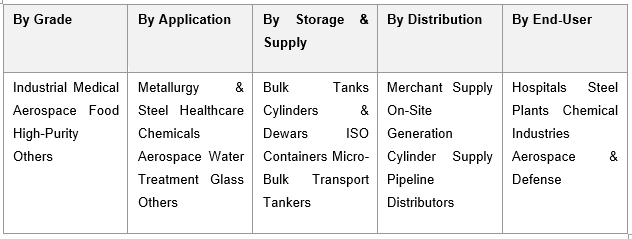
In this report, the India Liquid Oxygen Market has been segmented into the following categories, in addition to detailed analysis of key industry trends, market dynamics, competitive landscape, and growth opportunities across the forecast period:
- By Grade
- Industrial Grade
- Medical Grade
- Aerospace Grade
- Food Grade
- High-Purity Grade
- Others
- By Application
- Metallurgy & Steel
- Healthcare & Pharmaceuticals
- Chemicals & Petrochemicals
- Aerospace & Defense
- Water & Wastewater Treatment
- Glass & Ceramics
- Others
- By Storage & Supply Mode
- Cryogenic Bulk Tanks
- Cryogenic Cylinders & Dewars
- ISO Containers
- Micro-Bulk Systems
- Transport Tankers
- By Distribution Channel
- Bulk & Merchant Liquid Supply
- On-Site Generation
- Packaged Cylinder Supply
- Pipeline Supply
- Distributors & Resellers
- Direct Industrial Contracts
- By End-User
- Hospitals & Healthcare Facilities
- Steel & Metallurgy Plants
- Chemical & Process Industries
- Aerospace & Defense Organizations
- By Geography
- North India
- South India
- West India
- East India
- Central India
Competitive Landscape
Company Profiles:
Detailed analysis of the leading companies operating in the India Liquid Oxygen Market, including business overview, product portfolio, strategic initiatives, competitive positioning, and recent developments.
Company Information
Detailed profiling and strategic analysis of additional market players (up to five companies), including emerging domestic gas producers, specialty medical and high-purity liquid oxygen suppliers, regional merchant players, or niche state-level distributors.
For a free sample of the India Liquid Oxygen Market report, customised insights or delivery timelines, submit your query hereresearch@marketresearchoutlook.com
Table of Contents
- Research Framework
- Market Segmentation
- Research Objective
- Research Methodology
- Qualitative Research
- Primary Research
- Secondary Research
- Quantitative Research
- Market Breakdown & Data Triangulation
- Demand Side
- Supply Side
- Primary Research Respondents
- Assumption & Limitation
- Executive Summary
- Market Overview, 2021-2032
- By Grade
- By Application
- By Storage & Supply Mode
- By Distribution Channel
- By End-User
- By Region
- Analyst Recommendations
- Geopolitical Impact on India Liquid Oxygen Market
- India Liquid Oxygen Market Insights
- Market Dynamics
- Growth Drivers
- Expanding steel, metallurgy, and manufacturing capacity driving industrial liquid oxygen demand across India.
- Growing healthcare infrastructure, hospital bed expansion, and medical oxygen preparedness fuelling medical grade adoption.
- Rising investments in air separation units, cryogenic storage, and merchant liquid supply strengthening organized segment growth.
- Restraints
- High energy intensity of air separation and rising industrial electricity costs impacting liquid oxygen production margins.
- Cryogenic logistics gaps and limited tanker availability restricting liquid oxygen distribution across tier-2 and tier-3 cities.
- Volatility in merchant liquid oxygen prices and dependence on steel demand cycles impacting overall supplier margins.
- Opportunities
- Aerospace, space launch, and defense programs opening untapped liquid oxygen demand pools across strategic sectors.
- Green steel, oxy-fuel combustion, and gasification projects supporting next-generation growth in industrial segments.
- Healthcare preparedness investments, LMO storage mandates, and modern distribution expansion creating massive supply opportunities.
- Challenges
- Intense competition from captive air separation units, on-site PSA generation, and small regional gas vendors.
- Limited cryogenic storage infrastructure and inconsistent tanker fleet coverage across smaller Indian cities.
- Maintaining purity standards, safety compliance, and quality at scale across diverse Indian regional markets.
- Technological Advancements
- Recent Technological Advancements
- Prior to 2020
- Porter’s Five Forces Analysis
- PESTLE Analysis
- Industry Value Chain & Entry Points
- Upstream Inputs (atmospheric air, power, cryogenic equipment, storage tanks, transport tankers)
- Air Separation & Liquid Oxygen Producers (Linde India, INOX Air Products, Air Liquide, Ellenbarrie, Air Water India)
- Cryogenic Equipment & Tank Suppliers (storage tanks, vaporizers, dewars, ISO containers)
- On-Site & Captive Generation Players (PSA units, captive air separation plants)
- Quality Control, R&D & Testing Laboratories (PESO, BIS, ISO gas purity and safety standards)
- Distributors, Wholesalers & Merchant Traders (B2B bulk and packaged distribution networks)
- Hospitals & Healthcare Networks (government hospitals, private chains, LMO storage systems)
- Brand Owners & Gas Service Providers (Linde India, INOX Air Products, Air Liquide, Goyal MG, National Oxygen)
- Industrial Channels & Bulk Delivery (steel plants, chemical units, refineries, glass manufacturers)
- End-Users (steel plants, hospitals, chemical processors, aerospace programs, water treatment utilities)
- India Liquid Oxygen Market: Regulatory Framework
- India Liquid Oxygen Market Overview
- Market Size & Forecast, 2021-2032
- By Value (USD Million)
- By Volume (Thousand Tonnes)
- Market Share & Forecast
- By Grade
- Industrial Grade
- Medical Grade
- Aerospace Grade
- Food Grade
- High-Purity Grade
- Others
- By Application
- Metallurgy & Steel
- Healthcare & Pharmaceuticals
- Chemicals & Petrochemicals
- Aerospace & Defense
- Water & Wastewater Treatment
- Glass & Ceramics
- Others
- By Storage & Supply Mode
- Cryogenic Bulk Tanks
- Cryogenic Cylinders & Dewars
- ISO Containers
- Micro-Bulk Systems
- Transport Tankers
- By Distribution Channel
- Bulk & Merchant Liquid Supply
- On-Site Generation
- Packaged Cylinder Supply
- Pipeline Supply
- Distributors & Resellers
- Direct Industrial Contracts
- By End-User
- Hospitals & Healthcare Facilities
- Steel & Metallurgy Plants
- Chemical & Process Industries
- Aerospace & Defense Organizations
- By Geography
- North India
- South India
- West India
- East India
- Central India
- Competitive Landscape
- India Liquid Oxygen Market Company Market Share Analysis, 2025
- Competitive Benchmarking, By Operating Parameters
- Key Strategic Development (Mergers, Acquisitions, Partnerships, Etc.)
- List of Emerging Players
- Company Profile
- Linde India Limited
- Introduction & Company Profile
- Product Benchmarking
- Strategic Outlook
- Key Competitors
- Financial Analysis
- SWOT Analysis
(Same Data Pointers Will Be Provided for The Below Companies)
- INOX Air Products Pvt. Ltd.
- Air Liquide India Holding Pvt. Ltd.
- Ellenbarrie Industrial Gases Limited
- Air Water India Pvt. Ltd.
- Goyal MG Gases Pvt. Ltd.
- National Oxygen Limited
- Bhagawati Oxygen Limited
- SICGIL India Limited
- Southern Gas Limited
- JSW Industrial Gases Pvt. Ltd.
- Aims Industries Limited
- Taiyo Nippon Sanso India Pvt. Ltd.
- Other Prominent Players
* Financial information in case of non-listed companies will be provided as per availability
** The segmentation and the companies are subjected to modifications based on in-depth secondary for the final deliverable
Frequently Asked Questions
1. How large is the India liquid oxygen market and what is its growth forecast?
Ans: The India liquid oxygen market is valued at USD 1,120 million in 2025 and is projected to reach USD 1,970 million by 2032, growing at a CAGR of 8.4%, supported by steel capacity expansion, healthcare preparedness, and rising aerospace demand.
2. Which segments are driving demand in the India liquid oxygen market?
Ans: Industrial grade liquid oxygen leads the market with over 64% volume share, while medical grade and aerospace grade are the fastest-growing segments, driven by hospital LMO storage mandates, space launch programs, and high-purity manufacturing demand.
3. What are the key drivers of growth in the India liquid oxygen market?
Ans: Key drivers include expanding steel and metallurgy capacity, growing healthcare infrastructure and medical oxygen preparedness, rising chemicals and water treatment demand, and increasing investments in air separation units and merchant liquid supply.
4. Which regions are driving growth in the India liquid oxygen market?
Ans: West India and East India lead with around 55% to 58% of total volume, driven by Maharashtra, Gujarat, Odisha, Jharkhand, and West Bengal. South India and Tamil Nadu also show strong industrial demand.
5. What are the latest trends in the India liquid oxygen market?
Ans: The latest trends include rapid adoption of medical grade liquid oxygen, growth in merchant liquid supply, rising aerospace and space launch demand, digital telemetry-based tank monitoring, and expanding cryogenic distribution driving organized sales.