

India Electric Appliance Rental Market: Subscription Economy, Urban Mobility, and D2C Rental Platforms Power Structural Growth, Forecasts 2032
- Consumer Goods & Retail
- May 2026
- Pages 141
- Report Format: pdf
- Report Price: $1800 USD
India’s electric appliance rental market is witnessing rapid structural growth, fuelled by rising urban migration, growing rental and subscription economy adoption among working professionals and students, expansion of co-living and PG accommodation supply, high upfront cost of premium appliances, the rapid scaling of D2C rental platforms and mobile apps, growing rent-to-own (RTO) financing models, and rising investments by domestic and global players in India-specific logistics, refurbishment capacity, smart appliance offerings, and corporate B2B leasing partnerships.
Report Description
| Study Duration | 2021-2032 |
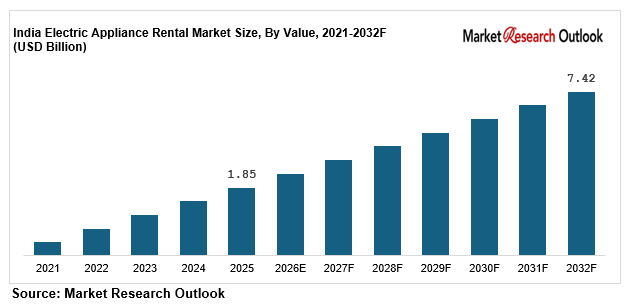
| Market Size (2025) | USD 1.85 Billion |
| CAGR (2026-2032) | 21.8% |
| Leading Segment | Refrigerators & Washing Machines (Subscription Rental) |
| Fastest Growing Segment | Air Conditioners & Smart Home Appliances |
| Market Size (2032) | USD 7.42 Billion |
Source: Market Research Outlook
Market Overview: India Electric Appliance Rental Market
The India electric appliance rental market size is witnessing rapid expansion, driven by rising urban migration of working professionals and students, accelerating subscription economy adoption, expansion of co-living and PG accommodation supply, high upfront cost of premium home appliances, and the rapid scaling of D2C rental platforms, mobile apps, and rent-to-own financing models. Valued at USD 1.85 billion in 2025 and projected to reach USD 7.42 billion by 2032, growing at a CAGR of 21.8%, the India electric appliance rental market growth is being fuelled by strong residential adoption among 22 to 35-year-old urban professionals, rising commercial demand from co-living platforms, hotels, hostels, and corporate offices, and growing rent-to-own appliance financing partnerships with NBFCs. Refrigerators and washing machines lead consumption, while air conditioners and smart home appliances are emerging as the fastest growing categories. Strengthening subscription culture, ESG and circular economy preferences by urban Indian consumers, alongside aggressive expansion by D2C rental platforms, are reshaping the supply landscape. As domestic majors including Furlenco, Rentomojo, RentSher, CityFurnish, and Fabrento scale subscription and rent-to-own portfolios, and global majors including Amazon Rentals and Flipkart SmartBuy deepen India-specific innovation, the India electric appliance rental market is evolving into a platform-led, technology-driven, and digitally enabled ecosystem with strong long-term growth potential.
Key Report Takeaways: India Electric Appliance Rental Market
- The India electric appliance rental market size is projected to grow from USD 1.85 billion in 2025 to USD 7.42 billion by 2032, registering a strong CAGR of 21.8%, driven by accelerated urban migration, rising subscription economy adoption, and the structural shift toward asset-light consumption across millennial and Gen-Z Indian urban households.
- Refrigerators and washing machines dominate the India electric appliance rental market, accounting for over 48% of total category value in 2025, driven by mass-market monthly rentals of INR 400 to INR 1,500, daily-use household requirements, and strong distribution across D2C platforms, mobile apps, and corporate co-living tie-ups across urban India.
- Air conditioners and smart home appliances are emerging as the fastest growing segment in the India electric appliance rental market, expected to grow at 28% to 35% annually as urban consumers, rising summer temperatures, and seasonal short-term rental demand reshape sourcing strategies across the appliance rental category.
- Rapid scaling of D2C rental platforms such as Furlenco, Rentomojo, RentSher, CityFurnish, and Fabrento, alongside corporate B2B partnerships with co-living players Stanza Living, OYO Life, Colive, and Zolo, with online rental adoption crossing 65% to 70% of category demand by mid-2025, is structurally expanding the India electric appliance rental market across residential and commercial categories.
- Rising investments by domestic players such as Furlenco, Rentomojo, RentSher, and CityFurnish in logistics, refurbishment capacity, mobile app technology, and rent-to-own NBFC partnerships with Bajaj Finserv and HDFC are strengthening platform economics and supporting the India electric appliance rental market forecast 2032.
Key Market Drivers: India Electric Appliance Rental Market
Rising Urban Migration, Working Professional Mobility, and Rental Culture Among Millennials
Growth in the India electric appliance rental market is being driven by rapid urban migration, working professional mobility, and the deepening rental culture among millennials and Gen-Z consumers. Over 25 crore Indians live in cities outside their home state in 2025 according to government estimates, with annual inter-city migration of working professionals exceeding 1.2 crore. The 22 to 35-year-old age cohort, representing over 35 crore Indians, increasingly views appliance ownership as a financial and logistical burden, preferring flexible monthly rental subscriptions of INR 400 to INR 4,500 instead of one-time appliance purchases of INR 25,000 to INR 75,000. Frequent job changes, work-from-home flexibility, and short-term assignment relocations in metros such as Bengaluru, Hyderabad, Pune, Mumbai, Delhi NCR, and Chennai are structurally pulling demand into the India electric appliance rental market. Mass-priced refrigerator and washing machine rentals between INR 400 and INR 1,500 monthly, available across D2C platforms, mobile apps, and corporate B2B channels, continue to drive high-volume penetration across the country.
High Upfront Cost of Premium Appliances and Growing Subscription Economy Adoption
The India electric appliance rental market is benefiting from rising consumer preference for asset-light consumption, with the upfront cost of premium home appliances increasingly viewed as a barrier to ownership. Premium air conditioner prices in India range from INR 35,000 to INR 75,000, refrigerator prices from INR 25,000 to INR 80,000, and washing machine prices from INR 18,000 to INR 55,000, while monthly rental subscriptions of INR 600 to INR 4,500 deliver immediate access without large capital outlay. The Indian subscription economy grew by over 32% year-on-year in 2025 according to leading industry trackers, with appliance rentals representing one of the fastest growing subscription verticals alongside OTT, music, and SaaS services. Domestic rental platform capacity has scaled rapidly, with Furlenco operating across 9 metro cities, Rentomojo covering 11 cities, RentSher across 7 cities, and CityFurnish across 6 cities by 2025. Strategic partnerships with NBFCs such as Bajaj Finserv, HDFC Bank, and Pine Labs for rent-to-own financing have further strengthened category economics, supporting price competitiveness across the India electric appliance rental market.
E-commerce Growth, D2C Rental Platforms, Mobile Apps, and Rent-to-Own Financing Accelerating Category Expansion
Rapid growth in online and D2C distribution is a major catalyst for the India electric appliance rental market, with the D2C platform channel projected to grow at 25% to 30% annually through 2032. Online and mobile app rental adoption now accounts for an estimated 65% to 70% of total category value, led by D2C platforms such as Furlenco, Rentomojo, RentSher, CityFurnish, Fabrento, GrabOnRent, and IndiaRents. Marketplace aggregators including Amazon Rentals and Flipkart SmartBuy have emerged as new growth engines for short-term seasonal appliance rentals across urban markets. Rent-to-own (RTO) financing partnerships with Bajaj Finserv, HDFC, Pine Labs, ZestMoney, and KreditBee have made premium appliances accessible to consumers with limited credit history, with RTO contracts of 18 to 36 months allowing eventual ownership. Mobile app technology, social media-led customer acquisition, and influencer-led content on Instagram, YouTube, and short-form video platforms are reinforcing aspirational demand. Leading D2C and digital-first platforms have scaled aggressive content, performance marketing, and corporate B2B partnership pipelines, supporting structural expansion of the India electric appliance rental market across all major end-user categories through 2032.
Key Market Challenges: India Electric Appliance Rental Market
Low Brand Awareness, Fragmented Unorganized Market, and Consumer Trust Deficit
The India electric appliance rental market continues to face challenges around low brand awareness, a fragmented unorganized rental economy, and a structural consumer trust deficit. The unorganized local rental economy, estimated at 35% to 40% of total category volume in 2025, undermines brand-building investments by organized platforms such as Furlenco, Rentomojo, RentSher, CityFurnish, and Fabrento. Local appliance rental shops, often operating without formal contracts, GST registration, or quality refurbishment, continue to dominate Tier-II and Tier-III city demand. Consumer concerns around used appliance quality, hygiene, hidden charges, security deposit recovery, and after-sales service have historically limited organized platform penetration to 25% to 30% of urban demand. Strengthening platform standardization, GST-compliant invoicing, professional refurbishment processes, and transparent security deposit policies are gradually easing these pressures, but trust gaps and unorganized competition remain a structural concern across the India electric appliance rental market.
Logistics, Last-Mile Delivery, Service, and Refurbishment Cost Pressures
The India electric appliance rental market faces structural complexity around logistics, last-mile delivery, on-site installation, service, and refurbishment cost pressures on platform unit economics. Bulky appliances such as refrigerators, washing machines, and air conditioners require specialized transportation, professional installation, and trained technicians for setup and pickup, with average per-transaction logistics costs ranging between INR 800 and INR 2,200. India imports a significant share of high-end smart appliance components, exposing rental platforms to currency volatility and supply chain risks during inventory replenishment. Refurbishment cycles between rental contracts require deep cleaning, parts replacement, performance testing, and repackaging, adding 8% to 14% to platform operating costs. Asset utilization rates of 70% to 80% are critical for platform profitability, while customer churn, security deposit recovery, and asset damage management add complexity. While leading platforms such as Furlenco, Rentomojo, and RentSher are scaling in-house logistics, refurbishment hubs, and technician training, operational cost pressures remain a near-term challenge for the India electric appliance rental market.
GST Taxation Complexity and Asset Depreciation, Recovery, and Damage Risks
The India electric appliance rental market faces practical constraints around GST taxation complexity on rental services, asset depreciation accounting, and damage recovery risks. Appliance rental services attract GST at 18%, placing additional pricing pressure on platform unit economics, while input GST credit on appliance procurement adds complexity to working capital management. Asset depreciation rates of 12% to 18% annually on white goods appliances require careful inventory rotation, secondary resale strategies, and asset write-off provisioning. Recovery of security deposits in cases of customer damage, premature contract termination, or asset loss has emerged as a structural challenge, with average dispute rates of 4% to 7% across platforms. Refurbishment, parts replacement, and quality control before re-rental add operational complexity, while corporate B2B contracts with co-living players such as Stanza Living, OYO Life, Colive, and Zolo involve longer payment cycles. While leading platforms are investing in AI-driven asset tracking, IoT-enabled appliance monitoring, and standardized damage recovery protocols, regulatory and operational complexity remains a near-term constraint across the India electric appliance rental market.
Key Market Trends: India Electric Appliance Rental Market
Rapid Adoption of Subscription-Based Rental Models and Flexible Tenure Plans
The India electric appliance rental market is undergoing a clear shift toward subscription-based rental models with flexible tenure plans ranging from 3 months to 36 months, with these flexible offerings expected to capture over 75% of rental contracts by 2027. Monthly subscription tenures of 3, 6, 12, and 24 months allow consumers to align rental commitments with job assignments, college terms, or short-term relocations. Leading platforms including Furlenco, Rentomojo, RentSher, CityFurnish, and Fabrento offer modular bundles combining refrigerator, washing machine, TV, and air conditioner rentals, with bundle discounts of 15% to 25% over individual product rentals. Rent-to-own (RTO) plans of 18 to 36 months, where monthly payments eventually transfer ownership, are also gaining traction, with RTO contracts representing 18% to 22% of platform revenues. Try-and-buy programs, where consumers test appliances for 30 to 90 days before committing to purchase or extended rental, are emerging as a key engagement strategy. This rental model diversification is reinforcing the India electric appliance rental market forecast 2032 across both short-term and long-term demand cohorts.
Growth of Smart Appliance Rentals, IoT-Enabled Devices, and Premium Subscription Plans
A clear shift toward smart appliance rentals, IoT-enabled devices, and premium subscription plans is reshaping the India electric appliance rental market, particularly across the premium and metro consumer segments. Smart appliance rental launches grew by over 38% in 2024 and 2025, with leading platforms scaling Wi-Fi-connected refrigerator rentals, IoT washing machines, smart air conditioners with voice control, and connected televisions with OTT subscriptions bundled. IoT-enabled monitoring of appliance usage, predictive maintenance alerts, and remote diagnostics from technicians reduce service downtime, supporting premium subscription positioning. Bundle subscription plans including appliance rentals, OTT services such as Netflix, Amazon Prime, and Disney+ Hotstar, and home cleaning add-ons are emerging as a key differentiator, with average revenue per user (ARPU) of INR 2,200 to INR 4,500 for premium subscribers. Sustainability and circular economy positioning, with refurbished premium appliances marketed as environmentally responsible alternatives to ownership, is also gaining traction among Gen-Z and millennial consumers. This smart and premium rental momentum is supporting category value growth and is reinforcing structural growth across the India electric appliance rental market.
Corporate B2B Rentals, Co-living Tie-ups, and Hyperlocal Quick-Commerce Expansion
A wave of corporate B2B rental expansion, co-living accommodation tie-ups, and hyperlocal quick-commerce partnerships is reshaping the India electric appliance rental market supply landscape. Combined India-focused capital expenditure announcements by leading rental platforms exceeded INR 1,800 crore across 2023 to 2025. Furlenco expanded across 9 metro cities, Rentomojo scaled across 11 cities, RentSher added new B2B contracts with corporate offices, CityFurnish expanded co-living partnerships, and Fabrento grew its hotel and hospitality B2B portfolio. Corporate B2B rentals with co-living players such as Stanza Living, OYO Life, Colive, Zolo Stays, and Nestaway have emerged as a high-growth segment, contributing over 25% to 30% of category revenues, with bulk contracts of 500 to 5,000 appliances per partnership. Hyperlocal quick-commerce platforms and 24-hour delivery services for short-term seasonal rentals such as AC summer rentals and party-equipment rentals are creating new value pools. Combined with rising urban migration and subscription economy adoption, these developments are reinforcing the India electric appliance rental market forecast 2032 across the entire value chain.
Segmental Insights: India Electric Appliance Rental Market
By Appliance Type: Refrigerators and Washing Machines Dominate the India Electric Appliance Rental Market
The refrigerators and washing machines segment dominates the India electric appliance rental market, accounting for an estimated 46% to 50% of total category value, driven by their daily-use household requirement, mass-market rental affordability, and strong distribution across D2C platforms, mobile apps, and corporate B2B channels. Refrigerators alone capture 25% to 28% of category demand, with monthly rentals ranging between INR 400 and INR 1,800. Washing machines contribute 20% to 22%, with rentals between INR 350 and INR 1,200 monthly. Air conditioners are the fastest growing category, contributing 18% to 22% of demand and growing at 30% to 35% annually, driven by short-term summer seasonal rentals from May to September. Televisions account for 14% to 16% of demand, supported by smart TV adoption and OTT-bundled subscription plans. Microwaves, water purifiers, geysers, and dishwashers together contribute 12% to 14%, with adoption rising in premium urban subscription plans. In 2025, leading platforms including Furlenco, Rentomojo, RentSher, CityFurnish, and Fabrento scaled up bundled appliance rental offerings, reinforcing segment dominance in the India electric appliance rental market.
By Rental Model and End-User: Subscription Leads While RTO and Co-living B2B Grow Fastest
Subscription rental leads the India electric appliance rental market rental model landscape, accounting for approximately 64% to 68% of total category value, driven by predictable monthly billing, flexible tenure options, and platform-led customer experience. Rent-to-Own (RTO) contracts contribute another 18% to 22% of category value but are the fastest growing model, expanding at 28% to 32% annually, supported by NBFC financing partnerships with Bajaj Finserv, HDFC Bank, Pine Labs, and ZestMoney. Lease contracts, primarily for corporate B2B segments, account for 8% to 10%, while try-and-buy programs contribute 4% to 6%. By end-user, residential consumers, particularly working professionals aged 22 to 35, dominate with 68% to 72% share. Commercial segments, including co-living spaces, hotels, hostels, PG accommodations, and corporate offices, account for 28% to 32% but are the fastest growing end-user cohort, expanding at 30% to 35% annually. Co-living B2B partnerships with Stanza Living, OYO Life, Colive, and Zolo Stays are scaling rapidly, reflecting evolving consumer preferences across the India electric appliance rental market.
Regional Insights: India Electric Appliance Rental Market
Regional analysis of the India electric appliance rental market shows that South India and West India collectively account for approximately 58% to 62% of total category value, driven by Karnataka (Bengaluru contributes over 22% of total India appliance rental demand alone), Maharashtra (Mumbai, Pune metro tech corridor), Telangana (Hyderabad), Tamil Nadu (Chennai), and Gujarat (Ahmedabad), supported by large IT, BFSI, and startup workforce migration, dense co-living supply, and progressive rental adoption among millennial professionals. North India contributes around 22% to 25% of demand, led by Delhi NCR (Gurugram, Noida tech belt), supported by corporate B2B rentals and student housing demand. Central and East India together account for 14% to 18% of demand, supported by Madhya Pradesh, Uttar Pradesh, West Bengal (Kolkata), where appliance rental platform adoption is accelerating in Tier-II cities. In 2025, capacity additions and platform operations by Furlenco across Bengaluru, Mumbai, Pune, and Hyderabad, Rentomojo across pan-India, RentSher in Delhi NCR, CityFurnish in West India, and Fabrento across hotel B2B segments reinforced regional supply hubs, supporting closer execution of residential and commercial rental contracts across the India electric appliance rental market.
Recent Developments: India Electric Appliance Rental Market
- The India electric appliance rental market witnessed strong momentum in platform expansion and category scaling during 2024 and 2025. The category grew by an estimated 22% to 26% in value terms in 2025, supported by aggressive D2C platform expansion, co-living B2B partnerships, summer AC rental campaigns, and rent-to-own NBFC tie-ups. Online and mobile app sales crossed 65% to 70% of total category value, with smart appliance and AC rental sales growing by over 35% year-on-year, according to leading industry trackers. Cumulative organized rental platform penetration is projected to expand from 30% in 2025 to 55% to 60% by FY32, growing at an average 22% to 26% annually.
- Domestic appliance rental platforms have deepened India-focused capacity expansion and city coverage. In 2025, Furlenco scaled operations across 9 metro cities and expanded into smaller bedrooms-bath bundled categories, Rentomojo expanded to 11 cities with new corporate B2B contracts, RentSher added new appliance categories and B2B contracts, CityFurnish expanded co-living tie-ups, and Fabrento grew hospitality and hotel B2B portfolios. Stanza Living, OYO Life, Colive, and Zolo Stays expanded co-living appliance rental partnerships. Tata Croma, Bajaj Finserv, Amazon Rentals, and Flipkart SmartBuy expanded rent-to-own and short-term rental programs. These developments are strengthening platform supply and supporting the India electric appliance rental market forecast 2032.
- Premium and smart appliance rental momentum has gained strong traction in the India electric appliance rental market. In 2025, leading premium and digital-first players including Furlenco, Rentomojo, and RentSher scaled smart TV, IoT washing machine, and connected air conditioner rental portfolios with OTT bundle subscriptions. Strategic partnerships between rental platforms, NBFC financing partners Bajaj Finserv, HDFC, Pine Labs, ZestMoney, and KreditBee, and co-living operators are positioning India as one of the most actively scaling appliance rental markets globally, strengthening long-term competitive positioning in the India electric appliance rental market forecast 2032.
Key Market Players: India Electric Appliance Rental Market
- Furlenco (House of Kieraya Furnishing Solutions Pvt. Ltd.)
- Rentomojo (Edunetwork Pvt. Ltd.)
- RentSher India Pvt. Ltd.
- Fabrento Furniture & Appliance Rentals
- CityFurnish (Fashtech Solutions Pvt. Ltd.)
- GrabOnRent India Pvt. Ltd.
- IndiaRents Furnishings Pvt. Ltd.
- Cohome Subscription Rentals
- Rentkar Self Drive Pvt. Ltd.
- Pluss Appliance Rentals
- Stanza Living (B2B Appliance Leasing Partner)
- Tata Croma (Rent-to-Own Programs)
- Bajaj Finserv EMI Network
- Amazon Rentals India
- Flipkart SmartBuy Rentals
Report Scope
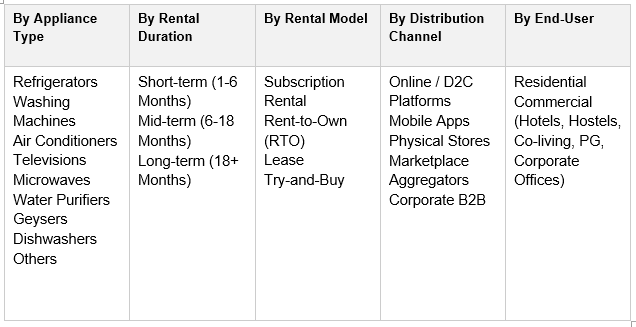
In this report, the India Electric Appliance Rental Market has been segmented into the following categories, in addition to detailed analysis of key industry trends, market dynamics, competitive landscape, and growth opportunities across the forecast period:
- By Appliance Type
- Refrigerators
- Washing Machines
- Air Conditioners
- Televisions
- Microwaves
- Water Purifiers
- Geysers
- Dishwashers
- Others
- By Rental Duration
- Short-term (1 to 6 Months)
- Mid-term (6 to 18 Months)
- Long-term (18+ Months)
- By Rental Model
- Subscription Rental
- Rent-to-Own (RTO)
- Lease
- Try-and-Buy
- By Distribution Channel
- Online / D2C Platforms
- Mobile Apps
- Physical Stores
- Marketplace Aggregators
- Corporate B2B
- By End-User
- Residential (Individuals, Students, Working Professionals, Newlyweds)
- Commercial (Hotels, Hostels, Co-living Spaces, PG Accommodations, Corporate Offices)
- By Price Range
- Economy
- Mid-Range
- Premium
- Luxury
- By Geography
- North India
- South India
- West India
- East India
- Central India
Competitive Landscape
Company Profiles:
Detailed analysis of the leading companies operating in the India Electric Appliance Rental Market, including business overview, product portfolio, strategic initiatives, competitive positioning, and recent developments.
Company Information
Detailed profiling and strategic analysis of additional market players (up to five companies), including emerging domestic D2C rental platforms, specialty smart appliance rental brands, premium luxury appliance subscription players, or niche regional rental operators.
The India Electric Appliance Rental Market report is part of our ongoing research coverage. For early access, customised insights, or to confirm the release timeline, please contact our team at sarita@marketresearchoutlook.com
Table of Contents
- Research Framework
- Market Segmentation
- Research Objective
- Research Methodology
- Qualitative Research
- Primary Research
- Secondary Research
- Quantitative Research
- Market Breakdown & Data Triangulation
- Demand Side
- Supply Side
- Primary Research Respondents
- Assumption & Limitation
- Executive Summary
- Market Overview, 2021-2032
- By Appliance Type
- By Rental Duration
- By Rental Model
- By Distribution Channel
- By End-User
- By Price Range
- By Region
- Analyst Recommendations
- Geopolitical Impact on India Electric Appliance Rental Market
- India Electric Appliance Rental Market Insights
- Market Dynamics
- Growth Drivers
- Rising urban migration, working professional mobility, and rental culture among millennials driving demand.
- High upfront cost of premium appliances and growing subscription economy adoption boosting category penetration.
- E-commerce growth, D2C rental platforms, mobile apps, and rent-to-own financing accelerating market expansion.
- Restraints
- Low brand awareness, fragmented unorganized market, and consumer trust deficit limiting category scaling.
- Logistics, last-mile delivery, service, and refurbishment cost pressures on rental platform unit economics.
- GST taxation complexity on rental services and asset depreciation, recovery, and damage risks.
- Opportunities
- Tier-II and Tier-III city expansion creating a massive untapped appliance rental demand base.
- Smart, IoT-enabled, and connected appliance rentals opening new premium subscription value pools.
- Corporate B2B leasing, co-living tie-ups, and hostel/PG accommodation partnerships supporting growth.
- Challenges
- Asset utilization, refurbishment quality, and after-sales service execution across pan-India coverage.
- Working capital intensity and long payback periods for premium appliance rental platforms.
- Customer churn, security deposit recovery, and asset damage management at scale.
- Technological Advancements
- Recent Technological Advancements
- Prior to 2020
- Porter’s Five Forces Analysis
- PESTLE Analysis
- Industry Value Chain & Entry Points
- Upstream OEM Appliance Manufacturers (LG, Samsung, Whirlpool, Voltas, Godrej, Haier)
- Bulk Procurement & Inventory Aggregators
- Refurbishment, Servicing & Quality Control Centres
- Logistics, Last-Mile Delivery & Installation Partners (Delhivery, ShadowFax, Porter)
- D2C Platforms, Mobile Apps & Marketplace Aggregators (Furlenco, Rentomojo, RentSher)
- Rent-to-Own Financing Partners (Bajaj Finserv, HDFC, Pine Labs, ZestMoney)
- Corporate B2B Leasing & Co-living Tie-ups (Stanza, OYO Life, Colive, Zolo)
- Service, Maintenance & Authorized Repair Networks
- Asset Recovery, Refurbishment & Secondary Sales Channels
- End-Users (individual consumers, students, working professionals, hotels, PG accommodations)
- India Electric Appliance Rental Market: Regulatory Framework
- India Electric Appliance Rental Market Overview
- Market Size & Forecast, 2021-2032
- By Value (USD Million)
- By Volume (Thousand Units on Rent)
- Market Share & Forecast
- By Appliance Type
- Refrigerators
- Washing Machines
- Air Conditioners
- Televisions
- Microwaves
- Water Purifiers
- Geysers
- Dishwashers
- Others
- By Rental Duration
- Short-term (1 to 6 Months)
- Mid-term (6 to 18 Months)
- Long-term (18+ Months)
- By Rental Model
- Subscription Rental
- Rent-to-Own (RTO)
- Lease
- Try-and-Buy
- By Distribution Channel
- Online / D2C Platforms
- Mobile Apps
- Physical Stores
- Marketplace Aggregators
- Corporate B2B
- By End-User
- Residential
- Commercial (Hotels, Hostels, Co-living, PG, Corporate Offices)
- By Price Range
- Economy
- Mid-Range
- Premium
- Luxury
- By Geography
- North India
- South India
- West India
- East India
- Central India
- Competitive Landscape
- India Electric Appliance Rental Market Company Market Share Analysis, 2025
- Competitive Benchmarking, By Operating Parameters
- Key Strategic Development (Mergers, Acquisitions, Partnerships, Etc.)
- List of Emerging Players
- Company Profile
- Furlenco (House of Kieraya Furnishing Solutions Pvt. Ltd.)
- Introduction & Company Profile
- Product Benchmarking
- Strategic Outlook
- Key Competitors
- Financial Analysis
- SWOT Analysis
- (Same Data Pointers Will Be Provided for The Below Companies)
- Rentomojo (Edunetwork Pvt. Ltd.)
- RentSher India Pvt. Ltd.
- Fabrento Furniture & Appliance Rentals
- CityFurnish (Fashtech Solutions Pvt. Ltd.)
- GrabOnRent India Pvt. Ltd.
- IndiaRents Furnishings Pvt. Ltd.
- Cohome Subscription Rentals
- Rentkar Self Drive Pvt. Ltd.
- Pluss Appliance Rentals
- Stanza Living (B2B Appliance Leasing Partner)
- Tata Croma (Rent-to-Own Programs)
- Bajaj Finserv EMI Network
- Amazon Rentals India
- Flipkart SmartBuy Rentals
- Other Prominent Players
- Furlenco (House of Kieraya Furnishing Solutions Pvt. Ltd.)
- Market Size & Forecast, 2021-2032
* Financial information in case of non-listed companies will be provided as per availability
** The segmentation and the companies are subjected to modifications based on in-depth secondary for the final deliverable
Frequently Asked Questions
1. How large is the India electric appliance rental market and what is its growth forecast?
Ans: The India electric appliance rental market is valued at USD 1.85 billion in 2025 and is projected to reach USD 7.42 billion by 2032, growing at a CAGR of 21.8%, supported by urban migration, subscription economy, and D2C platforms.
2. Which segments are driving demand in the India electric appliance rental market?
Ans: Refrigerators and washing machines dominate the India electric appliance rental market with over 46% value share, while air conditioners and smart home appliances are the fastest growing segments, supported by seasonal urban demand.
3. What are the key drivers of growth in the India electric appliance rental market?
Ans: Key drivers include rising urban migration, working professional mobility, subscription economy adoption, high upfront appliance costs, D2C rental platforms, mobile apps, and rent-to-own NBFC financing across India's electric appliance rental market.
4. Which regions are driving growth in the India electric appliance rental market?
Ans: Bengaluru, Mumbai, Pune, Hyderabad, Chennai, Delhi NCR, and Ahmedabad lead the India electric appliance rental market, supported by IT workforce migration, co-living supply, dense apartment culture, and strong rental platform coverage.
5. What are the latest trends in the India electric appliance rental market?
Ans: Latest trends include flexible subscription tenures, rent-to-own NBFC financing, smart IoT appliance rentals, co-living B2B partnerships, OTT-bundled subscriptions, hyperlocal quick-commerce, and AI-driven asset tracking across India's electric appliance rental market.
Frequently Asked Questions
1. How large is the India electric appliance rental market and what is its growth forecast?
Ans: The India electric appliance rental market is valued at USD 1.85 billion in 2025 and is projected to reach USD 7.42 billion by 2032, growing at a CAGR of 21.8%, supported by urban migration, subscription economy, and D2C platforms.
2. Which segments are driving demand in the India electric appliance rental market?
Ans: Refrigerators and washing machines dominate the India electric appliance rental market with over 46% value share, while air conditioners and smart home appliances are the fastest growing segments, supported by seasonal urban demand.
3. What are the key drivers of growth in the India electric appliance rental market?
Ans: Key drivers include rising urban migration, working professional mobility, subscription economy adoption, high upfront appliance costs, D2C rental platforms, mobile apps, and rent-to-own NBFC financing across India's electric appliance rental market.
4. Which regions are driving growth in the India electric appliance rental market?
Ans: Bengaluru, Mumbai, Pune, Hyderabad, Chennai, Delhi NCR, and Ahmedabad lead the India electric appliance rental market, supported by IT workforce migration, co-living supply, dense apartment culture, and strong rental platform coverage.
5. What are the latest trends in the India electric appliance rental market?
Ans: Latest trends include flexible subscription tenures, rent-to-own NBFC financing, smart IoT appliance rentals, co-living B2B partnerships, OTT-bundled subscriptions, hyperlocal quick-commerce, and AI-driven asset tracking across India's electric appliance rental market.