

India Sanitary Ware Market Size, Trend & Demand Outlook 2032
- Consumer Goods & Retail, Home Appliances & Durables
- May 2026
- Pages 140
- Report Format: pdf
- Report Price: $2400 USD
India sanitary ware market is witnessing strong structural growth, driven by the rapid expansion of residential real estate under PMAY and urban housing demand, rising disposable income, bathroom premiumisation, government-led Swachh Bharat Mission and Jal Jeevan Mission, accelerating commercial and hospitality construction, expanding organised retail and e-commerce, and rising interest from domestic and global sanitary ware majors investing in India-specific manufacturing capacity, smart sanitary ware platforms, and water-efficient product lines.
Report Description
| Study Duration | 2021-2032 |
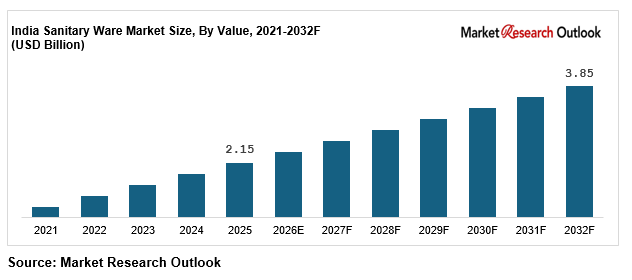
| Market Size (2025) | USD 2.15 Billion |
| CAGR (2026-2032) | 8.6% |
| Leading Segment | Water Closets / Ceramic Sanitary Ware |
| Fastest Growing Segment | Smart & Sensor-Based Sanitary Ware |
| Market Size (2032) | USD 3.85 Billion |
Source:
Market Overview: India Sanitary Ware Market
The India sanitary ware market size is witnessing rapid expansion, driven by the world’s largest rural sanitation drive Swachh Bharat Mission, the residential housing push under PMAY, rising disposable income across urban India, accelerating commercial and hospitality construction, and growing demand for branded, smart, and water-efficient bathroom solutions. Valued at USD 2.15 billion in 2025 and projected to reach USD 3.85 billion by 2032, growing at a CAGR of 8.6%, the India sanitary ware market growth is being fuelled by strong residential demand, rising premium sanitary ware adoption, rapid penetration of organised retail and e-commerce, and growing institutional uptake across hotels, hospitals, schools, and government buildings. Water closets and ceramic sanitary ware lead consumption, while smart and sensor-based sanitary ware is emerging as the fastest growing category. Tightening green building norms, rising RE100 and ESG commitments by Indian corporates, and the national Jal Jeevan Mission targets are reshaping the supply landscape. As domestic majors including HSIL, Cera, Parryware, Jaquar, Somany, and Kajaria Bathware expand integrated ceramic-to-installation capacity, and premium global brands such as Kohler, Roca, and Toto deepen India footprint, the India sanitary ware market is evolving into a design-led, branded, and digitally enabled ecosystem with strong long-term growth potential.
Related research: India Cloud Kitchen Market, India Modular Kitchen Market and India Furniture Rental Market.
Key Report Takeaways: India Sanitary Ware Market
- The India sanitary ware market size is projected to grow from USD 2.15 billion in 2025 to USD 3.85 billion by 2032, registering a strong CAGR of 8.6%, driven by accelerated PMAY-led residential housing demand, rising bathroom premiumisation, and the structural shift toward branded, water-efficient, and smart sanitary ware.
- Water closets and wash basins dominate the India sanitary ware market by product type, together accounting for over 65% of total value in 2025, supported by PMAY-Urban housing delivery, Swachh Bharat 2.0 toilet construction, and rising adoption of dual-flush and wall-hung water closets across urban India.
- Smart and sensor-based sanitary ware is emerging as the fastest growing segment in the India sanitary ware market, expected to grow at 14% to 17% annually as touchless faucets, sensor flush systems, and electronic bidets gain traction across hospitality, healthcare, airports, and premium residential projects.
- Rapid expansion of PMAY-Urban, with over 1.18 crore homes sanctioned and 92 lakh homes completed by 2025, is structurally expanding the India sanitary ware market across the residential, government housing, and rural sanitation categories.
- Rising investments by domestic majors such as HSIL Hindware, Cera Sanitaryware, Parryware India, Jaquar, and Somany Ceramics in capacity expansion, vertical integration, and premium ranges are strengthening local supply and supporting the India sanitary ware market forecast 2032.
Key Market Drivers: India Sanitary Ware Market
Real Estate Expansion, PMAY Housing Scheme, and Rapid Urbanisation Driving Residential Sanitary Ware Demand
Growth in the India sanitary ware market is being driven by the rapid expansion of residential real estate, the Pradhan Mantri Awas Yojana (PMAY) housing scheme, and rapid urbanisation. PMAY-Urban targets over 1.2 crore homes, with around 92 lakh homes completed by 2025 and the new PMAY-U 2.0 scheme launched with an outlay of INR 2.30 lakh crore for an additional 1 crore homes over 5 years. Each new home typically requires 2 to 4 sanitary ware fittings, creating strong structural pull-through demand across the India sanitary ware market. Urban population is projected to reach 600 million by 2030, supporting steady residential construction, while real estate launches in the top 8 cities crossed 5.4 lakh units in 2024. Combined with falling sanitary ware system costs of INR 5,000 to 12,000 per bathroom for mass-market fittings and INR 25,000 to 75,000 for premium ranges, these factors are creating strong long-term residential demand across the India sanitary ware market.
Rising Disposable Income, Bathroom Premiumisation, and Organised Retail Expansion
The India sanitary ware market is benefiting from rising disposable income across urban India, accelerating bathroom premiumisation, and rapid expansion of organised retail and e-commerce. India’s urban per-capita income crossed INR 2.45 lakh in FY25, growing at over 9% annually, while the premium and luxury sanitary ware segment is expanding at 12% to 14% CAGR, well above the overall market. Organised retail share of sanitary ware sales has crossed 55% in 2025, projected to reach 65% by 2030, supported by exclusive brand outlets, multi-brand showrooms, and modern trade. E-commerce share of sanitary ware sales rose from around 6% in 2021 to nearly 14% in 2025, led by platforms such as Hindware Lacasa, Pepperfry, Amazon, and brand-owned online stores. Branded sanitary ware companies including Jaquar, Kohler, Roca, Hindware Italian Collection, Cera Premium, and Toto have rapidly expanded India-focused premium ranges, strengthening the India sanitary ware market across mid and premium price points.
Government Infrastructure Programmes Driving Institutional and Rural Sanitary Ware Demand
Rapid expansion of government infrastructure programmes is a major catalyst for the India sanitary ware market, with institutional and rural sanitary ware demand projected to grow at 9% to 11% annually through 2032. Swachh Bharat Mission has supported the construction of over 11 crore household toilets in rural India, while Swachh Bharat 2.0 targets ODF Plus status across all villages by 2026. Jal Jeevan Mission has provided tap water connections to over 15 crore rural households, driving installation of associated sanitary ware. AMRUT 2.0 and Smart Cities Mission have funded urban water supply, sewerage, and sanitation infrastructure across over 500 cities. The hospitality sector is adding around 60,000 branded hotel rooms between 2025 and 2028, while the healthcare sector is expanding hospital bed capacity at 6% to 7% annually, both driving commercial sanitary ware procurement. Government programmes combined with private commercial construction are structurally expanding India sanitary ware market growth across all major end-user categories through 2032.
Key Market Challenges: India Sanitary Ware Market
Price Sensitivity, Unorganised Sector Competition, and Low-Cost Chinese Imports
The India sanitary ware market continues to face challenges around price sensitivity, intense competition from the unorganised sector, and pressure from low-cost Chinese imports. The unorganised segment still accounts for an estimated 45% of total India sanitary ware market volume in 2025, offering products at 30% to 50% lower price points than branded equivalents, particularly in Tier 3 cities and rural belts. Chinese sanitary ware imports, while reduced after Quality Control Orders (QCO) and BIS mandatory certification rolled out in 2023, continue to enter through grey channels, pressuring branded margins. Indian sanitary ware exports also face pricing competition from China, Vietnam, and Bangladesh in key Middle East and African markets. While branded companies such as Hindware, Cera, Parryware, and Jaquar have responded with value-tier sub-brands, mass-market price competition remains a near-term challenge for the India sanitary ware market.
Volatile Raw Material and Energy Costs Across the Sanitary Ware Value Chain
The India sanitary ware market faces structural complexity from volatile raw material and energy costs across the value chain. Key inputs including ball clay, kaolin, feldspar, quartz, china clay, and glaze chemicals together represent 22% to 28% of total sanitary ware production cost, with mining-linked pricing creating quarterly volatility. Natural gas, used for kiln firing, contributes another 18% to 24% of conversion cost, exposing manufacturers to global gas price swings. APM gas allocations to ceramic clusters in Morbi, Gujarat have been a recurring policy concern, with spot LNG pricing periodically driving up sanitary ware production costs. Logistics costs across the India sanitary ware market value chain remain elevated due to the high weight-to-value ratio of ceramic products, with road logistics alone representing 6% to 9% of delivered cost. While companies such as Hindware, Cera, and Parryware have adopted captive solar power, gas hedging, and process efficiency initiatives, raw material and energy volatility remains a key India sanitary ware market challenge.
Long Replacement Cycles and Skilled Installation Workforce Shortage
The India sanitary ware market faces practical constraints around long household replacement cycles, the skilled installation workforce shortage, and limited after-sales service penetration. Indian households typically replace sanitary ware once every 12 to 15 years, far longer than the 7 to 10 year cycle seen in developed markets, limiting near-term renovation-led India sanitary ware market demand. Skilled plumbers and bathroom installers remain in short supply, with industry estimates indicating a shortfall of 25% to 30% versus addressable demand, leading to long installation queues and quality concerns. Premium sanitary ware brands such as Kohler, Roca, Jaquar, and Hindware Italian Collection require trained installers for concealed cisterns, wall-hung toilets, sensor-based faucets, and electronic bidets, where execution quality directly impacts customer experience. While vendor training programmes by Hindware, Cera, Parryware, and Jaquar are scaling, the skilled workforce gap remains a persistent operational challenge across the India sanitary ware market.
Key Market Trends: India Sanitary Ware Market
Rapid Adoption of Smart, Sensor-Based, and Touchless Sanitary Ware in India
The India sanitary ware market is undergoing a clear technology shift toward smart, sensor-based, and touchless sanitary ware, with these advanced product categories expected to capture over 18% of premium installations by 2027. Touchless faucets, sensor flush systems, electronic bidets, and IoT-enabled bathroom fittings have seen rapid adoption post-COVID across hotels, airports, healthcare facilities, corporate offices, and premium residential projects. Sensor-based water closets and faucets reduce water consumption by 25% to 40%, supporting compliance with IGBC, GRIHA, and LEED green-building standards. Leading domestic and global brands including Jaquar, Hindware Smart Lacasa, Cera Senator, Kohler Numi, Roca In-Wash, and Toto Washlet have scaled smart sanitary ware portfolios through 2024 and 2025. Anti-microbial glaze finishes, voice-controlled fittings, and integrated bathroom hubs are also gaining traction in luxury residential and 5-star hospitality segments. This technology transition is reinforcing the India sanitary ware market forecast 2032 across both residential and commercial categories.
Premiumisation and Branded Sanitary Ware Growth in the India Sanitary Ware Market
A clear shift toward premiumisation, branded sanitary ware, and lifestyle bathroom solutions is reshaping the India sanitary ware market, particularly in metro and Tier 1 cities. Premium and super-premium sanitary ware now contribute around 22% of total India sanitary ware market value in 2025, up from 14% in 2020, with growth led by aspirational urban consumers, premium real estate launches, and the hospitality sector. Leading premium brands including Jaquar Group, Kohler India, Roca India, Hindware Italian Collection, Cera Premium, Toto, and Parryware Roca have rolled out extensive premium ranges spanning wall-hung toilets, rimless flush technology, intelligent bidets, and designer faucets at price points of INR 25,000 to 1.5 lakh per piece. Architect-led specification and influencer-led design content are also reshaping consumer aspiration. Online aggregators and digital design platforms such as Pepperfry, Livspace, and brand-owned configurators are reducing customer acquisition costs and accelerating premium sanitary ware adoption across the India sanitary ware market.
Capacity Expansion by Domestic Sanitary Ware Manufacturers and Vertical Integration
A wave of domestic capacity expansion and vertical integration is reshaping the India sanitary ware market supply landscape. Combined India-focused capital expenditure announcements in sanitary ware capacity, faucet manufacturing, and bathroom solutions exceeded INR 4,500 crore across 2023 to 2025. HSIL Hindware expanded vitreous china capacity to over 2 million pieces and added faucet capacity at Roorkee, Cera Sanitaryware commissioned a greenfield sanitary ware facility scaling to 3.5 million pieces by 2026, Parryware India (Roca Group) expanded plants at Perundurai and Dewas, Jaquar Group commissioned new faucet manufacturing capacity, and Somany Ceramics scaled bath fittings under the Somany Bathware brand. The Production Linked Incentive (PLI) outlook for ceramic and bathroom products, mandatory BIS certification under QCO 2023, and Basic Customs Duty on imports have structurally favoured domestic supply across the India sanitary ware market. Combined with PMAY-Urban driving residential demand and commercial procurement scaling rapidly, these developments are reinforcing the India sanitary ware market forecast 2032 across the entire value chain.
Segmental Insights: India Sanitary Ware Market
By Product Type: Water Closets Dominate While Smart Sanitary Ware Grows Fastest
Water closets and toilets dominate the India sanitary ware market product mix, accounting for approximately 38% to 42% of total value, driven by mass-market PMAY housing, Swachh Bharat 2.0 toilet construction, and accelerating urban renovation activity. Wash basins contribute another 22% to 25% of demand, supported by premium residential and commercial bathroom design. Urinals and bidets together account for around 8% to 10% of the India sanitary ware market, with urinals concentrated in commercial and institutional projects and bidets emerging in premium residential segments. Cisterns and sinks contribute another 18% to 22% of demand. Smart and sensor-based sanitary ware, while currently a niche category, is the fastest growing segment at 14% to 17% annual growth, with high penetration in luxury residential, hospitality, healthcare, and Grade A office construction across the India sanitary ware market.
By End-User: Residential Segment Dominates the India Sanitary Ware Market
The residential end-user segment dominates the India sanitary ware market, accounting for an estimated 62% to 65% of total demand, driven by the rapid scaling of PMAY-Urban, Swachh Bharat 2.0, rising urban housing launches, and growing renovation activity. Mid-range ceramic sanitary ware leads within this segment, while premium ranges are scaling in metro markets. The commercial segment contributes another 18% to 22% of demand, driven by hotels, retail malls, IT parks, and office complexes adopting branded sanitary ware to manage hygiene, design, and water efficiency requirements. The institutional segment accounts for 10% to 13%, led by hospitals, schools, airports, and government buildings, supported by Smart Cities and AMRUT funding. In 2025, leading sanitary ware players including HSIL Hindware, Cera, Parryware, Jaquar, and Somany scaled up residential and commercial sanitary ware deployment under PMAY and corporate procurement, reinforcing segment dominance in the India sanitary ware market.
Regional Insights: India Sanitary Ware Market
Regional analysis of the India sanitary ware market shows that West India and North India collectively account for approximately 55% to 58% of total sanitary ware demand, driven by Gujarat (which hosts the Morbi ceramic cluster, the largest sanitary ware manufacturing hub in India), Maharashtra (Mumbai, Pune residential and commercial belt), Rajasthan, Haryana, and Uttar Pradesh, supported by progressive real estate, organised retail, and strong distribution networks. South India contributes around 24% to 27% of demand, led by Tamil Nadu, Karnataka, Telangana, and Kerala, supported by residential and commercial sanitary ware adoption in IT and manufacturing clusters around Chennai, Bengaluru, Hyderabad, and Kochi. Central and East India together account for 15% to 18% of demand, supported by Madhya Pradesh, Chhattisgarh, West Bengal, and Odisha, where PMAY-Urban and Swachh Bharat 2.0 adoption is accelerating. In 2025, capacity additions and distribution expansion by HSIL Hindware across North and West India, Cera in Gujarat, Parryware across Tamil Nadu, Jaquar across pan-India premium retail, and Kohler in metro markets reinforced regional supply hubs, supporting closer execution of residential and commercial projects across the India sanitary ware market.
Recent Developments: India Sanitary Ware Market
- The India sanitary ware market witnessed strong momentum in capacity additions and policy progress during 2024 and 2025. India’s sanitary ware production crossed 35 million pieces in 2025, a growth of around 9% year-on-year, while organised sector share rose to 55% of value. PMAY-Urban crossed 92 lakh completed homes by 2025, with the residential segment accounting for over 62% of new sanitary ware demand. Cumulative installed sanitary ware capacity in India is projected to reach 45 to 50 million pieces by FY28 from 38 million pieces in FY25, growing at around 7% to 8% annually across the India sanitary ware market.
- Domestic sanitary ware manufacturers deepened India-focused capacity expansion. In 2025, HSIL Hindware expanded vitreous china capacity beyond 2 million pieces and added faucet capacity at Roorkee, Cera Sanitaryware commissioned greenfield expansion at Kadi to scale capacity to 3.5 million pieces by 2026, Parryware India (Roca Group) expanded Perundurai and Dewas plants, Jaquar Group commissioned new faucet manufacturing capacity, and Somany Ceramics scaled bath fittings under the Somany Bathware brand. These developments are strengthening domestic supply and supporting the India sanitary ware market forecast 2032.
- Premium and smart sanitary ware momentum gained strong traction in the India sanitary ware market. In 2025, leading premium brands including Kohler India, Roca Bathroom Products, Toto India, Jaquar Group, and Hindware Italian Collection expanded smart, sensor-based, and lifestyle product lines. Strategic partnerships between domestic ceramic majors, premium global brands, and e-commerce platforms are positioning India as one of the most actively scaling sanitary ware markets globally, strengthening long-term competitive positioning in the India sanitary ware market forecast 2032.
Key Market Players: India Sanitary Ware Market
- HSIL Limited (Hindware)
- Cera Sanitaryware Limited
- Parryware India Pvt. Ltd. (Roca Group)
- Jaquar Group
- Kohler India Corporation Pvt. Ltd.
- Roca Bathroom Products Pvt. Ltd.
- Toto India Industries Pvt. Ltd.
- Kajaria Bathware (Kajaria Ceramics Limited)
- H & R Johnson India (Prism Johnson Limited)
- Somany Ceramics Limited
- Asian Granito India Limited
- Anchor Bathroom Group
Report Scope
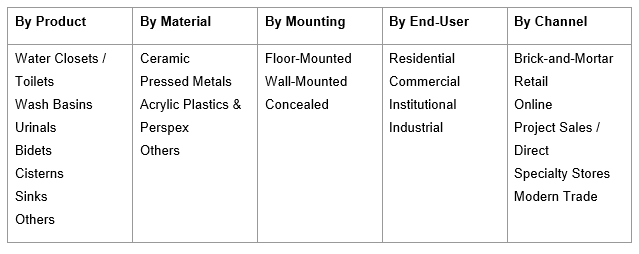
In this report, the India Sanitary Ware Market has been segmented into the following categories, in addition to detailed analysis of key industry trends, market dynamics, competitive landscape, and growth opportunities across the forecast period:
- By Product Type
- Water Closets / Toilets
- Wash Basins
- Urinals
- Bidets
- Cisterns
- Sinks
- Others
- By Material
- Ceramic
- Pressed Metals
- Acrylic Plastics & Perspex
- Others
- By Technology
- Slip Casting
- Pressure Casting
- Tape Casting
- Isostatic Casting
- By Price Range
- Premium
- Mid-Range
- Mass / Economy
- By Mounting Type
- Floor-Mounted
- Wall-Mounted
- Concealed
- By Distribution Channel
- Brick-and-Mortar Retail
- Online
- Project Sales / Direct
- Specialty Stores
- Modern Trade
- By End-User
- Residential
- Commercial
- Institutional
- Industrial
- By Application
- New Construction
- Renovation & Replacement
- By Geography
- North India
- South India
- West India
- East India
- Central India
Competitive Landscape
Company Profiles:
Detailed analysis of the leading companies operating in the India Sanitary Ware Market, including business overview, product portfolio, strategic initiatives, competitive positioning, and recent developments.
Company Information
Detailed profiling and strategic analysis of additional market players (up to five companies), including emerging domestic sanitary ware EPC firms, smart and sensor-based sanitary ware producers, premium designer faucet brands, and niche regional bathroom solution providers across the India sanitary ware market.
For a free sample of the India Sanitary Ware Market report, customised insights or delivery timelines, submit your query hereresearch@marketresearchoutlook.com
Table of Contents
- Research Framework
- Market Segmentation
- Research Objective
- Research Methodology
- Qualitative Research
- Primary Research
- Secondary Research
- Quantitative Research
- Market Breakdown & Data Triangulation
- Demand Side
- Supply Side
- Primary Research Respondents
- Assumption & Limitation
- Executive Summary
- Market Overview, 2021-2032
- By Product Type
- By Material
- By Mounting Type
- By End-User
- By Distribution Channel
- By Price Range
- By Region
- Analyst Recommendations
- Geopolitical Impact on India Sanitary Ware Market
- India Sanitary Ware Market Insights
- Market Dynamics
- Growth Drivers
- Real estate expansion, PMAY housing scheme, and rapid urbanisation driving residential sanitary ware demand.
- Rising disposable income, bathroom premiumisation, and organised retail expansion strengthening branded sanitary ware uptake.
- Government infrastructure programmes (Swachh Bharat Mission, Smart Cities, AMRUT, Jal Jeevan Mission) driving institutional and rural sanitary ware adoption.
- Restraints
- Price sensitivity, unorganised sector competition, and low-cost Chinese imports pressuring branded sanitary ware margins.
- Volatile raw material costs (ceramic body clay, feldspar, energy) and high logistics costs across the sanitary ware value chain.
- Long replacement cycles in middle-income households (12 to 15 years) limiting near-term renovation-led sanitary ware demand.
- Opportunities
- Tier 2 and Tier 3 city expansion, e-commerce penetration, and organised retail growth creating fresh sanitary ware demand pools.
- Smart, sensor-based, and touchless sanitary ware adoption across hospitality, healthcare, and premium residential segments.
- Water-efficient and green-certified sanitary ware tied to IGBC, GRIHA, and LEED building certification programmes.
- Challenges
- Skilled labour shortage in installation, plumbing, and after-sales service across the India sanitary ware market.
- Counterfeit branded products, GST compliance leakage, and quality standardisation gaps in the unorganised segment.
- Energy-intensive manufacturing, kiln emissions, and rising carbon footprint pressure on sanitary ware producers.
- Technological Advancements
- Recent Technological Advancements
- Prior to 2020
- Porter’s Five Forces Analysis
- PESTLE Analysis
- Industry Value Chain & Entry Points
- Upstream Raw Materials (ball clay, kaolin, feldspar, quartz, china clay, glaze chemicals, natural gas)
- Sanitary Ware Manufacturers (vitreous china, fireclay, fine fireclay, porcelain)
- Faucets, Cisterns & Fittings Suppliers (chrome plated brass, ceramic discs, dual-flush cisterns)
- Smart Sanitary Ware & Bathroom Technology (sensor faucets, touchless flush, electronic bidets)
- Quality Control, R&D & Testing Laboratories (BIS, ISI, IS 2556, EN 997 standards)
- Distributors, Dealers & Online Aggregators (B2B and B2C platforms)
- Sanitary Ware Retail Outlets (multi-brand showrooms, exclusive brand outlets)
- Brand Owners & Bathroom Solution Providers (Hindware, Cera, Parryware, Jaquar, Kohler, Roca)
- Installation, Plumbing & After-Sales Service (certified plumbers, system integrators)
- End-Users (residential, commercial, institutional, industrial, hospitality, healthcare)
- India Sanitary Ware Market: Regulatory Framework
- India Sanitary Ware Market Overview
- Market Size & Forecast, 2021-2032
- By Value (USD Million)
- By Volume (Million Pieces)
- Market Share & Forecast
- By Product Type
- Water Closets / Toilets
- Wash Basins
- Urinals
- Bidets
- Cisterns
- Sinks
- Others
- By Material
- Ceramic
- Pressed Metals
- Acrylic Plastics & Perspex
- Others
- By Technology
- Slip Casting
- Pressure Casting
- Tape Casting
- Isostatic Casting
- By Price Range
- Premium
- Mid-Range
- Mass / Economy
- By Mounting Type
- Floor-Mounted
- Wall-Mounted
- Concealed
- By Distribution Channel
- Brick-and-Mortar Retail
- Online
- Project Sales / Direct
- Specialty Stores
- Modern Trade
- By End-User
- Residential
- Commercial
- Institutional
- Industrial
- By Application
- New Construction
- Renovation & Replacement
- By Geography
- North India
- South India
- West India
- East India
- Central India
- Competitive Landscape
- India Sanitary Ware Market Company Market Share Analysis, 2025
- Competitive Benchmarking, By Operating Parameters
- Key Strategic Development (Mergers, Acquisitions, Partnerships, Etc.)
- List of Emerging Players
- Company Profile
- HSIL Limited (Hindware)
- Introduction & Company Profile
- Product Benchmarking
- Strategic Outlook
- Key Competitors
- Financial Analysis
- SWOT Analysis
- (Same Data Pointers Will Be Provided for The Below Companies)
- Cera Sanitaryware Limited
- Parryware India Pvt. Ltd. (Roca Group)
- Jaquar Group
- Kohler India Corporation Pvt. Ltd.
- Roca Bathroom Products Pvt. Ltd.
- Toto India Industries Pvt. Ltd.
- Kajaria Bathware (Kajaria Ceramics Limited)
- H & R Johnson India (Prism Johnson Limited)
- Somany Ceramics Limited
- Asian Granito India Limited
- Anchor Bathroom Group
- Other Prominent Players
- HSIL Limited (Hindware)
* Financial information in case of non-listed companies will be provided as per availability
** The segmentation and the companies are subjected to modifications based on in-depth secondary for the final deliverable
Frequently Asked Questions
1. How large is the India sanitary ware market and what is its growth forecast?
Ans: India sanitary ware market is valued at USD 2.15 billion in 2025 and is projected to reach USD 3.85 billion by 2032, growing at a CAGR of 8.6%, supported by PMAY housing and bathroom premiumisation.
2. Which segments are driving demand in the India sanitary ware market?
Ans: Water closets and wash basins lead the India sanitary ware market with over 65% share. Smart and sensor-based sanitary ware is the fastest growing segment at 14% to 17% annual growth.
3. What are the key drivers of growth in the India sanitary ware market?
Ans: Key drivers include PMAY-Urban housing, rising disposable income, bathroom premiumisation, organised retail growth, Swachh Bharat Mission, Jal Jeevan Mission, and growing hospitality and healthcare construction across India.
4. Which regions are driving growth in the India sanitary ware market?
Ans: West and North India lead with 55% to 58% share, driven by Gujarat (Morbi cluster), Maharashtra, Rajasthan, and Uttar Pradesh. South India contributes 24% to 27% of demand.
5. What are the latest trends in the India sanitary ware market?
Ans: Top trends include smart and sensor-based sanitary ware adoption, premium bathroom solutions, water-efficient products tied to green building norms, and capacity expansion by HSIL, Cera, Parryware, and Jaquar.