

India Soft Magnetic Materials Market Size & Forecast 2032
- Chemicals & Advanced Materials, Specialty Chemicals
- Apr 2026
- Pages 140
- Report Format: pdf
- Report Price: $2400 USD
India’s soft magnetic materials market is witnessing strong growth, driven by the rapid scale-up of electric vehicle (EV) manufacturing, accelerated power transmission and distribution infrastructure investment, expanding renewable energy and electronics manufacturing under PLI schemes, rising adoption of high-efficiency motors and transformers aligned with BEE energy norms, government-led Atmanirbhar Bharat and PLI Specialty Steel initiatives, and rising interest from global soft magnetic material majors investing in India-specific manufacturing capacity and technology.
Report Description
| Study Duration | 2021-2032 |
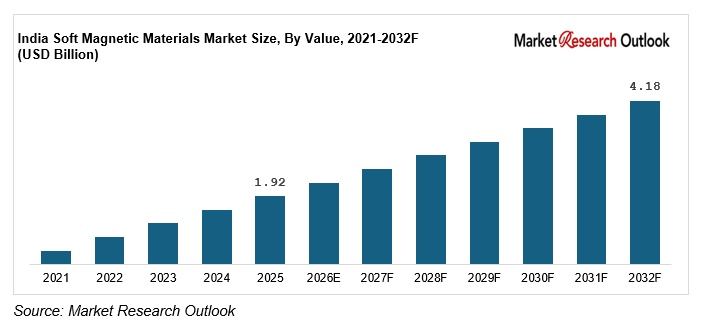
| Market Size (2025) | USD 1.92 Billion |
| CAGR (2026-2032) | 11.7% |
| Leading Segment | Electrical Steel (CRGO & CRNGO) |
| Fastest Growing Segment | Soft Ferrites & Nanocrystalline Alloys for EV Powertrains |
| Market Size (2032) | USD 4.18 Billion |
Source:
Market Overview: India Soft Magnetic Materials Market
The India soft magnetic materials market size is witnessing rapid expansion, driven by accelerated electric vehicle manufacturing, large-scale grid and distribution transformer modernisation, and rising investments in renewable energy and electronics under PLI schemes. Valued at USD 1.92 billion in 2025 and projected to reach USD 4.18 billion by 2032 at a CAGR of 11.7%, growth is being supported by strong demand from power utilities, transformer manufacturers, EV motor producers, renewable inverter makers, consumer electronics OEMs, industrial machinery builders, and railway and defence system integrators.
Related research: India Copper Pipes and Copper Tubes Market, India Steel Pipes and Steel Tubes Market and India Air Compressor Market.
Electrical steel, including CRGO and CRNGO, continues to lead overall consumption, while soft ferrites and nanocrystalline alloys are emerging as the fastest-growing segments, particularly in EV powertrains and high-frequency applications. The market is increasingly influenced by tightening BIS and BEE energy efficiency standards, FAME II and PLI Auto-led EV adoption, and RDSS-driven transformer upgrades, alongside rising ESG commitments across industries.
Global companies such as Proterial, Vacuumschmelze, TDK, JFE Steel, and POSCO are expanding India-focused manufacturing, while domestic players including Tata Steel, JSW Steel, ArcelorMittal Nippon Steel India, Cosmo Ferrites, and MIDHANI are scaling capacity across specialty alloys and electrical steel.
As a result, the India soft magnetic materials market is evolving into a sustainability-led, application-specific, and export-competitive ecosystem, with increasing focus on high-efficiency materials, localisation, and long-term value creation.
Key Report Takeaways: India Soft Magnetic Materials Market
- The India soft magnetic materials market size is projected to grow from USD 1.92 billion in 2025 to USD 4.18 billion by 2032, registering a CAGR of 11.7%, driven by EV manufacturing, grid modernisation, renewable energy expansion, and the shift toward high-efficiency, low-loss magnetic materials.
- Electrical steel, including CRGO and CRNGO grades, dominates the India soft magnetic materials market with over 55% share, supported by strong demand from power transformers, distribution networks, and industrial and EV motor laminations.
- Soft ferrites and nanocrystalline alloys are the fastest-growing segments, expected to expand at 14% to 18% annually, driven by EV powertrains, fast-charging infrastructure, high-frequency inverters, and advanced electronics applications.
- Policy support through FAME II, PLI Auto, PLI Specialty Steel, RDSS, and national grid investments is structurally increasing demand across automotive electrification, transmission and distribution, and renewable energy systems.
- Global players such as Proterial, Vacuumschmelze, TDK, JFE Steel, and POSCO are expanding India-focused manufacturing and technology capabilities, strengthening local innovation and supporting long-term market growth.
Key Market Drivers: India Soft Magnetic Materials Market
Rapid Scale-Up of Electric Vehicle Manufacturing under FAME II and PLI Auto
Growth in the India soft magnetic materials market is being strongly driven by the rapid expansion of the country’s electric vehicle manufacturing ecosystem, which is growing at 25% to 35% annually, significantly outpacing most other end-use segments. EV motors, traction inverters, onboard chargers, and DC-DC converters are highly dependent on soft magnetic materials, with each electric two-wheeler requiring 4 to 7 kilograms and each electric four-wheeler requiring 25 to 60 kilograms of CRNGO, soft ferrites, and advanced amorphous or nanocrystalline cores.
India’s EV penetration is expected to reach 30% to 40% of new vehicle sales by 2032, supported by policy frameworks such as FAME II, PLI Auto and Auto Components, and PLI Advanced Chemistry Cell. Leading OEMs including Tata Motors, Mahindra Electric, Ola Electric, Bajaj Auto, TVS Motor, Ather Energy, and Hero MotoCorp have announced cumulative EV investments exceeding USD 8 billion.
This surge in manufacturing is creating a strong structural demand for high-grade CRNGO electrical steel, soft ferrites, and nanocrystalline cores, positioning EV electrification as one of the most critical growth engines for the India soft magnetic materials market.
Massive Expansion of Power Transmission and Distribution Infrastructure under RDSS and Grid Modernisation
The India soft magnetic materials market is witnessing strong structural demand from power transmission and distribution investments, led by the Revamped Distribution Sector Scheme deploying over USD 36 billion to modernise networks, replace ageing transformers, and expand smart metering. Transformer capacity in India is projected to grow at 8% to 10% annually through 2032, driving sustained demand for CRGO electrical steel and amorphous metal cores used in energy-efficient distribution systems.
BEE star-rated transformer mandates are accelerating the shift toward thinner CRGO laminations and amorphous cores that can reduce no-load losses by 60% to 70% compared to conventional materials. This is pushing utilities and manufacturers to prioritise high-efficiency, low-loss magnetic materials across grid infrastructure upgrades.
Leading manufacturers such as BHEL, Crompton Greaves, Voltamp Transformers, Bharat Bijlee, Siemens India, and ABB India are scaling transformer production capacity, while utilities including Power Grid Corporation of India and NTPC are expanding HVDC and high-voltage AC corridors.
This combination of policy-driven upgrades and infrastructure expansion is creating sustained, high-value demand for premium soft magnetic materials, reinforcing grid modernisation as a core growth driver for the India soft magnetic materials market.
Accelerated Renewable Energy, Electronics, and Industrial Automation Demand
Rapid growth in renewable energy, electronics manufacturing, and industrial automation is acting as a major catalyst for the India soft magnetic materials market. India’s renewable energy capacity is targeted to reach 500 GW by 2030, while electronics manufacturing is expanding at 18% to 22% annually under PLI schemes, alongside rising Industry 4.0 adoption driving demand for motors and drives.
Soft magnetic materials play a critical role in solar and wind inverters, EV chargers, telecom power supplies, smart meters, and industrial automation systems. Demand is being further supported by 5G rollout, data centre expansion, and the development of semiconductor and electronics ecosystems under government-led initiatives.
Key players such as TDK, Vacuumschmelze, Proterial, Cosmo Ferrites, and Sundram Fasteners are scaling ferrite and soft magnetic composite capacity to meet this rising demand.
With PLI schemes supporting solar PV, advanced chemistry cells, and electronics components, the market is structurally expanding across both mass and premium segments, positioning soft magnetic materials as essential inputs in India’s energy transition and digital infrastructure growth.
Key Market Challenges: India Soft Magnetic Materials Market
High Import Dependence for CRGO Electrical Steel and Specialty Magnetic Materials
The India soft magnetic materials market remains highly dependent on imports across critical product categories, with over 80% of CRGO electrical steel, 70% to 75% of amorphous metal ribbons, and 50% to 60% of high-grade nanocrystalline alloys sourced from countries such as Japan, South Korea, China, Germany, and Russia. Specialty materials including soft ferrites, nickel-iron permalloy, and iron-cobalt alloys also exhibit significant import reliance, exposing the market to global supply dynamics.
Geopolitical tensions, shipping disruptions, and shifts in global steel and specialty material investments have increased supply risks, with Indian transformer, EV, and electronics manufacturers facing extended lead times of 10 to 16 weeks. This has made supply chain resilience a growing concern, particularly as demand scales rapidly across electrification and grid infrastructure.
While policy initiatives such as PLI Specialty Steel and capacity expansions by Tata Steel, JSW Steel, and ArcelorMittal Nippon Steel India are expected to reduce dependence on imported CRGO and CRNGO over the medium term, near-term supply security remains a strategic challenge.
Strengthening domestic manufacturing, technology transfer, and raw material sourcing will be critical for improving resilience and supporting long-term growth in the India soft magnetic materials market.
Volatility in Raw Material Prices Linked to Silicon, Nickel, Cobalt, and Rare Earths
The India soft magnetic materials market is highly sensitive to price volatility in key raw materials such as silicon, nickel, cobalt, rare earth oxides, copper, and steel scrap, which together account for 50% to 65% of total input costs and are closely tied to global commodity cycles. Fluctuations in these inputs directly impact production economics and pricing strategies across the value chain.
Nickel and cobalt prices have moved within wide ranges of 25% to 45% over the past two years, while rare earth oxide prices have shown similar volatility due to concentrated global supply. At the same time, crude steel and silicon iron costs continue to track global iron ore and energy markets, adding further uncertainty to cost structures.
These fluctuations are creating margin pressure for soft magnetic material producers and complicating long-term supply agreements with transformer manufacturers, EV OEMs, and electronics companies. Pricing instability is increasingly becoming a key risk factor as demand scales across high-growth applications.
In response, leading players are adopting strategies such as long-term raw material sourcing agreements, increased use of scrap-based recycling, and accelerated indigenisation of feedstock supply chains to improve cost stability and reduce exposure to global price shocks across the India soft magnetic materials market.
Tightening BIS, BEE, and Environmental Compliance Standards Raising Capex
The India soft magnetic materials market is facing rising compliance complexity driven by BIS specifications for electrical steel and ferrite cores, BEE energy efficiency star ratings for transformers and motors, and stricter environmental norms across rolling, annealing, and finishing processes. These requirements are increasing the technical and operational burden on manufacturers.
Production of CRGO, CRNGO, and high-purity ferrites is inherently energy-intensive, and compliance with CPCB emission and effluent standards is adding an estimated 6% to 10% to overall manufacturing costs. This is pushing companies to invest in cleaner processes, energy efficiency, and advanced production technologies.
Export-oriented players face an additional layer of compliance, with markets such as the EU, US, and Middle East requiring adherence to IEC, RoHS, and REACH standards, along with evolving sustainability frameworks such as CSRD and CBAM. At the same time, downstream OEMs are tightening efficiency mandates, ecolabel requirements, and ESG-driven procurement criteria, which are cascading upstream across the value chain.
While these regulatory pressures increase costs and complexity, they are also raising entry barriers and favouring organised, integrated, and R&D-driven players, strengthening the competitive positioning of advanced manufacturers in the India soft magnetic materials market.
Key Market Trends: India Soft Magnetic Materials Market
Indigenisation of CRGO and CRNGO Electrical Steel Capacity
The India soft magnetic materials market is steadily shifting toward indigenous CRGO and CRNGO electrical steel production, supported by PLI Specialty Steel investments aimed at reducing import dependence and building local capability.
Leading players such as Tata Steel and JSW Steel are adding significant capacity, while ArcelorMittal Nippon Steel India and POSCO are expanding CRNGO output to meet rising demand from EV motors and transformer manufacturing.
This transition is lowering import reliance, enabling thinner and more energy-efficient laminations aligned with BEE standards, and strengthening supply security across the value chain. Technology partnerships with global leaders like JFE Steel and Proterial are further accelerating localisation and advanced material development.
Capacity Expansion in Soft Ferrites, Amorphous, and Nanocrystalline Cores
A wave of domestic capacity expansion and global investment is reshaping the India soft magnetic materials market across soft ferrites, amorphous alloys, and nanocrystalline segments. Combined India-focused capital expenditure in soft magnetic materials and components exceeded USD 1.4 billion between 2023 and 2025, reflecting strong confidence in long-term demand.
Companies such as Cosmo Ferrites have expanded Mn-Zn and Ni-Zn ferrite capacity, while Proterial and Vacuumschmelze are strengthening India-focused application engineering for amorphous and nanocrystalline cores. TDK is scaling ferrite capacity for power electronics and 5G use cases, and Sundram Fasteners is expanding soft magnetic composite component production.
This investment cycle, combined with PLI Auto, PLI Advanced Chemistry Cell, and PLI Large-Scale Electronics Manufacturing initiatives, is structurally reinforcing demand and accelerating localisation across the India soft magnetic materials market.
Rising Role of EV Powertrains, Renewable Inverters, and 5G Electronics in Driving Demand
EV powertrains, renewable energy inverters, and 5G and high-frequency electronics are emerging as key high-growth segments for the India soft magnetic materials market, expected to contribute over 40% of incremental demand by 2032. EV motor capacity is projected to grow at 25% to 35% annually, while solar and wind inverter shipments are expanding at 18% to 22%, and 5G and data centre power demand is rising above 20% each year.
Leading players such as Proterial, TDK, Vacuumschmelze, Cosmo Ferrites, Sundram Fasteners, and MIDHANI are expanding specialty product portfolios and launching application-specific grades aligned with evolving OEM requirements.
This strong pull-through demand across electrification, renewable energy, and digital infrastructure is reinforcing long-term growth and strengthening the India soft magnetic materials market outlook through 2032.
Segmental Insights: India Soft Magnetic Materials Market
By Application: Power and Distribution Transformers Lead, EV Motors Grow Fastest
The power and distribution transformer segment continues to dominate the India soft magnetic materials market, accounting for 45% to 48% of total consumption. This is driven by sustained investments in transmission infrastructure, RDSS-led distribution upgrades, and replacement of ageing transformer fleets. CRGO electrical steel and amorphous cores remain the preferred materials due to their low core loss and efficiency benefits. Motors, including induction, BLDC, and PMSM types, contribute 28% to 32% of demand, with EV motors emerging as the fastest-growing sub-segment due to rapid electrification. Inductors, chokes, and EMI filters account for 10% to 13%, supported by 5G rollout, data centre expansion, and electronics manufacturing growth. In 2025, key manufacturers such as BHEL, Crompton Greaves, Voltamp Transformers, Tata Motors, and Mahindra Electric strengthened long-term procurement strategies, reinforcing stable demand visibility.
By Product Type: Electrical Steel Leads While Soft Ferrites and Nanocrystalline Grow Fastest
Electrical steel, including CRGO and CRNGO grades, leads the product landscape with a 55% to 58% share, reflecting its critical role in transformer cores and EV motor laminations. Soft ferrites account for 18% to 20%, widely used in power electronics, telecom systems, and consumer electronics. Amorphous alloys contribute 7% to 9%, driven by adoption in energy-efficient transformers, while nanocrystalline alloys account for 4% to 6%, increasingly used in high-frequency and fast-charging applications. Soft magnetic composites and iron powder cores together contribute 6% to 8%, particularly in compact and high-efficiency motor designs. Among these, soft ferrites and nanocrystalline alloys are the fastest-growing segments, expanding at 14% to 18% annually, as EV powertrains, renewable energy inverters, and advanced electronics reshape material demand patterns.
Regional Insights: India Soft Magnetic Materials Market
West and South India collectively account for 60% to 64% of total production and consumption, supported by dense automotive, electronics, and industrial clusters across Maharashtra, Gujarat, Tamil Nadu, and Karnataka. These regions benefit from proximity to OEMs, ports, and established supply chains. North India contributes 18% to 22% of demand, led by Haryana, Uttar Pradesh, and Rajasthan, with strong presence in transformer manufacturing and emerging EV component ecosystems in the NCR region. East and Central India account for 16% to 20%, supported by steel production hubs in Jharkhand, Odisha, and Chhattisgarh, along with industrial activity in West Bengal and Madhya Pradesh. In 2025, capacity expansions by Tata Steel in Jamshedpur and Kalinganagar, JSW Steel in Karnataka, Cosmo Ferrites in Himachal Pradesh, and global players like Proterial and TDK have strengthened regional supply hubs. This is enabling closer integration with transformer, EV, and electronics OEMs and improving supply chain efficiency across the India soft magnetic materials market.
Recent Developments: India Soft Magnetic Materials Market
- The India soft magnetic materials market has witnessed strong momentum in capacity expansion and product innovation during 2024 and 2025. Tata Steel and JSW Steel announced major CRGO and CRNGO investments under the PLI Specialty Steel scheme, while ArcelorMittal Nippon Steel India scaled CRNGO output. Cosmo Ferrites expanded Mn-Zn and Ni-Zn ferrite capacity, and Proterial along with Vacuumschmelze strengthened India-focused application engineering for amorphous and nanocrystalline cores. Domestic players such as MIDHANI and Sundram Fasteners also expanded specialty alloys and soft magnetic composite capacity, reinforcing India’s manufacturing competitiveness.
- Downstream transformer, EV, and electronics manufacturers have deepened India sourcing, with companies including BHEL, Crompton Greaves, Voltamp Transformers, Bharat Bijlee, Tata Motors, Mahindra Electric, Ola Electric, and Bajaj Auto scaling long-term supply contracts in 2025. Rapid EV motor capacity additions by Tata Motors, Mahindra Electric, Ola Electric, and Ather Energy are further accelerating demand for CRNGO and ferrites. Renewable and electronics players such as Sungrow India, Hitachi Hi-Rel Power Electronics, Delta Electronics India, and Schneider Electric India are also expanding capacity, strengthening downstream integration.
- Sustainability and indigenisation-led innovation is gaining strong traction, with global leaders including Proterial, TDK, Vacuumschmelze, JFE Steel, and POSCO launching high-efficiency, low-loss, and recycled-feedstock magnetic materials tailored for India. Increasing collaboration between steel producers, OEMs, and PLI-linked initiatives is accelerating localisation, strengthening India’s position as an emerging hub for advanced soft magnetic materials and supporting long-term market growth through 2032.
Key Market Players: India Soft Magnetic Materials Market
- Tata Steel Limited
- JSW Steel Limited
- ArcelorMittal Nippon Steel India Limited
- POSCO Maharashtra Steel Pvt. Ltd.
- Cosmo Ferrites Limited
- Hitachi Metals India Pvt. Ltd. (Proterial)
- Vacuumschmelze India Pvt. Ltd.
- TDK India Pvt. Ltd.
- Sundram Fasteners Limited
- Mishra Dhatu Nigam Limited (MIDHANI)
- JFE Steel India Pvt. Ltd.
- Magnequench India Pvt. Ltd.
Report Scope
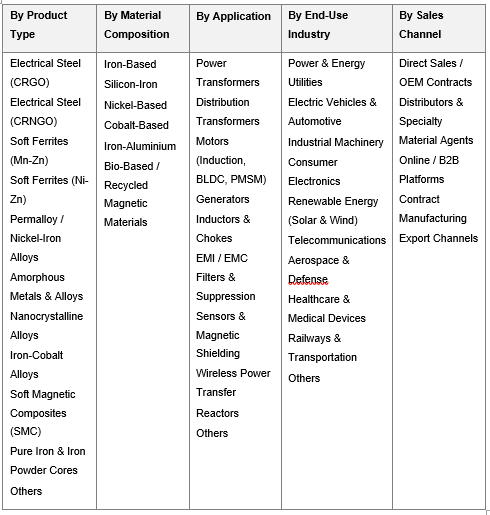
In this report, the India Soft Magnetic Materials Market has been segmented into the following categories, in addition to detailed analysis of key industry trends, market dynamics, competitive landscape, and growth opportunities across the forecast period:
- By Product Type
- Electrical Steel (CRGO)
- Electrical Steel (CRNGO)
- Soft Ferrites (Mn-Zn)
- Soft Ferrites (Ni-Zn)
- Permalloy / Nickel-Iron Alloys
- Amorphous Metals & Alloys
- Nanocrystalline Alloys
- Iron-Cobalt Alloys
- Soft Magnetic Composites (SMC)
- Pure Iron & Iron Powder Cores
- Others
- By Material Composition
- Iron-Based
- Silicon-Iron
- Nickel-Based
- Cobalt-Based
- Iron-Aluminium
- Bio-Based / Recycled Magnetic Materials
- By Form
- Sheet & Strip
- Lamination
- Powder
- Ribbon
- Toroid / Core
- Block / Bar
- Others
- By Frequency Range
- Low Frequency (Below 1 kHz)
- Medium Frequency (1 to 50 kHz)
- High Frequency (50 kHz to 1 MHz)
- Very High Frequency (Above 1 MHz)
- By Application
- Power Transformers
- Distribution Transformers
- Motors (Induction, BLDC, PMSM)
- Generators
- Inductors & Chokes
- EMI / EMC Filters & Suppression
- Sensors & Magnetic Shielding
- Wireless Power Transfer
- Reactors
- Others
- By End-Use Industry
- Power & Energy Utilities
- Electric Vehicles & Automotive
- Industrial Machinery
- Consumer Electronics
- Renewable Energy (Solar & Wind)
- Telecommunications
- Aerospace & Defense
- Healthcare & Medical Devices
- Railways & Transportation
- Others
- By Sales Channel
- Direct Sales / OEM Contracts
- Distributors & Specialty Material Agents
- Online / B2B Platforms
- Contract Manufacturing
- Export Channels
- By Geography
- North India
- South India
- West India
- East India
- Central India
Competitive Landscape
Company Profiles:
Detailed analysis of the leading companies operating in the India Soft Magnetic Materials Market, including business overview, product portfolio, strategic initiatives, competitive positioning, and recent developments.
Company Information
Detailed profiling and strategic analysis of additional market players (up to five companies), including emerging domestic soft magnetic material producers, specialty alloy and ferrite chemistry specialists, global entrants, or niche segment leaders.
For a free sample of the India Soft Magnetic Materials Market report, customised insights or delivery timelines, submit your query hereresearch@marketresearchoutlook.com
Table of Contents
- Research Framework
- Market Segmentation
- Research Objective
- Research Methodology
- Qualitative Research
- Primary Research
- Secondary Research
- Quantitative Research
- Market Breakdown & Data Triangulation
- Demand Side
- Supply Side
- Primary Research Respondents
- Assumption & Limitation
- Executive Summary
- Market Overview, 2021-2032
- By Product Type
- By Application
- By End-Use Industry
- By Form
- By Sales Channel
- By Region
- Analyst Recommendations
- Geopolitical Impact on India Soft Magnetic Materials Market
- India Soft Magnetic Materials Market Insights
- Market Dynamics
- Growth Drivers
- Rapid scale-up of India’s electric vehicle (EV) manufacturing under FAME II and PLI Auto schemes accelerating demand for high-efficiency soft magnetic materials in motors and powertrains.
- Massive expansion of power transmission and distribution infrastructure under PM Vidyut, Revamped Distribution Sector Scheme (RDSS), and grid modernisation driving CRGO, CRNGO and amorphous core consumption.
- Accelerated growth of renewable energy, electronics manufacturing, and industrial automation under PLI schemes structurally expanding demand for ferrites, nanocrystalline alloys, and soft magnetic composites.
- Restraints
- High import dependence for CRGO electrical steel, amorphous ribbons, and specialty ferrites creating supply security and forex risk.
- Volatility in raw material prices including silicon, nickel, cobalt, rare earths, and steel scrap linked to global commodity cycles pressuring producer margins.
- Tightening BIS, BEE energy efficiency, and environmental compliance standards raising compliance and capital expenditure costs.
- Opportunities
- Rapid scale-up of indigenous CRGO and CRNGO electrical steel capacity aligned with PLI Specialty Steel and Atmanirbhar Bharat mandates.
- High-growth demand from EV motors, traction inverters, fast-charging infrastructure, and renewable energy inverters supporting premium soft magnetic material consumption.
- Emerging export opportunity for specialty soft magnetic components to Middle East, Southeast Asia, and Africa with growing electrification and grid investments.
- Challenges
- Intense price-led competition between global majors from Japan, South Korea, China, and Europe and domestic producers compressing margins on commodity grades.
- Shortage of skilled metallurgists, electrical steel rolling experts, and ferrite formulation engineers limiting capacity scale-up speed.
- Fragmented downstream OEM customer base with diverse motor, transformer, and electronics specifications increasing inventory and customisation complexity.
- Technological Advancements
- Recent Technological Advancements
- Prior to 2020
- Porter’s Five Forces Analysis
- PESTLE Analysis
- Growth Drivers
- Industry Value Chain & Entry Points
- Upstream Raw Materials (iron ore, silicon, nickel, cobalt, rare earths, steel scrap, alumina)
- Primary Steel & Alloy Producers (CRGO, CRNGO, silicon-iron, nickel-iron alloys)
- Specialty Material Producers (soft ferrites, amorphous ribbons, nanocrystalline foils, SMC powders)
- Rolling, Annealing & Lamination Operations (cold rolling, decarburisation, slitting, stamping)
- Quality Control, R&D & Application Laboratories (BIS, IEC, BEE, ASTM, JIS standards)
- Distributors, Specialty Material Agents & B2B Marketplaces
- Downstream Component Manufacturers (transformer cores, motor laminations, inductor cores, EMI filters)
- OEMs & System Integrators (auto OEMs, transformer makers, electronics, industrial machinery)
- Aftermarket & Repair Channels (transformer rewinding, motor service, retrofits)
- End-Use Industries (power utilities, EVs, electronics, renewables, defense, railways, healthcare)
- India Soft Magnetic Materials Market: Regulatory Framework
- India Soft Magnetic Materials Market Overview
- Market Size & Forecast, 2021-2032
- By Value (USD Million)
- By Volume (‘000 Tons)
- Market Share & Forecast
- By Product Type
- Electrical Steel (CRGO)
- Electrical Steel (CRNGO)
- Soft Ferrites (Mn-Zn)
- Soft Ferrites (Ni-Zn)
- Permalloy / Nickel-Iron Alloys
- Amorphous Metals & Alloys
- Nanocrystalline Alloys
- Iron-Cobalt Alloys
- Soft Magnetic Composites (SMC)
- Pure Iron & Iron Powder Cores
- Others
- By Material Composition
- Iron-Based
- Silicon-Iron
- Nickel-Based
- Cobalt-Based
- Iron-Aluminium
- Bio-Based / Recycled Magnetic Materials
- By Form
- Sheet & Strip
- Lamination
- Powder
- Ribbon
- Toroid / Core
- Block / Bar
- Others
- By Frequency Range
- Low Frequency (Below 1 kHz)
- Medium Frequency (1 to 50 kHz)
- High Frequency (50 kHz to 1 MHz)
- Very High Frequency (Above 1 MHz)
- By Application
- Power Transformers
- Distribution Transformers
- Motors (Induction, BLDC, PMSM)
- Generators
- Inductors & Chokes
- EMI / EMC Filters & Suppression
- Sensors & Magnetic Shielding
- Wireless Power Transfer
- Reactors
- Others
- By End-Use Industry
- Power & Energy Utilities
- Electric Vehicles & Automotive
- Industrial Machinery
- Consumer Electronics
- Renewable Energy (Solar & Wind)
- Telecommunications
- Aerospace & Defense
- Healthcare & Medical Devices
- Railways & Transportation
- Others
- By Sales Channel
- Direct Sales / OEM Contracts
- Distributors & Specialty Material Agents
- Online / B2B Platforms
- Contract Manufacturing
- Export Channels
- By Geography
- North India
- South India
- West India
- East India
- Central India
- Competitive Landscape
- India Soft Magnetic Materials Market Company Market Share Analysis, 2025
- Competitive Benchmarking, By Operating Parameters
- Key Strategic Development (Mergers, Acquisitions, Partnerships, Etc.)
- List of Emerging Players
- Company Profile
- Tata Steel Limited
- Introduction & Company Profile
- Product Benchmarking
- Strategic Outlook
- Key Competitors
- Financial Analysis
- Swot Analysis
- Tata Steel Limited
- Market Size & Forecast, 2021-2032
- Market Dynamics
(Same Data Pointers Will Be Provided for the Below Companies):
- JSW Steel Limited
- ArcelorMittal Nippon Steel India Limited
- POSCO Maharashtra Steel Pvt. Ltd.
- Cosmo Ferrites Limited
- Hitachi Metals India Pvt. Ltd. (Proterial)
- Vacuumschmelze India Pvt. Ltd.
- TDK India Pvt. Ltd.
- Sundram Fasteners Limited
- Mishra Dhatu Nigam Limited (MIDHANI)
- JFE Steel India Pvt. Ltd.
- Magnequench India Pvt. Ltd.
- Other Prominent Players
* Financial information in case of non-listed companies will be provided as per availability.
** The segmentation and the companies are subjected to modifications based on in-depth secondary research for the final deliverable.
Frequently Asked Questions
1. How large is the India soft magnetic materials market and what is its growth forecast?
Ans: The India soft magnetic materials market size is valued at USD 1.92 billion in 2025 and is projected to reach USD 4.18 billion by 2032, growing at a CAGR of around 11.7%. This growth is driven by EV expansion, grid modernisation, renewable energy, and electronics manufacturing under PLI schemes, along with rising domestic and global capacity investments. The report delivers detailed market sizing, forecasts, and segment-level analysis to support strategic planning.
2. Which segments are driving demand in the India soft magnetic materials market?
Ans: Power and distribution transformers lead with 45% to 48% share, followed by motors at 28% to 32%, and inductors, chokes, and EMI filters at 10% to 13%. By product type, electrical steel including CRGO and CRNGO holds 55% to 58% share, while soft ferrites and nanocrystalline alloys are the fastest-growing segments at 14% to 18% annually. The report provides granular segmentation across applications, materials, and end-use industries.
3. What are the key drivers of growth in the India soft magnetic materials market?
Ans: Key drivers include EV manufacturing growth under FAME II and PLI Auto, grid expansion under RDSS, and increasing demand from renewable energy, electronics, and industrial automation. Global players such as Proterial, Vacuumschmelze, TDK, JFE Steel, and POSCO are strengthening India presence through manufacturing and technology investments.
4. Which regions are driving growth in the India soft magnetic materials market?
Ans: West and South India account for 60% to 64% of demand, supported by strong automotive, electronics, and industrial clusters. North India contributes 18% to 22% with expanding transformer and EV component ecosystems, while East and Central India account for 16% to 20%, driven by steel production and industrial manufacturing. The report offers detailed regional and state-level insights.
5. What are the latest trends in the India soft magnetic materials market?
Ans: Key trends include indigenisation of CRGO and CRNGO under PLI Specialty Steel, expansion in ferrites, amorphous, and nanocrystalline materials, and rising demand from EVs, renewable inverters, and high-frequency electronics. Innovations such as low-loss laminations, amorphous transformer cores, and nanocrystalline materials are reshaping competition and driving performance-led adoption across the India soft magnetic materials market.