

India Natural Cosmetics Market Size, Share & Forecast 2032
- Beauty & Personal Care, Consumer Goods & Retail
- Apr 2026
- Pages 180
- Report Format: pdf
- Report Price: $2400 USD
India’s natural cosmetics market is witnessing strong growth, driven by rising consumer preference for Ayurvedic, herbal, and plant-based beauty products, accelerated expansion of D2C natural beauty brands, increasing adoption of clean beauty and cruelty-free formulations, rapid digital influence and quick commerce penetration, growing demand for certified organic and vegan cosmetics, and rising FMCG as well as global beauty house investments in India-specific natural and Ayurvedic product innovation.
Report Description
| Study Duration | 2021-2032 |
| Market Size (2025) | USD 2.15 Billion |
| CAGR (2026-2032) | 15.4% |
| Leading Segment | Skincare |
| Fastest Growing Segment | Natural Haircare |
| Market Size (2032) | USD 5.88 Billion |
Source:
Market Overview — India Natural Cosmetics Market
India’s natural cosmetics market is expanding at a strong pace, reflecting a clear shift in how consumers approach beauty and personal care. Demand is increasingly moving toward Ayurvedic, herbal, and plant-based products, supported by the rapid rise of digital-first D2C brands and the growing influence of e-commerce and quick commerce on buying behaviour. The market is valued at USD 2.15 billion in 2025 and is expected to reach USD 5.88 billion by 2032, growing at a CAGR of 15.4 percent. This growth is closely linked to rising preference for clean-label, cruelty-free, and certified organic products across skincare, haircare, and colour cosmetics.
Related research: India Beauty and Personal Care Products Market, India Bath & Shower Products Market and India Organic Personal Care Products Market.
Younger consumers, particularly Gen Z and millennials, are playing a key role in this shift, with a strong focus on ingredient transparency, Ayurvedic formulations, and long-term skin and hair health. Categories such as natural skincare and herbal haircare continue to lead demand, supported by increasing awareness of product safety and efficacy. At the same time, digital platforms are shaping purchase journeys, influencing more than 70 percent of buying decisions, while enabling faster product discovery and repeat purchases.
Tier I and Tier II cities remain the core demand centres, backed by rising disposable incomes and deeper digital penetration. However, growth is also beginning to extend into emerging urban markets as access improves and awareness spreads. With global beauty companies, FMCG players, and new-age D2C brands all competing for share, the market is becoming more competitive and innovation-driven. Brands that can balance product authenticity, credible claims, and efficient distribution are expected to capture the next phase of growth in India’s natural cosmetics market.
Key Report Takeaways — India Natural Cosmetics Market
- The India natural cosmetics market is projected to grow from USD 2.15 billion in 2025 to USD 5.88 billion by 2032, registering a CAGR of 15.4 percent. This growth is driven by rising demand for Ayurvedic beauty products, increasing preference for clean-label formulations, and the rapid expansion of D2C natural beauty brands across urban markets.
- The rapid expansion of digital-first D2C natural beauty brands is reshaping the competitive landscape, with ingredient-led and Ayurveda-focused brands gaining share from traditional FMCG players, particularly in Tier I and Tier II cities.
- Increasing demand for Ayurvedic, herbal, and plant-based cosmetic formulations is creating strong growth opportunities for domestic brands, especially across skincare, haircare, and colour cosmetics tailored to Indian skin and hair needs.
- Quick commerce platforms and online marketplaces are emerging as key growth channels, influencing over 70 percent of purchase decisions for natural beauty products. These platforms are accelerating product discovery, repeat purchases, and faster adoption cycles.
- Rising investments by global beauty companies such as L’Oréal, Unilever, Estée Lauder, and Shiseido in India-focused natural product innovation, along with FMCG acquisitions of D2C brands, are strengthening long-term growth prospects for the India natural cosmetics market through 2032.
Market Source:
Key Market Drivers — India Natural Cosmetics Market
Rising Consumer Preference for Ayurvedic, Herbal, and Plant-Based Beauty Products in India
Growth in the India natural cosmetics market is being driven by a sustained shift toward Ayurvedic, herbal, and plant-based beauty products, which are expanding at 17–20 percent annually—nearly twice the pace of conventional cosmetics. More than 65 percent of urban Indian consumers now actively look for natural or Ayurvedic claims on product labels, reflecting a strong preference for ingredient familiarity and perceived safety. Traditional botanicals such as neem, tulsi, turmeric, aloe vera, sandalwood, amla, and shikakai are increasingly being incorporated across skincare, haircare, and colour cosmetic formulations. This shift is further reinforced by rising awareness of sulphate-free, paraben-free, and cruelty-free products, prompting brands to realign R&D strategies and maintain premium pricing across the natural cosmetics segment.
Rapid Expansion of D2C Natural Beauty Brands and Digital-First Go-to-Market Strategies
The expansion of digital-first D2C natural beauty brands is acting as a key growth catalyst, with online platforms influencing over 70 percent of purchase decisions in the natural cosmetics category. These brands rely on social media, influencer-led engagement, Ayurveda-backed positioning, and dermatologist endorsements to build trust and accelerate adoption. Compared to traditional FMCG players, D2C brands operate with significantly shorter product development cycles—typically 6 to 9 months versus 18 to 24 months—allowing them to respond quickly to changing consumer preferences. At the same time, e-commerce and quick commerce platforms are growing at 28–32 percent annually, with delivery windows of 10–30 minutes in major cities. This digital-first ecosystem is redefining go-to-market strategies and supporting sustained growth across the India natural cosmetics market.
FMCG Acquisitions and Global Beauty House Investments in India-Specific Natural Brands
Large FMCG companies and global beauty players are increasing their investments in India’s natural cosmetics segment, signalling long-term confidence in market potential. Total deal activity and investments in Ayurvedic and natural beauty have exceeded USD 1.2 billion between 2023 and 2025, with participation from Hindustan Unilever, Marico, Emami, ITC, and global brands such as L’Oréal and Shiseido. Strategic initiatives—including Marico’s expansion of Just Herbs and Plix, ITC’s Fiama and Engage natural product extensions, HUL’s scaling of Lever Ayush and Love Beauty and Planet, and Colgate-Palmolive’s Naturals range—are strengthening product visibility and distribution reach. At the same time, domestic brands such as Forest Essentials, Biotique, Kama Ayurveda, Mamaearth, and Plum are raising capital and expanding manufacturing capacity, reinforcing long-term growth prospects for the India natural cosmetics market through 2032.
Key Market Challenges — India Natural Cosmetics Market
Greenwashing Concerns and Consumer Skepticism Around Natural and Ayurvedic Product Claims
The India natural cosmetics market is facing rising consumer skepticism around greenwashing, with over 55 percent of urban consumers reporting difficulty in verifying the authenticity of “natural”, “organic”, or “Ayurvedic” claims on product packaging. The absence of standardised definitions and credible third-party validation, combined with marketing-led terms such as “naturally derived” and “Ayurveda-inspired”, has led to increasing label fatigue. Social media scrutiny, influencer-led reviews, and viral ingredient awareness are further widening this trust gap. In response, leading brands are investing in certifications such as Ecocert, COSMOS Organic, India Organic, and PETA cruelty-free labels. While this increases compliance costs, it is gradually strengthening consumer trust and improving brand credibility.
Regulatory Complexity and Ingredient Standardisation Across Natural and Ayurvedic Cosmetics
Regulatory complexity remains a key challenge, with CDSCO, BIS, and the Ministry of AYUSH continuously updating ingredient approvals, labelling norms, and claim validation requirements. Natural and Ayurvedic cosmetic products require additional documentation under the Drugs and Cosmetics Act, AYUSH guidelines, and BIS IS 4707 safety standards, increasing compliance costs by 10–15 percent. Export-oriented brands face further hurdles due to regulations such as EU Cosmetic Regulation (EC 1223/2009), US FDA requirements, and GCC standards, often extending approval timelines by 8–14 months. Smaller brands, in particular, struggle with documentation and testing infrastructure, while larger players benefit from scale and regulatory expertise.
Raw Material Volatility and Supply Chain Fragmentation for Natural Botanical Ingredients
The market remains highly sensitive to fluctuations in agri-based raw materials such as sandalwood, saffron, rose, lavender, argan oil, and essential oils. Price volatility of 30–50 percent within a single year is not uncommon, driven by monsoon variability, pest outbreaks, export demand, and geopolitical factors. In addition, fragmented supply chains, inconsistent quality standards, limited traceability, and low levels of organic certification at the farm level create procurement challenges. This is prompting companies to invest in contract farming, backward integration, and traceability solutions, including blockchain-based sourcing models. While these initiatives improve long-term stability, they continue to create short-term margin pressure.
Key Market Trends — India Natural Cosmetics Market
Rapid Shift Toward Clean Beauty, Cruelty-Free, and Certified Organic Products
The India natural cosmetics market is witnessing a strong shift toward clean beauty and certified formulations, with clean-label products growing at 18–22 percent annually—significantly faster than conventional cosmetics. Consumer demand for “free-from” formulations excluding sulphates, parabens, silicones, mineral oils, and synthetic fragrances is reshaping product development strategies. Certifications such as PETA cruelty-free, Ecocert, COSMOS Organic, and India Organic are becoming key purchase drivers. In 2025, brands such as Forest Essentials, Kama Ayurveda, Plum, Juicy Chemistry, and Disguise Cosmetics expanded their clean and certified product portfolios, reinforcing this transition.
Resurgence of Ayurvedic Heritage and Modern Ayurveda-Led Innovation
Ayurvedic heritage brands and modern Ayurveda-led companies are gaining renewed traction, with Ayurvedic product SKUs growing at 16–19 percent annually across skincare, haircare, and colour cosmetics. Established players such as Forest Essentials, Kama Ayurveda, Biotique, Shahnaz Husain, and Himalaya continue to maintain strong market presence, while newer brands such as Just Herbs, Kapiva, Ras Luxury Oils, and Soultree are attracting younger consumers through modern formulations. Traditional botanicals including ubtan, kumkumadi, bhringraj, brahmi, and rose attar are increasingly being incorporated into premium products. In 2025, initiatives such as Marico-backed Just Herbs expansion, Emami’s product innovations, and collaborations by global brands with Ayurveda-led players have strengthened this trend.
Digital Channels and Quick Commerce Reshaping Distribution
Digital channels are fundamentally transforming distribution, with e-commerce, D2C platforms, and quick commerce influencing over 70 percent of purchase decisions. Quick commerce platforms such as Blinkit, Zepto, and Swiggy Instamart are growing at 28–32 percent annually, enabling 10–30 minute delivery and driving impulse purchases. This shift is leading to faster product cycles, increased SKU launches, and stronger omnichannel integration. In 2025, platforms including Nykaa, Amazon India, Myntra Beauty, and Purplle significantly expanded their natural cosmetics portfolios, accelerating digital-led growth.
Segmental Insights — India Natural Cosmetics Market
By Product Type — Skincare Dominates the Market
The skincare segment holds the largest share, accounting for approximately 48–52 percent of total demand. Growth is driven by rising adoption of Ayurvedic creams, serums, herbal oils, and botanical cleansers. Consumers are increasingly following structured skincare routines, with products such as vitamin C serums, kumkumadi oils, ubtan face packs, and herbal sunscreens gaining traction. Premium natural skincare products are typically priced 2–3 times higher than conventional alternatives, supported by ingredient quality, brand positioning, and certification credibility. In 2025, brands such as Forest Essentials, Kama Ayurveda, Plum, Mamaearth, and Juicy Chemistry expanded their advanced skincare portfolios, reinforcing segment leadership.
By Sales Channel — Online Channels Lead Distribution
Online channels account for over 62 percent of total sales, driven by rapid expansion of e-commerce, D2C platforms, and quick commerce. Digital platforms influence more than 70 percent of purchase decisions, making them central to product discovery and conversion. Quick commerce is emerging as a high-growth segment, expanding at 28–32 percent annually, with platforms offering near-instant delivery in major cities. In 2025, Nykaa, Amazon India, Myntra Beauty, and Purplle significantly expanded their natural and Ayurvedic product offerings, further strengthening online dominance.
Regional Insights — India Natural Cosmetics Market
Regional analysis shows that Tier I cities—including Delhi NCR, Mumbai, Bengaluru, Hyderabad, and Pune—account for approximately 58–62 percent of total market revenue, supported by higher disposable income, stronger brand awareness, and greater adoption of natural beauty products. However, the next phase of growth is increasingly shifting toward Tier II cities, which contribute 38–42 percent of incremental demand. This growth is supported by rising income levels growing at 10–12 percent annually and internet penetration exceeding 55 percent. Cities such as Jaipur, Ahmedabad, Lucknow, Chandigarh, Kochi, and Coimbatore are emerging as key growth centres.
In 2025, both domestic and global brands—including Forest Essentials, Kama Ayurveda, Plum, Mamaearth, L’Oréal, and Shiseido—expanded their omnichannel presence in these regions through offline retail and quick commerce partnerships. This geographic expansion is expected to play a critical role in driving future market growth and shaping long-term consumption patterns across India’s natural cosmetics sector.
Recent Developments — India Natural Cosmetics Market
The India natural cosmetics market has seen strong momentum in Ayurvedic and clean beauty innovation during 2024 and 2025. Leading D2C brands such as Mamaearth, Plum, Juicy Chemistry, and The Moms Co have introduced advanced skincare and haircare ranges featuring ingredients like bakuchiol, kumkumadi, and certified organic botanicals. Established Ayurveda-led brands including Forest Essentials, Kama Ayurveda, and Biotique have expanded their premium portfolios, while FMCG players such as HUL, Marico, and Emami have launched new natural product lines aimed at mass-premium consumers.
- The rapid growth of online channels and quick commerce platforms has significantly improved accessibility and reshaped purchasing behaviour. In 2025, platforms such as Nykaa strengthened their natural and Ayurvedic beauty offerings through exclusive brand partnerships and expanded product ranges. At the same time, quick commerce players including Blinkit and Zepto scaled their natural cosmetics portfolios, offering delivery within 10–30 minutes across major cities. As a result, digital channels now influence over 70 percent of natural cosmetics purchase decisions in India.
- The market is also witnessing accelerated omnichannel and offline retail expansion, particularly beyond metro cities. In 2025, brands such as Forest Essentials, Kama Ayurveda, Plum, and Mamaearth expanded their physical presence into Tier II cities including Jaipur, Ahmedabad, Lucknow, Chandigarh, and Kochi. Global beauty companies such as L’Oréal, Shiseido, and Estée Lauder have continued to strengthen their India strategy through retail expansion, Ayurveda-led collaborations, and premium product launches, supporting long-term growth across the India natural cosmetics market.
Key Market Players — India Natural Cosmetics Market
- Forest Essentials (Mobikwik Emami Ltd.)
- Kama Ayurveda (L’Oréal-backed)
- Mamaearth (Honasa Consumer Ltd.)
- Plum Goodness (Pureplay Skin Sciences)
- Biotique (Bio Veda Action Research)
- Himalaya Wellness Company
- Hindustan Unilever Limited (Lever Ayush, Love Beauty and Planet)
- Dabur India Ltd. (Vatika, Dabur Herbal)
- Emami Limited (Kesh King, 7 Oils in One)
- Marico Limited (Just Herbs, Parachute Advansed Ayurvedic)
- Just Herbs (Marico-backed)
- Juicy Chemistry
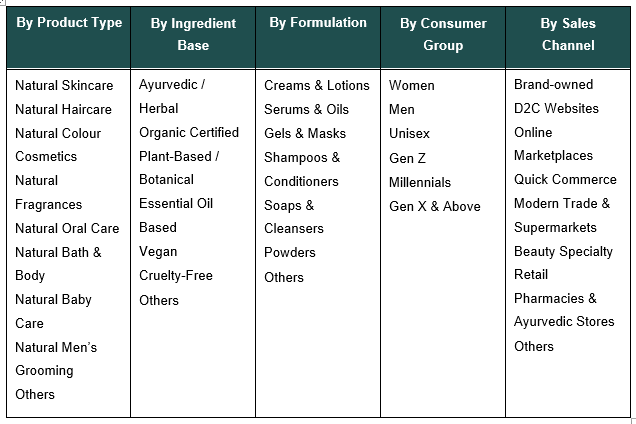
Report Scope
In this report, the India Natural Cosmetics Market has been segmented into the following categories, in addition to detailed analysis of key industry trends, market dynamics, competitive landscape, and growth opportunities across the forecast period:
- By Product Type
- Natural Skincare
- Natural Haircare
- Natural Colour Cosmetics
- Natural Fragrances
- Natural Oral Care
- Natural Bath & Body
- Natural Baby Care
- Natural Men’s Grooming
- Others
- By Ingredient Base
- Ayurvedic / Herbal
- Organic Certified
- Plant-Based / Botanical
- Essential Oil Based
- Vegan
- Cruelty-Free
- Others
- By Formulation
- Creams & Lotions
- Serums & Oils
- Gels & Masks
- Shampoos & Conditioners
- Soaps & Cleansers
- Powders
- Others
- By Price Tier
- Mass Natural
- Mid-Premium Natural
- Prestige & Luxury Natural
- By Consumer Group
- Women
- Men
- Unisex
- Gen Z
- Millennials
- Gen X & Above
- By Sales Channel
- Brand-owned D2C Websites
- Online Marketplaces
- Quick Commerce
- Modern Trade & Supermarkets
- Beauty Specialty Retail
- Pharmacies & Ayurvedic Stores
- Others
- By Geography
- North India
- South India
- West India
- East India
- Central India
Competitive Landscape
Company Profiles:
Detailed analysis of the leading companies operating in the India Natural Cosmetics Market, including business overview, product portfolio, strategic initiatives, competitive positioning, and recent developments.
Company Information
Detailed profiling and strategic analysis of additional market players (up to five companies), including emerging D2C natural beauty brands, global entrants, or niche segment leaders.
For a free sample of the India Natural Cosmetics Market report, customised insights or delivery timelines, submit your query hereresearch@marketresearchoutlook.com
Table of Contents
- Research Framework
- Market Segmentation
- Research Objective
- Research Methodology
- Qualitative Research
- Primary Research
- Secondary Research
- Quantitative Research
- Market Breakdown & Data Triangulation
- Demand Side
- Supply Side
- Primary Research Respondents
- Assumption & Limitation
- Executive Summary
- Market Overview, 2021–2032
- By Product Type
- By Ingredient Base
- By Formulation
- By Price Tier
- By Consumer Group
- By Distribution Channel
- Analyst Recommendations
- Market Overview, 2021–2032
- Geopolitical Impact on India Natural Cosmetics Market
- India Natural Cosmetics Market Insights
- Market Dynamics
- Growth Drivers
- Rising consumer preference for Ayurvedic, herbal, and plant-based beauty products driving core natural cosmetics demand.
- Rapid expansion of D2C natural beauty brands leveraging digital-first go-to-market strategies.
- FMCG acquisitions and global beauty house investments in India-specific natural and Ayurvedic brands.
- Restraints
- Greenwashing concerns and consumer skepticism around natural, organic, and Ayurvedic product claims.
- Regulatory complexity around natural ingredient standardisation, AYUSH compliance, and BIS certifications.
- Volatile raw material prices and fragmented supply chains for natural botanical and essential oil inputs.
- Opportunities
- Growing men’s natural grooming segment presenting an underpenetrated high-growth opportunity.
- Rising export opportunities for Indian Ayurvedic and herbal cosmetics to US, UK, Middle East, and ASEAN markets.
- Strategic partnerships between D2C natural beauty brands and FMCG majors accelerating omnichannel distribution.
- Challenges
- Intense competition from global luxury natural brands, homegrown D2C players, and FMCG mass natural lines compressing margins.
- Supply chain complexities for certified organic botanicals and premium essential oils limiting scale-up speed.
- Rising customer acquisition costs on digital platforms reducing D2C natural beauty brand margins.
- Technological Advancements
- Recent Technological Advancements
- Prior to 2020
- Porter’s Five Forces Analysis
- PESTLE Analysis
- Market Dynamics
- Industry Value Chain & Entry Points
- Botanical & Agri-Raw Material Suppliers (herbs, essential oils, botanical extracts)
- Organic & Ayurvedic Ingredient Processors (oleoresin, cold-pressed oils, standardized extracts)
- Contract Manufacturers & Formulators (natural CMO/CDMOs)
- Quality Control, Safety Testing & Certification (AYUSH, BIS, Ecocert, COSMOS, PETA, India Organic)
- Sustainable Packaging & Eco-friendly Material Suppliers
- Brand Owners (D2C, FMCG, heritage Ayurveda, global naturals, luxury segments)
- Digital Platforms, Marketplaces & Quick Commerce (D2C websites, Nykaa, Amazon, Blinkit, Zepto)
- Offline Retail (beauty specialty stores, Ayurvedic pharmacies, modern trade, heritage outlets)
- End Consumers (women, men, Gen Z, millennials, HNI, Ayurveda-conscious segment)
- After-sales Support, Loyalty Programs & Consumer Education
- India Natural Cosmetics Market: Regulatory Framework
- India Natural Cosmetics Market Overview
- Market Size & Forecast, 2021-2032
- By Value (USD Million)
- Market Share & Forecast
- By Product Type
- Natural Skincare
- Natural Haircare
- Natural Colour Cosmetics
- Natural Fragrances
- Natural Oral Care
- Natural Bath & Body
- Natural Baby Care
- Natural Men’s Grooming
- Others
- By Ingredient Base
- Ayurvedic / Herbal
- Organic Certified
- Plant-Based / Botanical
- Essential Oil Based
- Vegan
- Cruelty-Free
- Others
- By Formulation
- Creams & Lotions
- Serums & Oils
- Gels & Masks
- Shampoos & Conditioners
- Soaps & Cleansers
- Powders
- Others
- By Price Tier
- Mass Natural
- Mid-Premium Natural
- Prestige & Luxury Natural
- By Consumer Group
- Women
- Men
- Unisex
- Gen Z
- Millennials
- Gen X & Above
- By Sales Channel
- Brand-owned D2C Websites
- Online Marketplaces
- Quick Commerce
- Modern Trade & Supermarkets
- Beauty Specialty Retail
- Pharmacies & Ayurvedic Stores
- Others
- By Geography
- North India
- South India
- West India
- East India
- Central India
- Market Size & Forecast, 2021-2032
- Competitive Landscape
- India Natural Cosmetics Company Market Share Analysis, 2025
- Competitive Benchmarking, By Operating Parameters
- Key Strategic Development (Mergers, Acquisitions, Partnerships, Etc.)
- List of Emerging Players
- Company Profile
- Forest Essentials (Mobikwik Emami Ltd.)
- Introduction & Company Profile
- Product Benchmarking
- Strategic Outlook
- Key Competitors
- Financial Analysis
- SWOT Analysis
- Forest Essentials (Mobikwik Emami Ltd.)
*(Same Data Pointers Will Be Provided for The Below Companies)
- Kama Ayurveda (L’Oréal-backed)
- Mamaearth (Honasa Consumer Ltd.)
- Plum Goodness (Pureplay Skin Sciences)
- Biotique (Bio Veda Action Research)
- Himalaya Wellness Company
- Hindustan Unilever Limited (Lever Ayush, Love Beauty and Planet)
- Dabur India Ltd. (Vatika, Dabur Herbal)
- Emami Limited (Kesh King, 7 Oils in One)
- Marico Limited (Just Herbs, Parachute Advansed Ayurvedic)
- Just Herbs (Marico-backed)
- Juicy Chemistry
- Other Prominent Players
* Financial information in case of non-listed companies will be provided as per availability
** The segmentation and the companies are subjected to modifications based on in-depth secondary for the final deliverable
Frequently Asked Questions
1. How large is the India natural cosmetics market and what is its growth forecast?
Ans: The India natural cosmetics market size is valued at USD 2.15 billion in 2025 and is projected to reach USD 5.88 billion by 2032, growing at a CAGR of around 15.4 percent. This strong India natural cosmetics market growth is driven by rising demand for Ayurvedic and herbal beauty products, accelerated D2C natural beauty brand expansion, and deeper consumer preference for clean-label and cruelty-free formulations. The report provides detailed market sizing, forecast modelling, and segment-wise growth analysis to help businesses identify high-opportunity areas and plan long-term strategies across the India natural cosmetics market.
2. Which segments are driving demand in the India natural cosmetics market?
Ans: The India natural cosmetics market segmentation shows that skincare dominates with approximately 48 to 52 percent market share, including Ayurvedic creams, natural serums, herbal face oils, and botanical cleansers. Natural haircare is the fastest-growing product segment, expanding at 17 to 20 percent annually, led by Ayurvedic shampoos, bhringraj oils, and herbal conditioners. The report breaks down demand across product types, ingredient bases, formulations, price tiers, and sales channels, helping businesses understand where growth is accelerating across the India natural cosmetics market.
3. What are the key drivers of growth in the India natural cosmetics market?
Ans: Key India natural cosmetics market drivers include rising consumer preference for Ayurvedic, herbal, and plant-based products, rapid expansion of D2C natural beauty brands leveraging digital-first go-to-market strategies, and FMCG acquisitions alongside global beauty house investments in India-specific natural product innovation. Digital platforms and quick commerce influence over 70 percent of natural cosmetic purchase decisions, while rising income levels in Tier II cities are expanding the addressable base. The report provides in-depth analysis of growth drivers, supported by data-backed insights and real market trends shaping the India natural cosmetics market.
4. Which regions are driving growth in the India natural cosmetics market?
Ans: Regional analysis of the India natural cosmetics market shows that Tier I cities account for nearly 58 to 62 percent of total demand, driven by higher income levels and stronger natural beauty brand awareness. Tier II cities contribute around 38 to 42 percent of incremental growth, supported by rising internet penetration above 55 percent and expanding premium retail presence. Cities such as Jaipur, Ahmedabad, Lucknow, Chandigarh, Kochi, and Coimbatore are emerging as high-growth hubs for natural beauty adoption. The report offers city-level and regional insights, helping businesses identify high-growth markets and optimise expansion strategies.
5. What are the latest trends in the India natural cosmetics market?
Ans: The latest India natural cosmetics market trends include rapid adoption of clean beauty, cruelty-free, and certified organic formulations, the resurgence of Ayurvedic heritage brands and modern Ayurveda-led innovation, and rapid growth of D2C natural beauty brands and quick commerce channels in India. Digital platforms now influence over 70 percent of natural beauty purchase decisions, while consumers are increasingly investing in Ayurvedic skincare, herbal haircare, and plant-based colour cosmetics. The report provides detailed insights into emerging trends, innovation pipelines, and future demand shifts, helping businesses stay ahead of competition and capture new growth opportunities in the India natural cosmetics market.