

India Air Purifier Market, By Filter Type (HEPA, Activated Carbon, Ionic Filters, Electrostatic Precipitators, UV Filters, Others); By Product Type (Portable/Room Air Purifiers, In-Duct Air Purifiers, Car Air Purifiers, Tower Air Purifiers, Others); By Coverage Area (Up to 250 sq. ft., 250–500 sq. ft., Above 500 sq. ft.); By End User (Residential, Commercial, Industrial); By Distribution Channel (Multi-Brand Stores, Exclusive Brand Outlets, Online Channels, Institutional Sales, Others); By Trend Analysis, Competitive Landscape & Forecast, 2021–2032
- Consumer Goods & Retail
- Apr 2026
- Pages 151
- Report Format: pdf
- Report Price: $1800 USD
India Air Purifier Market, Forecasts 2032
Report Description
| Study Duration | 2021-2032 |
| Market Size (2025) | USD 65 Million |
| CAGR (2026-2032) | 11% |
| Leading Segment | Residential |
| Fastest Growing Segment | Commercial |
| Market Size (2032) | USD 132 Million |
India Air Purifier Market Overview
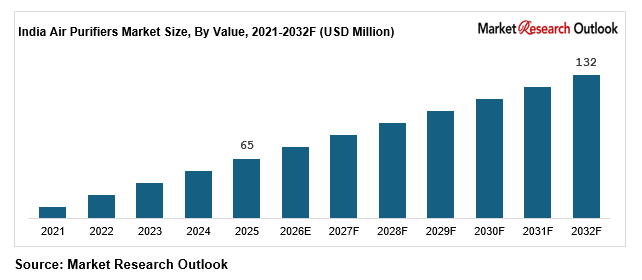
The India air purifier market is entering a high-opportunity growth phase, valued at USD 65 million in 2025 and projected to reach USD 132 million by 2032, growing at a CAGR of 11%. Despite this expansion, market penetration remains below 5% of urban households, highlighting a large untapped opportunity as awareness of indoor air quality in India continues to increase. Demand remains concentrated in high-pollution regions such as Delhi NCR, where AQI levels frequently exceed 300 to 500, driving seasonal sales spikes of 2x to 3x, although a gradual shift toward year-round usage is now emerging. Pricing between INR 8,000 and INR 20,000, within a broader range of INR 8,000 to 30,000, along with annual filter replacement costs of INR 2,000 to 6,000, continues to influence purchasing decisions, particularly in Tier II and Tier III cities. The report provides detailed insights into demand patterns, pricing dynamics, and city-level opportunities, helping businesses identify where real growth will come from and how to scale effectively in the India air purifier market.
Key Growth Drivers India Air Purifier Market
Rising Air Pollution Driving Demand
Air pollution remains the primary growth catalyst of the India air purifier market, with AQI levels in cities such as Delhi NCR frequently exceeding 300 to 500 during peak months, far above safe limits. This directly influences consumer behavior, with air purifier sales rising by 2x to 3x between October and January. What was once a seasonal purchase is now steadily becoming a year-round necessity, as prolonged exposure to poor air quality pushes households, offices, and healthcare facilities to adopt continuous air purification. This shift is strengthening long-term demand and expanding adoption across both residential and commercial segments. The report provides detailed insights into pollution-linked demand patterns, seasonal variations, and city-level opportunities.
Growing Health Awareness and Respiratory Concerns
Rising health awareness is strengthening demand in the India air purifier market, with nearly 30% of urban Indians experiencing respiratory conditions such as asthma, allergies, and breathing discomfort. This is accelerating the shift toward preventive healthcare solutions and increasing adoption of HEPA-based and multi-layer filtration systems capable of capturing fine particles such as PM2.5. Consumers are also showing a higher willingness to invest in certified and branded products, prioritising performance and reliability. The report provides a clear breakdown of consumer behavior, technology preferences, and product positioning strategies.
Urbanization and Expanding Middle-Class Demand
Urbanization and rising income levels are expanding the addressable market for air purifiers in India, with the urban population expected to exceed 40% by 2030. Demand is concentrated in the INR 8,000 to 20,000 price range, which represents the key segment for first-time buyers, while the growth of e-commerce platforms is improving accessibility across Tier I and Tier II cities. As awareness increases and pricing becomes more competitive, Tier II and Tier III cities are expected to drive the next phase of growth. The report delivers granular insights into regional demand, pricing sensitivity, and distribution dynamics.
Key Market Challenges India Air Purifier Market
High Product and Maintenance Costs Limiting Adoption
Affordability remains a major barrier in the India air purifier market, particularly for price sensitive consumers. Air purifiers are typically priced between INR 8,000 and INR 30,000, with annual filter replacement costs ranging from INR 2,000 to 6,000, significantly increasing the total cost of ownership. For many households in Tier II and Tier III cities, this represents a meaningful share of disposable income, limiting widespread adoption despite rising awareness. As a result, demand remains concentrated in upper middle and premium segments, with many consumers delaying purchases or opting for lower cost alternatives with limited effectiveness. The report provides detailed insights into price sensitivity, cost barriers, and strategies adopted by brands to improve affordability and expand market penetration.
Seasonal Demand Patterns Impacting Market Stability
The India air purifier market continues to experience strong seasonal demand, with sales increasing by 2x to 3x during peak pollution months between October and January, particularly in North India where AQI levels rise sharply. However, this surge is followed by a significant slowdown during the rest of the year, creating uneven revenue cycles for manufacturers and retailers. This seasonality creates challenges in inventory planning, production scheduling, and working capital management. While companies are gradually repositioning air purifiers as year round lifestyle and health products, adoption patterns still remain largely seasonal. The report analyzes demand fluctuations, regional variations, and strategies used by leading players to stabilize revenues and drive consistent year round growth.
Source: Market Research Outlook
Key Market Trends in the India Air Purifier Market
Smart and IoT Enabled Air Purifiers Becoming the New Standard
The India air purifier market is rapidly evolving toward smart and connected devices, with nearly 25% to 35% of new product launches featuring IoT capabilities such as real-time AQI monitoring, app-based controls, auto-adjust modes, and voice integration. This reflects changing consumer expectations, particularly in urban households adopting smart home ecosystems. Brands such as Dyson and Xiaomi are expanding connected product portfolios across both premium and mid-range segments. The report provides detailed insights into technology adoption trends, feature benchmarking, and pricing strategies.
Institutional Demand Emerging as a Stable Growth Engine
A key structural shift in the India air purifier market is the rise of institutional demand, with increasing adoption across hospitals, schools, offices, and hospitality spaces. Bulk procurement typically ranges from 50 to 500 units per facility, significantly increasing deal sizes and enabling long-term service contracts. This shift is reducing dependence on seasonal retail demand and creating more stable revenue streams. The report offers in-depth analysis of institutional demand patterns, procurement behavior, and high-value opportunity segments.
Shift Toward Affordable and Localized Product Innovation
Affordability and localization are emerging as critical factors shaping mass adoption, with most demand concentrated in the INR 8,000 to 20,000 price range, while the broader market extends up to INR 30,000. Manufacturers are designing products suited to Indian conditions, including higher dust levels and compact spaces. Companies are also expanding distribution across Tier II and Tier III cities to improve accessibility. The report provides detailed insights into pricing dynamics, product positioning, and regional expansion strategies.
Segmental Insights – India Air Purifier Market
By Product Type
HEPA air purifiers dominate the India air purifier market due to their proven ability to capture fine particulate matter such as PM2.5 and PM10, which are key pollutants across Indian cities. At the same time, hybrid air purifiers combining HEPA, activated carbon, and UV technologies are gaining traction in the mid to premium segment, with consumers willing to pay a 20% to 30% premium for enhanced filtration performance. The report provides detailed segmentation, product benchmarking, and pricing analysis across technologies.
By Application
The residential segment continues to account for the majority of demand, driven by rising pollution levels and increasing health awareness among urban households. However, the commercial segment is emerging as the fastest growing category, supported by increasing installations across offices, healthcare facilities, retail outlets, and hospitality spaces. Bulk procurement typically ranges from 20 to over 100 units per location, significantly increasing deal sizes. The report delivers detailed insights into segment wise demand, procurement trends, and growth opportunities across applications.
Regional Insights
North India leads the India air purifier market, with Delhi NCR accounting for a significant share due to consistently high AQI levels often exceeding 300 during peak periods. West India is witnessing steady growth driven by rising awareness and improving affordability, while South India remains relatively underpenetrated. At the same time, Tier II cities such as Lucknow, Jaipur, and Chandigarh are emerging as key growth centers, supported by increasing awareness, expanding middle class populations, and improved distribution access. The report provides a detailed regional and city level analysis to identify high growth markets and expansion opportunities.
Recent Developments in the India Air Purifier Market
- March 2026, Dyson introduced upgraded smart air purifiers in India with real time AQI monitoring and automatic adjustment features, positioned above INR 40,000 for premium urban consumers, highlighting rising demand for connected and high performance air purification systems, with the report analyzing premium segment trends and product innovation strategies
- January 2026, Xiaomi launched new smart air purifiers in the INR 10,000 to 15,000 range with app control and real time AQI display, targeting first time buyers and Tier II cities, reflecting the shift toward affordable smart solutions, with the report providing insights into pricing strategies and volume driven growth
- July 2025, Honeywell partnered with real estate developers to deploy air purifiers across office spaces with installations ranging from 50 to 200 units, indicating growing institutional demand and larger deal sizes, while supporting recurring revenue through service contracts, with the report covering institutional trends and long term revenue opportunities
Key Market Players
- Honeywell Automation India Limited
- Philips India Limited
- Dyson India Pvt. Ltd.
- Kent RO Systems Ltd.
- Xiaomi Technology India Pvt. Ltd.
- Blueair India
- Sharp India Limited
- Panasonic India Pvt. Ltd.
- Eureka Forbes Limited
- IQAir
- LG Electronics India Pvt. Ltd.
- Daikin Airconditioning India Pvt. Ltd.
Report Scope:
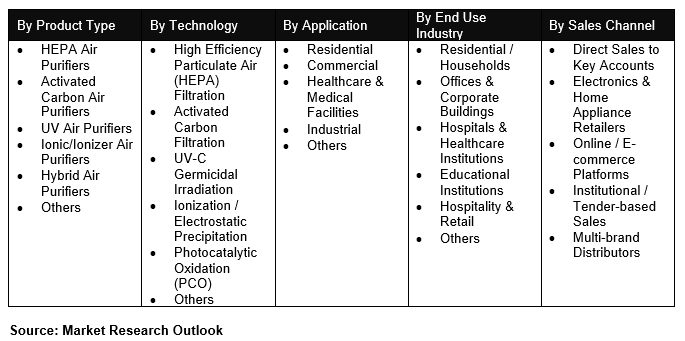
In this report, the India Air Purifier Market has been segmented into the following categories, in addition to the industry trends which have also been detailed below:
Segmentation
- By Product Type
- HEPA Air Purifiers
- Activated Carbon Air Purifiers
- UV Air Purifiers
- Ionic/Ionizer Air Purifiers
- Hybrid Air Purifiers
- Others
- By Technology
- High Efficiency Particulate Air (HEPA) Filtration
- Activated Carbon Filtration
- UV-C Germicidal Irradiation
- Ionization / Electrostatic Precipitation
- Photocatalytic Oxidation (PCO)
- Others
- By Application
- Residential
- Commercial
- Healthcare & Medical Facilities
- Industrial
- Others
- By End Use Industry
- Residential / Households
- Offices & Corporate Buildings
- Hospitals & Healthcare Institutions
- Educational Institutions
- Hospitality & Retail
- Others
- By Sales Channel
- Direct Sales to Key Accounts
- Electronics & Home Appliance Retailers
- Online / E-commerce Platforms
- Institutional / Tender-based Sales
- Multi-brand Distributors
Competitive Landscape
- Company Profiles: Detailed analysis of the major companies present in the India Air Purifier Market.
Available Customizations:
- India Air Purifier Market report with the given market data, Market Research Outlook (MRO) offers customizations according to a company’s specific needs. The following customization options are available for the report:
Company Information
- Detailed analysis and profiling of additional market players (up to five).
India Air Purifier Market is an upcoming report to be released soon. If you wish an early delivery of this report or want to confirm the date of release, please contact us at sarita@marketresearchoutlook.com
Table of contents
- Research Framework
- Market Segmentation
- Research Objective
- Research Methodology
- Qualitative Research
- Primary Research
- Secondary Research
- Quantitative Research
- Market Breakdown & Data Triangulation
- Demand Side
- Supply Side
- Primary Research Respondents
- Assumption & Limitation
- Qualitative Research
- Executive Summary
- Market Overview, 2021–2032
- By Product Type
- By Technology
- By Application
- By End Use Industry
- By Sales Channel
- Analyst Recommendations
- Market Overview, 2021–2032
- Geopolitical Impact on India Air Purifier Market
- India Air Purifier Market Insights
- Market Dynamics
- Growth Drivers
- Rising air pollution levels and deteriorating air quality index (AQI) across major Indian cities.
- Growing health awareness among consumers regarding respiratory diseases and airborne allergens.
- Increasing urbanization and expanding middle-class population driving residential demand.
- Restraints
- High product and filter replacement costs limiting affordability among lower-income segments.
- Lack of consumer awareness and product education in Tier-2 and Tier-3 cities.
- Inconsistent power supply and infrastructure challenges hindering adoption in rural areas.
- Opportunities
- Expansion of smart and IoT-enabled air purifiers offering remote monitoring and control features.
- Growing demand from healthcare facilities, schools, and commercial establishments post-COVID-19.
- Government initiatives and policies focused on improving indoor and outdoor air quality.
- Challenges
- Intense competition from low-cost local manufacturers affecting profitability of established brands.
- Seasonal fluctuation in demand concentrated around winter months and pollution peaks.
- Supply chain disruptions impacting availability of key components such as HEPA filters and motors.
- Technological Advancements
- Recent Technological Advancements
- Prior to 2020
- Porter’s Five Forces Analysis
- PESTLE Analysis
- Growth Drivers
- Market Dynamics
- Industry Value Chain & Entry Points
- Raw Material Suppliers (HEPA/activated carbon filters, motors, plastics, electronics)
- Component Manufacturers (fan assemblies, sensors, control boards)
- Air Purifier OEMs / Manufacturers (product assembly and branding)
- Quality Testing & Certification (BIS, CADR rating, filter efficiency validation)
- Packaging & Logistics (product packaging, warehousing, distribution)
- Distributors & Retailers (online platforms, electronics retailers, specialty stores)
- End Users (residential, commercial, healthcare, industrial)
- After-sales Support & Maintenance Services (filter replacement, servicing, warranties)
- India Air Purifier Market: Regulatory Framework
- India Air Purifier Market Overview
- Market Size & Forecast, 2021-2032
- By Value (USD Million)
- Market Share & Forecast
- By Product Type
- HEPA Air Purifiers
- Activated Carbon Air Purifiers
- UV Air Purifiers
- Ionic/Ionizer Air Purifiers
- Hybrid Air Purifiers
- Others
- By Technology
- High Efficiency Particulate Air (HEPA) Filtration
- Activated Carbon Filtration
- UV-C Germicidal Irradiation
- Ionization / Electrostatic Precipitation
- Photocatalytic Oxidation (PCO)
- Others
- By Application
- Residential
- Commercial
- Healthcare & Medical Facilities
- Industrial
- Others
- By End Use Industry
- Residential / Households
- Offices & Corporate Buildings
- Hospitals & Healthcare Institutions
- Educational Institutions
- Hospitality & Retail
- Others
- By Sales Channel
- Direct Sales to Key Accounts
- Electronics & Home Appliance Retailers
- Online / E-commerce Platforms
- Institutional / Tender-based Sales
- Multi-brand Distributors
- By Product Type
- Market Size & Forecast, 2021-2032
- Competitive Landscape
- India Air Purifiers Company Market Share Analysis, 2025
- Competitive Benchmarking, By Operating Parameters
- Key Strategic Development (Mergers, Acquisitions, Partnerships, Etc.)
- List of Emerging Players
- Company Profile
- Honeywell Automation India Limited
- Introduction & Company Profile
- Product Benchmarking
- Strategic Outlook
- Key Competitors
- Financial Analysis
- SWOT Analysis
- Honeywell Automation India Limited
**(Same Data Pointers Will Be Provided for The Below Companies)
- Philips India Limited
- Dyson India Pvt. Ltd.
- Kent RO Systems Ltd.
- Xiaomi Technology India Pvt. Ltd.
- Blueair India
- Sharp India Limited
- Panasonic India Pvt. Ltd.
- Eureka Forbes Limited
- IQAir
- LG Electronics India Pvt. Ltd.
- Daikin Airconditioning India Pvt. Ltd.
* Financial information in case of non-listed companies will be provided as per availability
**The segmentation and the companies are subjected to modifications based on in-depth secondary for the final deliverable