

India Packaged Food Market Size, Share & Forecast 2032
- Food, Beverage & Nutrition, Packaged Food
- Apr 2026
- Pages 125
- Report Format: pdf
- Report Price: $2400 USD
India’s packaged food market is growing strongly, driven by convenience demand, urban lifestyles, branded food adoption, modern retail expansion, health-focused innovation, and rising online sales across categories.
Report Description
| Study Duration | 2021-2032 |
| Market Size (2025) | USD 123 Billion |
| CAGR (2026-2032) | 5% |
| Leading Segment | Snacks & Savories |
| Fastest Growing Segment | Health & Functional Foods |
| Market Size (2032) | USD 175 Billion |
India Packaged Food Market Overview
The India Packaged Food market has transitioned from a specialized dietary niche into a commercially significant USD 175 Billion industrial segment by the end of the 2032 strategic horizon. Having established a baseline valuation of USD 123 Billion in 2025, the market is currently expanding at a robust and consistent CAGR of 5%. The increasing urban population together with rising household incomes and new eating patterns and growing need for accessible food products has created this expansion. Packaged food is no longer limited to urban elites but is increasingly penetrating Tier-2 and Tier-3 markets which creates a new pattern for Indian consumer behavior.
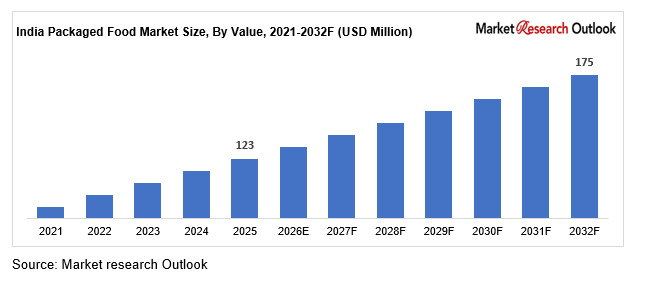
Snacks & Savories and Dairy & Dairy Alternatives maintain their market leadership because consumers buy these products at high rates and stores stock them in multiple varieties. However, the market experiences its fastest growth through Ready to Eat (RTE) & Convenience Foods and Health & Functional Foods because these products appeal to consumers who have active lives and want to maintain their health. The development of new retail formats together with instant delivery services and online grocery shopping platforms has created better access to products which now offer more choices throughout the nation.
Related research: India Rigid Plastic Packaging Market, India Biscuits Market and India Ready to Eat Food Market.
The competitive landscape is highly dynamic, the domestic FMCG giants and multinational corporations and emerging D2C brands all participate at high levels with the market. The FSSAI regulatory body increased its oversight of labeling requirements and nutritional disclosures and food safety standards, which resulted in greater consumer confidence. The market will evolve until 2032, which will lead to the development of clean-label products and plant-based alternatives and functional foods that contain added nutrients. The packaged food market will maintain its growth rate because of strong demand and ongoing product development.
Key Drivers of the India Packaged Food Market
The Convenience Revolution: Changing Lifestyles and Urbanization
The demand for ready-to-eat and easy-to-prepare food products is rising because people in cities lead busy lives while more people join the workforce and nuclear families become more common. Consumers are increasingly prioritizing convenient food options which maintain their taste preferences leading to rising sales of RTE meals and instant foods and packaged snacks.
The Health Shift: Demand for Functional and Clean-Label Foods
Health consciousness is reshaping the packaged food market because consumers now demand products which provide nutritional benefits through high protein content and low sugar levels and added vitamin content. Organic food and natural food and functional food categories are becoming more popular because people now understand lifestyle diseases and wellness trends better.
India Packaged Food Market Challenges
Price Sensitivity and Rural Penetration
The Indian market has experienced significant growth but its price sensitivity remains high in rural areas and among low-income consumers. The market for premium packaged foods faces adoption challenges which restrict their availability to urban markets. Manufacturers face their main difficulty because they must find a way to deliver affordable products while maintaining product quality and developing new innovations.
Supply Chain and Shelf-Life Constraints
The Indian cold-chain system which needs to achieve complete development lacks the ability to maintain frozen and chilled food products at their required quality standards. Product availability and operational expenses rise because of two main factors, which include inventory management problems and the restricted duration that products can remain usable.
India Packaged Food Market Share by Segment
Snacks and Savories together with Dairy Products and Dairy Alternatives lead the Indian packaged food market because these products people consume every day. Bakery Products and Confectionery Products together with Noodles and Pasta and Processed Grains maintain strong market positions while Ready to Eat Products and Convenience Foods experience fast growth because of urban demand. Frozen Foods and Chilled Foods together with Baby Foods and Infant Foods create high-growth niche markets.
By category, Staple & Essential Foods dominate the market, the market shows strong growth because consumers buy products in large quantities. The two product categories Indulgence & Premium Foods and Health & Functional Foods show rapid growth because consumer preferences are changing. Health-conscious consumers show increasing interest in Organic & Natural Foods products.
India Packaged Food Market by Region
The packaged food market in India shows significant regional differences because North India has both high population levels and strong demand for both staple foods and processed foods. The area demonstrates a strong tradition of consuming packaged food products. The Western Indian region has developed into an established high-end market through its widespread use of modern retailing systems and processed food items, which are common in Maharashtra and Gujarat. The area functions as a center for creating new products and introducing innovative solutions to market.
Recent Developments in the India Packaged Food Market
- Regulatory Strengthening: On February 2026, The Supreme Court has requested the Food Safety and Standards Authority of India (FSSAI) to assess the implementation of mandatory front-of-package warning labels (FOPL) for packaged food products that contain high levels of sugar and salt and saturated fat. The court stated that emergency regulations must be established to protect citizens’ fundamental right to health.
- Expansion of Quick Commerce: The rapid expansion of Q-commerce platforms enables restaurants to deliver packaged food products to customers at a faster rate which results in increased impulse buying.
Key Companies in the India Packaged Food Market
- Nestlé India Ltd.
- Hindustan Unilever Ltd.
- ITC Limited
- Britannia Industries Ltd.
- Tata Consumer Products Ltd.
- Amul (GCMMF)
- Parle Products Pvt. Ltd.
- Marico Ltd.
- Adani Wilmar Ltd.
- Godrej Consumer Products Ltd.
Segmentation
- Product Type
- Dairy & Dairy Alternatives
- Bakery & Confectionery
- Snacks & Savories
- Ready to Eat (RTE) & Convenience Foods
- Breakfast Cereals & Oats
- Condiments, Sauces & Dressings
- Oils & Fats
- Noodles, Pasta & Processed Grains
- Frozen & Chilled Foods
- Canned & Preserved Foods
- Beverages (Non-Alcoholic)
- Baby & Infant Food
- Others
- Category
- Staple & Essential Foods
- Indulgence & Premium Foods
- Health & Functional Foods
- Organic & Natural Foods
- Others
- Dietary Type
- Vegetarian
- Non-Vegetarian
- Vegan
- Gluten-Free
- Low-Calorie / Diet
- Diabetic-Friendly
- Others
- Packaging Type
- Pouches & Sachets
- Bottles & Jars
- Cans & Tins
- Boxes & Cartons
- Trays & Containers
- Wrappers & Flow Packs
- Others
- Packaging Material
- Plastic
- Glass
- Metal / Aluminium
- Paper & Paperboard
- Biodegradable & Sustainable Materials
- Others
- Price Range
- Mass / Economy
- Mid-Range
- Premium
- Super Premium
- End User
- Households / Retail Consumers
- HoReCa (Hotels, Restaurants & Catering)
- Institutional Buyers
- Others
- Distribution Channel
- Supermarkets & Hypermarkets
- Convenience Stores & Kirana Stores
- Online Retail / E-commerce
- Quick Commerce (Q-Commerce)
- Direct-to-Consumer (D2C)
- Wholesale & Cash & Carry
- Others
- Region
- East India
- West India
- North India
- South India
Table of Contents:
- Executive Summary
- Research Methodology
- Report Scope
- Market Definition
- Inclusions & Exclusions
- Research Methodology
- India Packaged Food Market Overview
- Market Evolution in India
- Industry Value Chain Overview
- Ecosystem Mapping
- Pricing Analysis Overview
- Market Dynamics
- Drivers
- Challenges
- Opportunities
- Emerging Trends
- Market Attractiveness Index
- Consumer Behaviour Analysis
- Buying Patterns
- Price Sensitivity
- Urban vs Tier 2 Demand
- Policy & Regulatory Landscape
- India Packaged Food Market Outlook
- Market Size & Forecast, 2021-2032
- By Value
- By Volume
- Market Share & Forecast by Product Type
- Dairy & Dairy Alternatives
- Bakery & Confectionery
- Snacks & Savories
- Ready to Eat (RTE) & Convenience Foods
- Breakfast Cereals & Oats
- Condiments, Sauces & Dressings
- Oils & Fats
- Noodles, Pasta & Processed Grains
- Frozen & Chilled Foods
- Canned & Preserved Foods
- Beverages (Non-Alcoholic)
- Baby & Infant Food
- Others
- Market Share & Forecast by Category
- Staple & Essential Foods
- Indulgence & Premium Foods
- Health & Functional Foods
- Organic & Natural Foods
- Others
- Market Share & Forecast by Dietary Type
- Vegetarian
- Non-Vegetarian
- Vegan
- Gluten-Free
- Low-Calorie / Diet
- Diabetic-Friendly
- Others
- Market Share & Forecast by Packaging Type
- Pouches & Sachets
- Bottles & Jars
- Cans & Tins
- Boxes & Cartons
- Trays & Containers
- Wrappers & Flow Packs
- Others
- Market Share & Forecast by Packaging Material
- Plastic
- Glass
- Metal / Aluminium
- Paper & Paperboard
- Biodegradable & Sustainable Materials
- Others
- Market Share & Forecast by Price Range
- Mass / Economy
- Mid-Range
- Premium
- Super Premium
- Market Share & Forecast by End User
- Households / Retail Consumers
- HoReCa (Hotels, Restaurants & Catering)
- Institutional Buyers
- Others
- Market Share & Forecast by Distribution Channel
- Supermarkets & Hypermarkets
- Convenience Stores & Kirana Stores
- Online Retail / E-commerce
- Quick Commerce (Q-Commerce)
- Direct-to-Consumer (D2C)
- Wholesale & Cash & Carry
- Others
- Market Share & Forecast by Region
- North India
- South India
- West India
- East India
- Market Size & Forecast, 2021-2032
- Competitive Landscape
- Market Share Analysis
- Competitive Benchmarking
- Company Profiles
- Product Portfolio Comparison
- Strategic Developments
- Strategic Recommendations
- Growth Strategies for New Entrants
- Expansion Strategies for Existing Players
- Investment Opportunities
Frequently Asked Questions
1. What is the projected market size of the India Packaged Food Market in 2025?
Ans: The India Packaged Food market is estimated to be valued at approximately USD 123 Billion in 2025.
2. What is the expected growth rate (CAGR) of the India Packaged Food Market during the forecast period?
Ans: The market is expected to exhibit a robust CAGR of 5% during the forecast period between 2026 and 2032.
3. What is the forecast value of the India Packaged Food Market by 2032?
Ans: By the end of the strategic horizon in 2032, the India Packaged Food market is projected to reach a valuation of approximately USD 175 Billion.
4. What are the major factors driving the growth of the India Packaged Food Market?
Ans: The increasing urban population together with rising household incomes and new eating patterns and growing need for accessible food products has created this expansion.
5. Name the key players operating in the India Packaged Food Market.
Ans: Prominent players shaping the Indian landscape include Nestlé India Ltd., Hindustan Unilever Ltd., ITC Limited, Britannia Industries Ltd., Tata Consumer Products Ltd., Amul (GCMMF), Parle Products Pvt. Ltd., Marico Ltd., Adani Wilmar Ltd., Godrej Consumer Products Ltd., and other prominent players.
6. Which regions/cities are expected to lead the growth in the India Packaged Food Market?
Ans: The packaged food market in India shows significant regional differences because North India has both high population levels and strong demand for both staple foods and processed foods.