

Asia-Pacific Shrimp Market, By Species Type (Whiteleg Shrimp, Black Tiger Shrimp, Indian White Shrimp, Kuruma Shrimp, Others); By Product Form (Fresh & Chilled, Frozen, Dried, Cooked & Ready-to-Eat, Value-Added & Processed, Others); By Application (Retail / Household Consumption, Foodservice & HoReCa, Food Processing Industry, Export / International Trade, Others); By Distribution Channel (Supermarkets & Hypermarkets, Fish Markets & Wet Markets, Specialty Seafood Stores, Online Platforms & E-commerce, Others); By Country (China, India, Indonesia, Vietnam, Thailand, Philippines, Malaysia, Japan, South Korea, Australia, Rest of Asia Pacific); By Trend Analysis, Competitive Landscape & Forecast, 2021–2032
- Food, Beverage & Nutrition
- Mar 2026
- Pages 250
- Report Format: pdf
- Report Price: $3000 USD
Asia-Pacific Shrimp Market, Size & Forecast 2021-2032
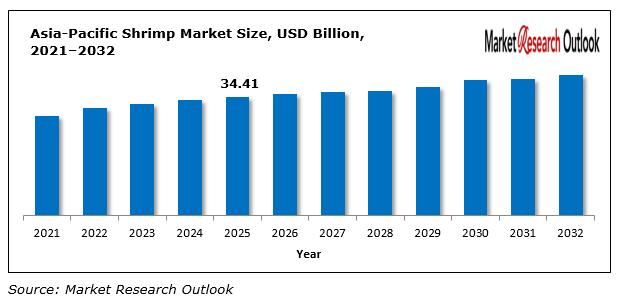
The Asia-Pacific Shrimp Market size was estimated at USD 34.41 Billion in 2025. During the forecast period, the Asia-Pacific Shrimp Market size is projected to grow at a CAGR of 7.00% reaching a value of USD 55.30 Billion by 2032. The combination of rising aquaculture production and increasing export markets and domestic demand growth drives market expansion. The frozen shrimp segment leads the market because its products maintain freshness for extended periods while Chinese buyers display strong purchasing interest. At the same time, consumers who want easy-to-use food products are driving demand for value-added and processed shrimp items. Market expansion throughout the region receives support from investments that develop cold chain systems and processing plants.
Asia-Pacific Shrimp Market – Overview
Market Trends
- The Asia-Pacific shrimp market currently experiences a significant trend which leads to increased development of sustainable aquaculture practices that protect the environment. Producers are adopting certification standards, traceability systems, and environmentally responsible farming methods to meet international export requirements and consumer expectations.
- The seafood industry is experiencing a significant trend because consumers want value-added ready-to-eat shrimp products. Urban consumers are increasingly preferring convenient seafood options such as pre-cooked, marinated, and packaged shrimp. E-commerce platforms have expanded their seafood distribution network to provide consumers with easier access to fresh and frozen shrimp products.
Geopolitical Impact on Asia-Pacific Shrimp Market
Geopolitical factors which include trade policies and tariffs and international relations of the Asia-Pacific shrimp market determine its operations. Export-oriented countries such as India, Vietnam, and Thailand are sensitive to changes in import regulations and trade agreements in major markets like the U.S. and the European Union. The combination of trade disputes and anti-dumping duties together with sanitary regulations results in major effects on both export quantities and market pricing. The production process and logistics operations experience disruptions through two main factors which are global supply chain disturbances and changing feed and fuel prices. Regional governments are developing policies which will aid aquaculture expansion and enhance export success while maintaining international standard compliance.
| Attributes | Details |
| Years Considered | Historical Data – 2021–2025
Base Year – 2025 Estimated Year – 2026 Forecast Period – 2026–2032 |
| Facts Covered | Revenue in USD Billion |
| Market Coverage | China, India, Indonesia, Vietnam, Thailand, Philippines, Malaysia, Japan, South Korea, Australia, Rest of Asia Pacific. |
| Segmentation | Species Type, Product Form, Application, Distribution Channel, Country |
Segmental Coverage
By Species Type
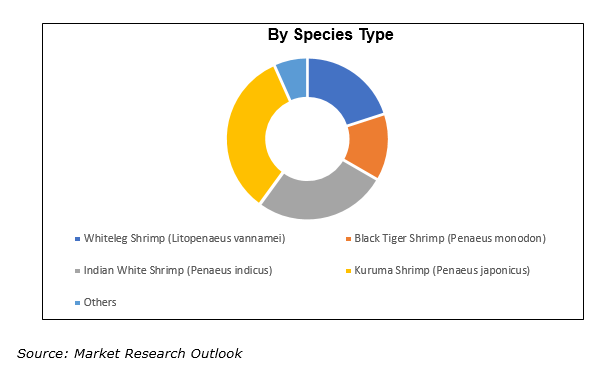
Based on species type, the market is segmented into whiteleg shrimp, black tiger shrimp, Indian white shrimp, Kuruma shrimp, and others. The whiteleg shrimp (Litopenaeus vannamei) leads the market because of its ability to produce high yields and resist diseases and its common use in aquaculture. The premium market for black tiger shrimp exists because the shrimp has larger dimensions and superior flavor characteristics. Indian white shrimp and Kuruma shrimp serve specific niche markets which include particular regional culinary traditions and upscale dining establishments. The availability of various shrimp species enables producers to serve both the general market and the high-end market.
By Product Form
Based on product form, the market includes fresh & chilled, frozen, dried, cooked & ready-to-eat, value-added & processed, and others. The exportable frozen shrimp product, which maintains its quality during extended storage, represents the biggest portion of frozen shrimp market share. Domestic markets throughout coastal areas show high demand for fresh and chilled shrimp products. The value-added processed shrimp market experiences rapid growth because consumers prefer convenience and ready-to-cook products. Dried shrimp remains popular in traditional cuisines across several Asian countries.
Regional Analysis
On the basis of geography, the market is divided into China, India, Indonesia, Vietnam, Thailand, Philippines, Malaysia, Japan, South Korea, Australia, Rest of Asia Pacific. China stands as the biggest buyer and importer of shrimp while India and Vietnam and Indonesia function as the main shrimp exporting countries. The processing industries of Thailand and Malaysia operate at full capacity while Japan and South Korea function as major import markets that require high-quality seafood products. Australia represents a smaller but high-value market. The region displays various production and consumption patterns which create multiple opportunities for business expansion.
Source: Market Research Outlook
Competitive Landscape
In the competitive landscape of the Asia-Pacific Shrimp market, the organisation has covered major players of the market and their details.
Here are some of the leading players that are playing a major role in the Asia-Pacific Shrimp market:
- Thai Union Group PCL
- Introduction & Company Profile
- Product Benchmarking
- Strategic Outlook
- Key Competitors
- Financial Analysis
- Swot Analysis
**(Same Data Pointers Will Be Provided for The Below Companies)
- Charoen Pokphand Foods PCL (CP Foods)
- Minh Phu Seafood Corp.
- Avanti Feeds Limited
- Apex Frozen Foods Limited
- Central Proteina Prima Tbk (CP Prima)
- Siam Canadian Group
- Maruha Nichiro Corporation
- Nippon Suisan Kaisha, Ltd. (Nissui)
- Seafresh Industry Public Company Limited
- Aqua Star Corporation
- Other Prominent Players
Segmentation
- By Species Type
- Whiteleg Shrimp (Litopenaeus vannamei)
- Black Tiger Shrimp (Penaeus monodon)
- Indian White Shrimp (Penaeus indicus)
- Kuruma Shrimp (Penaeus japonicus)
- Others
- By Product Form
- Fresh & Chilled
- Frozen
- Dried
- Cooked & Ready-to-Eat
- Value-Added & Processed
- Others
- By Application
- Retail / Household Consumption
- Foodservice & HoReCa
- Food Processing Industry
- Export / International Trade
- Others
- By Distribution Channel
- Supermarkets & Hypermarkets
- Fish Markets & Wet Markets
- Specialty Seafood Stores
- Online Platforms & E-commerce
- Others
- By Country
- China
- India
- Indonesia
- Vietnam
- Thailand
- Philippines
- Malaysia
- Japan
- South Korea
- Australia
- Rest of Asia Pacific
Asia Pacific Shrimp Market, 2032
- Research Framework
- Market Segmentation
- Research Objective
- Research Methodology
- Qualitative Research
- Primary Research
- Secondary Research
- Quantitative Research
- Market Breakdown & Data Triangulation
- Demand Side
- Supply Side
- Breakdown Of Primary Research Respondents, By Region
- China
- India
- Indonesia
- Vietnam
- Thailand
- Philippines
- Malaysia
- Japan
- South Korea
- Australia
- Rest of Asia Pacific
- Assumption & Limitation
- Qualitative Research
- Executive Summary
- Market Overview, 2021–2032
- By Species Type
- By Product Form
- By Application
- By Distribution Channel
- By Country
- Analyst Recommendations
- Market Overview, 2021–2032
- Geopolitical Impact on Asia Pacific Shrimp Market
- Asia Pacific Shrimp Market Insights
- Market Dynamics
- Growth Drivers
- Rising shrimp consumption driven by growing middle-class population and increasing seafood demand across Asia Pacific
- Expanding aquaculture production capacity in key producing countries such as India, Vietnam, Indonesia, and Bangladesh
- Growing export demand from North America, Europe, and the Middle East supporting regional shrimp production
- Restraints
- Prevalence of shrimp diseases such as Early Mortality Syndrome (EMS) and White Spot Syndrome impacting production yields
- Stringent food safety, traceability, and antibiotic residue regulations in major importing countries
- High production costs associated with feed, energy, and water management in shrimp aquaculture
- Opportunities
- Increasing adoption of advanced aquaculture technologies including biofloc, recirculating aquaculture systems (RAS), and precision farming
- Growing demand for value-added and processed shrimp products in both domestic and export markets
- Rising consumer preference for sustainably sourced and certified shrimp (ASC, BAP) creating premiumization opportunities
- Challenges
- Environmental concerns including mangrove destruction, water pollution, and carbon footprint of large-scale shrimp farming
- Volatile shrimp prices driven by supply fluctuations, currency risks, and intense global competition
- Labor shortages and rising labor costs in key shrimp-producing and processing countries
- Technological Advancements
- Recent Technological Advancements
- Prior to 2020
- Porter’s Five Forces Analysis
- PESTLE Analysis
- Trade Analysis
- Top 3 Importing Countries
- Top 3 Exporting Countries
- Growth Drivers
- Market Dynamics
- Industry Value Chain & Entry Points
- Shrimp hatcheries & broodstock suppliers
- Feed manufacturers & nutrition providers
- Shrimp farmers & aquaculture operators
- Processing & packaging facilities
- Cold chain logistics & storage providers
- Exporters, importers & trading companies
- End users (retail, foodservice, food processing industry)
- Aftermarket services & aquaculture support
- Asia Pacific Shrimp Market: Regulatory Framework
- China
- India
- Indonesia
- Vietnam
- Thailand
- Philippines
- Malaysia
- Japan
- South Korea
- Australia
- Rest of Asia Pacific
- Asia Pacific Shrimp Market Overview
- Market Size & Forecast, 2021-2032
- By Value (USD Billion)
- Market Share & Forecast
- By Species Type
- Whiteleg Shrimp (Litopenaeus vannamei)
- Black Tiger Shrimp (Penaeus monodon)
- Indian White Shrimp (Penaeus indicus)
- Kuruma Shrimp (Penaeus japonicus)
- Others
- By Product Form
- Fresh & Chilled
- Frozen
- Dried
- Cooked & Ready-to-Eat
- Value-Added & Processed
- Others
- By Application
- Retail / Household Consumption
- Foodservice & HoReCa
- Food Processing Industry
- Export / International Trade
- Others
- By Distribution Channel
- Supermarkets & Hypermarkets
- Fish Markets & Wet Markets
- Specialty Seafood Stores
- Online Platforms & E-commerce
- Others
- By Country
- China
- India
- Indonesia
- Vietnam
- Thailand
- Philippines
- Malaysia
- Japan
- South Korea
- Australia
- Rest of Asia Pacific
- By Species Type
- Market Size & Forecast, 2021-2032
- Competitive Landscape
- Asia Pacific Shrimp Company Market Share Analysis, 2025
- By Country
- China
- India
- Indonesia
- Vietnam
- Thailand
- Philippines
- Malaysia
- Japan
- South Korea
- Australia
- Competitive Benchmarking, By Operating Parameters
- Key Strategic Development (Mergers, Acquisitions, Partnerships, Etc.)
- List of Emerging players
- By Country
- Asia Pacific Shrimp Company Market Share Analysis, 2025
- Company Profile
- Thai Union Group PCL
- Introduction & Company Profile
- Product Benchmarking
- Strategic Outlook
- Key Competitors
- Financial Analysis
- Swot Analysis
- Thai Union Group PCL
**(Same Data Pointers Will Be Provided for The Below Companies)
- Charoen Pokphand Foods PCL (CP Foods)
- Minh Phu Seafood Corp.
- Avanti Feeds Limited
- Apex Frozen Foods Limited
- Central Proteina Prima Tbk (CP Prima)
- Siam Canadian Group
- Maruha Nichiro Corporation
- Nippon Suisan Kaisha, Ltd. (Nissui)
- Seafresh Industry Public Company Limited
- Aqua Star Corporation
- Other Prominent Players
* Financial information in case of non-listed companies will be provided as per availability
**The segmentation and the companies are subjected to modifications based on in-depth secondary for the final deliverable
Frequently Asked Questions
1. What is the market size of the Asia-Pacific Shrimp Market in 2025?
Ans: The Asia-Pacific Shrimp market is projected to reach approximately USD 34.41 Billion by 2032.
2. What is the expected growth rate of the Asia-Pacific Shrimp Market during the forecast period?
Ans: The Asia-Pacific Shrimp market is expected to grow at a CAGR of around 7.5% during the forecast period between 2026 and 2032.
3. What is the forecast value of the Asia-Pacific Shrimp Market by 2032?
Ans: The Asia-Pacific Shrimp market is projected to reach approximately USD 55.30 Billion by 2032.
4. What are the major factors driving the growth of the Asia-Pacific Shrimp Market?
Ans: The combination of rising aquaculture production and increasing export markets and domestic demand growth drives market expansion.
5. Name the key players operating in the Asia-Pacific Shrimp Market.
Ans: Key players operating in the Asia-Pacific Shrimp market include Thai Union Group PCL, Charoen Pokphand Foods PCL (CP Foods), Minh Phu Seafood Corp., Avanti Feeds Limited, Apex Frozen Foods Limited, PT. Central Proteina Prima Tbk (CP Prima), Siam Canadian Group, Maruha Nichiro Corporation, Nippon Suisan Kaisha, Ltd. (Nissui), Seafresh Industry Public Company Limited, Aqua Star Corporation, and other prominent players.
6. Which Country is Expected to Grow in the Asia-Pacific Shrimp Market.
Ans: China stands as the biggest buyer and importer of shrimp while India and Vietnam and Indonesia function as the main shrimp exporting countries.
Frequently Asked Questions
1. What is the market size of the Asia-Pacific Shrimp Market in 2025?
Ans: The Asia-Pacific Shrimp market is projected to reach approximately USD 34.41 Billion by 2032.
2. What is the expected growth rate of the Asia-Pacific Shrimp Market during the forecast period?
Ans: The Asia-Pacific Shrimp market is expected to grow at a CAGR of around 7.5% during the forecast period between 2026 and 2032.
3. What is the forecast value of the Asia-Pacific Shrimp Market by 2032?
Ans: The Asia-Pacific Shrimp market is projected to reach approximately USD 55.30 Billion by 2032.
4. What are the major factors driving the growth of the Asia-Pacific Shrimp Market?
Ans: The combination of rising aquaculture production and increasing export markets and domestic demand growth drives market expansion.
5. Name the key players operating in the Asia-Pacific Shrimp Market.
Ans: Key players operating in the Asia-Pacific Shrimp market include Thai Union Group PCL, Charoen Pokphand Foods PCL (CP Foods), Minh Phu Seafood Corp., Avanti Feeds Limited, Apex Frozen Foods Limited, PT. Central Proteina Prima Tbk (CP Prima), Siam Canadian Group, Maruha Nichiro Corporation, Nippon Suisan Kaisha, Ltd. (Nissui), Seafresh Industry Public Company Limited, Aqua Star Corporation, and other prominent players.
6. Which Country is Expected to Grow in the Asia-Pacific Shrimp Market.
Ans: China stands as the biggest buyer and importer of shrimp while India and Vietnam and Indonesia function as the main shrimp exporting countries.