

Global Automation Capex vs Productivity Outcomes Market, By Automation Type (Industrial Robotics, Process Automation Systems, AI-Driven Automation, Robotic Process Automation (RPA), Machine Vision Systems, Autonomous Material Handling Systems); By Investment Type (Greenfield Automation Investment, Brownfield Automation Upgrades, Equipment Replacement Investment, Digital Retrofit & Smart Factory Investment); By Productivity Outcome Type (Labor Cost Reduction, Output Capacity Expansion, Quality Improvement & Defect Reduction, Downtime Reduction, Energy Efficiency Improvement, Supply Chain Optimization); By Deployment Model (On-Premise Automation Systems, Cloud-Connected Automation, Hybrid Automation Infrastructure); By Industry Vertical (Manufacturing, Automotive, Electronics & Semiconductors, Food & Beverages, Pharmaceuticals, Logistics & Warehousing, Energy & Utilities, Others); By Region (North America, Europe, Asia Pacific (APAC), Latin America (LATAM), Middle East and Africa (MEA)); By Trend Analysis, Competitive Landscape & Forecast, 2022-2032
- AI and Automation
- Mar 2026
- Pages 350
- Report Format: pdf
- Report Price: $3500 USD
Global Automation Capex vs Productivity Outcomes Market, Size & Forecast 2021-2032
The Global Automation Capex vs Productivity Outcomes Market size was estimated at USD 310.6 Billion in 2025. During the forecast period, the Global Automation Capex vs Productivity Outcomes Market size is projected to grow at a CAGR of 9.4% reaching a value of USD 581.2 Billion by 2032. The current market expansion requires Industry 4.0 implementation and greater robotics usage and manufacturers’ AI system adoption and the increasing need for intelligent production facilities. Developed economies are focusing on reshoring production supported by automation, while emerging markets are investing in advanced manufacturing capabilities. Enterprises are increasing their automation budgets to strengthen their performance measurement efforts and return on investment assessments for sustainable productivity growth.
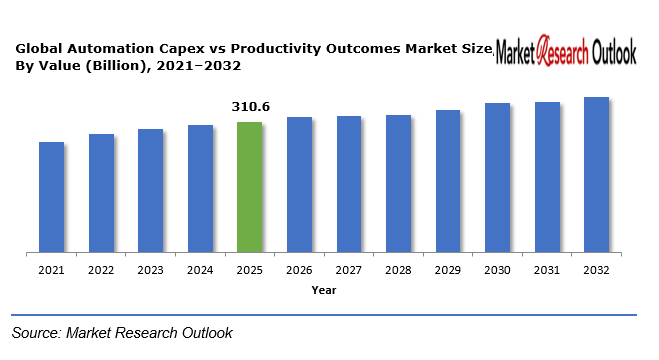
Automation Capex vs Productivity Outcomes – Overview
The study assesses capital investments in automation technologies through their actual efficiency improvements and financial returns to their investors. The category of automation investments includes industrial robotics systems together with process control systems and AI-driven platforms and autonomous logistics systems. The evaluation of productivity results employs metrics that measure output growth and labor efficiency and decreased defect rates and downtime reduction and energy efficiency improvements.
Global Automation Capex vs Productivity Outcomes Market
Growth Drivers
Rising Labor Costs and Workforce Shortage
The combination of global labor shortages together with rising wage inflation costs forces industries to speed up their automation technology spending. The implementation of automation technologies enables organizations to decrease their need for human workers while they achieve better operational performance and higher work process stability. The rising automation capital expenses in North America and Europe become more reasonable because these systems deliver fast returns on investment and continuous productivity gains. The combination of AI-driven automation together with robotics technology creates systems which support continuous production processes and predictive maintenance functions and real-time process optimization capabilities.
Challenges
High Initial Capital Expenditure and ROI Uncertainty
The implementation of automatic systems brings substantial productivity improvements but demands considerable initial expenditures for various elements including equipment and system integration and employee development and digital system development. Small and medium enterprises face financial limitations that prevent them from implementing extensive automation systems. The productivity enhancements achieved through automation depend on three factors which include the complexity of the industry and the ability of employees to adapt and the success of the integration process.
Geopolitical Impact on Global Automation Capex vs Productivity Outcomes Market
The Global Automation Capex vs Productivity Outcomes Market is influenced by geopolitical factors which include trade tensions and supply chain disruptions and semiconductor shortages and reshoring policies. The government provides domestic manufacturing incentives which drive industrial modernization programs that lead to increased automation adoption throughout North America and Europe and Asia Pacific. Energy security concerns and rising fuel prices are further encouraging energy-efficient automation systems. Global supply chain volatility forces companies to establish production networks which combine resilience with advanced automation capabilities.
Global Automation Capex vs Productivity Outcomes Market
Segmental Coverage
Global Automation Capex vs Productivity Outcomes Market – By Automation Type
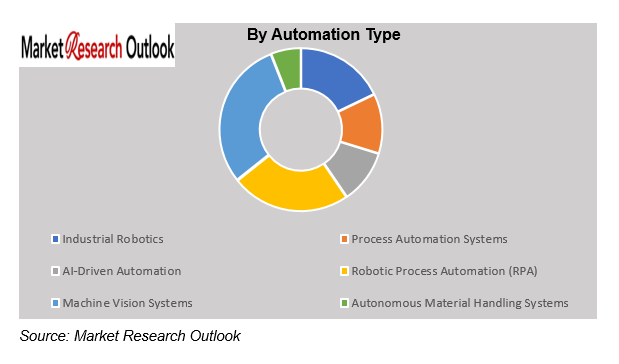
Based on automation type, the market is segmented into Industrial Robotics, Process Automation Systems, AI-Driven Automation, Robotic Process Automation (RPA), Machine Vision Systems, and Autonomous Material Handling Systems. Industrial Robotics dominates due to its widespread application in manufacturing and automotive sectors. AI-Driven Automation will experience its most rapid growth through the forecast period because of three technologies which include predictive maintenance and intelligent process optimization and decision-support systems. Machine Vision Systems and Autonomous Material Handling Systems are expanding rapidly in logistics and warehouse automation.
Global Automation Capex vs Productivity Outcomes Market – By Industry Vertical
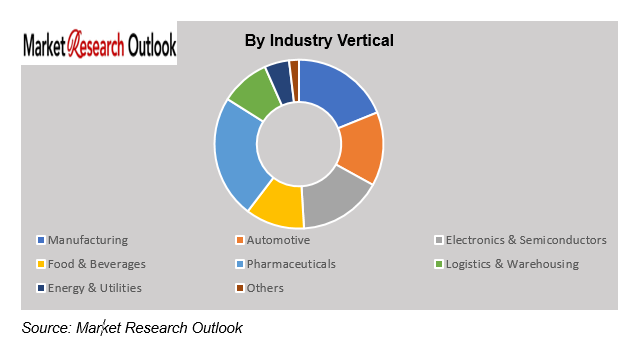
Based on industry vertical, the market is segmented into Manufacturing, Automotive, Electronics & Semiconductors, Food & Beverages, Pharmaceuticals, Logistics & Warehousing, Energy & Utilities, and Others. Manufacturing remains the largest adopter due to large-scale production automation requirements. The Automotive and Electronics & Semiconductors sectors are making large investments in robotic systems and artificial intelligence technologies to increase their operational accuracy and production capacity. The Logistics & Warehousing sector is experiencing fast growth because of its implementation of autonomous systems and intelligent inventory control systems. Energy & Utilities use automation to enhance their grid systems and boost their operational performance.
Competitive Landscape
Key participants in the Global Automation Capex vs Productivity Outcomes market include Siemens AG, ABB Ltd., Schneider Electric SE, Rockwell Automation, Inc., Mitsubishi Electric Corporation, Honeywell International Inc., Emerson Electric Co., FANUC Corporation, Yaskawa Electric Corporation, KUKA AG, Bosch Rexroth AG, and Omron Corporation, and other prominent players.
These companies are implementing strategic growth initiatives in order to gain a competitive advantage. The strategies being largely adopted include mergers and acquisitions, strategic alliances, joint ventures, licensing agreements, and new product launches. With the implementation of these strategies, the market participants aim to increase product portfolios, as well as enhance regional presence for long-term sustainable business growth in the Global Automation Capex vs Productivity Outcomes Market.
Scope of the Report
| Attributes | Details |
| Years Considered | Historical Data – 2021–2025
Base Year – 2025 Estimated Year – 2026 Forecast Period – 2026–2032 |
| Facts Covered | Revenue in USD Billion |
| Market Coverage | Global |
| Product/ Service Segmentation | Automation Type, Investment Type, Productivity Outcome Type, Deployment Model, Industry Vertical, Region |
| Key Players | Siemens AG, ABB Ltd., Schneider Electric SE, Rockwell Automation, Inc., Mitsubishi Electric Corporation, Honeywell International Inc., Emerson Electric Co., FANUC Corporation, Yaskawa Electric Corporation, KUKA AG, Bosch Rexroth AG, and Omron Corporation, and other prominent players. |
Market Segmentation
- By Automation Type
- Industrial Robotics
- Process Automation Systems
- AI-Driven Automation
- Robotic Process Automation (RPA)
- Machine Vision Systems
- Autonomous Material Handling Systems
- By Investment Type
- Greenfield Automation Investment
- Brownfield Automation Upgrades
- Equipment Replacement Investment
- Digital Retrofit & Smart Factory Investment
- By Productivity Outcome Type
- Labor Cost Reduction
- Output Capacity Expansion
- Quality Improvement & Defect Reduction
- Downtime Reduction
- Energy Efficiency Improvement
- Supply Chain Optimization
- By Deployment Model
- On-Premise Automation Systems
- Cloud-Connected Automation
- Hybrid Automation Infrastructure
- By Industry Vertical
- Manufacturing
- Automotive
- Electronics & Semiconductors
- Food & Beverages
- Pharmaceuticals
- Logistics & Warehousing
- Energy & Utilities
- Others
- By Region
- North America
- Europe
- Asia Pacific (APAC)
- Latin America (LATAM)
- Middle East and Africa (MEA)
- Research Framework
- Research Objective
- Product Overview
- Market Segmentation
- Executive Summary
- Global Automation Capex vs Productivity Outcomes Market Insights
- Growth Drivers
- Restraints
- Opportunities
- Challenges
- Productivity Proof & Measurable Output Gains
- Technological Advancements/Recent Developments
- Porter’s Five Forces Analysis
- Industry Value Chain & Entry Points
- Global Automation Capex vs Productivity Outcomes Market: Regulatory Framework
- Global Automation Capex vs Productivity Outcomes Market: Marketing Strategies
- Global Automation Capex vs Productivity Outcomes Market Overview
- Market Size & Forecast, 2021-2032
- By Value (USD Billion)
- Market Share & Forecast
- By Automation Type
- Industrial Robotics
- Process Automation Systems
- AI-Driven Automation
- Robotic Process Automation (RPA)
- Machine Vision Systems
- Autonomous Material Handling Systems
- By Investment Type
- Greenfield Automation Investment
- Brownfield Automation Upgrades
- Equipment Replacement Investment
- Digital Retrofit & Smart Factory Investment
- By Productivity Outcome Type
- Labor Cost Reduction
- Output Capacity Expansion
- Quality Improvement & Defect Reduction
- Downtime Reduction
- Energy Efficiency Improvement
- Supply Chain Optimization
- By Deployment Model
- On-Premise Automation Systems
- Cloud-Connected Automation
- Hybrid Automation Infrastructure
- By Industry Vertical
- Manufacturing
- Automotive
- Electronics & Semiconductors
- Food & Beverages
- Pharmaceuticals
- Logistics & Warehousing
- Energy & Utilities
- Others
- By Region
- North America
- Europe
- Asia Pacific (APAC)
- Latin America (LATAM)
- Middle East and Africa (MEA)
- By Automation Type
- Market Size & Forecast, 2021-2032
- North America Automation Capex vs Productivity Outcomes Market
- Market Size & Forecast, 2021-2032
- By Value (USD Billion)
- Market Share & Forecast
- By Automation Type
- By Investment Type
- By Productivity Outcome Type
- By Deployment Model
- By Industry Vertical
- By Country
- United States
- By Automation Type
- By Investment Type
- By Productivity Outcome Type
- By Deployment Model
- By Industry Vertical
- Canada
- By Automation Type
- By Investment Type
- By Productivity Outcome Type
- By Deployment Model
- By Industry Vertical
- United States
- Market Size & Forecast, 2021-2032
- Europe Automation Capex vs Productivity Outcomes Market
- Market Size & Forecast, 2021-2032
- By Value (USD Billion)
- Market Share & Forecast
- By Automation Type
- By Investment Type
- By Productivity Outcome Type
- By Deployment Model
- By Industry Vertical
- By Country
- Germany
- By Automation Type
- By Investment Type
- By Productivity Outcome Type
- By Deployment Model
- By Industry Vertical
- United Kingdom
- By Automation Type
- By Investment Type
- By Productivity Outcome Type
- By Deployment Model
- By Industry Vertical
- Italy
- By Automation Type
- By Investment Type
- By Productivity Outcome Type
- By Deployment Model
- By Industry Vertical
- France
- By Automation Type
- By Investment Type
- By Productivity Outcome Type
- By Deployment Model
- By Industry Vertical
- Spain
- By Automation Type
- By Investment Type
- By Productivity Outcome Type
- By Deployment Model
- By Industry Vertical
- Belgium
- By Automation Type
- By Investment Type
- By Productivity Outcome Type
- By Deployment Model
- By Industry Vertical
- Russia
- By Automation Type
- By Investment Type
- By Productivity Outcome Type
- By Deployment Model
- By Industry Vertical
- The Netherlands
- By Automation Type
- By Investment Type
- By Productivity Outcome Type
- By Deployment Model
- By Industry Vertical
- Rest of Europe
- By Automation Type
- By Investment Type
- By Productivity Outcome Type
- By Deployment Model
- By Industry Vertical
- Asia Pacific Automation Capex vs Productivity Outcomes Market
- Market Size & Forecast, 2021-2032
- By Value (USD Billion)
- Market Share & Forecast
- By Automation Type
- By Investment Type
- By Productivity Outcome Type
- By Deployment Model
- By Industry Vertical
- By Country
- China
- By Automation Type
- By Investment Type
- By Productivity Outcome Type
- By Deployment Model
- By Industry Vertical
- India
- By Automation Type
- By Investment Type
- By Productivity Outcome Type
- By Deployment Model
- By Industry Vertical
- Japan
- By Automation Type
- By Investment Type
- By Productivity Outcome Type
- By Deployment Model
- By Industry Vertical
- South Korea
- By Automation Type
- By Investment Type
- By Productivity Outcome Type
- By Deployment Model
- By Industry Vertical
- Australia & New Zealand
- By Automation Type
- By Investment Type
- By Productivity Outcome Type
- By Deployment Model
- By Industry Vertical
- Indonesia
- By Automation Type
- By Investment Type
- By Productivity Outcome Type
- By Deployment Model
- By Industry Vertical
- Malaysia
- By Automation Type
- By Investment Type
- By Productivity Outcome Type
- By Deployment Model
- By Industry Vertical
- Singapore
- By Automation Type
- By Investment Type
- By Productivity Outcome Type
- By Deployment Model
- By Industry Vertical
- Vietnam
- By Automation Type
- By Investment Type
- By Productivity Outcome Type
- By Deployment Model
- By Industry Vertical
- Rest of APAC
- By Automation Type
- By Investment Type
- By Productivity Outcome Type
- By Deployment Model
- By Industry Vertical
- Latin America Automation Capex vs Productivity Outcomes Market
- Market Size & Forecast, 2021-2032
- By Value (USD Billion)
- Market Share & Forecast
- By Automation Type
- By Investment Type
- By Productivity Outcome Type
- By Deployment Model
- By Industry Vertical
- By Country
- Brazil
- By Automation Type
- By Investment Type
- By Productivity Outcome Type
- By Deployment Model
- By Industry Vertical
- Mexico
- By Automation Type
- By Investment Type
- By Productivity Outcome Type
- By Deployment Model
- By Industry Vertical
- Argentina
- By Automation Type
- By Investment Type
- By Productivity Outcome Type
- By Deployment Model
- By Industry Vertical
- Peru
- By Automation Type
- By Investment Type
- By Productivity Outcome Type
- By Deployment Model
- By Industry Vertical
- Rest of LATAM
- By Automation Type
- By Investment Type
- By Productivity Outcome Type
- By Deployment Model
- By Industry Vertical
- Middle East & Africa Automation Capex vs Productivity Outcomes Market
- Market Size & Forecast, 2021-2032
- By Value (USD Billion)
- Market Share & Forecast
- By Automation Type
- By Investment Type
- By Productivity Outcome Type
- By Deployment Model
- By Industry Vertical
- By Country
- Saudi Arabia
- By Automation Type
- By Investment Type
- By Productivity Outcome Type
- By Deployment Model
- By Industry Vertical
- UAE
- By Automation Type
- By Investment Type
- By Productivity Outcome Type
- By Deployment Model
- By Industry Vertical
- Qatar
- By Automation Type
- By Investment Type
- By Productivity Outcome Type
- By Deployment Model
- By Industry Vertical
- Kuwait
- By Automation Type
- By Investment Type
- By Productivity Outcome Type
- By Deployment Model
- By Industry Vertical
- South Africa
- By Automation Type
- By Investment Type
- By Productivity Outcome Type
- By Deployment Model
- By Industry Vertical
- Nigeria
- By Automation Type
- By Investment Type
- By Productivity Outcome Type
- By Deployment Model
- By Industry Vertical
- Algeria
- By Automation Type
- By Investment Type
- By Productivity Outcome Type
- By Deployment Model
- By Industry Vertical
- Rest of MEA
- By Automation Type
- By Investment Type
- By Productivity Outcome Type
- By Deployment Model
- By Industry Vertical
- Demand Outlook & Customer Adoption Dynamics
- Demand Evolution by Industry Vertical
- Purchasing Behavior & Supplier Selection Criteria
- Demand Visibility & Contracting Trends
- Regional Demand Concentration & Customer Clusters
- Competitive Landscape
- List of Key Players and Their Products
- Global Automation Capex vs Productivity Outcomes Company Market Share Analysis, 2025
- Competitive Benchmarking, By Operating Parameters
- Key Strategic Developments (Mergers, Acquisitions, Partnerships, etc.)
- Geopolitical Impact on Global Automation Capex vs Productivity Outcomes Market
- Company Profile
- Siemens AG
- Introduction & Company Profile
- Product Benchmarking
- Strategic Outlook
- Key Personals
- Key Competitors
- Financial Analysis
- SWOT Analysis
- Siemens AG
- Saudi Arabia
- Market Size & Forecast, 2021-2032
- Brazil
- Market Size & Forecast, 2021-2032
- China
- Market Size & Forecast, 2021-2032
- Germany
- Market Size & Forecast, 2021-2032
**(same data pointers will be provided for the below companies)
- ABB Ltd.
- Schneider Electric SE
- Rockwell Automation, Inc.
- Mitsubishi Electric Corporation
- Honeywell International Inc.
- Emerson Electric Co.
- FANUC Corporation
- Yaskawa Electric Corporation
- KUKA AG
- Bosch Rexroth AG
- Omron Corporation
- Other Prominent Players
- Key Strategic Recommendations
- Research Methodology
- Qualitative Research
- Primary & Secondary Research
- Quantitative Research
- Market Breakdown & Data Triangulation
- Secondary Research
- Primary Research
- Breakdown of Primary Research Respondents, By Region
- Assumptions & Limitations
- Qualitative Research
*Financial information of case of non-listed companies can be provided as per availability.
**The segmentation and the companies are subject to modifications based on in-depth secondary research for the final deliverable
Frequently Asked Questions
1. What is the expected growth rate of the Global Automation Capex vs Productivity Outcomes Market during the forecast period?
Ans: The Global Automation Capex vs Productivity Outcomes Market size was estimated at USD 310.6 billion in 2025.
2. What is the expected growth rate of the Global Automation Capex vs Productivity Outcomes Market during the forecast period?
Ans: Global Automation Capex vs Productivity Outcomes Market is expected to grow at a CAGR of around 9.4% during the forecast period between 2026 and 2032.
3. What is the forecast value of the Global Automation Capex vs Productivity Outcomes Market by 2032?
Ans: The Global Automation Capex vs Productivity Outcomes Market is projected to reach a value of approximately USD 581.2 Billion by 2032.
4. What are the major factors driving the growth of the Global Automation Capex vs Productivity Outcomes Market?
Ans: The current market expansion requires Industry 4.0 implementation and greater robotics usage and manufacturers' AI system adoption and the increasing need for intelligent production facilities.
5. Name the key players operating in the Global Automation Capex vs Productivity Outcomes Market.
Ans: The key players of Global Automation Capex vs Productivity Outcomes Market are Siemens AG, ABB Ltd., Schneider Electric SE, Rockwell Automation, Inc., Mitsubishi Electric Corporation, Honeywell International Inc., Emerson Electric Co., FANUC Corporation, Yaskawa Electric Corporation, KUKA AG, Bosch Rexroth AG, and Omron Corporation, and other prominent players.
6. Which is the fastest-growing industry vertical segment in the Global Automation Capex vs Productivity Outcomes Market?
Ans: The Automotive and Electronics & Semiconductors sectors are making large investments in robotic systems and artificial intelligence technologies to increase their operational accuracy and production capacity.
7. Which region contributes significantly to the growth of the Global Automation Capex vs Productivity Outcomes Market?
Ans: North America is expected to grow significantly during the forecast period due to strong industrial automation adoption, reshoring of manufacturing activities, and rising labor cost pressures in the United States and Canada.
Frequently Asked Questions
1. What is the expected growth rate of the Global Automation Capex vs Productivity Outcomes Market during the forecast period?
Ans: The Global Automation Capex vs Productivity Outcomes Market size was estimated at USD 310.6 billion in 2025.
2. What is the expected growth rate of the Global Automation Capex vs Productivity Outcomes Market during the forecast period?
Ans: Global Automation Capex vs Productivity Outcomes Market is expected to grow at a CAGR of around 9.4% during the forecast period between 2026 and 2032.
3. What is the forecast value of the Global Automation Capex vs Productivity Outcomes Market by 2032?
Ans: The Global Automation Capex vs Productivity Outcomes Market is projected to reach a value of approximately USD 581.2 Billion by 2032.
4. What are the major factors driving the growth of the Global Automation Capex vs Productivity Outcomes Market?
Ans: The current market expansion requires Industry 4.0 implementation and greater robotics usage and manufacturers' AI system adoption and the increasing need for intelligent production facilities.
5. Name the key players operating in the Global Automation Capex vs Productivity Outcomes Market.
Ans: The key players of Global Automation Capex vs Productivity Outcomes Market are Siemens AG, ABB Ltd., Schneider Electric SE, Rockwell Automation, Inc., Mitsubishi Electric Corporation, Honeywell International Inc., Emerson Electric Co., FANUC Corporation, Yaskawa Electric Corporation, KUKA AG, Bosch Rexroth AG, and Omron Corporation, and other prominent players.
6. Which is the fastest-growing industry vertical segment in the Global Automation Capex vs Productivity Outcomes Market?
Ans: The Automotive and Electronics & Semiconductors sectors are making large investments in robotic systems and artificial intelligence technologies to increase their operational accuracy and production capacity.
7. Which region contributes significantly to the growth of the Global Automation Capex vs Productivity Outcomes Market?
Ans: North America is expected to grow significantly during the forecast period due to strong industrial automation adoption, reshoring of manufacturing activities, and rising labor cost pressures in the United States and Canada.