

India Cold Chain Market Size, Share & Forecast 2032
- Chemicals & Advanced Materials
- Feb 2026
- Pages 140
- Report Format: pdf
- Report Price: $2400 USD
The India Cold Chain Infrastructure Gaps & Food Loss Economics Market size was estimated at USD 4.8 Billion in 2025. During the forecast period, the India Cold Chain Infrastructure Gaps & Food Loss Economics Market size is projected to grow at a CAGR of 13.9% reaching a value of USD 11.6 Billion by 2032. The primary factors that propel growth for businesses in temperature-controlled logistics markets at present stem from increasing customer demand for these services which handle perishable food items and pharmaceutical products and from the expanding operations of food processing companies and from government efforts to minimize post-harvest agricultural waste. India loses more than 2000000 tons of food each year because its storage facilities and logistics systems fail to properly handle fruits and vegetables and dairy products and seafood. The establishment of integrated cold chain systems which include pack houses and reefer transport and modern warehouses has emerged as an essential requirement to achieve better supply chain performance. The food value chain will benefit from operational improvements and spoilage reductions through the implementation of IoT-enabled monitoring systems and renewable-powered cold storage facilities and digital logistics platforms which will occur throughout the forecast period.
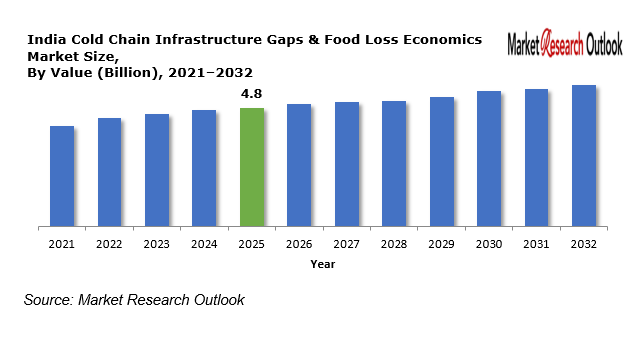
Cold Chain Infrastructure Gaps & Food Loss Economics – Overview
Related research: India Packaged Food Market, India Baby Food Market and India Emergency Food Market.
Cold chain infrastructure includes temperature-controlled systems which store and transport and distribute perishable goods that include agricultural products and dairy and meat and seafood and pharmaceutical items. The efficient operation of cold chain systems enables businesses to maintain product integrity while extending product shelf life and decreasing financial losses through spoilage and waste. The combination of modern refrigeration technologies with real-time monitoring systems and optimized logistics networks provides supply chains with ongoing temperature control throughout all stages of their operations.
India Cold Chain Infrastructure Gaps & Food Loss Economics Market
Growth Drivers
Rising Demand for Perishable Food and Pharmaceuticals
The rising demand for cold chain systems throughout India emerges from the growing consumption of fresh and processed food products which people buy in urban and semi-urban areas. The organized retail sector together with quick commerce platforms and food delivery services needs dependable refrigerated storage solutions and transportation systems. The pharmaceutical industry demands temperature-controlled transportation systems for vaccines and biologics and specialty drugs which increases the need for sophisticated cold chain systems. Government support through schemes such as PM Kisan Sampada Yojana and National Cold Chain Development programs is encouraging investments in integrated cold storage and logistics networks across the country.
Challenges
Infrastructure Gaps and High Capital Investment
India faces major infrastructure shortages which affect its ability to handle rising demand for cold storage facilities and refrigerated transport and agricultural storage spaces. The absence of contemporary pack houses and refrigerating trucks in many rural and semi-urban areas leads to considerable post-harvest waste. The operation of cold chain facilities requires high capital investments and operational expenses which make it difficult for small and medium enterprises to enter the market. Supply chain systems that operate in separate parts and the unreliable electricity service in specific areas create obstacles to running efficient cold chain systems and making profits.
Geopolitical Impact on India Cold Chain Infrastructure Gaps & Food Loss Economics Market
The India Cold Chain Infrastructure Gaps & Food Loss Economics Market operates under the influence of geopolitical events and economic conditions which affect both international food trade and fuel prices and supply chain operations. The demand for cold storage and refrigerated logistics services depends on international trade regulations and export-import rules that apply to perishable goods. The operational expenses for reefer transportation and storage facilities experience changes when fuel and energy prices fluctuate. The adoption of advanced refrigeration systems and automation technologies and monitoring systems in India receives support from partnerships which international logistics companies establish with technology vendors.
India Cold Chain Infrastructure Gaps & Food Loss Economics Market
Segmental Coverage
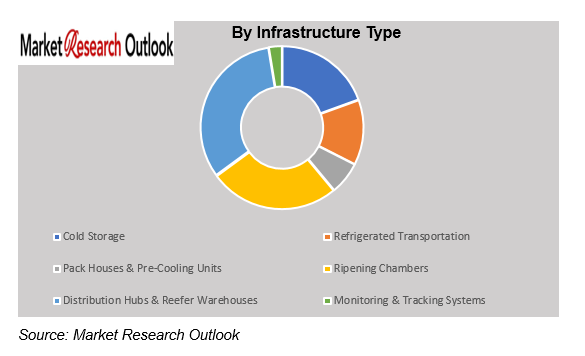
India Cold Chain Infrastructure Gaps & Food Loss Economics Market – By Infrastructure Type
Based on infrastructure type, the market is segmented into Cold Storage, Refrigerated Transportation, Pack Houses & Pre-Cooling Units, Ripening Chambers, Distribution Hubs & Reefer Warehouses, and Monitoring & Tracking Systems. The cold storage segment will experience significant growth throughout the forecast period because of the rising need for temperature-controlled storage facilities which handle fruits vegetables dairy products and pharmaceutical goods. Stakeholders are increasing their investments in modern pack houses and pre-cooling units because they want to decrease post-harvest product losses and enhance product quality. Refrigerated transportation and distribution centers have become vital components for supply chains which now operate in multiple geographic regions. The cold chain network achieves better operational transparency and efficiency through the implementation of IoT-based monitoring systems and digital tracking solutions which will drive market expansion for an extended period.
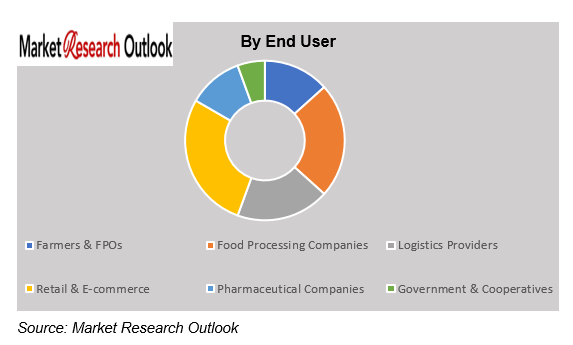
India Cold Chain Infrastructure Gaps & Food Loss Economics Market – By End User
Based on end user, the market is segmented into Farmers & FPOs, Food Processing Companies, Logistics Providers, Retail & E-commerce, Pharmaceutical Companies, and Government & Cooperatives. The food processing industry together with retail and e-commerce sectors will create strong demand for cold chain systems because processed food consumption and online grocery shopping continue to grow throughout India. Farmers and farmer producer organizations (FPOs) are increasingly establishing cold storage and aggregation centers to decrease operational losses while enhancing their ability to reach markets. Pharmaceutical companies drive market expansion because they need storage and distribution solutions for temperature-controlled medications.
Competitive Landscape
Key participants in the India Cold Chain Infrastructure Gaps & Food Loss Economics market include Snowman Logistics Ltd., ColdEx Logistics Pvt. Ltd., Gati Kausar, Transport Corporation of India, Mahindra Logistics Ltd., Stellar Value Chain Solutions, Kool-Ex Cold Chain Ltd., Safexpress Pvt. Ltd., Coldman Logistics Pvt. Ltd., and Inficold India Pvt. Ltd., and other prominent players.
These companies are implementing strategic growth initiatives in order to gain a competitive advantage. The strategies being largely adopted include mergers and acquisitions, strategic alliances, joint ventures, licensing agreements, and new product launches. With the implementation of these strategies, the market participants aim to increase product portfolios, as well as enhance regional presence for long-term sustainable business growth in the Cold Chain Infrastructure Gaps & Food Loss Economics industry of India.
Scope of the Report
| Attributes | Details |
| Years Considered | Historical Data – 2021–2025
Base Year – 2025 Estimated Year – 2026 Forecast Period – 2026–2032 |
| Facts Covered | Revenue in USD Billion |
| Market Coverage | India |
| Product/ Service Segmentation | Infrastructure Type, Temperature Type, Commodity Type, Supply Chain Stage, End User |
| Key Players | Snowman Logistics Ltd., ColdEx Logistics Pvt. Ltd., Gati Kausar, Transport Corporation of India, Mahindra Logistics Ltd., Stellar Value Chain Solutions, Kool-Ex Cold Chain Ltd., Safexpress Pvt. Ltd., Coldman Logistics Pvt. Ltd., and Inficold India Pvt. Ltd., and other prominent players. |
Market Segmentation
- By Infrastructure Type
- Cold Storage
- Refrigerated Transportation
- Pack Houses & Pre-Cooling Units
- Ripening Chambers
- Distribution Hubs & Reefer Warehouses
- Monitoring & Tracking Systems
- By Temperature Type
- Frozen
- Chilled
- Ambient Controlled
- By Commodity Type
- Fruits & Vegetables
- Dairy Products
- Meat & Seafood
- Processed Foods
- Pharmaceuticals & Vaccines
- Others
- By Supply Chain Stage
- Farm-level Storage
- Aggregation & Collection
- Processing
- Distribution & Logistics
- Retail & Export
- By End User
- Farmers & FPOs
- Food Processing Companies
- Logistics Providers
- Retail & E-commerce
- Pharmaceutical Companies
- Government & Cooperatives
- Research Framework
- Research Objective
- Product Overview
- Market Segmentation
- Executive Summary
- India Cold Chain Infrastructure Gaps & Food Loss Economics Market Insights
- Growth Drivers
- Restraints
- Opportunities
- Challenges
- Technological Advancements/Recent Developments
- Porter’s Five Forces Analysis
- Industry Value Chain & Entry Points
- India Cold Chain Infrastructure Gaps & Food Loss Economics Market: Regulatory Framework
- India Cold Chain Infrastructure Gaps & Food Loss Economics Market: Marketing Strategies
- India Cold Chain Infrastructure Gaps & Food Loss Economics Market Overview
- Market Size & Forecast, 2021-2032
- By Value (USD Billion)
- Market Share & Forecast
- By Infrastructure Type
- Cold Storage
- Refrigerated Transportation
- Pack Houses & Pre-Cooling Units
- Ripening Chambers
- Distribution Hubs & Reefer Warehouses
- Monitoring & Tracking Systems
- By Temperature Type
- Frozen
- Chilled
- Ambient Controlled
- By Commodity Type
- Fruits & Vegetables
- Dairy Products
- Meat & Seafood
- Processed Foods
- Pharmaceuticals & Vaccines
- Others
- By Supply Chain Stage
- Farm-level Storage
- Aggregation & Collection
- Processing
- Distribution & Logistics
- Retail & Export
- By End User
- Farmers & FPOs
- Food Processing Companies
- Logistics Providers
- Retail & E-commerce
- Pharmaceutical Companies
- Government & Cooperatives
- By Infrastructure Type
- Market Size & Forecast, 2021-2032
- Demand Outlook & Customer Adoption Dynamics
- Demand Evolution By End-Use Industry
- Purchasing Behavior & Supplier Selection Criteria
- Demand Visibility & Contracting Trends
- Regional Demand Concentration & Customer Clusters
- Competitive Landscape
- List Of Key Players And Their Offerings
- India Cold Chain Infrastructure Gaps & Food Loss Economics Company Market Share Analysis, 2025
- Competitive Benchmarking, By Operating Parameters
- Key Strategic Development (Mergers, Acquisitions, Partnerships, Etc.)
- Geopolitical Impact On India Cold Chain Infrastructure Gaps & Food Loss Economics Market
- Company Profile
- Snowman Logistics Ltd.
- Introduction & Company Profile
- Product Benchmarking
- Strategic Outlook
- Key Personals
- Key Competitors
- Financial Analysis
- Swot Analysis
- Snowman Logistics Ltd.
**(Same Data Pointers Will Be Provided For The Below Companies)
- ColdEx Logistics Pvt. Ltd.
- Gati Kausar
- Transport Corporation of India
- Mahindra Logistics Ltd.
- Stellar Value Chain Solutions
- Kool-Ex Cold Chain Ltd.
- Safexpress Pvt. Ltd.
- Coldman Logistics Pvt. Ltd.
- Inficold India Pvt. Ltd.
- Other Prominent Players
- Key Strategic Recommendations
- Research Methodology
- Qualitative Research
- Primary & Secondary Research
- Quantitative Research
- Market Breakdown & Data Triangulation
- Secondary Research
- Primary Research
- Breakdown Of Primary Research Respondents, By Country
- Assumption & Limitation
- Qualitative Research
* Financial information in case of non-listed companies will be provided as per availability
**The segmentation and the companies are subjected to modifications based on in-depth secondary for the final deliverable
Frequently Asked Questions
1. What is the expected growth rate of the India Cold Chain Infrastructure Gaps & Food Loss Economics Market during the forecast period?
Ans: The India Cold Chain Infrastructure Gaps & Food Loss Economics Market size was estimated at USD 4.8 billion in 2025.
2. What is the expected growth rate of the India Cold Chain Infrastructure Gaps & Food Loss Economics Market during the forecast period?
Ans: India Cold Chain Infrastructure Gaps & Food Loss Economics Market is expected to grow at a CAGR of around 13.9% during the forecast period between 2026 and 2032.
3. What is the forecast value of the India Cold Chain Infrastructure Gaps & Food Loss Economics Market by 2032?
Ans: The India Cold Chain Infrastructure Gaps & Food Loss Economics Market is projected to reach a value of approximately USD 11.6 billion by 2032.
4. What are the major factors driving the growth of the India Cold Chain Infrastructure Gaps & Food Loss Economics Market?
Ans: The primary factors that propel growth for businesses in temperature-controlled logistics markets at present stem from increasing customer demand for these services which handle perishable food items and pharmaceutical products and from the expanding operations of food processing companies and from government efforts to minimize post-harvest agricultural waste.
5. Name the key players operating in the India Cold Chain Infrastructure Gaps & Food Loss Economics Market.
Ans: The key players of India Cold Chain Infrastructure Gaps & Food Loss Economics Market are Snowman Logistics Ltd., ColdEx Logistics Pvt. Ltd., Gati Kausar, Transport Corporation of India, Mahindra Logistics Ltd., Stellar Value Chain Solutions, Kool-Ex Cold Chain Ltd., Safexpress Pvt. Ltd., Coldman Logistics Pvt. Ltd., and Inficold India Pvt. Ltd., and other prominent players.
6. Which is the fastest-growing infrastructure type segment in the India Cold Chain Infrastructure Gaps & Food Loss Economics Market?
Ans: The cold storage segment will experience significant growth throughout the forecast period because of the rising need for temperature-controlled storage facilities which handle fruits vegetables dairy products and pharmaceutical goods.